Unit
1
Name: ________________________
Ms. Lee - Rm 305
Notes Packet
Unit 1 – Measurement
Southside Middle School
8th Grade Earth Science Regents[email protected]
Ms. Lee
Classroom Procedures
Welcome to Earth Science! Earth Science is a high school – credit bearing course culminating with a Regents in June. The following is an outline of expectations, please discuss them with your parents / guardians, get them signed and return them
to your science teacher.
I. Homework
Homework will be assigned at least 2 days a week and is posted online. Homework is expected to be handed in on time and written neatly. (______________ = ____________ )~ it goes directly into the recycling bin. Homework is due the day after it was given unless otherwise stated.
II. Supplies
Everyday you must have with your notebook with paper (_____________________), pen or pencil, agenda book, and a ____________________. Coming to class prepared is part of your participation grade.
III. Textbook
Students must purchase a Review Book from _______________________ during the first month of school. (Approximately $13)
IV. Lateness
Lateness is disruptive to other students and will not be tolerated. You are expected to be in class on time and prepared.
V. Attendance and Absences
VI. Tests and Quizzes
Tests and quizzes are important for me to assess the comprehension of class material by the students. Major exams will be announced one week in advance. You should use this time to prepare for the exam and get any questions clarified. Frequently short quizzes will be given, both announced and unannounced. All tests and quizzes will be based on
______________________________________________________. By keeping up on these you will be prepared.
VII. Labs and Other Projects
Labs and other projects will provide hands on experience for all students. During the course we will be learning more about science by actually conducting experiments and doing hands on projects in a laboratory setting. Labs are designed to give you a better understanding of the material presented in class. New York State requires __________ of lab activity with a satisfactory lab report turned in for each. If you are absent for a lab activity, you have ONE week to make it up in extra help. (_______________________________________ – the lowest possible grade to count towards the Regents)
VIII. Cumulative Assessment
A cumulative assessment will be given at the ________________________ and is intended to evaluate student readiness to move on to the next level. This test will cover all material up to date and is intended to help prepare you for the REGENTS in June. Although this test is longer and has a lab component it will only count as one test grade.
IX. Grading
Unit Tests = _____% Quizzes = _____% Labs _____% and Homework / Classwork _____% of your quarter average. Extra credit will vary and can be used to make up points for missing Assignments. No more than 5 percentage points can be earned through extra credit per quarter. Students (and parents) are able to see their grades using Power Schools. Grades will be updated on Power Schools at least bi weekly.
X. Extra Help
Extra help is available most days from 7:40 – 8:14 in our classroom. Additional help is available at other times by appointment. (__________________ is the science No Extra Help Day)
In June, you will take the NYS Regents in Earth Science. You will be asked to purchase an inexpensive review book in order to prepare for this test. One portion of this test will consist of an in class lab proficiency assessment.
STUDENT RESPONSIBILITY It is your responsibility to get ALL missed work, to hand in
ALL assignments and PLAN AHEAD so you can succeed. Remember you are ultimately
responsible for your actions and inactions in the classroom-so make wise choices!!!!!!
I would like you to review this with your parents or guardians. I hope that it will help you better understand the requirements of this course and my expectations of you. I am looking forward to working with all of you and having a productive and enjoyable year ahead of us. If you have any questions or comments I can be reached though the school or by email. Thank you for your cooperation.
Sincerely,
Ms. Lee
Extra Credit –
** Parents should email [email protected] with their best contact information. Please provide who I am contacting, your relationship to the student, along with a phone number and email address. BE SURE TO PUT YOUR STUDENTS NAME AND PERIOD IN THE SUBJECT LINE. **
What is Science?
Do Now: Brainstorm - What is science? What is meant by “doing” science?
____________________________________________________________________________________ ____________________________________________________________________________________ ____________________________________________________________________________________ ____________________________________________________________________________________
Do Later: Brainstorm – How is this activity similar to “doing” science? What could the last square represent?
____________________________________________________________________________________ ____________________________________________________________________________________ ____________________________________________________________________________________ ____________________________________________________________________________________
Now think about Earth Science, what ideas come to mind? In the space provide you may draw a picture, brainstorm a chart, and/or write a paragraph expressing what you think Earth Science is.
Today’s Objective:
Analyze and Interpret Scientific Information
Observation
--
____________________
__________________________________________
_______________________________________________________________
_______________________________________________________________
-
Instrument - _________________________________________________
________________________________that would otherwise be inaccurate
or even impossible to make.
Inference
-- ______________________________________________________________
- A
prediction
is an inference based on observations that
- A
prediction
is an inference based on observations that
_______________________________________________________________.
Classification
--
____________________
_________________________________________
______________________________________________________________
Name: ________________________ Date: ______ Pd. ______ Observation / Inference
Part A – Label the following statements as either observations (O) or inference (I) 1. When I rang the doorbell, no one answered. _________
2. The hamburger was hot. _________ 3. Jamal must be very popular. _________
4. That animal has black and white spots, it must be a Dalmatian. _________ 5. Those clouds look like a mountain. _________
6. The beaker contains 250 mL of water. _________ 7. The bark on the birch tree was white. _________
8. A cloud was formed when I mixed the liquid and the solid. _________ 9. That sounds like a mean dog. _________
10.The rock feels like an ice cube. _________
Part B – Fill in the blank spaces.
Observation
Inference
11.The temperature of the glass of water near the window is warmer than the glass on
the shelf.
12.The milk must have been in the refrigerator.
13.The tulips are blooming.
14.It must be dismissal time.
15.The clouds are very dark.
Part C – Underline the observations in the story
You are walking along a street. The ground is wet and covered with fallen tree branches. No one seems to be around. There are many broken windows and the roofs of several houses are damaged.
Name: _____________________ Pd. ________ Observation, Inference & Classification
Ms Lee (A) Carbon dioxide and water vapor are
produced by the burning.
(B) The wick gets shorter as the candle burns. (C) The candle wax is melting.
(D) The flame is yellow.
1. Which statement about a burning candle is most likely an inference?
(A) interpretation (B) classification (C) observation (D) measurement 2. The grouping of objects or events based on
similar characteristics is called
(A) mathematical calculations (B) the senses
(C) experiments (D) proportions
3. In order to make observations, an observer must always use
(A) The rock formed deep in the Earth's interior.
(B) The rock is black and shiny.
(C) The rock dates from the Precambrian Era. (D) The rock cooled very rapidly.
4. In the classroom during a visual inspection of a rock, a student recorded four statements about the rock. Which statement about the rock is an observation?
(A) observed properties to group objects with similar characteristics
(B) instruments to observe properties of objects
(C) inferences to make observations
(D) the human senses to observe properties of objects
5. A classification system is based on the use of
(A) observations (B) interpretations (C) hypotheses (D) inferences 6. A student classifies several objects. The
classification system should be based on
(A) The hole is 2 meters deep.
(B) Some of the particles are rounded. (C) The sediments were deposited by a
stream.
(D) Over 50% of the sediments are the size of sand grains or smaller.
7. A student observed a freshly dug hole in the ground and recorded statements about the sediments at the bottom of the hole. Which statement is an inference?
(A) an inference (B) a fact
(C) an observation (D) a measurement 8. A person observes a sediment consisting of
clay, sand, and pebbles and then states that this material was transported and deposited by an agent of erosion. This statement is
(A) make measurements that are very accurate
(B) organize observations in a meaningful way
(C) extend their powers of observation (D) eliminate inaccurate inferences
9. The primary purpose of a classification system is to enable people to
(A) The rock was formed 100 million years ago.
(B) A balance indicates the rock's mass is 254 grams.
(C) The rock scratches a glass plate. (D) The rock has no visible crystals and is
red.
10. Which statement about a rock sample is an inference?
(A) tearing a sheet of paper into squares whose sides measure 1 centimeter (B) counting 28 shells from a beach (C) measuring the air pressure of a room (D) adding 10 grams of salt to a cup of water 11. Which action can be performed most
Ms Lee (A) "Some parts of this glacier will start
melting this spring."
(B) "The rocks on this glacier are of different sizes."
(C) "There are many cracks in this glacier." (D) "Some of the snow on this glacier is
powdery."
12. While walking on a glacier, an observer makes several statements. Which statement is an inference?
(A) The footprints were made by a dog. (B) The depth of the deepest footprint is 3
centimeters.
(C) The footprints are oriented in an east-west direction.
(D) There are five footprints in the mud. 13. A student examined a patch of mud and
recorded several statements about footprints in the mud. Which statement is most likely an inference?
(A) measuring the rate of change of the stick by making inferences
(B) calculating the percent of error by using a proportion
(C) extending the sense of sight by using an instrument
(D) predicting the length of the stick by guessing
14. Using a ruler to measure the length of a stick is an example of
(A) The machinery was turned off on Saturday and Sunday.
(B) The machinery ran 24 hours a day. (C) The noise volume reached a peak on
Friday.
(D) The level of pollution remained constant during working hours.
15. The graph below shows the amount of noise pollution caused by factory machinery during a one-week period.
Today’s Objective:
Calculating Scientific Notation
Think about it . . .
Why would we watch a “Powers of Ten” video
when we are learning about scientific notation?
Scientific Notation
--
Used to express
____________________________________
________________________________________________
- Large numbers have a ______________________ exponent.
ex. 9,600,000 = 9.6 x 10
6- Small numbers have a _________________ exponent.
ex. .00049 = 4.9 x 10
-4Converting to Scientific Notation
Step 1 - Position the decimal point to get
Step 1 - Position the decimal point to get
______________________________
Step 2 - _______________________________________
__________________________ to get that single digit number
Step 3 - Write the number as a product of a number between
_________ and __________ times a power of 10.
NOW TRY THESE . . .
Estimated age of the Earth
is 4,600,000,000 years.
What is this number in
scientific notation?
Estimated diameter of an
atom is 0.00000003 cm.
Scientific otation Review
Directions:
For numbers 1 – 15 write the number in scientific notation, for the last
5 write the scientific notation in standard form.
1) 0.046
2) 4,605,000
3) 33,000
4) 9,632
5) 0.008
6) 0.03
7) 1,458,000
8) 0.014
9) 5,700
10) 9,101
11) 0.009
12) 7,740
13) 6,722,000
14) 98,000
15) 0.0059
16) 7.179 x 10
317) 2 x 10
-218) 3.7 x 10
5Metric Conversions
--
Metric prefixes make units larger or smaller by
___________________________________
Complete the chart with the
correct prefix
Basic
Meter Liter Gram.1
.01
.001
10
100
1000
How to Convert one Prefix into Another:
Today’sObjective:
Converting Metric Prefixes
NOW TRY THESE . . .
Convert:
.030 m = _____________cm
70 mL = ___________ L
•
When changing from a ___________________________________
unit you move the decimal point to the ___________.
•
When changing from a ___________________________________
unit you move the decimal point to the __________.
How to Convert one Prefix into Another:
Move the decimal point the same direction and number of
places that you move along the chart.
4.5 hg = __________ g
Metric Conversions
Try these conversions, using the ladder method.
1) 1000 mg = ___________g 2) 1 L = ___________mL
3) 160 cm = ___________mm 4) 14 km = ___________m
5) 109 g = ___________kg 6) 250 m = ___________km
7) 2000 mg = ___________g 8) 5 L = ___________mL
9) 16 cm = ___________mm 10) 104 km = ___________m
11) 198 g = ___________kg 12) 2500 m = ___________km
13) 480 cm = ___________m 14) 75 mL = ___________L
15) 65 g = ___________mg 16) 5.6 kg = ___________g
17) 50 cm = ___________m 18) 6.3 cm = ___________mm
19) 8 mm = ____________cm 20) 5.6 m = ____________ cm
Milli .001 Kilo
Extra Credit -
Covert each number and decide if it’s greater than, less then, or equal to the
number it is paired with. Place the correct symbol >, <, = in the box provided.
1) 56 cm 6 m
2) 7 g 698 mg
3) 63 cm 6 m
4) 5 g 508 mg
5)1.5 L 1,500 mL
6) 536 cm 53.6 dm
7) 43 mg 5 g
Think about it . . .
Why do scientists use the metric system
to make all scientific measurements?
A scientific measurements
is made when an instrument is used to obtain a
measurement
-
Must contain ______________________________________________________
Instruments and Measurements
-Length - _________________________________________________________________
___________________________________________________________________________
Instrument:
Basic Unit:
Today’sObjective:
What is Scientific Measurement?
___________________________________________________________________________
Temperature - ___________________________________________________________
___________________________________________________________________________
Instrument:
Basic Unit:
___________________________________________________________________________
Time - ___________________________________________________________________
___________________________________________________________________________
Volume - ________________________________________________________________
Liquid Volume - ___________________________________________________________
Instrument:
Basic Unit:
_________________________________________________________________________
Regular Shape Volume - ___________________________________________________
Instrument:
Basic Unit:
___________________________________________________________________________
** 1 mL = 1 cm
3**
___________________________________________________________________________
Irregularly Shaped Volume - ______________________________________________
___________________________________________________________________________
___________________________________________________________________________
Instrument:
Basic Unit:
___________________________________________________________________________
Mass - __________________________________________________________________
Metric Measurement Activity
Using the materials from around the classroom, work with your lab partner to recorded the
correct measurements below. (
Be sure to pull all materials back where they belong
)
Length:
•Use the ruler to measure the horizontal and vertical length of the textbook cover.
•Record data on your data table
•Replace materials back where you found them
Object Measurement
Horizontal Length (from left to right)
Vertical Length (from desk to top)
Temperature :
•Use the thermometer to measure the temperature of the water in ONE of the beakers
•Record data on your data table
Object Measurement
Temperature of Water in Breaker •Replace materials back where you found
them
Water in Breaker
Time:
•Use the stop watch to time how long it takes your partner to WALK across the front of the classroom
•Record data on your data table
•Replace materials back where you found them
Object Measurement
Walking Time
Mass :
•Use the electronic balance to measure the mass of the rock
• Record data on your data table
•Replace materials back where you found them
Object Measurement
Regular Volume :
•Use the ruler to measure the length, width and height of the block. Multiply to
calculate volume
•Record data on your data table
•Replace materials back where you found them
Object Measurement
Length (top to bottom)
Width (left to right)
Height (from desk to top)
Volume
Liquid Volume :
•Use the graduated cylinder to measure the volume of the liquid present
volume of the liquid present
•Record data on your data table
•Replace materials back where you found them
Object Measurement
Volume of Colored Liquid
Irregular Volume :
•Use the graduated cylinder to measure the volume of the liquid present, drop the screw into the cylinder, record the new
measurement and subtract.
•Record data on your data table
•Replace materials back where you found them
Object Measurement
Starting water level
Water level with object in it
Density –
- ______________________________________________________________
- measure in _______________ or ______________
- can be used to __________________________________________
Density Formula
Today’sObjective:
What is Density ?
Using the one density formula you can rearrange the variables to solve for
any factor.
Use the Density Triangle to complete
the formulas below.
( ESRT pg 1)
M
Density =
D
M
V
** Density of an ___________________________________
no matter how many pieces it’s broken in to! **
* The density of an object ___________________________
change if you change its mass b/c you are also changing
the volume!*
divide
Multiply
Density =
Volume =
How does
temperature
affect density?
Can you draw that relationship on the graph?
Think –
Pressure
D
en
sit
y
Temperature
D
en
sit
y
What about pressure,
How does
pressure
affect density?
Can you draw that relationship on the graph?
What is Buoyancy ?
-
______________________________________________________________________
-
It explains ____________________________________________________________
-
Less dense materials _________________
-
More dense materials ________________
NOW TRY THESE . . .
1.
M = 34.1g
V = 78.5 mL
D =
2.
M = 27 g
D = .76 g/cm
3V =
3. V = 25 mL
D = 2.5 g/mL
M =
Pressure
Density Practice Problems
For the problems below, show all work and box your final answers.
1. A platinum bar measures 5.0 cm long, 4.0 cm wide, and 1.5 cm thick. It has a mass of 700.0 grams. Calculate the volume and the density of the platinum bar
2. A lead cylinder has a mass of 540 grams and a density of 2.70 g/ml. Calculate the volume of the lead cylinder.
3. A cork has a mass of 3 grams and a volume of 16 cm3. Calculate the density.
4. A thin glass bottle holds 25 ml of liquid and has a mass of 19 grams. Calculate the density.
5. A bar of soap is 12 cm tall, 6 cm wide, and 10 cm long. It has a mass of 710 grams. What is the density of the bar of soap.
6. A sheet of metal is 2 cm wide, 10 cm tall, and 15 cm long. It weighs 400 grams. What is the density?
8. If the density of 45.0 cm3 block of wood is 0.65 g/ml calculate the wood’s mass.
9. The mass of a 50.0 ml quantity of water is 50 grams. What is the density of water?
1. A sample of a gas has a volume of 6.5 L and a
mass of 3.8g. What is the density?
2. What is the mass of 64 mL of a liquid with a
density of 2.7 g/mL?
3. Mercury has a density of 11.2 g/mL. What is
the volume of a sample of mercury that has a
mass of 198 g?
D =
M
V
Formula
Substitute
Answer
Think about it . . .
Why is it important for scientists to organize
their data?
What is a graph?
_____________________________________________________________
_____________________________________________________________
Common Graphs
Today’sObjective:
How Can Scientists Organize Data?
• Line graphs usually have TWO AXIS.
• Short concise TITLE
• INTERVAL to count each axis by
• LABELES with proper units
Y Axis
-
Is the __________________________
-
This is for the
________________________________
Ex. Time, Depth, Temperature
X Axis
-
Is the __________________________
-
This is for the
________________________________
Ex. Inches grown, Number of bubbles
Graphing Relationships
Direct Relationship
-____________________________
____________________________
____________________________
Indirect Relationship –
____________________________________
____________________________________
____________________________________
Cyclic Relationship –
____________________________________
____________________________________
____________________________________
Most relationships in Earth
Science are
_________________
For Example –
-
The repeating high and low tides.
-
Temperatures go from cold to warm
each day
- The moon moves through phases
** Dynamic Equilibrium
is when
_
___________________________
__________________________**
-
This is also know as
Static
For Example –
-
Inhaled = Exhaled
Name: __________________________ Date: ______ Pd. ______
Creating Graphs
Pie Chart -
1. Base your answer to the following question on the data table below, which shows the industrial uses of wollastonite, a mineral mined in the eastern Adirondack Mountains.
Bar Graph –
2. Base your answer to the following question on the data table below, which shows the average date of the first breakup of ice on the Tanana River at Nenana, Alaska (65° N 149° W). The average date of the first ice breakup is shown for four decades.
On the grid provided, construct a bar graph of the average date of the first ice breakup for each decade shown on the data table.
3. Base your answer to the following question on the hardness of the minerals talc, quartz, halite, sulfur, and fluorite.
On the grid provided, construct a bar graph to represent the hardness of these minerals.
Mineral Hardness
Talc 1 Quartz 7
Line Graphs –
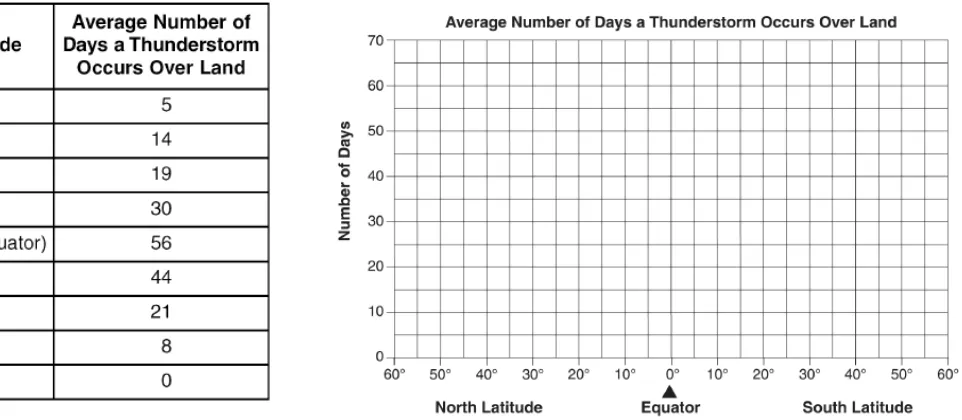
4. Base your answer to the following question on data table below, which shows the average number of days with thunderstorms that occur over land areas at different latitudes each year.
On the grid provided, plot, with an X, the average number of days per year a thunderstorm occurs over a land area for each latitude shown on the data table. Connect the centers of the Xs with a line.
5. Base your answer to the following question on the date table below, which shows the radioactive decay of carbon-14. The number of years required to complete four half-lives has been left blank.
6. Base your answer to the following question on the table below. The table shows air temperatures and air pressures recorded by a weather balloon rising over Buffalo, New York.
On the grid, construct a graph of altitude above sea level and air temperature by following the directions below.
a. Plot an X for the air temperature recorded at each altitude shown on the table.
Ms. Lee - 2016
Name: _____________________________ Date: _________ Pd. ________
ESRT Graphs and Charts
DIRECTIONS – Use your Earth Science Reference Tables to answer the following questions. Be sure to include UNITS.
1. Radioactive Decay Data – Pg 1 - What is the half life of the radioactive isotope Carbon – 14?
_________________________
2. Specific Heats of Common Materials – Pg 1 – What material has a specific heat of .79?
_______________________________
3. Average Chemical Composition of Earth’s Crust, Hydrosphere, and Troposphere – Pg 1 – What
elements are not present in Earth’s crust but are present in the hydrosphere or troposphere?
___________________________ & _______________________________
4. Which element has the highest percent by volume in the troposphere? ________________________
5. What are the major components of the hydrosphere? ______________________ &
_________________
6. Relationship of Transported Particle Size to Water Velocity – Pg 6 – At 10 cm/s, how large is
the particle diameter of the largest particle that can be transported?
_______________________________
7. A particle with a diameter of .01 cm can be transported by a stream moving how fast?
________________
8. What is the size range for a particle called a cobble? _____________________________________
9. What happens to Particle Size as Stream Velocity increases?______________________________________
10. Inferred Properties of Earth's Interior – Pg 10 – What is the density of the outer core?
____________________________
11. What is the interior temperature at a depth of 2900 km? __________________________
12.What is the melting point at a depth of 1000 km? _________________________
13.What is the pressure at depth of 5100 km? ______________________________
Ms. Lee - 2016 15.What happens to Pressure as Depth increases?_________________________________________
16. What happens to Interior Temperature as Depth increases?_____________________________________
17. Earthquake P-wave and S-wave Travel Time – pg 11 – How long does it take a P wave to travel 4 x 10³ (4000
km)? ________________________
18. In 10 minutes how far can an S Wave travel? __________________________________
19. How many minutes difference is there between the P and S wave that traveled 2000 km? ___________________
20.What happens to the Travel Time as the Epicenter Distance increases? ____________________________
21. Dewpoint – Pg 12 – With a dry bulb temperature of 10oC and a difference between the wet bulb and dry bulb is 3o,
what is the dewpoint temperature? _________________________________
22. Relative Humidity – Pg 12 - With a dry bulb temperature of -2oC and a difference between the wet bulb and dry bulb
is 5o, what is the relative humidity? _________________________________
23. Temperature – Pg 13 - Water freezes at 0oC, convert to Fahrenheit and Kelvin? _____________________________
24. Pressure – pg 13 - One atmosphere is equal to ________________________millibars and __________________
inches.
25. Selected Properties of Earth's Atmosphere – Pg 14 – What layer have the most water vapor?
_________________________
26. What is the temperature at the Stratopause? _______________________
27.What happens to Pressure as Altitude increases?____________________________________
28.Characteristics of Stars – pg 15 – Polaris has a temperature and color of
________________________ and ____________________________
29. Most star fall into which category? ___________________________________________
Name: ___________________________ Date: ________ Period: ________ Graphing Density Worksheet
Part A -
Use the data table below and the attached graph paper to plot the mass and volume of the 5 samples of the minerals galena below. Note: the resulting line you plot is the minerals density!
Sample
Size
Mass
Volume
Density
1
Small
15 g
2 cm
32
60 g
8 cm
33
120 g
16 cm
34
480 g
64 cm
35
Large
750 g
100 cm
3Questions
1. Use the completed graph to determine how much mass a sample of galena would have if its volume was 75 cm3
2. Use the completed graph to determine how much volume a sample of galena would have if it’s mass was 300 g.
3. Describe the relationship between mass and volume shown by the graph.
__________________________________________________________________________________
Part B - Calculate the density of samples 1-5 and place the value in the “density” column of the data table
4. How does the density of Sample 2 compare to that of Sample 4?
__________________________________________________________________________________
5. How did the density of the largest sample (5) compare to the smallest sample (1)?
__________________________________________________________________________________
6. What is the effect of sample size on the density of a material?
Volume (cm
3)
0 5 10 15 20 25 30 35 40 45 50 55 60 65 70 75 80 85 90 95 100 100
200 300 400 500 600 700 800
M
as
s (
g
)
What is RATE OF CHANGE?
________________________________________________________________
________________________________________________________________
Ex. The car is traveling 30 miles per hours.
Continental Plates move 4 cm per year.
Formula
(ESRT pg 1)
Change in Value simply refers to ____________________________________________
__________________________________________________________________________
PRACTICE PROBLEMS . . .
Today’sObjective:
Calculating Rate of Change
1.
A hot air balloon rose from a height of 100 m to 400 m in 3 minutes. What was
the balloon’s rate of change?
2.
A glacier advanced down a mountain from an elevation of 2010 m to 1780 m in 5
years. What was the glaciers rate of change?
Ms. Lee
RATE OF CHANGE
Directions: The questions are all based on "one year" for ease in learning to work with this
equation. Question
1- Mount Everest has risen 8.2 meters in the last 100 years. How many meters did Mount Everest uplift in one year?
2- A 1995 EPA study projects sea levels will rise about 30 centimeters (relative to the land) over the next century for the U.S. coast. Express this rise in sea level for a period of one year.
3- Scientists generally agree that erosion of the Grand Canyon started about 6 million years ago. The canyon, created by the Colorado River cutting a channel over millions of years, has attained a depth of about 1,600 m which is more than a mile. On the average, how many meters per year did the Colorado River downcut into the canyon?
4- Since the last period of glaciation, beaches on Kong Karls Land have risen 130 meters above sea level over the last 10,000 years. On average, how many meters have the beaches risen in one year?
5-Average global surface temperatures have increased about 0.6°C over the last century. On an average, approximately how many degrees have temperatures risen each year?
MORE RATE OF CHANGE PRACTICE . . .
1.
A climber is on a hike. After 2 hours he is at an altitude of 400 feet. After 6 hours, he is
at an altitude of 700 feet. What is the average rate of change?
2.
A scuba diver is 30 feet below the surface of the water 10 seconds after he entered the
water and 100 feet below the surface after 40 seconds. What is the scuba divers rate of
change?
3.
A rocket is 1 mile above the earth in 30 seconds and 5 miles above the earth in 2.5
minutes. What is the rockets rate of change in miles per second?
4.
A teacher weighed 145 lbs in 1986 and weighs 190 lbs in 2007. What was the rate of
change in weight?
5.
Over the last 50 years, the average temperature has increased by 2.5 degrees worldwide
. What is the rate of change in worldwide temperatures per year?
Layers ON the Earth
- Hydrosphere - ____________________________________________
- Atmosphere - _____________________________________________
- Lithosphere - _____________________________________________
- Biosphere - ________________________________________________
Layers IN the Earth
(ESRT pg 10
)
Today’sObjective:
What are the Layer IN, ON, and ABOVE the Earth?
- Crust - _________________________________
___________________________________________
- Upper Mantle – (________________________)
___________________________________________
___________________________________________
- Lower Mantle – (_______________________)
___________________________________________
- Outer Core - _________________________________________________________
- Inner Core - _________________________________________________________
Layers ABOVE the Earth
(ESRT pg 14)
-Layers of Earth
PART A - Complete the following.
1. What is the lithosphere? __________________________________________________________
2. What is the hydrosphere? _________________________________________________________
3. What is the atmosphere? _________________________________________________________
PART B - Which part of Earth is each of the following? Complete the table by placing a check mark in the correct column.
COMPARING THE PARTS OF EARTH
Part Lithosphere Atmosphere Hydrosphere
1. Mountains
2. Nitrogen
3. Ice caps
4. Rivers
5. Continents
6. Oxygen
7. Oceans
PART C - Label Earth’s layers. Then, write the name of the layer of Earth described by each statement.
________________________ 6. It is the innermost region of Earth.
________________________ 7. It has an area of rock that flows like a thick liquid.
________________________ 8. It forms the upper lithosphere.
________________________ 9. It is the thin, outer layer of Earth.
________________________10. It makes up about two-thirds of Earth’s mass.
The Earth is NOT a perfect SPHERE!!
Equatorial Diameter = _________________________
Polar Diameter = ______________________________
Difference of _____________________
The Earth is ACTUALLY
an ____________________
( slightly bulging at the equator)
Today’sObjective:
What is Earth’s Shape and How Do We Know?
Evidence of Earth’s Shape
•
_________________________________
•
Sailors noticed that ships _________
_________________________________
_________________________________
________________________________
•
Gravity measurements were
_________________________________
_________________________________
Gravity-
_______________________________________________________________
__________________________________________________________________________
•
As distance between two objects
increase
_____________________________________________
•
As the mass of an object
increases
_________________________________________________
Because the Earth is an oblate spheroid . . .
. . . there is ____________ distance to the center of the earth from the poles, which means
there is _________________________________________________.
. . . there is ____________ distance to the center of the earth to the equator, which means
there is _________________________________________________.
** The best representation of a true scale
model of Earth is
Name: _____________________
Pd. ________
Earth's Shape and Gravity
Nata/Lee
(A) its rotation(B) its molten core
(C) the pull of the sun and moon (D) storms on the sun's surface
1. The Earth is slightly flattened from a perfect spherical shape because of
(A)
(B)
(C)
(D)
2. Which diagram most accurately shows the cross-sectional shape of the Earth?
(A) a perfect sphere (B) an eccentric ellipse (C) a circle
(D) an oblate sphere
3. The Earth's actual shape is most correctly described as
4. The diagrams below represent
photographs of a large sailboat taken through a telescope over time as the boat sailed away from shore out to sea. Each diagram shows the magnification of the lenses and the time of day.
(A) The sailboat is moving around the curved surface of Earth.
(B) The change in density of the atmosphere is causing refraction of light rays.
(C) The sailboat appears smaller as it moves farther away.
(D) The tide is causing an increase in the depth of the ocean.
Which statement best explains the apparent sinking of this sailboat?
(A) a football (B) an egg (C) a pear
(D) a Ping-Pong ball
5. Which object best represents a true scale model of the shape of the Earth?
(A) slightly more, because the person is farther from the center of Earth (B) slightly more, because the person is
closer to the center of Earth
(C) slightly less, because the person is farther from the center of Earth (D) slightly less, because the person is
closer to the center of Earth
Nata/Lee
(A) shorter than its equatorial diameter(B) longer than its equatorial diameter (C) the same length as its equatorial
diameter
7. Precise measurements of the Earth indicate that its polar diameter is
(A) greatest in diameter at the Equator (B) pear shaped
(C) a perfect sphere
(D) greatest in diameter at the poles 8. Measurements taken from space show
the Earth to be
(A) The readings would be the same at the North Pole and at the Equator. (B) The reading would be lower at the
North Pole than at the Equator. (C) The reading would be higher at the
North Pole than at the Equator. 9. A gravity meter is used to measure the
amount of gravitational pull at the Earth's North Pole and at the Earth's Equator. How would these readings of gravitational pull compare? [Assume both readings are taken at sea level.]
(A) 40,076 km (B) 12,740 km (C) 40,008 km (D) 25,000 km
10. The polar circumference of the Earth is 40,008 kilometers. What is the
Name____________________________ Date: ___________ Pd.: ______
Mapping Do Now
Directions: Look at the diagrams below and answer the questions that follow.
1. What problem can you see here?
_____________________________________________________________________ _____________________________________________________________________ 2. What would happen to a globe if you tried to flatten it?
_____________________________________________________________________ _____________________________________________________________________ 3. Would you have distortions on your flattened globe? Explain why? _____________________________________________________________________ _____________________________________________________________________ 4. How could you show the best model of the different areas of earth
without using a globe?
Name: _________________________ Pd. _________ Date: _________ Mapping Review
Directions – Answer the following questions using the map on the back of this page.
1. What are some of the major features of this map?
2. Complete the labels on the compass.
Fill in the blanks with the appropriate compass direction
3. New York is _______________________ of Michigan.
4. Atlanta, Georgia is _____________________ of Miami, Florida.
5. Mexico is ____________________ of Colorado.
Fill in the blanks with the appropriate answer.
6. The western most ocean labeled on the map is? _________________________________
7. The eastern most ocean labeled on the map is? _________________________________
8. The northern most country is? ___________________________
9. The country that lies on the southern border of the U.S. is? _________________________
10. How many kilometers away is Nashville, Tennessee from Jackson, Mississippi?
Today’sObjective:
Why are Latitude and Longitude lines helpful?
The Global Grid
Scientists use two special Earth measurements to describe location. They are
_______________________________ and __________________________.
** Every location on the earth has
its own
latitude and longitude.**
Latitude
•
_________________________________
_________________________________
•
_________________________________
_________________________________
_________________________________
•
_________________________________
Longitude
Think about it . . . If I wanted to move the projector attached to the ceiling
to line up with the “X” on the ceiling, how could I describe this new position to
the technology person?
•
_________________________________
_________________________________
_________________________________
•
_________________________________
•
_________________________________
_________________________________
* Prime Meridian(0o) and the
International Date Line(180o) are
1 degree = ________ minutes
Calculating Precise Locations
•
Latitude and longitude lines are measured in __________________.
(One degree of latitude is equal to about 69 miles. )
•
To be more precise you can break a degree into
_________________________________.
(One minute of latitude is equal to about 1.5 miles. )
NOW TRY THESE . . .
What is the latitude and longitude of . . .
1.
Point A – __________________________
2.
Point B – __________________________
3.
Point C – __________________________
4.
Point D – __________________________
5.
Point E – __________________________
Using
degrees and minutes, (estimate to the nearest 15
minute)
1.
Give the latitude and longitude of Mt. Marcy
_________________________________________
2.
Give the latitude and longitude of Plattsburgh
_________________________________________
Ms. Lee
Name: _________________________ Pd. _________ Date: _________
What are Latitude and Longitude?
PART A Label the diagram below with the terms meridians, parallels,
and equator. Shade the Northern Hemisphere with your pencil.
PART B Complete the following.
1. The parallel that divides Earth into hemispheres is the _________________________________ .
2. The starting meridian (0º) is called the ________________________________________________ .
3. What is latitude? ______________________________________________________________________
_______________________________________________________________________________________
PART C Complete the following.
1. Find the latitude and longitude of the points marked A through F. Be sure to tell if the latitude is north or south and if the longitude is east or west.
Point A
Point B
Point C
Point D
Point E
Point F
2. Using degrees of latitude and longitude,
describe where South America is on the
map.
_______________________________________________________________________________________
3. Describe where Australia is on the map. ________________________________________________
elevation 175 m LAKE
43°
79° 78° 77°
44°
76°
45°75°
74° 73°45°
44° 43° 42° 73° 72° 41° 73° 40°30' 73°30' 74° 41° 75° 76° 77° 78° 79° 42°
elevation 75 m
LAKE ONTARIO JAMESTOWN BUFFALO ELMIRA ITHACA BINGHAMTON SLIDE MT. KINGSTON NEW YORK CITY
NIAGARA FALLS ROCHESTER SYRACUSE UTICA OSWEGO OLD FORGE VERMONT PLATTSBURGH MT. MARCY MASSENA St. Lawr ence River Hudson River Mohawk River River Susquehanna Delawar e River
FINGER LAKES
CONNECTICUT
NEW JERSEY
P E N N S Y L V A N I A
LAKE
ATLANTIC OCEAN
Miles
Kilometers
Genesee River
LONG ISLAND
RIVERHEAD
River
Hudson WATERTOWN
0 10 20 30 40 50 0 20 40 60 80
MASSACHUSETTS 41° ALBANY ERIE LONG ISLAND SOUND CH AM PL AIN Ph ysical Setting/Ear
th Science Ref
erence
T
a
b
les — 2011 Edition
3
modified from GEOLOGICAL SURVEY NEW YORK STATE MUSEUM
1989 N ia ga ra R ive r
GEOLOGIC PERIODS AND ERAS IN NEW YORK
CRETACEOUS and PLEISTOCENE (Epoch) weakly consolidated to unconsolidated gravels, sands, and clays LATE TRIASSIC and EARLY JURASSIC conglomerates, red sandstones, red shales, basalt, and diabase (Palisades sill) PENNSYLVANIAN and MISSISSIPPIAN conglomerates, sandstones, and shales
DEVONIAN limestones, shales, sandstones, and conglomerates SILURIAN SILURIANalso contains salt, gypsum, and hematite.
ORDOVICIAN
limestones, shales, sandstones, and dolostones CAMBRIAN
CAMBRIAN and EARLY ORDOVICIAN sandstones and dolostones
moderately to intensely metamorphosed east of the Hudson River
CAMBRIAN and ORDOVICIAN (undifferentiated) quartzites, dolostones, marbles, and schists
intensely metamorphosed; includes portions of the Taconic Sequence and Cortlandt Complex
TACONIC SEQUENCE sandstones, shales, and slates
slightly to intensely metamorphosed rocks of CAMBRIAN through MIDDLE ORDOVICIAN ages
MIDDLE PROTEROZOIC gneisses, quartzites, and marbles
Lines are generalized structure trends.
MIDDLE PROTEROZOIC anorthositic rocks
}
}
}
}
}
Dominantly sedimentary origin Dominantly metamorphosed rocksIntensely metamorphosed rocks
(regional metamorphism about 1,000 m.y.a.)
N
S
W E
0 20 40
0 20 40 60 80
Kilometers Miles
10 30 50
Name: ____________________________ Date: _____ Pd. _______
Using the ESRT to Locating Positions in New York State
Directions: Refer to the Generalized Bedrock of Geology of New York State map in the Earth Science Reference
Table and find the latitude and longitude (in degrees and minutes) for the following locations. Be sure to round
to the nearest five minutes.
1. Albany: Latitude : _________________________ Longitude: _________________________
2. Binghamton: Latitude : _______________________ Longitude: _________________________
3. Buffalo: Latitude : _________________________ Longitude: _________________________
4. Elmira: Latitude : _________________________ Longitude: _________________________
5. Jamestown: Latitude : ________________________ Longitude: _________________________
6. Massena: Latitude : _________________________ Longitude: _________________________
7. Mount Marcy: Latitude : ______________________ Longitude: _________________________
8. Oswego: Latitude : _________________________ Longitude: _________________________
9. Syracuse: Latitude : _________________________ Longitude: _________________________
10. Watertown: Latitude : ________________________ Longitude: _________________________
11. What is the eastern most point labeled in NYS? _____________________________
What is its longitude? _____________________________
What is the latitude? _____________________________
13. Which city lies closest to the Susquehanna River? _____________________________
14. Which city lies closest to Slide Mountain? _____________________________
State its latitude and longitude position: _____________________________
16. Which city lies closest to the Finger Lakes? _____________________________
State its latitude and longitude position: ___________________________________________________
17. Which city is located closest to Lake Champlain? _____________________________
State its latitude and longitude position: ___________________________________________________
18. Which city lies closest to the St. Lawrence River? _____________________________
19. Between which two cities does the Hudson River flow? ______________________________________
20. What is the latitude and longitude of the point where the Genesee River crosses the southern border of
New York State? _______________________________________________
21. Which city has the same longitude as Watertown, NY? _____________________________________
22. Which THREE cities have the same latitude as Elmira, NY?
_______________________________________________________________________________________
23. How far away in miles, is Massena from Mt. Marcy? _____________________________________
24. How many kilometers wide is Lake Ontario? _____________________________________
Today’sObjective:
What is the Relationship Between Latitude and Polaris?
Polaris
•
Is also known as the _________________________________
•
Is always in the _______________________ nighttime sky.
•
Is located above our ____________________________________________.
***Polaris’ ____________________ (or
height above the horizon) is EQUAL to an
observer’s _____________________. ***
What would the altitude of Polaris be if you lived in Mt. Marcy, NY? _______
Facts about
Polaris-•
As you move
NORTH
and your latitude increases, _______________________
______________________________________________________________________
•
If you pass
south
of the equator, ________________________________________
______________________________________________________________________
•
As an observe travels
east or west
, ____________________________________
_______________________________________________________________________
•
As an observe travels
north or south
, __________________________________
2. What is the latitude of each position?
(a)
Latitude = _______________
NYS City = ______________
(b)
(b)
Latitude = _______________
How can you find Polaris in the night sky?
NOW TRY THESE . . .
•
The pointer stars in the Big Dipper
________________________________.
•
In the NORTHERN hemisphere
______________________________
______________________________
______________________________
Name: ____________________________ Date: _______ Pd. _______ Latitude and Polaris
____1. At which latitude will Polaris be overhead?
(A) 0º (C) 90º S.
(B) 23 ½ºN. (D) 90º N.
____2. How does the position of Polaris appear to change as an observer travels due north from the Equator?
(A) The angle of Polaris above the northern horizon decreases.
(B) The angle of Polaris above the northern horizon increases.
(C)Polaris appears to move westward. (D)Polaris appears to move eastward.
____3. The table below shows the distance that an observer must travel on a north-south line along the surface of the Earth in order to change the observed altitude of Polaris by 5º.
The best inference about the Earth's shape that can be made from these observations is that the Earth
(A) is a perfect sphere
(B) is flattened at the Equator (C) has a curved surface (D) has a very smooth surface
____4. As a person travels due west across New York State, the altitude of Polaris will (A) decrease (C) remain the same (B) increase
____5. Which statement best explains the apparent daily motion of the stars around Polaris? (A) The Earth's orbit is an ellipse.
(B) The Earth has the shape of an oblate spheroid.
(C) The Earth rotates on its axis. (D) The Earth revolves around the Sun.
____6. Which graph best represents the relationship between the latitude of an observer and the observed altitude of Polaris above the northern horizon?
(A) (C)
(B) (D)
____7. The diagram below shows a student in New York State observing Polaris.
The student is located nearest to which city in New York State?
(A) Plattsburgh (C) New York City (B) Albany (D) Kingston
____8. As a ship crosses the Prime Meridian, the altitude of Polaris measured from the ship is 50°. What is the ship’s location?
(A) 0° latitude 50° east longitude (B) 0° latitude 50° west longitude (C) 50° north latitude 0° longitude (D) 50° south latitude 0° longitude
____9. Which diagram best shows the altitude of
Polaris observed near Buffalo, New York? (A)
(B)
(C)
(D)
____10. Which diagram represents the approximate altitude of Polaris as seen by an observer located Syracuse, New York?
(A) (C)
(B) (D)
____11. Base your answer to the following question on the map below, which shows the latitude and longitude of five observers, A, B, C, D, and E,
on Earth.
What is the altitude of Polaris (the North Star) above the northern horizon for observer A?
(A) 0° (C) 80°
(B) 10° (D) 90°
____12. As a ship crosses the Prime Meridian, an observer on the ship measures the altitude of Polaris at 60°. What is the ship's location? (A) 60° south latitude and 0° longitude (B) 60° north latitude and 0° longitude (C) 0° latitude and 60° east longitude (D) 0° latitude and 60° west longitude 13.
The group of stars known as the Big Dipper can be used to locate the North Star (Polaris) in the night sky. On the diagram of the Big Dipper provided draw a straight arrow passing through
two stars to indicate the direction to Polaris.
Answer Key [New Exam] Answer Key [New Exam]
1. D 2. B 3. C 4. C 5. C 6. D 7. D 8. C 9. B 10. B 11. B 12. B 13.
Credit for correctly drawing an arrow in the direction of Polaris. This credit may be allowed even if the arrow does not pass through two stars, as long as the arrow shows the correct direction to Polaris.
Today’sObjective:
How Does Time Change Around the World?
Do Now:
•
How many hours does it takes the Earth to rotate 360
o? __________
•
How many degrees does it rotate per hour? __________
Local Time
•
________________________________________________________________
Time Zones
•
A
time zone
is a region that has a uniform time for ________________
________________________________________________________________.
•
Time zones are loosely based on __________________________, but tend to
follow _____________________________________________.
•
Time zones start at the ____________________________________ and end at
the ___________________________________________________________.
•
As you move WEST from O
olongitude (Prime Meridian) you
must _________________________
approximately every 15
o.
•
As you move EAST from the O
oLee
Name: _________________________ Pd. _________ Date: _________ Telling Time with Longitude
Directions: Use the map below to answer the questions that follow.
1. Find the prime meridian (zero degrees longitude) on the map. Highlight it. If you follow the line to the top of the map, you can see that it is 12:00 noon in all the places on earth through which the prime meridian passes.
a. What hour of the day is printed on the 15O W line of longitude? ___________
30O W? ___________
2. As you have discovered, for every 15 degrees the earth turns toward the sun there is a one-hour change in time. Using this understanding and the information on the map, complete this table.
Longitude Time Longitude Time
0O 12: 00 Noon 120O W
30O W 150O W
Lee
3. Find New York on the map. Follow its line of longitude to the top of the map. What time is it in New York when it is 12:00 noon in London? ___________________
San Francisco? _______________________
4. Suppose that it is 12:00 noon in London and that you are going east of the rime meridian toward Europe and Asia. It is past noon (pm) in those places, and the people are doing after noon and evening activities. You can see on the map that on the 15OE line of longitude it is 1:00 PM, at 30OE it is 2:00 PM, and so on.
a. When it is 12:00 noon in London, what time is it in Osaka, Japan? ________________
b. In Irkutsk, Russia? _________________________________
Name: __________________________ Date: ________ Pd. ______ Polaris and Time
____1. Which diagram best shows the altitude of
Polaris observed near Buffalo, New York? (1)
(2)
(3)
(4)
____2. As a ship crosses the Prime Meridian, the altitude of Polaris measured from the ship is 50°. What is the ship’s location?
(1) 0° latitude 50° east longitude (2) 0° latitude 50° west longitude (3) 50° north latitude 0° longitude (4) 50° south latitude 0° longitude
____3. When the time of day for a certain ship at sea is 12 noon, the time of day at the Prime Meridian (0° longitude) is 5 p.m. What is the ship’s longitude? (1) 45° W (3) 75° W
(2) 45° E (4) 75° E
____4. Base your answer to the following question on the map below, which shows the latitude and longitude of five observers, A, B, C, D, andE,on Earth.
Which two observers would be experiencing the same apparent solar time?
(1) AandC (3) BandE
(2) BandC (4) DandE
____5. What time is it in Greenwich, England (at 0° longitude), when it is noon in Massena, New York? (1) 7 a.m. (3) 5 p.m.
Name: _____________________
Pd. ________
HW - Latitude and Longitude
Version 1
Nata/Lee
(A) 50q south latitude 0q longitude (B) 0q latitude 50q east longitude (C) 0q latitude 50q west longitude (D) 50q north latitude 0q longitude 1. As a ship crosses the Prime Meridian,
the altitude of Polaris measured from
the ship is 50q. What is the ship’s location?
(A) 25q S, 158q E (B) 25q N, 158q W (C) 25q N, 158q E (D) 50q N, 120q W
2. Approximately what are the coordinates of the Hawaii Hot Spot?
(A)
(B)
(C)
(D)
3. Which diagram best represents the
location of Polaris for an observer located at the Equator?
4. The diagram below shows the latitude-longitude grid on an Earth
model. Points A and B are locations on
the surface.
(A) 1 hour (B) 12 hours
(C) 24 hours (D) 5 hours
On Earth, the solar time difference between point A and point B would be
(A) 45q E (B) 45q W
(C) 75q E (D) 75q W
5. When the time of day for a certain ship at sea is 12 noon, the time of day at the
Prime Meridian (0q longitude) is 5 p.m.
What is the ship’s longitude?
(A) 1 hour (B) 2 hours
(C) 3 hours (D) 6 hours
6. What is the difference in mean solar time between
30º N 75º W and 30º N 90º W?
(A) 90º N. (B) 0º
(C) 90º S. (D) 23 ½ºN.
Version 1
Nata/Lee
8. The graph below shows the snow line (the elevation above which glaciers form atdifferent latitudes in the Northern Hemisphere).
(A) 45q N latitude at an elevation of 1,000 m
(B) 15q N latitude at an elevation of 4,000 m
(C) 30q N latitude at an elevation of 3,000 m
(D) 0q latitude at an elevation of 6,000 m
At which location would a glacier most likely form?
9. Base your answer to the following question on the map below. Letters A through F
are locations on Earth’s surface.
(A) 6 a.m. (B) 8 a.m. (C) 12 noon (D) 4 p.m.
Version 1
Nata/Lee
(A) Watertown(B) Massena (C) Buffalo
(D) New York City
10. What could be the approximate location of an observer if he measured the
altitude of Polaris to be 41 degrees above the horizon?
(A) the altitude of Polaris
(B) the longitude at which the person is located
(C) the date
(D) the latitude at which the person is located
11. A person knows the solar time on the Prime Meridian and the local solar time. What determination can be made?
(A) due east (B) due west
(C) due north (D) due south
12. An observer on a moving ship notices that the altitude of Polaris increases each night. Local solar noon occurs at the same time each day. In what direction is the ship moving?
(A) 42º 25' N, 74º 45' W (B) 74º 25' N, 42º W (C) 42º N, 74º W
(D) 42º N, 74º 25' W
13. The location of Slide Mountain is:
(A) decrease (B) increase
(C) remain the same
14. As a person travels northward from the Equator, the altitude of Polaris will appear to
(A) altitude (B) solar time
(C) length of daylight (D) latitude
Unit 1 Facts
1. Under the same temperature & pressure, __________________________________________
____________________________, regardless of size or shape