International Journal of Hematology-Oncology and Stem Cell Research
Determining Model for Maximum Blood Request
(MSBOS) for Surgery: An Elective Surgery in Imam
Ali Hospital, Zahedan, Iran
Seyed Mehdi Hashemi1, Seyed Hossein Soleimanzadeh Mousavi2, Zeinab Tavakolikia3
1Department of Internal Medicine, School of Medicine, Imam Ali Hospital Complex, Zahedan University of Medical Sciences, Zahedan, Iran 2Deprtment of Pediatric, School of Medicine, Imam Ali Hospital Complex, Zahedan University of Medical Sciences, Zahedan, Iran
3General Practitioner, Zahedan University of Medical Sciences, Zahedan, Iran
Corresponding Author: Seyed Hossein Soleimanzadeh Mousavi, Deprtment of Pediatric, School of Medicine, Imam Ali Hospital Complex, Zahedan University of Medical Sciences, Zahedan, Iran
Tel: +98 912 652 28 076
Email: [email protected]
Received: 28, Sep, 2018 Accepted: 27, Dec, 2018
ABSTRACT
Background: Nowadays, excessive blood intake is one of the most common problems in educational hospitals, causing issues such as the lack of proper distribution of blood products among centres,increases in costs and blood bank workloads. So, programs such as a Maximum Surgical Blood Ordering Schedule (MSBOS) were introduced to design a blood ordering schedule, which is a guide to normal transfusion needs for common surgical procedures.
Materials and Methods: This study was a descriptive cross-sectional study. The sampling method was designed and distributed among all sectors of the hospital. Each sector according to the demand for blood and cross-matched transfused units entered the rate of wasted and unused blood bags on the related forms. This study was performed on 1568 patients, of whom 562 (35/84%) were given blood transfusions.
Results: The aim of this study was to determine the pattern for the maximum surgical blood order schedule (MSBOS) for elective surgical procedures/in elective surgery cases in Imam Ali Hospital, Zahedan. This study was performed on 1568 patients, of whom 562 (35/84%) were given blood transfusions. The mean C/T ratio was 1.61 ± 0.99, the mean TI was 0.61 ± 0.38, and the mean T index was 36.4 ± 30.16%.
Conclusion: In general, only 55% of the blood units were used. Hernia surgery, thyroidectomy, and patients with renal problems had the greatest number of wasted units
.
Therefore, according to the results, indications of blood donation should be made correctly by health care personnel in all patients requiring a blood transfusion, and if there is an increased number of indications, packed cells are requested.96
International Journal of Hematology Oncology and Stem Cell Research ijhoscr.tums.ac.ir
International Journal of Hematology Oncology and Stem Cell Research ijhoscr.tums.ac.ir
INTRODUCTION
Nowadays, excessive blood intake is one of the most common problems in educational hospitals, causing issues such as poor distribution of blood products among centres, increases in costs and blood bank workloads1,2. This high demand is due to fears of inadequate access to adequate blood supply during surgery and or due to the lack of a specific pattern for requesting blood that ultimately worsens the overall condition and causes a delay in all surgical procedures3.
Various studies have shown that non-observance of the principles of blood demand for surgery leads to false deficiencies, increased age of blood stored in the blood bank, reduced quality and imposes heavy laboratory costs, and increases waste due to the expiration of the date of consumption. The side effects of unnecessary blood transfusions and its products are likely to cause contamination in the blood recipient4. Most studies in the 70s and 80s have shown the excessive demand for blood and blood products and their lack of use in many surgical procedures5-7.So, Maximum Surgical Blood Ordering Schedule (MSBOS) for surgery was designed based on the reports from each hospital about the amount of blood used during surgical operations of various types, providing a special guide for each centre to list the number of units of blood routinely requested. Based on the pattern, the request for an adaptation test will be limited to a number of surgical procedures, which have a high risk of blood transfusion4,8. The request for blood in these surgeries, based on the consumption pattern of each surgeon, set at the level, indicating the actual consumptions in each surgery. So, it leads to a reduction in the number of compatibility tests, intact blood products in most cases, and the effective use of the blood inventory 11-13. Some studies conducted in recent years have reduced the number of cross-match cases. Half of the cases were identified before MSBOS, and considerable saving was made in costs and resources.1, 2,8,14
/ :Crossmatched unit numbers C T Ratio
Transfusion unit numbers
In the year 1975, Henry and Burol proposed C/T Ratio (Crossmatch/Transfusion) and TI (Transfusion Index) to examine how demand and blood
consumption were in the hospitals. The C/T index is the ratio of blood cross-match blood units to the number of injected blood units.
1:Crossmatched unit numbers T
Transfusion unit numbers
Researchers rated 2.1 to 3.1 as the result of the optimal use of blood. In other words, in the management of blood transfusions, the C/T ratio, if greater than 2.5, indicates that less than 40% of the cross-match units are consumed in blood transfusions.
The TI index is referred to the blood transfusion index and represents the number of units injected per number of cross-match units.9,10
%:The number of patients whowere transfused 100
T
Crossmatchunit numbers
TI of more than 0.5 indicates a significant need for blood during surgery.
The T-index of the number of patients undergoing blood transfusion is expressed as the percentage of patients who are cross-matched9,10.
T% of more than 30 indicates a significant need for blood during surgery. The aim of this study was to determine the MSBOS pattern for all surgical procedures in Imam Ali Hospital, Zahedan. It is the first study of its kind in this centre which was designed to reduce the waste of blood bags and save our country's monetary resources.
MATERIALS AND METHODS
This is a descriptive cross-sectional study in which all patients referred to Imam Ali Hospital for elective surgery during from September 2016 to September 2017. The sampling method was designed and distributed among all sections of the hospital. Each section, according to the blood demand and cross-matched and blood transfusion rate statistics, determined the wasted and unused blood bag and register it in the appropriate forms. Finally, these forms were collected and after the information was recorded in the unit form, we extracted and used all the information.
Descriptive statistics Tables, percentages, Tables and charts were used for data analysis. At the end of the study, the data were entered into SPSS software and analyzed. To compare the variables in both groups, t-test, chi-square and Fisher’s exact test or U-Mann Whitney test were used.
elective surgery between September 2016 and September 2017. The sampling method was designed and distributed among all hospital sectors. Each sector according to the demand for blood and cross-matched transfused units entered the rate of wasted and unused blood bags on the related forms. Finally, these forms were collected, and all data were recorded on the unit form to extract meaningful information. Descriptive statistics Tables, percentages, Tables and charts were used for data analysis. At the end of the study, the data were entered into SPSS software and analyzed. To compare the variables in both groups, t-test, chi- square and Fisher’s exact test or U-Mann Whitney test were used.
RESULTS
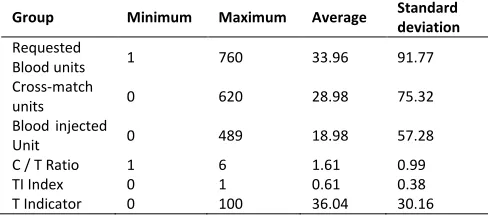
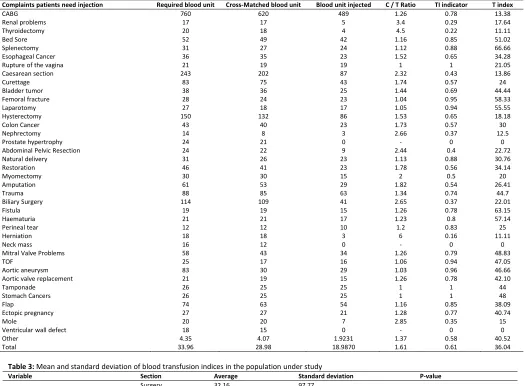
The aim of this study was to determine the pattern for maximal request for surgical surgeries (MSBOS) in elective surgery (elective) in Imam Ali Hospital, Zahedan. This study was performed on 1568 patients, of whom 562 (35/84%) were given blood transfusion. The findings of this study are presented in the following Tables (Tables 1 & 2).
Table 1: Mean and standard deviation of blood transfusion indices in the population under study
Group Minimum Maximum Average Standard
deviation
Requested
Blood units 1 760 33.96 91.77 Cross-match
units 0 620 28.98 75.32 Blood injected
Unit 0 489 18.98 57.28 C / T Ratio 1 6 1.61 0.99 TI Index 0 1 0.61 0.38 T Indicator 0 100 36.04 30.16
As shown in the Table 1, the average C / T ratio was 1.61 ± 0.99, the mean TI was 0.61 ± 0.38 and the mean T index was 36.4 ± 30.16%.
98
International Journal of Hematology Oncology and Stem Cell Research ijhoscr.tums.ac.ir
International Journal of Hematology Oncology and Stem Cell Research ijhoscr.tums.ac.ir
Table 2: The mean of the variables studied based on patients' problems
Complaints patients need injection Required blood unit Cross-Matched blood unit Blood unit injected C / T Ratio TI indicator T index
CABG 760 620 489 1.26 0.78 13.38
Renal problems 17 17 5 3.4 0.29 17.64
Thyroidectomy 20 18 4 4.5 0.22 11.11
Bed Sore 52 49 42 1.16 0.85 51.02
Splenectomy 31 27 24 1.12 0.88 66.66
Esophageal Cancer 36 35 23 1.52 0.65 34.28
Rupture of the vagina 21 19 19 1 1 21.05
Caesarean section 243 202 87 2.32 0.43 13.86
Curettage 83 75 43 1.74 0.57 24
Bladder tumor 38 36 25 1.44 0.69 44.44
Femoral fracture 28 24 23 1.04 0.95 58.33
Laparotomy 27 18 17 1.05 0.94 55.55
Hysterectomy 150 132 86 1.53 0.65 18.18
Colon Cancer 43 40 23 1.73 0.57 30
Nephrectomy 14 8 3 2.66 0.37 12.5
Prostate hypertrophy 24 21 0 - 0 0
Abdominal Pelvic Resection 24 22 9 2.44 0.4 22.72
Natural delivery 31 26 23 1.13 0.88 30.76
Restoration 46 41 23 1.78 0.56 34.14
Myomectomy 30 30 15 2 0.5 20
Amputation 61 53 29 1.82 0.54 26.41
Trauma 88 85 63 1.34 0.74 44.7
Biliary Surgery 114 109 41 2.65 0.37 22.01
Fistula 19 19 15 1.26 0.78 63.15
Haematuria 21 21 17 1.23 0.8 57.14
Perineal tear 12 12 10 1.2 0.83 25
Herniation 18 18 3 6 0.16 11.11
Neck mass 16 12 0 - 0 0
Mitral Valve Problems 58 43 34 1.26 0.79 48.83
TOF 25 17 16 1.06 0.94 47.05
Aortic aneurysm 83 30 29 1.03 0.96 46.66
Aortic valve replacement 21 19 15 1.26 0.78 42.10
Tamponade 26 25 25 1 1 44
Stomach Cancers 26 25 25 1 1 48
Flap 74 63 54 1.16 0.85 38.09
Ectopic pregnancy 27 27 21 1.28 0.77 40.74
Mole 20 20 7 2.85 0.35 15
Ventricular wall defect 18 15 0 - 0 0
Other 4.35 4.07 1.9231 1.37 0.58 40.52
Total 33.96 28.98 18.9870 1.61 0.61 36.04
Table 3: Mean and standard deviation of blood transfusion indices in the population under study
Variable Section Average Standard deviation P-value
Required blood unit Surgery 32.16 97.77 0.302
Obstetrics 40.81 66.12
Cross-matched unit Surgery 27.13 79.97 0.26
Obstetrics 36.06 55.66
Blood unit injected Surgery 18.6 62.9 0.165
Obstetrics 20.43 28.15
C / T Ratio Surgery 1.56 1 0.288
Obstetrics 1.75 0.97
TI indicator Surgery 0.6 0.39 0.853
Obstetrics 0.64 0.31
T index Surgery 39.26 32.38 0.076
Obstetrics 22.98 12.28
Mann-whitney u test
As shown in the Table above, the mean and standard deviation of blood transfusion indices in the studied population were not statistically significant difference (P> 0.05).
DISCUSSION
The aim of this study was to determine the pattern for maximal request for surgical surgeries (MSBOS) in elective surgery (elective) in Imam Ali Hospital, Zahedan. This study was performed on 1568 patients, of whom 562 (35/84%) were given blood transfusion.
patients selected for surgery, 318 of them were cross-matched and only 114 of them were given blood transfusion. In this study, C / T Ratio was 6.4, the probability of transfusion (T %) was 36.47%, and the transfusion index (TI) was 0.9, indicating that blood transfusion requirements were somewhat higher than standard15. In our study, we found that the mean C / T ratio was 1.61 ± 0.99, the mean TI Was equal to 0.61 ± 0.38 and the mean T index was 36.40 ± 30.16. Compared to Soleimanha et al.’ s study, only T-index was similar to their results, and the C / T ratio and the transfusion index were significantly better in our study. This difference is due to the type of collision in the consumption of blood and demand for blood in our study compared to Pursina Hospital in Rasht. Meanwhile, other causes of the difference may be due to the difference in the sample size, inclusion and exclusion criteria and sampling method.
Another study was conducted by Khalili Aalam et al. in Firoozgar Hospital in Tehran. This retrospective study consisted of 364 patients selected for 6 elective surgeries (cesarean section, thyroidectomy, total hysterectomy, laminectomy, cholecystectomy and mastectomy) in 2002. Necessary information was obtained, and with regard to C / T ratios, T% and TI, a program was proposed for these surgeries. Due to the high ratio of C / T (21.5) and low percent of cross-linked blood (4.7%), it was necessary to change the pattern of blood demand in this centre, so, the Type and Screen (T&S) method was suggested to use before these procedures16. However, in our study, the mean C / T ratio was 1.61, the mean TI was 61.0 and the mean T-value was 36.04%. The C / T ratio and transfusion index were significantly better in our study.
In another study by Hasan Rafiei in Besat Hospital in Hamadan (2009), among 926 blood samples obtained from males (63%) and females (37%) with a mean age of 28 years, the overall C / T and TI index were 2.01 and 0.86, respectively. Compared to the standard number (C / T <2.5 and TI> 0.5), the target outcome was is in desirable condition17. Compared to our study, it was found that in our study the indicator C / T is more favourable, but the TI index is significantly lower than that of the study, which indicates that our condition is worse. Therefore, although the findings of our study
indicate a favourable situation (C / T <2.5 and TI> 0.5).
In a descriptive study by Hayedeh Ala'a al-Dawlah et al. at Yahyanejad Hospital in Babylon, the consumption of blood was assessed among 1043 patients during three months. The results of the study showed the highest C / T ratio in the elective section (14.7) with TI = 0.16, indicating that the required blood count was about 15 times more than the blood transfusion9. Meanwhile, in our study, the requested blood was about 1.6 times more than the blood injected, which is much more favourable. This difference is due to the type of collision in the blood consumption and blood demand in our study hospital and Pursina Hospital in Rasht. Meanwhile, other causes of the difference may be due to the difference in the sample size, inclusion and exclusion criteria and sampling method.
Gharehbaghan et al. conducted a cross-sectional descriptive study on the blood request forms of patients (n=491) in five hospitals in Rasht (2007). As results shows, the highest and lowest blood request were received from Departments of Surgery and Internal Medicine, respectively and the C / T index was 1.910. The results of this study were in line with the findings of our study.
In another descriptive study carried out by Dr. Behrooz Zaman et al. in Rasoul-e-Akram Hospital in Tehran, only 1460 blood bags (17.4%) from the 8385 total blood bags reserved for elective surgery were injected. The blood cross-threaded blood injection rate was 3.12. The main cause of wasting blood was the error made by surgical groups (44.6%) 18. However, in our study, the blood cross-matched to transfusion ratio was calculated as 1.61 (half of the study results) and it turned out that the estimated mistake in obstetrics surgery was more than other surgical procedures (1.75 versus 1.56), but it was not statistically significant
100
International Journal of Hematology Oncology and Stem Cell Research ijhoscr.tums.ac.ir
International Journal of Hematology Oncology and Stem Cell Research ijhoscr.tums.ac.ir
is much higher than orthopaedic surgeries, which is different from the outcome of the study.
Between 1999 and 2001, London University Hospitals implemented the MSBOS program in the surgical ward and the C / T ratio decreased from 2.25 to 1.71, resulting in saving 102 blood units 15 months.21 In our study, the C / T ratio was 61/1, but careful consideration would need to be given in requesting and setting up a flowchart to carefully examine the indication of blood reserve for a hospital in various surgeries to reduce the loss of blood.
In the Shah Fahad University Hospital in Saudi Arabia, during the 4-year program (a type and screen program), the C/T ratio decreased from 4.8 to 2.122. Therefore, it is possible to carefully answer the request and make a flowchart for accurate selection and indication before blood is requested. In Sistan and Baluchistan, Zahedan is a specialist medical centre. Therefore, demand for blood, the existence of a program to supply blood and reduction of its costs are among the most notable cases in the hospitals of this city. According to the data extracted from the Transfusion Centre in Zahedan (2016), the total number of blood bags not used in all Zahedan hospitals was 882 bags and about USD 120 million (considering the cost per blood bag is about 134000 USD) was wasted. According to the statistics from the organization, the most blood bags were wasted in Imam Ali Hospital (283 bags of blood) and the least blood bags were wasted in Booali Hospital (4 bags of blood). The most wasted blood was released in the September and the lowest in the month of July. In a retrospective study conducted by Dr. Karami et al. in the Blood Transfusion Organization in Zahedan, during a 3-month period from August 2006 to October 2007, 2094 blood transfusions ordered by the blood bank of the Zahedan hospitals were reviewed; of which a total of 1536 PC units (44%) were not consumed (677 units) 23. In our study, only 18.98 units of 33.96 units requested were injected (55.88%), indicating that nearly 35% of the requested blood was wasted. Although it is a much more favourable result, careful examination is essential to preserve blood supplies from being wasted in various surgeries and conditions.
CONCLUSION
The results of our study showed that the mean C / T ratio was 1.61 ± 0.99, the mean TI was 0.61 + 0.38 and the mean T index was 36.4 ± 30.16%. In general, only 55% of the blood was used. Hernia surgery, thyroidectomy, and patients with renal problems had the most non-used blood bags. Therefore, according to the results, it is suggested that health care personnel make indications appropriately for all patients requiring blood transfusion, and if there is
increased number of
indications, blood is requested. Meanwhile, setting
up flowcharts and making careful query to accurately check the indication of the blood reserve in various surgeries may be helpful in reducing blood loss.SUGGESTIONS
According to the results of this study and other studies that showed high demand for blood and the lack of use of 35% of the requested blood (although our study was in desirable areas), the following are suggested:
1. Quick and timely identification of patients with a clear indication of blood transfusion.
2. Holding meetings and presenting information to doctors to introduce strict indications of blood donation in patients with trauma and patients requiring surgery (especially elective surgery such as hernia, thyroidectomy, etc.).
3. Given a small number of studies, studies similar to those of a larger sample are suggested.
4. To conduct a systematic study in line with the objectives of the present study.
statistical methods to provide more comprehensive information.
CONFLICT OF INTEREST:
The authors declare no conflict of interest.
REFERENCES
1. Gupta PK, Kumar H, Diwan RN. Blood ordering strategies in the Armed forces- A proposal.Med J Armed Forces India. 2003;59(4):302-5
2. Vibhute M, Komath SK, Shetty A. Blood utilization in elective general surgery cases: Requirements, ordering and transfusion practices. J Postgrad Med. 2000; 46(1):13-7.
3. Karami SH, Pourkhosravi N, sanei Moghadam E, etc. Consumption trend of blood and blood components in Zahedan teaching hospitals. J Blood Res. 2008; 5(4):257-266.
4. Friedman BA, Oberman HA, Chadwich AR, et al. The maximum surgical blood order schedule and surgical blood use in United States. Transfusion. 1976; 16(4): 380-7.
5. de Jongh DS, Feng CS, Frank S, et al. Improved utilisation of blood for elective surgery. Surg Gynecol Obstet. 1983; 156(3):326-8.
6. Mead JH, Anthony CD, Sattler M. Hemotherapy In elective surgery: An inclence report, review of literature, and alternative for guideline appraisal. Am J Clin Pathol. 1980; 74(2): 223-7.
7. Zaman B, Radmehr M, Sahraian A, et al. Determination of the ratio and causes of unused blood ordered from blood bank in elective surgery in Rasoul-e- Akram hospital. Sci J Iran Blood Transfus Org. 2009; 6(2): 141-146.
8. Atrah HI, Galea G, Urbainak SJ. The sustained impact of a group and screen and maximum surgical blood ordering schedule policy on the transfusion practice in gynecology and obstetrics. Clin Lab Haematol. 1995; 17(2): 177-81.
9. Alaoddolei H, Kashizadeh M, Sadighian F. The study of blood utilization at yahya-nejad hospitalin Babol. Sci J Iran Blood Transfus Org. 2008; 5(2): 133-137.
10. Gharehbaghian A, Hatami H, Emami H, et al. Evaluation of blood utilization in Rasht. Sci J Iran Blood Tranfus Org. 2010; 7(2): 101-108.
11. Aslani Y, Etemadyfar S, Noryan K. Nurses’ knowledge of blood transfusion in medical training centers of Shahrekord University of Medical Science in 2004. Iran J Nurs Midwifery Res. 2010; 15(3):141-4.
12. Purfarzad Z, Farmahini Farahani M, Ghamarizare Z, et al. Nurses’ Knowledge and practice of blood
transfusion in hospitals of Arak in 2010. Sci J Iran Blood Transfus Organ. 2012; 9 (3) :337-345
13. Salimi S, jabbarzade M, Fotohi A, et al. Evaluation of the knowledge level of Iranian medical graduates about transfusion medicine. Sci J Iran Blood Transfus Organ. 2009; 5 (4) :275-279
14. Karamati MR, Tafazoli M. Assessment of various medical groups’ knowledge of transfusion medicine. Hakim Res J. 2008; 10 (4):53-59.
15. Soleimanha M, haghighi M, Mirbollok A, et al. A survey on transfusion status in orthopaedic surgery at a trauma center. Arch Bone Jt Surge. 2016; 4(1):70-4. 16. Khalil Aalam KH, Zare Mirzaie A, Jalilvand A. Maximum Surgical Blood Ordering Schedule(MSBOS) in Elective Surgery Cases: An Original Study in Firoozgar Hospital. Razi J Med Sci. 2004; 11(44):939-43.
17. Rafieemehr H. The status of packed red blood cell transfusion in Besat hospital of Hamadan in 2009-2010. Med Lab J. 2010; 4(2):26-30.
18. Zaman B, Radmehr M, Sahraian A, Sohrabi P. Determination of the ratio and causes of unused blood ordered from blood bank in elective surgery in Rasoul-e-Akram hospital. Sci J Iran Blood Transfus Org. 2009; 6: 141-146.
19. Nakamura Y, Takano A, Shinagarua S. Type and screen system for elective surgery in obstetrics and gynecology, Nihon Sanka Fujinka Gakkai Zasshi. 1985; 37(1):141-4.
20. Richarson NG, Bradley WN, Donalson DR, et al. Maximum surgical blood ordering schedule in a district general hospital saves money and resources. Ann R coll Surg Engl. 1998:80(4):262-5.
21. Foley CL, Mould TA. Maximum surgical blood ordering schedule. Int J Gynecol Cancer .2003:13(6):889-93