3577
PREPARATION AND CHARACTERIZATION OF GLIPIZIDE SPHERICAL
AGGLOMERATES BY DIRECT COMPRESSION METHOD USING DIFFERENT
POLYMERS AND ITS EVALUATION
Kavuluru Venkata Swathi Krishna*
1, Kothapalli Bonnath Chandra Sekhar
21
Research Scholar, JNTUA, Ananthapuramu, Andhra Pradesh, India
2
Director, OTPRI, Ananthapuramu, Andhra Pradesh, India.
*Corresponding author E-mail:
[email protected]
ARTICLE INFO
ABSTRACT
Key words
:Spherical agglomeration, Glipizide,
Ceasalpiniea spinosa, HPMC
The purpose of the present research was to obtain glipizide spherical agglomerates with improved solubility, flow and compression characteristics by novel crystallization technique. Glipizide was dissolved in 30ml dichloromethane (good solvent) and stirred. 100ml of water (poor solvent) was added and continued stirring. 5ml of chloroform (bridging liquid) was added and stirred at 1000rpm for 40minutes to precipitate glipizide. Agglomeration process was optimized for parameters like speed and duration of agitation, volume of bridging liquid added. The precipitated particles were filtered and dried at 40°C. Spherical agglomerates were characterized by IR spectroscopy, X-ray diffractometry, DSC and SEM and its results revealed that there is no physical or chemical interaction existed in agglomerates. Spherical agglomerates exhibited decreased crystallinity and
improved micromeritic properties (bulk density, tapped density,
compressibility index, angle of repose). The obtained agglomerates of glipizide were spherical and dissolution rates were faster and exhibited improved solubility, dissolution rate and micromeritic properties than pure drug. Direct compressible tablets of the glipizide agglomerates showed hardness, friability and weight variation appropriately with improved drug release. Among the different control release polymers Caesalpinia spinosa(natural mucoadhesive polymer) was showing highest drug release retarding capacity. F2 was showing the satisfactory results and having better sustainability. When we plot the release rate kinetics for best formulation f2 was following zero order because correlation coefficient value of zero order is more than first order value. F2 formulation diffusion exponent n value is 0.45< n >0.89 so they are following Anomalous (Non- Fickian) diffusion.
INTRODUCTION:
Formulation and manufacture of solid oral dosage forms, and tablets especially, have undergone rapid change and development over the last several decades. One of the most revolutionary technologies is that of direct compression. In direct tabletting method, it is
necessary to increase flowability and
compressibility of the bulk powder inorder to retain a steady supply of powder mixture to the
tabletting machine and sufficient mechanical strength of the compacted tablets. In addition to increasing efficiency of the manufacturing process it is also important to increase bioavailability of the drug by improving the solubility of the bulk drug powder. Spherical agglomeration is one of such techniques to improve the micromeritic properties and
dissolution of the drug1. Spherical
agglomeration is a process of formation of
Journal of Global Trends in Pharmaceutical Sciences
3578
aggregates of crystals held together by liquid bridges. The agglomerates are formed by agitating the crystals in a liquid suspension in
presence of binding agent2. It is the latest
technique of enlarging smaller particles of
solid into large size by inter-particle
agglomeration3,4. This technique can also be
exploited to increase solubility, dissolution and hence bioavailability of poorly soluble
drugs5,6. Direct tabletting is most desirable,
easy and simplest technique of manufacturing tablet. Such manufacturing process of tablets involve simple mixing and compression of powder, which result in number of overall benefits including time, cost and energy savings. Direct compression of drug into tablet requires good micromeritic properties, such as good flowability, and good reproducible compressibility.
Glipizide is an oral rapid short acting anti diabetic drug from the sulfonyl urea class. It is classified as a second generation sulfonyl urea, which means it undergoes enterohepatic circulation. It is more potent and have shorter half lives than first generation sulfonyl ureas. Polymers like HPMC K100M (hydrophilic
polymer), caesalpinea spinosa (natural
polymer) were used with different viscosity grades.
MATERIALS AND METHODS
Glipizide drug was obtained as a gift
sample from Dr. Reddys laboratories,
Hyderabad. HPMCK100M was obtained as a gift sample from Astra Zeneca Bangalore, India. All other chemicals used were of
pharmacopeial grade.
EXTRACTION OF NATURAL MUCOADHESIVE MATERIAL FROM
CAESALPINEA SPINOSA:
1. Collection and authentication of plant:
The seeds of caesalpinea spinosa were collected from in and around areas of Nellore disctrict. The plants were authenticated by Prof. K. Madhava Chetty, Department of Botany, SV University, Tirupathi, Chittoor District, Andhra Pradesh and seeds specimen samples were kept in the laboratory for further use. Caesalpinia spinosa, a small tree of family Leguminosae. Commonly known as Tara is a gum obtained from the endosperm of seed of
Caesalpinia spinosa. Tara gum is an odorless, white powder; produced by separating and grinding the endosperm of the mature black colored seeds of Tara plant. The major component of the gum is a galactomannan polymer similar to the main components of guar and locust bean gums. In various pharmaceutical and food industries, Tara gum is used as a thickening agent and a stabilizer around the world. Further studies also gave an idea about its applications in various patents like; the use of tara gum as a controlled release formulations includes a gastro retentive controlled release tablets and emulsions for
various drugs7,8,9.
2. Extraction of natural mucoadhesive materials:
The collected seeds were washed thoroughly with water to remove the adhering materials. 500gm of dried seeds were soaked separately in distilled water (2500ml) for 24 hr and then boiled for one hour with continuous stirring at 2000rpm and then kept aside for the release of natural gum into water. The soaked seeds were taken and squeezed using several folds of muslin cloth to separate the marc from the filtrate. The marc was not discarded but it was used for multiple extractions. All the extractions were pooled and concentrated under vaccum at 60C to half of the volume. Then to the filtrate equal quantity of acetone
was added to precipitate the natural
mucoadhesive material, which was then separated by filtration. The precipitated mucilage was dried at 60C in a hot air oven. The dried mucoadhesive agent was powdered, passes through the sieve no.100 and stored in an airtight container at room temperature for further use. This natural mucoadhesive material is used for different formulations.
PHYSICAL CHARACTERIZATION OF SPHERICAL AGGLOMERATES
Differential scanning calorimetry (DSC)
study: A DSC study was carried out to detect
possible polymorphic transition during the crystallization process. DSC measurements
were performed with a thermal analyser. 10,
11,12,13,14
FT-IR Spectroscopy: The FT-IR spectral
measurements were taken at ambient
3579
8033(USA). Samples were dispersed in KBr powder and the pellets were made by applying 5 ton pressure. FTIR spectra were obtained by
powder diffuse reflectance on FTIR
spectrophotometer. 10, 11,12,13,14
X-RAY Analysis: X-Ray powder diffraction
patterns were obtained at room temperature using Bruker diffractometer, with Cu as anode
material and graphite monochromator,
operated at a voltage of 40mA, 45kV.
Scanning Electron Microscopy (SEM) 10,
11,12,13,14
SEM (Shimadzu-LV-5600, USA, with magnification of 250X) photographs were obtained to identify and confirm spherical nature and surface topography of the crystals.
PREPARATION OF GLIPIZIDE SPHERICAL AGGLOMERATES
Glipizide was dissolved in 30ml dichloromethane and stirred 100ml water was added and continued stirring. 5ml of chloroform was added and stirred at 1000rpm for 40min to precipitate glipizide. The precipitated recrystallized agglomerates were collected by vaccum filtration and dried in oven at 40°C for 6hr. The dried crystals were stored in dessicators at room temperature before use. The above process was repeated several times to obtain enough materials for characterization and to observe repetability. Formulation codes were given for spherical agglomerates with polymers (ceasalpinea spinosa, HPMC K100M) from F1 to F6 and for pure drug with polymers from F7 to F12 respectively.
Drug content: Drug content was determined
by taking spherical agglomerates of glipizide equivalent to 100mg glipizide were triturated and dissolved in a solvent system containing dichloromethane: water: chloroform(30:100:5 v/v). Diluted samples were filtered through 0.45µ injection filter and drug content was determined spectrophotometrically at 276nm
using UV-Visible spectrophotometer(Lab
india, UV 3000+)
Yield and Micromeritic properties
Yield of the prepared agglomerates
were determined by weighing the
agglomerates after drying. Bulk density (sisco), tapped density were determined by tap density tester and carr´s index and hausners ratio were determined. The flow behaviour of raw crystals and spherical agglomerates was determined by angle of repose by using fixed funnel method.
PREPARATION OF GLIPIZIDE TABLETS
Glipizide agglomerates equivalent to 10mg of glipizide were manually mixed with
directly compressible microcrystalline
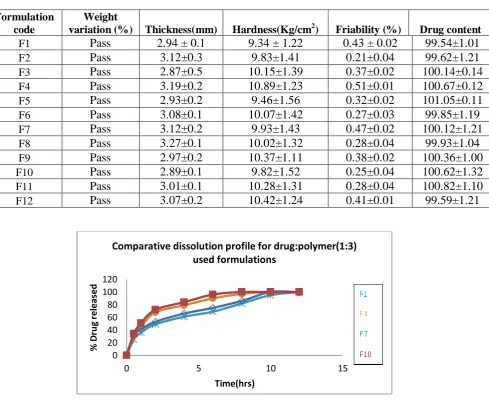
cellulose and the blend was finally mixed with magnesium stearate for 2 min. final blend (200mg per tablet) was compressed using rotary tablet machine with 6mm standard concave punch. The weight variation of the tablets was determined taking weight of 20tablets using electronic balance. Hardness, thickness, friability of tablets were studied by Monsanto Hardness tester, vernier calipers (Cd 6”Cs), Roche friabilator (ELECTRO LAB) respectively.
Evaluation of glipizide tablets In Vitro
dissolution study 10, 11,12,13,14
The dissolution studies of raw crystals and spherical agglomerates of glipizide were performed by using USP 26 type II dissolution test apparatus (electro lab 08L) in 900ml of pH 7.5 phosphate buffer. Temperature was maintained at 37±2°C and 50rpm stirring was provided for every dissolution study. At predetermined time intervals, 5ml of samples
were withdrawn and analysed
spectrophotometrically. At each time of withdrawl, 5ml of fresh corresponding medium was replaced into the dissolution flask. After filtration through Whattman filter
paper, concentration of glipizide was
determined spectrophotometrically at 276nm. The cumulative amount of drug release versus time was calculated and plotted.
RESULTS AND DISCUSSION
FT-IR Spectra of glipizide:
Glipizide pure drug & Glipizide spherical agglomerates
All the crystals have exhibited general
3580
cm-1 for NH-CO-NH stretching, 3030 cm-1for
aromatic C-H stretching). Specific changes in IR spectra are not very clear, could be due to variations in the resonance structure, rotation of a part of a molecular or certain bonds.
X-RAY Diffraction spectra of glipizide
All the samples showed similar peak positions in X-ray diffraction. The relative abundance of the planes exposed to the X-Ray source would have been altered, producing the variations in relative intensities of the peak or may be due to differences in crystal sizes.
DSC Results
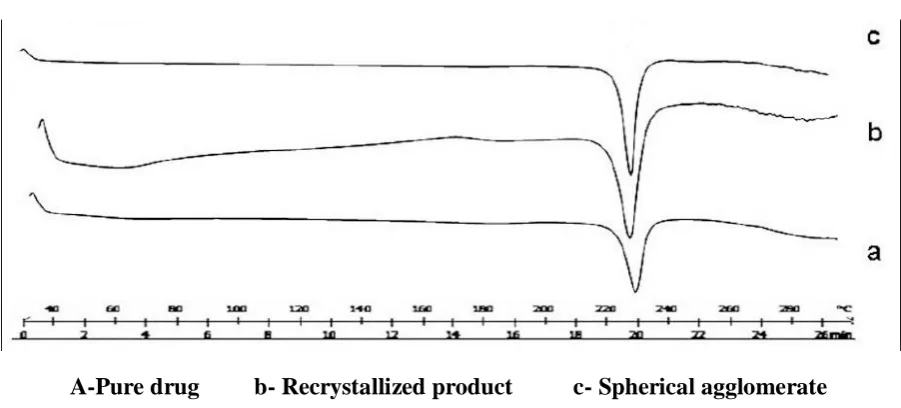
The DSC thermograms shows a sharp endothermic peak for all the glipizide crystals. Melting points show slight variation as the nature of the crystals might have been affected by the solvent.
Scanning electron microscopy of glipizide
Crystals of pure sample are of smallest size (4-10µm) and have irregular shapes.
Recrystallization product crystals have
intermediate size (9-15µm). The agglomerates
were formed by coalescence of the
microcrystalline precipitates, so the
agglomerates had a rugged surface.
Agglomerates obtained were spherical in shape with size 198µm- 670µm.
Dissolution profiles:
The dissolution profile of glipizide exhibited improved dissolution behavior for spherical agglomerates than pure sample.
Spherical crystals exhibited decreased
crystallanity and improved micromeritic
properties. Amount of bridging liquid, speed of agitation and duration of agitation affects the mechanical and micromeritic properties of spherical crystals. DSC and XRD studies showed that there is no change in the crystal structure of glipizide during the crystallization process i.e. polymorphism is not present.DSC results further supported IR spectroscopy results, which indicated the absence of any interactions between drug and additives used
in the preparation. Hence the spherical agglomeration technique can be used for formulation of tablets of glipizide by direct
compression with directly compressible
excipients. On the other hand, all prepared
spherical agglomerates exhibited good
compressibility which indicates good
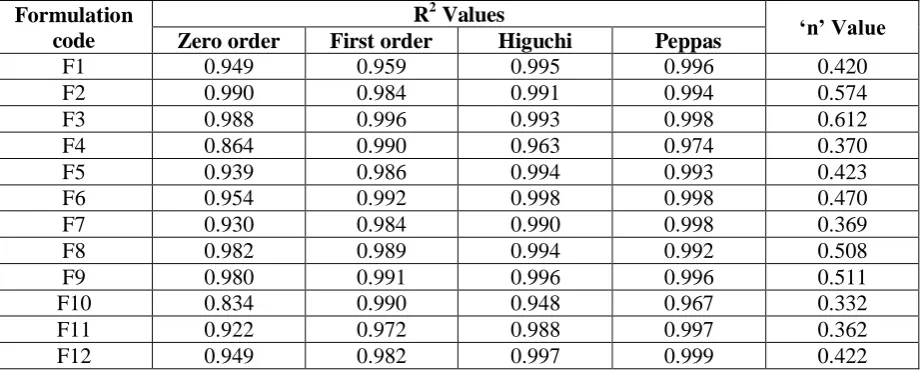
packability. The saturation solubility studies indicate that the pure drug having the least solubility while as the formulations have the higher solubility. Among the different control release polymers Caesalpinia spinosa was showing highest drug release retarding capacity. F2 was showing the satisfactory results and having better sustainability. When we plot the release rate kinetics for best formulation f2 was following zero order because correlation coefficient value of zero order is more than first order 2 value. F2 formulation diffusion exponent n value is 0.45< n >0.89 so they are following Anomalous( Non- Fickian) diffusion.
CONCLUSION
Glipizide spherical agglomerates were prepared which showed improved flowability, solubility, packability and compactability resulting in successful direct tabletting without capping. The main factor in the improvement of the flowability and packability was a significant reduction in interparticle friction, due to spherical shape of the tabletted particles. It concludes that direct compression of spherical crystallization of glipizide with selective polymers is a satisfactory method to improve compressibility as well as dissolution of glipizide.
ACKNOWLEDEMENTS
3581
Fig 1: FTIR Spectra of glipizide pure drug & glipizide spherical agglomerates
Fig 2: X-Ray diffraction spectra of glipizide
A-Pure drug b- Recrystallized product c- Spherical agglomerate
3582
Fig 4: Scanning Electron Microscopy of glipizide
Table 1: Composition of glipizide spherical agglomerates
Table 2: Precompression parameters
Formulation code
Bulk density(g/cm3)
Carr’s index
Hausners ratio
Angle of
repose(ɵ) Diameter
F1
0.52± 0.02
11.86±1.21
1.13±0.03
32.81±0.51
7.94±1.10
F2
0.55±0.01
9.84±1.23
1.11±0.04
30.45±0.54
7.99±1.12
F3
0.49±0.02
14.04±1.22
1.16±0.06
33.64±0.53
8.02±1.23
F4
0.52±0.01
10.34±1.20
1.12±0.07
31.28±0.67
7.96±1.27
F5
0.57±0.02
12.31±1.23
1.14±0.05
32.45±0.69
9.97±1.34
F6
0.54±0.01
10.00±1.36
1.11±0.04
30.87±0.56
7.94±1.40
F7
0.53±0.02
13.11±1.35
1.15±0.03
32.87±0.54
7.97±1.72
F8
0.57±0.01
12.31±1.26
1.14±0.04
34.73±0.52
8.02±1.75
F9
0.51±0.02
19.05±1.24
1.24±0.07
37.25±0.63
7.98±1.23
F10
0.51±0.02
17.74±1.43
1.22±0.04
36.93±0.56
7.96±1.34
F11
0.54±0.01
14.29±1.54
1.17±0.03
34.27±0.65
8.05±1.34
F12
0.56±0.1
17.65±1.36
1.21±0.04
38.23±0.67
8.01±1.24
Spherical agglomerates of
glipizide API
Glipizide API
Ingredients(mg)
F1
F2
F3
F4
F5
F6
F7
F8
F9
F10
F11
F12
DRUG
10
10
10
10
10
10
10
10
10
10
10
10
Mccph112
158 148 138 158 148 138 158 148 138 158 148 138
caesalpinia
spinosa
30
40
50
-
-
-
30
40
50
-
-
-
Hpmck100m
-
-
-
30
40
50
-
-
-
30
40
50
Mg sterate
2
2
2
2
2
2
2
2
2
2
2
2
3583
Table 3: Post-compression parameters
Formulation code
Weight
variation (%) Thickness(mm) Hardness(Kg/cm2) Friability (%) Drug content
F1
Pass
2.94 ± 0.1
9.34 ± 1.22
0.43 ± 0.02
99.54±1.01
F2
Pass
3.12±0.3
9.83±1.41
0.21±0.04
99.62±1.21
F3
Pass
2.87±0.5
10.15±1.39
0.37±0.02
100.14±0.14
F4
Pass
3.19±0.2
10.89±1.23
0.51±0.01
100.67±0.12
F5
Pass
2.93±0.2
9.46±1.56
0.32±0.02
101.05±0.11
F6
Pass
3.08±0.1
10.07±1.42
0.27±0.03
99.85±1.19
F7
Pass
3.12±0.2
9.93±1.43
0.47±0.02
100.12±1.21
F8
Pass
3.27±0.1
10.02±1.32
0.28±0.04
99.93±1.04
F9
Pass
2.97±0.2
10.37±1.11
0.38±0.02
100.36±1.00
F10
Pass
2.89±0.1
9.82±1.52
0.25±0.04
100.62±1.32
F11
Pass
3.01±0.1
10.28±1.31
0.28±0.04
100.82±1.10
F12
Pass
3.07±0.2
10.42±1.24
0.41±0.01
99.59±1.21
Fig 5: Comparative dissolution profile for drug: polymer (1:3) used polymers
(F1, F4, F7 and F10)
Fig 5: Comparative dissolution profile for drug: polymer (1:4) used polymers
(F2, F5, F8 and F11)
0 20 40 60 80 100 120
0 5 10 15
%
D
ru
g
rel
e
as
ed
Time(hrs)
Comparative dissolution profile for drug:polymer(1:3) used formulations
0 20 40 60 80 100 120
0 5 10 15
%
D
ru
g
rel
e
as
ed
Time(hrs)
3584
Formulation code
R2 Values ‘n’ Value
Zero order First order Higuchi Peppas
F1 0.949 0.959 0.995 0.996 0.420
F2 0.990 0.984 0.991 0.994 0.574
F3 0.988 0.996 0.993 0.998 0.612
F4 0.864 0.990 0.963 0.974 0.370
F5 0.939 0.986 0.994 0.993 0.423
F6 0.954 0.992 0.998 0.998 0.470
F7 0.930 0.984 0.990 0.998 0.369
F8 0.982 0.989 0.994 0.992 0.508
F9 0.980 0.991 0.996 0.996 0.511
F10 0.834 0.990 0.948 0.967 0.332
F11 0.922 0.972 0.988 0.997 0.362
F12 0.949 0.982 0.997 0.999 0.422
Table 4: Drug release kinetic profile of glipizide tablets
REFERENCES:
1. P.Kulkarni K, Mudit Dixit, Ashwini
G Kini, Akash Johri. Spherical agglomerates of mefanic acid by solvent change method. International Journal of Pharm.Sciences, Vol-2, Issue-2, 2011. Pg-111-125.
2. Mudit Dixit,
Dr.K.Kulkarni,Shahnanwaz Anis and Ashwini G Kini. Preparation and
characterization of spherical
agglomerates of ketoprofen by
neutralization method. International Journal of Pharma and Bio Sciences, Vol-1, Issue-4, Oct-Dec.2010, Pg:395-406).
3. Pavitra Solanki, Anoop Kumar,
Abinav Garg, Pankaj Sharma, Satyavir Singh. Designing and development of spherical agglomerates of
ibuprofen-paracetamol blend for improved
tableting and dissolution. International
/journal of therapeutic
Applications.Vol-8, 2012, Pg-8-13.
4. Martino DP, Barthelemy C, Piva F,
Joiris E, Palmieri GF and Martelli S. improved dissolution behavior of Fenbrufen by spherical crystallization. Drug Dev Ind Pharm 1999; 25(10): 1073-1081.
5. Sano A, Kuriki T, Handa T, Takeuchi
H, Kawashima Y. particle design of tolbutamide in the presence of soluble polymer or surfactant by the spherical
crystallization technique:
improvement of dissolution rate. J Pharm Sci 1987; 76:471-474.
6. Sano A, Kuriki T, Handa T, Takeuchi
H, Kawashima Y. particle design of tolbutamide in the presence of soluble polymer or surfactant by the spherical
crystallization technique:
improvement of dissolution and
bioavailability of direct compressed tablets prepared using tolbutamide agglomerated crystals. Chem Pharm Bull 1990; (11): 3030-3035.
7. Saurabh Dilip Bhandare*, Ekta
Kavade and Sunita Surse. natural
polymers: as pharmaceutical
excipients and their applications in different pharmaceutical formulations - a review. World Journal of Pharmaceutical Research. Volume 4, Issue 6, 2015, 626-644.
8. Pritam Dinesh Choudhary and Harshal
Ashok Pawar * Recently Investigated
Natural Gums and Mucilages as
Pharmaceutical Excipients: An
Overview. Journal of pharmaceutics. 2014; 2014: 204849.
9. D. Mahidhar Reddy , Sk. Razia
Begum , K. Jyothirmai , G.V. Dileep Kumar , S. Jayasree , J. Jeevankumar , A.V.S. Gita Samira. A Novel Review
on Natural Polymers Used In
Formulation of Pharmaceutical
Dosage Forms. International Journal of Pharmacy and Natural Medicines. 2013, Vol.1 (1): 71-78.
10. A.R.Tapas, P.S.Kawtikwar, D.M.
Sarkar. Enhanced dissolution rate of
felodipine using spherical
3585
emulsion solvent diffusion method. Research in pharmaceutical sciences. 2009 Jul-Dec; 4(2): 77–84.
11. Sarfaraz Md, Arshad Ahmed Khan,
Doddayya H, Reddy, SR, Udupi R.H.
Particle design of
aceclofenac-disintegrant agglomerates for direct
compression by
crystallo-co-agglomeration technique. Asian J.of Pharamaceutical Technology. 2011, vol-1, issue-2.Pg- 40-48.
12. Sachin Kumar Patil, Atul Kadam,
Shital Kumar Patil, Sunit Kumar
Sahoo. Directly compressible
glibenclamide tablet prepared from
spherical agglomerates: A
comparative evaluation with marketed
tablet. J.of Pharm.Sci.Tech.
vol-3.Issue-1.2013. Pg:31-36.
13. D.Saritha, P.Subhash Chandra Bose,
P. Srikanrth Reddy, G.Madhuri,
R.Nagaraju. Improved dissolution and micromeritic properties of naproxen
from spherical agglomerates:
preparation, invitro and invivo
characterization. Brajilian J of
Pharmaceutical Sciences.
Vol-48.2012. Pg-667-676.
14. A.Saritha, Nalini Shastri,
Sadanandam, Anantha Laxmi.