Available Online at www.ijpret.com 11
INTERNATIONAL JOURNAL OF PURE AND
APPLIED RESEARCH IN ENGINEERING AND
TECHNOLOGY
A PATH FOR HORIZING YOUR INNOVATIVE WORK
DESIGN AND IMPLEMENTATION OF SEALING UNIT FOR LPG CYLINDERS
CHAITANYA UMESH PRABHU GAUNKER1, DEVENDRA SUTAR2, MANISH LENPALE3
1. P.G. student, Electronics and Telecommunication department, Goa college of Engineering, Farmagudi, Ponda, Goa, India-4034011.
2. Assistant Professor, Electronics and Telecommunication department, Goa college of Engineering, Farmagudi, Ponda, Goa, India-4034012.
3. Plant Manager, Hindustan Petroleum Co. Ltd. Kundai, Ponda, Goa, India-4031153. Accepted Date: 23/04/2017; Published Date: 01/05/2017
\
Abstract: - This paper presents machine vision approach to put and inspect the integrity of
LPG cylinder seals. Programmable Logic Controllers (PLC) are used in industries over a decade because of its robust nature, computational power and applications beyond automation and control. Due to its advance features and high speed computations it can be easily used in designing a new sealing unit for sealing LPG cylinders. This paper focuses on Allen Bradley microtransistor 800 model which is widely used in the industries. PLC will be used to monitor the temperature, control the movement of LPG cylinders and seal them once they enter the unit. The whole sealing process should take place only if the temperature of hot air is above 250°C. This hot air will be passed onto the blue colour plastic cover so that it seals it. SCADA will be used to monitor sealing unit from distance.
Keywords: Allen Bradley PLC, Baliga Heater, Inductive Sensor, SCADA InTouch 10.0, Sealing
Unit.
Corresponding Author: MR. CHAITANYA UMESH PRABHU GAUNKER
Access Online On:
www.ijpret.com
How to Cite This Article:
Chaitanya Umesh Prabhu Gaunker, IJPRET, 2017; Volume 5 (9): 11-18
Available Online at www.ijpret.com 12
INTRODUCTION
LPG cylinders are the necessity of each and every one this days. Almost everyone uses LPG cylinders to cook at home, restaurants. As the demand for LPG increased, this has caused industry to rethink about the method of sealing. The present system was pneumatic based sealing system which was not entirely leaving up to the demand of LPG cylinders. There was a need for rethinking of that sealing process. The new system will be based upon Allen Bradley micro transistor 800 PLC. Before sealing, PLC will check for the temperature and if it is above 250ºC the sealing will take place. The main advantage of using PLC is that it can withstand in harsh temperature and conditions [1]. PLC can protect your work as you can put password for your work thus protecting it from alterations. It is easy to download code from PLC to any system if at all someone wants to make a change in the program. PLC is designed for an industrial environment and was manufactured to deal with the harsh conditions which could be electrical noise, electromechanical interferences, mechanical vibrations, extreme temperatures and non-condensing humidity of 95% [2].
II. DESIGNING
Available Online at www.ijpret.com 13
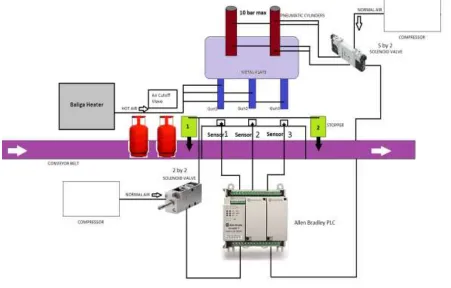
Figure 1: Block diagram for sealing unit
Once the conveyor belt is stopped, PLC will turn on the 5 by 2 solenoid valve which will be controlling the pneumatic cylinders mounted on top of the metal plate. This solenoid valve will turn on the outlet 1 so that the air supply entering through inlet gets to the pneumatic cylinders. This will force the piston to move down, because of this downward movement the metal plate will come downwards so that gun touches the LPG cylinders. The hot air coming out of the Baliga heater will be controlled by the air cut off valve which will only open when the gun touches the cylinder. There will be three cut off valves controlling the hot air supply to each gun. Once the gun touches the LPG cylinders, hot air will come though the opening inside the gun and will be passed onto the seals.
Available Online at www.ijpret.com 14 was the major advantage of the new system as it was not waiting for all cylinders. It saved crucial time and the number of LPG cylinders sealed per hour increased drastically. PLC and SMPS will be placed in a flame proof box. Control panel will have start and stop buttons.
III. ALGORITHM
1. When START is pressed, it should check for the heater temperature. If it is 250ºC it should go
to next step or else it should wait till it gets to that range.
2. When sensor 3 detects the LPG cylinder stopper 2 and stopper 1 will stop the movement of
LPG cylinders.
3. If sensor 2 and sensor 1 are high along with sensor 3 PLC will turn on the five by two solenoid
valve.
4. Five by two solenoid valve will force the metal plate to come down. Once the seal is applied
the same valve will force it to go up.
5. Once the seal is applied stopper 2 and stopper 1 will go low.
Available Online at www.ijpret.com 15
Available Online at www.ijpret.com 16
V. SCADA SIMULATION
The SCADA (Supervisory Control and Date Acquisition) is mainly designed to visualize and control processes, production sequences and machines and troubleshooting. SCADA implementation in automation systems improves the planning ability and also enables the operation, control and visualization of the automation system from one outdoor [3]. In order to observe and control the sealing process we will be using Wonderware InTouch 10.0 SCADA software. This software is widely used in the automation industries. When the InTouch software is start up, Application Manager Page will show all the existing projects and will give us the opportunity to make a new one. In Application Manager Page projects, modes, screen resolutions and versions can be checked [4].
InTouch SCADA software is run in Window Viewer mode. In Window Maker Page, there will be a Runtime icon, by clicking that the simulation can be carried out. InTouch SCADA software will have a window script option where in you have to write the script. After selecting the wizards required for the project, you have to name them in a specific order [5].There will be two screens, ‘On Show’ and ‘While Showing’. Under ‘On Show’ screen you have to define the initial conditions whereas in ‘While Showing’ you have to write the actual script.
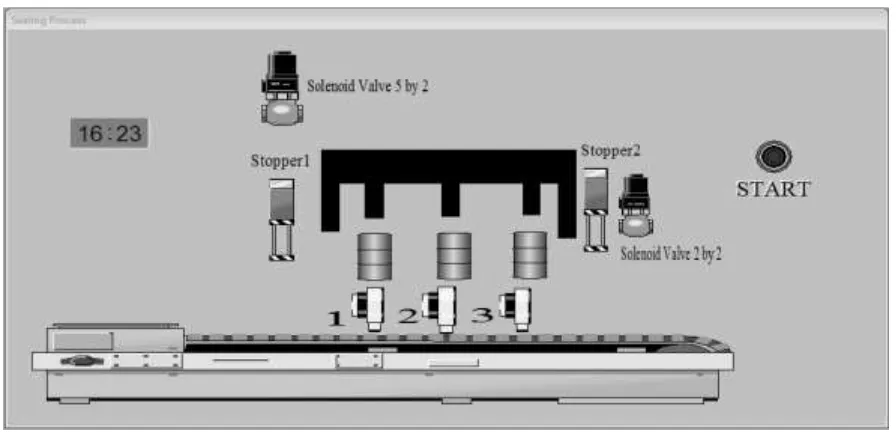
Three LPG cylinders are entering the sealing unit as shown in Figure 2. Once they enter the unit, seals will be applied onto the LPG cylinders as shown in Figure 3. Once the seals are applied, new cylinders will enter the sealing unit.
Available Online at www.ijpret.com 17
Figure 3: Sealing of LPG cylinders
VI. CONCLUSION
Previous system was time consuming as it used to wait for three cylinders to enter the unit. This new system will be based of timeout and it won’t wait for all three cylinders to enter the unit. Using the pneumatic system the sealing unit could seal around 1600 LPG cylinders per hour, but because of this PLC based system, the unit could seal around 1800 LPG cylinders per hour thus meeting the demand.
The main ideas of this study are designing and implementation of PLC based seal packing process by using the industrial production equipment and visualization and controlling the system via SCADA System. This SCADA System enables us to control and manage the sealing unit from a distance.
ACKNOWLEDGMENT
Available Online at www.ijpret.com 18 I thank my teachers, who have taught enthusiastically at the Goa College of Engineering. I also thank Dr. Hassanali Virani, (Head of the Department), Department of Electronics and Telecommunication Engineering, and Dr. Vinayak N. Shet (Principal), Goa College of Engineering.
REFERENCES
1. K. T. Erickson, “Programmable logic controllers”, IEEE Potentials, 1996.
2. Curtis Parrott, Ganesh K. Venayagamoorthy. (2003). Real-Time Implementation of Intelligent
Modelling and Control Techniques on a PLC Platform. Presented at IEEE International
Conference on Industrial Technology. [Online]. Available:
http://ieeexplore.ieee.org/document/4658952/
3. DOGANOLGU C., YENITIPE R., “SCADA Systems and an Application”, Graduation Project, M.
U. Istanbul, 2003.
4. R. Yenitepe. (2004, June). An Application of SCADA System on a MT educational MPS unit.
Presented at Mechatronics, 2004. ICM’04. Proceedings of the IEEE International Conference. [Online]. Available: http://ieeexplore.ieee.org/document/1364487/
5. “Wonderware Factory Suite, InTouch”, User’s Guide, Version A, Wonderware Corporation,
September 2002.
6. Wonderware Software System www.wonderware.com