Cite this article Ay M, Etyemez A. Effect of Processing Parameters on Surface Integrity. International Journal of Innovative Research and Reviews (INJIRR) (2019) 3(1) 16-20
Link to this article: http://www.injirr.com/article/view/27
Copyright © 2019 Authors.
This is an open access article distributed under the Creative Commons Attribution-NonCommercial-NoDerivatives 4.0 International License, which permits unrestricted use, and sharing of this material in any medium, provided the original work is not modified or used for commercial purposes.
International Journal of Innovative Research and Reviews, 3(1) 16-20
International Journal of Innovative Research and Reviews
ISSN: 2636-8919 Website: www.injirr.com
doi:
Research paper, Short communication, Review, Technical paper
RE S E A R C H AR T I C L E
Effect of Processing Parameters on Surface Integrity
Mustafa AY
1,*, Ayhan ETYEMEZ
21Marmara University, Faculty of Technology, Department of Mechanical Engineering, Istanbul – Turkey 2Nikken Turkey, Istanbul – Turkey
*Corresponding author E-mail: [email protected] HI G H L I G H T S
This study is concluded that TiAlN coatings had a positive effect on the machinability of PMD 23 cold work steel material.
Another result of this study is that PMD 23 cold work steel material can be manufactured by milling with MQL with TiAlN coating.
AR T I C L E IN F O
Received : 05.15.2019 Accepted : 06.24.2019 Published : 07.15.2019
Keywords: ANOVA MQL PM23
Surface integrity Taguchi
AB S T R A C T
In this study, the surface roughness of PMD 23 cold work tool steel in milling with multi-layer TiAlN coated cutting tools was experimentally investigated. The effect of surface roughness on the rotation, feed ratio, and MQL flow rate was investigated. The Taguchi technique was used to optimize the milling process. Also, variance analysis (ANOVA) was used to determine the effect of each parameter on the obtained results. Finally, the relationship between dependent variables and independent variables was modeled by regression analysis. In this study, the optimal machinability of PMD 23 cold work tool steel with multi-layer TiAlN coating was determined.
Contents
1. Introduction ... 16
2. Material and Method ... 17
2.1. Test Sample and Experimental Setup ... 17
2.2. Experimental Design and Measurement ... 17
3. Results and Discussion ... 18
3.1. Signal / Noise Ratios and Optimal Levels ... 18
3.2. Evaluation of Surface Roughness Results ... 18
3.3. Variance Analysis ... 19
4. Conclusion ... 19
Acknowledgment ... 19
References ... 19
1.
Introduction
Machining methods have an essential place in manufacturing processes. Materials with high mechanical properties have been obtained with the developments in materials. The selection of the appropriate cutting tool during material removal from such materials is essential to ensure efficiency
[1–5]. The choice of tool material and cutting geometry is critical. For efficient and economical processing, academic activities are required for each of the materials and cutting tools to be processed [1, 2, 6–9].
with cutters having a variety of features, but it is also common to use the indexable insert. These indexable inserts can process materials with different properties. To realize this idea, we tested PMD 23 material by using different indexable insert. First of all, let us give some information about PMD 23 material. This material is cold work steel, which is a product of powder metallurgy. Wear resistance and toughness are much more than the known 12% Cr-steels. Its difference in cutting, punching, pressing, blowing staples, and molds is very evident. It also provides perfect results for cutting tools such as milling and reamers. Compared to 1.3343, it gives many times more strength and can run at a higher speed.
Austenitic stainless steels, which indicates similar behavior to this material, consist of a class of chromium-nickel steels and provide very high corrosion resistance. It is not recommended to use with other alloys for a wide range of excellent mechanical properties. The austenitic group of stainless steels are non-magnetic materials and are not hardened by conventional heat management process despite their cold strengthening for cold works [10]. AISI 304 austenitic stainless steel is categorized under a group of materials which are difficult to process. In the machining operations of austenitic stainless steels, generally side wear, crater surface, and irregular wear occur in the tool [11]. Some reasons, such as poor machinability of this material, work hardening ratios, high infrangibility resistance, high leaning power, high ductility, and very low thermal conductivity explain the situation [11, 12]. The working hardness of this steel will cause tool wear and increase in tool damage. There is a way to reduce the effect of working hardness on tool life. This is a high level of feed rate progress with a hard tool [13]. Milling of high hardness steels leads to reduced tool life. Besides, sporadic refrigeration repetition, along with the cutting and periodic temperature, cause micro cracks to occur in inserts. Therefore, the thermal properties of tool materials such as thermal conductivity are a very important characteristic in hard milling materials. Measurement of the tool temperature is necessary to evaluate the applicability of the tool for milling. In contrast, it is difficult to measure the temperature of the tool directly because the cutting tool rotates at high speed, and the measurement area is small. In this study, by using L9322 carbide multi-layer, TiAlN coated end mill with PMD 23 material, the machinability of material at different progress and cutting depth was investigated. Considering the industrial conditions, Taguchi Experiment Design method was used both in order to perform these experiments most efficiently by considering economic conditions and time constraints and to get the best results by optimum experiment interpreting the results.
2.
Material and Method
2.1. Test Sample and Experimental Setup
PMD 23 cold work tool steel used in mold industry is a material which does not lose high-temperature stability, thermal conductivity, toughness, and wear resistance. PMD 23 cold work tool steel can be hardened by heat treatment.
properties are shown in Table 1, and mechanical properties in Table 2.
Table 1 Chemical properties of PMD 23
PMD23 C W Cr V
Basic 1.30 6.40 4.2 3.10
Table 2 Mechanical properties of PMD 23
Tensile Strength (N/mm2)
Notch-Impact Resistance
(N/mm)2)
Elongation (%) Hardness (HRC)
460 530-650 24 25-36
In the experiments, JOHNFORD VMC-850/550 + APC CNC Fanuc 0T with x-y-z-axis CNC milling machine, L9322 carbide multi-layer TiAlN coated endmill, MAHR-Perthometer surface roughness tester for surface roughness measurement, KISTLER 9265B dynamometer for cutting force measurement, KISTLER 5019b type load amplifier and DynoWare software program for analysis were used. 2.2. Experimental Design and Measurement
The experiment design was done by using Taguchi technique. Thus, it was possible to reach more comprehensive results with less experimentation. In this case, time and cost savings were provided. When determining the quality characteristics, since the surface roughness and cutting force ratios to be measured are desired to be the least, the smallest the best principle was applied. In this experimental study, tool path, progress, and cutting depth were selected as parameters.
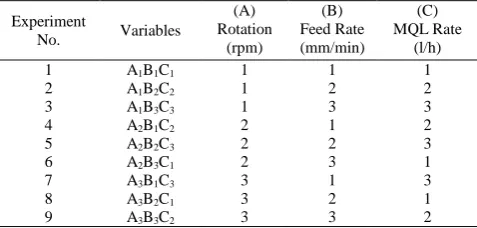
In all experiments, TiAlN coated carbide end mill with multilayer were used, the parameters and levels to be used in the experiment are presented in Table 3, L9 experimental design and surface roughness and cutting forces obtained in the experiments were presented in Table 4. The experimental setup is shown in Figure 1.
Table 3 Variables Used in the Experiment
Parameters (A) Rotation (rpm) (B) Feed Rate (mm/min) (C) MQL Rate (l/h)
Level I 1800 100 20
Level II 2200 200 30
Level III 2600 300 40
Table 4 L9 Experimental design and surface roughness and cutting force values
Experiment
No. Variables
(A) Rotation (rpm) (B) Feed Rate (mm/min) (C) MQL Rate (l/h)
1 A1B1C1 1 1 1
2 A1B2C2 1 2 2
3 A1B3C3 1 3 3
4 A2B1C2 2 1 2
5 A2B2C3 2 2 3
Figure 1 Experimental setup
3.
Results and Discussion
3.1. Signal / Noise Ratios and Optimal Levels
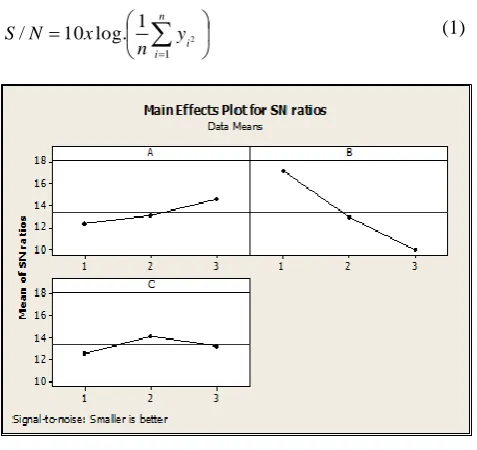
The results obtained with the Taguchi design are converted to signal/noise (S/N) ratios and expressed in decibels (dB). The signal value represents the real value that the system gives and is wanted to be measured, and the noise factor represents the share of unwanted factors within the measured value [14]. Since the goal in our study is to reach the best surface quality, the equation we used for the Signal/Noise ratio is the smallest the best equation [14–17].
n
i i
y n x N S
1 2
1 . log 10
/ (1)
Figure 2 S/N ratio
3.2. Evaluation of Surface Roughness Results
One of the subjects discussed in the experimental study was the roughness values of the processed surfaces. After years of studies, parameters effective in the occurrence of surface roughness have been determined, and even empirical equations related to this have been produced.
(2)
Here, Ra denotes to surface roughness, : feed, r: radius of insert tips and D: the diameter of the cutting tool. As shown in Equation 2, the Ra surface roughness value increases with the increase of the feeds and decreases with the increase of the cutting tool tip radius. However, this is a very general equation. The results obtained in our study have coincided with this equation. In general, the obtained roughness value was between 0.114-0.536 µm, which meets the expectations. According to machining parameters of surface roughness value, S/N ratios have been presented in Table 5 and Figure 2 below. As seen in Table 4, when the effect of the machining parameters on the cutting forces according to the S/N ratio obtained in the nine experiments carried out were examined; it is understood that when the federate is 100 mm/min, rotation is 2200 rpm and the MQL rate was 40 l/h the lowest surface roughness value was obtained. However, because this experiment transaction was not available in the experiments, validation tests have been performed. Validation experiments were performed, and it was found that there was a difference of approximately 0.06 µm (Table 6).
Table 5 Max. S/N ratios of cutting force values
Level A
(Rotation r/min)
B (Feed mm/min)
C (MQL ratio l/h)
1 12.391 17.156 12.653
2 13.082 12.957 14.172
3 14.625 9.984 13.272
Delta 2.233 7.172 1.519
Rank 2 1 3
Table 6 Optimal Results for force
Estimated Verification Test
Level A2 B1C3 A2B1C3
Surface roughness values (µm) 0.159 µm 0.213 µm
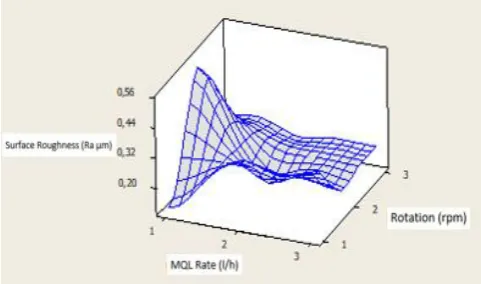
The effects of the parameters used in experimental studies on surface roughness are shown in Figure 3Figure 4Figure 5.
Figure 3 Effects of Rotation and Progress on Surface Roughness
f
f.r2.1000
Figure 4 Effects of Rotation and MQL rate on Surface Roughness
Figure 5 Effects of Progress and MQL rate on Surface Roughness
3.3. Variance Analysis
Nine experiments were performed using three different factors in PMD 23 cold work steel material turning on three different levels, and different Ra response values were measured from each of these experiments. Variance analysis is used to determine whether these differences are fully coincidental or originate from factors and the effect of each factor on this response. As it is seen in Table 7, the most effective factor in the occurrence of roughness on the machined surface as a result of the machining of PMD 23 material with TiAlN coated cutting tools is federate with 73.72%.
Table 7 ANOVA results according to Ra values
Notations Degree of Freedom Total of Squares Variables rate F
Percent Ratio
(%)
A 2 0.01482 0.00741 0.23 16.78
B 2 0.06654 0.03327 1.01 73.72
C 2 0.00835 0.00418 0.13 0.09
Error (e) 2 0.06570 0.03285 9.41
Total 8 0.15541 100
4.
Conclusion
Beneficial results were obtained in this study in which the machineability of PMD 23 cold work steel material with TiAlN coated indexable inserts were investigated. The
criterion under the ideal conditions, were selected at three different levels and applied in the experimental study. The results were summarized below.
In machineability of PMD 23 cold work steel with TiAlN coated cutting tools, the most effective control factor on the value of roughness occurred on the machined surface is feed rate. In the formation of surface roughness, all three control factors (rotation, feed rate, and MQL ratio) were also active. In the result of the experiments, rotation at 1800 rpm, feed rate amount with 100 mm/min, and MQL ratio with 20 l/h gave the best surface quality.
When the effects of the machining parameters on the cutting forces according to the S/N ratio obtained in nine experiments were examined, it is understood that the lowest surface roughness value is obtained when the machining is 100 mm/min, the rotation is 2200 rpm, and the MQL ratio is 40 l/h.
It has been seen that in machinability of PMD 23 cold work steel material experimental design and in ranging of response values in desired ratios by the optimization of parameters, Taguchi optimization technique was an effective technique.
With Variance analysis (ANOVA), it was successfully determined which control factor has how much importance on the formation of the results obtained from the experimental study. Accordingly, the feed rate with 73.72% effect is seen as an effective parameter on the surface roughness.
When the results were evaluated taking the literature into account, it was concluded that TiAlN coatings had a positive effect on the machinability of PMD 23 cold work steel material. Another result of this study is that PMD 23 cold work steel material can be manufactured by milling with MQL with TiAlN coating.
Acknowledgment
This paper has previously been presented in the conference 2nd International Congress on Engineering and Architecture (ENAR-2019) held in Marmaris/ Turkey on date 22-24 April 2019. Experiments were carried out by using the experimental equipment taken within the scope of FEN-E090517-0273 project supported by Marmara University BAPKO.
References
[1] Law KMY, Geddam A, Ostafiev VA. A Process-Design Approach to Error Compensation in the End Milling of Pockets. Journal of Materials Processing Technology (1999) 89-90:238–244. doi:10.1016/S0924-0136(99)00031-X.
[2] Toh CK. A Study of the Effects of Cutter Path Strategies and Orientations in Milling. Journal of Materials Processing Technology (2004) 152(3):346–356. doi:10.1016/j.jmatprotec.2004.04.382. [3] Omirou SL, Nearchou AC. An Epitrochoidal Pocket: A New Canned
Manufacture (2004) 44(12-13):1343–1353. doi:10.1016/j.ijmachtools.2004.04.011.
[5] Hinds BK, Ong TS. End Milling of Circular Pockets to Meet Geometric Tolerances. Journal of Materials Processing Technology (2004) 152(3):339–345. doi:10.1016/j.jmatprotec.2004.04.375. [6] Nurul Amin AKM, Dolah SB, Mahmud MB, Lajis MA. Effects of
Workpiece Preheating on Surface Roughness, Chatter and Tool Performance During End Milling of Hardened Steel D2. Journal of Materials Processing Technology (2008) 201(1-3):466–470. doi:10.1016/j.jmatprotec.2007.11.304.
[7] Brandão LC, Coelho RT, Rodrigues AR. Experimental and Theoretical Study of Workpiece Temperature When End Milling Hardened Steels Using (TiAl)N-coated and PcBN-tipped Tools. Journal of Materials Processing Technology (2008) 199(1-3):234– 244. doi:10.1016/j.jmatprotec.2007.07.049.
[8] Chung-Chen T, Hong H. Comparison of the Tool Life of Tungsten Carbides Coated by Multi-layer TiCN and TiAlCN for End Mills Using the Taguchi Method. Journal of Materials Processing Technology (2002) 123(1):1–4. doi:10.1016/S0924-0136(01)01152-9.
[9] Ghani JA, Choudhury IA, Masjuki HH. Performance of P10 TiN Coated Carbide Tools When End Milling AISI H13 Tool Steel at High Cutting Speed. Journal of Materials Processing Technology (2004) 153-154:1062–1066. doi:10.1016/j.jmatprotec.2004.04.353. [10] Bozdoğan M. CNC Freze Tezgahında Havuz İşlemede Takım Yolu
ve Kesme Parametrelerinin Yüzey Kalitesine Etkilerinin İncelenmesi [Investigation of the Effects of Tool Path and Cutting Parameters on Surface Quality in Pool Processing in CNC Milling Machine]. Master Thesis. Marmara University. İstanbul (2012). [11] Abou-El-Hossein KA, Kadirgama K, Hamdi M, Benyounis KY. Prediction of Cutting Force in End-Milling Operation of Modified AISI P20 Tool Steel. Journal of Materials Processing Technology (2007) 182(1-3):241–247. doi:10.1016/j.jmatprotec.2006.07.037. [12] Coldwell H, Woods R, Paul M, Koshy P, Dewes R, Aspinwall D. Rapid Machining of Hardened AISI H13 and D2 Moulds, Dies and Press Tools. Journal of Materials Processing Technology (2003) 135(2-3):301–311. doi:10.1016/S0924-0136(02)00861-0. [13] Gologlu C, Sakarya N. The Effects of Cutter Path Strategies on
Surface Roughness of Pocket Milling of 1.2738 Steel Based on Taguchi Method. Journal of Materials Processing Technology (2008) 206(1-3):7–15. doi:10.1016/j.jmatprotec.2007.11.300. [14] Ay M, Karagol T. Investigation of the Machinability of the Al 7075
Alloy Using DLC Coated Cutting Tools. Scientific Research and Essays (2011) 6(1):44–51.
[15] Ay M, Turhan A. Determination and Optimization of the Effect of Cutting Parameters and Workpiece Length on the Geometric Tolerances and Surface Roughness in Turning Operation. International Journal of Physical Sciences (2011) 6(5):1074–1084. doi:10.5897/IJPS11.130.
[16] Ay M, Altunpak Y. Optimization of Cutting Parameters and Graphite Rate in Drilling of a Hybrid Aluminium Matrix Composites. The Journal of Engineering and Fundamentals (2015) 2(2):42–50. doi:10.17530/jef.15.17.2.2.
[17] Ay M, Ay İ. The Prediction and Optimization of the Effects of Abrasive Waterjet Cutting Parameters On Kerf. Acta Physica Polonica A (2016) 129(4):762–766.