Available Online at www.ijpret.com
232
INTERNATIONAL JOURNAL OF PURE AND
APPLIED RESEARCH IN ENGINEERING AND
TECHNOLOGY
A PATH FOR HORIZING YOUR INNOVATIVE WORK
DATA HIDING USING STEGONOGRAPHY
MS. P. P. KHOBRAGADE1, DR. H. R. DESHMUKH2, A. S. MAHALLE3, S. A. KARALE4
1. P. G. Student, IBSS College of Engineering, Amravati. 2. Prof. & Head, IBSS College of Engineering, Amravati. 3. Assistant Professor, IBSS College of Engineering, Amravati. 4. M. E. , IBSS College of Engineering, Amravati.
Accepted Date: 27/02/2014 ; Published Date: 01/05/2014
\
Abstract: We consider the problem of detecting whether a compromised router is
manipulating its stream of packets. In particular, we are concerned with a simple yet effective attack in which a router selectively drops packets destined for some victim. Unfortunately, it is quite challenging to attribute a missing packet to an action because normal network congestion can produce the same effect. Modern networks routinely drop packets when the load temporarily exceeds their buffering capacities. Previous detection protocols have tried to address this problem with a user-defined threshold: too many dropped packets simply intent. We are going to design, an application to detect and recover data packet losses.
Keywords: Packet loss, Stegonography, Man in the Middle Attack, LSB
Corresponding Author: MS. P. P. KHOBRAGADE
Access Online On:
www.ijpret.com
How to Cite This Article:
PP Khobragade, IJPRET, 2014; Volume 2 (9): 232-241
Available Online at www.ijpret.com
233 INTRODUCTION
Packet loss is a set of programs to detect packet losses in between two hosts. It does this by sending a continuous stream of packets, and detects any delay or loss in the streams. It is useful to measure the impact of failover tests. Packet loss occurs when one or more packets of data travelling across a computer network fail to reach their destination. Packet loss is distinguished as one of the three main error types encountered in digital communications; the other two being bit error and spurious packets caused due to noise.
Packet loss can be caused by a number of factors including signal degradation over the network medium due to multi-path fading, packet drop because of channel congestion, corrupted packets rejected in-transit, faulty networking hardware, faulty network drivers or normal routing routines . There are two types of attacks:
a) Persistent - attack every connection between two TCP end.
b) Intermittent - attack some of the connections
e.g., 1 of every 5 connections
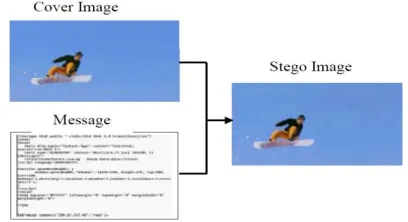
The main intention of our application is to detect data packet losses and to recover it. Packet loss occurs in every kind of network. All network protocols are designed to cope with the loss of packets in one way or another. But when any external attacker attacks on senders data it is difficult to recover it. In this project we are designing such application in which we can detect the corrupted data and original data will reaches to the destination safely by using the concept of stegonography [18]
.
Fig. 1. Producing Stego-Image Process
Available Online at www.ijpret.com
234
From security point of view, stegonography does not allow to detect the presence of hidden secret other than indeed user, over the communication channel[5].
The proposed method should provide better security while transferring the data or messages from one end to the other end. The main objective of the project is to hide the message or a secret data into an image which acts as a carrier file having secret data and to transmit to the destination securely without any modification. If any distortions occur in the image or on its resolution while inserting the secret message into the image, there may be a chance for an unauthorized person to modify the data. So, the data encryption into an image and decryption and stegonography plays an important role in this project.
I. RELATED WORK
Packet loss occurs in every kind of network. All network protocols are designed to cope with the loss of packets in one way or another. TCP protocol, for example, guarantees packet delivery by sending re-delivery requests for the lost packets. RTP employed by the VoIP protocol does not provide delivery guarantee, and VoIP must implement the handling of lost packet. But when any external attacker attacks on senders data it is difficult to recover it. Whenever sender want to send his data to the receiver due to some reason data is not properly reaches to its destination. There are mainly two reasons which are responsible for improper sending of data packets.
The field of packet loss detection and network security has been around since late 1980s. Since then, a number of methods and frameworks have been proposed and many systems have been built to detect packet loss. Various techniques such as association rules, clustering, naive Bayes classifier, support vector machines, genetic algorithms, artificial neural networks, and others have been applied to detect attacks.
II. EXTERNAL ATTACKS
Available Online at www.ijpret.com
235
those induced by errors in the wireless link have distinguishable enough statistics, a binary Bayes detector can effectively be used to infer the nature of a packet loss in TCP.
III. ATTACKER CAPABILITIES
The following attacker capabilities define the potential attack scenarios that can be launched from the compromised routers:
The attacker can selectively drop legitimate network traffic, which introduces malicious packet loss behavior by exploiting the congestion control mechanism.
The attacker can send arbitrary network traffic (data and control packets) from the compromised router[15]. The attacker can modify the data packet to introduce anomalous forwarding and routing behavior.
The attacker can physically tamper or remotely access the router to extract secure information from the device.
IV. IMPACTS OF PACKET DROPPING
a) Delay: When we transfer the packet from source to destination, due to congestion or external attacks time delay is occur.
b) Response time: Due to packet dropping response time decreases.
c) Quality: As the time of transmission increases and response time decreases, quality of service reduces.
V. EXISTING SYSTEM
Available Online at www.ijpret.com
236
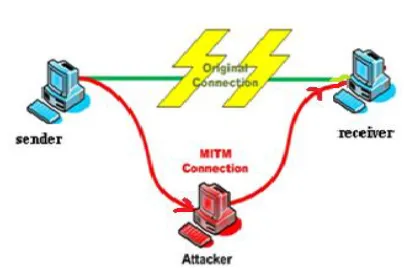
Fig. 3. Attacker Between Connection
In a Man-in-the-Middle attack, an attacker inserts himself between two network nodes. For example, in a successful attack, if Bob sends a packet to Alice, the packet passes through the attacker Eve first and Eve decides to forward it to Alice with or without any modifications; when Alice receives the packet, she thinks it comes from Bob[12]. The attack is bidirectional, so the same scenario applies when Alice sends a packet to Bob. Initially developed to attack public key encryption systems, this attack has expanded to include any form of eavesdropping in which the attacker acts as a proxy and controls the packets exchanged by the two target nodes.
Packet loss occurs when one or more packets of data travelling across a computer network fail to reach their destination. Packet loss is distinguished as one of the three main error types encountered in digital communications; the other two being bit error and spurious packets caused due to noise. When any data is transmitted from sender to receiver, if any packet drop or congestion is occur then receiver receives incorrect data but sender and receiver both are unaware about that[13]t. Packet loss can be caused by a number of factors including signal degradation over the network medium due to multi-path fading, packet drop because of channel congestion, corrupted packets rejected in-transit, faulty networking hardware, faulty network drivers or normal routing routines.
Available Online at www.ijpret.com
237
in throughput is due to the sliding window protocols used for acknowledgment of received packets. In certain variants of TCP, if a transmitted packet is lost, it will be re-sent along with every packet that had been sent after it. This retransmission causes the overall throughput of the connection to drop. Protocols such as UDP provide no recovery for lost packets. Applications that use UDP are expected to define their own mechanisms for handling packet loss.
VI. DISADVANTAGES OF EXISTING SYSTEM
Low packet loss rates usually produce same perception as high delays. However packet loss turns into a bigger issue with video applications such as streaming and videoconferencing. Large delays cause frustration to web users. On business-to-consumer applications this directly affects the actual sales rates.
It severely impacts the perceived quality of voice communication and leads users to shorten voice calls. Finally it results in very noticeable performance problems with gaming applications.
VII. PROPOSED SYSTEM
We are going to design an application for detecting packet losses which inform sender that sent data is corrupted. In this case, the users cannot access their applications anymore until a manual action is executed on the equipments to restore the function of the network. But in our application we can easily detect the packet loss. In proposed system we use stegonography concept based on LSB (Least Significant Bit )algorithm for sending data towards the receiver. we can retransmit the same packet towards the receiver if this stegonography technique fails.
As soon as attacker attacks on data immediately sender and receiver knew about the attack. Due to the reduction of time delay quality of service also increases. We can transmit original data to the receiver safely.
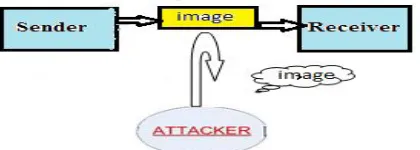
Fig 4 : Securely transmission of data
Available Online at www.ijpret.com
238
Fig 5: Block diagram for Stegonography
The procedure for data hiding using stegonography algorithm is as follows:
1) The sender first uses the stegonography algorithm for encrypting the secret message. 2) For this encryption, the sender uses any text documents or audio or video files in which the
data is written and the image file as a carrier file in which the secret message or text document or audio or video file to be hidden.
3) The sender sends the carrier file and text document or audio or video file to the encryption phase for data embedding, in which the text document or audio or video file is embedded into the image file.
Available Online at www.ijpret.com
239
or video file using the least significant bit decoding and decrypts the original message. As mentioned in the above block diagram, the data hiding and the data extracting will be done in three phases[19].
1) Encryption Phase: The “Encryption phase” uses two types of files for encryption purpose. One is the secret file which is to be transmitted securely, and the other is a carrier file such as image. In the encryption phase the data is embedded into the image using “Least Significant Bit algorithm” (LSB) by which the least significant bits of the secret document are arranged with the bits of carrier file such as image, Such that the message bits will merge with the bits of carrier file. In this procedure LSB algorithm helps for securing the originality of image.
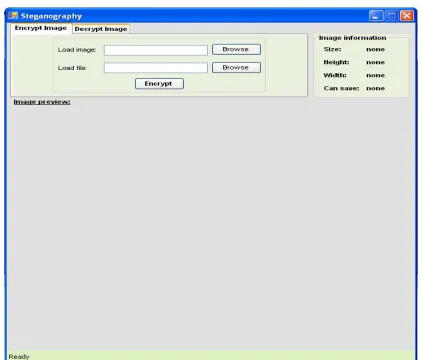
Fig 6: Encryption phase
2) Transmission Phase: The transmission phase is one of the important sections for sending the data to destination securely.
3) Decryption Phase: The Decryption phase is reverse to encryption phase. In decryption phase, the carrier image in which the data is hidden is given as an input file. The decryption phase uses the same password which was given for the encryption and decryption in order to secure from unauthorized access. After giving the correct password the decryption section uses the “Least Significant bit Algorithm” (LSB) by which the encoded bits in the image is decoded and turns to its original state and gives the output as a text document or audio or video file as well as image.
Fig 7: Decryption Phase
Available Online at www.ijpret.com
240
1. Enables secret communication
2. Complements regular encryption: Harder to break: need to first find the encrypted secret text then it needs to be decrypted
3. Tremendous use in Military Applications
REFERENCES
1. Kurose, J. F. & Ross, K. W. (2010). Computer Networking: A Top-Down Approach. New York:
Addison-Wesley. P 30.
2. Perkins, C. E. (2001). Ad-Hoc Networking. Boston: Addison-Wesley. P 147.
3. Overview of Attack Trends, http://www.cert.org/archive/pdf/attack_trends.pdf, 2002.
4. "Packet loss or latency at intermediate hops." (HTTP). Retrieved 2007-02-25.
5. A. Tacticus, How to survive under siege / Aineias the Tactician, pp. 84{90, 183{193.
Clarendon ancient history series, Oxford, England: Clarendon Press, 1990, ISBN
0-19-814744-9,translated with introduction and commentary by David Whitehead.
6. Mansfield, K. C. & Antonakos, J. L. (2010).Computer Networking from LANs to WANs:
Hardware, Software, and Security. Boston: Course Technology, Cengage Learning. P501.
7. Kurose, J. F. & Ross, K. W. (2010). Computer Networking: A Top-Down Approach. New York:
Addison-Wesley. P 282-283
8. Kurose, J. F. & Ross, K. W. (2010). Computer Networking: A Top-Down Approach. New York:
Addison-Wesley. P 30.
9. Kurose, J. F. & Ross, K. W. (2010). Computer Networking: A Top-Down Approach. New York:
Addison-Wesley. P 282-283
Available Online at www.ijpret.com
241
11.J. Padhye, V. Firoiu, and D. Towsley, “A stochastic model of tcp reno congestion avoidance
and control,” U. Massachusetts Amherst Dept. of Computer Science, Tech. Rep., 1999.
12.L. S. Brakmo, S. W. O’Malley, and L. L. Peterson, “Tcp vegas: new techniques for congestion
detection and avoidance,” in Proceedings of the conference on Communications architectures,
protocols and applications. ACM Press, 1994, pp. 24–35.
13.J. Liu, I. Matta, and M. Crovella, “End-to-end inference of loss nature in a hybrid
wired/wireless environment,” in Proceedings of WiOpt’03: Modeling and Optimization in
Mobile, Ad Hoc and Wireless Networks, 2003.
14.D. Barman and I. Matta, “Effectiveness of loss labeling in improving tcp performance in