-
Available Online at www.ijpret.com
608
INTERNATIONAL JOURNAL OF PURE AND
APPLIED RESEARCH IN ENGINEERING AND
TECHNOLOGY
A PATH FOR HORIZING YOUR INNOVATIVE WORK
DESIGN OF COMPLEX FUZZY LOGIC ARITHMETIC UNIT FOR FLOATING NUMBER
LOKESH TOPLE, A. B. BAVASKAR
Department of electronics, Priyadarshini college of Engg., Nagpur, Maharashtra
Accepted Date: 27/02/2014 ; Published Date: 01/05/2014
p
\
Abstract: This paper introduces several algorithms and compares the computational complexity first. Second, we introduce two FFT (Fast Fourier Transform) architectures and it includes of pipelined based architecture and memory based architecture. Because we cost a lot of area size in multiplication, we reduce the multiplication in each stage. And then we use the CORDIC (Coordinate Rotation Digital Computer) operator to reduce the computation of twiddle factor.
Keywords:Fatigue detection, Soft computing techniques, Fuzzy Logic.
Corresponding Author: MR. LOKESH TOPLE
Access Online On:
www.ijpret.com
How to Cite This Article:
Lokesh Tople, IJPRET, 2014; Volume 2 (9): 608-614
-
Available Online at www.ijpret.com
609
INTRODUCTION
FPGAs (Field Programmable Gate Arrays) are among the most popular types of ASICs. In SRAM-based FP-GAs, which are the focus of this paper, any k-input Boolean function is implemented by using 2k bits of look-up table.
The majority of technology mapping methods are de-signed to map a Boolean network into the
XILINX XC3000 FPGA circuit structure, where each CLB has 25 bits of SRAM LUT capable of
implementing Boolean expressions with up to inputs. As the FPGAs has become more popular, the FPGA architecture has evolved. In the new SRAM-based FPGA architectures, such as XILINX AT&T's ORCA [5], a configuration of a single CLB becomes more difficult to use.
For example, some substantial limitations are imposed on the mapping procedure for XILINX XC4000 FPGAs. Two of three inputs to the upper-level look-up table (H-LUT) should be outputs of the lower-level look-up table. The second important restriction is that only two outputs are allowed in one CLB, either directly or via ip ops. Restrictions mentioned above limit direct applicability and efficiency of the many previously developed algorithms to this new architecture.
In this paper the MOFL (Multi-criteria Optimization using Fuzzy Logic) technology mapping algorithm for complex CLB structures, particularly for the XILINX XC4000 family of FPGAs, is introduced. The input to the MOFL technology mapping procedure is a DAG of Boolean expressions. Prior to the technology mapping, the SIS logic optimizer is applied to logic input.
The proposed algorithm utilizes memory resources of CLBs in order to obtain better timing performance with-out sacricing area.
Most of the known mapping algorithms [4], [3], are based on decomposition of the input network, presented usually in a graph form, into a set of fan-out-free trees or a set of small pieces of graphs. When the network is de-composed into a set of trees, a technology mapper loses the exibility of mapping over the boundaries of trees. The proposed technology mapper does not decompose the DAG network into trees but directly uses the graph as a source structure for the technology mapping algorithm to retain exibility in optimizing delays.
-
Available Online at www.ijpret.com
610
comparisons were undertaken between theco-processors and equivalent sequential floating implementations
II. Background of fuzzy logic
A classical (crisp) set is normally de need as a collection of elements or objects. For a given set A X, each element x 2 X either belongs to the set or does not belong to the set, where X is a set
But fuzzy sets are different from classical sets in that they allow partial or gradual degrees of membership. A
fuzzy set A over X is de need as a set of ordered pairs:
= f(x; ~(x)) j x 2 Xg; A
A
where A~(x) is a membership function which associates with every member x of X a number in the interval [0,1], representing the degree of membership of x in A.
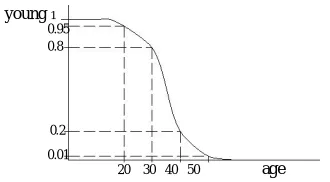
To represent fuzzy sets, linguistic variables are generally used [8]. The values of linguistic variables are not numbers but words or sentences in a natural or artificial language. For example \age" is a linguistic variable whose values can be \young", \old", \very old" and so on. Fig. 2 represents an example of membership function \young" de need graphically for the linguistic variable \age".
Fuzzy decisions are made using plain language rules describing relations between linguistic variables and there values de need by membership functions. Rules are stated in a simple IF/THEN format and input values can be combined using and or or operations. Min and max are most commonly used functions for fuzzy intersection (and) and union (or) operators, but other functions were also proposed [15] for more sophisticated applications. (See Sec. III.A)
III. Multi-criteria Optimization Using Fuzzy
-
Available Online at www.ijpret.com
611
The multi-criteria optimization problem can be presented as selection of x 2 X which optimizes the decision.
C1 C2 C3 C4
Inputs
Selector Outputs
G4
G State
G3 Lookup
S
G2 D Q Q2
Table
G1
E R
H H-G_in
Look-H-F_in up G
Table
State
F4
F
F3 Lookup S
F2 D Q Q1
Table
F1
E R
Vcc
Clock F
Fig. 1. The architecture of XC4000 FPGA CLB
young 1
0.95 0.8
0.2 0.01
20 30 40 50 age
Fig. 2. Membership function \young" for the linguistic variable \age" function D(x)
D(x) = f(C1 (x); C2(x); ; Cn(x))
where X is a solution space and Ci's are criteria de need over the set X.
In the proposed MOFL system, the multi-criteria optimization procedures are used for selection of nodes to be mapped into each CLB. The decision function D(x) is implemented by a multilevel function of fuzzy logic operators de need by fuzzy rules. Fuzzy logic model is selected because classical models are poorly suited for a solution with multiple criteria and varying degrees of importance of different objectives during design process.
In the following subsections, fuzzy logic operators used in this work and the methodology of balancing multiple criteria of varying importance are described in detail.
A. Application
-
Available Online at www.ijpret.com
612
rules, which include combinations of and or operators. Such representation allows to re ect complex interactions between goals in decision-making.
In many fuzzy logic applications, min and max operators have been used as fuzzy intersection (and) and union (or). But min and max are not the only possible operators to model intersection and union. The operators in fuzzy logic are divided into two categories: compensatory operators and non-compensatory operator
Fuzzy logic decision making procedure
Example of Hierarchical FZDM: Fig. 8 illustrates a hierarchical FZDM. In this and other FZDM’s described below, each block represents a linguistic value and is implemented as an OOP object. Depending on the context, a linguistic value can be either an objective or a criterion that is used to define an objective. For example, linguistic value 5 can be the objective good placement, linguistic value y can be the criterion strong connectivity to partial placement and linguistic value z can be the criterion almost within a feasible interval. Fuzzy logic.
Practicle Aspects
The proposed MOFL technology mapper was implemented with approximately 7000 lines of C code. In order to demonstrate performance of the mapper, 25 benchmark circuits were selected from the set of MCNC test cases. All test cases were chosen from the combinational multi-level examples.
XILINX's FPGA development system, called XACT, includes various subsystems such as FPGA design edi-tor, technology mapper, placement and routing system, timing analyzer and others. Among them, the Partition, Placement, and Route (PPR) program performs technology mapping and layout for the XILINX XC4000 series FPGAs. It was observed that the updated version of the XILINX mapper emphasised routability and timing performance rather than area. It does not pack CLBs as tightly as possible to improve routability and timing.
-
Available Online at www.ijpret.com
613
CONCLUSION
This paper presents characterization, justification, classification of fuzzy logic-based CAD tools for digital design. It is demonstrated that application of fuzzy logic is beneficial on all hierarchical levels of the design process. It allows to merge traditional numeric techniques with the domain information available in the linguistic form and, as a result, to improve quality of design solutions. Fuzzy logic structures are shown to be used in constructive and iterative procedures. Short descriptions of several tools are accompanied by the experimental data and comparison of design solutions is obtained by different tools for popular benchmark.
REFERENCES
1. Xilinx Programmable Logic Data Book, Xilinx Inc., San Jose 1994.
2. R. J. Francis, J. Rose, and Z. Vranesic, \Technology map-ping for lookup table-based FPGAs for
performance," Proc. ICCAD'91, pp. 568-571, Nov. 1991.
3. R. J. Francis, J. Rose, and Z. Vranesic, \Chortle-crf: Fast technology mapping for lookup
table-based FPGAs," Proc. 28th ACM/IEEE DAC, pp. 613-619, 1991.
4. D. Hill, B. Britton, B. Oswald, N.-S. Woo, S. Singh, T. Poon, B. Krambeck, \A new architecture
for high-performance FPGAs," Int. Workshop on FPGA, Sep. 1992.
5. N.-S. Woo, \A heuristic method for FPGA technology mapping based on the edge visibility,"
Proc. 28th ACM/IEEE Design Automation Conference, pp. 248-251, 1991.
6. R. Murgai, N. Shenoy, R. K. Brayton, and A. Sangiovanni-Vincentelli, \Improved logic synthesis
algorithms for table look up architectures," Proc. ICCAD'91, pp. 564-567, Nov. 1991.
7. L. A. Zadeh, \Fuzzy sets," Information and Control 8, pp. 338-353, 1965.
8. J. Cong and Y. Ding \On area/depth trade-o in LUT-based FPGA technology mapping," Proc.
DAC, pp. 213-218, Jun. 1993.
9. H. J. Zimmermann, \ Fuzzy set theory and its applications," 2nd ed. Kluwer Academic
Publishers, 1991.
10.XACT Reference Guide , Xilinx Inc., San Jose 1994.
11.R. Lin and E. Shragowitz, \Fuzzy logic approach to placement problem," Proc. 29th
-
Available Online at www.ijpret.com
614
12.E. Kang, R. Lin and E. Shragowitz, \Fuzzy logic approach to VLSI placement," IEEE Trans. VLSI
Systems, vol. 2 , pp. 489-501 , Dec. 1994.
13.J.-Y. Lee and E. Shragowitz, \Performance driven technology mapper for FPGAs with
complex logic block structures," Proc. IEEE International Symposium on Circuits and Systems, vol. 2 pp. 1219-1222, Apr. 1995.
14.D. Dubois and H. Prade, New results about properties and semantics of fuzzy set-theoretic