M. V. S. K. Jahnavi*
Email: [email protected]
Address for correspondence
BALANCED DIET
INTRODUCTION:
India being a sub tropical country with varied food habits, it is very important to have a balanced diet for all groups of people. Hence it is highly important to consider balanced diet as a part and parcel of every one’s life. Here we discuss importance of diet consequences of not having it and the sample menu plan for different age groups.
Food:
It is anything eaten or drunk which meets the needs of energy, building, regulation and protection of body.(1)
Balanced diet:
Balanced diet is the one which consists of all required nutrients in adequate amounts for proper maintenance and regulation of body. (2) Importance of balanced diet:
A balanced diet should be composed of macronutrients like proteins, carbohydrates and fats and micronutrients like vitamins and minerals and water which collectively helps to maintain and regulate the body functions. It is
responsible for proper maintenance of immune system and helps to maintain good health.(3)
Carbohydrates-These play an important role in
providing energy needed by our body.(1)
Proteins-These help in building of new tissues, maintenance and repair of the body.(1)
Fats-These are concentrated sources of energy,
carriers of fat soluble vitamins.(1)
Vitamins-These help in maintaining normal
growth, functions of the body and normal body processes.(1)
Minerals-These are used for building of bones,
teeth, formation of structural parts of body tissues and helps in body building.(1)
Hydration: Water is an important component
of balanced diet, it helps in regulating temperature, transport and absorption of nutrients and elimination of waste products.(1) Consequences of not having a balanced diet: Lack of a proper balanced diet in children, adult men, women and geriatrics lead to malnutrition and are prone to several health problems.
VITAMINS:
Vitamins are regarded as organic compounds required in small amounts to perform specific biological function for normal maintenance, optimum growth and health of people.(4)
The expression balanced diet and the ways intended to attain a well balanced diet has been discussed in this article. To the humans the prevailing theory of balanced diet has postulated that the requirement for successful growth, mental development has been met when supply of proteins, vitamins, carbohydrates, fats etc are adequate. A properly planned menu plan daily with all the nutrients in adequate amounts helps in maintaining good health and fitness. So in the present article balanced diet, the importance of having a balanced diet and dietary charts for different age groups like men women and children has been provided. While considering diet we have to be conscious of some foods like caffeine and alcohol which are discussed here in order to maintain good health. These foods in large amounts cause serious health effects which lead to several socio-economic problems and even to death. So the ways and means to maintain a well balanced diet has been discussed here to live a long healthy life.
Key words:Balanced diet, vitamins, proteins, carbohydrates, minerals, fats. ABSTRACT
M.V.S.K.Jahnavi*, A.K.M.Pawar
Department of Pharmaceutical analysis & Quality Assurance, Andhra University college of Pharmaceutical Sciences, Andhra
University, Visakhapatnam-530003, Andhra Pradesh, India
Journal of Global Trends in Pharmaceutical Sciences
Available online at www.JGTPS.com
ISSN: 2230-7346 Journal of Global Trends in Pharmaceutical Sciences
Classification:
1) Water soluble vitamins: (4)
a) B-Complex (B1, B2, Niacin, B6, Biotin,
Pantothenic acid, Folic acid, B12) (4)
b) Ascorbic acid(4)
2) Fat soluble vitamins(4) a) Vitamin A(4)
b) Vitamin B(4) c) Vitamin E(4) d) Vitamin K(4)
Vitamin A(4)
Vitamin A contain vitamers such as retinol, retinal and retinoic acid.
Sources:
Liver, kidney, egg yolk, milk, yellow and dark green vegetables like spinach, carrots, pumpkin and sweet potatoes.(4)
Functions: (4)
Vitamin A is essential to maintain healthy epithelial tissue of the body.
Retinol and retinoic acid involved in synthesis of transferrin which play an important role in heme synthesis.
Vitamin A is essential for maintenance of immune system.
Cholesterol synthesis requires vitamin A.
Table 1:Recommended dietary allowance of
vitamin A per day. (9)
Gender Age range (years) Diet allowance per day (in µg)
Children 4-8 400
Men 9-13 600
Men 14-50yrs and above 900
Women 9-13 600
Women 14-50yrs and above 700
Pregnancy 14 – 18 750
Pregnancy 19 – 50 770
Lactation 14 – 18 1200
Lactation 19 – 50 1300
Deficiency of Vitamin A leads to: (4)
Nightblindness,,Xeropthalmia,Keratomalaciaret ardation of growth and reproductive system is adversely affected.
Vitamin D: (4) Sources: (4)
Fatty fish, fish liver oils, milk, eggs, fats and oils, mushrooms, confectioneries and exposure of skin to sunlight for synthesis of vitamin D. Functions: (4)
Calcitriol is biologically active form of vitamin D. It regulates the plasma levels of calcium and phosphate.
Calcitriol increases intestinal absorption of calcium and phosphate.
Calcitriol binds with cystolic receptor to form calcitriol-receptor complex.
This complex interacts with specific DNA leading to the synthesis of a specific calcium binding protein, this increases calcium uptake by intestine.
It is involved in regulation of specific genes.
It acts as an antioxidant. Action of calcitriol on bone: (4)
Calcitriol stimulates calcium uptake for deposition as calcium phosphate. Thus calcitriol is essential for bone formation.
Action of calcitriol on kidney: (4)
Calcitriol is involved in minimizing the excretion of calcium and phosphate through the kidney, by decreasing their excretion and enhancing reabsorption.
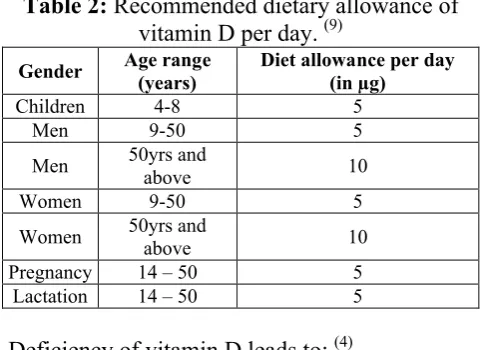
Table 2:Recommended dietary allowance of
vitamin D per day. (9)
Gender Age range (years) Diet allowance per day (in µg)
Children 4-8 5
Men 9-50 5
Men 50yrs and above 10
Women 9-50 5
Women 50yrs and above 10
Pregnancy 14 – 50 5
Lactation 14 – 50 5
Deficiency of vitamin D leads to: (4)
Rickets in children are characterized by bone deformities which result in bow-leg and osteomalacia, osteoporosis in adults.
Occurs in strict vegetarians, chronic alcoholics and those with liver and kidney diseases.
Vitamin E: (4)
It is naturally occurring anti-oxidant and so called anti- sterility vitamin.
Sources: (4)
Functions: (4)
Vitamin E is essential for maintaining cell membrane structure and integrity.
It prevents the peroxidation of polyunsaturated fatty acids in various tissues and cell membranes.
It is associated with reproductive functions and prevents sterility.
Increases synthesis of heme by enhancing activity of enzymes.
Required for cellular respiration.
Prevents oxidation.
Table 3:Recommended dietary allowance of
vitamin E per day.(9)
Gender Age range (years) Diet allowance per day (in mg)
Children 4-8 7
Men 9-13 11
Men 14-50yrs and above 15
Women 9-13 11
Women 14-50yrs and above 15
Pregnancy 14 – 50 15
Lactation 14 – 50 19
Deficiency of vitamin E leads to:
Sterility, degenerative changes in muscle, megaloblastic anemia and increased fragility of erythrocytes.
Vitamin K: (4)
Vitamin K helps in blood clotting. Sources: (4)
Cabbage, cauliflower, tomatoes, spinach and other green vegetables, egg yolk, meat, liver, cheese and dairy products.
Functions: (4)
Involved in blood clotting.
Post translational modifications of certain blood clotting factors.
Table 4:Recommended dietary allowance of
vitamin K per day. (9)
Gender Age range (years) Diet allowance per day (in µg)
Children 4-8 55
Men 9-13 60
Men 14-18 75
Men 19 – 50yrs and above 120
Women 9-13 60
Women 14-18 75
Women 19 – 50yrs and above 90
Pregnancy and
Lactation 14 – 18 75
Pregnancy and
Lactation 19 – 50 90
Deficiency of vitamin K leads to: (4)
Deficiency of vitamin K leads to lack of active prothrombin, due to which blood coagulation is adversely effected.
Vitamin K deficiency occurs due to faulty absorption.
Ascorbic acid: (4)
Vitamin C is water soluble. Sources:(4)
Citrus fruits, gooseberry, guava, green leafy vegetables, tomatoes and milk.
Functions: (4)
Ascorbic acid aids in - Collagen formation
- Iron and hemoglobin metabolism - Tryptophan metabolism
- Folic acid metabolism
- Synthesis of corticosteroid hormones - Synthesis of immunoglobulins
-Table 5:Recommended dietary allowance of
vitamin C per day.(9)
Gender Age range (years) Diet allowance per day (in mg)
Children 4-8 25
Men 9-13 45
Men 14-18 75
Men 19 – 50yrs and above 90
Women 9-13 45
Women 14-18 65
Women 19 – 50yrs and above 75
Pregnancy 14 – 18 80
Pregnancy 19 -50 85
Lactation 14 – 18 115
Lactation 19 -50 120
Deficiency of vitamin C leads to: (4)
Loose teeth, anemia, sore gums, scurvy, swollen joints, fragile blood vessels and delayed wound healing.
Thiamine(4) (Vitamin B1, Anti- beri-beri
vitamin ): Sources: (4)
Cereals, pulses, oilseeds, yeasts, pork, liver, heart, kidney and milk.
Functions: (4)
pyruvate to acetylCoA is dependent on TPP(Thiamine pyrophosphate).
- Enzyme transketolase is dependent on TPP. - It plays an important role in transmission of
nerve impulse.
Table 6: Recommended dietary allowance of
vitamin B1per day.(9)
Gender Age range (years) Diet allowance per day (in mg)
Children 4-8 0.6
Men 9-13 0.9
Men 14-18 1.2
Men 19 – 50yrs and above 1.2
Women 9-13 0.9
Women 14-18 1
Women 19 – 50yrs and above 1.1
Pregnancy 14 – 50 1.4
Lactation 14 – 50 1.4
Deficiency of vitamin B1 leads to: (4)
- Beri-beri, loss of appetite, weakness, constipation and nausea.
- Carbohydrate metabolism is impaired. - Impairment of nerve impulse.
- Wet-beri-beri causes edema of legs, face, trunk and raise in systolic blood pressure. - Dry- beri-beri causes neurological
manifestations which results in peripheral neuritis.
- Infantile- beri-beri causes restlessness and vomiting.
Riboflavin (Vitamin B2): (4)
Riboflavin takes part in cellular oxidation and reduction reactions.
Sources: (4)
Milk, milk products, meat, eggs, liver, kidney, cereals, fruits, vegetables and fish.
Functions: (4)
They participate in redox reactions, the coenzymes of riboflavin are involved in carbohydrate, lipid, protein and purine metabolism.
Table 7: Recommended dietary allowance of
vitamin B2 per day.(9)
Gender Age range (years) Diet allowance per day (in mg)
Children 4-8 0.6
Men 9-13 0.9
Men 14-18 1.3
Men 19 – 50yrs and above 1.3
Women 9-13 0.9
Women 14-18 1
Women 19 – 50yrs and above 1.1
Pregnancy 14 – 50 1.4
Lactation 14 – 50 1.4
Deficiency of vitamin B2 leads to: (4)
Cheilosis, Glossitis and Dermatitis. Niacin: (4)
Niacin is known as pellagra preventive vitamin. Sources: (4)
Yeast, liver, whole grains, pulses, cereals, beans, peanuts, milk, fish, eggs and vegetables. Functions: (4)
These are involved in oxidation-reduction reactions.
Table 8:Recommended dietary allowance of
niacin per day. (9)
Gender Age range (years) Diet allowance per day (in mg)
Children 4-8 8
Men 9-13 12
Men 14-50yrs and above 16
Women 9-13 12
Women 14-50yrs and above 14
Pregnancy 14 – 50 18
Lactation 14 – 50 17
Deficiency of niacin leads to: (4)
- Pellagra, it involves skin, gastrointestinal tract and central nervous system disorders. - The symptoms of pellagra are commonly
referred to as three D’s it also progresses in that order Dermatitis, Diarrhoea and Dementia.
Pyridoxine (Vitamin B6): (4)
It is used to collectively represent three compounds like Pyridoxine, Pyridoxal and Pyridoxamine.
Sources: (4)
Egg yolk, fish, milk, corn, cabbage, roots and tubers.
Functions: (4)
Pyridoxal phosphate (PLP), the co-enzyme of vitamin B6 plays an important role in
- Transamination - Decarboxylation
- Synthesis of catecholamines
Table 9: Recommended dietary allowance of pyridoxine per day. (9)
Gender Age range (years) Diet allowance per day (in mg)
Children 4-8 0.6
Men 9-13 1
Men 14-18 1.3
Men 19-50 1.3
Men 50 years and above 1.7
Women 9-13 1
Women 14-18 1.2
Women 19-50 1.3
Women 50 years and above 1.5 Pregnancy 19 – 50yrs and above 1.9
Lactation 19 – 50yrs and above 2.0
Deficiency of pyridoxine leads to: (4)
Neurological symptoms like depression, irritability, nervousness, mental confusion, convulsions and peripheral neuropathy.
Biotin: (11)
Biotin (anti-egg white injury factor) Sources: (4)
Animal and plant foods, the rich sources are liver, kidney, egg yolk, milk, tomatoes and grains.
Functions: (4)
- It plays an important role in gluconeogenesis(which takes place in liver and involves the conversion of non-carbohydrates to glucose).
- citric acid cycle(which takes part in mitochondrial matrix which involves oxidation of carbohydrates, fats and amino acids).
- It has a prominent role in Fatty acid synthesis.
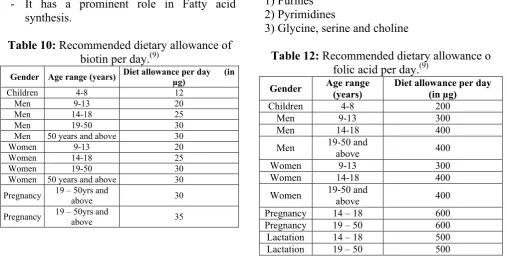
Table 10:Recommended dietary allowance of
biotin per day.(9)
Gender Age range (years) Diet allowance per day (in µg)
Children 4-8 12
Men 9-13 20
Men 14-18 25
Men 19-50 30
Men 50 years and above 30
Women 9-13 20
Women 14-18 25
Women 19-50 30
Women 50 years and above 30 Pregnancy 19 – 50yrs and above 30
Pregnancy 19 – 50yrs and above 35
Deficiency of biotin leads to: (4)
Anemia, loss of appetite, nausea, dermatitis and glossitis.
Pantothenic Acid: (4)
It is chik-anti-dermatitis factor. Sources: (4)
Egg, liver, meat, yeast and milk. Functions: (4)
It is a coenzyme of metabolic integration, it is a component of fatty acid synthase complex.
Table 11: Recommended dietary allowance of
Pantothenic acid per day. (9)
Gender Age range (years) Diet allowance per day (in mg)
Children 4-8 3
Men 9-13 4
Men 14-50 and above 5
Women 9-13 4
Women 14-50 and above 5
Pregnancy 14 – 50 6
Lactation 14 – 50 7
Deficiency of Pantothenic acid leads to: (4) Burning feet syndrome, anemia, fatty liver and decreased fatty acid synthesis.
Folic acid: (4) Sources: (4)
Green leafy vegetables, whole grains, cereals, liver, kidney, yeast and eggs.
Functions: (4)
The following compounds are synthesized with the help of folic acid
1) Purines 2) Pyrimidines
3) Glycine, serine and choline
Table 12: Recommended dietary allowance o
folic acid per day.(9)
Gender Age range (years) Diet allowance per day (in µg)
Children 4-8 200
Men 9-13 300
Men 14-18 400
Men 19-50 and above 400
Women 9-13 300
Women 14-18 400
Women 19-50 and above 400
Pregnancy 14 – 18 600
Pregnancy 19 – 50 600
Lactation 14 – 18 500
Deficiency of folic acid leads to: (4)
- Due to inadequate dietary intake, defective absorption, use of anticonvulsant drugs. - Decreased production of purines is
observed which impairs DNA synthesis. - Decreased maturation of erythrocytes
leading to macrocytic anemia.
- Deficiency in pregnant women may cause neural defects.
Cyanocobalamine (Vitamin B12): (4)
Vitamin B12 is also known anti-pernicious anemia vitamin.
Sources: (4)
Liver, kidney, milk, curd, eggs, fish, pork and chicken and Curd, it is better source than milk. Functions: (4)
It helps in the synthesis of Homocysteine →
Methionine.
It involves the isomerization of methylmalonyl CoA →Succinyl CoA.
Table 13:Recommended dietary allowance of
vitamin B12per day.(9)
Gender Age range (years) Diet allowance per day (in µg)
Children 4-8 1.2
Men 9-13 1.8
Men 14-18 2.4
Men 19-50 and above 2.4
Women 9-13 1.8
Women 14-18 2.4
Women 19-50 and above 2.4
Pregnancy 14 – 50 2.6
Lactation 14 – 50 2.8
Deficiency of vitamin B12leads to: (4)
- Pernicious anemia, decreased number of erythrocytes and neurological manifestations.
- Deficiency associated with neuronal degeneration and demyelination of nervous system.
Balanced diet for infants, men, women and geriatrics:
- Balanced diet is different for children, men, women and geriatrics, this is because of altered physiology in all these groups. Infants system is less developed when compared with adults and geriatrics.
- Women and men also have difference due to difference in physiology.
- Geriatrics also have an altered physiology due to age effect.
Balanced diet for Children (2)
Children in this age socialize and try to adapt as per his environment and develops new flavors as the mental development is continuously increasing, in this age lots of varieties of foods can be included to gain energy and to have sound health.
The following dietary chart and menu plan can be adopted in order to maintain a proper balanced diet for children .
Table 14:Dietary chart for children.
Pre-school children School Children
1-3 yrs 4-6 yrs 7-9 yrs 10-12 yrs
Veg (g) Non-veg (g) Veg (g) Non-veg (g) Veg (g) Non-veg (g) Veg (g) Non-veg (g)
Cereals 150 150 200 200 250 250 320 320
Pulses 50 40 60 50 70 60 70 60
Green leafy veg. 50 50 75 75 75 75 100 100
Other vegetables Roots and tubers 30 30 50 50 50 50 75 75
Fruits 50 50 50 50 50 50 50 50
Milk 300 200 250 2000 250 200 250 200
Fats & oils 20 20 25 25 30 30 35 35
Meat & fish - 30 - 30 - 30 - 30
Egg - 30 - 30 - 30 - 30
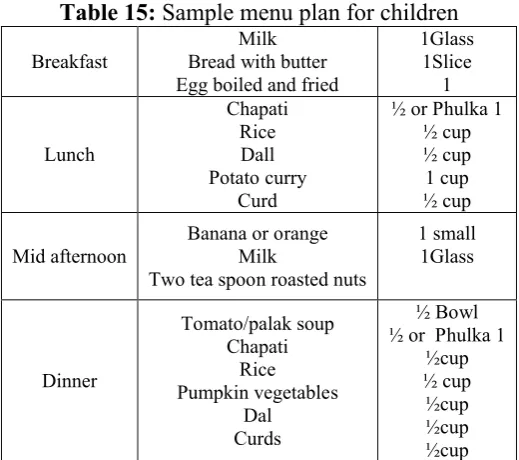
Table 15: Sample menu plan for children
Breakfast Bread with butterMilk Egg boiled and fried
1Glass 1Slice
1
Lunch
Chapati Rice Dall Potato curry
Curd
½ or Phulka 1 ½ cup ½ cup 1 cup ½ cup
Mid afternoon Banana or orangeMilk Two tea spoon roasted nuts
1 small 1Glass
Dinner
Tomato/palak soup Chapati
Rice Pumpkin vegetables
Dal Curds
½ Bowl ½ or Phulka 1
½cup ½ cup ½cup ½cup ½cup
Balanced diet for Adolescents(2)
- This phase of life includes lots of alterations not only in physique but also in sexual characters that develop in puberty. - At this time the body requires extra calories
and proteins, there is increased demand for iodine, boys grow a little bit slower than girls depending upon the basal metabolic rates.
- This age is vulnerable especially for adolescent girls they are conscious of figure and try to cut off most of the nutritive diet which lead to malnutrition.
- The following dietary chart and menu plan can be adopted in order to maintain a proper balanced diet for Adolescents.
Table 16:Dietary chart for Adolescents.
Boys Girls
13 yrs 16 – 18 yrs 13 – 18 yrs Veg(g) Non-veg(g) Veg(g) Non-veg(g) Veg(g) Non-veg(g)
Cereals 430 430 450 450 350 350
Pulses 70 50 70 50 70 50
Green leafy veg. 100 100 100 100 150 150
Other vegetables Roots and tubers 75 75 75 75 75 75
Fruits 30 30 30 30 30 30
Milk 250 150 250 150 250 100
Fats & oils 35 40 45 50 35 40
Meat & fish - 30 - 30 - 30
Egg - 30 - 30 - 30
Sugar & jaggery 30 30 40 40 30 30
-Table 17: Sample menu plan for Adolescents.
Breakfast Bread with butterMilk Egg boiled and fried
1 Glass 3 Slices
1
Lunch
Chapati Rice Dall Potato curry
Curd
½ or Phulka 1 ½ cup ½ cup 1 cup ½ cup
Mid afternoon
Banana or orange Milk roasted nuts
1 small 1Glass 2 tea spoons
Dinner
Tomato/palak soup Chapati
Rice Pumpkin vegetables
Dal Curds
½ Bowl ½ or Phulka 1
½cup ½ cup ½cup ½cup
Adult Woman (2):
Women require a separate plan compared to men because of different physiological functions in women because of menopause and menstrual cycle.
The following dietary chart and menu plan can be adopted in order to maintain a proper balanced diet for Adult woman.
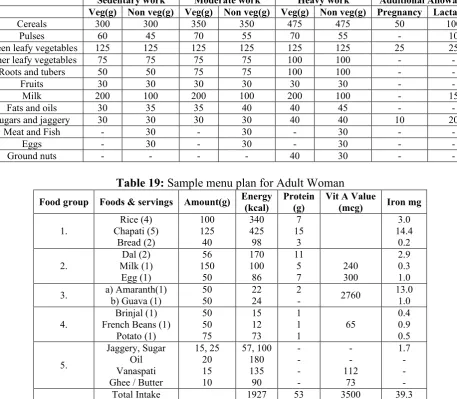
Table 18:Dietary chart for Adult Woman.
Sedentary work Moderate work Heavy work Additional Allowance Veg(g) Non veg(g) Veg(g) Non veg(g) Veg(g) Non veg(g) Pregnancy Lactation
Cereals 300 300 350 350 475 475 50 100
Pulses 60 45 70 55 70 55 - 10
Green leafy vegetables 125 125 125 125 125 125 25 25
Other leafy vegetables 75 75 75 75 100 100 -
-Roots and tubers 50 50 75 75 100 100 -
-Fruits 30 30 30 30 30 30 -
-Milk 200 100 200 100 200 100 - 15
Fats and oils 30 35 35 40 40 45 -
-Sugars and jaggery 30 30 30 30 40 40 10 20
Meat and Fish - 30 - 30 - 30 -
-Eggs - 30 - 30 - 30 -
-Ground nuts - - - - 40 30 -
-Table 19: Sample menu plan for Adult Woman
Food group Foods & servings Amount(g) Energy(kcal) Protein(g) Vit A Value(mcg) Iron mg
1. Chapati (5)Rice (4) Bread (2)
100 125 40
340 425 98
7 15
3
3.0 14.4
0.2
2. Milk (1)Dal (2) Egg (1)
56 150
50
170 100 86
11 5
7 240300
2.9 0.3 1.0 3. a) Amaranth(1)b) Guava (1) 5050 2224 2- 2760 13.01.0
4.
Brinjal (1) French Beans (1)
Potato (1)
50 50 75
15 12 73
1 1
1 65
0.4 0.9 0.5
5.
Jaggery, Sugar Oil Vanaspati Ghee / Butter
15, 25 20 15 10
57, 100 180 135 90
-112
73
1.7
Adult Man(2):
Men require a diet with high calories because of their higher muscularity.
The following dietary chart and menu plan can be adopted in order to maintain a proper balanced diet for Adult man.
Table 20:Dietary chart for Adult Man.
Sedentary work Moderate work Heavy work Veg(g) Non veg(g) Veg(g) Non veg(g) Veg(g) Non veg(g)
Cereals 400 400 475 475 650 650
Pulses 70 55 80 65 80 80
Green leafy vegetables 100 100 125 125 125 125
Other leafy vegetables 75 75 75 75 100 100
Fruits 30 30 30 30 30 30
Milk 200 100 200 100 200 100
Fats and oils 35 40 40 40 50 50
Meat and Fish - 30 - 30 - 30
Eggs - 30 - 30 - 30
Sugars and jaggery 30 30 40 40 55 55
Ground nuts - - - - 50 80
Table 21: Sample menu plan for Adult Man
Food groups Food and servings Amount(g) Energy(kcal) Protein(g) Vit A(mcg) Iron(mg)
1. Chapati(6)Rice(4) Bread(2)
100 150 4 slices
340 510 196
7 18
6
-3.0 17.2
0.4
2.
Dal(2) Milk(2) Eggs(2)
50 300 100
170 200 170
11 10
13 480600
2.9 0.6 2.1
3. Orange(1)Palak(1) 5050 1324 1- 0-5502,709 0.155
4. Cauliflower(1)Brinjal(1) Potato(1)
50 50 75
12 15 75
1 1
-0.4 0.7 0.5
5.
Jaggery Sugar
Oil Vanaspati
20g 20g 20g 20g
76 205 225 180
-150
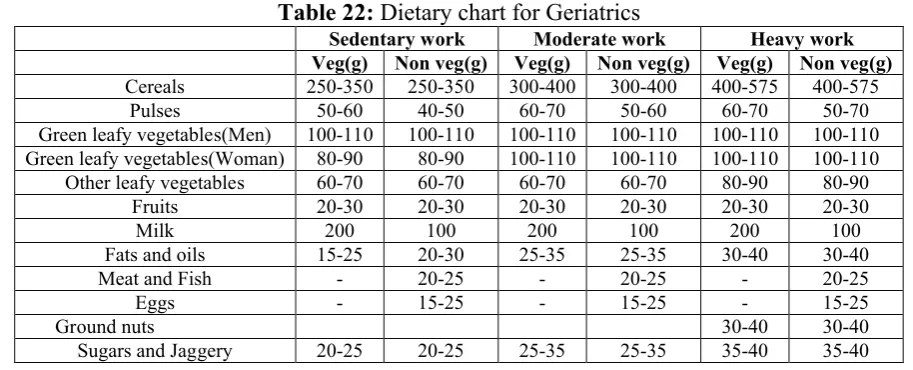
-Geriatrics (60 yrs and above)(2):
- Many elderly people remain physically active consequently require a varied diet in amounts which differ slightly from the needs of other population.
- A diet of old person should be such that it should help them to maintain good health. - The food intake may be limited due to
absence of certain foods because of some illness such as diabetes, hypertension. - Digestion may be impaired due to improper
chewing.
- The lower metabolic rates in the elderly reduce caloric requirement in them and this result in deficiency of proteins which can be supplemented by supplying eggs, milk, meat. Feeding should be in smaller amounts but must be frequently served for good metabolism.
Table 22:Dietary chart for Geriatrics
Sedentary work Moderate work Heavy work Veg(g) Non veg(g) Veg(g) Non veg(g) Veg(g) Non veg(g)
Cereals 250-350 250-350 300-400 300-400 400-575 400-575
Pulses 50-60 40-50 60-70 50-60 60-70 50-70
Green leafy vegetables(Men) 100-110 100-110 100-110 100-110 100-110 100-110 Green leafy vegetables(Woman) 80-90 80-90 100-110 100-110 100-110 100-110
Other leafy vegetables 60-70 60-70 60-70 60-70 80-90 80-90
Fruits 20-30 20-30 20-30 20-30 20-30 20-30
Milk 200 100 200 100 200 100
Fats and oils 15-25 20-30 25-35 25-35 30-40 30-40
Meat and Fish - 20-25 - 20-25 - 20-25
Eggs - 15-25 - 15-25 - 15-25
Ground nuts 30-40 30-40
Sugars and Jaggery 20-25 20-25 25-35 25-35 35-40 35-40
Table 23: Sample menu plan for Geriatrics
Breakfast
Tea Bread
Egg Banana
1cup 3slices with butter
1 1
Lunch
Chapati Rice
Dal Alupalak
Curds Orange or sweetlime
1 ½cup
1cup 1 cup ½cup
1
Snacks BiscutsTea 1cup2-3
Dinner
Chapati Rice
Dal Curd
1 1cup 1cup ½cup Bedtime Banana or appleMilk 1Glass1
DISADVANTAGES OF SOME FOODS: ALCOHOL:
Addiction:
When addicted, one’s life begins to revolve around and he cannot stop using them, he never stop it despite of several negative consequences.(6)
Withdrawl:
Symptoms of alcohol withdrawl include shakiness, nausea, hallucinations.(6)
Health problems:(7)
- Excessive alcohol consumption increases risk of heart complications, rise in blood pressure, and lead to blockage in arteries of brain.
- In excess amounts it may result in pancreas, mouth, pharynx, oesophagus and liver cancers.
- Atrophy of brain, cirrhosis, suicidal tendencies, sudden death in case of cardiovascular problems.
Socio-economic problems:
- Alcohol consumption causes several socio-economic problems like experiencing injuries at a higher rate when compared to non users the incidence of road accidents suicides and violence are higher in alcoholics.
- Many alcohol users had missed going to work, frequently borrowed money and faced a lack of respect from employees and colleagues.
Alcohol consumption is contraindicated during administration of:(7) Anti-coagulants,
β-blockers, Antihistaminics and Antibiotics. The alcohol drinking guidelines set by National health and medical research council are :(8)
2. Not more than 6 standard drinks on any one day.
A standard drink is: (8)
1. 1 can or stibble of medium beer (3-10%). 2. A 100ml glass of wine (8-14%).
3. 1nip of spirits (20-70%).
CAFFEINATED DRINKS: (8)
- Caffeine is present in tea, coffee, chocolates, cocoa etc
- In moderate doses caffeine causes increased mental arousal and alertness. - In high doses caffeine raises heart rate and
promotes release of fatty acids.It cuases anxiety, dizziness and headache and causes withdrawl symptoms.
Table 24:Effects of caffeine as intake increases(8)
Moderate 600mg (2 cups) Large amounts more than 600mg(2 cups) Long term effects more than 600mg(2 cups)
Become more alert Get headache Find sleeping difficulty
Heart rate increases Feel restlesness Worry more
Urinals with more frequency Feel nervous Depresssion
Body temp raises Become delirious Have stomach upsets
More acid produced in digestive
system Find difficulty to sleep May become addicted
Table 25:Caffeine contents of various drinks(8)
Food Amounts of caffeine
Instant coffee 60-100mg
Fresh coffee 80-350mg
Tea 80-90mg
Coca drinks 35mg per 250ml
Other caffeinated soft drinks 106mg per ml
cocoa 10-70mg per
Chocolate bars 20-60 mg per 20g bar
CONCLUSION:
Balanced diet is very important for every person in their day to day life. It is of immense response to maintain proper health. It is particularly important for children and geriatrics because children need a good balanced healthy diet for proper growth as it is the stage of physical and mental development. Geriatrics also needs a well balanced diet because maintaining good diet helps to retain good health. Balanced diet is vital for all people in order to have proper mental and physical development. It is important for women to have good strength during menstrual and menopause phases So, while maintaining a well balanced diet we have to consider about some foods which should be taken in a controlled manner like alcohol and caffeine, irrational consumption of these foods causes several serious health disorders. So by this, I conclude that a well balanced diet with a well managed physical exercise helps in maintaining good sound health and helps in living a long life without health problems.
REFERENCES:
1. S. R. Mudambi, M. V. Rajagopal-Food, nutrition and diet-170-171
1. Shabnam and mash-Essentials of food and nutrition-66-81
2. www.onlymyhealth.com/importance-balanced-diet-1298540964
3. U.satyanarayana,U.chakrapani-Biochemistry-116-156
4. B.Srilakshmi-Nutrition science-211-215,235-236
5. www.ehow/list-6887593-disdvantages-alcohol-drugs.html.
6. www.streetdirectory.com/food-
editorials/beverages/alcoholic- drinks/health-benefits-and-disadvantages-of-alcohol.html.
7. www.health.gov.au/internt/healthyeldery/ac tive/publishing.n