
Ensembles Method for One Class Classification
using Convex Hull Polytope Model
Jay Bhatt Chaita Jani
PG Student Assistant Professor
Department of Computer Engineering Department of Computer Engineering
Kalol Institute of Technology & Research Centre Kalol Institute of Technology & Research Centre
Abstract
Classification is a data mining task that allocated similar data to categories or classes. One of the most general methods for classification is ensemble method which refers supervised learning. After generating classification rules we can apply those rules on unidentified data and achieve the results. In one-class classification it is supposed that only information of one of the classes, the target class, is available. In an ensemble classification system, different base classifiers are combined in order to obtain a classifier with higher performance. In this work, a new one-class classification ensemble strategy called Approximate Polytope Ensemble is presented. The geometrical theory of convex hull is used to define the boundary of the target class defining the problem. The most widely used ensemble learning algorithms are AdaBoost and Bagging. The process of ensemble learning method can be divided into three phases: the generation phase, in which a set of candidate models is induced, the pruning phase, to select of a subset of those models and the integration phase, in which the output of the models is combined to generate a prediction.
Keywords: Bagging, Boosting, Classification, Ensembles, One Class Classification, convex hull, polytope.
_______________________________________________________________________________________________________
I.
I
NTRODUCTIONData classification is the categorization of data for its most effective and efficient use. Data classification is a two-step process: 1.Learning (Model Construction) 2.Classification (Model Usage). In the first step, a classifier is built describing a predetermined set of data classes or concepts. This is the learning step (or training phase), where a classification algorithm builds the classifier by analyzing or ―learning from‖ a training set made up of database tuples and their associated class labels. In the second step, the model is used for classification. A test set is used, made up of test tuples and their associated class labels. These tuples are randomly selected from the general data set. They are independent of the training tuples, meaning that they are not used to construct the classifier. The One Class Classification problem is diverse from the multi-class classification problem in the sense that in one-class classification it is assumed that only information of one of the classes, the target class, is available. This means that just example objects of the target class can be used and that no information about the other class of outlier objects is present because these data are either difficult or impossible to collect. This problem is called ’one class classification’ (OCC). For OCC several models have been planned. Most often the methods focus on outlier detection. Ensembles Method has been successfully useful to solve a variety of classification and function approximation problems. Ensembles Method Use a mixture of models to raise accuracy of problems. It merge a series of n learned models M1, M2,…, Mn with the aim of creating an better model M*. There are three Popular ensemble methods, Bagging: averaging the prediction over a collection of classifiers, Boosting: weighted vote with a collection of classifiers, Stacking: combining a set of heterogeneous classifiers. Here, the geometrical concept of convex hull is used to define the boundary of the target class defining the problem. Expansions and contractions of this geometrical structure are introduced in order to avoid over fitting. Then, the decision whether a point belongs to the convex hull model in high dimensional spaces. Finally, a tiling strategy is proposed in order to model non-convex structures.
II.
I
NTRODUCTION TO ONE CLASS CLASSIFICATION IN CLASSIFICATIONFig. 1: Proposed technique for OCC [7]
A Proposed technique for OCC is shown in Figure 1. It represents the three broad categories for the study of OCC problems, Availability of Training Data: Learning with positive data only (or with a limited amount of negative samples) or learning with positive and unlabeled data, Methodology Used: Algorithms based on One Class Support Vector Machines (OSVMs) or methodologies based on algorithms other than OSVMs, Application Domain Applied: OCC applied in the field of text/document classification or in other application domains. In figure 2 an example of a training dataset is given for the apple-pear problem. Each object has two feature values (for instance the width and the height of the object; the exact features are not important for this discussion). Each training object x can therefore be represented as a point in a 2-dimensional feature space. Here the apples are indicated by stars, the pears by pluses. In principle, objects can be scattered all around the (2-dimensional) feature space, but due to the continuity assumption, apples are near apples and pears near pears. Furthermore, there are physical constraints on the measurement values (weights and sizes are positive, and are bounded by some large number) [3].
Fig. 2: Conventional and a one-class classifier [3]
In the apple-pear example the two classes can be separated without errors by the solid line in figure 2. Unfortunately, when the outlier apple in the right lower corner is introduced, it cannot be distinguished from the pears. To identify the outlier, a one-class classifier should be trained. An example of a one-class classification is given by the dashed line.
Availability of Training Data: A.
OCC problems have been considered widely under three broad frameworks: Learning with positive class only.
Learning with positive class and some quantity of weakly distributed negative class. Learning with positive and unlabeled data.
III.
O
CC VS.
M
ULTI-
CLASS CLASSIFICATIONIn a usual multi-class classification problem, data from two or more classes are accessible and the decision boundary is supported by the existence of example samples from all class. Different researchers have used other terms to define one class classification such as Outlier Detection [7], Novelty Detection or Concept Learning. As defined before, in OCC tasks, the negative class is either missing or limited in its sharing, so only one side of the classification boundary can be made definitively by using the data. This makes problem of one-class classification harder than the problem of usual multi-class classification. The task in OCC is to describe a classification boundary about the positive or target class, such that it accepts as many objects as possible from the positive class, while it minimize the possibility of accepting non-positive or outlier objects. As only one side of the boundary can be described, in OCC, it is tough to make a decision, on the base of just one class how closely the boundary should fit in each of the information around the data. It is also harder to make a decision which attributes should be used to discover the best division of the positive and negative class objects. that's why it is to be accepted that occ algorithms will require a huge number training instances comparative to usual multi-class classification algorithms.
IV.
S
TATE OF THE ART ON ENSEMBLES TECHNIQUESData classification plays important role in the field of data mining. The increasing rate of data diversity and size decrease the performance and efficiency of classifier. The decreasing performance of classifier compromised with unvoted data of classifier. Now the merging of two or more classifier for better prediction and voting of data are used, such techniques are called Ensemble classifier. Now the merging of two or more classifier for better prediction and voting of data are used, such techniques are called Ensemble classifier. Good ensemble methods are that in which each individual classifiers are accurate and diverse But ensemble methods are combination of predictions made by a set of individual classifiers. Accurate classifier is meant to be produce accurate prediction than the random classifier and diverse classifier is meant to be produce prediction independently. Ensembles of classifiers, where a variety of classifiers are pooled before a final classification decision is made. Ensemble learning consists on the solution of two problems: (1) how to generate the ensemble of models? (Ensemble generation); and (2) how to integrate the predictions of the models from the ensemble in order to obtain the final ensemble prediction? (Ensemble integration). Ensemble pruning has been reported, at least in some cases, to reduce the size of the ensembles obtained without degrading the accuracy. Pruning has also been added to direct methods successfully increasing the accuracy.
Fig. 3: Ensemble learning model
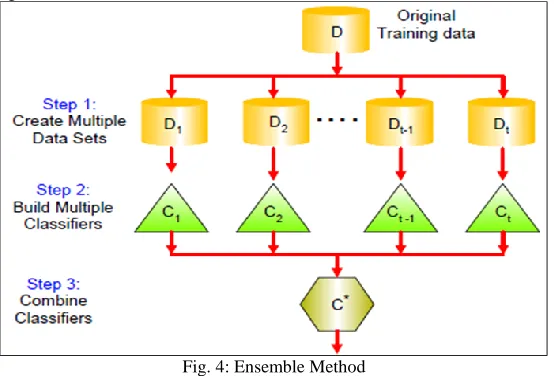
Ensembles are sets of learning machines that combine in some way their decisions, or their learning algorithms, or different views of data, or other specific characteristics to obtain more reliable and more accurate predictions in supervised and unsupervised learning problems. Ensembles method Use a combination of models to increase accuracy. The basic Ensemble Method model is as shown in figure 4.
Fig. 4: Ensemble Method
The Popular ensemble methods are: Bagging:
1)
techniques is usually simpler than their integration in boosting. A bagging algorithm does not require recomputing any kind of weights therefore, neither is necessary neither to adapt the weight update formula nor to change computations in the algorithm.
Fig. 5: Bagging [9]
Boosting: 2)
It is a family of ensemble learners. Its Basic idea is Weight the individual instances of the data-set. It iteratively learns models and records their errors and Distribute the effort of the next round on the miss-classified examples. The quantity of focus is measured by a weight, which initially is equal for all instances. After each iteration, the weights of misclassified instances are increased; on the contrary, the weights of correctly classified instances are decreased.
Fig. 6: Boosting[9]:
Stacking: 3)
Its Basic idea is to have the output of a layer of classifiers as input to another layer. Stacking (sometimes called stacked generalization) involves training a learning algorithm to combine the predictions of several other learning algorithms. First, all of the other algorithms are trained using the available data, then a combiner algorithm is trained to make a final prediction using all the predictions of the other algorithms as additional inputs.
Learning Ensembles of Classifiers: Description and Representative Techniques: A.
The main purpose of ensemble methodology is to try to increase the performance of single classifiers by inducing several classifiers and combining them to gain a new classifier. so, the basic idea is to build several classifiers from the original data and then summative their predictions when unknown instances are presented. This plan follows the human natural activity that tends to get several opinions before building any significant decision. Ensemble based classifiers generally refer to the mixture of classifiers that are negligible variants of the same base classifier, which can be considered in the broader concept of multiple classifier systems.
V.
P
ROPOSED WORKcircumvented by approximating the D-dimensional expanded convex polytope decision by an ensemble of decisions in very low-dimensional spaces like d << D. This new geometric structure is called approximate convex polytope decision ensemble. As a result, a very efficient and powerful one-class classifier is obtained. 3) However, many real world problems are not well modelled using a convex polytope. Thus, an ensemble of convex polytopes is finally proposed in order to approximate the non-convex boundary of the one-class classification problem. The algorithm is based on a tiling strategy and each non-convex polytope is approximated by the approximate convex polytope decision ensemble.
First, I used Approximate Polytope Ensemble (APE), to create a model for OCC.
Fig. 7: Illustration of the expanded convex polytope in the 2D space. [24]
Then, the geometrical concept of convex hull is used to define the boundary of the target class defining the problem. Second, the decision whether a point belongs to the convex hull model in high dimensional spaces is approximated by
means of random projections and an ensemble decision process. This algorithm describes the test procedure. It is possible to check if the test point lies inside the projected polytope.
Finally, a tiling strategy is proposed in order to model non-convex structures because, the main drawback of APE is that the boundary of training data may not be well modelled by a convex polytope. Hence, an extension of the algorithm to cope with non-convex boundaries is also proposed.
The Proposed Algorithm: A.
1) Create an initial convex hull. The initial convex hull has not any fixed boundary points.
2) The geometrical concept of convex hull is used to define the boundary of the target class defining the problem.
3) The decision whether a point belongs to the convex hull model in high dimensional spaces is approximated by means of random projections and an ensemble decision process.
4) Create a strategy that proposed in order to model non-convex structures. 5) Generate Rules that map Inside-Outside test point for convex hull.
Rules:
xt = Pt x (project data)
vtn = [vt + vi { (vi-c) / ||vi – c|| }] where vi is in {v}t . if xt is not in conv vtn then
Result = outside Break.
6) Decide whether structure need to shrink or expand the convex hull governed by parameter n. 7) Prune the redundant rule.
8) Check whether all test points are covered by any rules. If yes then stop, otherwise continue. 9) Determine a default rule: A default rule is chosen when no rule can be applied to a test point.
VI.
C
ONCLUSION AND FUTURE WORKstate of the art on ensemble methodologies. Furthermore, we have exposed the positive synergy between sampling techniques and Bagging ensemble learning algorithm.
A
CKNOWLEDGMENTThe authors would like to thank the reviewers for their precious comments and suggestions that contributed to the expansion of this work.
R
EFERENCES[1] Han Jiawei and Kamber Micheline, Data Mining: Concepts and Techniques, second edition, pp. 285-296. [2] Han Jiawei, Department of computer science, University of Illinois at Urbana-Champaign, 2006.
[3] David Martinus Johannes TAX, One class classification Concept-learning in the absence of counter-examples, Proefschrift. [4] S. B. Kotsiantis, ―Supervised Machine Learning- A Review of Classification Techniques,‖ Informatica 31 (2007) 249-26.
[5] Mikel Galar, Alberto Fern´andez, Edurne Barrenechea, Humberto Bustince, ― A Review on Ensembles for the Class Imbalance Problem: Bagging-, Boosting-, and Hybrid-Based Approaches,‖ IEEE Transactions On Systems, Man, And Cybernetics—Part C: Applications And Reviews, Vol. 42, No. 4, July 2012.
[6] Amir Ahmad and Gavin Brown, ―Random Projection Random Discretization Ensembles—Ensembles of Linear Multivariate Decision Trees,‖ IEEE Transactions On Knowledge And Data Engineering, Vol. 26, No. 5, May 2014 5, May 2014.
[7] Shehroz S. Khan and Michael G. Madden, ―A Survey of Recent Trends in One Class Classification,‖ National University of Ireland Galway, Ireland. [8] Youngmi Yoon, Sangjay Bien, and Sanghyun Park,‖ Microarray Data Classifier Consisting of k-Top-Scoring Rank-Comparison Decision Rules With a
Variable Number of Genes,‖ IEEE Transactions On Systems, Man, And Cybernetics—Part C: Applications And Reviews, Vol. 40, No. 2, March 2010. [9] Pengyi Yang, Yee Hwa Yang, Bing B. Zhou and Albert Y. Zomaya,‖ A review of ensemble methods in bioinformatics,‖ University of Sydney, NSW 2006,
Australia.
[10] Rashedur M. Rahman, Farhana Afroz,‖ Comparison of Various Classification Techniques Using Different Data Mining Tools for Diabetes Diagnosis,‖ Journal of Software Engineering and Applications, 2013, 6, 85-97.
[11] Arthur Zimek, Fabian Buchwald, Eibe Frank, and Stefan Kramer,‖ A Study of Hierarchical and Flat Classification of Proteins,‖ IEEE/ACM Transactions On Computational Biology And Bioinformatics, Vol. 7, No. 3, July-September 2010.
[12] D.Gopika1, B.Azhagusundari,‖ An Analysis on Ensemble Methods In Classification Tasks,‖ International Journal of Advanced Research in Computer and Communication Engineering Vol. 3, Issue 7, July 2014.
[13] Huimin Zhao, Member, IEEE, and Sudha Ram, Member, IEEE,‖ Constrained Cascade Generalization of Decision Trees,‖ IEEE Transactions On Knowledg And Data Engineering, Vol. 16, No. 6, June 2004.
[14] Shuo Wang, Student Member, IEEE, and Xin Yao, Fellow, IEEE,‖ Relationships Between Diversity of Classification Ensembles and Single-Class Performance Measures,‖ IEEE Transactions On Knowledge And Data Engineering.
[15] Sarwesh Site, Dr. Sadhna K. Mishra,‖ A Review of Ensemble Technique for Improving Majority Voting for Classifier,‖ International Journal of Advanced Research in Computer Science and Software Engineering, Volume 3, Issue 1, January 2013.
[16] Lior Rokach,‖ Taxonomy for Characterizing Ensemble Methods in Classification Tasks: a review and annotated bibliography,‖ Ben-Gurion University of the Negev.
[17] Joao M. Moreira, Carlos Soares, Alpio M. Jorge and Jorge Freire de Sousa,‖ Ensemble Approaches for Regression: a Survey,‖ LIAAD, INESC Porto L.A., R. De Ceuta, 118, 6, 4050-190, Porto PORTUGAL.
[18] Matteo Re, Ensemble methods: a review.
[19] Thomas G Dietterich,‖ Ensemble Methods in Machine Learning,‖ Oregon State University Corvallis Oregon USA.
[20] Ms. Aparna Raj, Mrs. Bincy G, Mrs. T.Mathu,‖ Survey on Common Data Mining Classification Techniques,‖ International Journal Of Wisdom Based Computing, Vol. 2(1), April 2012.
[21] Tulips Angel Thankachan, Dr. Kumudha Raimond, ‖ A Survey on Classification and Rule Extraction Techniques for Datamining,‖ IOSR Journal of Computer Engineering (IOSR-JCE),Volume 8, Issue 5 (Jan. - Feb. 2013), PP 75-78.
[22] Chesner Desir, Simon Bernard, Caroline Petitjean, Heutte Laurent, One class random forests , HAL Id: hal-00862706.
[23] Rashedur M. Rahman, Farhana Afroz, ―Comparison of Various Classification Techniques Using Different Data Mining Tools for Diabetes Diagnosis,‖ Journal of Software Engineering and Applications, 2013, 6, 85-97.
![Fig. 2: Conventional and a one-class classifier [3]](https://thumb-us.123doks.com/thumbv2/123dok_us/8870722.1813756/2.612.133.487.50.249/fig-conventional-class-classifier.webp)
![Fig. 6: Boosting[9]:](https://thumb-us.123doks.com/thumbv2/123dok_us/8870722.1813756/4.612.208.391.80.258/fig-boosting.webp)
