Volume 3
Issue 2 Inclusion not Exclusion: Comparative Educational Perspectives at the Heart of Sustainable Development in the Gulf States
Article 7
2016
The Educational Aspirations of Saudi Arabian Youth: Implications
The Educational Aspirations of Saudi Arabian Youth: Implications
for Creating a New Framework to Explain Saudi Arabian Society
for Creating a New Framework to Explain Saudi Arabian Society
Woohyang Sim
Waseda University, [email protected]
Follow this and additional works at: https://preserve.lehigh.edu/fire
Part of the Educational Sociology Commons, Higher Education Commons, and the Near and Middle Eastern Studies Commons
Recommended Citation Recommended Citation
Sim, W. (2016). The Educational Aspirations of Saudi Arabian Youth: Implications for Creating a New Framework to Explain Saudi Arabian Society. FIRE: Forum for International Research in Education, 3(2).
http://dx.doi.org/10.18275/fire201603021081
Abstract Abstract
Higher education in Saudi Arabia has garnered immense praise for its rapid expansion and developments in both quantity and quality. In response to this, the tertiary school enrollment in Saudi Arabia is rapidly rising. These achievements can be explained by changes in educational policies. However, studies regarding youth’s awareness are scarce. Thus, this study clarifies the educational aspiration of Saudi Arabia's young generations through an awareness survey. Data collected from 316 respondents was analyzed by using SPSS. The findings of this study indicate strong educational aspirations of young Saudis who are motivated by their meritocratic way of thinking. These results are discussed while examining the application of status attainment and status expression theories in the case of Saudi Arabia.
Keywords Keywords
Educational Aspiration, Higher Education, Saudi Arabia, Status Attainment, Status Expression
THE EDUCATIONAL ASPIRATIONS OF SAUDI
ARABIAN YOUTH: IMPLICATIONS FOR CREATING A
NEW FRAMEWORK TO EXPLAIN SAUDI ARABIAN
SOCIETY
Woohyang Sim
1Waseda University, Japan
The Expansion and Development of Higher Education in Saudi Arabia
Since the introduction of human capital theory by Becker (1962) and Schultz (1971; 1972) in the 1960s and 1970s, education has been understood to exert a strong influence, not only on individuals, but also on the social and economic development of a nation. Recognizing the power of education, the national budget for education in the Kingdom of Saudi Arabia (KSA) has seen some of the highest increase rates in the world (Aljubaili, 2014). With strong government support, the country’s education system has seen enormous growth over the past several decades. Education is a national priority in KSA, reflected in national policies and large budgets. Indeed, higher education in the country, in particular, has garnered immense praise for its rapid development in both quantity and quality (Nakamura, 2007; Han, Yun, & Park, 2011). King Saud University, established in 1957, was the first university to open in the country. Since then, according to KSA’s Ministry of Education, a total of 28 public and 30 private universities and colleges have been founded, with private universities allowed to open beginning in 1998 (Al-Dali, Fnais, & Newbould, 2013; Smith & Abouammoh, 2013). As shown in Figure 1, most public universities have been established only in the last decade.
Mazi and Altbach (2013) found that Saudi universities have risen in international rankings of universities, largely as a result of their focus on quality assurance. For example, according to Ranking Web of Universities (2015), King Saud University ranked 212th in the
January 2011 World Universities List, up from its standing at 3,062nd place in the July 2007 list.
Additionally, King Saud University has ranked first among Arab countries since 2008, accompanied by other Saudi research universities2 which have also achieved much higher
rankings over time (Mazi & Altbach, 2013). This visible rise in rankings shows that not only the quantity but also the quality of Saudi universities is growing as the government planned.
1Correspondence: Address: 1-6-1 Nishiwaseda, Shinjuku-Ku, Tokyo 169-8050 Japan; Email: [email protected]
As the number of higher education institutions in KSA increases, tertiary school enrollment is visibly growing, as shown in Figure 2. At the level of higher education, KSA’s gross enrollment ratio (GER)—the number of students enrolled as a percentage of the corresponding grade level—was 57.5% in 2013, up from only 1.6% in 1971 (World Bank Group, 2004 & 2015).
Figure 1: Years of establishment and total number of public universities in KSA.
Source: Ministry of Higher Education, 2015.
Figure 2: Higher education Gross Enrollment Ratios in KSA from 1971–2013.
Source: World Bank Group, 2015.
This is considered a phenomenal increase, especially considering that in 2013, the world average GER was 32.8% and the average GER among Arab states was 28.1% (World Bank Group, 2015).
0 5 10 15 20 25 30
1950 1960 1970 1980 1990 2000 2010 2020
0 10 20 30 40 50 60
1960 1962 1964 1966 1968 1970 1972 1974 1976 1978 1980 1982 1984 1986 1988 1990 1992 1994 1996 1998 2000 2002 2004 2006 2008 2010 2012 2014
With a higher education GER exceeding 50%, the higher education system in KSA is now on a “universal”3 level, as defined by Trow (1973).
The growth—in quantity and quality—of public higher education institutions in KSA reflects the government’s perception that higher education is crucial to their transition from an economy reliant on oil to an economy based on knowledge. However, KSA’s educational expansion is typically explained by supply-side policies (Aljubaili, 2014), while research on educational aspirations and motivation is scarce. Thus, to give a more well-rounded perspective on higher education in the nation, this paper explores educational aspirations and motivation within Saudi society of individuals to enter higher education.
Theoretical Framework
Status attainment theory is commonly used to explain the educational aspirations of a society (Blau & Duncan, 1967). The theory’s popularity, surpassing psychological theories like Maslow’s (1943) hierarchy of needs theory, stems from the strong relationship between education and the labor market, which has emerged as a function of education (Collins, 1971 & 1979; Dore, 1976; Spence, 1973). Status attainment theory stresses that educational aspiration is a cognitive state that motivates and drives young people to strive for academic success (Khoo & Ainsley, 2005), later connecting individuals to prestigious jobs and ultimately leading to a higher social status (Collins, 1971 & 1979; Dore, 1976; Spence, 1973).
Spence (1973) found that education credentials signal an employee’s success in the labor market. Additionally, Dore (1976) explained that education acts as a means to obtain a job, and eventually to obtain a more prestigious one. Collins (1979) discussed status attainment from a different perspective, emphasizing the strong relationship between education and occupational status. He claimed that social groups use education to construct and maintain their status. The three aforementioned theories explain the function of education in society and argue that educational aspirations are motivated by these functions. Inevitably, in these studies, status attainment is affected by ascribed factors such as socio-economic situation, parental status, and education level.
Most status attainment theories have been derived from Western contexts, primarily from the United States and Europe (Amano, 1983). However, researchers from other areas of the world have made important contributions to the literature. Studying Japanese higher education, Amano (1983) recognized that the female labor force participation rate was not increasing in tandem with the educational enrollment rate. To explain this phenomenon, Amano coined the term “status expression” (chii hyouji kinou):
This “status expression” is similar to Havighurst’s “symbolic value.” In this case, education indicates a person’s social class. Reproducing social structure is the role of educational institutes, by conveying culture that fits a person’s social status. So, education is considered as a consumable material” (Amano, 1983, p44).
3Trow (1973; 2000) classified tertiary education systems into three groupings and described their different functions in society: (1) Elite higher education system: student enrollment of about of about 5% of age group; high academic standards and homogeneous group of student; university main functions is to train students by
Until now, the function of education has been explained by the two main theories discussed previously: status attainment and status expression. Typically, the former is used to explain men’s educational aspirations, and the latter to explain those of women (Li, 2011). However, in KSA—where the population is approximately 30,770,000, with 33% of residents being non-Saudi (CDSI, 2014)—it is not easy to predict educational aspirations, due in part to the country’s unique patriarchal social structure and its tribal society.
The aim of this study is threefold. Firstly, through a survey, it seeks to clarify the educational aspirations of Saudi youth. Secondly, it aims to examine the application of status attainment and status expression theories in the case of KSA. Finally, it is aims lay the groundwork for creating a new framework that better explains Saudi Arabian society.
Methodology
This study examined educational aspiration, motivation, and purpose of enrollment in higher education for Saudi youth through an online survey. Survey items focused on the following three research questions:
1. What are the academic aspirations of Saudi youth? 2. What motivates Saudi youth to aim for higher education? 3. What is the main reason why Saudis enroll in higher education?
Survey Design and Limitations
This survey was created to examine Saudi Arabian youth’s level of aspiration and motivation for attending higher education. To avoid non-responses and to make the survey easier to answer, pre-coded answers were applied to most of the survey. The survey contained 40 items and was divided into three major parts: (1) personal data, (2) educational awareness, and (3) occupational awareness. The survey was conducted online, in Arabic, from June 19, 2013 until October 13, 2013 (approximately four months). Data was collected from a total of 321 Saudi Arabian respondents, both males and females. Excluding five individuals who responded to less than 50% of the survey, data from a total of 316 respondents has been analyzed using IBM SPSS Statistics 22.
One of the study’s limitations is that female respondents outnumbered male respondents, with approximately two women answering for every man. Another limitation is that, bearing in mind the nature of KSA’s conservative society, survey questions were selected carefully and certain questions were not asked.
Description of Respondents
Two hundred and twenty-two respondents (70%) were women and 94 respondents (30%) were men. The respondents’ age varied but most of the respondents were in their 20s and were born during the era of higher education expansion. For the purposes of this paper, “youth” refers to those aged 30 or under. Some comparison will be made between men and women. Figure 3 below shows the age and gender distribution of the respondents.
As shown in Table 1, over 85% of the 316 respondents were under 30 years old. The most commonly reported “current status,” in descending order, was undergraduate student (45%), employee (25.3%), secondary school student (13.6%), unemployed (9.8%), and, finally, graduate student (6.3%) (see Appendix 1–1).
this paper, they are designated as the middle class. On the low end of the spectrum, fewer than 10% of respondents self-reported their economic status to be either “not wealthy” (6.6%) or “not wealthy at all” (2.7%) (see Appendix 1–2). Interestingly, this distribution of self-reported economic statuses resembles the greater Saudi population, where 30% of Saudi society is categorized as lower class, 67% as middle class, and 3% as upper class (Alnuaim, 2013). However, the “middle class” is made up of individuals with a wide range of monthly salaries: 3,900–38,200 Saudi Riyals (1,040–10,185 USD) (Alnuaim, 2013). By supposition, the data set mainly represents the middle class of KSA, although this group contains a large amount of variance.
Table 1: Age and gender of survey respondents as a percentage of the sample.
Age Gender Total (n)
Male (n) Female (n)
Under 19 8.5 27.9 22.0
20 to 25 37.2 54.9 49.6
26 to30 20.0 12.6 14.8
31 to 35 13.8 2.7 6.0
36 to 40 10.6 0.0 10.0
Over 41 9.5 1.8 4.0
Total 100.0 (94) 100.0 (222) 100.0 (316)
Table 2 shows the education level of the respondents’ parents. In descending order, fathers’ education levels were college or undergraduate university (36.1%), secondary school (35.3%), primary school or below (15.7%), and graduate school (12.9%). Mothers’ education levels were lower, especially with regard to graduate studies: 30.3% had attended college or undergraduate university, 34.1% had attended through secondary school, 32.4% had attended primary school or below, and only 3.2% had completed graduate school. It is interesting to note that there was no statistically significant correlation between fathers’ and mothers’ education levels, or for parents’ education level and economic status.
Table 2: Parental education levels by gender as a percentage of the sample.
Father's education (n) Mother's education (n) Primary school and below 15.7 32.4
Secondary school 35.3 34.1
College or undergraduate university 36.1 30.3
Graduate school or higher 12.9 3.2 100(255) 100(255)
As for reported parental involvement in education, regardless of gender, economic status, and parental education level, over half of the respondents considered it “very strong” (61.9%) or “strong” (18.4%), which left “not strong” (14.5%) and “not strong at all” (5%) below 20% (see Appendixes 1–3).
Of the 257 respondents, 249 (96.8%) stated that they want to enroll in, currently study in, or have graduated from an undergraduate institution. Moreover, of these 249 respondents, 202 (81.1%) also reported that they want to enroll in, currently study in, or have graduated from a graduate school, demonstrating the strength of their aspiration to further their studies. No statistically significant difference between genders or along other ascribed factors was found (Appendix 1–4). Still, 13 individuals answered that they were not currently in a university and/or did not intend to enroll in the future. No statistically significant difference was observed between the characteristics of the 13 respondents and those with stronger educational ambitions.
While the 13 respondents not in university or planning to enroll were a small sample, and their reasons cannot be taken as generalizable to the greater population, their reasons for not enrolling were revealing. Men explained that they “want to work” or “already have a job”. Women explained that they were “getting married,” that their “scores [were] not good enough to go to university,” and that “there is no meaning in education.” The average age of marriage for females in KSA, 24 years old (Nakamura, 2007), could help explain those women who responded that they were not enrolled because they were getting married.
More than half of respondents (58%) reported having thought about attending university since their childhood, even before they started mandatory education (Appendix 1–5). Women’s educational aspirations were reportedly founded earlier than those of their male counterparts: approximately 63% of women, versus 47% of men, answered that they started thinking about attending university in childhood (p < .01). This 16% difference is considerable, but, regardless of gender, the results suggest that youth anticipate university studies.
What is more, the educational ambitions of contemporary Saudi youth are expected to be passed onto their children (Appendix 1-6). Ninety-nine percent of respondents want their children to complete at least undergraduate studies, and approximately 80% also expect their children to hold, at a minimum, master’s degrees. Women have higher educational aspirations for their children (p < .05) than men do. Fifty-nine and one-tenth percent of women, as opposed to 43.1% of men, want their children to have a master’s degree from a university abroad. Notably, not one woman reported wanting her children to study only through high school. But when it comes to their own goals, both women and men reported having ambitious educational aspirations; there was no statistical significance between genders or other ascribed factors (Appendix 1–4; 1–5).
The survey results corroborate the demand-driven expansion of higher education in KSA. As higher education in KSA progresses, both in quantity and quality, enrollment in higher education increases. In terms of demand, the population has a strong desire to attain a higher education, while, on the supply side, the government continues to allocate public funds and policies that support expanding, quality higher education. Given these corresponding factors, it is expected that enrollment in higher education will continue to increase.
Research Question 2: What motivates Saudi youth to aim for higher education?
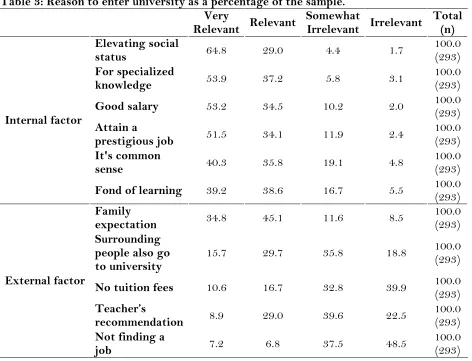
The survey instrument used to answer this question asked respondents to rate 11 items— external or internal factors that might influence their pursuit of higher education—as either “very relevant,” “relevant,” “somewhat irrelevant,” or “irrelevant” to their seeking higher education. The next section of the study asked further questions related to what motivates Saudis to seek higher education. Throughout the paper, there are distinctions made between internal factors, motivations from within, and external factors, motivations influenced by outside elements (see Table 3 for the breakdown of factor).
knowledge (53.9%), attaining a good salary (53.2%), and obtaining a prestigious job (51.5%). Fewer respondents reported the following external factors as very relevant to their attendance: could not find a job (7.2%), free tuition fees (10.6%), and teachers’ recommendation (8.9%). Internal factors were selected more often than external factors.
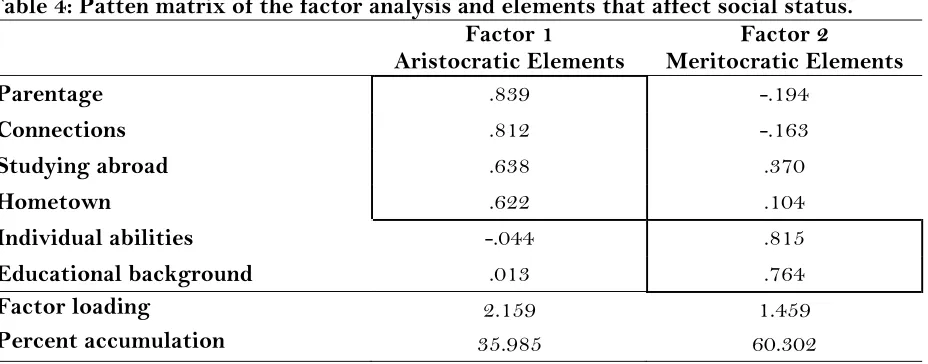
Respondent answers to the question, “What are the elements that you think affect having a high-social-status occupation?” reveal a meritocratic way of thinking, which refers to a belief in a system in which social status is assigned through intellect and hard-work (Appendix 1–7). The greatest number of respondents (98.5%) considered educational background to be “very relevant” in determining social status, closely followed by individual ability (97.5%). A lesser number of respondents rated the following as “very relevant”: experience studying abroad (71.8%), connections (57%), parentage (31.5%), and hometown (13.7%). What is noteworthy here is that the top three items are regarded as meritocratic elements, and the bottom three items are aristocratic. Interestingly, there was more notable disagreement among respondents as to the importance of parentage and hometown, with a large proportion of respondents rating these factors as “somewhat irrelevant” or “irrelevant” to having a high-social-status occupation (68.5% and 86.3% for each factor, respectively).
Table 3: Reason to enter university as a percentage of the sample. Very
Relevant Relevant Somewhat Irrelevant Irrelevant Total (n)
Internal factor
Elevating social
status 64.8 29.0 4.4 1.7
100.0 (293)
For specialized
knowledge 53.9 37.2 5.8 3.1 100.0 (293)
Good salary 53.2 34.5 10.2 2.0 100.0 (293)
Attain a
prestigious job 51.5 34.1 11.9 2.4
100.0 (293)
It's common
sense 40.3 35.8 19.1 4.8 100.0 (293)
Fond of learning 39.2 38.6 16.7 5.5 100.0 (293)
External factor
Family
expectation 34.8 45.1 11.6 8.5 100.0 (293)
Surrounding people also go to university
15.7 29.7 35.8 18.8 100.0 (293)
No tuition fees 10.6 16.7 32.8 39.9 100.0 (293)
Teacher’s
recommendation 8.9 29.0 39.6 22.5 100.0 (293)
Not finding a
job 7.2 6.8 37.5 48.5
100.0 (293)
thinking would prevail, due to the political system and tribal culture in KSA. Conversely, the results suggest that a meritocratic way of thinking is strong among the Saudi Arabian youth, and this meritocratic way of thinking is driving them to aim for higher education.
In this context, studying abroad appears to be more aristocratic than meritocratic. There are two reasons behind this. Firstly, there is a prevailing thought that degrees from famous universities abroad are necessary to get a better position, especially as many of royal family members and high government officials have studied abroad in the United States (U.S.) or United Kingdom (U.K.), making the foreign degrees symbolic. Secondly, the most frequent responses to “Why do you want to study abroad?” were to experience living abroad (24.8%), for specialized knowledge (21.7%), for future career (17.4%), to attain a good reputation (12%), to contribute to one’s country (10%), to obtain a good salary (7.7%) and, finally, to attain a prestigious job (5.4%) (Appendix 1-8). Most of these responses reflect respondents’ curiosity and desire to experience different cultures. Their top reasons to study abroad were not directly tied to a meritocratic way of thinking, unlike the reasons to go to university.
Table 4: Patten matrix of the factor analysis and elements that affect social status. Factor 1
Aristocratic Elements Meritocratic Elements Factor 2
Parentage .839 -.194
Connections .812 -.163
Studying abroad .638 .370
Hometown .622 .104
Individual abilities -.044 .815
Educational background .013 .764
Factor loading 2.159 1.459
Percent accumulation 35.985 60.302 Note: Varimax rotation used; Kaiser-Meyer-Olkin (KMO) = .654, p < .001.
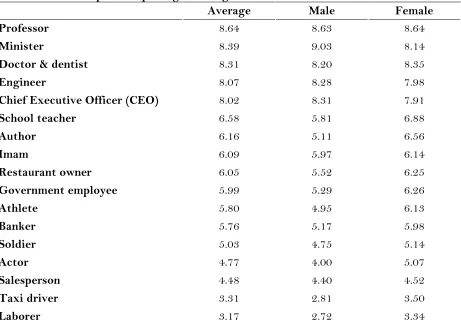
Respondents’ educational goals are tied to occupational prestige. Table 5 presents ratings of the social statuses corresponding with 17 different occupations (occupational prestige) from 1 (low) to 10 (high), in descending order, with responses disaggregated by gender. Overall, respondents reported the profession of “professor” to be the most prestigious, followed by minister, doctor and dentist, engineer, and Chief Executive Officer (CEO), with rankings ranging from 8.64 to 8.02. The rest of the occupations received averages less than 6.5 points, reflecting a large gap between the top five occupations and the rest. In contrast with the lower-ranked occupations, the high-scoring occupations generally require a higher educational background. Women and men ranked the same occupations highest, but in different orders. In descending order, women ranked the following occupations highest: professor, doctor and dentist, minister, engineer, and CEO. In descending order, men chose minister, professor, CEO, engineer, and doctor and dentist. Males tended to lean to occupations with a high social and economic status whereas females had higher opinions of occupations that required greater levels of education. (t
= -3.00, df = 16, p < .05).
status. Perceived prestige of occupation correlates with respondents’ educational background, regardless of gender, economic status, and parental education level.
Most of these results corroborate higher education research findings from a Western context (Dore, 1976). In the West, academic degrees, especially from higher education, are commonly required to obtain high-status jobs. What makes the case of KSA exceptional is that educational achievement does not necessarily lead to employment (Central Department of Statistics and Information [CDSI], 2015), even though direct linkage between educational and occupational hierarchies has emerged. As seen in Figure 3, KSA’s youth unemployment rate remains high, despite the sharp increase in higher education enrollment. This is especially notable for women who exceed men in educational aspiration and actual enrollment (Figure 2), yet have a lower employment rate (CDSI, 2015). The female unemployment rate has stayed consistently around 70%, twice as high as the 2015 male unemployment rate (CDSI, 2015). This may be due to the gender division of the labor market, making it important to also examine the reasons why students enroll in higher education.
Table 5: Mean occupational prestige rankings.4
Average Male Female Professor 8.64 8.63 8.64
Minister 8.39 9.03 8.14
Doctor & dentist 8.31 8.20 8.35
Engineer 8.07 8.28 7.98
Chief Executive Officer (CEO) 8.02 8.31 7.91
School teacher 6.58 5.81 6.88
Author 6.16 5.11 6.56
Imam 6.09 5.97 6.14
Restaurant owner 6.05 5.52 6.25
Government employee 5.99 5.29 6.26
Athlete 5.80 4.95 6.13
Banker 5.76 5.17 5.98
Soldier 5.03 4.75 5.14
Actor 4.77 4.00 5.07
Salesperson 4.48 4.40 4.52
Taxi driver 3.31 2.81 3.50
Laborer 3.17 2.72 3.34
Research Question 3: What are the main reasons why Saudis enroll in higher education?
Predetermined responses to the question, “What are the reasons to study (in higher education)?” included “to achieve my dreams” (30.5%), “to attain a better job” (27.7%), “to contribute to society” (24.0%), “there is meaning in education” (10.1%), “to be a better parent”
(5.0%), and “to attain a good reputation” (1.0%). There was a statistically significant difference between genders (p < .01): 35.9% of women, while just 16.7 percent of men responded that they go through education in order to achieve their dreams. Thirty five point seven percent of men and only 24.5% of women reported studying to attain a better job.
Figure 3: KSA youth unemployment rate by gender from 1999-2015.
M: Male (Blue), F: Female (Blue), T: Total (Red)
Source: Central Department of Statistics and Information (CDSI), 1999-2015.
The lower percentage of women who selected higher education as way to enter the workforce is not surprising, as “despite their educational successes, women in GCC countries are more likely to be unemployed or if they are employed, to be working in lower-paid jobs” (Ridge, 2014, p. 129). Only 1,192,969 (17.6%) of all Saudi women, those aged 15 years old and above, are in the labor force (CDSI, 2015). If educational attainment is not always directly connected to the labor market, it is necessary to consider why women and men do enter the workforce—and why they do not.
Men’s and women’s reported reasons for working are statistically significantly different (p < .001). Almost half of male respondents answered that work is a “means to support living” (45.0%), and a quarter stated that they work to “contribute to society” (25.0%), followed by the response that “there is meaning to work itself” (13.7%). Other response items such as work as a “means to improve social status” (8.7%) and “self-realization” (6.2%) were reported by fewer than 10% of respondents and were insignificant. On the other hand, women did not expect economic returns from jobs to the same extent that men did. Female respondents’ most frequent answer was also that work is a “means to support living” (27.8%)—a full 17% lower than their male counterparts. This answer was narrowly followed by “self-realization” (24.2%)—men’s least popular answer (6.2%). Finally, women also responded that “there is meaning to work itself” (23.6%), and that work is a “means to improve social status” (4.3%).
Additionally, in a free-text response inquiring about the respondents’ reason to study, one male responded, “Access to social status and good access to a high salary,” reflecting that some men are aware of the strong relationship between education and labor. On the other side, women appear to view both education and labor as factors enabling self-improvement, enrichment, actualization, realization and elevating society, rather than something used for only personal economic and social benefit. The following free-text responses detail women’s reasons for studying and reflect such awareness1:
“[I study] to help build society, myself, and my character, and [to] take advantage of my abilities.”
“[I study] for myself and the intellectual progress ofhumanity.” “[I study] to contribute to the service of my country.”
“[I study] to be a better parent, to build my country, and [to] earn the respect of others.”
“[I study to] develop life and what God has given us (worshipping and building the land bestowed upon us). With science, we can elevate ourselves, achieve our dreams, and lead a better life and afterlife.”
“[I study for] the following reasons: to get a better job, to be a good parent, and to build my country and society.”
Table 6: Reasons to study and work by gender, as a percentage of the sample. Reason to work
Total (n) Means to support living Self-realization There is meaning to work itself Means to improve social status Contribute to society Rea son to st ud y Attain a better job
M 66.7 0.0 10.0 10.0 13.3 100 (30)
F 57.1 14.3 16.7 9.5 0.1 100 (42)
To be a better parent
M 20.0 0.0 60.0 20.0 0.0 100 (5)
F 33.3 11.1 11.1 0.0 44.4 100 (9)
Contribute to society
M 27.3 4.6 4.6 9.0 54.5 100 (22)
F 9.1 22.7 22.7 2.3 43.2 100 (44)
There is meaning in
education
M 33.3 33.3 16.7 0.0 16.7 100 (6)
F 14.3 33.3 42.9 0.0 9.5 100 (21)
To achieve dreams
M 38.5 15.5 23.0 0.0 23.0 100 (13) F 25.7 30.0 25.7 2.9 12.9 100 (70)
“parenting.” Respondents consider education to be a path to develop society, and they are very conscious of developing society overall.
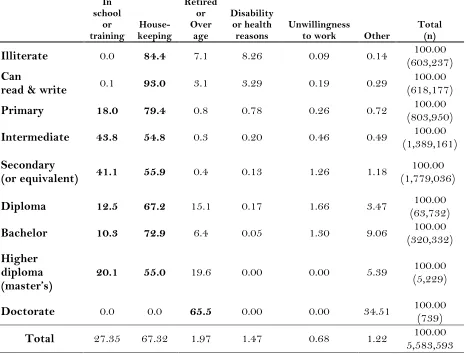
Again, although men expect economic and social returns from education, unemployment rates are high for men as well as women in KSA. A possible reason for this is the lower education attainment of males, which has been seen in Western context and also across the Gulf countries (Ridge, 2014; Stoet & Geary, 2015). Another reason to consider is that Saudi nationals could be very satisfied with the government’s welfare (Jang, 2004) and thus, do not feel pressured to work. It is not only the restricted labor market but also feminized domestic responsibilities that explain women’s low (formal) labor force participation rates. Table 7 displays some of the reasons why women do not join the labor force (Central Department of Statistics and Information [CDSI], 2015). Although responses differed by education status, “housekeeping” (67.3%) was the most frequent explanation, followed by being “in school or training” (27.4%). Across all education levels, only 0.7% of respondents cited “unwillingness to work” as the reason for their unemployment (CDSI, 2015). Thus, gendered responsibility for household tasks and work outside the home partially explains women’s low rates of labor force participation.
Table 7: Saudi female population out of the labor force (15 years old and above) by education status, as a percentage of the sample.
In school
or
training keeping
House-Retired or Over
age
Disability or health
reasons Unwillingness to work Other Total (n)
Illiterate 0.0 84.4 7.1 8.26 0.09 0.14 (603,237) 100.00
Can
read & write 0.1 93.0 3.1 3.29 0.19 0.29
100.00 (618,177)
Primary 18.0 79.4 0.8 0.78 0.26 0.72 (803,950) 100.00
Intermediate 43.8 54.8 0.3 0.20 0.46 0.49 (1,389,161) 100.00
Secondary
(or equivalent) 41.1 55.9 0.4 0.13 1.26 1.18 (1,779,036) 100.00
Diploma 12.5 67.2 15.1 0.17 1.66 3.47 (63,732) 100.00
Bachelor 10.3 72.9 6.4 0.05 1.30 9.06 (320,332) 100.00
Higher diploma
(master’s) 20.1 55.0 19.6 0.00 0.00 5.39
100.00 (5,229)
Doctorate 0.0 0.0 65.5 0.00 0.00 34.51 100.00 (739)
Total 27.35 67.32 1.97 1.47 0.68 1.22 5,583,593 100.00
Conclusion
This preliminary investigation of education aspirations in KSA has produced five main findings. First, Saudi youth wish to attend school and university, and the demand for advanced degrees appears to be rising. Second, there are differences in education desires between men and women, such as women wanting their children to study for longer than men. A third finding is that Saudi youth start to think of attending higher education even before they begin their mandatory K-12 education. Fourth, motivations behind education aspirations are explained largely by a meritocratic outlook towards higher education. Saudis regard academic, meritocratic elements, such as educational background and individual abilities, as necessary to obtain prestigious jobs that ultimately lead to higher social statuses. Finally, the few women who did not have the desire to attend higher education were generally unwilling to due to societal factors, like marriage. These findings, while not representative, do speak to important factors and trends in educational aspirations and the connection between education and the (formal) labor market.
As for status attainment theory—which considers social status to be determined by occupation—it is true that Saudi Arabian youth have a meritocratic way of thinking. In general, they are also aware of meritocratic elements that can impact high social status in KSA. Nevertheless, labor force participation has not risen in parallel with higher education enrollment. This is particularly true for women, who have higher educational goals than men, but which are not tied to the labor market. Women do not view education as a tool to attain a higher status, because it is unlikely they will use it to obtain a job, due to the gender division of labor in KSA (both formal and domestic). However, the meritocratic way of thinking is strong and the desire for a high level of education is apparent among women. Therefore, the traditional status attainment hypothesis was not capable of explaining education aspiration. The question of status expression remains.
Status expression was used in Japan to explain the phenomena when female labor participation rates did not increase in parallel with the rising higher education enrollment rate (Amano, 1985). Today in Saudi society, a similar phenomenon can be observed. Contrary to status attainment theory, the status expression hypothesis emphasizes that the educational hierarchy itself would determine a social status. Nevertheless, status expression fails to explain the aspirations of Saudi Arabian women because they are not taking factors such as parental socio-economic status into their consideration for work or study, and because there are also gendered labor expectations in the country. Since the data in this study consists mainly of responses from the middle class, differences between social classes cannot be discussed. Nevertheless, demand for advanced degrees was observed regardless of social class. Thus, we can ascertain that both status attainment and status expression theories are unsuitable in the KSA context.
Within KSA’s unique social setting, despite strong educational aspirations, neither excessive competition for university entrance nor an educational supply-and-demand imbalance has occurred. This is, in large part, due to strong government policies. As a strong welfare state, KSA has the tenth-lowest poverty rate worldwide (World Bank, 2013). Additionally, the government provides free public education, and, as such, KSA higher education degrees are regarded as accessible, especially for women, who are less likely to enter the labor market. Men, on the other hand, are often seen as the main agents of formal economic activity and may be encouraged to enter the labor force earlier than women, forgoing education (Ridge, 2014). The results of this study show that female educational aspiration is not driven out of necessity, but instead, by desire.
explain the function of education in KSA society. Expanding on this study, the author plans to conduct an on-site investigation, involving interviews with local female and male university students about the function of higher education in the Kingdom of Saudi Arabia.
References
Al-Dali, W., Fnais, M., & Newbould, I. (2013, February). Private higher education in the Kingdom of Saudi Arabia: Reality, challenges and aspirations. In Higher Education in Saudi
Arabia: Achievements, Challenges and Opportunities (pp. 127–136). Springer. doi:
10.1007/978-94-007-6321-0_12.
Aljubaili, A. (2014, February) Showcase Middle East. Saudi Arabia—dramatic developments in
higher education. Retrieved on 20th September 2016 from
http://qsshowcase.com/main/saudi-arabia-dramatic-developments-in-higher-education/.
Alnuaim, M. (2013, October). The composition of the Saudi middle class: A preliminary study (GRC Gulf Paper). Gulf Research Center. Retrieved from
https://www.files.ethz.ch/isn/171150/Middle_Class_8157.pdf0.pdf
Amano, Ikuo. (1983). The function of higher education: Status expression. The Japan Society of
Educational Sociology, 38, 44–49 (Japanese). Retrieved from www.jstage.jst.go.jp
Becker, G. S. (1962, October). Investment in human capital: A theoretical analysis. Journal of
Political Economy, 70(5), 9–49. Retrieved on 20th September 2016 from
http://www.jstor.org/stable/1829103
Blau, P. M., & Duncan O. D. (1967). The American occupational structure. New York: John Wiley & Sons.
Borger, J. (2009, February 16). Saudi Arabia appoints first female minister. The Guardian.
Retrieved on 20th September 2016 from
https://www.theguardian.com/world/2009/feb/16/saudi-cabinet-woman-minister Central Department of Statistic & Information. (2015). Retrieved on 20th September 2016 from
http://www.cdsi.gov.sa/english/
Collins, R. (1971, December). Functional and conflict theories of educational stratification.
American Sociological Review, 36(6), 1002–1019. American Sociological Association.
Retrieved on 20th September 2016 from http://www.jstor.org/stable/2093761
Collins, R. (1979). The credential society: A historical sociology of education and stratification. New York: Academic Press.
Dore, R. P. (1976). The diploma disease: Education, qualification and development. Berkeley: University of California Press.
Han, B., Yun, S.Y., & Park, K.S. (2011, November 30). Labor market in the Middle East: A study of
Saudi Arabia and the UAE (Research Paper 11–31). Korea Institute for International
Economic Policy. Retrieved on 20th September 2016 from
http://papers.ssrn.com/sol3/papers.cfm?abstract_id=2322632
Khoo, S. T., & Ainsley, J. (2005) Attitudes, intentions and participation (Longitudinal Surveys of Australian Youth Research Report No. 41). Victoria: Australian Council for Educational Research. Retrieved on 20th September 2016 from
http://research.acer.edu.au/cgi/viewcontent.cgi?article=1044&context=lsay_research Li, S. (2011). A study of the employment of university-educated women in the age of equal
employment. The Japanese journal of labour studies, 53(10), 63-72.
Nakamura, S. (2007). Saujiarabia o shiru tameno rokujugosho [Sixty-five chapters to understand
Maslow, A. H. (1943, July). A theory of human motivation. Psychological Review, 50(4), 370–96. doi: 10.1037/h0054346
Mazi, A. & Altbach, P. G. (2013). Dreams and realities: The world-class idea and Saudi Arabian higher education. In Higher Education in Saudi Arabia: Achievements, Challenges and
Opportunities (pp. 13–26). Springer. doi: 10.1007/978-94-007-6321-0_2
Ministry of Higher Education. (2015). About KSA. Retrieved on 20th September 2016 from
http://www.moe.gov.sa/en/studyinside/aboutKSA/Pages/default.aspx
Ranking Web of Universities. (2015). Webometrics.info. Arab World. Retrieved on 20th
September 2016 from http://webometrics.info/en/aw
Ridge, N. (2014). Education and the reverse gender divide in the Gulf States: Embracing the global,
ignoring the local. New York: Teachers College Press.
Spence, M. A. (1973, August). Job market signaling. The Quarterly Journal of Economics, 87(3), 355–374. Retrieved on 20th September 2016 from http://www.jstor.org/stable/1882010
Stoet, G. & Geary, D. C. (2015). Sex differences in academic achievement are not related to political, economic, or social equality. Intelligence, 48, 137–151. doi:
10.1016/j.intell.2014.11.006
Schultz, T. W. (1971). Investment in human capital: the role of education and of research. New York: Free Press.
Schultz, T. W. (1972) Human capital: Policy issues and research opportunities. In T.W. Schultz, Economic Research: Retrospect and Prospect, Volume 6, Human Resources (pp. 1–84). New York: National Bureau of Economic Research. Retrieved on 20th September 2016
from http://www.nber.org/chapters/c4126.pdf
Smith, L. & Abouammoh, A. (2013). Higher education in Saudi Arabia: Reforms, challenges and priorities. Higher Education in Saudi Arabia: Achievements, Challenges and Opportunities (pp. 1–12). Springer. doi: 10.1007/978-94-007-6321-0_1
Trow, M. (1973). The distribution of academic tenure in American higher education. The
Tenure Debate (pp. 223–250). San Francisco: Jossey-Bass.
Trow, M. (2000, December). From mass higher education to universal access: The American advantage. Minerva, 37(4), 303–328. doi: 10.1023%2FA%3A1004708520977
World Bank Group. (2004). Beyond economic growth student book: Glossary. Retrieved on 20th
September 2016 from
http://www.worldbank.org/depweb/english/beyond/global/glossary.html
World Bank Group. (2013). World Development Indicators 2013. Retrieved on 20th September
2016 from http://databank.worldbank.org/data/download/WDI-2013-ebook.pdf World Bank Group. (2015). Gross enrollment ratio, tertiary, both sexes. Retrieved on 20th
September 2016 from http://data.worldbank.org/indicator/SE.TER.ENRR/countries
About the Author
Woohyang Sim is a PhD candidate at Waseda University in Japan. Her field of study is
Appendix A: Results
1–1: Current Status as a percentage of the sample
Total Gender
p (n) Male Female
Secondary school
students 13.6 5.3 17.1
***
Undergraduate
students 44.9 31.9 50.4 Graduate students 6.3 9.5 4.9
Employees 25.3 50 14.8
Unemployed 9.8 3.1 12.6 100.0(316) 100.0(94) 100(222) + p < .1, * p < .05, ** p < .01, *** p < .001
1–2: Economic status as a percentage of the sample
Total(n) Gender p
Males Females
How do you rate your economic status?
Very wealthy 20.6 22.6 19.7
n. s.
Wealthy 70.0 69.3 70.3
Not wealthy 6.6 5.3 7.1
Not wealthy at all 2.7 2.7 2.7
100.0(257) 100.0(75) 100(257)
1–3: Economic status and parental involvement in education as a percentage of the sample
Total (n)
Parental Involvement in Education
p Very
Strong Strong Strong Not
Not Strong
at all
Economic Status
Very
wealthy 100.0(53) 71.6 15.0 7.5 5.6
n. s.
Wealthy 100.0(180) 57.7 20.5 16.6 5.0
Not
wealthy 100.0(17) 70.5 11.7 17.6 0.9 Not
wealthy at
1–4: Educational aspiration for higher education as a percentage of the sample Total Gender
p (n) Male Female
Undergraduate
Yes 92.7 93.6 92.3
n. s.
-want to attend -attending
-attended No 7.3 6.4 7.7
Total 100.0(316) 100.0(94) 100.0(222)
Graduate School
Yes 80.2 84.1 78.5
n. s.
-want to attend -attending
-attended No 19.8 15.9 21.5
Total 100.0(293) 100.0(88) 100.0(205)
1–5: First thought of matriculation, by gender, as a percentage of the sample Total Gender
p (n) Male Female
When did you start thinking of attending university?
Childhood 58 46.5 62.9
**
Elementary 4 6.8 2.9
Middle 7.5 3.4 9.2
High 18.4 27.2 14.6
After high 11.9 15.9 10.2
Total 100(293) 100(88) 100(205) + p < .1, * p < .05, ** p < .01, *** p < .001
1–6: Educational background for children, by gender, as a percentage of the sample Total Gender
p (n) Male Female
Educational background for children in the future
High school 0.9 3.4 0
*
undergraduate 12.3 14.7 12.4
Graduate 80.3 81.7 87.4
1–7: Elements that affect social status as a percentage of the sample Very
Relevant Relevant
Somewhat
Relevant Irrelevant Total (n) Educational
background 75.6 21.9 2.2 0.3 100.0(270) Individual ability 71.5 27.0 1.5 0.0 100.0(270)
Studied abroad 34.4 37.4 20.7 7.5 100.0(270)
Connection 31.1 25.9 19.6 23.3 100.0(270)
Parentage 14.8 16.7 30.7 37.8 100.0(270)
Hometown 3.3 10.4 31.1 55.2 100.0(270)
1–8: Reasons to study abroad as a percentage of the sample Total Gender
p
(n) Male Female
Future career 17.4 20.8 16.1
n. s.
Good salary 7.7 9.7 6.9
Attain a prestigious job 5.4 6.9 4.8
For specialized
knowledge 21.7 26.3 19.8 Contribute to country 10.4 6.9 11.8
Scholarship program 0.3 0.0 0.5
Attain a good reputation 12.0 8.3 13.4
Curiosity to experience
Appendix B: Questionnaire
Q1. Gender Q2. Age
Q3. Current occupation
Q4. Do you with to enter university / already in university / already graduated? Q5. At which period did start to desire entering university?
Q6. What are the main reasons that urged you to enter university?
Q7. What type of university to you want to enter / already in / already graduated? Q8. What is the college/major do you want to enter / already in / already graduated? Q9. Do you wish to go to graduate school / already in / already graduated?
Q10. What kind of graduate school do you wish to enter? Q11. At with period did you decide not to enter university? Q12. What is reason for not wanting to enter university? Q13. The higher educational background is the better Q14. Educational background is tied to the social status Q15. Educational background is tied to the salary
Q16. Educational background is tied to the quality of life
Q17. In the future, where do you want your children to continue their education to? Q18. Regarding the points you take in consideration when choosing a university Q19. Do you believe studying abroad is feasible for you in the future?
Q20. Did you parents urge you to study abroad?
Q21. Is it competitive to enter Saudi Arabian universities? Q22. What is the main reason to study in higher education?
Q23. Do you want study abroad / already studying / already graduated? Q24. What are the reasons to study abroad?
Q25. Are you currently employed?
Q26. Do you wish to have a job in the future?
Q27. What is your current job / What kind of job to you wish to have? Q28. What is your reason for not wanting to work?
Q29. What was your family’s reaction towards you not wanting to work? Q30. Regarding the points you take in consideration when choosing a job. Q31. What is the meaning of having a job in your opinion?
Q32. From 1 (Low) to 10 (High), please rate the following occupations on their social status: Q33. What are the elements that affect high social status?
Q34. Is it competitive to get a job?
Q35. How many people are there in your family? Q36. How many cars does your family possess? Q37. How do your rate your economic status? Q38. What is father’s your final education? Q39. What is your mother’s final education?