2016
Generational differences in practice site selection criteria amongst
Generational differences in practice site selection criteria amongst
primary care physicians.
primary care physicians.
Christopher Duffrin PhD, MCHES; Molly Cashion MPH; Doyle M. Cummings PharmD; Lauren Whetstone PhD; Jonathon Firnhaber MD; Gary Levine MD; Ricky Watson MD, MSPH; and Aaron Lambert MD
Follow this and additional works at: https://mds.marshall.edu/mjm
Part of the Health Services Research Commons, Medical Education Commons, and the Primary Care Commons
Recommended Citation
Duffrin, Christopher PhD, MCHES; Cashion, Molly MPH; Cummings, Doyle M. PharmD; Whetstone, Lauren PhD; Firnhaber, Jonathon MD; Levine, Gary MD; Watson, Ricky MD, MSPH; and Lambert, Aaron MD (2016) "Generational differences in practice site selection criteria amongst primary care physicians.," Marshall Journal of Medicine: Vol. 2: Iss. 1, Article 9.
DOI: http://dx.doi.org/10.18590/mjm.2016.vol2.iss1.9
Available at: https://mds.marshall.edu/mjm/vol2/iss1/9
DOI: http://dx.doi.org/10.18590/mjm.2016.vol2.iss1.9 Open Access |
influence eventual choice of practice location? Med Educ. 2003; 37:299-304. https://doi.org/10.1046/ j.1365-2923.2003.01472.x
2. Hancock C, Steinbach A, Nesbitt TS, Adler SR, Auerswald CL. Why doctors choose small towns: A developmental model of rural physician recruitment and retention. Soc Sci Med. 2009; 69:1368-76. https://doi.org/10.1016/j.socscimed.2009.08.002
3. Daniels ZM, VanLeit BJ, Skipper BJ, Sanders ML, Rhyne RL. Factors in recruiting and retaining health professionals for rural practice. J Rural Health. 2007; 23(1):62-71. https://doi.org/10.1111/
j.1748-0361.2006.00069.x
4. Steinbrook R. Easing the shortage in adult primary care-Is it all about money? N Engl J Med. 2009; 360(26):2696-9. https://doi.org/10.1056/nejmp0903460
5. LaRavia D, Calvert J, Zavala J, et al. Keeping physicians in rural practice. Kansas Rural Health Works Position Paper. 2002. Available from: http://www.krhw.net/assets/docs/Physician%20Recruitment/ Keeping_Physicians_in_Rural_Practice.pdf
6. Costa AJ, Schrop SL, McCord G, Gillanders WR. To stay or not to stay: Factors influencing family practice residents’ choice of initial practice location. Fam Med. 1996; 28:214-9.
7. Geyman JP, Hart LG, Norris TE, Coombs JB, Lishner DM. Educating generalist physicians for rural practice: How are we doing? J Rural Health. 2000; 16(1):56-80. https://doi.org/10.1111/
j.1748-0361.2000.tb00436.x
8. Quinn KJ, Hosokawa MC. Factors contributing to the specialty selection, practice location, and retention of physicians in rural practice. Ann Behav Sci Med Educ. 2010; 16(1):21-27. https://doi.org/ 10.1007/bf03355113
9. Pew Research Center. Millennials: Confident. Connected. Open to change; 2010. Available from: http://www.pewsocialtrends.org/2010/02/24/millennials-confident-connected-open-to-change/
10. Forum for Innovation: US Chamber of Commerce Foundation. The millennial generation research review; 2012. Available from: http://forum.uschamber.com/MillennialsReport
11. Johnston, S. See one, do one, teach one: Developing professionalism across the generations. Clin Orthop Relat R. 2006: 449:186-192
12. American Academy of Pediatrics Department of Research. How do gender, generational differences affect pediatric workforce? AAP News. 2014; 35:13
13. Putre, L. The march of the millennials. Your hospital staff in 2025: The same only different. Hospitals and Health Networks. 87; 9:38-40.
14. Twenge, J. Campbell, W.K., & Freeman, E.C. Generational differences in young adults life goals, concern for others, and civic orientation, 1996-2009. J Pers Soc Psychol. 102; 5;1045-1062. https://doi.org/10.1037/a0027408
15. Straus, W. & Howe, N. Generations: The history of America’s future, 1584-2069, Perennial Press. 1992.
18. Lancaster, L.C. & Stillman, D.: When generations collide, New York, NY, Harper Collins. 2002.
Generational Differences in Practice Site Selection Criteria Amongst
Primary Care Physicians
Christopher Duffrin, PhD, MCHES1, Molly Cashion, MPH1, Doyle Cummings, PharmD1, Lauren Whetstone, PhD2, Jonathon Firnhaber, MD1, Gary Levine, MD1, Ricky Watson, MD, MSPH1, Robert Lambert MD1
Author Affiliations:
1. Brody School of Medicine, East Carolina University, Department of Family Medicine, Greenville, NC 27834
2. Nutrition Policy Institute, Oakland, CA 94607
All authors have no conflict of interest to disclose.
Corresponding Author:
Christopher Duffrin, PhD, MCHES
Associate Professor & Educational Specialist East Carolina University
Department of Family Medicine Brody School of Medicine
ABSTRACT
Background and Objectives:Generational differences are often viewed as shaping the overall attitudes and actions of different age cohorts. It is essential to understand the motivations and generational differences in primary care physicians for efforts to recruit, retain, and educate the future physician workforce. Determining what factors most influence different generations of primary care physicians when choosing a practice site is essential to build our future primary care system. This study examined generational differences in the factors that attracted primary care physicians to their current practice.
Methods: A survey instrument was mailed to all active members of the North Carolina Medical Board who listed their primary occupation as a primary care specialty. The survey consisted of 24 demographic questions regarding personal and practice variables and a list of 21 reasons for choosing a practice location measured on a 7-point Likert type scale. A total of 975 surveys were returned and usable for the final analysis, for a return rate of 34.5%. Data were analyzed using regression and correlation procedures to determine attitudes of each generation and factors that significantly influenced responses.
Results: While slight differences between generations did exist, the overall choices for choosing a site remained stable across generations. Personality of the practice, on-call responsibilities, ability to practice comprehensive care, and location were deemed the most important factors for all generations. Differences between various demographic groups and family medicine versus other primary care specialties were minor with very little alteration of the top ten items being seen between groups.
Conclusion: This study indicated that there were few differences between generations regarding primary reasons for choosing a practice site. In addition, factors remained remarkably similar across different specialties, family situations, genders, and ethnic groups. Several of the top reasons that primary care physicians indicate are the most important for site selection were also potentially modifiable, such as on-call responsibilities, practice personality, and ability to practice comprehensive care. Managers, clinicians, and educators can potentially utilize this information to better prepare and recruit current and future generations of primary care physicians.
INTRODUCTION
What motivates physicians to choose particular locations for practice is important to the training, recruitment, placement and retention of our next generation of family medicine and primary care physicians. A great deal of research has been done on what social, personal, and demographic variables influence physician’s openness to choosing a particular practice site, especially when choosing between rural and urban sites. These studies have indicated that those with rural backgrounds and training experiences are more likely to practice in rural areas (1-6)and spousal wishes and family connections also play a large part in the decision process.(7-8)
Much of this previous research however has not determined what the newest generation is
seeking when they choose a practice site or whether their motivations are different from previous generations. This is especially important, as educators and practitioners are often told that the “generation Y or millennials” (those between 1981-2000) have many differing motivations from previous generations, which include generation X (those born between 1961-1980), the baby boom generation (those born between 1946-1960), and the silent generation (those born between 1925-1945). A recent Pew Foundation report stated that millennials differed from previous generations in that they desired a greater involvement in social and community interaction, demanded a greater work-life balance, had decreased loyalty to employers, had greater sense of entitlement, a civic minded focus, and generally were more positive about the state of the nation and the future than older generations.(9-10) These traits may very well lead to a different attitude and selection variables than previous generations regarding their motivations and reasoning on choosing a practice site.
Generational impacts on selection of specialty and practice location are largely unstudied, and yet there may be major differences between the general attitudes and approaches of various generations of physicians and the population as a whole. Many other studies in the medical and social science literature have used generational attributes to explore educational approaches, work preferences, and job satisfaction. (11-15)
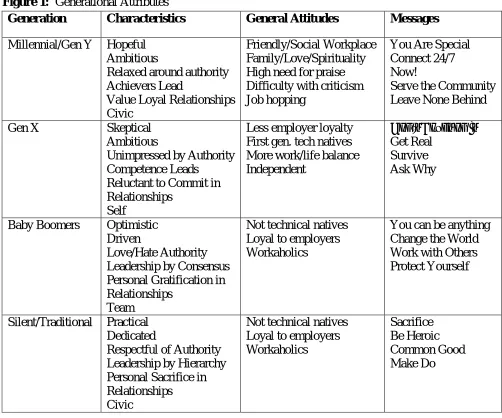
Figure 1: Generational Attributes
Generation Characteristics General Attitudes Messages
Millennial/Gen Y Hopeful Ambitious
Relaxed around authority Achievers Lead
Value Loyal Relationships Civic
Friendly/Social Workplace Family/Love/Spirituality High need for praise Difficulty with criticism Job hopping
You Are Special Connect 24/7 Now!
Serve the Community Leave None Behind
Gen X Skeptical Ambitious
Unimpressed by Authority Competence Leads
Reluctant to Commit in Relationships
Self
Less employer loyalty First gen. tech natives More work/life balance Independent
Don’t Count on it Get Real
Survive Ask Why
Baby Boomers Optimistic Driven
Love/Hate Authority Leadership by Consensus Personal Gratification in Relationships
Team
Not technical natives Loyal to employers Workaholics
You can be anything Change the World Work with Others Protect Yourself
Silent/Traditional Practical Dedicated
Respectful of Authority Leadership by Hierarchy Personal Sacrifice in Relationships
Civic
Not technical natives Loyal to employers Workaholics
Sacrifice Be Heroic Common Good Make Do
While younger physicians may have differing motivations from their older peers, it is questionable whether these actually alter their approach to picking a practice location. This study was designed to determine whether generational differences influenced family medicine and other primary care physicians in their reasons for choosing a practice site. It sought to determine not only the top overall reasons for choosing a practice location, so that practice sites and educational institutions could potentially choose students with particular goals and
ambitions, but was also designed to serve as a guidance tool for practice sites seeking to recruit younger physicians and determine if new approaches to recruitment were warranted.
METHODS
development was started with focus group interviews with 24 residents and 12 faculty from the East Carolina University Family Medicine residency program. Residents and faculty were given open-ended questions regarding their top reasons for choosing a practice site. The survey was then pilot tested on a general population of family medicine physicians at Brody School of Medicine (n=25). The final 21 items used in the survey instrument included all items cited by the faculty and residents and perceived as potentially modifiable. Past surveys have focused on the spouse as an active partner in the decision making process in site selection. (6) This factor was not included in our survey as we found that a spouse’s acceptance of a site would have been considered prior to the application process, and was not based on practice factors, but rather personal factors. Therefore, this factor was found to be inherent and pre-determined in married physicians (and almost 95% of the survey population had been or was married), and as a
potentially modifiable reason for choosing a site it was not a primary concern. For this reason, as well as the lack of influence a clinical site or educational institution could have on spousal approval of a site, it was decided not to include this in the survey. Spousal employment as a factor however, was found to be potentially modifiable and was therefore included as a factor. Final survey development was completed by the investigator and reviewed and approved by the project team. The final survey consisted of 24 demographic and background questions in a checkbox format and 2 questions regarding reasons for site selection, including the primary 21 item 7-point Likert scale list, and a question asking the respondents to rank their top three reasons for choosing a practice site in a fill-in-the-blank format. For this research the Likert scale was continuous with 1 indicating least important and 7 indicating most important. For this study, generations were defined as age 25-34/millennials, 35-44/generation X, 45-64/baby boomers, and over 65/silent generation. This was based on a definition commonly used and compiled by Strauss, W & Howe, N. (1992) The History of America’s Future, 1584-2069, Perennial, New York. Metropolitan and non-metropolitan designations were created using the United States Department of Agriculture, Rural-Urban Area Commuting Codes (RUCA) (http://www.ers.usda.gov/data-products/rural-urban-commuting-area
codes.aspx#.U9_cs6Nn2So), with areas defined as 1-3 as metro (35 counties), and areas of 4-10 defined as non-metro (65 counties). The project was reviewed and approved under East Carolina University IRB UMCIRB 12-000255. The project was also supported under HRSA/BHPr grant #D58HP-P23217.
All active members of the NC Medical Board with a North Carolina address who were listed as primary care physicians including; family medicine, general practitioner, OB/GYN, pediatrics and general internal medicine (n=2,880) were surveyed in July 2012. The inclusion of OB-GYN as a primary care specialty was based on the definition currently used by the state of North Carolina, and analysis of different types of practitioners was done to determine if significant differences existed between groups. Surveys were sent via first class mail with a postage paid return envelope to the address listed in the NC Medical Board database. A follow up was sent in September 2012 to increase response rate. Statistics were analyzed using rank order, t-test, ANOVA, and Bonferroni’s post-hoc, and Spearman’s rho to determine group differences. Missing data were analyzed utilizing listwise deletion. Statistics were analyzed using SPSS v. 20.
RESULTS
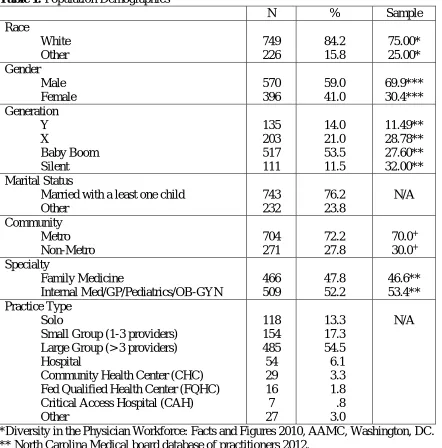
continuum codes). Table 1 displays demographics of the study sample. Of the 975 participants, 59% were male. Generation Y physicians (age group 25-34) represented about 14% of the sample. The majority of respondents represented the baby boom generation (54%). Eighty-four percent of the sample was White/Caucasian. Of the 975 participants 76% were married and had at least one child, 4.2% were unmarried with no children, and the remainder was
divorced/separated/widowed or living with a partner. About 48% of the participants indicated family medicine as their specialty and about 55% practice medicine in a large group practice (defined as > 3 providers). Because the North Carolina Medical Board does not contain in-depth demographic information, we were unable to make a direct comparison to the general population of licensed North Carolina providers, however basic demographics for the family medicine respondents (gender, age, and rural/urban practice), were similar to those of a general population described as described by various sources and the sample was found to be similar to the group as a whole. The sample was also representative of family medicine versus specialty populations at the state level with the total North Carolina physician population equaling 46.6% family
Table 1: Population Demographics
N % Sample
Race White Other 749 226 84.2 15.8 75.00* 25.00* Gender Male Female 570 396 59.0 41.0 69.9*** 30.4*** Generation Y X Baby Boom Silent 135 203 517 111 14.0 21.0 53.5 11.5 11.49** 28.78** 27.60** 32.00** Marital Status
Married with a least one child Other 743 232 76.2 23.8 N/A Community Metro Non-Metro 704 271 72.2 27.8 70.0+ 30.0+ Specialty Family Medicine Internal Med/GP/Pediatrics/OB-GYN 466 509 47.8 52.2 46.6** 53.4** Practice Type Solo
Small Group (1-3 providers) Large Group (> 3 providers) Hospital
Community Health Center (CHC) Fed Qualified Health Center (FQHC) Critical Access Hospital (CAH) Other 118 154 485 54 29 16 7 27 13.3 17.3 54.5 6.1 3.3 1.8 .8 3.0 N/A
*Diversity in the Physician Workforce: Facts and Figures 2010, AAMC, Washington, DC. ** North Carolina Medical board database of practitioners 2012.
*** From the 2012 Physician Specialty Data Book, AAMC, Washington, D.C.
+ Demographic and Economic Profile of North Carolina 2008, Rural Policy Institute, Columbia,
MO.
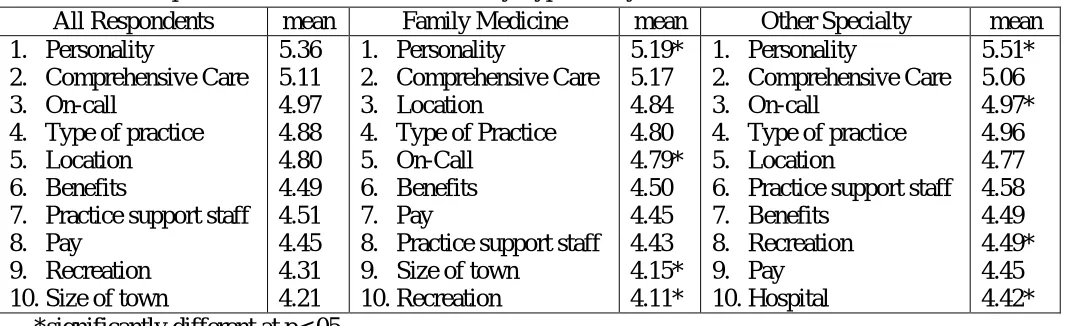
Among all participants, the items chosen as most important based on the mean were personality of other physicians in the practice (5.31 ± 1.9) opportunity to provide comprehensive care (5.12 ± 1.6) and on-call responsibility (4.96 ± 1.7). Daycare/childcare, shopping and patient racial diversity represented the least important site selection factors among all participants.
Table 2 represents the top ten site selection factors among all respondents. Respondents from metropolitan and non-metropolitan counties differed only on one factor where those from metropolitan counties ranked the number of physicians in the practice in the top ten and
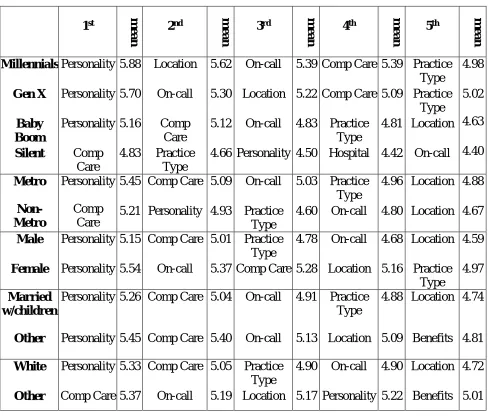
nine other factors differing only in rank order. Generationally, the top site selection factors remained relatively constant with the top three being one of the following five among all four generations; on-call responsibility, location, personality of other physicians in the practice, opportunity to provide comprehensive care, and type of practice (e.g., solo, small group). White physicians ranked personality as the most important site selection factor while other races indicated the opportunity to provide comprehensive care was most important. However, when looking at the top ten among these two groups, eight of the ten were the same but differed in rank order. When comparing family medicine physicians to other primary care specialties, eight of the top ten were the same but in differing order. The top two factors for both of these groups were personality of the other physicians in the practice and the opportunity to provide
comprehensive care. Males and females differed in only two of the top ten factors, where males indicated recreation and size of town were among the top ten, females indicated the number of physicians in the practice and job for spouse were in the top ten. Males and females agreed on eight of the top ten factors but rank order differed slightly. Females ranked the opportunity to provide comprehensive care the highest while males selected the personality of other physicians in the practice as most important. Table 3 indicates the top five site selection factors among various demographic groups.
Table 2: Comparison of Site Selection Factors by Type of Physician
All Respondents mean Family Medicine mean Other Specialty mean 1. Personality
2. Comprehensive Care 3. On-call
4. Type of practice 5. Location
6. Benefits
7. Practice support staff 8. Pay
9. Recreation 10.Size of town
5.36 5.11 4.97 4.88 4.80 4.49 4.51 4.45 4.31 4.21
1. Personality
2. Comprehensive Care 3. Location
4. Type of Practice 5. On-Call
6. Benefits 7. Pay
8. Practice support staff 9. Size of town
10. Recreation 5.19* 5.17 4.84 4.80 4.79* 4.50 4.45 4.43 4.15* 4.11* 1. Personality
2. Comprehensive Care 3. On-call
4. Type of practice 5. Location
Table 3: Top Five Practice Site Selection Factors between Groups
1st
m
ean 2nd
m
ean 3rd
m
ean 4th
m
ean 5th
m ean Millennials Gen X Baby Boom Silent Personality Personality Personality Comp Care 5.88 5.70 5.16 4.83 Location On-call Comp Care Practice Type 5.62 5.30 5.12 4.66 On-call Location On-call Personality 5.39 5.22 4.83 4.50 Comp Care Comp Care Practice Type Hospital 5.39 5.09 4.81 4.42 Practice Type Practice Type Location On-call 4.98 5.02 4.63 4.40 Metro Non- Metro Personality Comp Care 5.45 5.21 Comp Care Personality 5.09 4.93 On-call Practice Type 5.03 4.60 Practice Type On-call 4.96 4.80 Location Location 4.88 4.67 Male Female Personality Personality 5.15 5.54 Comp Care On-call 5.01 5.37 Practice Type Comp Care 4.78 5.28 On-call Location 4.68 5.16 Location Practice Type 4.59 4.97 Married w/children Other Personality Personality 5.26 5.45 Comp Care Comp Care 5.04 5.40 On-call On-call 4.91 5.13 Practice Type Location 4.88 5.09 Location Benefits 4.74 4.81 White Other Personality Comp Care 5.33 5.37 Comp Care On-call 5.05 5.19 Practice Type Location 4.90 5.17 On-call Personality 4.90 5.22 Location Benefits 4.72 5.01
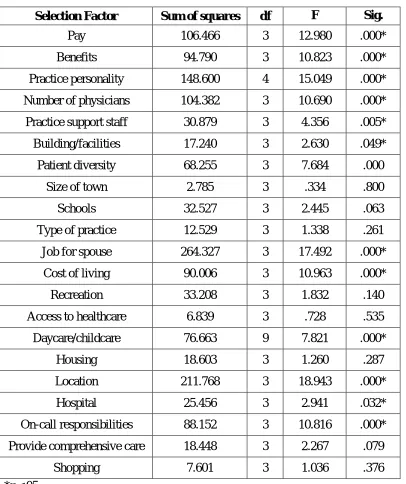
Table 4: ANOVA for between group test variables
Selection Factor Sum of squares df F Sig.
Pay 106.466 3 12.980 .000*
Benefits 94.790 3 10.823 .000*
Practice personality 148.600 4 15.049 .000* Number of physicians 104.382 3 10.690 .000* Practice support staff 30.879 3 4.356 .005* Building/facilities 17.240 3 2.630 .049* Patient diversity 68.255 3 7.684 .000
Size of town 2.785 3 .334 .800
Schools 32.527 3 2.445 .063
Type of practice 12.529 3 1.338 .261 Job for spouse 264.327 3 17.492 .000*
Cost of living 90.006 3 10.963 .000*
Recreation 33.208 3 1.832 .140
Access to healthcare 6.839 3 .728 .535 Daycare/childcare 76.663 9 7.821 .000*
Housing 18.603 3 1.260 .287
Location 211.768 3 18.943 .000*
Hospital 25.456 3 2.941 .032*
On-call responsibilities 88.152 3 10.816 .000* Provide comprehensive care 18.448 3 2.267 .079
Shopping 7.601 3 1.036 .376
*p<.05
DISCUSSION
The results of this study determined that family medicine and primary care physicians have relatively stable and consistent reasons for choosing a practice site. Generational differences were found to be relatively benign and responses across different ages were found to be
being slightly more interested in schools and daycare were logical, but did not ultimately change the top reasons physicians chose their practice location. It is also worthwhile to note that the effect of spousal work, while important for some, was not chosen by any generation as a top five reason for practice site. While this is contrary to some other research in this area, (6,12) it can possibly be explained by the fact that spouses seldom consider or apply to sites not already approved by their spouse.
The top reasons that were found to be most important across generations, races, genders, types of physicians, and marriage status, included: 1) personality of the practice, 2) opportunity to
practice comprehensive care, 3) on-call responsibilities, 4) location, 5) practice type, and 6) benefits. What is particularly important to note about this list is that many of the items can be managed by practices to attract the very best employees. Practice variables, such as location and practice type cannot be easily altered by the employer, but the majority of the remaining items can be managed, at least to some extent, by the practice. Some items, such as personality of the practice, opportunity to practice comprehensive care, and on-call responsibilities may very well be indicative of the overall health of the practice and can be tailored individually to potentially recruit physicians. It is important to note that the personality of the practice ranked in the top three for all generations and was particularly important for younger physicians. Other items that ranked somewhat higher for particular groups may also be considered as attractors for various generations and groups of physicians.
Overall, this research indicated that little difference occurs between physicians in what factors they utilize to choose a practice site. These factors also tend to be incredible similar across generational lines and other demographic factors. To a certain extent, it also diminishes the perception that younger physicians, and perhaps those currently training, have significantly different attitudes and approaches to their choice of practice location. It also indicates that there should be further research done to define whether physicians are more prone to choose certain locations for practice due to their backgrounds before their medical training (i.e. predisposing factors), or whether it is more effective to alter these factors with focused training in
geographical areas of need.
LIMITATIONS
This research focused on factors that could be addressed by organizations or institutions when recruiting primary care physicians. Some social and personal factors that may play a role in practice site selection were not addressed. Further study to determine these factors should be examined with further research. While the population was representative of North Carolina and in general terms primary care physicians as a population, it was not a national sample. Some sub-groups were also not large enough to adequately compare to the larger population, such as single and minority physicians. Further research to examine these factors on a national basis would be appropriate.
CONCLUSION
REFERENCES
1. Tavernier LA, Connor PD, Gate D, Wan JY. Does exposure to medically underserved areas during training
influence eventual choice of practice location? Med Educ. 2003; 37:299-304.
2. Hancock C, Steinbach A, Nesbitt TS, Adler SR, Auerswald CL. Why doctors choose small towns: A
developmental model of rural physician recruitment and retention. Soc Sci Med. 2009; 69:1368-76.
3. Daniels ZM, VanLeit BJ, Skipper BJ, Sanders ML, Rhyne RL. Factors in recruiting and retaining health
professionals for rural practice. J Rural Health. 2007; 23(1):62-71.
4. Steinbrook R. Easing the shortage in adult primary care-Is it all about money? N Engl J Med. 2009;
360(26):2696-9.
5. LaRavia D, Calvert J, Zavala J, et al. Keeping physicians in rural practice. Kansas Rural Health Works
Position Paper. 2002. Available from:
http://www.krhw.net/assets/docs/Physician%20Recruitment/Keeping_Physicians_in_Rural_Practice.pdf
6. Costa AJ, Schrop SL, McCord G, Gillanders WR. To stay or not to stay: Factors influencing family
practice residents’ choice of initial practice location. Fam Med. 1996; 28:214-9.
7. Geyman JP, Hart LG, Norris TE, Coombs JB, Lishner DM. Educating generalist physicians for rural
practice: How are we doing? J Rural Health. 2000; 16(1):56-80.
8. Quinn KJ, Hosokawa MC. Factors contributing to the specialty selection, practice location, and retention of
physicians in rural practice. Ann Behav Sci Med Educ. 2010; 16(1):21-27.
9. Pew Research Center. Millennials: Confident. Connected. Open to change; 2010. Available from:
http://www.pewsocialtrends.org/2010/02/24/millennials-confident-connected-open-to-change/
10. Forum for Innovation: US Chamber of Commerce Foundation. The millennial generation research review;
2012. Available from: http://forum.uschamber.com/MillennialsReport
11. Johnston, S. See one, do one, teach one: Developing professionalism across the generations. Clin Orthop
Relat R. 2006: 449:186-192
12. American Academy of Pediatrics Department of Research. How do gender, generational differences affect
pediatric workforce? AAP News. 2014; 35:13
13. Putre, L. The march of the millennials. Your hospital staff in 2025: The same only different. Hospitals and Health Networks. 87; 9:38-40.
14. Twenge, J. Campbell, W.K., & Freeman, E.C. Generational differences in young adults life goals, concern
for others, and civic orientation, 1996-2009. J Pers Soc Psychol. 102; 5;1045-1062.
15. Straus, W. & Howe, N. Generations: The history of America’s future, 1584-2069, Perennial Press. 1992.
16. Tolbize A. Generational differences in the workplace. Minneapolis (MN): Research and Training Center on
Community Living, University of Minnesota; 2008.
17. Raines, C.: Connecting Generations, Menlo Park, CA, Crisp Publications, 2003.