Vol. 13, No. 2, 2017, 165-172
ISSN: 2279-087X (P), 2279-0888(online) Published on 4 April 2017
www.researchmathsci.org
DOI: http://dx.doi.org/10.22457/apam.v13n2a2
165
Annals of
New Arithmetic-Geometric Indices
V.R.Kulli
Department of Mathematics
Gulbarga University, Gulbarga 585106, India e-mail: vrkulli @gmail.com
Received 19 March 2017; accepted 28 March 2017
Abstract. We introduce some new topological indices: second, third, fourth and fifth arithmetic-geometric indices of a molecular graph. A single number that can be computed from the molecular graph and used to characterize some property of the underlying molecule is said to be topological index or molecular structure descriptor. In this paper, we compute the general reformulated first Zagreb index and the fifth arithmetic-geometric index of triangular benzenoid Tn and hexagonal parallelogram P(m,n) nanotube
by using the line graphs of subdivision graphs of these chemical graphs.
Keywords: topological index, second, third, fourth and fifth arithmetic-geometric indices, triangular benzenoid, hexagonal parallelogram P(m, n) nanotube.
AMS Mathematics Subject Classification (2010): 05C05, 05C12, 05C35 1. Introduction
We consider only finite, simple and connected graph with a vertex V(G) and an edge set E(G). The degree dG(v) of a vertex v is the number of vertices adjacent to v. The edge
connecting the vertices u and v will be denoted by uv. Let dG(e) denote the degree of an
edge e=uv in G, which is defined by dG(e)= dG(u)+ dG(v) – 2. Let SG(v) denote the sum of
degrees of all vertices adjacent to a vertex v. The line graph L(G) of a graph G is the graph whose vertex set corresponds to the edges of G such that two vertices of L(G) are adjacent if the corresponding edges of G are adjacent. The subdivision graph S(G) of a graph G is the graph obtained from G by replacing each of its edges by a path of length two. We refer to [1, 2] for undefined term and notation.
We need the following existing results.
Lemma 1. [1] Let G be a (p, q) graph. Then L(G) has q vertices and
( )
2 11 2
p
G i i
d u q
=
−
∑
edges.
Lemma 2. [1] Let G be a (p, q) graph. Then S(G) has p+q vertices and 2q edges.
166
which has an important effect on the development of the chemical sciences. A single number that can be computed from the molecular graph and used to characterize some property of the underlying molecule is said to be a topological index or molecular structure descriptor. Numerous such descriptors have been considered in theoretical chemistry and have found some applications, especially in QSPR/QSAR research, see [3]
In [4], Miličević et al. reformulated the first Zagreb index in terms of edge degrees instead of vertex degrees and defined the respective topological index as
( )
( )
( ) 2
1 G .
e E G
EM G d e
∈
=
∑
This topological index was also studied, for example, in [5, 6]. The K-edge index of a graph G is defined as
( )
( )
( ) 3
.
e G
e E G
K G d e
∈
=
∑
The K-edge index was introduced by Kulli in [7] and was studied, for example, in [8].
In [9], Kulli proposed the general reformulated Zagreb index of a graph G and defined it as
( )
( )
( ) 1 a a G e E GEM G d e
∈
=
∑
where a is a real number.
The arithmetic-geometric index [10] of a graph is defined as
( )
( )
( )
( ) ( )
( ) 1 . 2 ∈ +=
∑
G Guv E G G G
d u d v
AG G
d u d v
Motivated by previous research on topological indices, we now propose the second, third, fourth and fifth arithmetic-geometric indices of a graph as follows:
The second arithmetic-geometric index of a graph G is defined as
( )
( ) 2
2
u v
uv E G u v
n n AG G n n ∈ + =
∑
where the number nu of vertices of G lying closer to the vertex v for the edge uv of a
graph G.
The third arithmetic-geometric index of a graph G is defined as
( )
( ) 3
2
u v
uv E G u v
m m AG G m m ∈ + =
∑
where the number mu of edges of G lying closer to the vertex v for the edge uv of a graph
G.
The fourth arithmetic-geometric index of a graph G is defined as
( )
( ) ( )
( ) ( )
( ) 4
2
uv E G
u v AG G u v ε ε ε ε ∈ + =
∑
167
( )
( )
( )
( ) ( )
( ) 5
2
G G
uv E G G G
S u S v
AG G
S u S v
∈
+
=
∑
where SG(u) is the sum of the degrees of all vertices adjacent to a vertex u.
In this paper, we compute the general reformulated first Zagreb index, reformulated first Zagreb index, K-edge index and fifth arithmetic-geometric index of triangular benzenoids Tn and hexagonal parallelogram P(m, n) nanotubes by using the
line graphs of the subdivision graphs of these chemical graphs.
2. Results for triangular Benzenoids Tn, n∈∈∈∈N
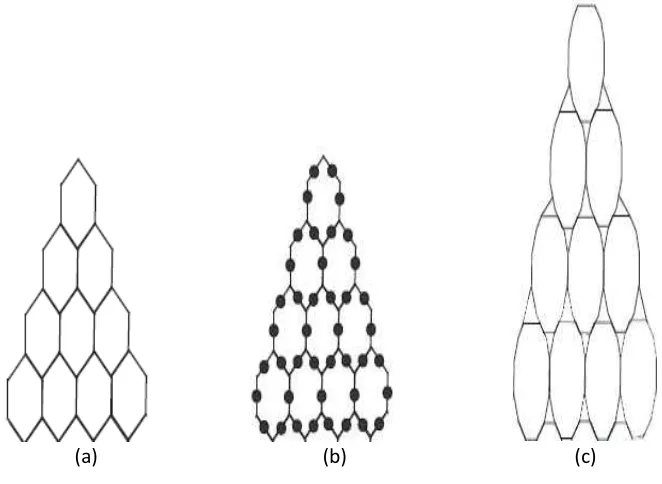
We consider triangular benzenoids which is a family of benzenoid molecular graphs. We denote the triangular benzenoid molecular graph by Tn in which n is the number of
hexagons in the base of a graph, as shown in Figure 1(a). Clearly a triangular benzenoid
Tn has |V(Tn)|= n 2
+ 4n + 1 vertices and
( )
3(
3)
2n
E T = n n+ edges.
The line graph of the subdivision graph of triangular benzenoid Tn is depicted in
Figure 1(c).
(a) (b) (c)
Figure 1: (a) triangular benzenoid T4 (b) subdivision graph of T4 (c) Line graph of the
subdivision graph of T4.
168
Theorem 1. Let G be the line graph of the subdivision graph of a triangular benzenoid Tn,
n ∈ N. Then
( ) (
)
(
)
(
2)
1
3
3 3 2 6 1 3 3 1 4 .
2
a a a a
EM G = n+ + n− + n + −n (1)
where a is a real number.
Proof: The triangular benzenoid is a graph with n2 + 4n + 1 vertices and 3
(
3)
2n n+ edges. By Lemma 2 and Lemma 1, the line graph of the subdivision graph G has(
2)
3
3 7 2
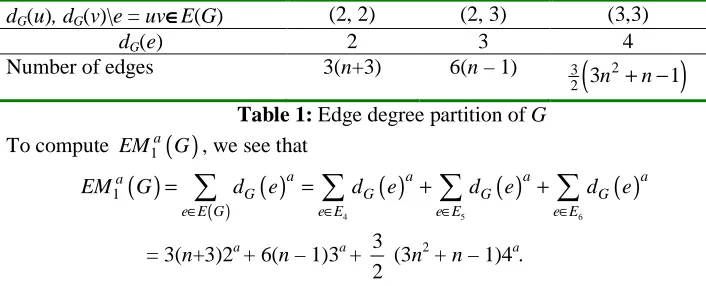
2 n + n− edges. Father, the edge partition of G based on degree of end vertices of each edge is given in Table 1.
dG(u), dG(v)\e = uv∈∈∈∈E(G) (2, 2) (2, 3) (3,3)
dG(e) 2 3 4
Number of edges 3(n+3) 6(n – 1) 3
(
2)
2 3n + −n 1
Table 1: Edge degree partition of G To compute EM1a
( )
G , we see that( )
( )
( ) 4
( )
5( )
6( )
1
a a a a
a
G G G G
e E G e E e E e E
EM G d e d e d e d e
∈ ∈ ∈ ∈
=
∑
=∑
+∑
+∑
= 3(n+3)2a + 6(n – 1)3a + 3 2 (3n
2
+ n – 1)4a.
An immediate result is the reformulated first Zagreb index of G.
Corollary 1.1. Let G be the line graph of the subdivision graph of a triangular benzenoid Tn, n∈N. Then
EM1(G) = 72n2 + 90n + 42.
Proof: Put a = 2 in equation (1), we get the required result.
Corollary 1.2. Let G be the line graph of the subdivision graph of a triangular benzonoid Tn, n∈N. Then
Ke(G) = 288n 2
+ 282n – 186.
Prof: Put a = 2 in equation (1), we get the required result.
We compute fifth arithmetic-geometric index of the line graph of the subdivision graph of a triangular benzenoid.
Theorem 2. Let G be the line graph of the subdivision graph of a triangular benzenoid Tn,
n∈N. Then
( )
25
9 39 17 3 27 39 17
6
2 2 10 2 2 2 2 5 2 10 2 2
AG G = n + + − n+ − − +
, if n ≠ 1,
169
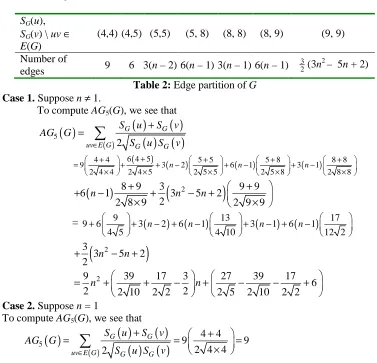
Proof: The edge partition based on the degree sum of neighbor vertices of each edge of G is obtained as given in Table 2.
SG(u),
SG(v) \ uv ∈
E(G)
(4,4) (4,5) (5,5) (5, 8) (8, 8) (8, 9) (9, 9)
Number of
edges 9 6 3(n – 2) 6(n – 1) 3(n – 1) 6(n – 1) 3 2(3n
2
– 5n + 2)
Table 2: Edge partition of G Case 1. Suppose n ≠ 1.
To compute AG5(G), we see that
( )
( )
( )
( ) ( )
( ) 5
2
∈
+
=
∑
G Guv E G G G
S u S v
AG G
S u S v
( ) ( ) ( ) ( )
6 4 5
4 4 5 5 5 8 8 8
9 3 2 6 1 3 1
2 4 4 2 4 5 2 5 5 2 5 8 2 8 8
+
+ + + +
= + + − + − + −
× × × × ×
n n n
(
)
8 9 3(
2)
9 96 1 3 5 2
2
2 8 9 2 9 9
n + n n +
+ − + − +
× ×
= 9 6 9 3
(
2) (
6 1)
13 3(
1) (
6 1)
174 5 n n 4 10 n n 12 2
+ + − + − + − + −
(
2)
3
3 5 2
2 n n
+ − +
2
9 39 17 3 27 39 17
6
2n 2 10 2 2 2 n 2 5 2 10 2 2
= + + − + − − +
Case 2. Suppose n = 1
To compute AG5(G), we see that
( )
( )
( )
( ) ( )
( ) 5
4 4
9 9
2 4 4 2
∈
+ +
= = =
×
∑
G Guv E G G G
S u S v
AG G
S u S v
3. Results for hexagonal parallelogram P(m, n) for any m,n ∈∈∈∈ N nanotubes
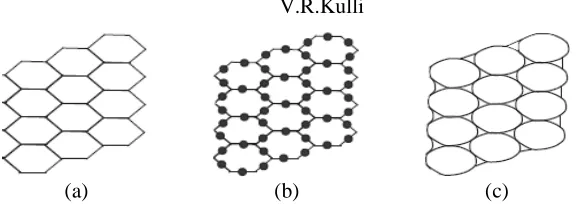
We consider hexagonal parallelogram nanotubes. These nanotubes usually symbolized as P(m, n) for any m, n ∈ N in which m is the number of hexagons in any row and n is the number of hexagons in any column, see. Figure 2(a). A hexagonal parallelogram P(m, n) has 2 (m+n+mn) vertices and 3mn + 2m +2n – 1 edges.
The line graph of the subdivision graph of hexagonal parallelogram P(m,n) is depicted in Figure 2(c).
170
(a) (b) (c)
Figure 2: (a) hexagonal parallelogram P(3,4) (b) subdivision graph of P(3,4) (c) line graph of the subdivision graph of P(3,4).
Theorem 3. Let G be the line graph of the subdivision graph of a hexagonal parallelogram P(m, n) for any m, n ∈ N. Then
( ) (
)
(
)
(
)
( )
1 2 4 2 4 2 3 9 2 2 5 4
a a a a
EM G = m+ +n + m+ −n + mn− m− n− (2)
where a is a real number.
Proof: The hexagonal parallelogram is a graph with 2(m+n+mn) vertices and 3mn+2m+2n – 1 edges. By Lemma 2 and Lemma 1, the line graph of the subdivision graph G has 2(3mn+2m+2n – 1) vertices and 9mn+4m+4n–5) edges. Further, the edge partition of G based on degree of end vertices of each edge is given in Table 3.
dG(u), dG(v)\e = uv∈E(G) (2, 2) (2, 3) (3,3)
dG(e) 2 3 4
Number of edges 2(m+n+4) 4(m+n–2) 9mn–2m–2n–5
Table 3: Edge degree partition of G.
To compute EM1( )a
( )
G ,we see that( )
( )
( ) 4
( )
5( )
6( )
( ) 1
a a a a
a
G G G G
e E G e E e E e E
EM G d e d e d e d e
∈ ∈ ∈ ∈
=
∑
=∑
+∑
+∑
= 2(m+n+4)2a + 4(m+n – 2)3a + (9mn – 2m – 2n – 5)4a. An immediate result is the reformulated first Zagreb index of G.
Corollary 3.1. Let G be the line graph of the subdivision graph of a hexagonal parallelogram P(m, n) for any m,n ∈ N. Then
EM1(G) = 144mn + 12(m+n) – 120.
Proof: Put a = 2 in equation (2), we get the required result. Another immediate result is the K-edge index of G.
Corollary 3.2. Let G be the line graph of the subdivision graph of a hexagonal parallelogram P(m,n) for any m, n ∈ N. Then
Ke(G) = 576mn – 4(m+n) – 472.
Proof: Put a = 3 in equation (2), we get the required result.
171
Theorem 4. Let G be the line graph of the subdivision in graph of a hexagonal parallelogram P(m,n) for any m, n ∈ N. Then
( )
513 17 9 13 17
5 3 ,
10 3 2 5 10 3 2
AG G = + + n+ + − −
if n≠1, m=1.
(
)
13 17 18 26 34
9 4 3 ,
10 3 2 5 10 3 2
mn m n
= + + − + + + − −
if n≠1, m>1.
Proof: Case 1. The edge partition based on the degree sum of neighbor vertices of each edge of G = P(m,n) n ≠ 1, m = 1 is obtained as given in Table 4.
SG(u),
SG(v)\ uv ∈E(G)
(4,4) (4,5) (5,5) (5, 8) (8, 8) (8, 9) (9,9)
Number of edges 10 4 2(n–2) 4(n–1) 2(n–1) 4(n–1) n–1 Table 4: Edge partition of G = P(m, n) , n ≠ 1, m = 1
Suppose n ≠ 1 and m = 1. To compute AG5(G), we see that
( )
( )
( )
( ) ( )
( ) 5
2
G G
uv E G G G
S u S v
AG G
S u S v
∈
+
=
∑
(
)
(
)
4 4 4 5 5 5 5 8
10 4 2 2 4 1
2 4 4 2 4 5 2 5 5 2 5 8
+ + + +
= + + − + −
× × × ×
n n
(
)
8 8(
)
8 9(
)
9 92 1 4 1 1
2 8 8 2 8 9 2 9 9
n + n + n +
+ − + − + −
× × ×
13 17 9 13 17
5 3 .
10 3 2 n 5 10 3 2
= + + + + − −
Case 2. The edge partition based on the degree sum of neighbor vertices of each edge of G = P(m,n), n ≠ 1, m>1 is obtained as given in Table 5.
SG(u),
SG(v) \ uv∈E(G)
(4,4) (4,5) (5,5) (5, 8) (8, 8) (8, 9) (9,9)
Number of edges 8 8 2(m+n–4) 4(m+n–2) 2(m+n–2) 4(m+n–2) 9mn-8(m+n)+7
Table 5: Edge partition of G =P(m, n), n ≠ 1, m>1.
Suppose n ≠ 1, and m>1.
To compute AG5(G), we see that
( )
( )
( )
( ) ( )
( ) 5
2
G G
uv E G G G
S u S v
AG G
S u S v
∈
+
=
∑
(
)
(
)
4 4 4 5 5 5 5 8
8 8 2 4 4 2
2 4 4 2 4 5 m n 2 5 5 m n 2 5 8
+ + + +
= + + + − + + −
× × × ×
172
(
)
8 8(
)
8 9(
)
9 92 2 4 2 9 8 8 7
2 8 8 2 8 9 2 9 9
m n + m n + mn m n +
+ + − + + − + − − +
× × ×
(
)
13 17 18 26 34
9 4 3 .
10 3 2 5 10 3 2
mn m n
= + + − + + + − −
REFERENCES
1. F.Harary, Graph Theory, Addison Wesley, Reading MA. (1969).
2. V.R.Kulli, College Graph Theory, Vishwa International Publications, Gulbarga, India (2012).
3. I.Gutman, Degree-based topological indices, Croat. Chem. Acta., 86 (2013) 351-361. 4. A.Milićević, S.Nikolić, and N.Trinajstić, On reformulated Zagreb indices, Mol.
Divers, 8 (2004) 393-399.
5. V.R.Kulli, On K indices of graphs, International Journal of Fuzzy Mathematical Archive, 10(2) (2016) 105-109.
6. I.Gutman, V.R.Kulli, B.Chaluvaraju and H.S. Baregowda, On Banhatti and Zagreb indices, Journal of the International Mathematical Virtual Institute, 7(2017) 53-67. 7. V.R.Kulli, On K edge index and coindex of graphs, International Journal of Fuzzy
Mathematical Archive, 10(2) (2016) 111-116.
8. V.R.Kulli, On K edge index of some nanostructures, Journal of Computer and Mathematical Sciences, 7(7) (2016) 373-378.
9. V.R.Kulli, Computation of general topological indices for titania nanotubes, International Journal of Mathematical Archive, 7(12) (2016) 33-38.
10. V.Shigehalli and R.Kanabur, Computing degree based topological indices of polyhex nanotube, Journal of Mathematical Nanoscience, 6(1-2) (2016) 47-55.
11. S.Akhter and M.Imran, On molecular topological properties of benzenoid structures, Canadian Journal of Chemistry, (2016) 1-27.
12. V.R.Kulli, On multiplicative connectivity indices of certain nanotubes, Annals of Pure and Applied Mathematics, 12(2) (2016) 169-176.
13. V.R.Kulli, Some new multiplicative geometric-arithmetic indices, Journal of Ultra Scientist of Physical Sciences, A 29(2) (2017) 52-67.
DOI:http://dx.odi.org/10.22147/jusps-A/290201.
14. V.R.Kulli, Two new multiplicative atom bond connectivity indices, Annals of Pure and Applied Mathematics, 13(1) (2017) 1-7.