Vol. 12, 2018, 33-39
ISSN: 2349-0632 (P), 2349-0640 (online) Published 16 February 2018
www.researchmathsci.org
DOI: http://dx.doi.org/10.22457/jmi.v12a4
33
Journal of
Edge Stable Sets and Edge Independent Sets in
Hypergraphs
D.K.Thakkar1 and V.R.Dave2
1
Department of Mathematics, Saurashtra University, Rajkot – 360 005, India Email: [email protected]
2
Shree M. and N. Virani Science College, Kalavad Road, Rajkot – 360 005, India Email: [email protected]
2
Corresponding author
Received 12 January 2018; accepted 31 January 2018
Abstract. In this paper we have introduce two new concepts namely edge stable sets& edge independent sets in hypergraphs. We have proved a necessary and sufficient condition under which an edge stable set is a maximal edge stable set. We have also proved an important result that an edge stable set of a hypergraph is a maximal edge stable set of it if and only if it is a minimal edge h–dominating set of that hypergraph. A characterization of edge independent set is also given by us and some results related to edge independent set in hypergraphs have been proved.
Keywords: Hypergraph, Edge Stable Set, Edge Independent Set, Maximum Edge Stable Set, Maximal Edge Stable Set, Maximal Edge Independent Set
AMS Mathematics Subject Classification (2010): 05C15, 05C69, 05C65
1. Introduction
Domination related parameters for graphs have been studied by several authors [5, 6]. These parameters can also be extended to hypergraphs and new parameters related to hypergraph have been introduced in [8, 9]. The domination in hypergraphs has been studied in [2]. We introduce the concept of edge h-domination for hypergraphs in [10]. In this paper we introduce two new concepts namely edge stable sets and edge independent sets for hypergraphs. We relate them with known concepts of edge domination and edge h- domination. We also give characterization of maximal sets of the above types.
2. Preliminaries
Definition 2.1. (Hypergraph) [4] A hypergraph ܩ is an ordered pair (ܸ(ܩ), ܧ(ܩ)) where ܸ(ܩ) is a non-empty finite set and ܧ(ܩ) is a family of non-empty subsets of ܸ(ܩ)
∋ their union = ܸ(ܩ).The elements of ܸ(ܩ) are called vertices& the members of ܧ(ܩ) are called edges of the hypergraph ܩ.
We make the following assumption about the hypergraph. (1) Any two distinct edges intersect in at most one vertex.
34
Definition 2.2. (Edge degree) [4] Let G be a hypergraph and v ∈ V(G) then the edge degree of v = dE(v) = the number of edges containing the vertex v. The minimum edge degree among all the vertices of G is denoted as δE(G) and the maximum edge degree is denoted as ∆E(G).
Definition 2.3. (Dominating set in hypergraph) [1] Let G be a hypergraph and ܵ ⊆ ܸ(ܩ) then S is said to be a dominating set of G if for every ݒ ∈ ܸ(ܩ) – ܵ there is ݑ ∈ ܵ ∋ u and v are adjacent vertices.
A dominating set with minimum cardinality is called minimum dominating set and cardinality of such a set is called domination number of G and it is denoted as γ (ܩ).
Definition 2.4. (Edge dominating set) [7] Let G be a hypergraph and ܵ ⊆ ܧ(ܩ) then S is said to be an edge dominating set of G if for every ݁ ∈ ܧ(ܩ) – ܵ there is some f in S ∋ e and f are adjacent edges.
An edge dominating set with minimum cardinality is called a minimum edge dominating set and cardinality of such a set is called edge domination number of G and it is denoted as γE(G).
Definition 2.5. (Sub hypergraph and partial sub hypergraph) [3] Let G be a hypergraph and ݒ ∈ ܸ(ܩ). Consider the subset ܸ(ܩ) – {ݒ} ݂ ܸ(ܩ).This set will induce two types of hypergraphs from G.
(1) First type of hypergraph: Here the vertex set = ܸ(ܩ)– {ݒ} and the edge set= {݁′ / ݁′ = ݁ – {ݒ} ݂ݎ ݏ݉݁ ݁ ∈ ܧ(ܩ)}. This hypergraph is called the sub hypergraph of G and it is denoted as ܩ – {ݒ}.
(2) Second type of hypergraph: Here also the vertex set = ܸ(ܩ) – {ݒ} and edges in this hypergraph are those edges of G which do not contain the vertex v.This hypergraph is called the partial sub hypergraph of G.
Definition 2.6. (Edge h–dominating set) [10] Let G be a hypergraph. A collection F of edges of G is called an edge h – dominating set of G if
(1) All isolated edges of G are in F.
(2) If f is not an isolated edge and f ∉F then there is a vertex x in f ∋ edge degree of x ≥ 2 and all the edges containing x except f are in F.
An edge h – dominating set with minimum cardinality is called a minimum edge h – dominating set of G and its cardinality is called edge h – domination number of G and it is denoted as γ′ (G).
Definition 2.7. (Minimal edge h–dominating set) [10] Let G be a hypergraph and F be an edge h – dominating set of G. Then F is said to be a minimal edge h – dominating set if for every edge e ∈ F, F – {e} is not an edge h–dominating set of G.
35
Definition 2.9. (Minimal edge cover in hypergraph) [11] Let G be a hypergraph and F be an edge cover of G then F is said to be a minimal edge cover of G if no proper subset of F is an edge cover of G. Equivalently for every e in F, F – {e} is not an edge cover of G.
Definition 2.10. (Minimum edge cover in hypergraph) [11] An edge cover with minimum cardinality is called a minimum edge cover of G.
Definition 2.11. (Edge covering number) [11] Let G be a hypergraph. The cardinality of a minimum edge cover is called the edge covering number of the hypergraph G and it is denoted as α1(G).
3. Main results
Definition 3.1. (Edge stable set) Let G be a hypergraph and F be a set of edges of G then F is said to be an edge stable set of G if for every vertex x with edge degree of x ≥ 2 there is an edge ex containing x ∋ ex∉ F.
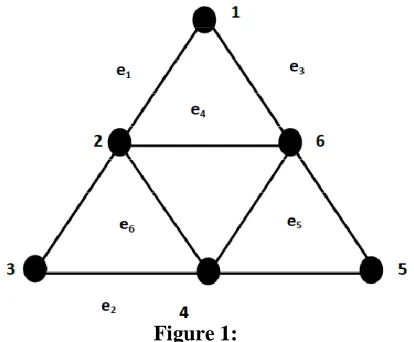
Example 3.2. Consider the hypergraph G whose vertex set V(G) = {1, 2, 3, 4, 5, 6} and E(G) = {e1, e2, e3, e4,e5, e6}
Figure 1: Let F = {e4, e5, e6} then F is an edge stable set of G.
Remark 3.3. We may note that if G is a hypergraph with minimum edge degree ≥ 2 then a set F of edges is a edge stable set iff E(G) – F is an edge cover of G.
We may also note that any subset of an edge stable set is also an edge stable set however a superset of an edge stable set need not be an edge stable set.
36
Example 3.5. Let G be the finite projective plane with r2 – r + 1 vertices and r2 – r + 1 edges(r ≥ 2). Edge covering number of this hypergraph is r. Since the complement of a minimum edge covering set is a maximum edge stable set (in a hypergraph with minimum edge degree ≥ 2). Edge stability number of the hyper plane G is (r2 – r + 1) – r = r2 –2r + 1.
Definition 3.6. (Maximum edge stable set) Let G be a hypergraph. An edge stable set with maximum cardinality is called a maximum edge stable set. The cardinality of a maximum edge stable set is called edge stability number of a hypergraph and it is denoted as β௦ଵ(G).
Remark 3.7. Let G be a hypergraph with minimum edge degree = k (k ≥ 2). Let 1 ≤ j < k. Let F = {e1, e2, ….. ,ej} be any set of j edges. Let x be any vertex of G. Since edge degree of x > j there is an edge h containing x ∋ h ∉ F.
∴ F is an edge stable set of G.
∴βଵ௦(G) ≥ k – 1.
Definition 3.8. (Maximal edge stable set) Let G be a hypergraph. An edge stable set F is said to be a maximal edge stable set if F ∪ {e} is not an edge stable set for every edge e in E(G) – F.
Example 3.9. Consider the hypergraph in above example. Let F = {e4, e5, e6} then F is a maximal edge stable set.
Now, we stat and prove a necessary and sufficient condition under which an edge stable set is a maximal edge stable set.
Theorem 3.10. Let G be a hypergraph and F be an edge stable set of G then F is a maximal edge stable set iff the following two conditions are satisfied.
(1) F contains all the isolated edges of G.
(2) For every edge e in E(G) – F there is a vertex x0 in e ∋ edge degree of x0 ≥ 2 and all the edges containing x0 except e are in F.
Proof: Suppose F is a maximal edge stable set. Suppose there is an isolated edge f ∋f∉F then F ∪ {f} is also an edge stable set. This contradicts the maximality of F. Therefore, f
∈F. Thus, F contains all the isolated edges of G.
Next, let e ∈E(G) – F then e is not an isolated edge of G. Now, F ∪ {e} is not an edge stable set of G. ∴there is a vertex x0 ∋ edge degree of x0≥ 2 and all the edges containing x0 are in F ∪ {e} but F is an edge stable set of G. Therefore, there is an edge h containing x0 ∋ h ∉ F.∴ h = e.
Also it follows that all the edges containing x0 except e are in F. Thus, the conditions (1) and (2) are satisfied.
Conversely suppose conditions (1) and (2) are satisfied.
Let e ∈E(G) – F then e is not an isolated edge of G. (∵ condition (1)).
By the given conditions there is a vertex x0 ∋ x0∈ e, edge degree of x0 ≥ 2 and all the edges containing x0 except e are in F. Thus, all the edges containing x0 are in F ∪ {e}.
37
∴ F is a maximal edge stable set of G. ∎
Theorem 3.11. Let G be a hypergraph and F be an edge stable set of G then F is a maximal edge stable set of G iff F is an edge h – dominating set of G.
Proof: Suppose F is a maximal edge stable set of G. If e is an isolated edge of G then by above theorem e ∈ F.
Suppose e is not an isolated edge and e ∉ F. Again by the above theorem there is a vertex x in e ∋ edge degree of x ≥ 2 and all the edges containing x except e are in F. Thus, F is an edge h – dominating set of G.
Conversely suppose F is an edge h – dominating set of G then by definition of edge h – dominating set conditions (1) and (2) of the above theorem are satisfied. Therefore, F is a
maximal edge stable set of G. ∎
The above result can be improved as follows.
Theorem 3.12. Let G be a hypergraph and F be an edge stable set of G then F is a maximal edge stable set of G iff F is a minimal edge h – dominating set of G.
Proof: Suppose F is a maximal edge stable set of G. By the above theorem F is an edge h – dominating set of G. Let e ∈ F. If e is an isolated edge of G then F1 = F – {e} is a set of edges which cannot be an edge h – dominating set because e ∉ F1.
Suppose e ∈ F and e is not an isolated edge of G. Suppose F1 = F – {e} is an edge h – dominating set of G. Since e ∉ F1, there is a vertex x in e ∋ edge degree of x ≥ 2 and all the edges containing x except e are in F1 then all the edges containing x are in F. This contradicts the fact that F is an edge stable set. Thus, F – {e} cannot be an edge h – dominating set of G. Thus, F is a minimal edge h – dominating set of G.
Conversely suppose F is a minimal edge h – dominating set of G. Since F is an edge h – dominating set of G it is a maximal edge stable set of G. (By the above theorem) ∎
Definition 3.13. (Edge independent set) Let G be a hypergraph and F be a set of edges of G then F is said to be an edge independent set of G if no two edges of F are adjacent.
Example 3.14. Consider the hypergraph in above example. Let F = {e1, e5} then F is an edge independent set.
Example 3.15. Let G be the finite projective plane with r2 – r + 1 vertices and r2 – r + 1 edges. Any two edges in this hypergraph intersect and therefore any edge independent subset must have only one edge in it.
First, we prove an important characterization of edge independent set.
Theorem 3.16. Let G be a hypergraph and F be a set of edges of G. Then F is an edge independent set of G iff for every vertex x with edge degree ≥ 2 there is at most one edge which contains x and which is in F.
38
Conversely suppose the condition holds. Suppose there are two edges g and h of F which are adjacent. Let x ∈ g ∩ h. Then x is a vertex of edge degree ≥ 2 and there are two edges namely g and h containing x ∋ g ∈ F and h ∈ F. Which is a contradiction.
∴ No two edges of F are adjacent.
∴ F is an edge independent set. ∎
Proposition 3.17. If G is a hypergraph and F is an edge independent set of G then F is an edge stable set of G.
Proof: Let x be a vertex of G ∋ edge degree of x ≥ 2. Suppose all the edges containing x are in F. Since edge degree of x ≥ 2 there are at least two edges say e and f which contains x. Now, e, f ∈F and by above statement e and f are adjacent edges which contradicts the edge independence of F. Thus, F is an edge stable set of G. ∎
Remark 3.18. Note that every subset of an edge independent set is an edge independent set but a superset of an edge independent set need not be an edge independent set.
Definition 3.19. (Maximal edge independent set) Let G be a hypergraph and F be an edge independent set of G then F is said to be a maximal edge independent set if F ∪ {e} is not an edge independent set of G for every edge e ∈ E(G) – F.
Example 3.20. Consider the hypergraph in above example. Let F = {e1, e5} then F is a maximal edge independent set.
Note that it is not a maximal edge stable set of G.
Theorem 3.21. Let G be a hypergraph and F be an edge independent set of G then F is a maximal edge independent set iff F is an edge dominating set of G.
Proof: Suppose F is a maximal edge independent set of G. Let e ∈E(G) – F then F ∪ {e} is not an edge independent set. Therefore, there are two edges in F ∪ {e} which are adjacent. One of these edges must be e because F is an edge independent set. Let f be the other edge. Thus e is adjacent to some member f of F. Thus, F is an edge dominating set. Conversely suppose F is an edge dominating set of G. Let e ∈E(G) – F. Then e is adjacent to some member f of F. Therefore, e and f are edges of F ∪ {e} ∋ e and f are adjacent.
∴ F ∪ {e} is not an edge independent set of G.
Thus, F is a maximal edge independent set of G. ∎
Acknowledgement:We are thankful to referee for valuable comments.
REFERENCES
1. B.Acharya, Domination in hypergraphs, AKCE J. Graphs. Combin., 4(2) (2007) 111 – 126
2. A.Behr and L.Camarinopoulos, On the domination of hypergraphs by their edges, Discrete Mathematics, 187 (1998) 31 - 38
39
4. C.Berge, Hypergraphs, North-Holland Mathematical Library, New York, Vol. 45 (1989).
5. T.Haynes, S.Hedetniemi and P.Slater, Domination in Graphs Advanced Topics, Marcel Dekker, Inc., New York, (1998).
6. T.Haynes, S.Hedetniemi and P.Slater, Fundamental of Domination in Graphs, Marcel Dekker, Inc., New York, (1998).
7. D.Thakkar and V.Dave, Edge domination in hypergraph, International Journal of Mathematics and Statistics Invention, 5(9) (2017) 13-17.
8. D.Thakkar and V.Dave, More about edge domination in hypergraph, submitted. 9. D.Thakkar and V.Dave, Regarding edge domination in hypergraph, International
Journal of Mathematics Trends and Technology, 44(3) (2017) 108-114.
10. D.Thakkar and V.Dave, Edge h-domination in hypergraph, International Journal of Mathematical Archive, 8(8) (2017) 51-59.