Applying Patterns and Frameworks to Develop
Object-Oriented Communication Software
Douglas C. Schmidt
[email protected] Department of Computer Science Washington University, St. Louis, MO 63130This paper appeared in the Handbook of Programming Languages, Volume I, edited by Peter Salus, MacMillan Com-puter Publishing, 1997.
1
Introduction
Communication software for next-generation distributed ap-plications must be flexible and efficient. Flexibility is needed to support a growing range of multimedia datatypes, traf-fic patterns, and end-to-end quality of service (QoS) require-ments. Efficiency is needed to provide low latency to delay-sensitive applications (such as avionics and call processing) and high performance to bandwidth-intensive applications (such as medical imaging and teleconferencing) over high-speed and mobile networks.
This paper outlines the key sources of complexity for com-munication software and describes how patterns and frame-works can alleviate much of this complexity. To focus the discussion, the paper explains how patterns and frameworks have been applied to develop high-performance, concurrent Web servers.
1.1
Sources of Complexity for Communication
Software
Despite dramatic increases in computing power and network bandwidth, however, the cost of developing communication software remains high and the quality remains relatively low. Across the industry, this situation has produced a “communi-cation software crisis,” where computing hardware and net-works get smaller, faster, and cheaper; yet communication software gets larger, slower, and more expensive to develop and maintain.
The challenges of communication software arise from in-herent and accidental complexities [1]. Inin-herent complexities stem from fundamental challenges of developing communica-tion software. Chief among these are detecting and recovering
from network and host failures, minimizing the impact of com-munication latency, and determining an optimal partitioning of application service components and workload onto processing elements throughout a network.
The accidental complexities associated with communica-tion software stem from limitacommunica-tions with convencommunica-tional tools and techniques. For instance, low-level network programming interfaces like Sockets are tedious and error-prone. Likewise, higher-level distributed computing middleware like CORBA, DCOM, and Java RMI lack key features, such as asynchronous I/O and end-to-end QoS guarantees. Moreover, conventional higher-level middleware implementations are not yet opti-mized for applications with stringent performance require-ments [2, 3].
Another source of accidental complexity arises from the widespread use of algorithmic design [4] to develop commu-nication software. Although graphical user-interfaces (GUIs) are largely built using object-oriented (OO) design, commu-nication software has traditionally been developed with al-gorithmic design. However, alal-gorithmic design yields non-extensible software architectures that cannot be customized rapidly to meet changing application requirements. In an era of deregulation and stiff global competition, it is prohibitively expensive and time consuming to repeatedly develop applica-tions from scratch using algorithmic design techniques.
1.2
Alleviating the Complexity of
Communica-tion Software with OO Frameworks and
Patterns
OO techniques provide principles, methods, and tools that sig-nificantly reduce the complexity and cost of developing com-munication software [5]. The primary benefits of OO stem from its emphasis on modularity, reusability, and extensibil-ity. Modularity encapsulates volatile implementation details behind stable interfaces. Reusability and extensibility enhance software by factoring out common object structures and func-tionality. This paper illustrates how to produce flexible and
ef-ficient communication software using OO application frame-works and design patterns.
A framework is a reusable, “semi-complete” application that can be specialized to produce custom applications [6]. A pattern represents a recurring solution to a software devel-opment problem within a particular context [7]. Patterns and frameworks can be applied together synergistically to improve the quality of communication software by capturing success-ful software development strategies. Patterns capture abstract designs and software architectures in a systematic format that can be readily comprehended by developers. Frameworks cap-ture concrete designs, algorithms, and implementations in par-ticular programming languages.
The examples in the paper focus on developing high-performance concurrent Web servers using the ACE frame-work [8]. ACE is an OO frameframe-work that provides components that implement core concurrency and distribution patterns [9] related to the domain of communication software. The frame-work and patterns in this paper are representative of solutions that have been successfully applied to communication systems ranging from telecommunication system management [9] to enterprise medical imaging [10] and real-time avionics [11].
This paper is organized as follows: Section 2 presents an overview of patterns and frameworks and motivates the need for the type of communication software framework provided by ACE; Section 3 outlines the structure of the ACE frame-work; Section 4 illustrates how patterns and components in ACE can be applied to develop high-performance Web servers; and Section 5 presents concluding remarks.
2
Applying Patterns and Frameworks
to Communication Software
2.1
Common Pitfalls of Developing
Communi-cation Software
2.1.1 Limitations of Low-level Native OS APIs
Developers of communication software confront recurring challenges that are largely independent of specific application requirements. For instance, applications like network file sys-tems, email gateways, object request brokers, and Web servers all perform tasks related to connection establishment, service initialization, event demultiplexing, event handler dispatch-ing, interprocess communication, shared memory manage-ment, static and dynamic component configuration, concur-rency, synchronization, and persistence. Traditionally, these tasks have been implemented in an ad hoc manner using low-level native OS application programming interfaces (APIs), such as the Win32 or POSIX, which are written in C.
Unfortunately, native OS APIs are not an effective way to
develop complex communication middleware and applications [12]. The following are common pitfalls associated with the use of native OS APIs:
Excessive low-level details: Developers must have intimate knowledge of low-level OS details. For instance, develop-ers must carefully track which error codes are returned by each system call and handle these OS-specific problems in their applications. These details divert attention from the broader, more strategic application-related semantics and pro-gram structure.
Continuous re-discovery and re-invention of incompatible higher-level programming abstractions: A common rem-edy for the excessive level of detail with OS APIs is to de-fine higher-level programming abstractions. For instance, a Reactor [13] is a useful component for demultiplexing I/O events and dispatching their associated event handlers. How-ever, these abstractions are often re-discovered and re-invented in an ad hoc manner by each developer or project. This pro-cess hampers productivity and creates incompatible compo-nents that cannot be reused readily within and across projects in large software organizations.
High potential for errors: Programming to low-level OS APIs is tedious and error-prone due to their lack of typesafety. For example, many networking applications are programmed with the Socket API [14]. However, endpoints of communi-cation in the Socket API are represented as untyped handles. This increases the potential for subtle programming mistakes and run-time errors [15].
Lack of portability: Low-level OS APIs are notoriously non-portable, even across releases of the same OS. For in-stance, implementations of the Socket API on Win32 plat-forms (WinSock) are subtly different than on UNIX platplat-forms. Moreover, even WinSock on different versions of Windows NT possesses incompatible bugs that cause sporadic failures when performing non-blocking connections and when shut-ting down processes.
Steep learning curve: Due to the excessive level of detail, the effort required to master OS-level APIs can be very high. For instance, it is hard to learn how to program the thread can-cellation mechanism correctly in POSIX Pthreads. It is even harder to learn how to write a portable application using thread cancellation mechanisms since they differ widely across OS platforms.
Inability to handle increasing complexity: OS APIs define basic interfaces to mechanisms like process and thread man-agement, interprocess communication, file systems, and mem-ory management. However, these basic interfaces do not scale up gracefully as applications grow in size and complexity. For instance, a Windows NT process only allows 64 thread local
storage (TLS) keys. This number is inadequate for large-scale server applications that utilize many DLLs and thread local objects.
2.1.2 Limitations of Higher-level Distributed Object Computing Middleware
It is possible to alleviate some of the pitfalls with native OS APIs by using higher-level distributed computing middle-ware. Common examples of higher-level distributed comput-ing middleware include CORBA [16], DCOM [17], and Java RMI [18]. Higher-level distributed computing middleware re-sides between clients and servers and eliminates many tedious, error-prone, and non-portable aspects of developing and main-taining distributed applications by automating common net-work programming tasks such as object location, object acti-vation, parameter marshaling, fault recovery, and security.
However, higher-level distributed computing middleware is often only a partial solution, for the following reasons: Lack of portability: Conventional higher-level middleware is not widely portable. For instance, the Object Adapter com-ponent in the CORBA 2.0 specification is woefully under-specified [19]. Therefore, servers written in CORBA are not portable among ORB products from different vendors. Like-wise, DCOM is targeted for Win32 platforms and Java RMI is targeted for applications written in Java.
Lack of features: Conventional higher-level middleware fo-cuses primarily on communication. Therefore, it does not cover other key issues associated with developing distributed applications. For instance, conventional higher-level middle-ware does not specify important aspects of high-performance and real-time distributed server development such as shared memory, asynchronous I/O, multi-threading, and synchroniza-tion [20].
Lack of performance: Conventional higher-level middle-ware incurs significant throughput and latency overhead [2, 21]. These overheads stem from excessive data copying, non-optimized presentation layer conversions, internal mes-sage buffering strategies that produce non-uniform behavior for different message sizes, inefficient demultiplexing algo-rithms, long chains of intra-ORB virtual method calls, and lack of integration with underlying real-time OS and network QoS mechanisms [22].
2.2
Overcoming Communication Software
Pit-falls with Patterns and Frameworks
Successful developers and software organizations overcome the pitfalls described above by identifying the patterns that underly proven solutions and by reifying these patterns in object-oriented application frameworks. Together, patterns
and frameworks help alleviate the continual re-discovery and re-invention of communication software concepts and compo-nents by capturing solutions to standard communication soft-ware development problems [7].
2.2.1 The Benefits of Patterns
Patterns are particularly useful for documenting the structure and participants in common micro-architectures for concur-rency and communication such as Reactors [13], Active Ob-jects [23], and Brokers [24]. These patterns are generaliza-tions of object-structures that have proven useful to build flex-ible and efficient event-driven and concurrent communication software frameworks and applications.
Traditionally, communication software patterns have either been locked in the heads of the expert developers or buried deep within the source code. Allowing this valuable informa-tion to reside only in these locainforma-tions is risky and expensive, however. For instance, the insights of experienced designers will be lost over time if they are not documented. Likewise, substantial effort may be necessary to reverse engineer pat-terns from existing source code. Therefore, explicitly captur-ing and documentcaptur-ing communication software patterns is es-sential to preserve design information for developers who en-hance and maintain existing software. Moreover, knowledge of domain-specific patterns helps guide the design decisions of developers who are building new applications.
2.2.2 The Benefits of Frameworks
Although knowledge of patterns helps to reduce development effort and maintenance costs, reuse of patterns alone is not suf-ficient to create flexible and efsuf-ficient communication software. While patterns enable reuse of abstract design and architec-ture knowledge, abstractions documented as patterns do not directly yield reusable code. Therefore, it is essential to aug-ment the study of patterns with the creation and use of appli-cation frameworks. Frameworks help developers avoid costly re-invention of standard communication software components by implementing common design patterns and factoring out common implementation roles.
2.2.3 Relationship Between Frameworks and Other Reuse Techniques
Frameworks provide reusable software components for appli-cations by integrating sets of abstract classes and defining stan-dard ways that instances of these classes collaborate [25]. The resulting application skeletons can be customized by inherit-ing and instantiatinherit-ing from reuseable components in the frame-works.
The scope of reuse in a framework can be significantly larger than using traditional function libraries or conventional OO class libraries. The increased level of reuse stem from the fact that frameworks are tightly integrated with key communi-cation software tasks such as service initialization, error han-dling, flow control, event processing, and concurrency control. In general, frameworks enhance class libraries in the fol-lowing ways:
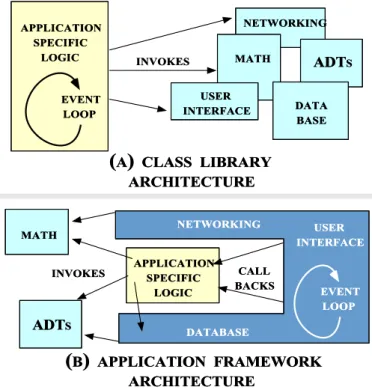
Frameworks define “semi-complete” applications that em-body domain-specific object structures and functionality: Class libraries provide a relatively small granularity of reuse. For instance, the classes in Figure 1 (A) are typically low-level, relatively independent, and general components like Strings, complex numbers, arrays, and bitsets. In contrast,
APPLICATION APPLICATION
SPECIFIC SPECIFIC LOGIC LOGIC
USER USER INTERFACE INTERFACE
((
AA))
CLASS LIBRARY CLASS LIBRARYARCHITECTURE ARCHITECTURE
NETWORKING NETWORKING MATH
MATH ADTADTSS
DATA DATA BASE BASE
APPLICATION APPLICATION
SPECIFIC SPECIFIC LOGIC LOGIC MATH
MATH
((
BB))
APPLICATION FRAMEWORK APPLICATION FRAMEWORK ARCHITECTUREARCHITECTURE ADT
ADTSS
INVOKES INVOKES
CALL CALL BACKS BACKS
NETWORKING
NETWORKING USERUSER INTERFACE INTERFACE
DATABASE DATABASE
INVOKES INVOKES EVENT EVENT LOOP LOOP
EVENT EVENT LOOP LOOP
Figure 1: Differences Between Class Libraries and OO Frame-works
components in a framework collaborate to provide a customiz-able architectural skeleton for a family of related applications. Complete applications can be composed by inheriting from and/or instantiating framework components. As shown in Fig-ure 1 (B), this reduces the amount of application-specific code since much of the domain-specific processing is factored into the generic components in the framework.
Frameworks are active and exhibit “inversion of control” at run-time: Class libraries are typically passive, i.e., they
perform their processing by borrowing threads of control from self-directed application objects. This is illustrated in Fig-ure 1 (A), where the application-specific logic manages the event loop. In contrast, frameworks are active, i.e., they man-age the flow of control within an application via event dis-patching patterns like Reactor [13] and Observer [7]. The callback-driven run-time architecture of a framework is shown in Figure 1 (B). This “inversion of control” is referred to as The Hollywood Principle [26], i.e., “don’t call us, we’ll call you.”
In practice, frameworks and class libraries are complemen-tary technologies. Frameworks often utilize class libraries in-ternally to simplify the development of the framework. For instance, portions of ACE use the string and vector contain-ers provided by the C++ Standard Template Library [27] to manage connection maps and other search structures. In ad-dition, application-specific callbacks invoked by framework event handlers frequently use class library components to per-form basic tasks such as string processing, file management, and numerical analysis.
To illustrate how OO patterns and frameworks are being successfully applied to communication software, the remain-der of this paper examines the structure and use of the ACE framework [8].
3
Overview of ACE
ACE is an object-oriented (OO) framework that implements core concurrency and distribution patterns [9] for communica-tion software. ACE provides a rich set of reusable C++ wrap-pers and framework components that are targeted for develop-ers of high-performance, real-time services and applications across a wide range of OS platforms. The components in ACE provide reusable implementations of the following common communication software tasks:
Connection establishment and service initialization [28]; Event demultiplexing and event handler dispatching [13,
29, 30];
Interprocess communication [15] and shared memory
management;
Static and dynamic configuration [8, 31] of
communica-tion services;
Concurrency and synchronization [29, 23];
Distributed communication services – such as naming,
event routing [11], logging, time synchronization, and network locking;
Higher-level distributed computing middleware
compo-nents – such as Object Request Brokers (ORBs) [20] and Web servers [32].
This section outlines the structure and functionality of the ACE framework. Section 4 illustrates how components and patterns in ACE can be applied to build high-performance, concurrent Web servers.
3.1
The Structure and Functionality of ACE
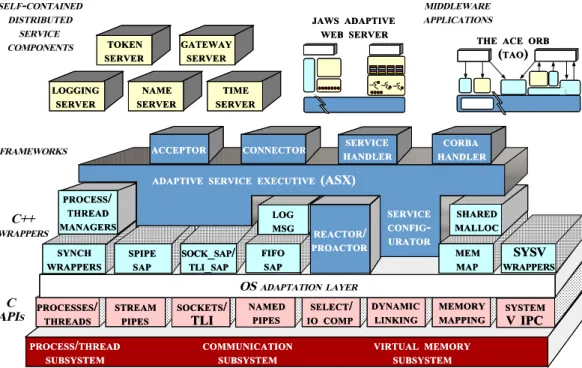
ACE is a relatively large framework, containing over 135,000 lines of C++ code divided into450 classes. To separatecon-cerns and to reduce the complexity of the framework, ACE is designed using a layered architecture. Figure 2 illustrates the relationships between ACE components.
The lower layers of ACE contain an OS adapter and C++ wrappers that portably encapsulate core OS communication and concurrency services. The higher layers of ACE ex-tend the C++ wrappers to provide reusable frameworks, self-contained distributed service components, and higher-level distributed computing middleware components. Together, these layers simplify the creation, composition, and configu-ration of communication systems. The role of each layer is outlined below.
3.1.1 The OS Adaptation Layer
The OS adaptation layer constitutes approximately 13% of ACE, i.e.,18,000 lines of code. This layer resides directly
atop the native OS APIs written in C. The OS adaptation layer shields the other layers in ACE from platform-specific depen-dencies associated with the following OS APIs:
Concurrency and synchronization: ACE’s adaptation layer encapsulates OS concurrency APIs for multi-threading, multi-processing, and synchronization;
Interprocess communication (IPC) and shared memory: ACE’s adaptation layer encapsulates OS APIs for local and remote IPC and shared memory;
Event demultiplexing mechanisms: ACE’s adaptation layer encapsulates OS APIs for synchronous and asyn-chronous demultiplexing I/O-based, timer-based, signal-based, and synchronization-based events;
Explicit dynamic linking: ACE’s adaptation layer encapsu-lates OS APIs for explicit dynamic linking, which allows ap-plication services to be configured at installation-time or run-time.
File system mechanisms: ACE’s adaptation layer encapsu-lates OS file system APIs for manipulating files and directo-ries.
The portability of ACE’s OS adaptation layer enables it to run on a wide range of operating systems. The OS plat-forms supported by ACE include Win32 (i.e., WinNT 3.5.x, 4.x, Win95, and WinCE using MSVC++ and Borland C++),
most versions of UNIX (e.g., SunOS 4.x and 5.x; SGI IRIX 5.x and 6.x; HP-UX 9.x, 10.x, and 11.x; DEC UNIX, AIX 4.x, DG/UX, Linux, SCO, UnixWare, NetBSD, and FreeBSD), real-time operating systems (e.g., VxWorks, Chorus, LynxOS, and pSoS), and MVS OpenEdition. Due to the abstraction pro-vided by ACE’s OS adaptation layer, a single source tree is used for all these platforms.
3.1.2 The ACE C++ Wrapper Layer
It is possible to program highly portable C++ applications di-rectly atop ACE’s OS adaptation layer. However, most ACE developers use the C++ wrappers layer shown in Figure 2. The ACE C++ wrappers simplify the development of applica-tions by encapsulating and enhancing the native OS concur-rency, communication, memory management, event demulti-plexing, dynamic linking, and file system APIs with typesafe C++ interfaces.
The use of C++ alleviates the need for developers to pro-gram to the weakly-typed OS C APIs directly, which improves application robustness. For instance, since the C++ wrappers are strongly typed, compilers can detect type system violations at compile-time rather than at run-time, which is often the case with the C-level OS APIs. ACE uses C++ inlining extensively to eliminate performance penalties that would otherwise be in-curred from the additional typesafety and levels of abstraction provided by the OS adaptation layer and the C++ wrappers.
The C++ wrappers provided by ACE are quite comprehen-sive, constituting50% of its source code. Applications can
combine and compose these wrappers by selectively inherit-ing, aggregatinherit-ing, and/or instantiating the following compo-nents:
Concurrency and synchronization components: ACE ab-stracts native OS multi-threading and multi-processing mecha-nisms like mutexes and semaphores to create higher-level OO concurrency abstractions like Active Objects [23] and Poly-morphic Futures [33].
IPC and filesystem components: The ACE C++ wrappers encapsulate local and/or remote IPC mechanisms [15] such as sockets, TLI, UNIX FIFOs and STREAM pipes, and Win32 Named Pipes. ACE wrappers also encapsulate the OS filesys-tem APIs, as well.
Memory management components: The ACE memory management components provide a flexible and extensible ab-straction for managing dynamic allocation and deallocation of shared memory and local heap memory.
3.1.3 The ACE Framework Components
The remaining40% of ACE consists of communication
PROCESSES PROCESSES// THREADS THREADS DYNAMIC DYNAMIC LINKING LINKING MEMORY MEMORY MAPPING MAPPING SELECT SELECT// IO COMP IO COMP
SYSTEM SYSTEM V V IPCIPC STREAM STREAM PIPES PIPES NAMED NAMED PIPES PIPES C
APIS SOCKETSSOCKETSTLITLI //
COMMUNICATION COMMUNICATION
SUBSYSTEM SUBSYSTEM
VIRTUAL MEMORY VIRTUAL MEMORY
SUBSYSTEM SUBSYSTEM
GENERAL POSIX AND WIN32 SERVICES
PROCESS PROCESS//THREADTHREAD
SUBSYSTEM SUBSYSTEM
FRAMEWORKS ACCEPTORACCEPTOR CONNECTORCONNECTOR
SELF-CONTAINED DISTRIBUTED SERVICE COMPONENTS NAME NAME SERVER SERVER TOKEN TOKEN SERVER SERVER LOGGING LOGGING SERVER SERVER GATEWAY GATEWAY SERVER SERVER SOCK SOCK__SAPSAP//
TLI TLI__SAPSAP
FIFO FIFO SAP SAP LOG LOG MSG MSG SERVICE SERVICE HANDLER HANDLER TIME TIME SERVER SERVER C++ WRAPPERS SPIPE SPIPE SAP SAP CORBA CORBA HANDLER HANDLER SYSV SYSV WRAPPERS WRAPPERS SHARED SHARED MALLOC MALLOC
THE ACE ORB THE ACE ORB
((TAOTAO)) JAWS ADAPTIVE
JAWS ADAPTIVE WEB SERVER WEB SERVER
MIDDLEWARE APPLICATIONS REACTOR REACTOR// PROACTOR PROACTOR PROCESS PROCESS// THREAD THREAD MANAGERS MANAGERS
ADAPTIVE SERVICE EXECUTIVE ADAPTIVE SERVICE EXECUTIVE (ASX)(ASX)
SERVICE SERVICE CONFIG CONFIG --URATOR URATOR SYNCH SYNCH WRAPPERS WRAPPERS MEM MEM MAP MAP OS ADAPTATION LAYER
Figure 2: The Layering Structure of Components in ACE
C++ wrappers. These framework components support flexible configuration of concurrent communication applications and services [8]. The framework layer in ACE contains the fol-lowing components:
Event demultiplexing components: The ACE Reactor [13] and Proactor [30] are extensible, object-oriented demultiplex-ers that dispatch application-specific handldemultiplex-ers in response to various types of I/O-based, timer-based, signal-based, and synchronization-based events.
Service initialization components: The ACE Connector and Acceptor components [28] decouple the active and pas-sive initialization roles, respectively, from application-specific tasks that communication services perform once initialization is complete.
Service configuration components: The ACE Service Con-figurator [31] supports the configuration of applications whose services may be assembled dynamically at installation-time and/or run-time.
Hierarchically-layered stream components: The ACE Streams components [8] simplify the development of com-munication software applications that are composed of hierarchically-layered services, e.g. user-level protocol stacks. ORB adapter components: ACE can be integrated seam-lessly with single-threaded and multi-threaded CORBA imple-mentations via ORB adapters [10].
In general, the ACE framework components facilitate the development of communication software that may be updated and extended without modifying, recompiling, relinking, or even restarting running systems [8]. This degree of flexibility is achieved in ACE by combining C++ language features like templates, inheritance, and dynamic binding with design pat-terns like Abstract Factory, Strategy, and Service Configurator [7, 31].
3.1.4 Self-contained Distributed Service Components In addition to its C++ wrappers and framework components, ACE provides a standard library of distributed services that are packaged as self-contained components. Although these ser-vice components are not strictly part of the ACE framework, they play two important roles:
Factoring out reusable distributed application building blocks: These service components provide reusable imple-mentations of common distributed application tasks such as naming, event routing, logging, time synchronization, and net-work locking.
Demonstrating common use-cases of ACE components: The distributed services also demonstrate how ACE compo-nents like reactors, service configurators, acceptors and con-nectors, active objects, and IPC wrappers can be used
effec-tively to develop flexible and efficient communication soft-ware.
3.1.5 Higher-level Distributed Computing Middleware Components
Developing robust, extensible, and efficient communication applications is challenging, even when using a communica-tion framework like ACE. In particular, developers must still master a number of complex OS and communication concepts such as:
Network addressing and service identification;
Presentation conversions (e.g., encryption, compression,
and network byte-ordering conversions between hetero-geneous end-systems with alternative processor byte-orderings);
Process and thread creation and synchronization; System call and library routine interfaces to local and
re-mote interprocess communication (IPC) mechanisms. It is possible to alleviate some of the complexity of devel-oping applications using ACE by employing higher-level dis-tributed computing middleware, such as CORBA [16], DCOM [17], or Java RMI [18]. Higher-level distributed computing middleware resides between clients and servers and automates many tedious and error-prone aspects of distributed applica-tion development, including:
Authentication, authorization, and data security; Service location and binding;
Service registration and activation;
Demultiplexing and dispatching in response to events; Implementing message framing atop bytestream-oriented
communication protocols like TCP;
Presentation conversion issues involving network
byte-ordering and parameter marshaling.
Two middleware applications bundled with the ACE release include:
The ACE ORB (TAO): TAO [22] is a real-time implemen-tation of CORBA built using the framework components and patterns provided by ACE. TAO contains the network inter-face, operating system, communication protocol, and CORBA middleware components and features shown in Figure 3. TAO is based on the standard OMG CORBA reference model [16], with the enhancements designed to overcome the shortcom-ings of conventional ORBs [3] for high-performance and real-time applications. TAO, like ACE, is freely available at
www.cs.wustl.edu/schmidt/TAO.html.
NETWORK NETWORK ORB ORB QQOOSS
INTERFACE INTERFACE
REAL REAL--TIMETIME ORB ORB CORECORE
operation() operation()
RIDL RIDL
STUBS STUBS
REAL REAL--TIMETIME
OBJECT OBJECT ADAPTER ADAPTER
RIDL RIDL
SKELETON SKELETON in args
in args
out args + return value out args + return value
CLIENT CLIENT
OS KERNEL OS KERNEL
HIGH HIGH--SPEEDSPEED NETWORK ADAPTERS NETWORK ADAPTERS
REAL REAL--TIME ITIME I//OO
SUBSYSTEM SUBSYSTEM
RIOP RIOP SERVANT SERVANT
OS KERNEL OS KERNEL
HIGH HIGH--SPEEDSPEED NETWORK ADAPTERS NETWORK ADAPTERS
REAL REAL--TIME ITIME I//OO
SUBSYSTEM SUBSYSTEM
Figure 3: Components in the TAO Real-time ORB
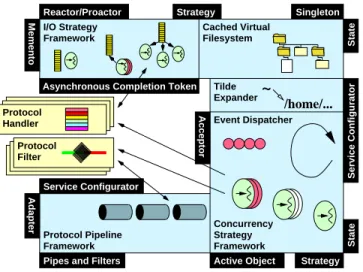
JAWS: JAWS [34] is a high-performance, adaptive Web server built using the framework components and patterns pro-vided by ACE. Figure 4 illustrates the major structural com-ponents and design patterns in JAWS. JAWS is structured as
Framework Framework
Tilde Framework
Cached Virtual Filesystem
Strategy Protocol Pipeline
Concurrency Expander I/O Strategy
~
/home/...
Memento Reactor/Proactor Strategy Singleton
State
Service Configurator
State
Strategy Active Object
Pipes and Filters
Adapter Service Configurator
Protocol Handler
Protocol Filter
Acceptor
Event Dispatcher Asynchronous Completion Token
Figure 4: Architectural Overview of the JAWS Framework a framework of frameworks. The overall JAWS framework contains the following components and frameworks: an Event Dispatcher, Concurrency Strategy, I/O Strategy, Protocol Pipeline, Protocol Handlers, and Cached Virtual Filesystem. Each framework is structured as a set of collaborating objects implemented using components in ACE. JAW is also freely available at www.cs.wustl.edu/jxh/research/.
4
Developing High-performance Web
Servers with Patterns and
Frame-work Components
The benefits of applying frameworks and patterns to commu-nication software is best introduced by example. This section describes the structure and functionality high-performance Web servers developed using the patterns and framework com-ponents in ACE. Many error handling details are omitted to keep the code examples concise. In addition, the examples focus on features that are portable across multiple OS plat-forms, though noteworthy platform-specific features of ACE (such as asynchronous I/O and I/O completion ports) are de-scribed where appropriate.
4.1
Overview of a Web System
Figure 5 illustrates the general architecture of a Web system. The diagram provides a layered view of the architectural
com-WWW WWW SERVER SERVER 2: index.html
2: index.html 1: GET ~schmidt 1: GET ~schmidt
HTTP/1.0 HTTP/1.0
COMMUNICATION PROTOCOL (E.G., HTTP) GUI
HTML PARSER
REQUESTER
GRAPHICS ADAPTER
NETWORK NETWORK
OS KERNEL OS KERNEL
OS I
OS I//O SUBSYSTEMO SUBSYSTEM NETWORK ADAPTERS NETWORK ADAPTERS
OS KERNEL OS KERNEL
OS I
OS I//O SUBSYSTEMO SUBSYSTEM NETWORK ADAPTERS NETWORK ADAPTERS
DISPATCHER DISPATCHER PROTOCOL PROTOCOL HANDLERS HANDLERS WWW
WWW CLIENT CLIENT
Figure 5: General Architecture of a Web System ponents required for an HTTP client to retrieve an HTML file from an HTTP server. Through GUI interactions, the client application user instructs the HTTP client to retrieve a file. The requester is the active component of the client that com-municates over the network. It issues a request for the file to the server with the appropriate syntax of the transfer proto-col, in this case HTTP. Incoming requests to the HTTP server are received by the dispatcher, which is the request demulti-plexing engine of the server. It is responsible for creating new
threads or processes (for concurrent Web servers) or managing sets of socket handles (for single-threaded concurrent servers). Each request is processed by a handler, which goes through a lifecycle of parsing the request, logging the request, fetching file status information, updating the cache, sending the file, and cleaning up after the request is done. When the response returns to the client with the requested file, it is parsed by an HTML parser so that the file may be rendered. At this stage, the requester may issue other requests on behalf of the client, e.g., in order to maintain a client-side cache.
4.2
Overview of an OO Web Server
Communi-cation Software Architecture
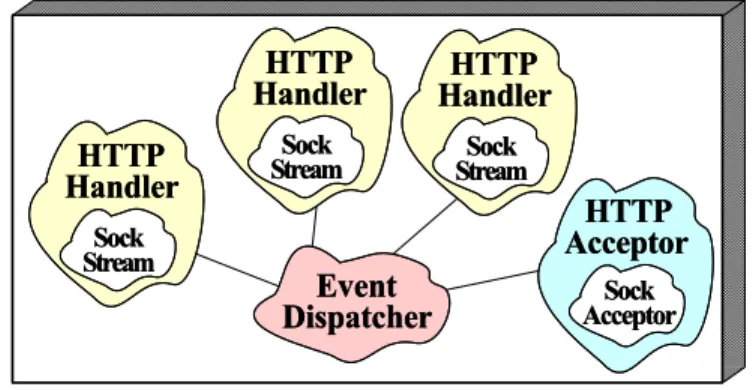
Figure 6 illustrates the general object-oriented communication software architecture for the Web servers covered in this sec-tion. The roles performed by the components in this
architec-HTTP HTTP Handler Handler
Sock Sock Stream Stream
HTTP HTTP Acceptor Acceptor
Sock Sock Acceptor Acceptor
Event Event Dispatcher Dispatcher HTTP HTTP Handler Handler
Sock Sock Stream Stream
HTTP HTTP Handler Handler
Sock Sock Stream Stream
Figure 6: Object-oriented Communication Software Architec-ture for a Web Server
ture include the following:
The Event Dispatcher: This component encapsulates the Web server’s concurrency strategies (such as Thread-per-Request or Thread Pool) and request dispatching strategies (such as synchronous Reactive or asynchronous Proactive dis-patching). The ACE framework allows these strategies to be customized according to platform characteristics such as user-level vs. kernel-level threading in the OS, the num-ber of CPUs in the endsystem, and the existence of special-purpose OS support for HTTP processing (e.g., the Windows NTTransmitFilesystem call [32]).
An HTTP Handler: This component is created for each client HTTP connection (e.g., from a Web browser). It parses HTTP requests and performs the work specified by the re-quests (e.g., retrieving Web pages). AnHTTP Handler con-tains an ACE SOCK Stream, which encapsulates the data transmission capabilities of TCP/IP sockets.
The HTTP Acceptor: This component is a factory that ac-cepts connections from clients and createsHTTP Handlers
to process the requests from clients. There is typically one
HTTP Acceptor per server, though certain concurrency strategies (such as Thread Pool) allocate multiple Accep-tors to leverage OS multi-threading capabilities. An HTTP Acceptorcontains an ACESOCK Acceptor, which en-capsulates the passive connection establishment capabilities of TCP/IP sockets.
TheSOCK AcceptorandSOCK Streamare C++ wrap-pers provided by ACE. They shield applications from non-portable, tedious, and error-prone aspects of developing com-munication software using the native OS socket interfaces written in C. Other ACE components will be introduced throughout this section, as well.
4.3
Design Patterns for Web Server
Communi-cation Software
The communication software architecture diagram in Figure 6 explains how the Web server is structured, but not why it is structured this particular way. To understand why the Web server contains roles such as Event Dispatcher, Acceptor, and Handler requires a deeper understanding of the design patterns underlying the domain of communication software, in general, and Web servers, in particular. Figure 7 illustrates the strategic and tactical patterns related to Web servers. These patterns are summarized below.
Half-Sync/
Half-Async
Active
Object
Reactor/
Proactor
Acceptor
State Singleton
Strategy Adapter
TACTICAL PATTERNS STRATEGIC PATTERNS
Figure 7: Common Design Patterns in Web Servers
4.3.1 Strategic Patterns in JAWS
The following patterns are strategic because they are ubiqui-tous to the domain of communication software. Therefore, they significantly influence the software architecture of Web servers.
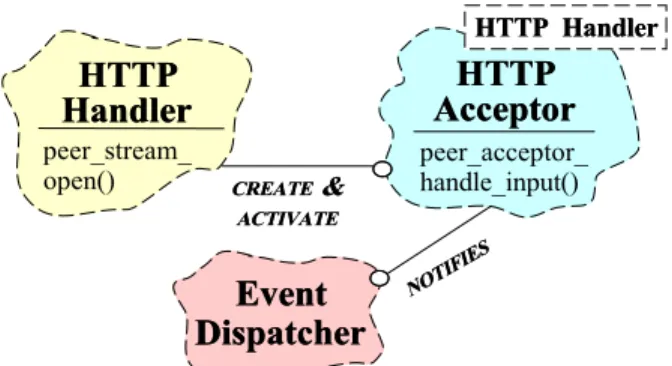
The Acceptor pattern: This pattern [28] decouples passive connection establishment from the service performed once the connection is established. Figure 8 illustrates the structure of the Acceptor pattern in the context of Web servers. TheHTTP
CREATE CREATE &&
ACTIVATE ACTIVATE
HTTP
HTTP
Handler
Handler
peer_stream_ open()HTTP
HTTP
Acceptor
Acceptor
peer_acceptor_ handle_input()HTTP Handler HTTP Handler
Event
Event
Dispatcher
Dispatcher
NOTIFIES NOTIFIES
Figure 8: Structure of the Acceptor Pattern
Acceptoris a factory that creates, accepts, and activates a newHTTP Handlerwhenever theEvent Dispatcher
notifies it that a connection has arrived from a client. All the Web server implementations described below use the Accep-tor pattern to decouple connection establishment from HTTP protocol processing.
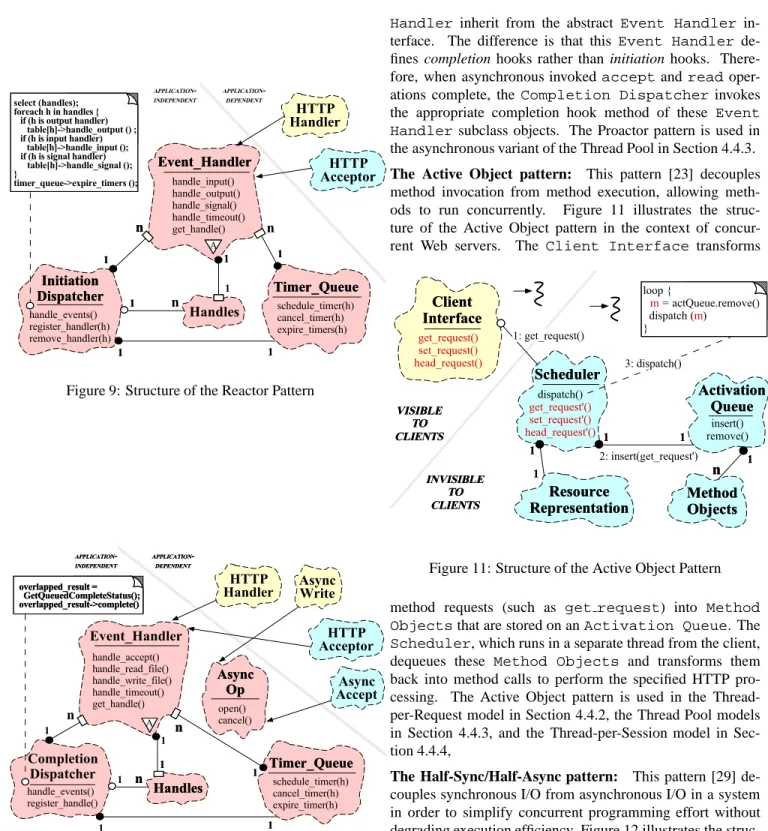
The Reactor pattern: This pattern [13] decouples the syn-chronous event demultiplexing and event handler notifica-tion dispatching logic of server applicanotifica-tions from the ser-vice(s) performed in response to events. Figure 9 illustrates the structure of the Reactor pattern in the context of Web servers. Both theHTTP AcceptorandHTTP Handler
inherit from the abstract Event Handler interface and register themselves with the Initiation Dispatcher
for input events (i.e., connections and HTTP requests), re-spectively. The Initiation Dispatcher invokes the
handle input notification hook method of theseEvent Handlersubclass objects when their associated events oc-cur. The Reactor pattern is used by most of the Web server concurrency models presented in Section 4.4.
The Proactor pattern: This pattern [30] decouples the asynchronous event demultiplexing and event handler com-pletion dispatching logic of server applications from the ser-vice(s) performed in response to events. Figure 10 illustrates the structure of the Proactor pattern in the context of Web servers. As before, both theHTTP Acceptor andHTTP
Initiation Initiation Dispatcher Dispatcher handle_events() register_handler(h) remove_handler(h) 11 11 11 Event_Handler Event_Handler handle_input() handle_output() handle_signal() handle_timeout() get_handle() A 11 nn nn Timer_Queue Timer_Queue schedule_timer(h) cancel_timer(h) expire_timers(h) 11 11 select (handles);
foreach h in handles { if (h is output handler) table[h]->handle_output () ; if (h is input handler) table[h]->handle_input (); if (h is signal handler) table[h]->handle_signal (); }
timer_queue->expire_timers ();
n Handles1 APPLICATION -DEPENDENT APPLICATION -INDEPENDENT n HTTP Handler HTTP Acceptor
Figure 9: Structure of the Reactor Pattern
Completion Dispatcher handle_events() register_handle() 1 1 1 Event_Handler handle_accept() handle_read_file() handle_write_file() handle_timeout() get_handle() 1 n HTTP Handler Timer_Queue Timer_Queue schedule_timer(h) cancel_timer(h) expire_timer(h) 11 11 overlapped_result = overlapped_result = GetQueuedCompleteStatus(); GetQueuedCompleteStatus(); overlapped_result->complete() overlapped_result->complete() nn Handles Handles 11 APPLICATION APPLICATION --DEPENDENT DEPENDENT APPLICATION APPLICATION --INDEPENDENT INDEPENDENT nn A Async Async Op Op open() cancel() HTTP Acceptor Async Write Async Accept
Figure 10: Structure of the Proactor Pattern
Handler inherit from the abstract Event Handler in-terface. The difference is that this Event Handler de-fines completion hooks rather than initiation hooks. There-fore, when asynchronous invokedacceptandread oper-ations complete, theCompletion Dispatcherinvokes the appropriate completion hook method of these Event Handlersubclass objects. The Proactor pattern is used in the asynchronous variant of the Thread Pool in Section 4.4.3. The Active Object pattern: This pattern [23] decouples method invocation from method execution, allowing meth-ods to run concurrently. Figure 11 illustrates the struc-ture of the Active Object pattern in the context of concur-rent Web servers. The Client Interface transforms
Client Client Interface Interface get_request() set_request() head_request() Activation Activation Queue Queue insert() remove() Scheduler Scheduler Resource Resource Representation
Representation MethodMethodObjectsObjects
loop {
m = actQueue.remove() dispatch (m)
} INVISIBLE INVISIBLE TO TO CLIENTS CLIENTS VISIBLE VISIBLE TO TO CLIENTS CLIENTS nn 11 11 11 11 11 1: get_request() 2: insert(get_request') 3: dispatch() dispatch() get_request'() set_request'() head_request'()
Figure 11: Structure of the Active Object Pattern method requests (such as get request) into Method Objectsthat are stored on anActivation Queue. The
Scheduler, which runs in a separate thread from the client, dequeues these Method Objects and transforms them back into method calls to perform the specified HTTP pro-cessing. The Active Object pattern is used in the Thread-per-Request model in Section 4.4.2, the Thread Pool models in Section 4.4.3, and the Thread-per-Session model in Sec-tion 4.4.4,
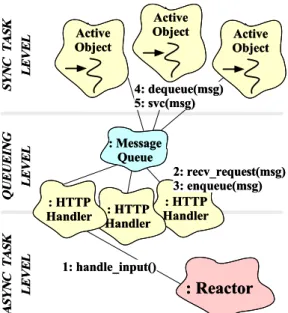
The Half-Sync/Half-Async pattern: This pattern [29] de-couples synchronous I/O from asynchronous I/O in a system in order to simplify concurrent programming effort without degrading execution efficiency. Figure 12 illustrates the struc-ture of the Half-Sync/Half-Async pattern in the context the queue-based Thread Pool model in Section 4.4.3. In this de-sign, theReactoris responsible for reading HTTP requests from clients and and enqueueing valid requests on aMessage Queue. ThisMessage Queuefeeds the pool ofActive Objectsthat process the requests concurrently.
ASYNC TASKASYNC TASK
LEVELLEVEL
SYNC TASKSYNC TASK LEVELLEVEL
1: handle_input() 1: handle_input()
:: Reactor Reactor
QUEUEINGQUEUEING LEVELLEVEL
4: dequeue(msg) 4: dequeue(msg) 5: svc(msg) 5: svc(msg)
: HTTP : HTTP Handler Handler : HTTP
: HTTP Handler Handler : HTTP
: HTTP Handler Handler
: Message : Message Queue Queue
2: recv_request(msg) 2: recv_request(msg) 3: enqueue(msg) 3: enqueue(msg) Active
Active Object Object
Active Active Object
Object ActiveActive Object Object
Figure 12: Structure of the Half-Sync/Half-Async Pattern
4.3.2 Tactical Patterns in JAWS
Web servers also utilize many tactical patterns. For instance, the following patterns are widely used in ACE and JAWS: The Strategy pattern: This pattern defines a family of al-gorithms, encapsulates each one, and make them interchange-able. JAWS uses this pattern extensively to configure different concurrency and event dispatching strategies without affecting the core software architecture of the Web server.
The Adapter pattern: This pattern transforms a non-conforming interface into one that can be used by a client. ACE uses this pattern in its OS adaptation layer to encapsu-late the accidental complexity of the myriad native OS APIs in a uniform manner.
The State pattern: This pattern defines a composite ob-ject whose behavior depends upon its state. The Event Dispatcherin JAWS uses the State pattern to seamlessly support both synchronous and asynchronous I/O.
The Singleton pattern ensures: This pattern ensures a class only has one instance and provides a global point of access to it. JAWS uses a Singleton to ensure that only one copy of its Caching Virtual Filesystem exists in the Web server.
In contrast to the strategic patterns describe earlier, tactical patterns are domain-independent and have a relatively local-ized impact on a software design. For instance, Singleton is a tactical pattern that is often used to consolidate all option pro-cessing used to configure a Web server. Although this pattern
is domain-independent and thus widely applicable, the prob-lem it addresses does not impact Web server software architec-ture as pervasively as strategic patterns like the Active Object and Reactor. A thorough understanding of tactical patterns is essential, however, to implement highly flexible software that is resilient to changes in application requirements and platform environments.
4.4
Implementing Web Server Concurrency
Models with ACE
Existing Web servers use a wide range of concurrency strate-gies to implement the role of the Event Dispatcher. These strategies include single-threaded concurrency (e.g., Roxen), process concurrency (e.g., Apache), and multi-thread concurrency (e.g., PHTTPD, Zeus, and JAWS). This section examines common Web concurrency models including Single-threaded Reactive, Thread-per-Request, Thread Pool, and Thread-per-Session. Each of these models is discussed below, focusing on the patterns they use and outlining how they can be implemented using ACE components.
Note how each concurrency model reuses most of the same patterns (e.g., Reactor, Acceptor, and Active Object) and ACE components (e.g., ACE Reactor, HTTP Acceptor, and
HTTP Handler), by simply restructing these core architec-tural building blocks in different configurations. This high degree of consistency is common in applications and frame-works that are explicitly built using patterns. When patterns are used to structure and document applications and frame-works, nearly every class plays a well-defined role and collab-orates effectively with its related classes.
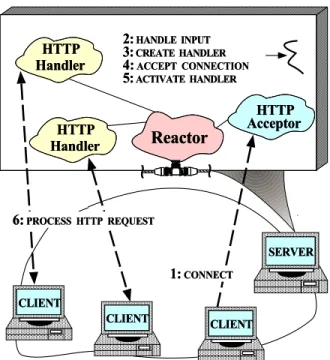
4.4.1 The Single-threaded Reactive Web Server Model In the Single-threaded Reactive model, all connections and HTTP requests are handled by the same thread of control. This thread is responsible for demultiplexing requests from differ-ent clidiffer-ents and dispatching evdiffer-ent handlers to perform HTTP processing. If each request is processed in its entirety, the Re-active Web server is deemed iterative. If the processing of each request is split into chunks that are performed separately the Reactive Web server is deemed a single-threaded concur-rent server.
The Single-threaded Reactive model is a highly portable model for implementing the Event Dispatcherrole in a Web server. This model runs on any OS platform that sup-ports event demultiplexing mechanisms such asselect or
WaitForMultipleObjects. The structure of a Reactive Web server based on the ACE Reactor is shown in Fig-ure 13.
The ACEReactoris an OO implementation of the Re-actor pattern that waits synchronously in a single-thread of
Reactor
Reactor
HTTPHTTP Handler Handler
HTTP HTTP Acceptor Acceptor
SERVER SERVER CLIENT
CLIENT
CLIENT
CLIENT CLIENTCLIENT
6:
6: PROCESS HTTP REQUEST PROCESS HTTP REQUEST
HTTP HTTP Handler Handler
1:
1: CONNECT CONNECT
2:
2: HANDLE INPUT HANDLE INPUT
3:
3: CREATE HANDLER CREATE HANDLER
4:
4: ACCEPT CONNECTION ACCEPT CONNECTION
5:
5: ACTIVATE HANDLER ACTIVATE HANDLER
Figure 13: Single-threaded Reactive Web Server Model
control for the occurrence of various types of events (such as socket data, signals, or timeouts). When these events occur, the ACE Reactor demultiplexes the event to a pre-registered ACE Event Handlerobject and then dis-patches the appropriate upcall method (e.g.,handle input,
handle signal,handle timeout) on the object. Figure 14 illustrates how the Reactor pattern is used to trig-ger the acceptance of HTTP connections from clients. When a connection event arrives from a client the ACEReactor in-vokes thehandle inputfactory method hook on theHTTP Acceptor. This hook accepts the connection and creates a newHTTP Handlerobject that processes the client request. Since this model is single-threaded and driven entirely by re-active I/O, eachHTTP Handlermust register with the ACE
Reactor. The Reactor can then trigger the processing of HTTP requests from clients. When an HTTPGETrequest ar-rives, the ACEReactorinvokes thehandle inputhook method on theHTTP Handler. This hook processes the re-quest by retrieving the URI from the HTTPGETrequest and transferring the specified file to the client.
To avoid blocking the server for extended periods of time, each I/O request can be broken into small chunks and sent sep-arately. Therefore, the State pattern is typically used to main-tain eachHTTP Handler’s state (e.g., awaiting theGET re-quest, transmitting then
th
chunk, closing down, etc.). Like-wise, theTimer Queuecapabilities of the ACEReactor
can be used to prevent denial of service attacks where erro-neous or malicious clients establish connections and consume
Reactor Reactor REGISTERED
OBJECTS
FRAMEWORK
LEVEL
KERNEL LEVEL
APPLICATION
LEVEL
OS EVENT DEMULTIPLEXING INTERFACE
1: handle_input() 2: accept() 3: make_handler()
Event Handler HTTP HTTP Handler Handler
Event Event Handler Handler HTTP HTTP Handler Handler
Event Event Handler Handler HTTP HTTP Acceptor Acceptor
Initiation Initiation Dispatcher Dispatcher Event Event Handler Handler HTTP HTTP Handler Handler
4: handle_input() 4: handle_input() 5: recv(request) 5: recv(request) 6: process(request) 6: process(request)
Figure 14: Accepting Connections and Processing HTTP Re-quests with the Reactor
Web server resources (e.g,. socket handles), but never send data to or receive data from the server.
The main advantages of the Single-threaded Reactive model are its portability and its low overhead for processing very small files. It is not suitable for high-performance Web servers, however, since it does not utilize parallelism effec-tively. In particular, all HTTP processing is serialized at the OS event demultiplexing level. This prevents Web servers from leveraging the parallelism available in the OS (e.g., asyn-chronous I/O) and hardware (e.g., DMA to intelligent I/O pe-ripherals).
4.4.2 The Thread-per-Request Web Server Model In the Thread-per-Request model, a new thread is spawned to handle each incoming request. Only one thread blocks on the acceptor socket. This acceptor thread is a factory that creates a new handler thread to process HTTP requests from each client. The Thread-per-Request model is a widely used model for implementing multi-threaded Web servers. This model runs on any OS platform that supports preemptive multi-threading. The structure of a Thread-per-Request Web server based on the ACEReactorand ACE Active Objects is shown in Fig-ure 15.
Figure 15 illustrates how the ACE Reactor and HTTP Acceptor components can be reused for the Thread-per-Request model, i.e., the ACE Reactorblocks in the main thread waiting for connection events. When a connection
SERVER
CLIENT
CLIENT CLIENT Reactor Reactor
HTTP HTTP Acceptor Acceptor HTTP
HTTP Handler Handler
HTTP HTTP Handler Handler
HTTP HTTP Handler Handler
6:
6: PROCESS HTTP REQUEST PROCESS HTTP REQUEST
1: CONNECT
2: HANDLE INPUT
3: CREATE HANDLER
4: ACCEPT CONNECTION
5: SPAWN THREAD
Figure 15: Thread-per-Request Web Server Model
event occurs it notifies theHTTP Acceptorfactory, which creates a newHTTP Handler.
The primary difference between the Thread-per-Request model and the Single-threaded Reactive model is that a new thread is spawned in eachHTTP Handlerto process every client request concurrently. Thus, theHTTP Handlerplays the role of an Active Object, i.e., the ACEReactorthread that accepts the connection and invokes theHTTP Handler
executes concurrently with the threads that perform HTTP processing. In HTTP 1.0, the lifecycle of anHTTP Handler
Active Object is complete once the file transfer operation is finished.
The Thread-per-Request model is useful for handling re-quests for large files from multiple clients. It is less useful for small files from a single client due to the overhead of creating a new thread for each request. In addition, Thread-per-Request can consume a large number of OS resources if many clients perform requests simultaneously during periods of peak load. 4.4.3 The Thread Pool Web Server Model
In the Thread Pool model, a group of threads are pre-spawned during Web server initialization. Each thread blocks on the same acceptor socket, waiting for connections to arrive from clients. Pre-spawning eliminates the overhead of creating a new thread for each request. It also bounds the number of OS resources consumed by a Web server.
The Thread Pool model is generally the most efficient
way to implement the Event Dispatcher in high-performance Web servers [32]. This model is most effective on OS platforms (such as Windows NT and Solaris 2.6) that permit simultaneous calls to theacceptfunction on the same acceptor socket. On platforms that do not allow this (such as most SVR4 implementations of UNIX) it is necessary to ex-plicitly serializeacceptwith an ACEMutex synchroniza-tion object.
There are several variations of the Thread Pool model. Fig-ure 16 and FigFig-ure 17 illustrate the handle-based and queue-based synchronous Thread Pool models, respectively. Fig-ure 18 illustrates the asynchronous Thread Pool model. Each of these variants is outlined below:
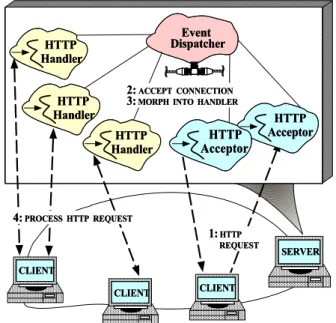
The Handle-based Synchronous Thread Pool: As shown in Figure 16, this model does not use a Reactor. Instead,
1: 1: HTTP HTTP REQUEST REQUEST
4:
4: PROCESS HTTP REQUEST PROCESS HTTP REQUEST
SERVER SERVER CLIENT
CLIENT
CLIENT
CLIENT CLIENTCLIENT
HTTP HTTP Handler Handler HTTP HTTP Handler Handler
HTTP HTTP Handler Handler
Event Event Dispatcher Dispatcher
HTTP HTTP Acceptor Acceptor
HTTP HTTP Acceptor Acceptor
2:
2: ACCEPT CONNECTION ACCEPT CONNECTION
3:
3: MORPH INTO HANDLER MORPH INTO HANDLER
Figure 16: Handle-based Synchronous Thread Pool Web Server Model
each thread in the pool directly invokes thehandle input
method of the HTTP Acceptor, which blocks awaiting client connections on the acceptor socket handle. When clients connect, the OS selects a thread from the pool of
HTTP Acceptorstoacceptthe connection. Once a con-nection is established, the acceptor “morphs” into anHTTP Handler, which performs a synchronousreadon the newly connected handle. After the HTTP request has been read, the thread performs the necessary computation and filesystem op-erations to service the request. The requested file is then trans-mitted synchronously to the client. After the data transmission completes, the thread returns to the pool and reinvokesHTTP Acceptor’shandle inputmethod.
Client requests can execute concurrently until the number of simultaneous requests exceed the number of threads in the pool. At this point, additional requests are queued in the ker-nel’s socket listen queue until a thread in the pool finishes its processing and becomes available. To reduce latency, the Thread Pool can be configured to always have threads avail-able to service new requests. However, the number of threads needed to support this policy can be very high during peak loads as threads block in long-duration synchronous I/O oper-ations.
One drawback with the handle-based Thread Pool model is that the size of the socket listen queue is relatively small (i.e., around 8 to 10 connections on most OS platforms). Therefore, high volume servers that receive hundreds of Web hits per sec-ond may not be able to accept connections fast enough to keep the kernel from rejecting clients. Moreover, it is not possible to prioritize which connections are dropped since the kernel does not distinguish among different clients.
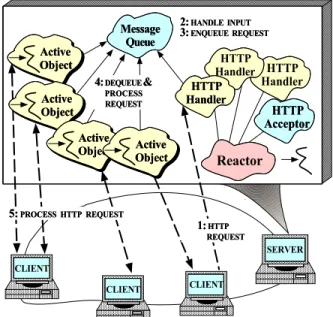
The Queue-based Synchronous Thread Pool: As shown in Figure 17, this model uses the Half-Sync/Half-Async pat-tern, which combines the Reactor and Active Object patterns. In this model, the ACEReactorthread accepts connections
Reactor
HTTP Handler
SERVER CLIENT
CLIENT CLIENT
HTTP Handler 4:
4: DEQUEUE DEQUEUE && PROCESS PROCESS REQUEST REQUEST Active
Active Object Object Active Active Object Object
Active Active Object
Object ActiveActiveObjectObject Message Message Queue Queue
HTTP HTTP Acceptor Acceptor
HTTP HTTP Handler Handler
1: 1: HTTP HTTP REQUEST REQUEST 2:
2: HANDLE INPUT HANDLE INPUT 3:
3: ENQUEUE REQUEST ENQUEUE REQUEST
5:
5: PROCESS HTTP REQUEST PROCESS HTTP REQUEST
Figure 17: Queue-based Synchronous Thread Pool Web Server Model
from clients (via theHTTP Acceptor) and manages all the
HTTP Handlers.
When HTTP requests arrive from clients they are vali-dated briefly by the associatedHTTP Handlerin the ACE
Reactorthread and then enqueued in the thread-safe ACE
Message Queuethat joins the “async” and “sync” layers in the Web server. Each Active Object in the thread pool
invokes the dequeue method of the request queue, which blocks awaiting client requests.
Once an HTTP request has been dequeued by a thread in the pool this thread performs the necessary computation and filesystem operations to service the request. The requested data is then transmitted synchronously to the client. After the data transmission completes the thread returns to the pool and reinvokesdequeuemethod to retrieve another HTTP re-quest.
In contrast with the handle-based Thread Pool model, the queue-based Thread Pool design makes it possible to accept (or reject) all incoming connections rapidly and prioritize how each client is processed. The primary drawback stems from the extra context switching and synchronization required to manage the queue in the Web server.
The Asynchronous Thread Pool: As shown in Figure 18, this model uses the ACEProactor, which manages an I/O completion port. An I/O completion port is a thread-safe
Proactor Proactor
7:
7: PROCESS HTTP REQUEST PROCESS HTTP REQUEST
SERVER SERVER CLIENT
CLIENT
CLIENT
CLIENT CLIENTCLIENT 6:
6: DEQUEUE COMPLETION DEQUEUE COMPLETION
& & PROCESS PROCESS
REQUEST REQUEST
HTTP HTTP Handler Handler HTTP HTTP Handler Handler
HTTP HTTP Handler
Handler HandlerHandlerHTTPHTTP I/O I/O Completion Completion
Port Port
Async Async Read Read Async Async Write Write
Async Async Accept Accept Async Async Accept Accept
3: 3: HTTP HTTP REQUEST REQUEST
1:
1: INITIATE ASYNC ACCEPT INITIATE ASYNC ACCEPT
2:
2: RUN EVENT LOOP RUN EVENT LOOP
4:
4: ACCEPT COMPLETES ACCEPT COMPLETES
5:
5: QUEUE COMPLETION QUEUE COMPLETION
Figure 18: Asynchronous Thread Pool Web Server Model queue of I/O completion notifications that resides in the OS kernel (in contrast, the queue-based Thread Pool managed the thread in user-space). Each I/O operation is initiated and “handed off” to the kernel, where it runs to completion. There-fore, the initiating thread does not block. When these opera-tions complete asynchronously, the kernel queues the resulting notifications at the appropriate I/O completion port.
Thread Pool is created during Web server initialization. Un-like the synchronous model, however, the threads wait on an I/O completion port rather than waiting onaccept. The OS queues up results from all asynchronous operations (e.g., asyn-chronous accepts, reads, and writes) on the I/O completion port. The result of each asynchronous operation is handled by a thread selected by the OS from the pool of threads waiting on the completion port. The thread that dequeues the com-pletion notification need not be the same one that initiated the operation.
The asynchronous Thread Pool model is typically less re-source intensive and provides more uniform latency under heavy workloads than synchronous Thread Pool models [32]. It is also more scalable since the same programming model works for a single thread, as well as multiple threads. The primary drawback with the asynchronous Thread Pool is that it is not portable to platforms that lack asynchronous I/O and proactive event dispatching. Windows NT 4.0 is the main con-temporary operating system that support I/O completion ports in its OS API. The ACE Proactorencapsulates the Win-dows NT 4.0 I/O completion port asynchronous demultiplex-ing mechanism within a typesafe C++ wrapper.
4.4.4 The Thread-per-Session Web Server Model In the Thread-per-Session model the newly created handler thread is responsible for the lifetime of the entire client ses-sion, rather than just a single request from the client. As with the Thread-per-Request model, only one thread blocks on the acceptor socket. This acceptor thread is a factory that creates a new handler thread to interact with each client for the duration of the session. Therefore, the new thread may serve multiple requests from a client before terminating.
The Thread-per-Session model is not appropriate for HTTP 1.0 since protocol establishes a new connection for each re-quest. Thus, Session is equivalent to Thread-per-Request in HTTP 1.0. This model is applicable in HTTP 1.1, however, since it supports persistent connections [35, 36]. Fig-ure 19 illustrates the Thread-per-Session model.
Thread-per-Session provides good support for prioritization of client requests. For instance, higher priority clients can be associated with higher priority threads. Thus, request from higher priority clients will be served ahead of requests from lower priority clients since the OS can preempt lower prior-ity threads. One drawback to Thread-per-Session is that con-nections receiving considerably more requests than others can become a performance bottleneck. In contrast, the Thread-per-Request and Thread Pool models provide better support for load balancing.
SERVER SERVER CLIENT
CLIENT
CLIENT
CLIENT CLIENTCLIENT
HTTP HTTP Handler Handler HTTP
HTTP Handler Handler HTTP
HTTP Handler
Handler HTTP HTTP Acceptor Acceptor
Reactor Reactor 2:
2: CREATE CREATE,, ACCEPT ACCEPT,, AND ACTIVATE AND ACTIVATE HTTP HTTP__HANDLERHANDLER
1: 1: HTTP HTTP REQUEST REQUEST
3:
3: SPAWN THREAD SPAWN THREAD PER CONNECTION PER CONNECTION
4:
4: PROCESS HTTP REQUEST PROCESS HTTP REQUEST
Figure 19: Thread-per-Session Web Server Model
5
Concluding Remarks
Computing power and network bandwidth has increased dra-matically over the past decade. However, the design and im-plementation of communication software remains expensive and error-prone. Much of the cost and effort stems from the continual re-discovery and re-invention of fundamental design patterns and framework components across the software in-dustry. Moreover, the growing heterogeneity of hardware ar-chitectures and diversity of OS and network platforms make it hard to build correct, portable, and efficient applications from scratch.
Object-oriented application frameworks and design patterns help to reduce the cost and improve the quality of software by leveraging proven software designs and implementations to produce reusable components that can be customized to meet new application requirements. The ACE framework described in this paper illustrates how the development of communi-cation software, such as high-performance Web servers, can be simplified and unified. The key to the success of ACE is its ability to capture common communication software design patterns and consolidate these patterns into flexible framework components that efficiently encapsulate and enhance low-level OS mechanisms for interprocess communication, event de-multiplexing, dynamic configuration, concurrency, and syn-chronization.
The ACE C++ wrappers, framework components, dis-tributed services, and higher-level disdis-tributed computing mid-dleware components described in this paper are freely avail-able at www.cs.wustl.edu/schmidt/ACE.html.
example applications, including JAWS. ACE has been used in research and development projects at many universities and companies. For instance, it has been used to build avionics systems at Boeing [11]; telecommunication systems at Bell-core [13], Ericsson [37], and Motorola [9]; medical imaging systems at Siemens [31] and Kodak [10]; and many academic research projects.
References
[1] F. P. Brooks, The Mythical Man-Month. Reading, MA: Addison-Wesley, 1975.
[2] A. Gokhale and D. C. Schmidt, “Measuring the Performance of Communication Middleware on High-Speed Networks,” in
Proceedings of SIGCOMM ’96, (Stanford, CA), pp. 306–317,
ACM, August 1996.
[3] D. C. Schmidt, S. Mungee, S. Flores-Gaitan, and A. Gokhale, “Alleviating Priority Inversion and Non-determinism in Real-time CORBA ORB Core Architectures,” in Proceedings of the
Fourth IEEE Real-Time Technology and Applications Sympo-sium, (San Francisco, CA), IEEE, December 1997.
[4] G. Booch, Object Oriented Analysis and Design with
Ap-plications (2 nd
Edition). Redwood City, California: Ben-jamin/Cummings, 1993.
[5] M. E. Fayad and D. C. Schmidt, “Object-Oriented Application Frameworks,” Communications of the ACM, vol. 40, October 1997.
[6] R. Johnson and B. Foote, “Designing Reusable Classes,”
Journal of Object-Oriented Programming, vol. 1, pp. 22–35,
June/July 1988.
[7] E. Gamma, R. Helm, R. Johnson, and J. Vlissides, Design
Pat-terns: Elements of Reusable Object-Oriented Software.
Read-ing, MA: Addison-Wesley, 1995.
[8] D. C. Schmidt and T. Suda, “An Object-Oriented Framework for Dynamically Configuring Extensible Distributed Commu-nication Systems,” IEE/BCS Distributed Systems Engineering
Journal (Special Issue on Configurable Distributed Systems),
vol. 2, pp. 280–293, December 1994.
[9] D. C. Schmidt, “A Family of Design Patterns for Application-level Gateways,” The Theory and Practice of Object Systems
(Special Issue on Patterns and Pattern Languages), vol. 2, no. 1,
1996.
[10] I. Pyarali, T. H. Harrison, and D. C. Schmidt, “Design and Performance of an Object-Oriented Framework for High-Performance Electronic Medical Imaging,” USENIX
Comput-ing Systems, vol. 9, November/December 1996.
[11] T. H. Harrison, D. L. Levine, and D. C. Schmidt, “The De-sign and Performance of a Real-time CORBA Event Service,” in Proceedings of OOPSLA ’97, (Atlanta, GA), ACM, October 1997.
[12] D. C. Schmidt and C. Cleeland, “Applying Patterns to Develop Extensible ORB Middleware,” Submitted to the IEEE
Commu-nications Magazine, 1998.
[13] D. C. Schmidt, “Reactor: An Object Behavioral Pattern for Concurrent Event Demultiplexing and Event Handler Dispatch-ing,” in Pattern Languages of Program Design (J. O. Coplien and D. C. Schmidt, eds.), pp. 529–545, Reading, MA: Addison-Wesley, 1995.
[14] M. K. McKusick, K. Bostic, M. J. Karels, and J. S. Quarter-man, The Design and Implementation of the 4.4BSD Operating
System. Addison Wesley, 1996.
[15] D. C. Schmidt, T. H. Harrison, and E. Al-Shaer, “Object-Oriented Components for High-speed Network Programming,” in Proceedings of the1
st
Conference on Object-Oriented Tech-nologies and Systems, (Monterey, CA), USENIX, June 1995.
[16] Object Management Group, The Common Object Request
Bro-ker: Architecture and Specification, 2.2 ed., Feb. 1998.
[17] D. Box, Essential COM. Addison-Wesley, Reading, MA, 1997. [18] A. Wollrath, R. Riggs, and J. Waldo, “A Distributed Object Model for the Java System,” USENIX Computing Systems, vol. 9, November/December 1996.
[19] D. C. Schmidt and S. Vinoski, “Object Adapters: Concepts and Terminology,” C++ Report, vol. 11, November/December 1997.
[20] D. C. Schmidt, A. Gokhale, T. Harrison, and G. Parulkar, “A High-Performance Endsystem Architecture for Real-time CORBA,” IEEE Communications Magazine, vol. 14, February 1997.
[21] A. Gokhale and D. C. Schmidt, “Measuring and Optimizing CORBA Latency and Scalability Over High-speed Networks,”
Transactions on Computing, vol. 47, no. 4, 1998.
[22] D. C. Schmidt, D. L. Levine, and S. Mungee, “The Design and Performance of Real-Time Object Request Brokers,” Computer
Communications, vol. 21, pp. 294–324, Apr. 1998.
[23] R. G. Lavender and D. C. Schmidt, “Active Object: an Ob-ject Behavioral Pattern for Concurrent Programming,” in
Pat-tern Languages of Program Design (J. O. Coplien, J. Vlissides,
and N. Kerth, eds.), Reading, MA: Addison-Wesley, 1996. [24] F. Buschmann, R. Meunier, H. Rohnert, P. Sommerlad, and
M. Stal, Pattern-Oriented Software Architecture - A System of
Patterns. Wiley and Sons, 1996.
[25] R. Johnson, “Frameworks = Patterns + Components,”
Commu-nications of the ACM, vol. 40, Oct. 1997.
[26] J. Vlissides, “The Hollywood Principle,” C++ Report, vol. 8, Feb. 1996.
[27] A. Stepanov and M. Lee, “The Standard Template Library,” Tech. Rep. HPL-94-34, Hewlett-Packard Laboratories, April 1994.
[28] D. C. Schmidt, “Acceptor and Connector: Design Patterns for Initializing Communication Services,” in Pattern Languages of
Program Design (R. Martin, F. Buschmann, and D. Riehle,
eds.), Reading, MA: Addison-Wesley, 1997.
[29] D. C. Schmidt and C. D. Cranor, “Half-Sync/Half-Async: an Architectural Pattern for Efficient and Well-structured Con-current I/O,” in Pattern Languages of Program Design (J. O. Coplien, J. Vlissides, and N. Kerth, eds.), Reading, MA: Addison-Wesley, 1996.