JENNIFER SLOAN MCCOMBS
✲CATHERINE H. AUGUSTINE
HEATHER L. SCHWARTZ
✲SUSAN J. BODILLY
✲BRIAN MCINNIS
DAHLIA S. LICHTER
✲AMANDA BROWN CROSS
EDUCATION
How Summer Programs Can Boost Children’s Learning
Making
Summer Count
The RAND Corporation is a nonprofit institution that helps improve policy and decisionmaking through research and analysis. RAND’s publications do not necessarily reflect the opinions of its research clients and sponsors.
R
®
is a registered trademark.© Copyright 2011 RAND Corporation
Permission is given to duplicate this document for personal use only, as long as it is unaltered and complete. Copies may not be duplicated for commercial purposes. Unauthorized posting of RAND documents to a non-RAND website is prohibited. RAND documents are protected under copyright law. For information on reprint and linking permissions, please visit the RAND permissions page (http://www.rand.org/publications/permissions.html).
Published 2011 by the RAND Corporation
1776 Main Street, P.O. Box 2138, Santa Monica, CA 90407-2138 1200 South Hayes Street, Arlington, VA 22202-5050 4570 Fifth Avenue, Suite 600, Pittsburgh, PA 15213-2665
RAND URL: http://www.rand.org/
To order RAND documents or to obtain additional information, contact Distribution Services: Telephone: (310) 451-7002;
Fax: (310) 451-6915; Email: [email protected]
Library of Congress Cataloging-in-Publication Data is available for this publication. ISBN 978-0-8330-5266-7
iii
Summer learning programs have the potential to help children and youth improve their academic and other outcomes. This is especially true for children from low-income families who might not have access to educational resources throughout the summer months and for low-achieving students who need additional time to master academic content. However, summer learning programs are often an afterthought of school dis-tricts or not offered at all, especially in restrictive funding environments.
To focus attention on the potential of such programs, this monograph reviews the literature on summer learning loss and the effectiveness of summer learning programs, determines key cost drivers of and available funds for summer programs, and gathers information about how such programs operate in district and city contexts, including facilitators and challenges.
The findings should be of interest to policymakers and practitioners involved in improving the performance of and expanding opportunities for income and low-achieving students, including school district and city leaders, the National Summer Learning Association, the Council of the Great City Schools, the U.S. Department of Education, funders of summer learning programs, state departments of education, state legislators, and the education research community.
This research was conducted by RAND Education, a unit of the RAND Cor-poration, and sponsored by The Wallace Foundation, which seeks to support and share effective ideas and practices to improve learning and enrichment opportunities for children. Its current objectives are to improve the quality of schools, primarily by developing and placing effective principals in high-need schools; improve the quality of and access to out-of-school-time programs through coordinated city systems and by strengthening the financial management skills of providers; integrate in- and out-of-school learning by supporting efforts to reimagine and expand learning time during the traditional school day and year as well as during the summer months, helping to expand access to arts learning, and using technology as a tool for teaching and pro-moting creativity and imagination. For more information about research on these and other related topics, please visit The Wallace Foundation Knowledge Center at www. wallacefoundation.org.
v
Preface . . . iii
Figures . . . ix
Tables . . . xi
Summary . . . .xiii
Acknowledgments . . . .xxi
Abbreviations . . . xxiii
ChAPTer One Introduction . . . 1
Policy Context . . . .1
Research Questions . . . .2
Summer Learning Programs and Site Selection . . . .3
Analytic Approach . . . .4
Conceptual Framework . . . .4
Data and Methods . . . .7
Study Limitations . . . .14
Organization of This Monograph . . . .15
ChAPTer TwO Time, Learning, Learning Decay, and Summer Learning Loss . . . .17
General Relationship Between Time and Learning . . . .17
Time and Learning in and out of School . . . .18
Summer Learning Loss . . . 20
Average Summer Loss of Learning. . . 20
Differences by Family Income . . . .21
Cumulative Effects of Summer Learning Loss . . . 22
Differences by Subject and Grade Level . . . 23
ChAPTer Three
effectiveness of Summer Learning Programs . . . 27
Effectiveness of Summer Learning Programs . . . 27
Overall Effectiveness. . . 27
Subject . . . 28
Demographic Groups. . . .29
Grade . . . .29
Attendance . . . 30
Long-Term Effects . . . 30
Nonacademic Outcomes . . . .32
Components of Quality Summer Learning Programs . . . .32
Smaller Class Sizes . . . .32
Differentiated Instruction . . . .32
High-Quality Instruction . . . .33
Aligned School-Year and Summer Curricula . . . .33
Engaging and Rigorous Programming . . . .33
Maximized Participation and Attendance . . . .33
Sufficient Duration . . . 34
Involved Parents . . . 34
Evaluations of Effectiveness . . . 34
Conclusions . . . 36
ChAPTer FOur Costs of Summer Programming . . . .37
Evidence from the Literature . . . .37
Cost Estimates for Select Summer Learning Programs . . . 40
Sources of Cost Variation Across Programs . . . 43
Core Services: Central Office and Site-Based Instructional and Administrative Costs . . . 43
Supportive Services: Meals, Facilities, and Transportation . . . .47
How Summer Costs Compare to School-Year Costs . . . .49
Financial Sources for Summer School Programming . . . .49
Federal Funding Sources . . . 50
State Funding Sources . . . .52
Private Funding Sources . . . .53
Putting It All Together: Achieving Stable Funding Streams . . . 54
Conclusions . . . .55
ChAPTer FIve Creating and Maintaining Summer Learning Programs: Lessons from the Field . . . .57
Purposes and Commitments . . . .57
Overcoming Barriers to Launching and Maintaining Programs . . . .59
Ongoing Challenges . . . 60
Barriers to Scale . . . 60
Overcoming Barriers . . . 60
Quality Program Components . . . .63
Smaller Class Sizes and Differentiated Instruction . . . 64
High-Quality Instruction . . . 64
Aligned School-Year and Summer Curricula . . . .65
Engaging and Rigorous Programming . . . .65
Maximized Participation and Attendance . . . .65
Sufficient Duration . . . 66
Involved Parents . . . 66
Evaluations of Effectiveness . . . 66
Lessons on Where and How to Offer Programs . . . .67
Conclusions . . . 68
ChAPTer SIx Conclusions and recommendations . . . .71
Recommendations for Districts and Providers . . . .72
Invest in Highly Qualified Staff and Early Planning . . . .73
Embed Promising Practices into Summer Learning Programs . . . .73
Consider Partnerships When Developing Summer Learning Programs . . . .73
Think Creatively About Funding . . . .73
Recommendations for Policymakers and Funders . . . .74
Extend the Research Base . . . .74
Support Consistent Funding Sources for Summer Learning Programs . . . .75
Provide Clear Guidance Regarding the Use of Scarce Funds . . . .75
APPenDIx Approach to Cost estimates for Summer Learning Programs . . . 77
ix
1.1. Conceptual Framework for District-Provided Summer Learning Programs . . . .5 4.1. Cost Estimates for Selected Summer Learning Programs, per Slot
per Summer, 2009 . . . 42 4.2. Cost Estimates for Core Summer Services, per Slot per Hour, 2009 . . . 46
xi
1.1. Interviews, by Type . . . .9
1.2. Sites Visited and Programming Types . . . .11
2.1. Average Annual Gains in Effect Size from Nationally Normed Tests, by Grade . . . .21
3.1. National Summer Learning Association Quality Standards . . . .35
4.1. Estimates per Enrollee from Existing Studies of Summer Programming Costs . . . .39
4.2. Programmatic Structure of Selected Summer Learning Programs . . . .45
A.1. Cost Categories on a per-Slot, per-Summer Basis . . . .82
A.2. Incremental Additional Costs of Ingredients on a per-Slot Basis . . . 84
xiii
During summer vacation, many students lose knowledge and skills. By the end of summer, students perform, on average, one month behind where they left off in the spring. Of course, not all students experience “average” losses. Summer learning loss disproportionately affects low-income students. While all students lose some ground in mathematics over the summer, low-income students lose more ground in reading, while their higher-income peers may even gain. Most disturbing is that summer learn-ing loss is cumulative; over time, the difference between the summer learnlearn-ing rates of low-income and higher-income students contributes substantially to the achievement gap.
Because many students lose learning over the summer and some students need more time on task to master content, participation in summer learning programs should mitigate learning loss and could even produce achievement gains. Indeed, edu-cators and policymakers are increasingly promoting summer learning as a key strategy to improving the achievement of low-performing students. In 2009, a Johns Hopkins University–based center for summer learning became an independent organization, the National Summer Learning Association, providing resources, guidance, and expertise to the summer learning community. In 2010, President Obama noted, “Students are losing a lot of what they learn during the school year during the summer.”1 Earlier that
year, First Lady Michelle Obama launched “United We Serve: Let’s Read, Let’s Move,” a program that encourages Americans to fight the summer reading gap, acknowledging that youth who do not read during the summer can lose months of academic progress (White House, 2010).
Study Purpose and Research Questions
The Wallace Foundation is encouraging the establishment of district-supported summer learning programs, particularly for urban students in grades 1–8. To support this effort, The Foundation asked RAND to conduct a study to assess both the need
for summer learning programs and the existing evidence on effective, viable, and sus-tainable summer learning programs in urban districts.
In this monograph, we address the following research questions: 1. What is the nature of summer learning loss?
2. Are summer learning programs effective in improving student achievement? What are the elements of effective summer programs?
3. How much do summer learning programs cost?
4. What are the facilitators and challenges to implementing summer programs?
Data and Methods
To answer our first two research questions, we conducted literature reviews on summer learning loss and the effectiveness of summer learning programs. To examine cost, we conducted a literature review to identify common funding sources for summer programs, collected detailed cost data from seven summer learning programs, and determined their costs and the primary reasons for the variation among them. To address the final question, regarding facilitators and challenges to implementing such programs, we conducted 15 telephone interviews: eight with providers (either school districts or programs affiliated with school districts) and seven with national nondis-trict providers.
We also conducted site visits to five cities, where we interviewed summer learn-ing leaders from among city and district representatives, summer learnlearn-ing staff, and external partners (more than 60 interviews in total). In four of the cities, we had the opportunity to observe summer learning. Cities selected for interviews and site visits were those that had a long history of providing summer programs or were considered by the national organizations to have particularly innovative programming or a par-ticular context of interest, such as city-led programming or high proportions of English language learners.
Limitations and Contributions
This monograph does not include any independent analyses to determine the nature of summer learning loss or summer program effectiveness. Instead, it summarizes and draws out lessons from a set of existing research. While our independent cost analysis provides much-needed information for the field, it is limited to seven cases of academi-cally oriented summer programming that operate at scale. Thus, it does not capture the cost range of all types of summer learning programs. In addition, because our findings and recommendations are drawn from a limited sample of summer programs that are
not representative of all summer learning program contexts, they are not generalizable to all programs. In particular, by design, we spent more time studying programs pro-vided by school districts than we did studying those propro-vided by national or commu-nity-based summer learning providers. We also made no attempt to assess the quality of the summer programs that we visited.
Despite these limitations, this monograph makes an important contribution to the field by addressing both the value and the cost of summer learning programs. We synthesize evidence from the research about summer learning loss and the effectiveness of summer learning programs in preventing that loss. We also estimate the potential costs of such programs and provide lessons learned from districts and other providers about how to fund, implement, and sustain such programs.
Key Findings
Summer Learning Loss, Which Is Disproportionate and Cumulative, Contributes Substantially to the Achievement Gap
Research indicates that, on average, students lose skills over the summer, particularly in mathematics. However, not all students experience “average” losses, and summer learning loss disproportionately affects low-income students. Low-income students lose substantial ground in reading during the summer, while their higher-income peers often gain. Most disturbing is that it appears that summer learning loss is cumulative and that, over time, these periods of differential learning rates between low-income and higher-income students contribute substantially to the achievement gap in read-ing. It may be that efforts to close the achievement gap during the school year alone will be unsuccessful.
Students Who Attend Summer Programs Have Better Outcomes Than Similar Peers Who Do Not Attend These Programs
Rigorous studies of voluntary summer programs, mandatory summer programs, and programs that encourage students to read at home in the summer have all found posi-tive effects on student achievement. The combined evidence from these studies sug-gests that all of these types of summer learning programs can mitigate summer learn-ing losses and even lead to achievement gains. Moreover, longitudinal studies conclude that the effects of summer learning programs endure for at least two years after the student has engaged in the summer program. (No studies have examined whether effects last beyond two years.)
Strategies for Maximizing Quality, Enrollment, and Attendance Are Critical to Achieving Benefits
Not all summer learning programs result in positive outcomes for enrollees. Pro-gramming needs to be high-quality, and students need to enroll and attend regularly.
Research points to several practices that are associated with program quality, includ-ing individualized instruction, parental involvement, and small class sizes. For volun-tary summer learning programs, providers need to adopt targeted strategies to build enrollment and maximize attendance among enrollees. Several effective strategies were offered by the program staff we interviewed. Notifying parents early before they make other plans for the summer was important in maximizing enrollment. Offering engag-ing enrichment activities, providengag-ing transportation, and offerengag-ing full-day programs, which better suit the needs of working families, were noted as methods of increasing enrollment and encouraging high attendance rates.
Cost Is the Main Barrier to Implementing Summer Learning Programs
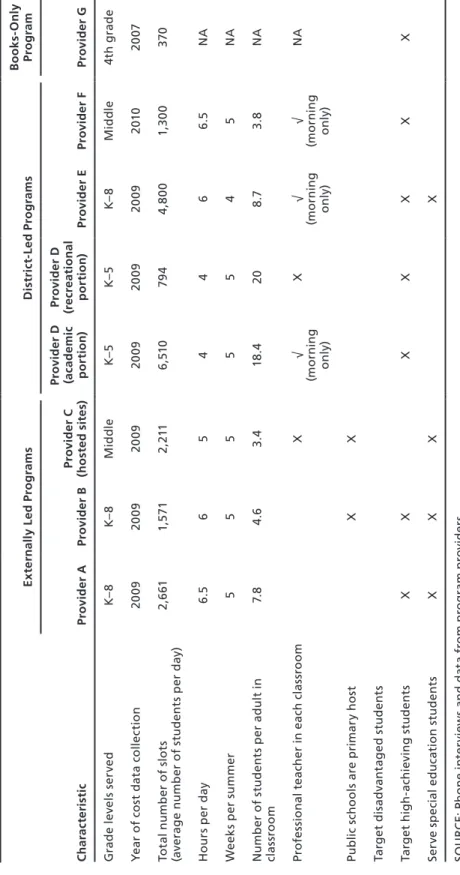
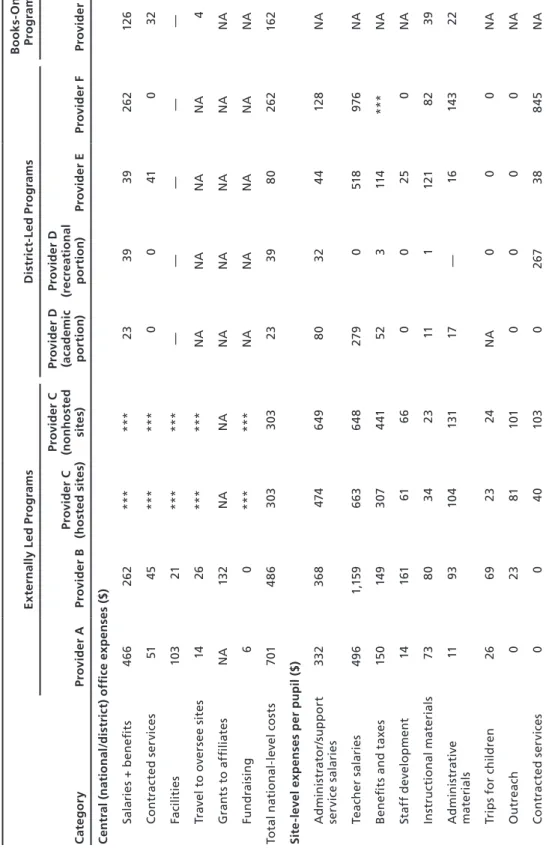
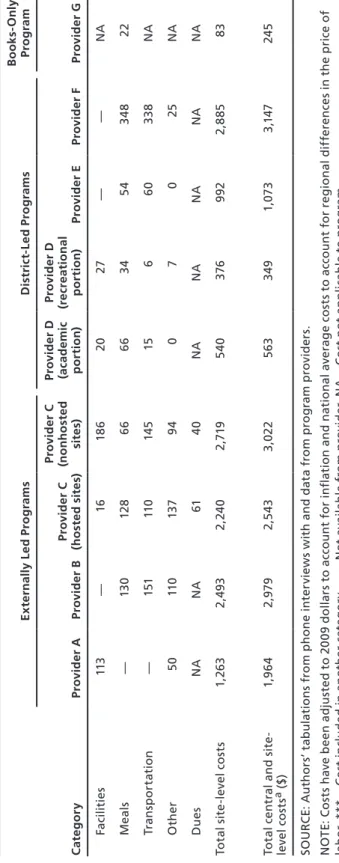
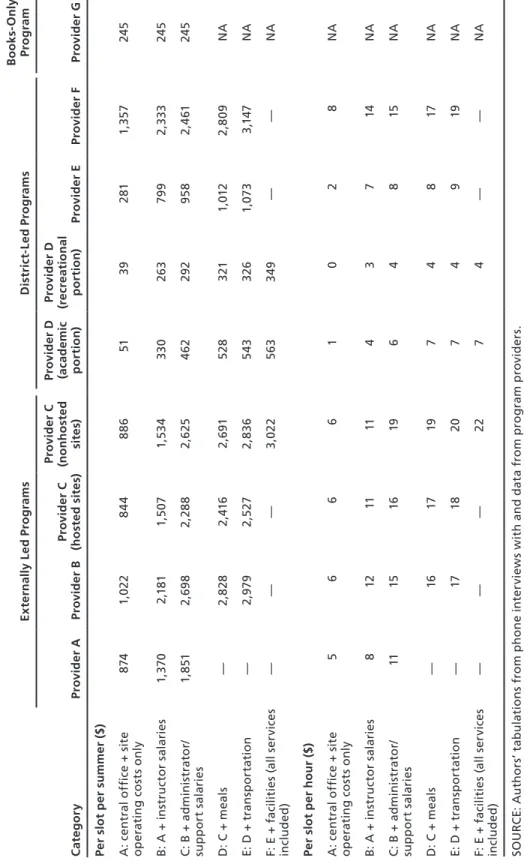
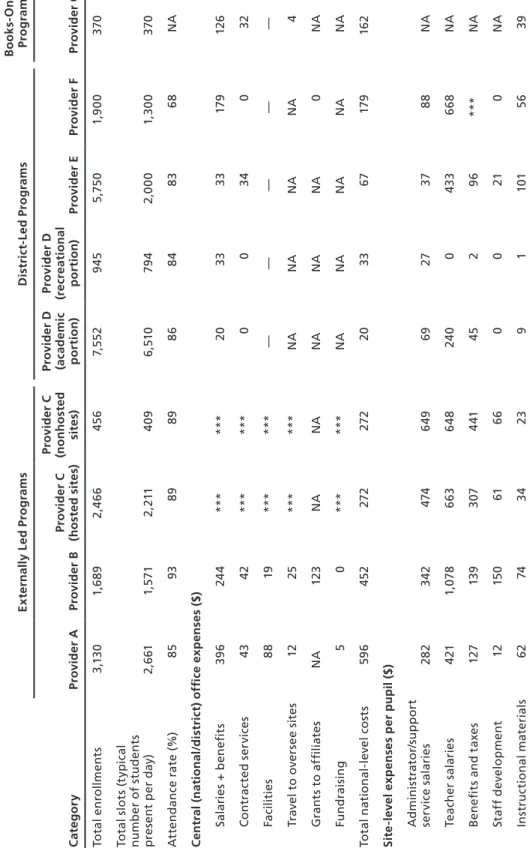
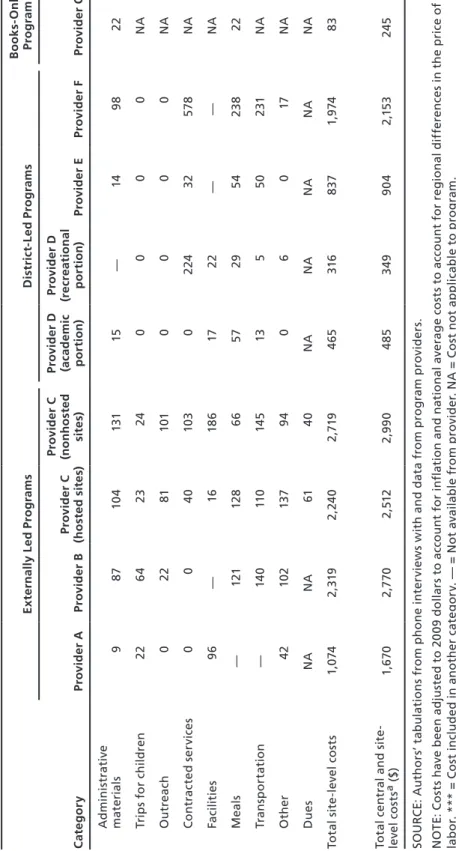
Providing a high-quality summer learning program can cost between $1,109 and $2,801 per child for a six-hour-per-day, five-week program. Although preliminary evi-dence suggests that the cost of summer school programs can be less than two-thirds of what providers spend on programs during the academic year (on a per-slot, per-week basis), summer programs nonetheless represent an additional cost to districts, espe-cially relative to other interventions that simply update or reform practices used during the school year.
Districts Question the Cost-Effectiveness of Summer Learning Programs, and Many Have Discontinued Them in Response to Budget Cuts
Interviewees from the National Summer Learning Association indicated that, given the costs, districts are uncertain of the value they would get from a summer learning program. Furthermore, some of our interviewees who are currently offering summer learning programs questioned the extent to which the benefits of the program out-weigh the costs. In fact, the recent economic downturn has created such severe short-falls in state education budgets that many districts across the country have cut what little summer school programming they have offered. However, district leaders who are committed to such programs have found creative ways to fund them.
Partnerships Can Strengthen Summer Learning Programs
The majority of the summer learning programs examined in this study were provided by or operated in partnership with districts, and we found benefits from these part-nerships. We found that summer learning programs cost less when offered by school districts due, in part, to lower central office costs and in-kind contributions of services, such as facilities and meals. In addition, districts can leverage consistent sources of funding (e.g., Title I or general operating funds) for such programs, creating a greater likelihood of sustainment. We also found that partnerships between districts and com-munity-based organizations (CBOs) provided increased benefits and lowered costs. CBOs offered opportunities for enrichment beyond those typically offered in schools, such as kayaking and fencing, that encouraged students to enroll and attend—steps
critical to program effectiveness. We also found that CBO instructors were less expen-sive than certified teachers. Thus, partnerships between these two types of organi-zations resulted in lower costs overall. Further, in one city, provision of enrichment opportunities attracted local foundation funding for summer programs.
Developing and Sustaining District-Based Voluntary Summer Learning Programs Is Challenging but Feasible
Interviewees reported that launching a summer learning program that serves a high proportion of low-performing students is challenging. Early implementation chal-lenges include establishing consistent expectations for the program, navigating internal district bureaucracies, and partnering with local CBOs. Ongoing challenges to main-taining a summer learning program include funding (particularly during times of con-strained school budgets), facilities constraints due to building maintenance or lack of air conditioning, low or uncertain enrollment, and an underspecified or unsupported vision for the summer program. Interviewees also reported that the lack of evaluations and teacher contract rules threatened the quality of their programs. Despite these chal-lenges, some urban districts have long-standing summer learning programs, and others have launched new programs over the last few years. Challenges can be overcome by supportive leaders who can find and dedicate funding, as well as ensure that qualified staff devote time to early planning, early hiring, and early recruiting for summer learn-ing programs.
Recommendations for Districts and Providers
Districts and communities must decide for themselves whether the potential value of these programs is worth the cost and effort of establishing and sustaining them. But our analysis suggests that they should be seriously considered within the context of the needs and resources available to districts and communities. Rigorous studies have shown that strong summer programs can achieve several important goals: reverse summer learning loss, achieve learning gains, and give low-performing students the chance to master material that they did not learn during the previous school year.
Here, we offer a set of recommendations for districts and other providers that want to invest in summer learning programs. Specifically, we recommend that districts and providers invest in staffing and planning for summer learning programs, actively incorporate practices that will help ensure the success of programs, and maximize the benefits of partnerships and a variety of funding sources.
Invest in Highly Qualified Staff and Early Planning
Developing high-quality summer programs can be challenging. We found that pro-viders that succeeded in developing a well-structured program that attracted students
to enroll and attend had high-quality, dedicated year-round administrators with time devoted to planning and programming. Planning began early in the school year. Early planning allowed programs to conduct early hiring (thereby maximizing their teacher recruiting pool) and early recruiting (thereby maximizing student enrollment).
Embed Promising Practices into Summer Learning Programs
Research shows that a number of practices are associated with improved student out-comes, such as smaller class sizes, involving parents, providing individualized instruc-tion, and maximizing students’ attendance. Other best practices include providing structures that support high-quality instruction, aligning the school year and summer curricula, including content beyond remediation, and tracking effectiveness. Provid-ers also need to adopt strategies for attracting students to these programs to ensure value for their investment, such as print and radio advertising; advertising at commu-nity meetings, summer learning fairs, and even grocery stores; targeted recruiting of students living in housing projects, including door-to-door recruiting and phone calls to parents; student and teacher focus groups; and CBO recruiting among students in their after-school programs.
Consider Partnerships When Developing Summer Learning Programs
Partnerships may enable the creation and sustainment of high-quality voluntary summer learning programs. We found benefits from partnerships between school dis-tricts and CBOs that included a wider variety of programming options, and more varied funding sources. However, a number of other partnerships may be beneficial, as several types of organizations have an interest in promoting summer learning experi-ences for youth—districts, CBOs, private summer learning providers, cities, and local funders. Each of these organizations has a set of resources and skills that can help build sustainable summer learning programs. We encourage leaders to consider all local resources and build appropriate partnerships when developing these programs.
Think Creatively About Funding
There are several pots of funding from which districts can draw to support summer learning programs. Researchers have documented, for example, more than 100 pro-grams that can support summer learning. The National Summer Learning Association provides guidelines for funding summer learning programs on its website. This mono-graph provides other funding ideas, such as hiring AmeriCorps students and hiring teachers who need administrative hours to serve as summer site coordinators. Partner-ing with local CBOs can also result in economies of scale, as noted earlier.
Recommendations for Policymakers and Funders
Finally, we offer recommendations for policymakers and funders who are interested in supporting summer learning programs: Extend the research base on the efficacy of summer learning programs and support stable funding for new and existing programs.
Extend the Research Base
Although research has established the efficacy of summer learning programs, it has not tested several aspects of such programs when offered to large numbers of low- performing students in urban settings. Rigorous, longitudinal research on large pro-grams would provide valuable information to policymakers and practitioners. In par-ticular, we make the following recommendations:
• Conduct randomized controlled trials of programs designed to maximize atten-dance that compare treated to nontreated students over multiple years.
• Conduct studies that include multiple outcomes beyond academic performance: secondary academic outcomes, such as school attendance and graduation rates, and nonacademic outcomes, such as reductions in juvenile delinquency, improved nutrition, and increases in exercise. Including a range of outcomes will help moti-vate other stakeholders, such as city governments, to support or fund summer learning programs.
• Conduct studies that examine whether programs can be constructed to attract high levels of participation in multiple, consecutive years of programming. If so, the studies should evaluate the effects of consecutive years of participation on a range of student outcomes.
• Conduct studies of the cost-effectiveness of summer learning programs to help district leaders and other policymakers consider how best to invest in improving education.
Support Consistent Funding Sources for Summer Learning Programs
A key obstacle to providing summer learning programs is a lack of stable funding. Poli-cymakers at the federal, state, and local levels can work to provide funding for summer programming by specifying that existing funding targeted to high-need youth can be used for summer programming, by establishing new funding for programs, and by fundraising for summer programming. The school district officials whom we spoke with who run summer learning programs independently confirmed that funding was contingent on the support of key leaders, including the superintendent, local politi-cians, and local foundations.
Provide Clear Guidance Regarding the Use of Scarce Funds
District leaders described the difficulty of braiding multiple funding sources together, given the restrictions and requirements associated with each source of funds. State policymakers could support district efforts by providing clear guidance on how federal and state funds can be combined to support summer programs.
xxi
Many people helped in conducting this study and producing this monograph. We would like to thank those at The Wallace Foundation for their substantive and finan-cial support. In particular, Edward Pauly and Ann Stone provided valuable guidance on the intellectual and analytic components of our work. Dara Rose, Richard Laine, Christine DeVita, Pam Mendels, and Lucas Held provided other substantive insights.
Representatives from school districts, mayors’ offices, CBOs, and local provider organizations also contributed their time and expertise, especially on implementation issues and cost. Representatives from some of the national provider organizations were very generous with their time and expertise and contributed substantially to the study, especially in providing details on likely costs.
The document itself benefited from the input of internal and external reviewers, including Lynn Karoly and Geoffrey Borman, and from the contributions of Laura Zakaras and Lauren Skrabala, who helped prepare the final manuscript. We acknowl-edge their help in improving this document.
xxiii
21st CCLC 21st Century Community Learning Centers program ARRA American Recovery and Reinvestment Act
BELL Building Educated Leaders for Life
CBO community-based organization
CCDF Child Care and Development Fund
CDBG Community Development Block Grant
CPI Consumer Price Index
CWI Comparable Wage Index
ECLS-K Early Childhood Longitudinal Study, Kindergarten Class ERIC Education Resources Information Center
FTE full-time equivalent
OST out-of-school time
SES socioeconomic status
1
Policy Context
Despite steady efforts to close the large achievement gap between disadvantaged and advantaged students over the past 40 years, significant discrepancies remain. In 2009, on the National Assessment of Educational Progress, 49 percent of low-income fourth-grade students scored at the “below basic” level in reading (the lowest proficiency level) compared with 20 percent of their higher-income students. Large achievement gaps exist for mathematics as well, with 30 percent of low-income students performing at the lowest performance level compared with only 9 percent of their higher-income peers. These trends also hold in the eighth grade, where the differences are 40 percent versus 15 percent in reading and 43 percent versus 17 percent in mathematics (U.S. Department of Education, undated). Due to the inequitable proportion of low-income minority students, similarly sized achievement gaps are found between white and black children in the United States, white and Hispanic children, and native speakers and English language learners. Depending on the subject and grade level, there has been either a modest reduction or no substantive change in the achievement gap along eco-nomic or racial lines since the 1990s.
These achievement gaps are particularly troubling because they comport with subsequent inequities in educational attainment, in which students from the bottom quartile of the income distribution are more than twice as likely to drop out of high school as students from the top quartile of the distribution (National Center for Edu-cation Statistics, 2007). Failure to complete high school has significant ramifiEdu-cations for the individuals themselves and for society as a whole because formal schooling is an increasingly important gateway to future employment, earnings, and attendant life chances (Belfield and Levin, 2007). Some analysts believe that closing the achievement gap would do more to promote equality in the United States than any other political strategy (Jencks and Phillips, 1998).
Increasingly, educators and policymakers are considering additional learning time to be a key strategy for improving the achievement of low-performing students, many of whom are also low-income. For instance, Title I legislation specifies summer learn-ing time as a key strategy that can be used to turn around schools. In fact, research
evidence shows (1) that students’ skills and knowledge often deteriorate during the summer months, and low-income students face larger losses than other students (Cooper, Charlton, et al., 2000), and (2) that low-achieving students need additional time on task to master academic content (Brown and Saks, 1986; Walberg, 1988; Ketterlin-Geller, Chard, and Fien, 2008). As a result, instruction during the summer has the potential to stop losses that might occur and to propel students toward higher achievement.
Three approaches to preventing summer learning loss are offered most often: modifying the school calendar, extending the school year, and providing summer school. Modifying the school calendar does not add instructional days to the calendar, but it redistributes days across the calendar to replace the long summer break with sev-eral shorter breaks. Unfortunately, the quality of current evidence regarding the effec-tiveness of modified calendars is poor (Cooper, Valentine, et al., 2003). Extending the school year would provide students with additional days of instruction. In an interview on the Today Show, President Obama called for a longer school year, citing the fact that U.S. students go to school, on average, a month less than students in other developed countries. He also noted that this means that “students are losing a lot of what they learn during the school year during the summer.”1
The clear challenge to extending the school year is its cost. In addition, in cities across the country, districts that have tried to extend the school year (or modify the cal-endar) have met resistance from parents, employers of teenagers, and family recreation businesses. And data suggest that more time was cut away from the instructional cal-endar in the 2010–2011 school year as fiscal pressures forced school districts to weigh options to furlough teachers or shorten the instructional calendar. For instance, 16 of the 30 largest school districts in California reduced the number of school days to bal-ance their budgets, and 12 districts cut instructional time by the maximum of five days (Benefield, 2010; Freedberg, 2010).
Summer programs, the focus of this monograph, are less costly than extending the school year because they are typically offered only to a subset of students. Thus, they may be more attractive to cost-conscious districts. They also provide the oppor-tunity to give low-income students additional instruction that could help close local achievement gaps and give struggling students additional time on task so they can master material already learned by their peers.
Research Questions
As part of its interest in expanding opportunities for students to learn outside of the school day, The Wallace Foundation wants to encourage district-supported summer
learning programs, particularly for urban students in grades 1–8. To support this effort, The Foundation asked RAND to conduct a study to assess both the need for summer learning programs and the existing evidence on effective, viable, and sus-tainable summer learning programs in urban districts. Specifically, this monograph addresses the following research questions:
1. What is the nature of summer learning loss?
2. Are summer learning programs effective in improving student achievement? What are the elements of effective summer programs?
3. How much do summer learning programs cost?
4. What are the facilitators and challenges to implementing summer programs?
Summer Learning Programs and Site Selection
Summer programs vary along a number of dimensions:
• Instructional purpose. Some programs serve low-performing students and provide
remedial instruction, focusing on skills that students failed to master during the school year. Other programs serve both low- and higher-performing students and focus on skills that a student will encounter in the upcoming school year, to pre-pare students to master the material.
• Type of provider. Summer learning programs are offered by school districts,
national providers that operate a program in multiple cities across the country, and local providers that operate only within a particular city or region.
• Voluntary or mandatory. Another way in which programs vary is the extent to
which they are voluntary or mandatory. Voluntary programs recruit students who may or may not choose to attend. Mandatory programs are typically provided for students who are at risk of being retained in grade, as the threat of retention becomes the method of mandating program attendance. However, even manda-tory programs are not strictly mandamanda-tory—parents may choose to not send their child to summer school, and the student can try to test into the next grade in the fall without having attended a summer program.
• Dosage. Summer learning programs typically operate for anywhere between four
and eight weeks during the summer for four or five days per week. Hours of programming vary as well. All the summer learning programs described in this monograph provide half-day academic instruction in reading and/or mathemat-ics. However, many of the programs we studied operate for a full day and also offer enrichment activities. Enrichment may be provided by regular teachers or by
community-based organizations (CBOs).2 Some summer learning programs
spe-cifically offer enrichment activities that are intended to address the “opportunity gap,” in that they provide low-income students with opportunities that are similar to those that middle- and higher-income students have during the summer.
• Setting. Summer learning programs operate inside and outside the classroom. The
majority of summer programs discussed here are those in which students attend a summer school site that operates for a designated number of hours and weeks over the summer. These programs can be operated in schools or outside of schools (e.g., at CBOs or college campuses). Researchers have also studied reading-at-home summer interventions. These programs send or mail books home to students, appropriately matched to their reading level and interests, to read over the course of the summer. In addition, prior to the summer, teachers might provide some scaffolding that provides students with strategies to use when reading the books over the summer.
Analytic Approach
By drawing on existing literature, program cost data, and interviews with leaders of national organizations, summer learning providers, school districts, and city gov-ernments, this study examined multiple aspects of the factors that influence urban districts’ student achievement (including loss and learning) during the summer. To answer our first two research questions on the extent of summer learning loss and the effectiveness of summer learning programs, we conducted literature reviews on summer learning loss and on the effectiveness of summer learning programs. To exam-ine cost, we conducted a literature review to identify common funding sources for summer programs, collected detailed cost data from seven summer learning programs, and determined the programs’ costs and the primary reasons for the variation among them. To address our fourth research question, we conducted interviews with represen-tatives from national organizations, national providers of summer learning programs, and district officials involved in providing summer programming to understand the factors that facilitate and challenge the implementation of summer programming for urban districts’ students in kindergarten through eighth grade.
Conceptual Framework
A basic conceptual framework for district-provided summer learning programs guided our study (see Figure 1.1). Given that breaks from school during the summer result in achievement loss for students and that some students need more time on task to master content, we expect that participation in summer learning programs can
gate that loss and even produce achievement gains. This hypothesis is supported by prior research, described in Chapters Two and Three. By providing students with pro-ductive time on academic tasks during the summer, we expect that summer learning programs will result in improved achievement in the content areas covered by the program and will have nonacademic benefits as well. Student attendance in summer learning programs may decrease juvenile delinquency among older youth during the summer and improve students’ diet and level of exercise.3 Further, students who are
better prepared academically may reap future benefits such as • improved school-year attendance
• reduced risk of being retained in grade
3 Researchers examining childhood obesity among kindergarten and first-grade students found that growth in body mass index is faster during the summer vacation than during the school year, especially among black and Hispanic children who are already overweight (Von Hippel et al., 2007).
Figure 1.1
Conceptual Framework for District-Provided Summer Learning Programs
RAND MG1120-1.1
Summer programs
• Professional development • Parent outreach • instructor ratio • Transportation • Food
Program mediators
• Number and length of sessions • Content • Quality of instruction
Program components Student mediators
• Student attendance • Student engagement
Typical summer activity Low-income
students and/or low-performing
students
• Leadership
• Bargaining agreements • Summer school staff recruitment techniques • Funding
• Student recruitment techniques
• Dedicated staff for summer learning • Partnerships
District External partners
• Community-based organizations • Philanthropic organizations • Families
• Private summer learning providers
Academic: Prevention of loss + gains contributing to narrowed achievement gap
Nonacademic: Reduced delinquency, improved nutrition and fitness
Secondary academic outcomes
• School attendance • School persistence • Behavior/attitudes • Future academic performance
Summer learning loss
• Contributing to widened achievement gap
• increased persistence in school, resulting in a greater likelihood of graduating • improved socioemotional and behavioral outcomes, such as feeling more attached
to school, having greater self-efficacy in subject areas, and having fewer disciplin-ary problems.
Based on research on the effectiveness of instruction during the regular school year, we expect that the extent to which these outcomes are generated will depend on program components, student behavior, and district and program factors. Program components include the amount of instructional time, the curriculum used, and the quality of instruction. Clearly, student behaviors mediate the effectiveness of the pro-gram in that students must be present and engaged to benefit. A number of district and program factors may also influence the quality of programs, including
• professional development • student-to-instructor ratio • parent engagement activities • funding
• strength of leadership • dedication of staff
• student and staff recruitment techniques • use of data for program improvement.
These factors may also influence student participation and engagement. Program logistics, such as transportation and availability of food, may also influence student participation.
The ability to develop partnerships among school districts, government organiza-tions, philanthropic organizaorganiza-tions, CBOs, and families may affect the quality of the program as well. Each of these entities has a set of resources and skills that can build sustainable summer learning programs. Districts can offer students, teachers, student data, facilities, central office management, transportation, food services, and curricu-lar experts. CBOs can offer deep content knowledge in certain areas and can provide enrichment opportunities that go far beyond what is typically provided in schools. Private summer learning providers have vast experience in creating engaging summer academic programs that maximize attendance. Cities can offer funds, and they have an existing interest in keeping youth safe and engaged during the summer months. Local funders can bring additional resources to these programs and can be attracted by the promise of academic and nonacademic opportunities for youth. Partnerships could maximize these resources and expertise to support quality and sustainment.
Data and Methods
Summer Learning Loss. We modeled our literature search approach after the work
of Cooper, Nye, et al. (1996), using keyword searches of computerized reference data-bases, sifting through reference lists for relevant sources, and leveraging the expertise of education researchers who are leaders in the out-of-school-time (OST) field. Cooper, Nye, et al. (1996) provide a rigorous summary of the early evidence of summer learn-ing loss through an extensive meta-analysis of the research published between 1975 and 1994. The literature included in Cooper, Nye, et al. (1996) was found through the computerized reference databases ERIC (Education Resources Information Center) and PsychLIT using the following keywords: summer loss, summer vacation, summer break, summer intercession, summer school, and summer variations.
We identified the work by Cooper, Nye, et al. (1996), Heyns (1978, 1987), and Entwistle and Alexander (1992) as the foundational studies on summer learning loss. We searched for studies that had referenced these pieces. Google Scholar indexed 294 publications that cited Cooper, Nye, et al. (1996); similar searches were performed for each of the other key articles. We reviewed each indexed publication citing one or more of these key articles for inclusion in our study, considering whether (1) the students represented in the research were between kindergarten and eighth grade and (2) whether summer loss was measured for an academic content area.
We also searched several computerized databases for articles published since 1994. The databases included in our search were ERIC, JSTOR, ISI Web of Knowl-edge, and Google Scholar. Wherever possible, we made use of “thesaurus terms,” such as “summer programs,” pairing them with the keywords “loss,” “slide,” or “gap”; ERIC identified 41, 47, and 29 publications, respectively (for a total of 117 citations). Through Google Scholar, we found 69 references that matched a search for “summer program” and “academic achievement” with the same sequence of loss-related keywords, and 23 of these references had been published between 2000 and 2010. JSTOR indexed 38 articles related to “summer loss,” and the ISI Web of Knowledge was used to find 19 articles that had been published since 2000. We reviewed the abstracts to determine whether each article contained some information or assessment of summer learning loss and whether it fit our inclusion guidelines. Chapter Two presents a more detailed discussion of the extent of summer learning loss, its cumulative effects, and differences by subject and grade level.
Effectiveness of Summer Programs. We searched for rigorous studies
document-ing the effectiveness of summer programs. Cooper, Charlton, et al. (2000) carried out an extensive, rigorous meta-analysis of the summer learning research conducted through 1999. To be included in the analysis a program had to be provided by a school, school district, college, or university and have goals associated with preventing delinquency, improving academic performance, or improving attendance. The stud-ies also had to compare the effects of attending versus not attending using a pre-post comparison or a comparison of outcomes between two groups; however, they were not
required to have an experimental or quasi-experimental design. We designed our litera-ture search to identify more recent rigorous studies.
Other articles—identified by searches of either Google Scholar or ERIC—were considered for inclusion and for further review if the summer program described in the article (1) served students between kindergarten and eighth grade, (2) measured or evaluated academic achievement, and (3) was evaluated by an external party (or had been peer-reviewed) using a quasi-experimental design (a comparison group) or a ran-domized controlled trial.
We found 13 studies of nine programs that met these criteria. We created a matrix to describe the range of these programs’ characteristics, including academic outcomes, the evaluation method, the student population, the control group, teacher qualifica-tions, teacher training, student recruitment, hours of instruction, attendance rates, cost, curricula, and others.
In addition to analyzing these studies for evidence on program effectiveness in general, we used Cooper, Nye, et al.’s (1996) meta-analysis findings and findings from the more recent studies to examine summer learning program effectiveness based on program components and whether or not these programs were associated with differen-tial effects based on student characteristics. We also consulted expert opinion found in the literature, such as that provided by the U.S. Department of Education, in search of promising program characteristics. Chapter Three discusses our findings on the effec-tiveness of summer programs in greater detail.
Cost of Summer Programming. We consulted a variety of databases and online
resources to review the literature on the financial resources required for academically oriented summer programming that targets disadvantaged children between kinder-garten and eighth grade. To obtain an initial set of research documents for review, we searched four online databases: ERIC, JSTOR, ISI Web of Knowledge, and Google Scholar. In these databases we used search terms such as “summer program” or “summer school” paired with limiting terms, such as “cost,” “cost-effectiveness,” and sometimes “academic achievement.” Using the combinations of “summer program” and “cost” and sometimes “achievement,” JSTOR yielded 1,018 articles, ISI Web of Knowledge contained six articles, and ERIC offered 26 results. After excluding arti-cles about higher education or specialized programming (such as music or outdoor education), we reviewed more than 120 abstracts to determine whether each article contained some information about the costs or sources of funds and whether it docu-mented a program that met our criteria for full review: the given program (1) had an academic orientation and (2) served students in any grade between kindergarten and eighth. Chapter Four presents additional details on our approach to studying the cost of summer learning programs.
In addition to academic journals, we also searched the websites of leading cen-ters, advocates, and foundations that fund either summer school programs or research. These sites included The Wallace Foundation, the William T. Grant Foundation, the
Mott Foundation, the National Summer Learning Association, Afterschool Alliance, The Finance Project, the Education Commission of the States, the Institute for Youth Education and Families, and the Harvard Family Research Project. Here, we found reports, position papers, and memos, which we retained if they met the criteria for our study. Finally, in documents that best matched our selection criteria, we also reviewed the citations to obtain further articles or other documents. Collectively, we selected 31 relevant documents as our primary sources for the literature review on the cost of summer programs.
To supplement the literature with more detailed information, we conducted semi-structured phone interviews with five school districts about their source of funds for summer programming and with seven summer school providers about the detailed costs of their programs.
The Context of Summer Learning Programs. To understand the factors that
sup-port or hinder providers’ and districts’ efforts to provide high-quality summer pro-gramming, during summer 2010 we conducted telephone interviews with represen-tatives from national organizations, leaders of summer school programming in eight cities, and six national providers (see Table 1.1).
We conducted both telephone and in-person interviews. We conducted 15 tele-phone interviews: eight with providers (either school districts or programs affiliated with school districts) and seven with national nondistrict providers. We interviewed heads of the summer schools in the Charlotte-Mecklenburg, Cincinnati, Los Angeles, and Philadelphia school districts. We interviewed two local private providers operat-ing in school districts—a representative from Summer Scholars, which operates several summer learning programs in the Denver Public Schools, and the executive director of
Table 1.1
Interviews, by Type
Telephone
Interviews Site-Visit Interviews Provider Interviews Organization InterviewsNational
Cincinnati, OH Charlotte-Mecklenburg, nC Dallas, tX Denver, CO Los angeles, Ca new Orleans, La Philadelphia, Pa Portland, Or
albuquerque, nM (10 individuals interviewed) Baltimore, MD
(7 individuals interviewed) Minneapolis, Mn
(16 individuals interviewed) Pittsburgh, Pa
(10 individuals interviewed) San Francisco, Ca
(10 individuals interviewed)
BeLL (Building educated Leaders for Life)
(3 individuals interviewed) Breakthrough
Collaborative Higher achievement Horizons
Summer advantage Classroom, Inc.
national League of Cities national Summer Learning association
(3 individuals interviewed)
nOte: Unless otherwise specified, one person was interviewed at each location or organization. this list does not include those interviewed for the cost and resource portion of the study. to maintain source anonymity, discussions of cost and resource data do not identify the providers.
Big Thought, a CBO that has partnered with the Dallas Independent School District to provide summer learning opportunities for students in all grades. In New Orleans, we interviewed a representative from the Greater New Orleans Afterschool Partner-ship, an intermediary that coordinates out-of-school learning time across the city. In Portland, we interviewed a city leader who was serving as a coordinator for the school district and local CBOs in providing summer programming. We selected Charlotte-Mecklenburg and Los Angeles because both districts have had to cut summer learning programs for budgetary and other reasons. Including these cases deepened our per-spective on the challenges that districts face in sustaining summer learning programs.
We also conducted telephone interviews with six national nondistrict providers of summer learning programs: BELL, Horizons, Breakthrough Collaborative, Higher Achievement, Classroom, Inc., and Summer Advantage. Some of these programs, like BELL, were operating in districts, and their programming was very similar to what we observed in the districts. Others, like the Breakthrough Collaborative, provide instruction primarily in nondistrict sites, such as private school settings, and have more narrow, niche programming directed toward particular types of students, such as high-performing minority students or future teachers. Although we learned quite a bit about these programs through our telephone interviews, we have more detailed information about the sites where we conducted in-person interviews.
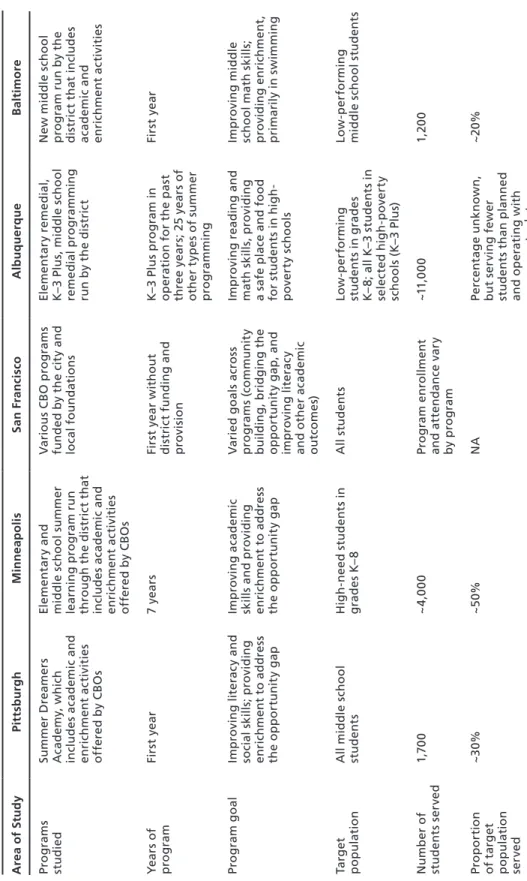
We visited and conducted interviews at five sites that were recommended to us by summer learning practitioners and experts from the National Summer Learning Association and the National League of Cities: Albuquerque, Baltimore, Minneapolis, Pittsburgh, and San Francisco. In Baltimore, Minneapolis, and Pittsburgh, we focused on a particular summer program provided by the school district, although we also learned about other programs offered in those cities, either by the district or by other stakeholders, such as the mayor’s office. For example, in Pittsburgh, we studied the Summer Dreamers Academy, a Pittsburgh Public Schools program providing summer learning opportunities for middle school students. Pittsburgh was also offering an ele-mentary school summer program, which we did not investigate. In San Francisco, the district had lost most of its summer school funding for the 2010 summer, so we focused that visit on programming provided by CBOs and funded by the city and local foundations. At each of these sites, we interviewed school district and city administra-tors, summer program teachers, representatives from CBOs, funders, and others about their summer learning programs. Table 1.2 lists the sites we visited for this analysis, along with descriptive information on each.
Ta b le 1 .2 Si te s V is it ed a n d P ro g ra m m in g T yp es A re a o f S tu d y Pi tt sb u rg h M in n ea p o lis Sa n F ra n ci sc o A lb u q u er q u e B al ti m o re Pr o g ra m s st u d ie d Su m m er D re am er s a ca d em y, w h ic h in cl u d es a ca d em ic a n d en ri ch m en t a ct iv it ie s o ff er ed b y C B O s el em en ta ry a n d m id d le s ch o o l s u m m er le ar n in g p ro g ra m r u n th ro u g h t h e d is tr ic t t h at in cl u d es a ca d em ic a n d en ri ch m en t a ct iv it ie s o ff er ed b y C B O s V ar io u s C B O p ro g ra m s fu n d ed b y t h e c it y a n d lo ca l f o u n d at io n s el em en ta ry r em ed ia l, K –3 P lu s, m id d le s ch o o l re m ed ia l p ro g ra m m in g ru n b y t h e d is tr ic t n ew m id d le s ch o o l p ro g ra m r u n b y t h e d is tr ic t t h at i n cl u d es ac ad em ic a n d en ri ch m en t a ct iv it ie s Y ea rs o f p ro g ra m Fi rs t y ea r 7 y ea rs Fi rs t y ea r w it h o u t d is tr ic t f u n d in g a n d p ro vi si o n K –3 P lu s p ro g ra m i n o p era ti o n f o r t h e p as t th re e y ea rs ; 2 5 y ea rs o f o th er t yp es o f s u m m er p ro g ra m m in g Fi rs t y ea r Pr o g ra m g o al Im p ro vi n g li te ra cy a n d so ci al s kill s; p ro vi d in g en ri ch m en t t o a d d re ss th e o p p o rt u n it y g ap Im p ro vi n g a ca d em ic sk ill s a n d p ro vi d in g en ri ch m en t t o a d d re ss th e o p p o rt u n it y g ap V ar ie d g o al s a cr o ss p ro g ra m s ( co m m u n it y b u ild in g , b ri d g in g t h e o p p o rt u n it y g ap , a n d im p ro vi n g li te ra cy an d o th er a ca d em ic o u tc o m es ) Im p ro vi n g r ea d in g a n d m at h s kill s, p ro vi d in g a s af e p la ce a n d f o o d fo r s tu d en ts i n h ig h -p o ve rt y s ch o o ls Im p ro vi n g m id d le sc h o o l m at h s kill s; p ro vi d in g e n ri ch m en t, p ri m ar ily i n s w im m in g ta rg et p o p u la ti o n a ll m id d le s ch o o l st u d en ts H ig h -n ee d s tu d en ts i n g ra d es K –8 a ll s tu d en ts Lo w -p er fo rm in g st u d en ts i n g ra d es K –8 ; a ll K –3 s tu d en ts i n se le ct ed h ig h -p o ve rt y sc h o o ls ( K –3 P lu s) Lo w -p er fo rm in g m id d le s ch o o l s tu d en ts n u m b er o f st u d en ts s er ve d 1, 70 0 ~ 4, 0 0 0 Pr o g ra m e n ro llm en t an d a tt en d an ce v ar y b y p ro g ra m ~1 1, 0 0 0 1, 20 0 Pr o p o rt io n o f t ar g et p o p u la ti o n se rv ed ~3 0% ~5 0% n a Pe rc en ta g e u n kn o w n , b u t s er vi n g f ew er st u d en ts t h an p la n n ed an d o p era ti n g w it h m an y e m p ty s lo ts ~2 0%
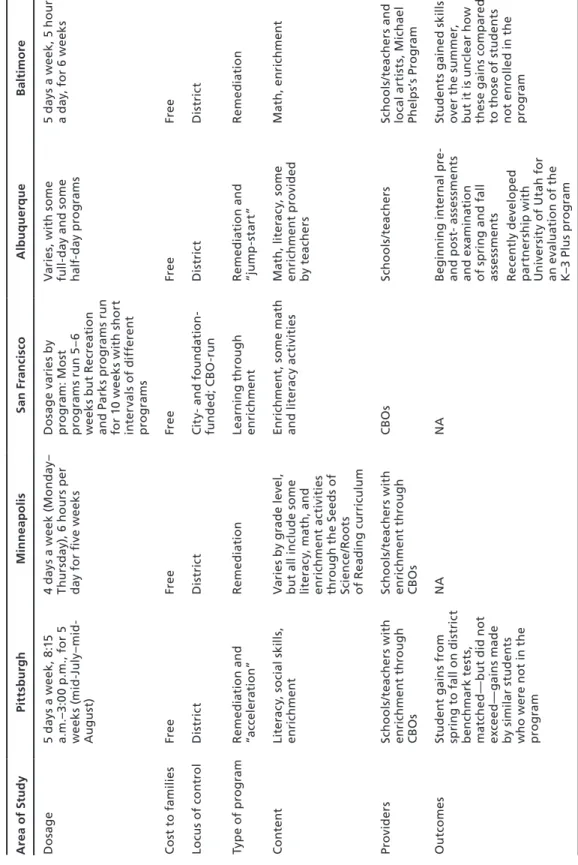
A re a o f S tu d y Pi tt sb u rg h M in n ea p o lis Sa n F ra n ci sc o A lb u q u er q u e B al ti m o re D o sa g e 5 d ay
s a w
ee k, 8 :1 5 a. m .– 3: 0 0 p .m ., f o r 5 w ee ks ( m id -J u ly –m id -a u g u st ) 4 d ay
s a w
ee k ( M o n d ay – th u rs d ay
), 6 h
o u rs p er d ay f o r fi ve w ee ks D o sa g e v ar ie s b y p ro g ra m : M o st p ro g ra m s r u n 5 –6 w ee ks b u t r ec re at io n an d P ar ks p ro g ra m s r u n fo r 1 0 w ee ks w it h s h o rt in te rv al s o f d if fe re n t p ro g ra m s V ar ie s, w it h s o m e fu ll-d ay a n d s o m e h al f-d ay p ro g ra m s 5 d ay
s a w
ee
k, 5 h
o u rs a d ay , f o
r 6 w
ee ks C o st t o f am ili es Fr ee Fr ee Fr ee Fr ee Fr ee Lo cu s o f c o n tr o l D is tr ic t D is tr ic t C it y- a n d f o u n d at io n -fu n d ed ; C B O -r u n D is tr ic t D is tr ic t ty p e o f p ro g ra m r em ed ia ti o n a n d “a cc el era ti o n ” r em ed ia ti o n Le ar n in g t h ro u g h en ri ch m en t r em ed ia ti o n a n d “j u m p -s ta rt ” r em ed ia ti o n C o n te n t Li te ra cy , s o ci al s kill s, en ri ch m en t V ar ie s b y g ra d e l ev el , b u t a ll i n cl u d e s o m e lit era cy , m at h , a n d en ri ch m en t a ct iv it ie s th ro u g h t h e S ee d s o f Sc ie n ce /r o o ts o f r ea d in g c u rr ic u lu m en ri ch m en t, s o m e m at h an d li te ra cy a ct iv it ie s M at h , li te ra cy , s o m e en ri ch m en t p ro vi d ed b y t ea ch er s M at h , e n ri ch m en t Pr o vi d er s Sc h o o ls /t ea ch er s w it h en ri ch m en t t h ro u g h C B O s Sc h o o ls /t ea ch er s w it h en ri ch m en t t h ro u g h C B O s C B O s Sc h o o ls /t ea ch er s Sc h o o ls /t ea ch er s a n d lo ca l a rt is ts , M ic h ae l Ph el p s’ s P ro g ra m O u tc o m es St u d en t g ai n s f ro m sp ri n g t o f all o n d is tr ic t b en ch m ar k t es ts , m at ch ed — b u t d id n o t ex ce ed — g ai n s m ad e b y s im ila r s tu d en ts w h o w er e n o t i n t h e p ro g ra m n a n a B eg in n in g i n te rn al p re - an d p o st - a ss es sm en ts an d e xa m in at io n o f s p ri n g a n d f all as se ss m en ts r ec en tl y d ev el o p ed p ar tn er sh ip w it h U n iv er si ty o f U ta h f o r an e va lu at io n o f t h e K –3 P lu s p ro g ra m St u d en ts g ai n ed s kill s o ve r t h e s u m m er , b u t i t i s u n cl ea r h o w th es e g ai n s c o m p ar ed to t h o se o f s tu d en ts n o t e n ro lle d i n t h e p ro g ra m Ta b le 1 .2 — C o n ti n u ed
Although each site was recommended because the nominator thought it had a successful, innovative, or long-standing summer learning program, the programs varied in several ways:
• Some were brand new; others were several years old.
• While all the programs espoused academic improvement goals, other goals and concomitant target populations varied across the providers.
• Some of the programs were led by districts; others by CBOs.
• In four of the five sites we visited, the district developed and funded the summer learning program. In San Francisco, the district lost funding to support its summer learning programs (although it continued to fund some programs for high school seniors and special education students). In that case, city and private agencies stepped in and directed funding to CBOs to provide ongoing summer programming. While all providers funded by the city were required to include an academic learning component, this was not standardized across programs, and there was no requirement that the academic content be provided by licensed teachers.
• Although each of these cities’ programs served at least 1,000 students, the propor-tion of the target populapropor-tion served ranged from 20 to 50 percent.
• Dosage varied across the programs, ranging from five to six hours a day, four to five days a week, and five to six weeks in total.
• These programs targeted low-performing or high-need students. However, some districts, like Pittsburgh, accepted all students who enrolled in the program, even if the curriculum was designed for lower-achieving students. Indeed, these pro-grams are primarily remedial in focus, but two propro-grams were also attempting to accelerate learning over the summer in an effort to jump-start students’ learning in the following fall.
• Some programs employed certified teachers for academic instruction and CBO staff for enrichment programming, while Albuquerque’s program was more akin to traditional “summer school” programs, with teachers (rather than CBOs) pro-viding enrichment.
• Baltimore, Pittsburgh, and Albuquerque had evaluated their summer programs. Both the Baltimore and Pittsburgh evaluations concluded that students who par-ticipated in the program gained, but it is unclear whether they gained more than similar students who did not participate. The Pittsburgh evaluation found that low-income students in the program did not outperform low-income students who did not participate, but the study did not compare students of comparable academic backgrounds. The results of the Albuquerque study were not yet avail-able as of this writing.
We interviewed participants using semistructured interview protocols that were developed to match the study’s conceptual framework. Topics included structure, con-tent, curriculum, instructional methods, professional development, average student attendance, recruiting methods, parental involvement strategies, funding, teacher hiring practices, external partnerships, and facilitators and challenges.
Researchers’ notes were used to develop summaries of each program, organized according to a common template. We analyzed these templates both structurally and thematically. Our structural analysis compared answers to the same questions across sites to systematically compare programs’ components, strategies, practices, facilitators, and challenges.
We also conducted thematic analyses, looking across all answers to our questions for themes related to our conceptual framework, such as on the topics of funding and quality. We also noted instances of unique, promising practices and of disconfirming evidence (e.g., where findings did not align with the conceptual framework).
Study Limitations
This study relied on prior research to describe the nature of summer loss and summer program effectiveness. While our independent cost analysis provides much-needed information for the field, it is limited to seven cases, which do not represent the full range of costs across all summer learning programs. We selected academically oriented summer programs that operate at scale for our cost analysis. In addition, our findings and recommendations are drawn from a limited sample of summer programs, and the programs included, by design, are primarily run by or in partnership with school dis-tricts. Thus, these data are not representative of all summer learning program contexts, nor are the findings generalizable to all programs.
Our study did not attempt to judge the quality of the summer programs exam-ined. Nor did it attempt to count the number of summer learning programs offered in urban districts across the country. We were told by representatives from the National Summer Learning Association that many urban districts provide programs for a subset of their populations (e.g., English language learners, high school students in need of credit recovery, special education students), but large-scale programs offering compre-hensive summer learning opportunities that target all low-performing or low-income students are rare. Indeed, the National Summer Learning Association website refer-ences 69 “member organizations and districts”; only three are school districts and none are large, urban districts (see National Summer Learning Association, undated[a]). We therefore conclude that district-based, large-scale summer learning programs are not ubiquitous in urban districts, but we found no data to confirm this assumption.
Despite these limitations, this monograph contributes to the literature in that it builds a broad conceptual framework for summer learning, drawing together
informa-tion on the nature of summer loss, expectainforma-tions for summer learning program effec-tiveness, the range of potential costs and the identification of cost drivers, and evidence on how districts and providers implement and maintain programs.
Organization of This Monograph
The next two chapters synthesize the evidence in the research on the value of summer learning programs. In Chapter Two, we review the findings on summer learning loss, beginning with an overview of research on the connection between time and learning and learning decay, then focusing specifically on evidence of summer learning losses in mathematics and reading. In Chapter Three, we focus on the effects of summer learning programs on achievement, including overall effects, effects over time, and the differences in these effects as they relate to student demographics, grade level, and attendance. We also summarize the literature on recommended practices for summer programming. Chapters Four and Five address key obstacles that districts face in developing summer learning programs: cost (Chapter Four) and the chal-lenge of implementing, sustaining, and scaling high-quality programs (Chapter Five). Chapter Six concludes with a discussion of the findings and recommendations for practitioners and policymakers.
17
In this chapter, we explore the nature of summer learning loss and its effects. We first provide some background on the relationship between time and learning to create the conceptual link between summer vacation and loss of academic skills. Many of the findings in this chapter are derived from Cooper, Nye, et al.’s 1996 analysis of the lit-erature on summer learning loss. In addition, we draw heavily on two key longitudinal studies conducted in Atlanta and Baltimore, which tracked students over time and enabled an examination of the effects of school separately from the effects of summer and the impact of summer learning loss over time. We also highlight the extent to which summer learning loss has been found to differ according to student characteris-tics, grade level, and subject.
General Relationship Between Time and Learning
The phenomenon of adult learning, retention, and relearning was investigated heav-ily from the 1950s through the 1980s in noneducation fields, such as the military and industrial sectors. The military, in particular, was interested in what training its recruits would remember after a period of nonpractice and how often their skill acqui-sition would need refreshing. This large body of literature led to the following con-clusions, based on adult learning of specific tasks (Naylor and Briggs, 1961; Adams, 1967; Garlin and Sitterley, 1972; Baldwin, Cliborn, and Foskett, 1976; Prophet, 1977; Schendel, Shields, and Katz, 1978; Osborn, Campbell, and Harris, 1979; Shields, Goldberg, and Dressel, 1979; Hagman, 1980; Goldberg, Drillings, and Dressel, 1981; and Schendel and Hagman, 1982). The following findings were of significance for our study:
• In the absence of practice or other reinforcement, skills deteriorate over time at a rate that is initially quite rapid, with the rate of decay slowing over time.
• The rate of decay varies by task or skill. Tasks with performance that deteriorates rapidly tend to be procedural, involve a number of steps, have no performance