HOW MANY, HOW MUCH?
Single homelessness and the question
of numbers and cost
Crisis is the national charity for solitary homeless people.
We work year-round to help vulnerable and marginalised people get through the crisis of homelessness, fulfil their potential and transform their lives.
We develop innovative services that help homeless people rebuild their social and practical skills, join the world of work and reintegrate into society.
We enable homeless people to overcome acute problems such as addictions and mental health problems.
We run services directly or in partnership with organisations across the UK, building on their grass roots knowledge, local enthusiasm and sense of community. We also regularly commission and publish research and organise events to raise awareness about the causes and nature of homelessness, to find innovative and integrated solutions and share good practice.
Crisis relies almost entirely on donations from non-government organisations and the public to fund its vital work. Last financial year we raised £5m and helped around 19,000 people.
Much of our work would not be possible without the support of over 3,700 volunteers. Crisis was founded in 1967 and has been changing the lives of homeless people for 35 years.
Crisis
64 Commercial Street London E1 6LT Tel: 0870 011 3335 Fax: 0870 011 3336
Email: [email protected] Website: www.crisis.org.uk
Crisis UK (trading as Crisis)
Charity no. 1082947. Company no. 4024938 © Crisis, 2003
For a full list of Crisis publications and an order form please contact 0870 011 3335 or visit the Crisis website at www.crisis.org.u/publications.
CONTENTS
PREFACE ... 1
SUMMARY ... 2
Single homelessness in the UK... 2
Key findings ... 2
Policy implications ... 4
1. INTRODUCTION... 5
1.1. ‘Single homelessness’... 5
1.2. Aim and scope of the report... 5
2. THE POLICY CONTEXT ... 6
2.1. Overview of the chapter... 6
2.2. The new approach... 6
The legislation ... 6
The new administrative structure and policy focus ... 7
2.3. Is ‘single homelessness’ still a useful term? ... 7
3. OUR INTERPRETATION OF HOMELESSNESS... 9
3.1. Overview of the chapter... 9
3.2. The legal definition of homelessness ... 9
3.3. Our approach ... 11
Groups being counted... 11
The merits of a broad interpretation ... 13
4. COUNTING SINGLE HOMELESSNESS... 15
4.1. Overview of the chapter... 15
4.2. The numbers in detail: pre-existing estimates ... 15
Rough sleepers ... 16
Hostels/YMCAs/shelters ... 17
Bed and breakfast and other boarded accommodation... 18
Facing eviction... 18
Squatting ... 19
4.3. The numbers in detail: new analyses... 19
Involuntary sharing in overcrowded conditions... 19
Involuntary sharing in non-overcrowded conditions ... 21
Other possible categories where no estimates are possible... 22
4.4. Summary and reflection... 22
The overall numbers ... 22
Reflections on these numbers ... 24
Observations on the national and regional variations ... 25
5. COSTS OF SINGLE HOMELESSNESS ... 26
5.1. Overview of the chapter... 26
5.2. The basic approach: scenarios and unit costs... 26
5.3. Six scenarios... 27
Scenario A: Leaving home (relationship breakdown with parent)... 27
Scenario B: Leaving home (relationship breakdown due to violent partner) ... 28
Scenario C: Leaving an institution ... 30
Scenario D: Loss of a job/increased indebtedness ... 31
Scenario E: Increased drug use and deterioration of mental health... 32
Scenario F: Older man, increase in alcohol dependency... 33
6. QUANTIFYING THE COSTS... 36
6.1. Overview of the chapter... 36
Hard costs and soft costs ... 36
Unit cost estimates ... 37
6.3. Costing the scenarios ... 39
6.4. Conclusions ... 40
7. IMPLICATIONS FOR POLICY... 42
7.1. Overview of the chapter... 42
7.2. A goal for policy ... 42
7.3. Specific challenges for policy makers ... 43
Successfully implementing the new direction in England and Wales ... 44
Understanding the situations experienced by single homeless people... 44
Supporting those who share their accommodation with homeless people... 44
Ending the discriminatory approach based on ‘priority need’... 45
Providing sufficient resources... 45
Summary and conclusion... 45
PREFACE
The election of the Labour government in 1997 saw the issue of homelessness catapulted to the top of the policy agenda. Within a year of coming to office the newly established Social Exclusion Unit had published its report on Rough Sleeping in which it set out proposals for bringing the numbers of rough sleepers “to as near to zero as possible.” Two years later, following the sustained and co-ordinated efforts of both government and the voluntary sector the numbers of rough sleepers were reduced by two thirds and a new policy direction was announced.
Government promised to take a more holistic view of the problems of homelessness arguing that “the vast majority of homeless people are actually families or single people who are not literally sleeping on the street but living with relatives and friends or in temporary accommodation1” and that
in turn the solution to homelessness was about more than the provision of housing. The
Homelessness Act was passed in the same year and set this policy within a clear legal framework – calling upon local authorities to develop strategies aimed at tackling all forms of homelessness and expanding the categories of people who could be deemed to be in priority need and thus eligible for housing.
There remains in practice however, a bias at the heart of homelessness policy, a bias that is reflected in both the legislation and its interpretation. Single homeless people, that is adults or couples
without dependent children, are usually not provided with accommodation. Their exclusion means a lack of priority in terms of policy, research and services.
Yet single homeless people are often amongst the most vulnerable people in our society and as the findings of Crisis’ latest report reveal their numbers are considerable and the cost to society
significant.
At Crisis we believe that the challenge is to ensure that all homeless people receive appropriate support to help them to overcome their homelessness and that to do this requires a fundamental and radical shift in thinking and ultimately in resource allocation.
The first step however is do develop our knowledge and understanding of the problem and the report How Many, How Much is one of the first, most important and most ambitious of a series of reports that aim to do just that. The questions that it seeks to answer on the issues of definition, scale and cost of single homelessness are fundamental to the development of policy in this area. It represents an opening shot in what we hope will be genuine and meaningful debate about the future of homelessness policy.
SUMMARY
Single homelessness in the UK
1. Homelessness in the United Kingdom has a broad legal definition that is pitched in terms of a person’s entitlement to a home that is reasonable for them to continue to occupy. It is a definition that in theory could ensure that assistance and housing are offered to all homeless people. In practice, however, limitations on resources have necessitated the development of what is often described as a rationing system, whereby homeless people are judged on the basis of their perceived vulnerability.
2. Out of this has emerged the problem of single homelessness: strictly speaking, the homelessness suffered by single adults or couples without dependent children, although in practice,
overwhelmingly the former. The significance of single homelessness is that these people, unlike homeless adults with dependent children, are usually not owed what is known as the local authority’s ‘primary duty’ towards the homeless, namely to provide them with accommodation. 3. The fact that they have been excluded by the legislation has meant that there has been a lack of
priority in terms of both policy and research about their numbers and circumstances. It is this problem that is the focus of this study. More specifically, the study seeks to answer four questions: • Is ‘single homelessness’ any longer a very helpful or even meaningful term?
• How many single homeless people are there?
• How much does single homelessness cost – and who bears that cost? • What implications for policy arise from the findings on numbers and costs?
Key findings
4. Single homelessness remains a significant problem despite recent, welcome changes to the legislation. Recent guidance in England has increased the classes of person who can be deemed vulnerable and therefore in priority need. We expect that, as a result, more single homeless people will be classified as being in priority need than is the case now. However, we also expect that single homeless people will continue to make up the great bulk of those who are not deemed to be in priority need. Single homeless people therefore remain a group deserving of special attention and the term ‘single homelessness’ remains valid and powerful.
5. The number of single homeless people at any one time is in the hundreds of thousands: we suggest a range of between 310,000 and 380,000. Only a tiny proportion of these – less than 1,000 – are rough sleepers. Around a quarter are single people staying either in hostels, bed and breakfast accommodation or facing imminent threat of eviction on the grounds of debt. The remaining three quarters form what are known as concealed households, residing with friends or family but without any explicit right so to do and in accommodation which is, in some important way, unsatisfactory.
The central technical challenge for this report has been to find a way of interpreting the definition of homelessness to allow it to be applied to the available sources of survey and administrative data. The following is a list of the groups we conclude may be considered as homeless, alongside our estimate of the number of people in Great Britain without dependent children in each group at any particular point in time.
Rough sleepers 800
Those who have been provided with supported housing (hostels/YMCAs/shelters) around 25,000 Bed and breakfast and other boarded accommodation: around 50,000
People at imminent risk of eviction around 2,000
Squatters up to 10,000
Concealed households sharing overcrowded accommodation (that is, people who neither own nor rent the property they are living in and are neither the spouse, partner nor dependant child of the owner/renter):
• Aged 25 and over or living with friends (‘higher likelihood’) • Aged under 25 and living with family (‘lower likelihood’):.
around 160,000. around 330,000 Concealed households sharing accommodation which is not overcrowded but
where the head of household deems the arrangement unsatisfactory: • Aged 25 and over or living with friends (‘higher likelihood’):. • Aged under 25 and living with family (‘lower likelihood’):.
around 60,000 around 120,000
These groups total some 750,000 but not all of them will be homeless. In order to produce an overall estimate of the number of single homeless, it is necessary to make judgements about the proportion of each group likely to be homeless. On the basis of the characteristics of the different groups, we suggest a range for the overall number of single homeless people of between 310,000 and 380,000.
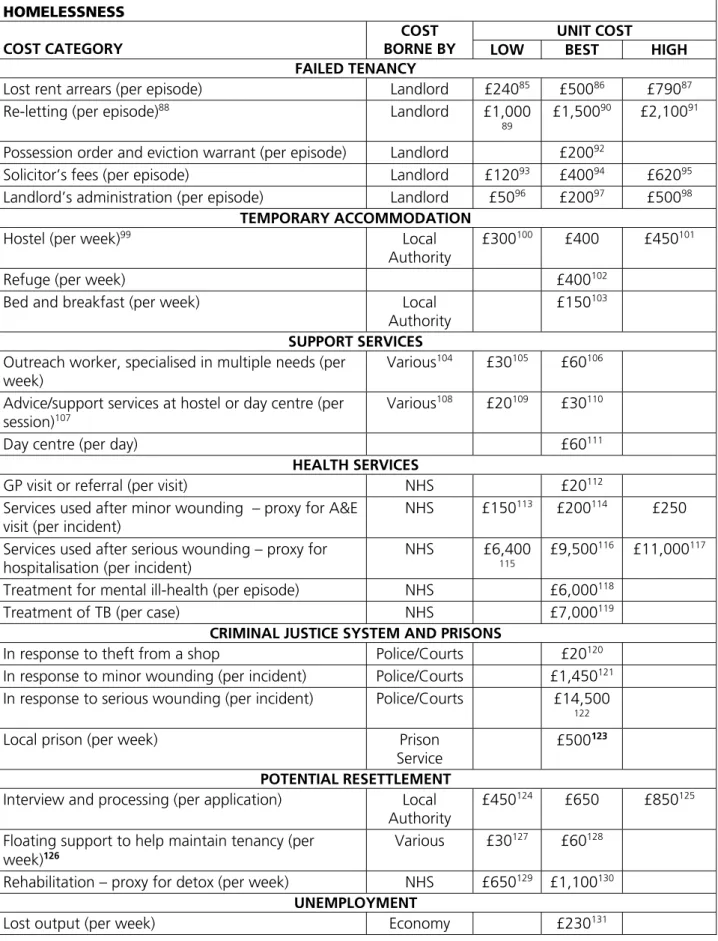
6. The cost of an individual’s homelessness can run to many thousands of pounds, suggesting that there may be an economic case for spending money to reduce homelessness. We would particularly draw attention to the scale and importance of recurring, time-related costs, such as the costs of temporary accommodation and the economic cost to society as a whole unemployment associated with homelessness.
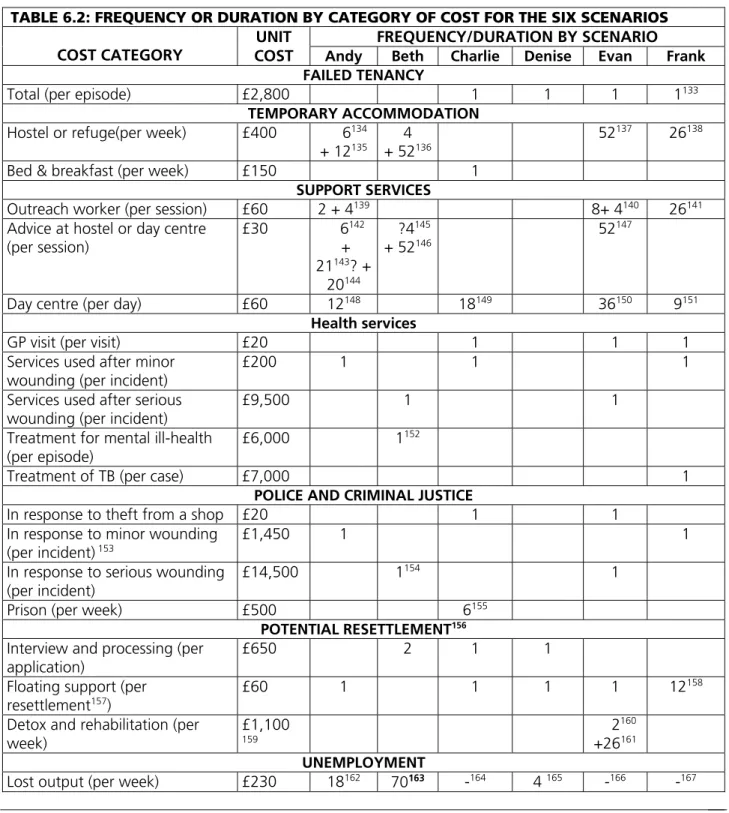
The report represents the first attempt to quantify the costs that might be saved by reducing homelessness. This is calculated by providing estimates of the unit costs associated with particular episodes or incidents that arise in connection with homelessness. The costs that have been quantified in this report are those that usually fall upon institutions in the public, private and voluntary sectors. The cost categories that have been applied can be seen in the table overleaf which highlights costs associated with one particular case.
The report applied these unit costs to a number of scenarios, each of which (developed on the basis of the research literature and discussed with people working directly with homeless people)
represents a particular possible pathway into, and sometimes through homelessness. In each individual case, the total cost of the scenario is sizeable – always thousands of pounds and
sometimes tens of thousands. The report develops six case studies and applies six estimates of costs borne to each case. We have chosen Frank’s story (see page 33) to highlight this methodology.
THE COSTS OF FRANK’S HOMELESSNESS
COST CATEGORY FRANK’S CASE
Failed tenancy
Includes: lost rent arrears; re-letting; possession order and eviction warrant; solicitor’s fees; landlord’s administration.
£3,000
Temporary accommodation
Includes: hostel or refuge; bed and breakfast accommodation.
£10,500 Support services
Includes: outreach worker; advice at hostel or day centre.
£2,000 Health services
Includes: GP visit; services used after minor wounding; services used after serious wounding; treatment for mental ill health; treatment of TB; rehabilitation.
£7,000
Police and criminal justice
Includes: in response to theft from a shop; in response to minor wounding; in response to serious wounding; prison.
£1,500
Potential resettlement
Includes interview and processing; floating support
£500 Unemployment
The value of the output lost (not produced).
nil
Total for 12 months £24,500
Policy implications
7. The scale of the problem and the costs associated with it demonstrate that policy makers and campaigning organisations need to treat homelessness of adults without dependant children as a serious problem which should have a high priority. We conclude that the overall goal of policy should be to ensure that all homeless people should receive appropriate support to help them
overcome their homelessness. This is deliberately wide and flexible to cover both the diverse needs that homeless people have themselves, and potentially the needs of those who help the many homeless people by sharing their accommodation with them.
8. Providing appropriate support to all homeless people requires, we believe, a profound change both of policy and thinking. We have identified a range of challenges that must be addressed in order to bring about, or accelerate, the shift in policy that is needed. They are:
• In preparing to carry out their duties local authorities must ensure that they are gearing themselves up to operate on a scale that will allow them to tackle the full extent of the homelessness problem.
• Government and local authorities should review service provision to ensure that it is able to address the problem of hidden homelessness.
• Government, local authorities and the voluntary sector must improve their understanding of the true nature and extent of the problems facing single homeless people.
• Government needs to consider what contribution improved employment opportunities could make to reducing the problem of single homelessness.
• Government, local authorities and the voluntary sector should consider how best to recognise and support those families and friends who are providing accommodation to homeless people.
• Government needs to examine whether the legislative framework and guidance that creates the distinction between single homeless people and families is compatible with ensuring that all homeless people receive the support that they need.
1. INTRODUCTION
1.1. ‘SINGLE
HOMELESSNESS’
1.1.1. The term ‘single homelessness’ is typically used to refer to single people without dependent children (plus couples without dependent children) who are homeless. Why exactly is there an issue of single homelessness at all? As we suggest at various points in this report, there are parallels between the terms ‘homelessness’ and ‘poverty’. Yet no one speaks of ‘single poverty’ or suggests that it is a subject of particular importance in its own right, distinct from poverty in general. So why is single homelessness seen in this way? Why is it so significant?
1.1.2. The answer lies in past government policy, which has drawn a sharp distinction between homeless people depending on whether or not they have dependent children. Single homelessness is a subject of special concern because single homeless people make up the bulk of those homeless people to whom local authorities do not owe what is known as the ‘primary duty’ to provide accommodation. This arises not out of any vindictiveness directed towards single homeless people but because the primary duty has been confined to those homeless people classified as in ‘priority need’, who, until recent changes, have overwhelmingly been those with dependent children.1 Single homelessness has therefore acquired a weight and a significance because single homeless people have usually lacked the same rights as homeless people with dependent children.
1.2. AIM AND SCOPE OF THE REPORT
1.2.1. The aim of this report is to help improve understanding of ‘single homelessness’ in the United
Kingdom today, particularly in the light of recent changes in both legislation and associated guidance. To fulfil this aim, the report looks into four specific questions:
• First, in the light of recent changes in the homelessness legislation and guidance, in both England, Wales and Scotland, is ‘single homelessness’ any longer a very helpful or even meaningful term? • Second, how many single homeless people are there?2 The Labour government made reducing the
number of ‘rough sleepers’ a high priority during its first term. Does success there mean that the problem of single homelessness is now but a small one?
• Third, how much does single homelessness cost – and who bears that cost?
• Fourth, what implications for policy – both for governments, national and local, and the voluntary sector – arise from the findings on numbers and costs?
1.2.2. In approaching this report, it is important to remember that it is concerned above all with numbers. This means that it is necessarily constrained by the data that is actually available. Obviously, this has implications for the numbers themselves. But since you cannot start counting until you have decided what it is you are trying to count, arguments about how many homeless people there are in this country are really arguments about what homelessness means. The question of what should count as homelessness therefore lies at the heart of this report.
2. THE POLICY CONTEXT
2.1. OVERVIEW OF THE CHAPTER
2.1.1. In this chapter, we set out the background to the study by reviewing recent changes in the policy framework on homelessness across Britain. Our overall conclusion is that these developments are potentially very positive for single homeless people in a number of ways. Nevertheless, we also conclude that the term ‘single homelessness’ remains a valid and powerful term since, despite the extensions that the legislation and guidance has brought, people without dependent children – the vast majority of single homeless people – remain at the bottom of the pecking order as far as the official response to their homelessness is concerned.
2.2. THE NEW APPROACH
2.2.1. This is a time of radical change in official policy on homelessness. In England and Wales, the creation of the Homelessness Directorate, the 2002 Homelessness Act 2002, the policy programme set out in More than a Roof and the introduction of the Supporting People initiative, collectively represent a significant new approach to the prevention and tackling of homelessness. During the 1990s, under governments of both parties, the focus was on the more extreme forms of homelessness, namely rough sleeping and households accommodated temporarily in bed-and-breakfast. Now, the attention is turning to tackling all forms of homelessness and the factors leading to them in a more coherent way.
2.2.2. In Scotland, the shift in prospect may be even more dramatic, with the 2003 Homelessness Act promising to abolish the ‘priority need’ test by 2012, at which point all those found to be legally homeless will be entitled to accommodation.3
2.2.3. Such changes are nothing to do with the legal definition of homelessness, where definitions laid down in earlier years continue to apply. Recent changes are chiefly concerned with the responses of
government and the developed administrations to the situation, in terms of both who should be provided with accommodation and what other actions should be taken with respect to homelessness more generally.
The legislation
2.2.4. The 2002 changes in England and Wales aim to improve both the provision for those who are homeless (primarily by extending local authorities’ duty to provide housing to a larger group of homeless people) and the quality and coherence of preventative work (through the introduction of a statutory duty on local authorities to conduct homelessness reviews and compile homelessness strategies). More specifically:
• The level of assistance available to homeless people is enhanced through the extension of priority need to include new groups of vulnerable people and through the requirement that all homeless people, even if not in priority need, receive advice and assistance which meets minimum standards. • The duty to compile a review of homelessness consists of assessing current and likely future levels
of homelessness in the area, current activities contributing to the prevention of homelessness and the provision of accommodation and support, and resources available to the local authority and other relevant organisations for carrying out those activities.
• The strategies, due to be published in summer 2003 and at least every five years thereafter, will set out how each local authority will tackle and prevent homelessness in its broadest sense looking beyond the ‘statutory’ definition of unintentionally homeless and in priority need. In practice, this
The new administrative structure and policy focus
2.2.5. In March 2002, the Homelessness Directorate was formed, bringing together the Rough Sleepers Unit, the Bed and Breakfast Unit, and a new team responsible for tackling homelessness. The directorate was charged with the aim of promoting new and more strategic approaches to tackle homelessness more effectively, based on an analysis of the underlying causes and trends. While the two key numerical targets remain those of sustaining the two thirds reduction in rough sleeping and of ensuring that no family with dependent children has to live in bed and breakfast accommodation by March 2004, the emphasis of policy making has shifted towards prevention of all forms of
homelessness.
2.2.6. The shape of the approach is outlined in More than a Roof, published in March 2002. The central thesis is that there needs to be as much focus on tackling the personal problems – such as relationship breakdown, domestic violence, debt, and drug abuse – faced by homeless or potentially homeless people as on their need for accommodation. More than a Roof was explicit in its acknowledgement that government’s understanding of the causes of homelessness and the most effective responses to it were at a reasonably embryonic stage.
2.2.7. It therefore emphasised the importance of research to develop evidence-based policy focusing on cost effective measures of prevention. Such approaches include: further development of partnerships (e.g. between local authorities and voluntary organisations involved with homeless people, as well as bodies with wider responsibilities such as schools, colleges and the police); improved access to advice,
assistance and information; the development of schemes to help people maintain tenancies; and housing solutions such as encouraging private rented accommodation and wider use of rent deposit schemes.
2.2.8. Broadly speaking, the directorate will deliver on the new agenda by providing assistance, guidance and funding to local authorities in the development and implementation of their homelessness strategies. Through researching and developing effective policies for prevention and intervention, disseminating good practice, setting targets and rewarding achievement, the directorate is intended to ensure that the duties under the 2002 Act are carried out as effectively as possible. In 2002/03, it had a budget of £100 million and it will be spending £260 million over the next three years.
2.2.9. Finally, Supporting People, which came into operation in April 2003, aims to improve housing related support services for vulnerable people including those who might be at risk of homelessness. The key client groups are
older people; people with learning difficulties; people with mental health
problems or some disabilities; women fleeing domestic violence; young homeless people and
vulnerable people struggling with their accommodation.
The type of provision offered includes housing management, housing related support (such as independent living skills), home care, meals services and personal care.2.3. IS ‘SINGLE HOMELESSNESS’ STILL A USEFUL TERM?
2.3.1. The extension of priority need in England, and perhaps even more its prospective abolition in Scotland, may be especially significant for single people.4 Until 2002, priority need groups included pregnant women, families with dependent children, victims of emergencies (such as fires and floods) and various categories of people deemed to be vulnerable. The 2002 legislation extends priority need to: • 16 and 17 year olds other than those who social services are responsible for accommodating; and • care leavers under the age of 21 who were looked after by social services when they were 16 or
17; and
• people who are vulnerable as a result of violence or threats of violence; and
2.3.2. The first two categories are automatically in priority need, whereas the other two have to be found to be ‘vulnerable’ as a consequence of their leaving an institution or experiencing a threat of violence. 2.3.3. Early signs are that the changes are significant but it remains to be seen what the practical effects turn
out to be.5 It is possible that the new arrangements could lead to a sustained increase in homeless applications, exerting increased pressure on local authorities to determine certain categories of people as being vulnerable and in ‘priority need’. Since institution leavers account for a significant proportion of the ‘single homeless’ population, the effect could be considerable if local authorities choose to interpret the legislation liberally.
2.3.4. Whether they are able to do so, though, is another matter. As ever, there is likely to be a gap between the potential impact of the legislation and its effect in practice, with resources and other constraints on local authorities restricting their room for manoeuvre in interpreting the legislation in a more liberal way.6 Without significant increased resources, it is hard to see how an alteration to the priority need categories can do much more than change the mix, but not the total number, of people accepted as being in priority need. The fact that judgement abounds, with vulnerability itself assessed in relation to how an ‘ordinary’ homeless person is expected to cope, leaves plenty of scope for this to happen.7 2.3.5. While it is important to recognise how an understanding of single homelessness derived from an
interpretation of the legislation and guidance has contracted as a result of recent changes in
homelessness legislation and guidance, the people at the bottom of the homelessness pecking order will still for the most part be single people without dependent children. This being the case, single homeless people (to be understood here as including couples without dependent children) remain a group deserving of special attention. The term ‘single homelessness’ therefore remains valid and powerful.
2.3.6. One important qualification must be made to this conclusion. In the past, the degree of overlap between single homeless people and homeless people deemed not to be in priority need led ‘single homelessness’ to be understood as more or less the same thing as ‘non-statutory homelessness’. Although this equation has always carried some dangers, the recent changes mean that it may now be seriously misleading. In particular:
• The extension of priority need means that local authorities will owe more single homeless people the primary duty of providing them with accommodation.
• The strengthened requirement to offer advice and guidance to all homeless people, irrespective of whether they are in priority need, underlines the point that statutory duties extend beyond the primary duty.8
2.3.7. As a result, we conclude that the two terms should now no longer be used interchangeably because some single people are now in priority need and all homeless people, whether in priority need or not, have certain statutory rights. ‘Single homelessness’ remains an important term, but it must not be confused with ‘non-statutory homelessness’.
3. OUR INTERPRETATION OF HOMELESSNESS
3.1. OVERVIEW OF THE CHAPTER
3.1.1. In this chapter, we explain which groups of people are to be counted as homeless, justifying our selection by showing it to be consistent with the definition of homelessness set out in the legislation. The chapter begins with a discussion of that legal definition, showing both how broad it is and how dependent it is on judgements about both whether someone has a ‘right’ to occupy the place where they are staying and whether it is ‘reasonable’ for them to continue to occupy it.
3.1.2. The practical challenge the chapter has to deal with is how to interpret the legal definition in a way that allows it to be applied to the various data sets from which the numerical estimates are obtained (in the next chapter). While the discussion here inevitably has to deal with detail, it remains at all times within the legal definition of homelessness.
3.2. THE LEGAL DEFINITION OF HOMELESSNESS
3.2.1. Like poverty, what constitutes homelessness in Britain in the 21st century is bound to be a matter of judgement and disagreement. But unlike poverty, homelessness has a legal definition. In the form in which it appears in the statute itself, this definition is broad – broad enough, we suggest, to contain all reasonable disagreements. What is at issue then, and what the disagreements are likely to be about, is not the definition of homelessness but, rather, the interpretation of that definition.
3.2.2. The current, legal definition of homelessness for England and Wales is given in the 1996 Housing Act. There are slight differences in the definitions in Scotland and Northern Ireland and these differences are noted here wherever they are relevant to the discussion. According to the law, a person is homeless if there is no accommodation they are entitled to occupy. Entitlement here means having: • either an interest in it (i.e. they are the owner or the tenant); or
• an express or implied licence to occupy (in Scotland, a right or permission, or an implied right or permission to occupy);
• some other enactment or rule of law giving the right to remain in occupation or restricting the right of another person to recover possession.
3.2.3. A person is also considered to be legally homeless if they have accommodation but: • they cannot secure entry to it; or
• (in the case of, for example, a caravan) they have nowhere they are entitled both to place it and live in it; or
• (in Scotland and Northern Ireland) it is probable that occupation will lead to violence, or threats of violence which are likely to be carried out; or
• (in Scotland), it is overcrowded and may endanger the health of the occupants; or
• (in England and Wales) it is not reasonable for them to continue to occupy the accommodation. 3.2.4. A person is also considered to be threatened with homelessness if it is likely that they will become
3.2.5. The breadth of this definition stems from the fact that is pitched in terms of a person’s entitlement, or right, to a home rather than the particular circumstances in which they are living. So the definition is not restricted to a list of various situations in which people could be living, such as rough sleeping, or living in a hostel for homeless people. Neither is it restricted to people who have in some way
identified themselves as homeless, for example, by seeking help either from a local authority or
through contact with homelessness agency, nor to those whom local authorities either judge or record as homeless.9 As a result, no particular category of homelessness – for example, certain groups of people living in overcrowded conditions – is automatically excluded by the legal definition.
3.2.6. Rather, what matters is the interpretation of the conditions that define homelessness. While some of these conditions are clear if somewhat rare (having a caravan but nowhere to place it), two are not. One of these is the condition of having a ‘licence to occupy’. An adult living in their parents’ home may enjoy such a licence. However, it will not necessarily be timeless and if relations within the home gradually deteriorate, the licence will gradually disappear. In some cases, this disappearance will be clear-cut but in many cases it will not, as everybody struggles with what are likely to be conflicting feelings.
3.2.7. Ambiguity also surrounds the condition that the accommodation must be ‘reasonable to continue to occupy’, which applies in England and Wales. This is given further definition within the Act as referring specifically to the threat of domestic violence (which is a condition in its own right in Scotland and Northern Ireland). Yet the Act also allows the Secretary of State to specify other circumstances in which it is reasonable, or not, to continue to occupy accommodation, leaving the definition very open. While the Scottish definition is not so open, it does contain an explicit overcrowding condition.
3.2.8. In summary, then, the legal definition of homelessness is constructed broadly, with the two most important conditions, namely reasonable to occupy and licence to occupy, being inherently subjective and therefore matters of judgement. In this report, our interpretation of these conditions may well be broader than the interpretation of many local authorities and, as a result, some of those whom we are counting as homeless would probably not be judged as homeless by some local authorities. But any such difference of opinion over interpretation is not the same as a difference of opinion over definition.
3.2.9. Finally, in passing, we note that broad definitions, replete with judgement, are to be found in other countries’ official and semi-official definitions, as the following three examples show:
• In the United States, a person who is homeless is “an individual who lacks a fixed, regular, and adequate night-time residence, or an individual who has a primary night-time residence that is: a supervised publicly or privately operated shelter designed to provide temporary living
accommodations (including welfare hotels, congregate shelters, and transitional housing for the mentally ill); a public or private place that provides a temporary residence for individuals intended to be institutionalised; or a public or private place not designed for, or ordinarily used as, regular sleeping accommodations for human beings”.10
• In Australia, although there is no Homelessness Act as such, there is an Act covering the
Supported Accommodation Assistance Program, the major funding instrument administered jointly by Federal and State Governments. Within this program, a person is homeless “if, and only if, he or she has inadequate access to safe and secure housing”. This in turn applies if the only housing to which the person has access: damages, or is likely to damage, their health; threatens their safety; marginalises them through failing to provide access to either adequate personal amenities or the economic and social supports that a home normally affords; or places the person in circumstances which threaten or adversely affect the adequacy, safety, security and affordability of that housing. • In the Netherlands, “homelessness can be defined as a severe condition of social, personal, and
3.3. OUR
APPROACH
3.3.1. A workable approach to the measurement of homelessness has to take account data that is actually available. Ideally, the way to proceed would be to identify various groups of people who could be deemed homeless and then find data that would allow them to be counted. In practice, however, things are rarely that straightforward. Sometimes, there is simply no data at all on a group that should, ideally, be included; one example of this is people staying in institutions such as medical and care establishments simply because they have nowhere else to go.
3.3.2. More importantly, it is often necessary to filter many of the groups in order to select out those that could be considered to be homeless from the group in general. Since we can only use what is
available, these filters are themselves rarely ideal. A good example is people living in bed and breakfast accommodation. In order to measure homelessness, we certainly want to exclude those who are there because they are working away from home. Arguably, too, we should also exclude those who are quite happy with the arrangement (that is, they regard it as reasonable that they should occupy such accommodation). But information that would allow us to directly filter out these two sub-groups is not currently available. Our approach, therefore, is to use receipt of housing benefit as a filter, restricting our count of homelessness in the bed and breakfast group to these people only. The rationale for this is that receipt of housing benefit is a proxy for low income, which in turn is a proxy for a lack of choice about whether to be in bed and breakfast accommodation.
Groups being counted
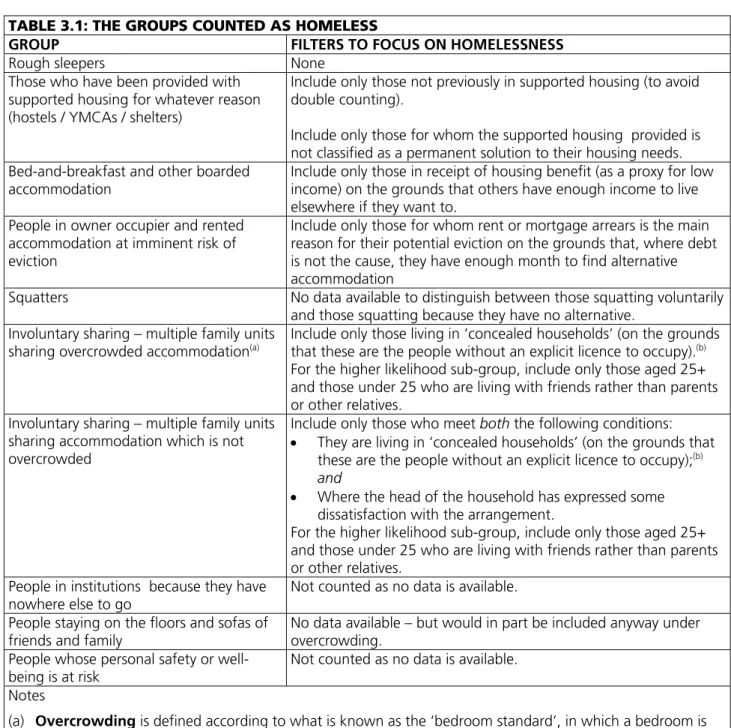
3.3.3. Table 3.1 identifies the various groups of people whom we are counting as homeless, alongside the filters that have been used to restrict the overall population in the group to those whom we judge as homeless. Since we are interested in this report in single homelessness only, it can be taken as given that our final count is restricted to single adults and couples without dependent children only.
TABLE 3.1: THE GROUPS COUNTED AS HOMELESS
GROUP FILTERS TO FOCUS ON HOMELESSNESS
Rough sleepers None
Those who have been provided with supported housing for whatever reason (hostels / YMCAs / shelters)
Include only those not previously in supported housing (to avoid double counting).
Include only those for whom the supported housing provided is not classified as a permanent solution to their housing needs. Bed-and-breakfast and other boarded
accommodation
Include only those in receipt of housing benefit (as a proxy for low income) on the grounds that others have enough income to live elsewhere if they want to.
People in owner occupier and rented accommodation at imminent risk of eviction
Include only those for whom rent or mortgage arrears is the main reason for their potential eviction on the grounds that, where debt is not the cause, they have enough month to find alternative accommodation
Squatters No data available to distinguish between those squatting voluntarily and those squatting because they have no alternative.
Involuntary sharing – multiple family units
sharing overcrowded accommodation(a) Include only those living in ‘concealed households’ (on the grounds that these are the people without an explicit licence to occupy).(b) For the higher likelihood sub-group, include only those aged 25+ and those under 25 who are living with friends rather than parents or other relatives.
Involuntary sharing – multiple family units sharing accommodation which is not overcrowded
Include only those who meet both the following conditions: • They are living in ‘concealed households’ (on the grounds that
these are the people without an explicit licence to occupy);(b)
and
• Where the head of the household has expressed some dissatisfaction with the arrangement.
For the higher likelihood sub-group, include only those aged 25+ and those under 25 who are living with friends rather than parents or other relatives.
People in institutions because they have
nowhere else to go Not counted as no data is available. People staying on the floors and sofas of
friends and family
No data available – but would in part be included anyway under overcrowding.
People whose personal safety or well-being is at risk
Not counted as no data is available. Notes
(a) Overcrowdingis defined according to what is known as the ‘bedroom standard’, in which a bedroom is deemed necessary for each single adult or couple in the property who is aged 21 or over, and various fractions of a bedroom to children and young adults who are less than 21.12
(b) Concealedhouseholds are people who do not own or rent the property they are living in and are also not the spouse, partner or dependant child of the owner/tenant.13
3.3.4. The filters here are critical. In principle, homelessness only requires either that there is no licence to occupy, or that it is unreasonable to occupy. In interpreting the data and offering an estimate of the number of single homeless people we have required that both conditions are met for the situation to be described as one of homelessness. As a consequence we only count someone as homeless if first, they lack a legal licence to occupy (which we take to be the case with any concealed household); and, second, there is something else wrong with the living arrangement (either overcrowding, or an expression of dissatisfaction on the part of the head of household).
3.3.5. It is important to recognise that we do not at any point equate overcrowding with homelessness: those in concealed households who are living in overcrowded conditions represent around a fifth of the total number living in overcrowded conditions.14 Likewise, the filter we apply to those in concealed households who are not overcrowded means that, of that group, we are actually including less than one in twenty in our count.
3.3.6. We go further, assigning a different likelihood of being homeless according to age and who the person is living with. Younger adults might well not self-define as homeless or perhaps even be reasonably viewed as homeless if, for example, they are sharing with their parents (potentially on the expectation that it may not be a particularly long-term arrangement). On the other hand, it would be difficult to argue that an older adult who appeared in an overcrowded household (such that it is highly likely someone is sleeping in a living room or on the floor) in which neither they, nor their spouse, were the head of the household, and which they did not own or rent themselves, was anything other than homeless. The cut-off age used to distinguish between these groups is 24-25 on the grounds that the vast majority of those aged 25 and over have reached a more settled living arrangement, whereas those aged 24 and below are often still in the period of transition from dependent to independent living.15
3.3.7. Time is another factor: an adult living in their parents’ home may currently enjoy an implicit ‘licence to occupy’ but this will not necessarily be timeless and if relations within the home gradually deteriorate, the licence will gradually disappear. So, even on a conservative view, these people are, at the very least, at some risk of becoming homeless at some time in the future. And at least arguably, those living with non-relatives are at greater risk of being in an unsatisfactory or unstable housing situation that those living with parents or other relatives.
3.3.8. The fact that around a third of households accepted as being homeless and in priority need now arise because parents, relatives or friends are no longer able, or willing, to accommodate them underlines the importance of this category of ‘involuntary sharing’.16
The merits of a broad interpretation
3.3.9. Describing some people in concealed households as homeless, either when they are overcrowded or when the head of household deems the arrangement unsatisfactory, represents a broad interpretation of homelessness. In so doing, we are not suggesting that all forms of homelessness are equally severe, nor that they all require the same policy response. This is analogous with poverty where, within an official government threshold that leaves still more than 20 per cent of the population in poverty,17 attention is paid to a variety of sub-groups and where a range of quite different policy measures have been developed over recent years.
3.3.10. But quite apart from the fact that we believe that people in the situations we have listed can quite properly be interpreted as being homeless, we see a number of big advantages in adopting a broad interpretation.
• First, homelessness ceases to be seen simply in relation to the responses to the problem from either government or voluntary sector agencies. This is important because it frees government from the perverse situation in which the more people it decides to help, the worse, by definition, the problem apparently becomes.18
• Second, it recognises that a good part of homelessness is ‘contained’ within civil society, through the help and support that homeless people get from their friends and family. The burden that this can represent, and the fact that it is shouldered by ordinary people, fully deserves to be recognised.
• Third, as a consequence of this, perceptions of homelessness are changed into something that many more people will recognise as belonging to them, or at least to someone they know. This is partly a matter of scale but partly, too, of a subtle change in the perception of the problem itself. By so doing, it reduces the degree to which homelessness is seen as an extreme, even alien problem of ‘others’, which is helpful for social cohesion and vital for building public and political support for action to address the problem.
• Fourth, it can stimulate changed behaviour from the relevant agencies, for example, the provision of advice and support to a much wider group of people, or encouraging preventative action. • Finally, it may encourage different kinds of explanation of homelessness, away from the individual
homeless person’s characteristics; it is bound to lead into questions about how society works. It also throws up the interesting, and perhaps rather positive, issue of why so much homelessness is actually contained within civil society.
4. COUNTING SINGLE HOMELESSNESS
4.1. OVERVIEW OF THE CHAPTER
4.1.1. In this chapter, we set out in detail how we have reached our estimates of the numbers of homeless people. If we had been able to do this by analysing just one or two wide-ranging sources of survey data that between them provided a comprehensive picture of the phenomenon, the presentation here would have been both brief and straightforward. Unfortunately, however, no such source exists and we have therefore had to reach our total by using a disparate collection of data sources to estimate the size of each of the individual groups of homeless people that were identified in chapter 3. The bulk of the chapter explains how we have done this. While the detail here does not make for light reading, it is this that provides the essential guarantee that the findings can be replicated by others if desired.
4.1.2. In those cases where the numbers are estimates that have been published elsewhere, the chapter summarises the previous findings. In other cases, however, where the estimates are based on our own analysis, the chapter provides more detail, breaking the estimates down by age, region (or sometimes country), and the characteristics of the household in which the homeless person is staying. Besides being of interest in its own right, this extra information plays a vital part in helping us narrow our broad-range estimate of the number of single homeless people – somewhere between 75,000 and 750,000 – down to something more precise, between 310,000 and 380,000.
4.1.3. The chapter concludes by discussing how reasonable an estimate of single homelessness in the hundreds of thousands looks from other perspectives. The most important of these is the poverty perspective, where the official data show more than three quarters of a million single, working age people without dependent children, living in shared accommodation and in poverty, with over half a million of them being unemployed or economically inactive.
4.2. THE NUMBERS IN DETAIL: PRE-EXISTING ESTIMATES
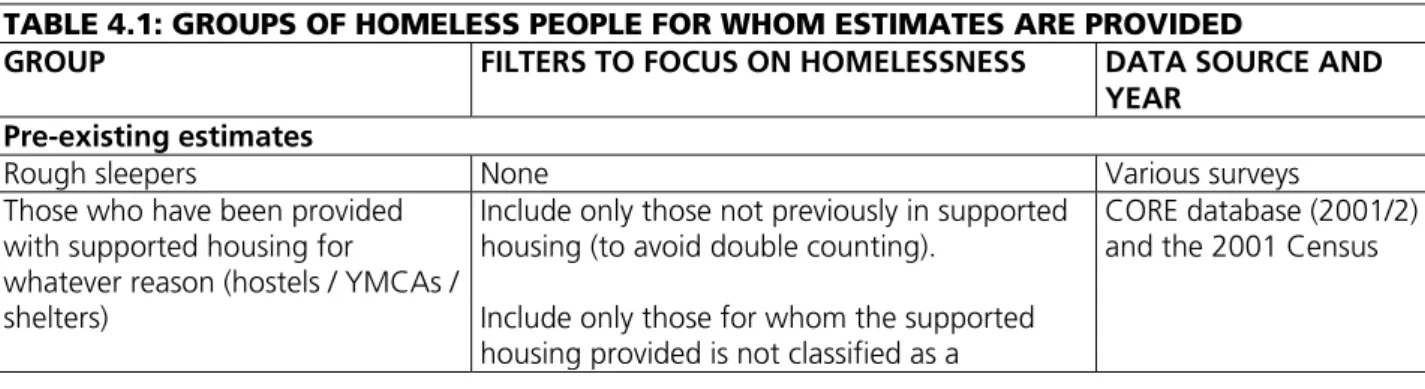
4.2.1. The presentation of estimates in this chapter is divided into two parts, according to whether they are the result of new analyses of datasets that we ourselves have carried out (the next section), or whether they are existing pre-estimates, originally produced by others (this section). Building on the conclusions of chapter 3, table 4.1 lists the groups whose numbers are presented in this chapter, divided between pre-existing and new analyses.
4.2.2. Throughout, the estimates are on the following basis:
• The estimates are for adults aged 16 and over without dependent children. Although this does include a few couples, they are overwhelmingly single people.
• The estimates are ‘point in time’ estimates – in other words, they are estimates of the numbers who might be considered homeless at any one time.
• Because of very limited data availability in the province, the estimates are for Great Britain rather than Northern Ireland. Where possible, estimates have been presented separately for England, Scotland and Wales.
TABLE 4.1: GROUPS OF HOMELESS PEOPLE FOR WHOM ESTIMATES ARE PROVIDED
GROUP FILTERS TO FOCUS ON HOMELESSNESS DATA SOURCE AND
YEAR Pre-existing estimates
Rough sleepers None Various surveys
Those who have been provided with supported housing for
whatever reason (hostels / YMCAs / shelters)
Include only those not previously in supported housing (to avoid double counting).
Include only those for whom the supported housing provided is not classified as a
CORE database (2001/2) and the 2001 Census
permanent solution to their housing needs. Bed and breakfast and other
boarded accommodation Include only those in receipt of housing benefit (as a proxy for low income) on the grounds that others have enough income to live elsewhere if they want to.
DWP Housing Benefit Statistics (2002)
People at imminent risk of eviction Include only those for whom rent or mortgage arrears is the main reason for their potential eviction on the grounds that, where debt is not the cause, they have enough money to find alternative accommodation.
The Court Service (2002)
Squatters None (no data available to distinguish between those squatting voluntarily and those squatting because they have no alternative).
No authoritative data sources
New analyses
Involuntary sharing – multiple family units sharing overcrowded accommodation
Include only those living in ‘concealed households’.
For the higher likelihood sub-group, include only those aged 25+ and those under 25 who are living with friends rather than parents or other relatives.
Survey of English Housing (GB estimates derived by factoring up the English estimates): 2000/01, 2001/02, 2002/03
Involuntary sharing – multiple family units sharing
accommodation which is not overcrowded
Include only those who meet both the following conditions:
• They are living in ‘concealed households’ (on the grounds that these are the people without an explicit licence to occupy); and
• Where the head of the household has expressed some dissatisfaction with the arrangement.
For the higher likelihood sub-group, include only those aged 25+ and those under 25 who are living with friends rather than parents or other relatives.
Survey of English Housing (GB estimates derived by factoring up the English estimates): 2000/01, 2001/02, 2002/03
Rough sleepers
4.2.3. We stress that we are not providing a new estimate of the number of rough sleepers. There are currently no national records of the flow of rough sleepers and most areas do not have such local records. Rather, estimates for the numbers of rough sleepers are only available on a somewhat ad hoc basis via particular once-off data collections which are typically made on a ‘snapshot’ basis (i.e. the number of rough sleepers on a given night). On this basis, the best estimates are:
• England: 550.19 • Wales: 150.20 • Scotland: 100.21
4.2.4. It is inevitable that any daily ‘snapshot’ count will be smaller than the total number of people who sleep rough at some point in any year, with some evidence suggesting a factor of 10.22 Using this scaling factor would give a total estimate of around 8,000 people sleeping rough at some time during a given year. Some of these people, however, will be the same as those in other categories discussed below; for example, someone who sometimes sleeps rough may well also sometimes be staying in a
Hostels/YMCAs/shelters
4.2.5. The sources vary by home country. For England and Wales, the obvious source is the relevant countries’ Supported Housing CORE ‘lettings’ database (2001/02). There is no equivalent to the support housing part of CORE for Scotland, but there are estimates of the number of bed spaces in hostels. The 2001 Census also provides estimates for the numbers of people either living in hostels or sleeping rough.
4.2.6. For England, the CORE ‘lettings’ database is data collected annually for almost all housing association and voluntary sector supported housing lettings (both to statutory and non-statutory homeless and other households) over the year. The dataset can classify lettings according to whether individuals are statutory or non-statutory homeless, their last settled base (including geographical region as well as e.g. rough sleeping, squatting etc.), their current geographical location (postcode), the intended length of stay in the accommodation, their problems (e.g. alcohol abuse, drug abuse etc.), age, marital status, presence of dependent children, ethnicity, economic status and income. Note that, although it is a 100 per cent sample, there are some uncertainties about the estimates because it does not include local authority hostel accommodation, nor smaller, non-RSL accommodation, nor people in such accommodation who moved in previous years.
4.2.7. In 2001/02, 45,000 adults aged 16+ were provided with supported housing on a non-permanent basis in the RSL/voluntary sector (after removing re-lets from hostel accommodation during the year on grounds of double counting and removing those accommodated on a permanent basis on the grounds that they clearly cease to be homeless, if they ever were). Note that this figure only includes registered social landlord (RSL) accommodation and levels of non-RSL accommodation are not known but clearly not negligible23.
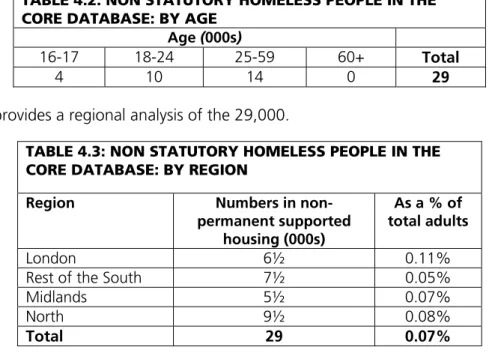
4.2.8. Of these, 11,000 were classified by the relevant housing association as ‘statutorily homeless’, 22,000 as ‘non-statutorily homeless’, 11,000 as ‘not homeless’ and 1,000 as ‘other’.24 Among the 33,000 here who were classified as homeless, 29,000 were people without dependent children.25 Table 4.2 below analyses these people by age group. Note here and elsewhere that totals may not be the sum of the parts shown due to rounding figures.
TABLE 4.2: NON STATUTORY HOMELESS PEOPLE IN THE CORE DATABASE: BY AGE
Age (000s)
16-17 18-24 25-59 60+ Total
4 10 14 0 29
4.2.9. The next table provides a regional analysis of the 29,000.
TABLE 4.3: NON STATUTORY HOMELESS PEOPLE IN THE CORE DATABASE: BY REGION
Region Numbers in
non-permanent supported housing (000s)
As a % of total adults
London 6½ 0.11%
Rest of the South 7½ 0.05%
Midlands 5½ 0.07%
North 9½ 0.08%
4.2.10. How many of these 29,000 are being provided with non-permanent supported housing at any
particular point in time? Given that around three quarters of them have an intended stay of less than a year and a quarter of them have an intended stay of more than a year, a reasonable estimate for the average length of stay would be around nine months.26 This, in turn, implies a figure of around 21,000 (9/12ths of 29,000) being provided with non-permanent supported housing at any particular point in time.
4.2.11. In Scotland, there were some 1,300 people without dependent children in hostels at any one time during 2002.27 Data for Wales is apparently available on a similar basis to that for England. Despite repeated requests, however, no estimates have been provided.
4.2.12. Adding up the estimates above for England and Scotland, and scaling up the figures for Wales, gives a total estimate of 24,000 people without dependent children provided with hostel accommodation or equivalent on a non-permanent basis at any particular point in time.
4.2.13. According to the 2001 Census, there were around 28,000 people aged 16 and over either living in hostels or sleeping rough in Great Britain on the day of the Census.28 This is a similar order of
magnitude to the 24,000 figure above, particularly given the estimate of 800 rough sleepers discussed earlier.
Bed and breakfast and other boarded accommodation
4.2.14. The source here is the DWP’s Housing Benefit database which is for Great Britain and for which the latest available data is for 2002. This database is the best source of data on homeless people in bed and breakfast and other boarded accommodation since it identifies those people who, broadly speaking, do not have accommodation of their own and are on low incomes. The dataset can classify individuals by whether they are local authority or private boarders, self-placed or placed by the local authority, in receipt of housing benefit or not, singles/couples, with or without children, and by region.29
4.2.15. In 2002, at any one time, there were around 53,000 benefit unit boarders across Great Britain in bed and breakfast and other boarded accommodation who were on low incomes (i.e. claiming housing benefit).30 Of these, an estimated 49,000 were people without dependent children.31
Facing eviction
4.2.16. There is no regularly available data on the actual number of evictions, but research conducted by the National Housing Federation suggests that the number of evictions roughly corresponds to the number of outright possession orders.32 The estimated number of people facing outright possession orders in 2002 was about 50,000 in England and 3,000 in Wales.33 Research indicates that around four fifths of such cases are because of rent arrears – which clearly makes such cases at direct risk of homelessness – with arrears being an additional factor in many of the others. It also indicates that around half are households without dependent children.34 Applying these ratios to the numbers above gives a total estimate of around 22,000 people without dependent children were evicted because of rent arrears in 2002.
4.2.17. What proportion of these 22,000 people should be considered to be at imminent risk of eviction at any particular point in time? There are two reasons for saying that the answer is around 1,700 (28/365ths of 25,000): first, from a legal standpoint, a person is considered to be threatened with homelessness if it is likely that they will become homeless within 28 days; and, second, possession orders typically take effect 28 days from the day of the Court judgement.35
4.2.18. In Scotland, there were just over 650 evictions (including abandonments following court action) among local authority tenants during the last quarter of 2002. Only 15 of these were for anti-social behaviour. Assuming similar rates of eviction both for RSL tenants, private tenants and occupiers buying with a mortgage produces a figure of 2,100 evictions over the three-month period.36 Assuming (in line with England) that about half of these are without dependent children, this implies (again following the logic of the English argument) some 350 at imminent risk of eviction at any one point in time. Since their derivation is utterly different, it should be stressed that England and Scotland cannot be compared here.
Squatting
4.2.19. There is no obvious data source. Data is available from local authorities on the extent of illegal occupation of their properties, but this can give only an inadequate indication of the extent of the issue. Research studies have previously indicated that there may be around 10,000 squatters at any one time.37
4.2.20. No data is available to distinguish between those who are squatting because of the lack of an alternative versus those who are voluntary and, similarly, no data is available on what proportion do not have dependent children. And the numbers may well have changed since the research in question (1996). In summary, therefore, the numbers of people without dependent children who are squatting because of the lack of any alternative is likely to be somewhat less than the 10,000 figure above.
4.3. THE NUMBERS IN DETAIL: NEW ANALYSES
4.3.1. The source here is our own analysis of the Survey of English Housing.38 To improve statistical reliability, all the figures presented below are averages for the three years 2000/01, 2001/02 and 2002/03. Note that the figures are not vastly different in the three different years (i.e. there is no strong short-term time trend) and thus averaging them does not distort the estimated current numbers in each category. The 2001 Census has been used to gross up the figures to the total English population. All estimates are rounded to the nearest 10,000.
4.3.2. The Survey of English Housing is an annual survey of around 30,000 households (50,000 individuals). Households can be classified according to whether they are overcrowded and how the head of the household feels about the adequacy of the accommodation, as well as a range of other household-level factors. Details of the composition of each household are also known and thus, for example, individual adults within the households can be classified according to their relationship with both the head of the household and their partner/spouse39 and the landlord as well as their family composition. From the viewpoint of this study, the data has two main limitations: it contains no personal details about the individual adults and views of the adequacy of the accommodation etc. are only sought from the head of the household and not from the other adults.
Involuntary sharing in overcrowded conditions
4.3.3. According to this survey, there are an estimated 4.3 million adults aged 16 and over in England living in ‘concealed households’ – people who do not own or rent a property, do not belong to a tenancy group, are neither the head of the household nor the spouse/partner of the head of the household, and are not considered to be dependent children.40 Of these, an estimated 480,000 in England live in overcrowded conditions (i.e. the housing is below the bedroom standard). Note that, in principle, boyfriends/girlfriends are excluded from these figures as they would be considered to be partners of the relevant head of household.
4.3.4. In this context, table 4.4 analyses the estimated 480,000 people in England in concealed households according to their age group and who they are living with. It also incorporates our judgement about the relative risk of the people being in an unsatisfactory or unstable housing situation (L=lower risk, M=middling and H=highest). Those aged 25 and over, or those living with friends rather than family are assigned an ‘M’ as opposed to an ‘L’. Those aged 25 and over and living with friends are assigned an ‘H’. Table 4.4 shows that an estimated 10,000 people in England in concealed households can be considered to be at the ‘highest risk’ of being homeless because of their overcrowded conditions, with 160,000 at ‘middling risk’ and 300,000 at ‘lower risk’.
TABLE 4.4: PEOPLE IN CONCEALED HOUSEHOLDS IN OVERCROWDED CONDITIONS: BY AGE AND WHO THEY ARE LIVING WITH
Age (000s)
Living with 16-17 18-24 25-59 60+ Total
Parents 40 L 240 L 110 M - M 380
Other relatives - L 20 L 30 M 20 M 70
Friends etc - M 10 M 10 H - H 30
Total 40 260 150 20 480
4.3.5. The next table analyses the numbers in each of these risk groups according to whether or not they have dependent children. As can be seen from the table, the vast majority (420,000 out of 480,000) of people in England in concealed households who are living in overcrowded conditions do not have dependent children. Of this 420,000, an estimated 140,000 of these people can be considered to be at ‘highest’ or ‘middling’ risk of being in an unsatisfactory or unstable housing situation, with 270,000 being at ‘lower’ risk.
TABLE 4.5: PEOPLE IN CONCEALED HOUSEHOLDS IN OVERCROWDED CONDITIONS: BY RISK AND FAMILY TYPE
Level of risk (000s)
Family type Low Medium High Total
Without dependent children 270 130 10 420
With dependent children 20 40 - 60
Total 290 170 10 480
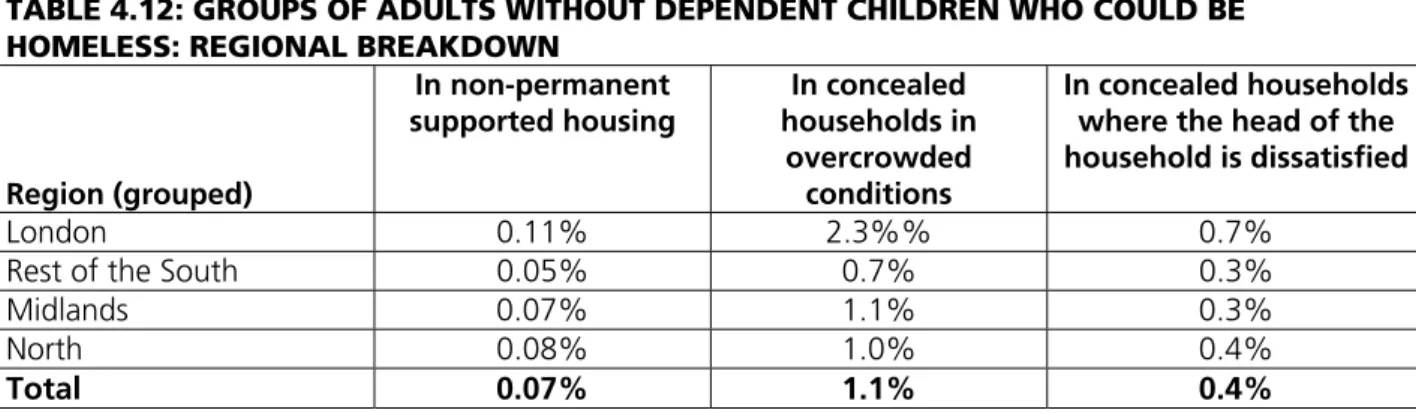
4.3.6. Note that, because many of the people without dependent children are living with their parents, who often also have other children who are still dependent, there is a substantial overlap between the families living in overcrowded conditions and single adults living in overcrowded conditions.41 4.3.7. Finally, table 4.6 provides a regional analysis.
TABLE 4.6: PEOPLE WITHOUT DEPENDENT CHILDREN IN CONCEALED HOUSEHOLDS IN OVERCROWDED CONDITIONS: BY REGION
Adults in concealed households without dependant children
Region
Numbers in overcrowded conditions (000s)
Numbers
total (000s) overcrowded % in
conditions total adults As a % of
London 130 730 18% 2.3%
Rest of the South
100 1,440 7% 0.7%
Midlands 80 820 10% 1.1%
North 110 1,200 9% 1.0%
4.3.8. In summary, up to 480,000 adults in England in concealed households could be considered to be homeless because of the overcrowded conditions in which they are living. An estimated 420,000 of these people do not have dependent children. At the very least, all of these people are at some risk of becoming homeless at some time in the future, with 140,000 of them being at particular risk because of their age and/or who they are living with. The 420,000 figure for England is equivalent to 490,000 for Britain as a whole, with the 140,000 at particular risk in England scaling up to 160,000.42
Involuntary sharing in non-overcrowded conditions
4.3.9. Of the estimated 4.3 million adults aged 16 and over in England living in ‘concealed households’, an estimated 3.8 million are in accommodation which is not overcrowded. The adequacy of the living arrangements for these people clearly depends on how satisfied both they and the head of the household are about the current living arrangements. Whilst data on the individuals’ views are not available from the survey, data on the views of the head of the household are available and it would seem to be a realistic assumption that, if the head of the household is dissatisfied, then there is a potential problem.43 Using this information, we find that some 160,000 of the 3.85 million live in homes where the head of the household is dissatisfied with the current living arrangements.44 4.3.10. As with overcrowding, the likelihood of homelessness may depend on their age and who they are
living with. Table 4.7 therefore analyses the numbers according to these two factors and incorporates our assessment of the relative risk of their being in an unsatisfactory or unstable housing situation (L=lower risk, M=middling and H=highest). It shows an estimated 50,000 people in concealed households could be considered to be at the ‘middling risk’ of being homeless either now or in the future because of the dissatisfaction of the head of the household, and 100,000 at ‘lower risk’.
TABLE 4.7: PEOPLE IN CONCEALED HOUSEHOLDS IN NON-OVERCROWDED CONDITIONS WHERE THE HEAD OF HOUSEHOLD EXPRESSES
DISSATISFACTION: BY AGE AND WHO THEY ARE LIVING WITH Age (000s)
Living with 16-17 18-24 25-59 60+ Total
Parents 20 L 70 L 40 M - M 140
Other relatives - L - L - M - M 10
Friends etc - M - M - H - H 10
Total 20 80 50 10 150
4.3.11. The next table below analyses the numbers in each of these risk groups according to their family type. As can be seen from the table, just about all of the 160,000 people in concealed households who are living in homes where the head of the household is dissatisfied with the current living arrangements do not have dependent children.
TABLE 4.8: PEOPLE IN CONCEALED HOUSEHOLDS IN NON-OVERCROWDED CONDITIONS WHERE THE HEAD OF HOUSEHOLD EXPRESSES
DISSATISFACTION: BY RISK AND FAMILY TYPE
Level of risk (000s)
Family type Low Medium High Total
Without dependent children 100 50 - 150
With dependent children - - - -
Total 100 50 - 150
.