Applying a Pattern Language to Develop Extensible ORB Middleware
Douglas C. Schmidt
Chris Cleeland
[email protected] cleeland [email protected]
Electrical & Computer Engineering Dept. Object Computing Inc. University of California, Irvine, USA St. Louis, MO, USA
This paper appeared as a chapter in the book Design Pat-terns in Communications, (Linda Rising, ed.), Cambridge Uni-versity Press, 2000. An abridged version appeared in the IEEE Communications Magazine Special Issue on Patterns (Linda Rising, ed.), Volume 37, No. 4, April 1999.
Abstract
Distributed object computing forms the basis of next-generation communication software. At the heart of dis-tributed object computing are Object Request Brokers (ORBs), which automate many tedious and error-prone distributed pro-gramming tasks. Like much communication software, conven-tional ORBs use statically configured designs, which are hard to port, optimize, and evolve. Likewise, conventional ORBs cannot be extended without modifying their source code, which forces recompilation, relinking, and restarting running ORBs and their associated application objects.
This paper makes two contributions to the study of extensi-ble ORB middleware. First, it presents a case study illustrating how a pattern language can be used to develop dynamically configurable ORBs that can be customized for specific appli-cation requirements and system characteristics. Second, we quantify the impact of applying this pattern language to re-duce the complexity and improve the maintainability of com-mon ORB tasks, such as connection management, data trans-fer, demultiplexing, and concurrency control.
1
Introduction
Four trends are shaping the future of commercial software de-velopment. First, the software industry is moving away from programming applications from scratch to integrating applica-tions using reusable components [1]. Second, there is great de-mand for distribution technology that provides remote method invocation and/or message-oriented middleware to simplify application collaboration. Third, there are increasing efforts to define standard software infrastructure frameworks that per-mit applications to interwork seamlessly throughout heteroge-neous environments [2]. Finally, next-generation distributed
This work was supported in part by ATD, BBN, Boeing, Cisco, DARPA contract 9701516, Motorola Commercial Government and Industrial Solu-tions Sector, Motorola Laboratories, Siemens, and Sprint.
applications such as video-on-demand, teleconferencing, and avionics require quality-of-service (QoS) guarantees for la-tency, bandwidth, and reliability [3].
A key software technology supporting these trends is dis-tributed object computing (DOC) middleware. DOC mid-dleware facilitates the collaboration of local and remote ap-plication components in heterogeneous distributed environ-ments. The goal of DOC middleware is to eliminate many te-dious, error-prone, and non-portable aspects of developing and evolving distributed applications and services. In particular, DOC middleware automates common network programming tasks, such as object location, implementation startup (i.e., server and object activation), encapsulation of byte-ordering and parameter type size differences across dissimilar architec-tures (i.e., parameter marshaling), fault recovery, and security. At the heart of DOC middleware are Object Request Brokers (ORBs), such as CORBA [4], DCOM [5], and Java RMI [6].
This paper describes how we have applied a pattern lan-guage to develop and evolve dynamically configurable ORB middleware that can be extended more readily than statically configured middleware. In general, pattern languages help to alleviate the continual re-discovery and re-invention of soft-ware concepts and components by conveying a family of re-lated solutions to standard software development problems [7]. For instance, pattern languages are useful for documenting the roles and relationships among participants in common com-munication software architectures [8]. The pattern language presented in this paper is a generalization of the one presented in [9] and has been used successfully to build flexible, effi-cient, event-driven, and concurrent communication software, including ORB middleware.
To focus our discussion, this paper presents a case study that illustrates how we have applied this pattern language to develop The ACE ORB (TAO) [10]. TAO is a freely avail-able, highly extensible ORB targeted for applications with real-time QoS requirements, including avionics mission com-puting [11], multimedia applications [12], and distributed in-teractive simulations [13]. A novel aspect of TAO is its ex-tensible design, which is guided by a pattern language that en-ables the ORB to be customized dynamically to meet specific application QoS requirements and network/endsystem charac-teristics.
Sec-tion 2 presents an overview of CORBA and TAO; SecSec-tion 3 motivates the need for dynamic configuration and describes the pattern language that resolves key design challenges faced when developing extensible ORBs; Section 3.5 evaluates and quantifies the contribution of the pattern language to ORB middleware; and Section 4 presents concluding remarks.
2
Overview of CORBA and TAO
This section outlines the CORBA reference model and describes the enhancements that TAO provides for high-performance and real-time applications.
2.1
Overview of the CORBA Reference Model
CORBA Object Request Brokers (ORBs) [14] allow clients to invoke operations on distributed objects without concern for the following issues:Object location: A CORBA object either can be collocated with the client or distributed on a remote server, without af-fecting its implementation or use.
Programming language: The languages supported by
CORBA include C, C++, Java, Ada95, COBOL, and Smalltalk, among others.
OS platform: CORBA runs on many OS platforms, includ-ing Win32, UNIX, MVS, and real-time embedded systems, such as VxWorks, Chorus, and LynxOS.
Communication protocols and interconnects: The com-munication protocols and interconnects that CORBA run on include TCP/IP, IPX/SPX, FDDI, ATM, Ethernet, Fast Ether-net, embedded system backplanes, and shared memory.
Hardware: CORBA shields applications from side effects stemming from hardware diversity, such as different storage layouts and data type sizes/ranges.
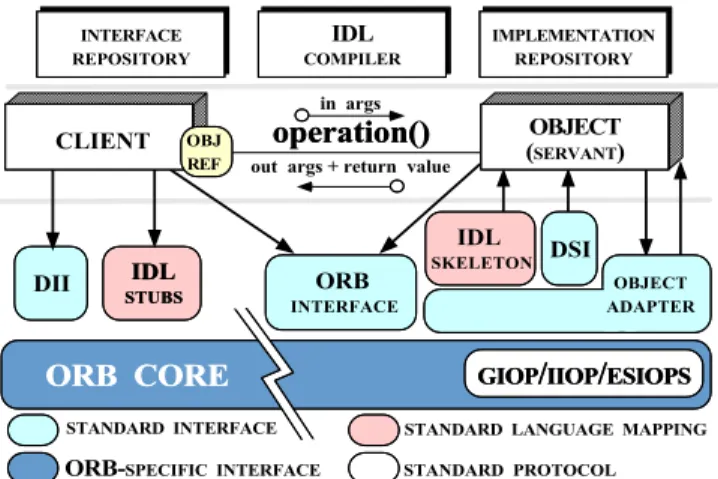
Figure 1 illustrates the components in the CORBA refer-ence model, all of which collaborate to provide the portability, interoperability and transparency outlined above.
Each component in the CORBA reference model is outlined below:
Client: A client is a role that obtains references to objects and invokes operations on them to perform application tasks. Objects can be remote or collocated relative to the client. Clients can access remote objects just like a local object, i.e.,
object!operation(args). Figure 1 shows how the
underlying ORB components described below transmit remote operation requests transparently from client to object.
INTERFACE REPOSITORY
IMPLEMENTATION REPOSITORY IDL
COMPILER
DII ORB
INTERFACE
ORB
ORB CORECORE GIOPGIOP//IIOPIIOP//ESIOPSESIOPS IDL
IDL STUBS STUBS
operation() operation()in args
out args + return value
CLIENT OBJ (OBJECTSERVANT)
REF
STANDARD INTERFACE STANDARD LANGUAGE MAPPING ORB-SPECIFIC INTERFACE STANDARD PROTOCOL
INTERFACE REPOSITORY
IMPLEMENTATION REPOSITORY IDL
COMPILER
IDL SKELETON DSI
OBJECT ADAPTER
Figure 1: Components in the CORBA Reference Model
Object: In CORBA, an object is an instance of an OMG Interface Definition Language (IDL) interface. Each object is identified by an object reference, which associates one or more paths through which a client can access an object on a server. An object ID associates an object with its implemen-tation, called a servant, and is unique within the scope of an Object Adapter. Over its lifetime, an object has one or more servants associated with it to implement its interface.
Servant: This component implements the operations de-fined by an OMG IDL interface. In object-oriented (OO) lan-guages, such as C++ and Java, servants are implemented us-ing one or more class instances. In non-OO languages, such as C, servants are typically implemented using functions and
structs. A client never interacts with servants directly, but always through objects identified by object references. To-gether, an object and its servant form an implementation of the Bridge pattern [15], with object as the RefinedAbstraction and servant as the ConcreteImplementor.
ORB Core: When a client invokes an operation on an ob-ject, the ORB Core is responsible for delivering the request to the object and returning a response, if any, to the client. An ORB Core is implemented as a run-time library linked into client and server applications. For objects executing re-motely, a CORBA-compliant ORB Core communicates via a version of the General Inter-ORB Protocol (GIOP), such as the Internet Inter-ORB Protocol (IIOP) that runs atop the TCP transport protocol. In addition, custom Environment-Specific Inter-ORB protocols (ESIOPs) can also be defined [16].
ORB Interface: An ORB is an abstraction that can be im-plemented various ways, e.g., one or more processes or a set of libraries. To decouple applications from implementation details, the CORBA specification defines an interface to an ORB. This ORB interface provides standard operations to ini-tialize and shut down the ORB, convert object references to
strings and back, and create argument lists for requests made through the dynamic invocation interface (DII).
OMG IDL Stubs and Skeletons: IDL stubs and skeletons serve as a “glue” between the client and servants, respectively, and the ORB. Stubs implement the Proxy pattern [15] and provide a strongly-typed, static invocation interface (SII) that marshals application parameters into a common message-level representation. Conversely, skeletons implement the Adapter pattern [15] and demarshal the message-level representation back into typed parameters that are meaningful to an applica-tion.
IDL Compiler: An IDL compiler transforms OMG IDL
definitions into stubs and skeletons that are generated automat-ically in an application programming language, such as C++ or Java. In addition to providing programming language trans-parency, IDL compilers eliminate common sources of network programming errors and provide opportunities for automated compiler optimizations [17].
Dynamic Invocation Interface (DII): The DII allows
clients to generate requests at run-time, which is useful when an application has no compile-time knowledge of the inter-face it accesses. The DII also allows clients to make deferred synchronous calls, which decouple the request and response portions of two-way operations to avoid blocking the client until the servant responds. CORBA SII stubs support both synchronous and asynchronous two-way, i.e., request/response and one-way, i.e., request-only operations.
Dynamic Skeleton Interface (DSI): The DSI is the server’s analogue to the client’s DII. The DSI allows an ORB to deliver requests to servants that have no compile-time knowledge of the IDL interface they implement. Clients making requests need not know whether the server ORB uses static skeletons or dynamic skeletons. Likewise, servers need not know if clients use the DII or SII to invoke requests.
Object Adapter: An Object Adapter is a composite compo-nent that associates servants with objects, creates object refer-ences, demultiplexes incoming requests to servants, and col-laborates with the IDL skeleton to dispatch the appropriate operation upcall on a servant. Object Adapters enable ORBs to support various types of servants that possess similar re-quirements. This design results in a smaller and simpler ORB that can support a wide range of object granularities, lifetimes, policies, implementation styles, and other properties.
Interface Repository: The Interface Repository provides run-time information about IDL interfaces. Using this infor-mation, it is possible for a program to encounter an object whose interface was not known when the program was com-piled, yet be able to determine what operations are valid on the object and make invocations on it using the DII. In addition, the Interface Repository provides a common location to store
additional information associated with interfaces to CORBA objects, such as type libraries for stubs and skeletons.
Implementation Repository: The Implementation Reposi-tory [18] contains information that allows an ORB to activate servers to process servants. Most of the information in the Im-plementation Repository is specific to an ORB or OS environ-ment. In addition, the Implementation Repository provides a common location to store information associated with servers, such as administrative control, resource allocation, security, and activation modes.
2.2
Overview of TAO
TAO is a high-performance, real-time ORB endsystem tar-geted for applications with deterministic and statistical QoS requirements, as well as best-effort requirements. TAO’s ORB endsystem contains the network interface, OS, communication protocol, and CORBA-compliant middleware components and services shown in Figure 2. TAO supports the standard OMG
NETWORK NETWORK ORB
ORB RUN RUN--TIMETIME SCHEDULER SCHEDULER
operation() operation()
IDL IDL STUBS STUBS
IDL IDL SKELETON SKELETON in args
in args out args + return value out args + return value CLIENT
CLIENT
OS KERNEL OS KERNEL
HIGH HIGH--SPEEDSPEED NETWORK INTERFACE NETWORK INTERFACE
REAL REAL--TIME ITIME I//OO
SUBSYSTEM SUBSYSTEM
OBJECT OBJECT ((SERVANTSERVANT))
OS KERNEL OS KERNEL
HIGH HIGH--SPEEDSPEED NETWORK INTERFACE NETWORK INTERFACE
REAL REAL--TIME ITIME I//OO
SUBSYSTEM SUBSYSTEM ACE
ACE COMPONENTSCOMPONENTS OBJ
OBJ REF REF
REAL
REAL--TIMETIME ORBORB CORECORE
IOP
IOP PLUGGABLEPLUGGABLE
ORB
ORB & & XPORTXPORT
PROTOCOLS PROTOCOLS
IOP IOP
PLUGGABLE PLUGGABLE ORB
ORB & & XPORTXPORT
PROTOCOLS PROTOCOLS
REAL REAL--TIMETIME
OBJECT OBJECT ADAPTER ADAPTER
Figure 2: Components in the TAO Real-time ORB Endsystem
CORBA reference model [14] and Real-time CORBA speci-fication [19], with enhancements designed to ensure efficient, predictable, and scalable QoS behavior for high-performance and real-time applications. In addition, TAO is well-suited for general-purpose distributed applications. Below, we outline the features of TAO’s components shown in Figure 2.
Optimized IDL Stubs and Skeletons: IDL stubs and skele-tons perform marshaling and demarshaling of application op-eration parameters, respectively. TAO’s IDL compiler gener-ates stubs/skeletons that can selectively use highly optimized compiled and/or interpretive (de)marshaling [20]. This flex-ibility allows application developers to selectively trade off
time and space, which is crucial for high-performance, real-time, and/or embedded distributed systems.
Real-time Object Adapter: An Object Adapter associates servants with the ORB and demultiplexes incoming requests to servants. TAO’s real-time Object Adapter uses perfect hash-ing [21] and active demultiplexhash-ing [22] optimizations to dis-patch servant operations in constantO(1)time, regardless of
the number of active connections, servants, and operations de-fined in IDL interfaces.
Run-time Scheduler: TAO’s run-time scheduler [19] maps application QoS requirements, such as bounding end-to-end latency and meeting periodic scheduling deadlines, to ORB endsystem/network resources, such as CPU, memory, network connections, and storage devices. TAO’s run-time scheduler supports both static [10] and dynamic [23] real-time schedul-ing strategies.
Real-time ORB Core: An ORB Core delivers client re-quests to the Object Adapter and returns responses (if any) to clients. TAO’s real-time ORB Core [24] uses a multi-threaded, preemptive, priority-based connection and concurrency archi-tecture [20] to provide an efficient and predictable CORBA protocol engine. TAO’s ORB Core allows customized proto-cols to be plugged into the ORB without affecting the standard CORBA application programming model [25].
Real-time I/O subsystem: TAO’s real-time I/O (RIO) sub-system [26] extends support for CORBA into the OS. RIO as-signs priorities to real-time I/O threads so that the schedulabil-ity of application components and ORB endsystem resources can be enforced. When integrated with advanced hardware, such as the high-speed network interfaces described below, RIO can (1) perform early demultiplexing of I/O events onto prioritized kernel threads to avoid thread-based priority inver-sion and (2) maintain distinct priority streams to avoid packet-based priority inversion. TAO also runs efficiently and as pre-dictably as possible on conventional I/O subsystems that lack advanced QoS features.
High-speed network interface: At the core of TAO’s I/O subsystem is a “daisy-chained” network interface consisting of one or more ATM Port Interconnect Controller (APIC) chips [27]. The APIC is designed to sustain an aggregate bi-directional data rate of 2.4 Gbps using zero-copy buffering op-timization to avoid data copying across endsystem layers. In addition, TAO runs on conventional real-time interconnects, such as VME backplanes and multi-processor shared memory environments, as well as TCP/IP.
TAO internals: TAO is developed using lower-level mid-dleware called ACE [28], which implements core concur-rency and distribution patterns [8] for communication soft-ware. ACE provides reusable C++ wrapper facades and frame-work components that support the QoS requirements of
high-performance, real-time applications and higher-level middle-ware like TAO. ACE and TAO run on a wide range of OS plat-forms, including Win32, most versions of UNIX, and real-time operating systems, such as Sun/Chorus ClassiX, LynxOS, and VxWorks.
To expedite our project goals, and to avoid re-inventing ex-isting components, we based TAO on SunSoft IIOP, which is a freely available C++ reference implementation of the Inter-net Inter-ORB Protocol (IIOP) version 1.0. Although SunSoft IIOP provides core features of a CORBA ORB it also has the following limitations:
Lack of standard ORB features: Although SunSoft IIOP provides an ORB Core, an IIOP 1.0 protocol engine, and a DII and DSI implementation, it lacks an IDL compiler, an Interface Repository and Implementation Repository, and a Portable Object Adapter (POA). TAO implements all these missing features and provides newer CORBA features, asyn-chronous method invocations [29], real-time CORBA [19] fea-tures [30], and fault tolerance CORBA feafea-tures [31, 32].
Lack of IIOP optimizations: Due to the excessive marshal-ing/demarshaling overhead, data copying, and high-levels of function call overhead, SunSoft IIOP performs poorly over high-speed networks. Therefore, we applied a range of opti-mization principle patterns [22] that improved its performance considerably [33]. The principles that directed our optimiza-tions include: (1) optimizing for the common case, (2) elim-inating gratuitous waste, (3) replacing general-purpose meth-ods with efficient special-purpose ones, (4) precomputing val-ues, if possible, (5) storing redundant state to speed up expen-sive operations, (6) passing information between layers, and (7) optimizing for processor cache affinity.
This paper does not discuss how TAO solves the limitations with SunSoft IIOP outlined above, which are described in de-tail in [10, 20]. Instead, we focus on how TAO uses patterns to implement an ORB that overcomes the following SunSoft IIOP limitations while simultaneously preserving its QoS ca-pabilities:
Lack of portability: Like most communication software, SunSoft IIOP is programmed directly using low-level net-working and OS APIs, such as sockets,select, and POSIX Pthreads. Not only are these APIs tedious and error-prone, they are also not portable across OS platforms, e.g., many op-erating systems lack Pthreads support. Section 3.3.1 illustrates how we used the Wrapper Facade pattern [15] to improve TAO’s portability.
Lack of configurability: Like many ORBs and other mid-dleware, SunSoft IIOP is configured statically, which makes it hard to extend without modifying its source code directly.
This violated a key design goal of TAO, namely dynamic adap-tation to diverse application requirements and system environ-ments. Sections 3.3.7, 3.3.6, and 3.3.8 explain how we used the Abstract Factory [15], Strategy [15], and Component Con-figurator [8] patterns to simplify the TAO’s configurability for different use-cases.
Lack of software cohesion: Like many applications, Sun-Soft IIOP focuses on solving a specific problem, i.e., imple-menting an ORB Core and an IIOP protocol engine. It ac-complish this using a tightly-coupled, ad-hoc implementation that hard-codes key ORB design decisions. Sections 3.3.7 and 3.3.6 explain how we used Abstract Factory and Strategy to decrease the unnecessary coupling and increase cohesion when evolving SunSoft IIOP to TAO.
3
Applying a Pattern Language to
Build Extensible ORB Middleware
3.1
Why We Need Dynamically Configurable
Middleware
A key motivation for ORB middleware is to offload complex, lower-level distributed system infrastructure tasks from appli-cation developers to ORB developers. ORB developers are re-sponsible for implementing reusable middleware components that handle connection management, interprocess communica-tion, concurrency, transport endpoint demultiplexing, schedul-ing, dispatchschedul-ing, (de)marshalschedul-ing, and error handling. These components are typically compiled into a run-time ORB li-brary, linked with application objects that use the ORB com-ponents, and executed in one or more OS processes.
Although this separation of concerns can simplify applica-tion development, it can also yield inflexible and inefficient applications and middleware architectures. The primary rea-son is that many conventional ORBs are configured statically at compile-time and link-time by ORB developers, rather than dynamically at installation-time or run-time by application developers. Statically configured ORBs have the following drawbacks [28]:
Inflexibility: Statically-configured ORBs tightly couple each component’s implementation with the configuration of internal ORB components, i.e., which components work to-gether and how they work toto-gether. As a result, extending statically-configured ORBs requires modifications to existing source code. In commercial non-open-source ORBs, this code may not be accessible to application developers.
Even if source code is available, extending statically-configured ORBs requires recompilation and relinking. More-over, any currently executing ORBs and their associated ob-jects must be shutdown and restarted. This static
reconfigura-tion process is not well-suited for applicareconfigura-tion domains, such as telecom call processing, that require 724 availability [34].
Inefficiency: Statically-configured ORBs can be inefficient, both in terms of space and time. Space inefficiency can oc-cur if unnecessary components are always statically config-ured into an ORB. This can increase the ORB’s memory foot-print, forcing applications to pay a space penalty for features they do not require. Overly large memory footprints are par-ticularly problematic for embedded systems, such as cellular phones or telecom switch line cards [35].
Time inefficiency can stem from restricting an ORB to use statically configured algorithms or data structures for key pro-cessing tasks, thereby making it hard for application develop-ers to customize an ORB to handle new use-cases. For in-stance, real-time avionics systems [11] often can instantiate all their servants off-line. These systems can benefit from an ORB that uses perfect hashing or active demultiplexing [36] to demultiplex incoming requests to servants. Thus, ORBs that are configured statically to use a general-purpose, “one-size-fits-all” demultiplex strategy, such as dynamic hashing, may perform poorly for mission-critical systems.
In theory, the drawbacks with static configuration described above are internal to ORBs and should not affect application developers directly. In practice, however, application devel-opers are inevitably affected since the quality, portability, us-ability, and performance of the ORB middleware is reduced. Therefore, an effective way to improve ORB extensibility is to develop ORB middleware that can be both statically and dynamically configured.
Dynamic configuration enables the selective integration of customized implementations for key ORB strategies, such as connection management, communication, concurrency, de-multiplexing, scheduling, and dispatching. This design allows ORB developers to concentrate on the functionality of ORB components, without committing themselves prematurely to a specific configuration of these components. Moreover, dy-namic configuration enables application developers and ORB developers to change design decisions late in the system life-cycle, i.e., at installation-time or run-time.
Figure 3 illustrates the following key dimensions of ORB extensibility:
1. Extensibility to retarget the ORB on new platforms,
which requires that the ORB be implemented using modular components that shield it from non-portable system mecha-nisms, such as those for threading, communication, and event demultiplexing. OS platforms such as POSIX, Win32, Vx-Works, and MVS provide a wide variety of system mecha-nisms.
2. Extensibility via custom implementation strategies,
1
POSIX,POSIX, WWININ32,32, RTOSRTOSSS,, MVSMVS3
DLLDLLSS2
strategy2 strategy1
strategy3 profile2
profile1 profile3 profile4
Figure 3: Dimensions of ORB Extensibility
instance, ORB components can be customized to meet peri-odic deadlines in real-time systems [11]. Likewise, ORB com-ponents can be customized to account for particular system characteristics, such as the availability of asynchronous I/O or high-speed ATM networks.
3. Extensibility via dynamic configuration of custom strategies, which takes customization to the next level by
dy-namically linking only those strategies that are necessary for a specific ORB “personality.” For example, different application domains, such as medical systems or telecom call processing, may require custom combinations of concurrency, scheduling, or dispatch strategies. Configuring these strategies at run-time from dynamically linked libraries (DLLs) can (1) reduce the memory footprint of an ORB and (2) make it possible for ap-plication developers to extend the ORB without requiring ac-cess or changes to the original source code.
Below, we describe the pattern language applied to enhance the extensibility of TAO along each dimension outlined above.
3.2
Overview of a Pattern Language that
Im-proves ORB Extensibility
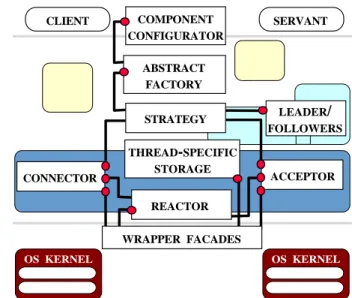
This section uses TAO as a case study to illustrate a pattern language that can help developers of applications and ORBs build, maintain, and extend communication software by re-ducing the coupling between components. Figure 4 shows the patterns in the pattern language that we applied to develop an extensible ORB architecture for TAO. It is beyond the scope of this paper to describe each pattern in detail or to discuss all the patterns used within TAO. Instead, we focus on how key patterns can improve the extensibility and performance of real-time ORB middleware. The references in [9, 15] contain comprehensive descriptions of these patterns and [8] explains how the patterns can be woven together to form a pattern lan-guage.
ACCEPTOR CONNECTOR
ABSTRACT FACTORY
SERVANT CLIENT
OS KERNEL OS KERNEL
LEADER/ FOLLOWERS THREAD-SPECIFIC
STORAGE COMPONENT CONFIGURATOR
REACTOR
WRAPPER FACADES STRATEGY
Figure 4: Applying a Pattern Language to TAO
The intent and usage of the patterns in this language are outlined below:
Wrapper Facade [8]: This pattern encapsulates the func-tions and data provided by existing non-OO APIs within more concise, robust, portable, maintainable, and cohesive OO class interfaces. TAO uses this pattern to avoid tedious, non-portable, and non-typesafe programming of low-level, OS-specific system calls, such as the Socket API or POSIX threads.
Reactor [8]: This pattern structures event-driven applica-tions, particularly servers, that receive requests from multiple clients concurrently but process them iteratively. TAO uses this pattern to notify ORB-specific handlers synchronously when I/O events occur in the OS. The Reactor pattern drives the main event loop in TAO’s ORB Core, which accepts con-nections and receives/sends client requests/responses.
Acceptor-Connector [8]: This pattern decouples connec-tion establishment and service initializaconnec-tion from service pro-cessing in a networked system. TAO uses this pattern in the ORB Core on servers and clients to passively and actively es-tablish GIOP connections that are independent of the underly-ing transport mechanisms.
Leader/Followers [8]: This pattern provides an efficient concurrency model in which multiple threads take turns to share a set of event sources to detect, demultiplex, dispatch and process service requests that occur on the event sources. TAO uses this pattern uses this pattern to facilitate the use of multiple concurrency strategies that can be configured flexibly into its ORB Core at run-time.
Thread-Specific Storage [8]: This pattern allows multiple threads to use a “logically global” access point to retrieve an
object that is local to a thread, without incurring locking over-head for each access to the object. TAO uses this pattern to minimize lock contention and priority inversion for real-time applications.
Strategy [15]: This pattern provides an abstraction for se-lecting one of several candidate algorithms and packaging it into an object. TAO uses this pattern throughout its software architecture to extensibly configure custom ORB strategies for concurrency, communication, scheduling, and demultiplexing.
Abstract Factory [15]: This pattern provides a single com-ponent that builds related objects. TAO uses this pattern to consolidate its dozens of Strategy objects into a manageable number of abstract factories that can be reconfigured en masse into clients and servers conveniently and consistently. TAO components use these factories to access related strategies without specifying their subclass name explicitly.
Component Configurator [8]: This pattern allows an ap-plication to link and unlink its component implementations at run-time without having to modify, recompile or statically re-link the application. It also supports the reconfiguration of components into different processes without having to shut down and re-start running processes. TAO uses this pattern to dynamically interchange abstract factory implementations in order to customize ORB personalities at run-time.
The patterns constituting this pattern language are not lim-ited to ORBs or communication middleware. They have been applied in many other communication application domains, in-cluding telecom call processing and switching, avionics flight control systems, multimedia teleconferencing, and distributed interactive simulations.
3.3
How to Use a Pattern Language to Resolve
ORB Design Challenges
In the following discussion, we outline the forces underlying the key design challenges that arise when developing extensi-ble real-time ORBs. We also describe which pattern(s) in our pattern language resolve these forces and explain how these patterns are used in TAO. In addition, we show how the ab-sence of these patterns in an ORB leaves these forces unre-solved. To illustrate this latter point concretely, we compare TAO with SunSoft IIOP. Since TAO evolved from the SunSoft IIOP release, it provides an ideal baseline to evaluate the im-pact of patterns on the software qualities of ORB middleware.
3.3.1 Encapsulate Low-level System Mechanisms with
the Wrapper Facade Pattern
Context: One role of an ORB is to shield application-specific clients and servants from the details of low-level sys-tems programming. Thus, ORB developers, rather than
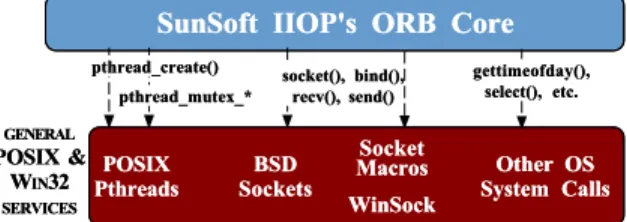
appli-cation developers, are responsible for tedious, low-level net-work programming tasks, such as demultiplexing events, send-ing and receivsend-ing GIOP messages across the network, and spawning threads to execute client requests concurrently. Fig-ure 5 illustrates a common approach used by SunSoft IIOP,
POSIX POSIX Pthreads
Pthreads SocketsSocketsBSDBSD
WinSock WinSock Socket Socket Macros
Macros Other OSOther OS System Calls System Calls
pthread_create() pthread_create()
pthread_mutex_*
pthread_mutex_* socket(), bind(),socket(), bind(),recv(), send()recv(), send()
gettimeofday(), gettimeofday(), select(), etc. select(), etc.
SunSoft IIOP's ORB Core SunSoft IIOP's ORB Core
GENERAL GENERAL POSIX POSIX &&
W WININ3232 SERVICES SERVICES
Figure 5: SunSoft IIOP Operating System Interaction
which is programmed internally using system mechanisms, such as sockets,select, and POSIX threads.
Problem: Developing an ORB is hard. It is even harder if developers must wrestle with low-level system mechanisms written in languages like C, which often yield the following problems:
ORB developers must have intimate knowledge of many
OS platforms: Implementing an ORB using system-level C APIs forces developers to deal with non-portable, tedious, and error-prone OS idiosyncrasies, such as using untyped socket handles to identify transport endpoints. Moreover, these APIs are not portable across OS platforms. For example, Win32 lacks POSIX Pthreads and has subtly different semantics for sockets andselect.
Increased maintenance effort: One way to build an
ORB is to handle portability variations via explicit conditional compilation directives in ORB source code. However, using conditional compilation to address platform-specific variations at all points of use increases the complexity of the source code, as shown in Section 3.5. Extending such ORBs is hard since platform-specific details are scattered throughout the imple-mentation source code files.
Inconsistent programming paradigms: System
mecha-nisms are accessed through C-style function calls, which cause an “impedance mismatch” with the OO programming style supported by C++, the language we use to implement TAO.
How can we avoid accessing low-level system mechanisms when implementing an ORB?
Solution ! the Wrapper Facade pattern: An effective
way to avoid accessing system mechanisms directly is to use the Wrapper Facade pattern [8], which is a variant of the Fa-cade pattern [15]. The intent of the FaFa-cade pattern is to sim-plify the interface for a subsystem. The intent of the Wrapper Facade pattern is more specific: it provides typesafe, modu-lar, and portable OO interfaces that encapsulate lower-level,
stand-alone system mechanisms, such as sockets, select, and POSIX threads. In general, the Wrapper Facade pattern should be applied when existing system-level APIs are non-portable and non-typesafe.
Using the Wrapper Facade pattern in TAO: TAO accesses all system mechanisms via the wrapper facades provided by ACE [28]. Figure 6 illustrates how the ACE C++ wrapper facades improve TAO’s robustness and portability by encap-sulating and enhancing native OS concurrency, communica-tion, memory management, event demultiplexing, and dy-namic linking mechanisms with typesafe OO interfaces. The
TAO's ORB Core TAO's ORB Core
spawn() spawn()
acquire() acquire()
open(), open(), close(), close(), recv(), send() recv(), send()
dlopen() dlopen() dlsym() dlsym()
COMMUNICATION COMMUNICATION
SUBSYSTEM SUBSYSTEM
VIRTUAL VIRTUAL MEMORY MEMORY SUBSYSTEM SUBSYSTEM
GENERAL GENERAL POSIX POSIX &&
WWININ3232 SERVICES SERVICES
PROCESS PROCESS//
THREAD THREAD SUBSYSTEM SUBSYSTEM
THREAD THREAD WRAPPERS WRAPPERS
DYNAMIC LINKING SELECT/
IO COMP SOCKETS/
TLI ACE
WRAPPER FACADES
handle_events()
Figure 6: Using the Wrapper Facade Pattern to Encapsulate Native OS Mechanisms
OO encapsulation provided by ACE alleviates the need for TAO to access weakly-typed system APIs directly. Thus, C++ compilers can detect type system violations at compile-time rather than waiting for the problems to occur at run-time.
The ACE wrapper facades use C++ features to eliminate performance penalties that would otherwise be incurred from its additional type safety and layer of abstraction. For instance, inlining is used to avoid the overhead of calling small meth-ods. Likewise, static methods are used to avoid the overhead of passing a C++thispointer to each invocation.
Although the ACE wrapper facades resolve several common low-level development problems, they are just the first step to-wards developing an extensible ORB. The remaining patterns described in this section build on the encapsulation provided by the ACE wrapper facades to address more challenging ORB design issues.
3.3.2 Demultiplexing ORB Core Events Using the Reac-tor Pattern
Context: An ORB Core is responsible for demultiplexing I/O events from multiple clients and dispatching their asso-ciated event handlers. For instance, a server-side ORB Core listens for new client connections and reads/writes GIOP re-quests/responses from/to connected clients. To ensure re-sponsiveness to multiple clients, an ORB Core uses OS event demultiplexing mechanisms to wait for CONNECTION,
READ, andWRITEevents to occur on multiple socket handles. Common event demultiplexing mechanisms includeselect,
WaitForMultipleObjects, I/O completion ports, and threads.
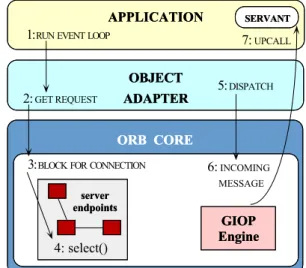
Figure 7 illustrates a typical event demultiplexing se-quence for SunSoft IIOP. In (1), the server enters its event
ORB CORE ORB CORE
1: RUN EVENT LOOP
OBJECT OBJECT ADAPTER ADAPTER APPLICATION APPLICATION
2: GET REQUEST
3: BLOCK FOR CONNECTION 6: INCOMING MESSAGE
5: DISPATCH SERVANT SERVANT
7: UPCALL
GIOP GIOP Engine Engine 4: select()
server server endpoints endpoints
Figure 7: The SunSoft IIOP Event Loop
loop by (2) calling get request on the Object Adapter. Theget request method then (3) calls the static method
block for connection on the server endpoint. This method manages all aspects of server-side connection management, ranging from connection establishment to GIOP protocol handling. The ORB remains blocked (4) onselect
until the occurrence of I/O event, such as a connection event or a request event. When a request event occurs,
block for connectiondemultiplexes that request to a specificserver endpointand (5) dispatches the event to that endpoint. The GIOP Engine in the ORB Core then (6) re-trieves data from the socket and passes it to the Object Adapter, which demultiplexes it, demarshals it, and (7) dispatches the appropriate method upcall to the user-supplied servant.
Problem: One way to develop an ORB Core is to hard-code it to use one event demultiplexing mechanism, such as
select. Relying on just one mechanism is undesirable, how-ever, since no single scheme is efficient on all platforms or for all application requirements. For instance, asynchronous I/O completion ports are highly efficient on Windows NT [37], whereas synchronous threads are an efficient demultiplexing mechanism on Solaris [33].
Another way to develop an ORB Core is to tightly couple its event demultiplexing code with the code that performs GIOP protocol processing. For instance, the event demultiplexing logic of SunSoft IIOP is not a self-contained component. In-stead, it is closely intertwined with subsequent processing of
client request events by the Object Adapter and IDL skele-tons. In this case, however, the demultiplexing code cannot be reused as a blackbox component by other communication mid-dleware applications, such as HTTP servers [37] or video-on-demand servers. Moreover, if new ORB strategies for thread-ing or Object Adapter request schedulthread-ing algorithms are in-troduced, substantial portions of the ORB Core must be re-written.
How then can an ORB implementation decouple itself from a specific event demultiplexing mechanism and decouple its demultiplexing code from its handling code?
Solution!the Reactor pattern: An effective way to
re-duce coupling and increase the extensibility of an ORB Core is to apply the Reactor pattern [8]. This pattern supports synchronous demultiplexing and dispatching of multiple event handlers, which are triggered by events that can arrive concur-rently from multiple sources. The Reactor pattern simplifies event-driven applications by integrating the demultiplexing of events and the dispatching of their corresponding event han-dlers. In general, the Reactor pattern should be applied when applications or components, such as an ORB Core, must han-dle events from multiple clients concurrently, without becom-ing tightly coupled to a sbecom-ingle low-level mechanism, such as
select.
Note that applying the Wrapper Facade pattern is not suffi-cient to resolve the event demultiplexing problems outlined above. A wrapper facade for select may improve ORB Core portability somewhat. However, this pattern alone does not resolve the need to completely decouple the low-level event demultiplexing logic from the higher-level client request processing logic in an ORB Core. Recognizing the limitations of the Wrapper Facade pattern, and then applying the Reactor pattern to overcome the limitations, is one of the benefits of applying a pattern language, rather than just isolated patterns.
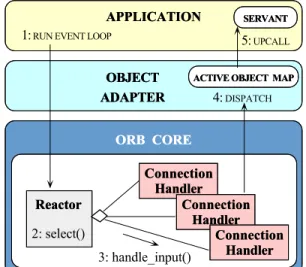
Using the Reactor pattern in TAO: TAO uses the
Re-actor pattern to drive the main event loop in its ORB Core, as shown in Figure 8. A TAO server (1) initi-ates an event loop in the ORB Core’s Reactor, where it (2) remains blocked on select until an I/O event oc-curs. When a GIOP request event occurs, the Reactor
demultiplexes the request to the appropriate event handler, which is the GIOP Connection Handlerthat is associ-ated with each connected socket. TheReactor(3) then calls
Connection Handler::handle input, which (4) dis-patches the request to TAO’s Object Adapter. The Object Adapter demultiplexes the request to the appropriate upcall method on the servant and (5) dispatches the upcall.
The Reactor pattern enhances the extensibility of TAO by decoupling the event handling portions of its ORB Core from the underlying OS event demultiplexing mech-anisms. For example, the WaitForMultipleObjects
ORB CORE ORB CORE
1: RUN EVENT LOOP
OBJECT OBJECT ADAPTER ADAPTER
APPLICATION APPLICATION
3: handle_input()
4: DISPATCH SERVANT SERVANT
5: UPCALL ACTIVE OBJECT MAP ACTIVE OBJECT MAP
2: select() Reactor Reactor
Connection Connection Handler Handler
Connection Connection Handler Handler
Connection Connection Handler Handler
Figure 8: Using the Reactor Pattern in TAO’s Event Loop
event demultiplexing system call can be used on Win-dows NT, whereas select can be used on UNIX plat-forms. Moreover, the Reactor pattern simplifies the con-figuration of new event handlers. For instance, adding a new Secure Connection Handler that performs en-cryption/decryption of all network traffic will not affect the
Reactor’s implementation. Finally, unlike the event demul-tiplexing code in SunSoft IIOP, which is tightly coupled to one use-case, the ACE implementation of the Reactor pattern [8] used by TAO has been applied in many other OO event-driven applications ranging from HTTP servers [37] to real-time avionics infrastructure [11].
3.3.3 Managing Connections in an ORB Using the
Acceptor-Connector Pattern
Context: Managing connections is another key responsi-bility of an ORB Core. For instance, an ORB Core that implements the IIOP protocol must establish TCP connec-tions and initialize the protocol handlers for each IIOP
server endpoint. By localizing connection management logic in the ORB Core, application-specific servants can focus solely on processing client requests, rather than dealing with low-level network programming tasks.
An ORB Core is not limited to running over IIOP and TCP transports, however. For instance, while TCP can transfer GIOP requests reliably, its flow control and congestion control algorithms can preclude its use as a real-time protocol [10]. Likewise, it may be more efficient to use a shared memory transport mechanism when clients and servants are collocated on the same endsystem. Thus, an ORB Core should be flexible enough to support multiple transport mechanisms [16].
Problem: The CORBA architecture explicitly decouples (1) the connection management tasks performed by an ORB Core
from (2) the request processing performed by application-specific servants. However, a common way to implement an ORB’s internal connection management activities is to use low-level network APIs, such as Sockets. Likewise, the ORB’s connection establishment protocol is often tightly cou-pled with its communication protocol.
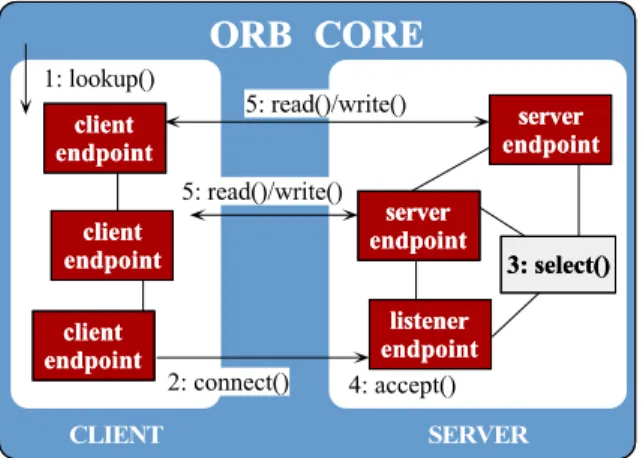
For example, Figure 9 illustrates the connection manage-ment structure of SunSoft IIOP. The client-side of SunSoft
ORB CORE
ORB CORE
1: lookup()
2: connect() 4: accept() 5: read()/write()
5: read()/write() client
client endpoint endpoint client client endpoint endpoint client client endpoint endpoint
server server endpoint endpoint listener listener endpoint endpoint
server server endpoint endpoint
3: select() 3: select()
SERVER CLIENT
Figure 9: Connection Management in SunSoft IIOP
IIOP implements a hard-coded connection caching strategy that uses a linked-list of client endpoint objects. As shown in Figure 9, this list is traversed to find an unused endpoint whenever (1) client endpoint::lookup is called. If no unused client endpoint to the server is in the cache, a new connection (2) is initiated; otherwise an existing connection is reused. Likewise, the server-side uses a linked list ofserver endpointobjects to generate the read/write bitmasks required by the (3) select event de-multiplexing mechanism. This list maintains passive transport endpoints that (4) accept connections and (5) receive requests from clients connected to the server.
The problem with SunSoft IIOP’s design is that it tightly couples (1) the ORB’s connection management implemen-tation with the socket network programming API and (2) the TCP/IP connection establishment protocol with the GIOP communication protocol, thereby yielding the following draw-backs:
Inflexibility: If an ORB’s connection management data
structures and algorithms are too closely intertwined, substan-tial effort is required to modify the ORB Core. For instance, tightly coupling the ORB to use the Socket API makes it hard to change the underlying transport mechanism, e.g., to use shared memory rather than Sockets. Thus, it can be hard to port such a tightly coupled ORB Core to new communication mechanisms, such as ATM, Fibrechannel, or shared memory, or different network programming APIs, such as TLI or Win32 Named Pipes.
Inefficiency: Many internal ORB strategies can be
op-timized by allowing both ORB developers and application de-velopers to select appropriate implementations late in the soft-ware development cycle, e.g., after systematic performance profiling. For example, to reduce lock contention and over-head, a multi-threaded, real-time ORB client may need to store transport endpoints in thread-specific storage [8]. Similarly, the concurrency strategy for a CORBA server might require that each connection run in its own thread to eliminate per-request locking overhead. If connection management mech-anisms are hard-coded and tightly bound with other internal ORB strategies, however, it is hard to accommodate efficient new strategies.
How then can an ORB Core’s connection management com-ponents support multiple transports and allow connection-related behaviors to be (re)configured flexibly late in the de-velopment cycle?
Solution!the Acceptor-Connector pattern: An effective
way to increase the flexibility of ORB Core connection man-agement and initialization is to apply the Acceptor-Connector pattern [8]. This pattern decouples connection initialization from the processing performed after a connection endpoint is initialized. TheAcceptorcomponent in this pattern is re-sponsible for passive initialization, i.e., the server-side of the ORB Core. Conversely, theConnectorcomponent in the pattern is responsible for active initialization, i.e., the client-side of the ORB Core. In general, the Acceptor-Connector pat-tern should be applied when client/server middleware must al-low flexible configuration of network programming APIs and must maintain proper separation of initialization roles.
Using the Acceptor-Connector pattern in TAO: TAO uses the Acceptor-Connector pattern in conjunction with the Reac-tor pattern to handle connection establishment for GIOP/IIOP communication. Within TAO’s client-side ORB Core, a
Connectorinitiates connections to servers in response to an operation invocation or an explicit binding to a remote object. Within TAO’s server-side ORB Core, anAcceptorcreates a GIOP Connection Handlerto service each new client connection. Acceptors and Connection Handlers both derive from an Event Handler, which enable them to be dispatched automatically by aReactor.
TAO’sAcceptorsandConnectorscan be configured with any transport mechanisms, such as Sockets or TLI, pro-vided by the ACE wrapper facades. In addition, TAO’s
Acceptor and Connector can be imbued with custom strategies to select an appropriate concurrency mechanism, as described in Section 3.3.4.
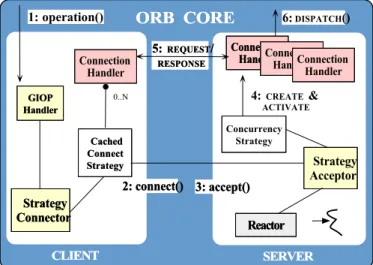
Figure 10 illustrates the use of Acceptor-Connector strate-gies in TAO’s ORB Core. When a client (1) invokes a remote operation, it makes a connect call through a
GIOP GIOP Handler Handler
Strategy Strategy Connector Connector
Cached Cached Connect Connect Strategy Strategy
Connection Connection Handler Handler
Reactor Reactor
ORB
ORB CORE
CORE
SERVER SERVER CLIENT
CLIENT
5:
5: REQUEST REQUEST// RESPONSE RESPONSE
2: connect()
2: connect() 3: accept()3: accept() 0..N
6: DISPATCH()
4: CREATE & ACTIVATE 1: operation()
Connection Handler
Connection HandlerConnectionHandler
Concurrency Strategy
Strategy Acceptor
Figure 10: Using the Acceptor-Connector Pattern in TAO’s Connection Management
(2) consults its connection strategy to obtain a connection. In this example, the client uses a “caching connection strat-egy” that recycles connections to the server and only creates new connections when existing connections are all busy. This caching strategy minimizes connection setup time, thereby re-ducing end-to-end request latency.
In the server-side ORB Core, the Reactor notifies TAO’s Strategy Acceptor to (3) accept newly con-nected clients and create Connection Handlers. The
Strategy Acceptordelegates the choice of concurrency mechanism to one of TAO’s concurrency strategies, e.g., reac-tive, thread-per-connection, or thread-per-priority, described in Section 3.3.4. After a Connection Handleris acti-vated (4) within the ORB Core, it performs the requisite GIOP protocol processing (5) on a connection and ultimately dis-patches (6) the request to the appropriate servant via TAO’s Object Adapter.
3.3.4 Simplifying ORB Concurrency Using the
Leader/Followers Pattern
Context: After the Object Adapter has dispatched a client request to the appropriate servant, the servant executes the re-quest. Execution may occur in the same thread of control as theConnection Handlerthat received it. Conversely, ex-ecution may occur in a different thread, concurrent with other request executions.
The Real-time CORBA specification [38] defines a thread pool API. In addition, the CORBA specification defines an in-terface on the POA for an application to specify that all re-quests be handled by a single thread or be handled using an ORB’s internal multi-threading policy. To meet application
QoS requirements, it is important to develop ORBs that im-plement these various concurrency APIs efficiently [24]. Con-currency allows long-running operations to execute simulta-neously without impeding the progress of other operations. Likewise, preemptive multi-threading is crucial to minimize the dispatch latency of real-time systems [11].
Concurrency is often implemented via the multi-threading capabilities available on OS platforms. For instance, Sun-Soft IIOP supports the two concurrency architectures shown in Figure 11: a single-threaded Reactive architecture and a thread-per-connection architecture. SunSoft IIOP’s
reac-select() select()
2: NOTIFY
ORB CORE
server endpoint
REACTIVE
1: ARRIVAL 3: READ
server endpoint
select()
2: NOTIFY
ORB CORE
server endpoint
1: ARRIVAL 3: READ
server endpoint
THREAD-PER CONNECTION Figure 11: SunSoft IIOP Concurrency Architectures tive concurrency architecture uses select within a sin-gle thread to dispatch each arriving request to an individual
server endpointobject, which subsequently reads the re-quest from the appropriate OS kernel queue. In (1), a rere-quest arrives and is queued by the OS. Then,selectfires, (2) no-tifying the associatedserver endpoint of a waiting re-quest. Theserver endpointfinally (3) reads the request from the queue and processes it.
In contrast, SunSoft IIOP’s thread-per-connection architec-ture executes each server endpoint in its own thread of control, servicing all requests arriving on that connection within its thread. After a connection is established,select
waits for events on the connection’s descriptor. When (1) re-quests are received by the OS, the thread performingselect
(2) reads one from the queue and (3) hands it off to a
server endpointfor processing.
Problem: In many ORBs, the concurrency architecture is programmed directly using the OS platform’s multi-threading API, such as the POSIX threads API [39]. However, there are several drawbacks to this approach:
Non-portable: Threading APIs are highly
are not available on many widely-used OS platforms, includ-ing Win32, VxWorks, and pSoS. Not only is there no direct syntactic mapping between APIs, but there is no clear map-ping of semantics either. For instance, POSIX threads sup-port deferred thread cancellation, whereas Win32 threads do not. Moreover, although Win32 has a thread termination API, the Win32 documentation strongly recommends not using it since it does not release all thread resources after a thread ex-its. Moreover, even POSIX Pthread implementations are non-portable since many UNIX vendors support different drafts of the Pthreads specification.
Hard to program correctly: Portability aside,
program-ming a multi-threaded ORB is hard since application and ORB developers must ensure that access to shared data is serialized properly in the ORB and its servants. In addition, the tech-niques required to robustly terminate servants executing con-currently in multiple threads are complicated, non-portable, and non-intuitive.
Non-extensible: The choice of an ORB concurrency
strategy depends largely on external factors like application requirements and network/endsystem characteristics. For in-stance, reactive single-threading [8] is an appropriate strategy for short duration, compute-bound requests on a uni-processor. If these external factors change, however, an ORB’s design should be extensible enough to handle alternative concurrency strategies, such as thread pool or thread-per-priority [24].
When ORBs are developed using low-level threading APIs, they are hard to extend with new concurrency strategies with-out affecting other ORB components. For example, adding a thread-per-request architecture to SunSoft IIOP would require extensive changes in order to (1) store the request in a thread-specific storage (TSS) variable during protocol processing, (2) pass the key to the TSS variable through the scheduling and demarshaling steps in the Object Adapter, and (3) access the request stored in TSS before dispatching the operation on the servant. Thus, there is no easy way to modify SunSoft IIOP’s concurrency architecture without drastically changing its in-ternal structure.
How then can an ORB support a simple, extensible, and portable concurrency mechanism?
Solution ! the Leader/Followers pattern: An effective
way to increase the portability, correctness, and extensibility of ORB concurrency strategies is to apply the Leader/Follwers pattern [8]. This pattern provides an efficient concurrency model in which multiple threads take turns to share a set of event sources to detect, demultiplex, dispatch and process ser-vice requests that occur on the event sources. In general, the Leader/Followers pattern should be used when an appli-cation needs to minimize context switching, synchronization, and data copying, while still allowing multiple threads to run concurrently.
While Wrapper Facades provide the basis for portability, they are simply a thin syntactic veneer over the low-level na-tive OS APIs. Moreover, a facade’s semantic behavior may still vary across platforms. Therefore, the Leader/Followers pattern defines a higher-level concurrency abstraction that shields TAO from the complexity of low-level thread fa-cades. By raising the level of abstraction for ORB developers, the Leader/Followers pattern makes it easier to define more portable, flexible, and conveniently programmed ORB concur-rency strategies. For example, if the number of threads in the pool is 1, the Leader/Followers pattern behaves just like the Reactor pattern.
Using the Leader/Followers pattern in TAO: TAO uses the Leader/Followers pattern to demultiplex GIOP events to
Connection Handlers handlers within a pool of threads. When using this pattern, an application pre-spawns a fixed number of threads. When these threads invoke TAO’s stan-dardORB::runmethod, one thread will become the leader and wait for a GIOP event. After the leader leader thread de-tects the event, it promotes an arbitrary thread to become the next leader it and then demultiplexes the event to its associated
Connection Handler, which processes the event concur-rently with respect to other threads in the ORB. This sequence of steps is shown in Figure 12.
ORB CORE
LEADER
FOLLOWERS 2: read()
Reactor
1: select() 3: release()
server endpoint DISPATCHER
server endpoint 4: dispatch upcall
POA
Figure 12: Using the Leader/Followers Pattern to Structure TAO’s Concurrency Strategies
As shown in Figure 12, a pool of threads is allocated and a leader thread is chosen toselect(1) on connections for all servants in the server process. When a request arrives, this thread reads (2) it into an internal buffer. If this is a valid request for a servant, a follower thread in the pool is released to become the new leader (3) and the leader thread dispatches the upcall (4). After the upcall is dispatched, the original leader thread becomes a follower and returns to the thread pool. New
requests are queued in socket endpoints until a thread in the pool is available to execute the requests.
3.3.5 Reducing Lock Contention and Priority Inversions with the Thread-Specific Storage Pattern
Context: The Leader/Followers pattern allows applications and components in the ORB to run concurrently. The primary drawback to concurrency, however, is the need to serialize access to shared resources. In an ORB, common shared re-sources include the dynamic memory heap, an ORB pseudo-object reference created by theCORBA::ORB init initial-ization factory, the Active Object Map in a POA [22], and the
Acceptor, Connector, and Reactor components de-scribed earlier. A common way to achieve serialization is to use mutual-exclusion locks on each resource shared by multi-ple threads.
Problem: In theory, multi-threading an ORB can improve performance by executing multiple instruction streams simul-taneously. In addition, multi-threading can simplify inter-nal ORB design by allowing each thread to execute syn-chronously, rather than reactively or asynchronously. In prac-tice, however, multi-threaded ORBs often perform no better, or even worse, than single-threaded ORBs due to (1) the cost of acquiring/releasing locks and (2) priority inversions that arise when high- and low-priority threads contend for the same locks [40]. In addition, multi-threaded ORBs are hard to pro-gram due to complex concurrency control protocols used to avoid race conditions and deadlocks.
Solution!the Thread-Specific Storage pattern: An
ef-fective way to minimize the amount of locking required to serialize access to resources shared within an ORB is to use the Thread-Specific Storage pattern [8]. This pattern allows multiple threads in an ORB to use one logically global access point to retrieve thread-specific data without incurring locking overhead for each access.
In general, the Thread-Specific Storage pattern should be used when the data shared by objects within each thread must be accessed through a globally visible access point that is “log-ically” shared with other threads, but “phys“log-ically” unique for each thread.
Using the Thread-Specific Storage Pattern in TAO: TAO uses the Thread-Specific Storage pattern to minimize lock con-tention and priority inversion for real-time applications. In-ternally, each thread in TAO uses thread-specific storage to store its ORB Core components, e.g.,Reactor,Acceptor, andConnector. When a thread accesses any of these com-ponents, they are retrieved by using a keyas an index into the thread’s internal thread-specific state, as shown in Fig-ure 13. Thus, no additional locking is required to access thread-specific ORB state.
THREAD A
THREAD A THREAD BTHREAD B
1: ACE_OS::thr_getspecific(key)
2: get_state(key) ORB THREAD-SPECIFIC STATE Reactor
Acceptor Connector
Reactor Acceptor
Connector THREAD-SPECIFIC
OBJECT TABLES INDEXED BY KEY
Figure 13: Using the Thread-Specific Storage Pattern in TAO
3.3.6 Support Interchangeable ORB Behaviors with the Strategy Pattern
Context: Extensible ORBs must support multiple request demultiplexing and scheduling strategies in their Object Adapters. Likewise, they must support multiple connection es-tablishment, request transfer, and concurrent request process-ing strategies in their ORB Cores.
Problem: One way to develop an ORB is to provide only static, non-extensible strategies, which are typically config-ured in the following ways:
Preprocessor macros: Some strategies are determined
by the value of preprocessor macros. For example, since threading is not available on all OS platforms, conditional compilation is often used to select a feasible concurrency model.
Command-line options: Other strategies are controlled
by the presence or absence of flags on the command-line. For instance, command-line options can be used to selectively en-able ORB concurrency strategies for platforms that support multi-threading [24].
While these two configuration approaches are widely used, they are inflexible. For instance, preprocessor macros only support compile-time strategy selection, whereas command-line options convey a limited amount of information to an ORB. Moreover, these hard-coded configuration strategies are divorced completely from any code they might affect. Thus, ORB components that want to use these options must (1) know of their existence, (2) understand their range of values, and (3) provide an appropriate implementation for each value. Such restrictions make it hard to develop highly extensible ORBs that are composed from transparently configurable strategies.
How then does an ORB (1) permit replacement of subsets of component strategies in a manner orthogonal and transparent to other ORB components and (2) encapsulate the state and
behavior of each strategy so that changes to one component do not permeate throughout an ORB haphazardly?
Solution!the Strategy pattern: An effective way to
sup-port multiple transparently “pluggable” ORB strategies is to apply the Strategy pattern [15]. This pattern factors out sim-ilarities among algorithmic alternatives and explicitly asso-ciates the name of a strategy with its algorithm and state. Moreover, the Strategy pattern removes lexical dependencies on strategy implementations since applications access special-ized behaviors only through common base class interfaces. In general, the Strategy pattern should be used when an applica-tion’s behavior can be configured via multiple interchangeable strategies.
Using the Strategy Pattern in TAO: TAO uses a variety of strategies to factor out behaviors that are often hard-coded in conventional ORBs. Several of these strategies are illus-trated in Figure 14. For instance, TAO supports multiple
re- Thread-Specific Specific Connect Connect Strategy Strategy Cached Cached Connect Connect Strategy Strategy Reactive Reactive Concurrency Concurrency Strategy Strategy Threaded Threaded Concurrency Concurrency Strategy Strategy SERVANT
SERVANT 11 SERVANT NSERVANT N IDL
IDL SKEL SKEL 22
IDL IDL SKEL N SKEL N
ORB CORE ORB CORE
SERVER SERVER CLIENT CLIENT ... ... ... SERVANTSERVANT N::N:: OPERATIONOPERATION KK SERVANTSERVANT N::N:: OPERATIONOPERATION 11 SERVANTSERVANT 1::1:: OPERATIONOPERATION KK SERVANTSERVANT 1::1:: OPERATIONOPERATION 22 SERVANTSERVANT 1::1:: OPERATIONOPERATION 11
(B) ACTIVE DEMUXING STRATEGY
index(object key) ...
... ... ...
(A) PERFECT HASHING DEMUXING STRATEGY OPERATIONOPERATION KK OPERATIONOPERATION 22 ... ... OPERATIONOPERATION 11 hash(operation)
hash(object key) OBJECTOBJECT
ADAPTER ADAPTER
IDL IDL SKEL SKEL 11
SERVANT SERVANT 22
ORB CORE ORB CORE ORB CORE
ORB CORE
Strategy Strategy Acceptor Acceptor Strategy Strategy Connector Connector
Figure 14: ORB Core and POA Strategies in TAO
quest demultiplexing strategies (e.g., perfect hashing vs. active demultiplexing [36]) and dispatching strategies (i.e., FIFO vs. rate-based) in its Object Adapter, as well as connection man-agement strategies (e.g., process-wide cached connections vs. thread-specific cached connections) and handler concurrency strategies (e.g., Reactive vs. variations of Leader/Followers) in its ORB Core.
3.3.7 Consolidate ORB Strategies Using the Abstract Factory Pattern
Context: There are many potential strategy variants sup-ported by TAO. Table 1 shows a simple example of the strate-gies used to create two configurations of TAO. Configuration 1
Strategy Configuration
Application Concurrency Dispatching Demultiplexing Protocol
Avionics Thread-per Priority Perfect VME
priority -based hashing backplane
Medical Thread-per FIFO Active TCP/IP
Imaging connection demultiplexing
Table 1: Example Applications and their ORB Strategy Con-figurations
is an avionics application with deterministic real-time require-ments [11]. Configuration 2 is an electronic medical imaging application [41] with high throughput requirements. In gen-eral, the forces that must be resolved to compose all ORB strategies correctly are the need to (1) ensure the configura-tion of semantically compatible strategies and (2) simplify the management of a large number of individual strategies.
Problem: An undesirable side-effect of using the Strategy pattern extensively in complex ORB software–as well as other types of software–is that it becomes hard to manage extensi-bility for the following reasons:
Complicated configuration and evolution: ORB source
code can become littered with hard-coded references to strat-egy types, which complicates configuration and evolution. For example, within a particular application domain, such as real-time avionics or medical imaging, many independent strate-gies must act harmoniously. Identifying these stratestrate-gies indi-vidually by name, however, requires tedious replacement of selected strategies in one domain with a potentially different set of strategies in another domain.
Semantic incompatibilities: It is not always possible
for certain ORB strategy configurations to interact compati-bly. For instance, the FIFO strategy for scheduling requests shown in Table 1 may not work with the thread-per-priority concurrency architecture. The problem stems from semantic incompatibilities between scheduling requests in their order of arrival (i.e., FIFO queueing) vs. dispatching requests based on their relative priorities (i.e., preemptive priority-based thread dispatching). Moreover, some strategies are only useful when certain preconditions are met. For instance, the perfect hash-ing demultiplexhash-ing strategy is generally feasible only for sys-tems that statically configure all servants off-line [22].
How can a highly-configurable ORB reduce the complexi-ties required to manage its myriad strategies, as well as enforce semantic consistency when combining discrete strategies?
![Figure 2: Components in the TAO Real-time ORB Endsystem CORBA reference model [14] and Real-time CORBA speci-fication [19], with enhancements designed to ensure efficient, predictable, and scalable QoS behavior for high-performance and real-time applicati](https://thumb-us.123doks.com/thumbv2/123dok_us/8442272.2246702/3.918.469.846.513.785/components-endsystem-reference-enhancements-efficient-predictable-performance-applicati.webp)