Trends in emergency admissions for ambulatory care sensitive
conditions, 2001 to 2013
admissions for ambulatory care sensitive conditions. Focus On reports
provide snapshots and longitudinal analyses of aspects of quality in a
particular area or areas of care.
QualityWatch is a major research programme providing independent
scrutiny into how the quality of health and social care is changing over time.
Developed in partnership by the Nuffield Trust and the Health Foundation,
the programme provides in-depth analysis of key topics and tracks an
extensive range of quality indicators. It aims to provide an independent
picture of the quality of care, and is designed to help those working in health
and social care to identify priority areas for improvement. The programme
is primarily focused on the NHS and social care in England, but will draw on
evidence from other UK and international health systems.
The QualityWatch website
www.qualitywatch.org.uk
presents key
indicators by area of quality and sector of care, together with analysis of the
data. This free online resource also provides research reports, interactive
charts and expert commentary.
© 2013 The Health Foundation and the Nuffield Trust. ISBN 978-1-905030-70-5
List of figures and tables 2
Summary 3
Background 3
Key findings 3
Implications 4
1 Introduction 5
2 Method 8
3 Results: cross-sectional analysis 10
How many emergency admissions were ambulatory care
sensitive in 2012/13? 10
Which conditions caused the most ACS admissions? 11
Do deprived areas have more ACS admissions than
affluent areas? 12
How did rates of ACS admissions vary across England
in 2012/13? 13
How did admission rates for specific conditions vary
across England in 2012/13? 15
4 Results: changes over time 17
Are rates of ACS admissions increasing? 17
Did rates of ACS admission show greater increases in more
deprived areas? 18
Did ACS conditions all show the same trend over time? 19
Where had ACS rates changed the most? 20
Were any changes associated with constrained funding
in public services? 22
5 Discussion 25
Headline findings 25
What might be causing the change in rates? 26
Messages for policy-makers 26
Messages for clinical commissioning groups and providers 27
Figure 3.1a: Rates of emergency ACS admissions by age band and
sex, 2012/13 10
Figure 3.1b: Number of emergency ACS admissions by age band and
sex, 2012/13 10
Figure 3.2: Age and sex adjusted emergency admission rate per 100,000
for each ACS condition by type and cumulative contribution 12
Figure 3.3: Directly standardised admission rates for the five most
common ACS conditions by vigintile of deprivation, 2012/13 13
Figure 3.4: Ratio of observed-to-expected ACS for each area in England
in 2012/13, standardised for age, sex and deprivation 14
Figure 3.5: Area distributions for the ten most common ACS conditions,
2012/13 15
Figure 4.1: Number of emergency admissions 2001–2013, classified as being ACS (defined by the primary diagnosis), ACS (defined by
secondary diagnoses) or non-ACS 17
Figure 4.2: Overall ACS admission rate by vigintile of deprivation,
standardised for age and sex 18
Figure 4.3: Rates of ACS admission over time by ACS type 19
Figure 4.4: Directly standardised rates for the three conditions with the
greatest increases and decreases 20
Figure 4.5: Average annual change in admission ratio (standardised for age, sex and deprivation) between 2001/02 and 2012/13, for all
ACS conditions 21
Figure 4.6: Monthly rates of emergency admission for ACS conditions between April 2008 and January 2013, relative to the introduction of
financial constraints in the NHS 23
Figure 4.7: Monthly directly standardised rate for chronic ACS conditions between April 2008 and March 2013, with trend in the
‘before’ and ‘after’ periods 24
Tables
Summary
Background
One common marker of success for health systems is their ability to control rates of emergency admission, especially for those conditions where preventive management is possible in the community. Specific subsets of these conditions (referred to as ambulatory care sensitive or ACS) are used increasingly as markers of changes, and are now in the NHS Outcomes Framework.
This study examined the pattern of admissions across England for people with ACS conditions over the 12-year period from 2001 to 2013 as an indicator of how well primary and preventive care were working to reduce emergency admissions. The analysis was based on anonymised person-level records extracted from national hospital episode statistics. These records captured episodes of care for all NHS hospitals in England, totalling more than 165 million finished consultant episodes in the period April 2001 to March 2013.
Key findings
• ACS admissions (which are potentially avoidable) make up one in every five emergency admissions. Five conditions account for half of all ACS admissions. Three of these disproportionately affect older people (urinary tract infection/ pyelonephritis, pneumonia and chronic obstructive pulmonary disease (COPD)) and the other two disproportionately affect children and young people
(convulsions and epilepsy, and ear, nose and throat infections).
• The level of deprivation in an area is strongly linked to rates of ACS admission, especially for COPD. Adjusting for deprivation explains a substantial amount of the variation in the rates of ACS admissions between areas. However, there are significant differences between areas, even after adjusting for age, sex and deprivation of the population.
• ACS admissions increased by 48 per cent over the 12 years from 2001 to 2013, more than the increase in other emergency admissions (34 per cent). Less than half of this increase can be explained by population growth and ageing. The magnitude of change varied by type of ACS condition, with admission for acute conditions increasing by 49 per cent, but rates for chronic ACS
conditions falling by 3 per cent.
• There have been some successes in reducing ACS admissions, particularly when initiatives are supported by proven innovations in care (for example, angina and bleeding ulcer). Yet, in other conditions, substantial policy effort has had little or no impact. For example, COPD has been the focus for a range of national and local initiatives since the early 2000s, yet rates of admission have not changed significantly since 2001.
• While most areas showed increased rates of ACS admissions over time, a very small number of areas achieved notable reductions in ACS admissions relative
to average increase in England. The level of variation in rates did not change over time.
• The trends in ACS admissions do not appear to have changed significantly during the past two years – the first years since financial constraints were increased in the NHS in 2010/11.
Implications
The rates of emergency admission for ACS conditions have been growing over time, and represent a substantial proportion of NHS urgent care costs. This trend is already a major concern and is estimated to cost around £1.4 billion a year. However, despite the level of attention paid to the topic, and a number of interventions having been tried to reduce admissions, there is only limited evidence that these have had any effect on rates of emergency admissions. In using ACS conditions as markers of improved health outcomes, policy-makers need to consider the implication of the current trajectories when defining what success means for these indicators, at both national and local levels. Moreover, the fact that ACS rates are strongly related to measures of deprivation needs to be considered when interpreting both cross-sectional variation and change in these indicators.
Although some ACS conditions have shown a fall, there have been increases in other ACS conditions that are a cause for concern: in particular, pneumonia and urinary tract infection (UTI). Often, these are associated with frail older people. The increases are caused most likely by a combination of changes in the way that people respond to health crises, coupled with changes in access to wider alternative care services.
Given the importance of reducing the need for emergency admission, this report suggests three ways that commissioners and providers can respond to reduce rates of ACS admissions:
• Develop a local understanding of the rate and trend of admissions for each ACS condition in their area as markers of local performance. Where admission rates for a particular condition in their area appear atypical (that is, usually higher than expected) compared with similar areas, undertake further local analysis to explore why this is the case.
• Where proven interventions or quality standards exist for a condition, ensure that these are in place across their own area.
• Consider the extent to which broader strategies for reducing the need for emergency admission are being successful. In particular, focus on changes in key patient groups – especially care for frail older patients. The need is not only to prevent hospital admission, but also to prevent the distress and deterioration of the patient that leads to hospital admission.
At a time of financial constraint in the NHS, reducing admissions for ACS conditions represents a huge opportunity to improve both the quality and efficiency of care.
‘emergency admissions for ACS conditions... represent a substantial proportion of NHS urgent care costs’
‘Although some ACS conditions have shown a fall, there have been increases in other ACS conditions that are a cause for concern’
1
Introduction
Emergency hospital admission is distressing for patients and carers, associated with a greater risk of mortality and longer-term morbidity, and expensive to the healthcare system. Increasingly, the level of emergency admissions is being seen as a marker of how well health systems are performing, and there are many initiatives which aspire to reduce the level of admissions (Purdy and others, 2012). Despite this attention, observed rates of emergency admission have been rising for some time in England and other countries (Blunt and others, 2010).
Many emergency admissions are unavoidable: for example, acute appendicitis. Conditions such as these develop unexpectedly, and the patient swiftly becomes seriously ill. However, for many conditions, problems develop over longer
periods, and the risk of a crisis leading to emergency hospital admission can be reduced by timely and effective self-care, primary and community care or outpatient care (Sanderson and Dixon, 2000). A subset of these conditions has been identified as potential indicators of how well those health services are managing care to avoid the problems that require emergency admissions. Collectively, these are referred to as ambulatory care sensitive (ACS) conditions. The implication is that an emergency admission for an ACS condition could indicate suboptimal care (because the individual’s health had deteriorated avoidably to the extent that hospitalisation was necessary). Consequently, the rate of emergency admissions for conditions amenable to ambulatory care is commonly used to measure quality and access in primary care. This technique for quality measurement was developed in the USA in the early 1990s (Billings and others, 1993), and since then has been adapted and applied in a number of studies internationally, including the UK (Agency for Healthcare Research and Quality, 2001; Bindman and others, 2005; Caminal and others, 2004; Purdy and Griffin, 2008). In the NHS, where access to care is not linked to the ability to pay, ACS admission rates are interpreted as measures of quality in primary and community care. However, rates are also influenced to some extent by the quality of other services, such as outpatient clinics and social care, and the integration between them.
Indicators based on ACS conditions feature in the NHS Outcomes Framework in England (Department of Health, 2011): a set of indicators used by government to ensure the delivery of strategic goals for the service. These measures were previously championed by the NHS Institute for Innovation and Improvement as useful tools to target productivity improvements. Currently, analyses of admissions for ACS conditions are being made available by commercial information vendors as a tool to improve local commissioning (Dr Foster Intelligence, 2009). Recent analysis in England suggests that better management of ambulatory care could achieve savings of more than £1.42 billion (Tian and others, 2012), as well as improving health and the
In the NHS there have been many policy initiatives focusing on particular
ACS conditions, including most recently the Quality, Innovation, Productivity and Prevention programme. For certain ACS conditions, higher performance
on the primary care Quality and Outcomes Framework measures specific to those conditions have been shown to be weakly, but significantly, associated with admission rates (standardised for age, sex and deprivation) (Dixon and others, 2011).
While measurement of ACS rates is common in England, and often used to compare rates between areas (Right Care, 2013), to date there has been little work in the UK examining area trends in admissions for ACS conditions over time. A study of national ACS trends in England between 2001 and 2011 (Bardsley and others, 2013) found that the number of admissions had grown by 40 per cent over that period.
Interpreting the differences in ACS admission rates between areas can be complex. Clearly, there are certain characteristics of the population in an area which can lead to higher or lower rates of ACS admission that are beyond the control of local health services. Studies have shown how rates of ACS admission are linked to age, ethnicity, the supply of healthcare and levels of deprivation (Billings and others, 1997; Howard and others, 2007; Purdy and Griffin, 2008; Roos and others, 2005). Any analysis comparing ACS rates between areas or over time needs to adjust for these population factors. However, factors with more subtle effects that cannot be easily adjusted for may remain. The analysis in this report explores how rates of emergency admission for ACS conditions can be used as markers of the quality of preventive care in different parts of the country. It also explores how patterns of ACS admission may be linked with changes in the financial climate.
Since 2008 many countries have been going through a period of major economic weakness. This has the potential to affect avoidable admissions in England in two ways:
• A severe economic downturn is likely to lead to greater ill health meaning there is likely to be an increasing need (Browning and Heinesen, 2012). • The imposition of spending constraints will affect the delivery of health and
social care services.
Preventive services are particularly vulnerable as they may not treat an
immediate need, and could be perceived as less essential. It is also possible that people in some areas will find it more difficult to access primary care if services are scaled back. Both could have a detrimental effect on ambulatory care and increased emergency hospital admissions. However, any changes that coincide with the introduction of financial constraints may be a result of other factors, and need to be understood within the context of broader trends and changes over time.
‘This technique for quality measurement... has been adapted and applied in a number of studies internationally’
This study examines the pattern of emergency admissions across England for people with ACS conditions over 12 years. It aims to answer five basic questions: 1. How many potentially avoidable emergency admissions were there
in 2012/13?
2. To what extent did the rates of these admissions vary between areas? 3. Are rates of ACS admission increasing or decreasing over time? 4. Which rates have changed the most, and where?
5. Were any changes in admission rate associated with constrained funding in the NHS and state-funded social care?
The results are presented in two chapters. Chapter 3 examines the state of ACS admissions in 2012/13, the most recent year of data available. Chapter 4 explores the way that patterns of ACS admissions have changed over time. Additional analysis on many of the issues raised in this report can be found in the online appendix (Blunt, forthcoming).
2
Method
The analysis was based on hospital episode statistics data from April 2001 to March 2013. The hospital episode statistics dataset examined covered all day-case and inpatient admissions in NHS hospitals in England for the 12 years, totalling more than 165 million inpatient care episodes.
The analyses were confined to emergency admissions and patients with valid age and sex fields, resident in England at the time of admission. ACS
hospitalisations were identified by the presence of one of the ACS conditions outlined below in the admission episode’s diagnoses.
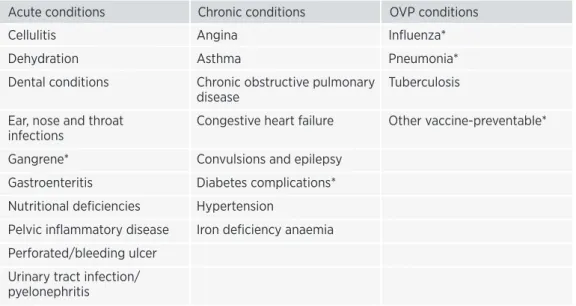
This analysis used the Victoria State Health Department (State Government of Victoria, Australia, 2001) list of ACS conditions, which is the most commonly used list in the NHS (Purdy and others, 2009). In addition, the study included a
condition based on tuberculosis that had been part of the original set by Billings and others (Bardsley and others, 2013). These conditions are listed in Table 2.1, and detailed definitions are provided in the online appendices. Most ACS conditions were classified on the basis of primary diagnosis for most categories, but five conditions were also defined in terms of codes present as secondary diagnoses. The conditions were split into three main groups, as described by Billings (Billings and others, 1993):
• acute – those that can occur as an isolated episode and the patient often returns to full health
• chronic – long-term conditions
• other and vaccine-preventable (OVP) – this includes pneumonia, which is vaccine-preventable in some circumstances, and conditions that can generally be prevented through the use of vaccines.
Table 2.1: List of ACS conditions analysed for module
Acute conditions Chronic conditions OVP conditions Cellulitis Angina Influenza* Dehydration Asthma Pneumonia* Dental conditions Chronic obstructive pulmonary Tuberculosis
disease
Ear, nose and throat Congestive heart failure Other vaccine-preventable* infections
Gangrene* Convulsions and epilepsy Gastroenteritis Diabetes complications* Nutritional deficiencies Hypertension
Pelvic inflammatory disease Iron deficiency anaemia Perforated/bleeding ulcer
Urinary tract infection/ pyelonephritis
Population denominators were drawn from the Office for National Statistics mid-year population estimates of local authority of residence (Office for National Statistics, 2013), and deprivation measured by Indices of Multiple Deprivation 2010 (Department for Communities and Local Government, 2012). The patient’s area of residence at the time of admission was derived from the Lower layer Super Output Area (LSOA) recorded in the hospital episode statistics.
When analysing at the national level, admission rates were directly standardised for age by calculating age-specific admission rates and applying them to the European Standard Population (NHS Public Health Network, 2010). Analyses at the local level were indirectly standardised by age, gender and deprivation vigintile. Trends were calculated using ordinary least squares regression, and correlations were measured using Pearson’s coefficient.
The study used 2010/11 as the year in which recent financial constraints in the NHS were introduced, based on a change from real-terms growth of 4 per cent a year to 0 per cent (Dilnot, 2012).
3
Results: cross-sectional analysis
How many emergency admissions were ambulatory care
sensitive in 2012/13?
In the period between 1 April 2012 and 31 March 2013, English NHS hospitals received nearly 5.3 million emergency admissions. A small number, fewer than 2 per cent of these (80,284), were excluded from the study due to invalid age or gender codes, or were for people resident outside England.
Figure 3.1a: Rates of emergency ACS admissions by age band and sex, 2012/13
R a te o f a d m is s io n s p e r 10 0 ,0 0 0 p o p u la ti o n Age
Male ACS admission rate Female ACS admission rate
20,000 15,000 10,000 5,000 0 0
1–4 5–9 10–1 4 15–1 9 20–2 4 25–2 9 30–3 4 35–3 9 40–4 4 45–4 9 50–5 4 55–5 9 60–6 4 65–6 9 70–7 4 75–7 9 80–8 4 85+
Figure 3.1b: Number of emergency ACS admissions by age band and sex, 2012/13
N u m b e r o f a d m is s io n s Age
Number of male ACS admissions Number of female ACS admissions
120,000 100,000 80,000 60,000 40,000 20,000 0 0
1–4 5–9 10–1 4 15–1 9 20–2 4 25–2 9 30–3 4 35–3 9 40–4 4 45–4 9 50–5 4 55–5 9 60–6 4 65–6 9 70–7 4 75–7 9 80–8 4 85+
Of the remaining admissions, 1,044,407 (20.1%) were recorded as falling within one of the 27 conditions defined as ACS. The mean age of patients admitted as an emergency with an ACS condition was 55 years; 52 per cent were female. The number and rates of potentially avoidable emergency admission differed notably by age and gender (Figures 3.1a and 3.1b).
The differences in rates of emergency admissions between age groups demonstrate the importance of standardising for age when comparing rates between areas. If an area has an unusually high proportion of older people, we would expect its rate of potentially avoidable admissions to be higher. Standardisation is required also when comparing rates of emergency admissions over time, as the population of England continues to get older. The age-standardised rate of admission for ACS conditions in 2012/13 was 1,613 per 100,000 people.
Which conditions caused the most ACS admissions?
There were marked differences in the rates at which emergency ACS admissions occurred, both between the broad categories and between individual
conditions. These differences are demonstrated in Figure 3.2 (see page 12), where each condition is represented by a box proportional in width to its admission rate. Boxes are arranged vertically by descending contribution to the total admission rate for each ACS type. For example, COPD has a relatively wide box because it had a high admission rate, and is placed near the top because it contributed 24 per cent of all chronic ACS admissions. Dehydration has a narrow box due to its much lower admission rate, and is placed near the bottom with a cluster of conditions that, when combined, contributed fewer than 10 per cent of all acute ACS admissions. The top row shows the admission rates for each of the three ACS categories.
In 2012/13, the vast majority (86 per cent) of ACS admissions were caused by acute and chronic conditions rather than the third category of ACS: other and vaccine-preventable conditions. Five individual ACS conditions accounted for more than half of all ACS admissions. These were urinary tract infection (UTI) and pyelonephritis (16 per cent of ACS admissions, 229 admissions per 100,000), COPD (12 per cent, 163 per 100,000), pneumonia (10 per cent, 141 per 100,000), ear, nose and throat (ENT) infections (9 per cent, 207 per 100,000) and
convulsions and epilepsy (7 per cent, 142 per 100,000).
While 27 ACS conditions are specified under the most common definition, it is clear from Figure 3.2 that the majority of these conditions (15) contributed a combined total of fewer than 10 per cent of all ACS admissions. While many of the less common conditions might not seem sufficiently prevalent to be of interest, in some areas they will be of greater concern than others (for example, tuberculosis in London).
It is notable that three out of the five most common conditions disproportionately affect older people. In total, 40 per cent of all emergency admissions were for patients aged 65 and over, and this proportion rose to 50 per cent when considering only the ACS admissions. However, COPD, pneumonia and UTI/pyelonephritis had 75 per cent, 70 per cent and 63 per cent of their admissions for older people, respectively.
‘Five individual ACS conditions accounted for more than half of all ACS admissions’
1,613
age-standardised admission rate per 100,000 people in 2012/13
The other two of the most common conditions disproportionately affect children and young adults (ENT infections, and epilepsy and convulsions). However, when considering all ACS admissions, half were for patients aged 65 and over, whereas just 19 per cent were for the under-20s. This confirms that potentially avoidable emergency admission is an issue that predominantly – but not exclusively – affects older people.
Do deprived areas have more ACS admissions than
affluent areas?
For this analysis, small areas (LSOAs) were grouped into 20 strata (vigintiles). Each vigintile represents a slice of one-twentieth of all LSOA values, and included approximately 2.5 million people. Across all ACS conditions it was observed that rates of ACS admissions for people living in the most deprived vigintile of LSOAs were 3.15 times higher than those in the least deprived. For non-ACS emergency admissions the ratio was 2.35, suggesting that ACS conditions had a stronger relationship with deprivation.
Note: The width of the box is proportional for the condition’s directly standardised rate (DSR), so the box for COPD is large (163 admission per 100,000) while those for nutritional deficiencies (0.4 per 100,000) or influenza as a secondary diagnosis (1.0) are barely visible. The DSR for each condition also appears in brackets after the condition label.
Figure 3.2: Age and sex adjusted emergency admission rate per 100,000 for each ACS condition by type and cumulative contribution
UTI/pyelonephritis (229)
Pneumonia (primary diagnosis) (141)
Pneumonia (secondary diagnosis) (44) COPD (163)
Convulsions and epilepsy (142)
Asthma (122)
Angina (80) Congestive heart failure (63) Diabetes complications (secondary diagnosis) (50)
Diabetes complications (primary diagnosis) (40) Iron deficiency anaemia (17) Hypertension (12)
Other vaccine-preventable (secondary diagnosis) (4.6) Influenza (primary diagnosis) (3.7) Other vaccine-preventable (primary diagnosis) (4.2) Tuberculosis (2.7) Influenza (secondary diagnosis) (1.0) ENT infections (207)
Gastroenteritis (126)
Cellulitis (98)
Dental conditions (21) Dehydration (13) Gangrene (secondary diagnosis) (10) Pelvic inflammatory disease (10) Perforated/bleeding ulcer (6.9) Gangrene (primary diagnosis) (1.8) Nutritional deficiencies (0.4)
C
u
m
u
la
ti
v
e
%
A
S
C
t
y
p
e
D
S
R
100%
50%
10%
Acute
723 per 100,000
Chronic
689 per 100,000
OVP
The reasons for these differences are most likely to be related to a range of factors. Some may be due to underlying health problems: for example, COPD is strongly related to smoking, which is generally higher in the lowest
socioeconomic groups. For other conditions such as UTIs, the link may not be so obvious (Hancox and others, 2004; Hawker and others, 2003).
While the rates in Figure 3.3 were standardised for age, it is worth noting that this might not be completely adequate. Proximity to death is known to be a very important factor driving the use of healthcare (McGrail and others, 2000), and in general, the lower life expectancy in deprived areas means that people from those areas tend to be closer to death than people of a similar age from more affluent areas.
How did rates of ACS admissions vary across England
in 2012/13?
Several studies have shown that rates of admission to a hospital bed vary between areas. Some of this variation will be caused by chance, some by underlying differences in the population between areas, and some by the local Figure 3.3: Directly standardised admission rates for the five most common ACS conditions by vigintile of deprivation, 2012/13
D ir e c tl y s ta n d a rd is e d r a te o f a d m is s io n p e r 10 0 ,0 0 0
Vigintile of deprivation
UTI/pyelonephritis ENT infections COPD Convulsions and epilepsy Pneumonia (primary diagnosis) 500 450 400 350 300 250 200 150 100 50 0 Leas t dep
rived 3r d
5th 7th 9th 11th 13th 15th 17th 19th
‘All of the ACS conditions showed... higher rates of
admission in the more deprived areas’
All of the ACS conditions showed a statistically significant positive association with deprivation, with higher rates of admission in the more deprived areas. In most cases the relationship was linear, with the admission rate increasing by around 6 per cent for each successive deprivation vigintile. However, the study found that the relationship was especially strong in COPD admissions, where the rate in the most deprived areas was nine times higher than that in the least deprived areas. Moreover, it was notable that rates of admission for COPD increased much more quickly between vigintiles in the more deprived half of LSOAs than the least deprived half. Figure 3.3 shows the relationship between deprivation and rates of admission for the five most common ACS conditions.
performance of the local health system (Appleby and others, 2011; Dixon and others, 2011; Wennberg and Gittelsohn, 1973).
ACS conditions are no exception to this pattern. Figure 3.4 shows the pattern by local authority area of the ratio of observed-to-expected admissions (standardised for age, sex and deprivation) in 2012/13. If an area has a ratio of 1, then its admission rates are the same as the national average (allowing for its population). If the ratio is greater than 1, then it has more admissions than would be expected for its population; and if the ratio is less than 1, it has fewer admissions. A map of local authority areas in England is presented on the left; coloured by rate of emergency admission where blue is low and red is high. On the right of the figure is a chart showing the distribution of rates by area, where the rate is the vertical axis and each area at that rate is a dot spreading
horizontally outwards.
There was more than a two-fold variation between the highest and lowest ratios (West Somerset at 0.65, and Stafford at 1.34). If the extreme outliers are
excluded (that is, outside the range between the 10th and 90th percentile), then there is still a 1.4-fold variation across the country. The ACS admission ratios are moderately but significantly correlated with the proportion of people self-reporting their health status (Office for National Statistics, 2012) as ‘bad’ or ‘very bad’1.
1.4
1.3
0.7 1.2
0.8 1.1
0.9 1.0
0.6
In
d
ir
e
c
tl
y
s
ta
n
d
a
rd
is
e
d
a
d
m
is
s
io
n
r
a
ti
o
0–0.8
0.8–1
1–1.2
1.2–1.4
Local authority England mean
± One Standard Deviation
± Two Standard Deviations Figure 3.4: Ratio of observed-to-expected ACS for each area in England in 2012/13, standardised for age, sex and deprivation
Providers and commissioners operating in areas that are outliers (that is, more than two standard deviations above the national average) may be understandably concerned. As mentioned previously, having a fundamentally different pattern of admissions to most other areas could be indicative of the performance of providers and commissioners in the local health economy. However, when looking at a period of time in isolation, there is always the possibility that an area happened to experience a single atypical year and can be expected to return to normal values in forthcoming years (regression to the mean). Trends over time are considered in more detail later in this report, but a brief examination reveals that of the nine outlying areas in 2012/13, only two were also outliers in both of the two previous years (2010/11 and 2011/12).
How did admission rates for specific conditions vary across
England in 2012/13?
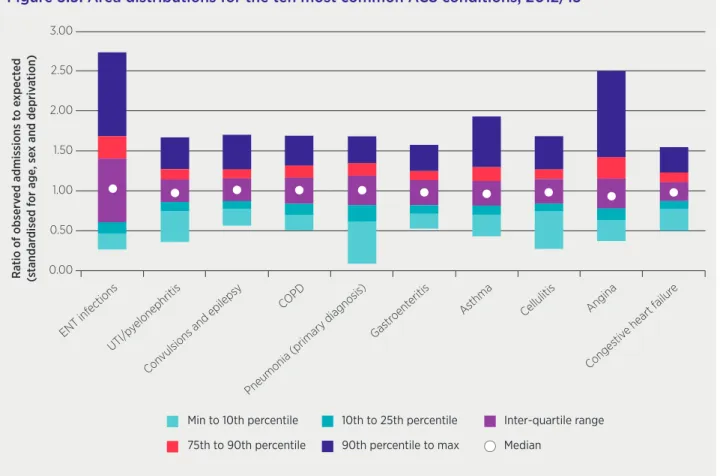
We have seen that overall ACS admission rates varied by area. This study was interested in looking at the degree to which admission rates for individual conditions also varied between areas. Conditions for which there is more variability in rates are more likely to be responsive to changes in the delivery of healthcare. Figure 3.5 describes the distribution of standardised admission ratios at local authority level for the ten most common ACS conditions.
Figure 3.5: Area distributions for the ten most common ACS conditions, 2012/13
R a ti o o f o b s e rv e d a d m is s io n s t o e x p e c te d (s ta n d a rd is e d f o r a g e , s e x a n d d e p ri v a ti o n )
Min to 10th percentile 10th to 25th percentile Inter-quartile range 75th to 90th percentile 90th percentile to max Median
3.00 2.50 2.00 1.50 1.00 0.50 0.00 ENT infe ctio ns UTI /pye lone phrit is Conv ulsi ons and epile psy CO PD Pneu mon
ia (p rim ary diag nosi s) Gas troe nter itis Ast hm a Cellu litis Ang ina Cong estiv
e he art f
ailu re
All conditions displayed much greater variability than would be expected by chance alone. The conditions with the greatest variability were ENT infections, where 80 per cent of areas had admission rates significantly different from the average at 95 per cent confidence, angina (60 per cent of areas) and pneumonia (primary diagnosis, 67 per cent of areas). The least variable condition (congestive heart failure) still had 39 per cent of areas whose ratios were significantly different from the national average.
The variation observed in higher volume conditions was substantial. The
difference between the 90th and 10th percentiles of ENT infections was 3.6-fold, which represents a difference of 211 admissions per 100,000. Among the ten most prevalent ACS conditions in England (Figure 3.5), the difference in admissions between the 90th and 10th percentiles was greater than 100 admissions per 100,000 population in four conditions: ENT infections, UTI/pyelonephritis, COPD and pneumonia.
4
Results: changes over time
Are rates of ACS admissions increasing?
In the period between 1 April 2001 and 31 March 2013, English NHS hospitals received more than 56 million emergency admissions. Fewer than 2 per cent of these (1,029,665) had to be excluded from this study due to invalid age or gender codes, or were for people resident outside England. Of the remaining admissions, 10.4 million (18.7%) were recorded as falling within one of the 27 conditions defined as ACS. The mean age of patients admitted as an emergency with an ACS condition increased over time, from 51.5 years to 55.2. The average age for non-ACS admissions was slightly younger, and only increased from 49.4 to 50.9 years.
Between April 2001 and March 2013, the number of emergency admissions a year for ACS conditions increased by 48 per cent, rising from 704,153 to 1,043,913 – an increase of 339,760 (Figure 4.1). Over the same time period, emergency admissions for non-ACS conditions increased by only 34 per cent, meaning that the proportion of all emergency admissions that were ACS increased from 18 per cent in 2001/02 to 20 per cent in 2012/13.
Further analysis revealed that there was a threefold growth in the four ACS conditions defined by their secondary diagnoses (gangrene, influenza, pneumonia and complications of diabetes), but that this accounted for just one-eighth of the additional growth in ACS over non-ACS admissions (that is, 48 per cent versus 34 per cent). This appears to be part of a general trend for more complete recording of diagnoses and co-morbidities in hospital data
Figure 4.1: Number of emergency admissions, 2001–2013, classified as being ACS (defined by the primary diagnosis), ACS (defined by secondary diagnoses) or non-ACS
N u m b e r o f a d m is s io n s ( m il li o n s) 6.00 5.00 4.00 3.00 2.00 1.00 0.00 2001 /02 2002 /03 2003 /04 2004 /05 2005 /06 2006 /07 2007 /08 2008 /09 2009 /10 2010 /11 2011/ 12 2012 /13
Non-ACS ACS (primary diagnosis) ACS (secondary diagnosis)
339,760
increase in emergency admissions for ACS conditions between 2001 and 2013during this period (Robinson, 2007). ACS emergency admissions defined by primary diagnosis alone increased by 42 per cent between 2001/02 and 2012/13. While the increase in numbers of emergency admissions for ACS conditions was large, the population of England grew and aged over that period. When comparing admissions over time, it is important to consider the age-standardised rate of admission to adjust for changes in the population. Between 2001/02 and 2012/13, the rate of ACS admissions rose from 1,278 per 100,000 to 1,614, an increase of 26 per cent. This means population growth and ageing explain less than half of the increase in rates of potentially avoidable emergency admissions. The age-standardised rate of admission for non-ACS conditions grew by 19 per cent over the same period.
Did rates of ACS admission show greater increases in more
deprived areas?
It is important to consider whether the increase in ACS admissions in England was evenly distributed across levels of deprivation. Previously we saw large differences in ACS rates between deprivation vigintiles. Figure 4.2 shows the directly standardised rate of emergency ACS admissions per 100,000 population for each year between 2001/02 and 2012/13 for selected vigintiles of deprivation, and the overall England rate.
The differences in rate observed in 2012/13 were present in every preceding year (back to 2001/02). The rate of admission increased significantly in all vigintiles between 2001/02 and 2012/13. The rate in the most deprived vigintile increased from 2,362 admissions per 100,000 to 2,963, while that for the least deprived vigintile increased from 758 to 940.
Rates of admission for people living in deprived areas increased more than those living in less deprived areas (336 extra admissions per 100,000 in the most deprived vigintile, compared with 181 in the least deprived). Yet the percentage
D ir e c tl y s ta n d a rd is e d a d m is s io n r a te p e r 10 0 ,0 0 0 Least deprived 5th vigintile 10th vigintile 15th vigintile 18th vigintile 19th vigintile Most deprived England 3,500 3,000 2,500 2,000 1,500 1,000 500 0 2001 /02 2002 /03 2003 /04 2004 /05 2005 /06 2006 /07 2007 /08 2008 /09 2009 /10 2010 /11 2011/ 12 2012 /13
Figure 4.2: Overall ACS admission rate by vigintile of deprivation, standardised for age and sex
increase was similar (21 per cent compared with 24 per cent), and the relative difference between the most and least deprived remained almost constant over the period (average 3.2-fold difference, standard deviation 0.08).
Did ACS conditions all show the same trend over time?
When ACS admissions were categorised as acute, chronic or other and
vaccine-preventable, it was evident these categories changed at different rates. Figure 4.3 shows the annual England rate of admission per 100,000
(standardised for age) in each category.
The rate of emergency admissions for acute ACS conditions increased by 49 per cent, from 486 admissions per 100,000 population in 2001/02 to 723 in 2012/13. The increase in the other and vaccine-preventable category of admissions was even greater (147 per cent), but from a much lower base (81 in 2001/02, 201 in 2012/13). Rates of admission for chronic ACS conditions remained relatively stable over time (710 in 2001/02, 689 in 2012/13, a decrease of 3 per cent). Individual conditions also exhibited differing behaviours over time. Based on a linear trend fitted to annual rates (standardised for age), 15 conditions had increased significantly1, while five significantly decreased. The directly
standardised rates (DSRs) for the three conditions with the greatest increases and decreases (in terms of absolute rate of admission) are shown in Figure 4.4 (see page 20). The group of conditions for which rates had not changed significantly included the high incidence of conditions such as asthma, COPD, and convulsions and epilepsy.
Rates of emergency admission for angina had nearly halved since 2001/02, and admissions for congestive heart failure were down by one quarter. However, the net saving of 96 admissions per 100,000 a year was swamped by the increase in Figure 4.3: Rates of ACS admission over time by ACS type
D ir e c tl y s ta n d a rd is e d r a te o f a d m is s io n p e r 10 0 ,0 0 0 p o p u la ti o n 800 700 600 500 400 300 200 100 0 2001 /02 2002 /03 2003 /04 2004 /05 2005 /06 2006 /07 2007 /08 2008 /09 2009 /10 2010 /11 2011/ 12 2012 /13
Acute Chronic Other and vaccine-preventable 2001 /02 2002 /03 2003 /04 2004 /05 2005 /06 2006 /07 2007 /08 2008 /09 2009 /10 2010 /11 2011/ 12 2012 /13 2001 /02 2002 /03 2003 /04 2004 /05 2005 /06 2006 /07 2007 /08 2008 /09 2009 /10 2010 /11 2011/ 12 2012 /13
UTI/pyelonephritis alone (an extra 127 annual admissions per 100,000 since 2001/02). While changes in rates of admission for asthma were not statistically significant, the volume of admissions was so large that it was among the three largest decreases in rate.
Generally, patterns of change over time in individual conditions were similar across all deprivation levels. However, it is notable that age-standardised rates of pneumonia (primary diagnosis) increased by 98 per cent between 2001/02 and 2012/13 for the least deprived people, but increased by 150 per cent for the most deprived. Also, asthma fell by 3 per cent in the least deprived areas, but did not change in the most deprived.
Where had ACS rates changed the most?
While comparisons between two points in time are a useful way of assessing change nationally, when this technique is repeated across a large number of areas it runs the risk of focusing on areas that are atypical in their baseline year. Generally these will return to more representative levels in subsequent years (a phenomenon known as ‘regression to the mean’), meaning that the trend is not accurately captured.
Instead, this study chose to assess the pattern of change over each year between 2001/02 and 2011/13, using a simple linear regression where the trend in each area is expressed in terms of a constant figure plus an annual rate of change. A simple statistical test (Petrie and Sabin, 2009) can show if the rate of change is significantly different from zero: this allows us to distinguish genuine trends from random year-on-year change. The results in terms of the change in admission ratio (standardised at 2001/02 rates) each year are presented in Figure 4.5. The increase in admission ratio was statistically significant (95 per cent confidence interval (CI)) in 312 areas out of 324, while only a single area (Nottingham) decreased its ratio significantly.
Figure 4.4: Directly standardised rates for the three conditions with the greatest increases and decreases D ir e c tl y s ta n d a rd is e d r a te p e r 10 0 ,0 0 0 300 250 200 150 100 50 0 2001 /02 2002 /03 2003 /04 2004 /05 2005 /06 2006 /07 2007 /08 2008 /09 2009 /10 2010 /11 2011/ 12 2012 /13 Incr ease s Dec reas es 2001 /02 2002 /03 2003 /04 2004 /05 2005 /06 2006 /07 2007 /08 2008 /09 2009 /10 2010 /11 2011/ 12 2012 /13 UTI/pyelonephritis Pneumonia (primary diagnosis) Gastroenteritis
Asthma Congestive heart failure Angina
The national trend was a 0.03 increase in standardised admission ratio a year. Fifty-five areas had trends that significantly exceeded the national increase (at 95 per cent CI), although 75 areas had trends that were significantly less than the national increase.
The areas with the greatest increases were Tameside (Greater Manchester), Tandridge (Surrey), and Reigate and Banstead (Surrey), with average annual increases in standardised admission ratio of 0.09, 0.08 and 0.08, respectively. All three areas increased from ratios well below the national average (0.58, 0.74 and 0.84) in 2001/02, but by 2012/13 far exceeded the average (1.66, 1.54 and 1.60, against the England figure of 1.32).
Areas with the greatest decreases started above England’s admission ratio, but remained broadly constant rather than declined. Average annual changes were very slight decreases in standardised admission ratio of only 0.02 (North
Lincolnshire), 0.01 (Richmondshire district, Yorkshire) and 0.01 (Nottingham). By 2012/13, the ratios in these areas had fallen below the England value for that year, although none fell below England’s 2001/02 levels (despite occasionally achieving this in the intermediate years).
Despite absolute admission rates having increased markedly, the variation in admission ratios of ACS conditions between all local authorities changed little over time, with a consistent 1.43-fold difference between the 90th and 10th percentiles.
0.09
0.05 0.06 0.07 0.08
-0.01 0.04
0 0.03
0.01 0.02
-0.02
Local authority England mean ± One Standard Deviation
± Two Standard Deviations
A
v
e
ra
g
e
a
n
n
u
a
l
c
h
a
n
g
e
i
n
s
ta
n
d
a
rd
is
e
d
a
d
m
is
s
io
n
r
a
ti
o
-0.03–0 0–0.03 0.03–0.06 0.06–0.09
Figure 4.5: Average annual change in admission ratio (standardised for age, sex and deprivation) between 2001/02 and 2012/13, for all ACS conditions
Emergency admissions for all causes were increasing for some time. The
similarity in the rate of increase to that of ACS admissions makes it worth asking if changes in ACS admission rates are just a part of a wider trend for increasing emergency admissions. This argument is particularly significant, as it
could indicate whether health services should focus their efforts to reduce ACS admissions on condition-specific prevention or generic hospital avoidance schemes.
In a single year (2012/13) there was a statistically significant correlation between the admission ratio for ACS conditions and non-ACS conditions within areas1. This suggests that when standardising for these factors, 44 per cent of the variation in ACS admission ratios is explained by the variation in non-ACS admissions. This means that the underlying admission rate does have a big influence on rate of ACS admissions, but that clearly there are other factors also driving ACS admissions.
In order to establish whether they are really part of the same trend, the study examined the way in which the rate of ACS and non-ACS admissions changed over time, between 2001 and 2013. When the correlation between area trends derived from the linear regression were tested, it was found that relationships over time were slightly less strong than the cross-sectional ones, but still
statistically significant2. The trends in each category of ACS admission ratios also were significantly associated with trends in non-ACS admissions, but the
association was weak in the case of OVP ACS admissions3.
Were any changes associated with constrained funding in
public services?
Since 2008, many countries have been going through a period of major financial constraint. This could affect potentially avoidable admissions in England in two ways: economic hardship may lead to an increased need for care (Browning and Heinesen, 2012) and the imposition of significant spending constraints in the NHS and social care will affect the performance of health services.
Although we recognise that the relationship between cost and quality is complex, and constraints in funding needn’t inevitably lead to reductions in quality, recent NHS history has shown a number of cases where significant service failure has been accompanied by organisations focusing on the achievement of financial or managerial goals or targets which came at the expense of maintaining quality of patient care (Mid Staffordshire NHS Foundation Trust Inquiry, 2013).
As these events are relatively recent, this study changed its analysis from annual data to monthly data. This allowed for assessment of any changes in ACS admissions in greater detail. The analysis looked at changes around the critical period of 2010/11, when the NHS moved from regular growth in funding to flat real growth. Figure 4.6 shows actual monthly rates (DSRs) for potential
avoidable admissions between April 2008 and January 2013. The figure has been divided into ‘before’, ‘change’ and ‘after’ periods.
1. Both standardised for age, sex and deprivation; r = 0.66, p<0.000. 2. r = 0.61, p<0.000.
Figure 4.6 exhibits the typical annual pattern of fluctuations with winter peaks, which can make it difficult to interpret in the context of change between April 2010 and March 2011. Fitting linear regressions to rates in the ‘before’ and ‘after’ period provides clearer evidence of trends. From April 2008 to March 2010, the DSR increased at an average of 0.6 admissions per 100,000 per month (95 per cent CI ±0.6). Between April 2011 and March 2013, the DSR was increasing at a rate of 0.7 admissions per 100,000 per month (95 per cent CI ±0.5). This means that the rate at which admissions for ACS conditions increased was slightly lower before constraints in funding were introduced, but the difference was not statistically significant.
Looking at individual conditions, there were large changes in the rates of OVP ACS admissions, which increased by 25 per cent over the ‘before’ baseline. Acute ACS conditions also rose, but by much less (6 per cent). However, due to the prevalence of acute ACS conditions, these increases represent a similar absolute number of extra admissions. The trend in each type was similar in the ‘before’ and ‘after’ periods.
Chronic ACS conditions exhibit a more complex pattern. While the average monthly DSR was lower after the introduction of the recent financial constraints than it was before, trend analysis shows rates of admission growing more strongly than in the ‘before’ period. This picture becomes clearer when examining the monthly data (Figure 4.7, see page 24). In the ‘before’ period, large differences in rates between the winter and summer months produced a trend that was almost flat – despite the annual DSR falling from 719 per 100,000 to 692 between 2008/09 and 2009/10. Annual admission rates continued to decrease in 2010/11 and 2011/12. However, monthly DSRs began a small but steady increase near the start of the ‘after’ period (August 2011/12), which continued into March 2013. When combined with less seasonal variation than previous years, this produced a much stronger growth trend in the ‘after’ period Figure 4.6: Monthly rates of emergency admission for ACS conditions between April 2008 and January 2013, relative to the introduction of financial constraints in the NHS
D ir e c tl y s ta n d a rd is e d r a te o f a d m is s io n p e r 10 0 ,0 0 0 f o r a ll A C S c o n d it io n s 180 160 140 120 100 80 60 40 20 0 Apr 200 8 Jul 2
008 Oct 200 8 Jan 2009 Apr 200 9
Jul 2 009 Oct 200 9 Jan 2010 Apr 201 0
Jul 2 010 Oct 201 0 Jan 2011 Apr 201 1
Jul 2 011 Oct 201 1 Jan 2012 Apr 201 2
Jul 2 012 Oct 201 2 Jan 2013
Figure 4.7: Monthly directly standardised rates for chronic ACS conditions between April 2008 and March 2013, with trend in the ‘before’ and ‘after’ periods
M o n th ly d ir e c tl y s ta n d a rd is e d r a te o f a d m is s io n p e r 10 0 ,0 0 0 80 70 60 50 40 30 20 10 0 Apr 200 8 Jul 2
008 Oct 200 8 Jan 2009 Apr 200 9
Jul 2 009 Oct 200 9 Jan 2010 Apr 201 0
Jul 2 010 Oct 201 0 Jan 2011 Apr 201 1
Jul 2 011 Oct 201 1 Jan 2012 Apr 201 2
Jul 2 012 Oct 201 2 Jan 2013
5
Discussion
Headline findings
This analysis explored patterns of potentially avoidable admissions in England over a period of 12 years, using ACS conditions. Approximately 20 per cent of all emergency admissions in 2012/13 were ACS, and thus potentially avoidable. This study’s definition of ACS conditions included 27 conditions, but five accounted for more than half of all ACS admissions; of these, three disproportionately affect older people (COPD, pneumonia and UTI/pyelonephritis) and two disproportionately affect children and younger people (convulsions and epilepsy, and ENT infections).
Reducing the levels of emergency admissions is a common goal in health
systems. While there have been many initiatives since the beginning of the 2000s within the NHS to reduce avoidable hospital admissions, the number of ACS avoidable admissions rose by 48 per cent between 2001/02 and 2012/13. After adjusting for the effects of changes in the age of the population, the rate of growth was lower but still 26 per cent, which was higher than the rate of increase for emergency admissions for all other (that is, non-ACS) conditions (19 per cent). High rates of emergency admissions for ACS conditions were concentrated in some population groups more than others: for example, they were higher in older people (aged 65 and over), children under five and socioeconomically deprived groups. These groups tend to be the most vulnerable and more dependent on care services.
However, this study found substantial variation in the rate of emergency admission between areas, even after adjusting for age, sex and deprivation. Although rates of ACS admission were highest in deprived areas, their proportionate growth was similar across all levels of deprivation (although the absolute increases in more deprived areas were greater).
In dividing ACS conditions into three groups – acute, chronic and OVP – the study found different trends in emergency admissions. There was a lower rate of increase in the chronic group compared with the other two groups. The rate of admissions for acute ACS conditions grew by 49 per cent, and for OVP
conditions it more than doubled; yet the rate of admissions for chronic ACS conditions actually fell by 3 per cent. Rates also varied by condition within each of the three groups. However, the number of additional admissions from
conditions for which rates increased far outweighed the number for which rates decreased.
Over the 12 years examined in this study, the level of variation in emergency admission rates between local authority areas did not change significantly. This implies that the various measures put in place to narrow health inequalities have had little effect on ACS admissions.
‘Approximately 20 per cent of all emergency admissions in 2012/13 were... potentially avoidable’
‘This study found substantial variation in the rate of
emergency admission between areas, even after adjusting for age, sex and deprivation’
No immediate impact was found of the constraints in NHS and social care funding since 2010/11. While rates of emergency admission for ACS conditions had increased after 2010/11, this was broadly in line with the established trend before this period. There was some evidence that admission rates for chronic ACS conditions may be increasing at a greater rate.
What might be causing the change in rates?
Decades of analysis looking at why admission rates vary between areas suggest three groups of factors:
• individual-level factors – such as ageing and levels of need • area-based factors – such as socioeconomic deprivation
• health service factors – such as the available supply of healthcare.
Although there has been much recent debate about the causes of rising levels of emergency admissions, there are no simple, generally accepted explanations as to why this might be the case. It may be that the increases seen in ACS admissions are just following the overall patterns for emergency admissions and are driven by similar factors, as suggested by the fact that at the national level the emergency rates of admission for ACS and non-ACS conditions are rising at a comparable rate.
However, when looking at patterns for specific conditions, this study found that not all are increasing, and that there were clear differences in trends between specific ACS conditions: for example, UTI/pyelonephritis, where the upward growth was fastest. This merits much further attention locally, as these are clinical conditions for which clear diagnosis can be difficult in older people, yet an emergency admission is preventable.
The admission rates for some other ACS conditions actually declined. This could be due to changes in the underlying prevalence of disease and the introduction of new treatments. For example, reductions in the prevalence of ischaemic heart disease (due to lower rates of smoking and increased prescribing of statins) have coincided with falls in the admission rate for angina and congestive heart failure. The significant reduction in admissions for perforated or bleeding ulcers may be due to the use of antibacterial therapy and proton pump inhibitors in the
preceding 20 years (Bardsley and others, 2013).
Messages for policy-makers
ACS conditions account for approximately one-fifth of all emergency admissions. Their treatment represents a substantial proportion of NHS urgent care costs, and the rate of emergency admission for these conditions is growing steadily. Despite the level of attention paid to the topic, and a number of interventions having been tried to reduce admissions, there is only limited evidence of this having any effect on hospital use (Purdy and others, 2012).
In using emergency admissions for ACS conditions as a marker of the quality of healthcare, the Department of Health needs to be mindful of the upward, underlying trend in the national rates over time. Moreover, the interaction between patterns of ACS admission and socioeconomic deprivation needs to be considered when interpreting both differences between areas and change in these indicators over time.
National emergency admission rates for some ACS conditions actually declined, or are growing more slowly (which may be related to improvements in treatment or public health measures). However, this has not been seen in all areas and it will be important to assess whether more could be done in areas where the decline has been most modest or non-existent.
For other conditions, there has been much national effort to improve care, but with little or no apparent impact on emergency admissions. For example, COPD has been the focus for a range of national and local initiatives since the early 2000s, yet rates of admission have not changed significantly since 2001. It could be argued that keeping the rise lower than that seen at the national level for overall emergency admission is a success of sorts, but it is clear that this falls some way short of the ambition of initiatives to improve the quality of care. It is here that policy efforts could focus the most.
Some areas have reduced their rates of ACS admission relative to the national average, albeit more by admission rates remaining constant rather than any absolute reduction. They may have specific approaches to managing conditions, or more generic local initiatives, that other areas could study and adopt.
Identifying impactful interventions through good evaluation will be increasingly important, as there are continued budget constraints across the NHS and local authorities.
Rates of ACS admission rose over the period under study, and the rate of increase was similar before the period of severe budget constraints (2010/11) as after. However, small comfort can be drawn from this, as the impact of the resource constraints is very likely to be subject to a time lag. Indeed, it would be surprising if the first years of a real terms freeze in NHS funding resulted in dramatic change. However, it is likely that the NHS and local authorities will be forced to make continued efficiency savings for many years to come (Roberts and others, 2012). The key to avoiding ACS hospital admissions is preventive care delivered in the community, whether through improved technology or service design. Reductions in the availability of this care are likely to increase the use of Accident and Emergency departments, and consequently drive up rates of potentially avoidable admission. For these reasons it is important that rates of ACS
admission are monitored continuously as part of the NHS Outcomes Framework, and used to hold commissioners to account. The Outcomes Framework splits the ACS conditions into two groups (indicators 2.3i and 3a, broadly chronic and acute ACS conditions), which is consistent with the two prevailing trends observed in this study.
Messages for clinical commissioning groups and providers
A composite of these measures will also dictate 25 per cent of the national component of each clinical commissioning group’s ‘quality premium’: a portion of the budget withheld from clinical commissioning groups by NHS England, and granted on condition that performance in specified areas is achieved.
However, while commissioners will have their performance assessed on the aggregate measure, providers should note the differences between the conditions explored in this report, and ensure that their interventions are informed by, and tailored to, the underlying factors of each condition. ‘The rate of
increase was similar before the period of severe budget
There are three ways that providers and commissioners can respond to reduce rates of ACS admissions:
• Develop a local understanding of the rate and trend of admissions for each ACS condition in their area as markers of local performance. Where admission rates for a particular condition in their area appear atypical (that is, usually higher than expected) when compared with similar areas, undertake further local analysis to explore why this is the case. This report has shown that factors such as age, sex and deprivation make a sizeable contribution to the variation in rates between areas. However, substantial variation still exists even after standardising for these factors, and the reasons for this must be explored.
• Where proven interventions or quality standards exist for a condition, ensure that these are in place across their own area.
• Consider the extent to which broader strategies for reducing the need for emergency admission are being successful. In particular, focus on changes in key patient groups, especially care for frail older patients. The need is not only to prevent hospital admission, but also to prevent the distress and
deterioration of the patient that leads to hospital admission.
At a time of financial constraint in the NHS, reducing admissions for ACS conditions represents a huge opportunity to improve both the quality and efficiency of care.
References
Agency for Healthcare Research and Quality (2001) Guide to Prevention Quality Indicators: Hospital admission for ambulatory care sensitive conditions. www.qualityindicators.ahrq.gov . Accessed 30 August 2013.
Appleby J, Raleigh V, Frosini F, Bevan G, Gao H and Lyscom T (2011) Variations in Health Care: The good, the bad and the inexplicable. The King’s Fund.
Bardsley M, Blunt I, Davies S and Dixon J (2013) ‘Is secondary preventive care improving? Observational study of 10-year trends in emergency admissions for conditions amenable to ambulatory care’, British Medical Journal Open2;3(1) DOI: 10.1136/bmjopen-2012-002007. Billings J, Anderson GM and Newman LS (1997) ‘Race, poverty, and ACS admissions: the authors respond’, Health Affairs16(1), 225–5a.
Billings J, Zeitel L, Lukomnik J, Carey TS, Blank AE and Newman L (1993) ‘Datawatch: impact of socioeconomic status on hospital use in New York City’, Health Affairs12(1), 162–73.
Bindman AB, Chattopadhyay A, Osmond DH, Huen W and Bacchetti P (2005) ‘The impact of Medicaid managed care on hospitalizations for ambulatory care sensitive conditions’, Health Services Research40(1), 19–38.
Blunt I (forthcoming) Focus on Preventable Admissions: Trends in emergency admission for abulatory care sentitive conditions, 2001 to 2013. Appendix. Nuffield Trust/The Health Foundation. Blunt I, Bardsley M and Dixon J (2010) Trends in Emergency Admissions in England 2004–2009: Is greater efficiency breeding inefficiency?Nuffield Trust.
Browning M and Heinesen E (2012) ‘Effect of job loss due to plant closure on mortality and hospitalization’, Journal of Health Economics31(4), 599–616.
Caminal J, Starfield B, Sánchez E, Casanova C and Morales M (2004) ‘The role of primary care in preventing ambulatory care sensitive conditions’, European Journal of Public Health14(3), 246–51. Department for Communities and Local Government (2012) Indices of Multiple Deprivation 2010. Department of Health (2011) NHS Outcomes Framework 2012 to 2013.
www.dh.gov.uk/en/Publicationsandstatistics/Publications/PublicationsPolicyAndGuidance/ DH_131700 . Accessed 30 August 2013.
Dilnot A (2012) ‘Letter to Andy Burnham MP’, 4 December.
www.statisticsauthority.gov.uk/reports—-correspondence/correspondence/letter-from-andrew-dilnot-to-rt—hon—andy-burnham-mp-04122012.pdf .
Dixon A, Khachatryan A, Wallace A, Peckham S, Boyce T and Gillam S (2011) The Quality and Outcomes Framework (QOF): Does it reduce health inequalities?, National Institute for Health Research. www.netscc.ac.uk/hsdr/files/project/SDO_FR_08-1716-207_V01.pdf . Accessed 30 August 2013.
Dr Foster Intelligence (2009) ‘Commissioning to reduce inequalities’.
www.drfosterhealth.co.uk/features/commissioning-to-reduce-inequalities/methodology.aspx . Accessed 30 August 2013.
Hancox RJ, Milne BJ, Taylor DR, Greene JM, Cowan JO, Flannery EM, Herbison GP, McLachlan CR, Poulton R and Sears MR (2004) ‘Relationship between socioeconomic status and asthma: a longitudinal cohort study’, Thorax59(5), 376–80.
Hawker JI, Olowokure B, Sufi F, Weinberg J, Gill N and Wilson RC (2003) ‘Social deprivation and hospital admission for respiratory infection: an ecological study’, Respiratory Medicine97(11), 1219–24.
Howard DL, Hakeem FB, Njue C, Carey T and Jallah Y (2007) ‘Racially disproportionate admission rates for ambulatory care sensitive conditions in North Carolina’, Public Health Report122(3), 362–72.
McGrail K, Green B, Barer ML, Evans RG, Hertzman C and Normand C (2000) ‘Age, costs of acute and long-term care and proximity to death: evidence for 1987–88 and 1994–95 in British Columbia’,
Age and Ageing29(3), 249–53.
Mid Staffordshire NHS Foundation Trust Inquiry (2013) Report of the Mid Staffordshire NHS Foundation Trust public inquiry. www.midstaffspublicinquiry.com/report . Accessed 30 August 2013. NHS Public Health Network (2010) ‘Directly age standardised rates’.
www.avon.nhs.uk/phnet/Methods/directly_age_standardised_rates.htm . Accessed 30 August 2013. Office for National Statistics (2012) 2011 Census.
Office for National Statistics (2013) ‘Mid-year population estimates’.
www.ons.gov.uk/ons/search/index.html?newquery=1.%09Mid-year+population+estimates+ . Accessed 30 August 2013.
Petrie A and Sabin C (2009) Medical Statistics at a Glance(3rd edn). Blackwell Publishing.
Purdy S and Griffin T (2008) ‘Reducing hospital admissions’, British Medical Journal336(7634), 4–5. Purdy S, Griffin T, Salisbury C and Sharp D (2009) ‘Ambulatory care sensitive conditions:
terminology and disease coding need to be more specific to aid policy makers and clinicians’,
Public Health123(2), 169–73.
Purdy S, Paranjothy S, Huntley A, Thomas R, Mann M, Huws D, Brindle P and Elwyn G (2012)
Interventions to Reduce Unplanned Hospital Admission: A series of systematic reviews. Bristol University.
Right Care (2013) ‘NHS atlas of variation in healthcare series’. www.rightcare.nhs.uk/index.php/ nhs-atlas/ . Accessed 30 August 2013.
Roberts A, Marshall L and Charlesworth A (2012) A Decade of Austerity? The funding pressures facing the NHS from 2010/11 to 2021/22. Nuffield Trust.
Robinson P (2007) ‘Data briefing: cash incentives improve coding’, Health Service Journal26 July, 21. Roos L, Walld R, Uhanova J and Bond R (2005) ‘Physician visits, hospitalizations, and
socioeconomic status: ambulatory care sensitive conditions in a Canadian setting’, Health Services Research40(4), 1167–85.
Sanderson C and Dixon J (2000) ‘Conditions for which onset or hospital admission is potentially preventable by timely and effective ambulatory care’, Journal of Health Services Research & Policy
5(4), 222–30.
State Government of Victoria, Australia (2001) Victorian Ambulatory Care Sensitive Conditions. Department of Human Services, Public Health Division, State Government of Victoria.
Tian Y, Dixon A and Gao H (2012) Data Briefing: Emergency hospital admissions for ambulatory care-sensitive conditions. The King’s Fund.
Wennberg J and Gittelsohn A (1973) ‘Small area variations in health care delivery’, Science
admissions for ambulatory care sensitive conditions and implementing a predictive risk model for emergency readmissions within 30 days. Past projects have included studies on person-based resource allocation, patient-level costing and the rising trend of
emergency admissions.
Before joining the Trust, Ian worked for the Healthcare Commission, developing an automated risk assessment process to help target inspections.
Nuffield Trust
The Nuffield Trust is an authoritative and independent source of evidence-based research and policy analysis for improving healthcare in the UK. Our vision is to help provide the objective research and analysis that boosts the quality of health policy and practice, and ultimately improves the health and healthcare of people in the UK.
The Health Foundation
The Health Foundation is an independent charity working to improve the quality of healthcare in the UK. We want the UK to have a healthcare system of the highest possible quality – safe, effective, person-centred, timely, efficient and equitable. We conduct research and evaluation, put ideas into practice through a range of improvement programmes, support and develop leaders and share evidence to drive wider change.
Download this publication from our website:
www.qualitywatch.org.uk/focus-on
Find out more:
www.qualitywatch.org.uk
Subscribe to our newsletter:
www.qualitywatch.org.uk/newsletter
Follow us at:
twitter.com/Quality_Watch
Tell us your views: [email protected]
The Health Foundation
90 Long Acre London WC2E 9RA 020 7257 8000 [email protected] www.health.org.uk
Nuffield Trust
59 New Cavendish Street London W1G 7LP
020 7631 8450
info@nuffieldtrust.org.uk www.nuffieldtrust.org.uk