Contents lists available atScienceDirect
Information and Computation
j o u r n a l h o m e p a g e : w w w . e l s e v i e r . c o m / l o c a t e / i cThe myriad virtues of Wavelet Trees
聻
Paolo Ferragina
a,1, Raffaele Giancarlo
b,2, Giovanni Manzini
c,∗,3 aDipartimento di Informatica, Università di Pisa, ItalybDipartimento di Matematica ed Applicazioni, Università di Palermo, Italy cDipartimento di Informatica, Università del Piemonte Orientale, Italy
A R T I C L E I N F O A B S T R A C T Article history:
Received 20 March 2008 Revised 17 November 2008 Available online 29 January 2009
Wavelet Trees have been introduced by Grossi et al. in SODA 2003 and have been rapidly recognized as a very flexible tool for the design of compressed full-text indexes and data compression algorithms. Although several papers have investigated the properties and usefulness of this data structure in the full-text indexing scenario, its impact on data compression has not been fully explored. In this paper we provide a throughout theoretical analysis of a wide class of compression algorithms based on Wavelet Trees. Also, we propose a novel framework, calledPruned Wavelet Trees, that aims for the best combination of Wavelet Trees of properly-designed shapes and compressors either binary (like, Run-Length Encoders) or non-binary (like, Huffman and Arithmetic encoders).
© 2009 Elsevier Inc. All rights reserved.
1. Introduction
The Burrows–Wheeler Transform [5] (bwtfor short) has changed the way in which fundamental tasks for string processing and data retrieval, such as compression and indexing, are designed and engineered (see e.g. [9,18,19]). The transform reduces the problem of high-order entropy compression to the apparently simpler task of designing and engineering good zero-order (or memoryless) compressors. This point has lead to the paradigm of compression boosting presented in [9]. However, despite nearly 60 years of investigation in the design of good memoryless compressors, no general theory for the design of zero-order compressors suited for thebwtis available, since it poses special challenges. Indeed,bwtis a string in which symbols following the same context (substring) are grouped together, giving raise to clusters of nearly identical symbols. A good zero-order compressor must both adapt fast to those rapidly changing contexts and compress efficiently the runs of identical symbols. By now, it is understood that one needs a clever combination of classic zero-order compressors and Run-Length Encoding techniques. However, such a design problem is mostly open. Recently, Grossi et al. [10,11,13] proposed an elegant and effective solution to the posed design problem: the Wavelet Tree. It is a binary tree data structure that reduces the compression of a string over a finite alphabet to the compression of a set of binary strings. The latter problem is then solved via Run-Length Encoding or Gap Encoding techniques. (A formal definition is given in Section4.1.)
聻 This paper extends results appeared on the Proceedings of the 33th International Colloquium on Automata and Languages (ICALP ’06). * Corresponding author. Fax: +39 0131 360198.
E-mail addresses:[email protected] (P. Ferragina), [email protected] (R. Giancarlo), [email protected] (G. Manzini).
1 Partially supported by Italian PRIN project “MainStream”, Italy–Israel FIRB Project “Pattern Discovery Algorithms in Discrete Structures, with Applications
to Bioinformatics”, and by a Yahoo! Research Grant.
2 Partially supported by PRIN project “Metodi Combinatori ed Algoritmici per la Scoperta di Patterns in Biosequenze”, FIRB project “Bioinformatica per
la Genomica e La Proteomica”, and Italy–Israel FIRB Project “Pattern Discovery Algorithms in Discrete Structures, with Applications to Bioinformatics”.
3 Partially supported by Italy–Israel FIRB Project “Pattern Discovery Algorithms in Discrete Structures, with Applications to Bioinformatics”.
0890-5401/$ - see front matter © 2009 Elsevier Inc. All rights reserved. doi:10.1016/j.ic.2008.12.010
Wavelet Trees are remarkably natural since they use a well known decomposition of entropy in terms of binary entropy and, in this respect, it is surprising that it took so long to define and put them to good use. The mentioned ground-breaking work by Grossi et al. highlights the beauty and usefulness of this data structure mainly in the context of full-text indexing, and investigates a few of its virtues both theoretically and experimentally in the data compression setting. In this paper we make a step forward by providing throughout theoretical analysis of a wide class of compression algorithms based on Wavelet Trees. A part of our theoretical results either strengthen the ones by Grossi et al. or fully support the experimental evidence presented by those researchers and cleverly used in their engineering choices. The remaining part of our results highlight new virtues of Wavelet Trees. More specifically, in this paper:
(A)We provide a theoretic analysis of the two most common techniques used to compress a binary stringβ, namely Run-Length Encoding (Rle) and Gap Encoding (Ge), in terms of the zero-order entropyH0(β)of the stringβ(see Lemmas3.3and
3.4). These results are the key for our subsequent analysis, and are quite general that may turn to be useful in other settings. (B) We provide a throughout analysis of Wavelet Trees asstand-alonegeneral-purpose compressor by considering two specific cases in which either the binary strings associated to the tree nodes are compressed viaRle, and refer to it asRleWavelet Tree (Theorem4.2), or viaGe, and refer to it asGeWavelet Tree (Theorem4.3). Our results generalize the ones given in [14,11] to the case of ageneric prefix-free encodingof the integers output byRleorGe, and hence provide compression bounds which depend on the features of these prefix-free encoders and on the zero-order entropyH0(s)of the input strings. A notable consequence of these results is Corollary4.7that provides the first theoretical analysis of Inversion Frequencies coding [3,4]. Then, we move to study the use of Wavelet Trees for compressing the output of thebwt, and show thatRleWavelet Trees can achieve a compression bound in terms ofHk(s)(Theorem5.3), whereasGeWavelet Treescannot. This result generalizes [14,11] to the case in which a generic prefix-free encoder is used in combination withRleorGe, and also it theoretically supports the algorithmic engineering choices made in [7,10,11], based only on an experimental analysis of the data. Note that our result has been recently strengthened in [17] where the authors show thatRlecan be replaced by the succinct dictionaries of [20] (see discussion at the end of Section5).
(C) We combine Wavelet Trees with the compression booster [9] to build a new compression algorithm that compresses any stringsin at most 2.2618|s|H*k(s)+log|s| +||k+1bits for anyk
0 (Theorem6.2and Corollary6.3), whereH*
k(s)is the modifiedk-th order empirical entropy defined in Section2. This improves the best known bound [9] that achieved a constant 2.5 in front of|s|Hk*(s). Moreover, we show that we cannot lower that constant down to 2, so that our result is actually close to being optimal. We remark that these kinds ofentropy-only bounds, namely having the formλ|s|Hk*(s)+log|s| +gkwith gkdepending only onkand the alphabet size, are much interesting because they guarantee that the compression ratio is proportional to the entropy of the input strings, even ifsis highly compressible (see Section6for further details).
(D) We definePruned Wavelet Trees(see Section7) that generalize Wavelet Trees and add to this class of data structures in several ways. In order to present our results here, we need to mention some facts about Wavelet Trees, when they are used as stand-alone zero-order compressors. The same considerations apply when they are used upon the BWT. Wavelet Trees reduce the problem of compressing a string to that of compressing a set of binary strings. That set is uniquely identified by: (D.1) the shape (or topology) of the binary tree underlying the Wavelet Tree; (D.2) an assignment of alphabet symbols to the leaves of the tree. How to choose the best Wavelet Tree, in terms of number of bits produced for compression, is open. Grossi et al. establish worst-case bounds that hold for the entire family of Wavelet Trees and therefore they do not depend on (D.1) and (D.2). They also bring some experimental evidence that choosing the “best” Wavelet Tree may be difficult [11, Section 3]. It is possible to exhibit an infinite family of strings over an alphabetfor which changing the Wavelet Tree shape (D.1) influences the coding cost by a factor(log||), and changing the assignment of symbols to leaves (D.2) influences the coding cost by a factor(||). So, the choice of the best tree cannot be neglected and remains open. Moreover, (D.3) Wavelet Trees commit to binary compressors, losing the potential advantage that might come from a mixed strategy in which only some strings are binary and the others are defined on an arbitrary alphabet (and compressed via general purpose zero-order compressors, such as Arithmetic and Huffman coding). Again, it is possible to exhibit an infinite family of strings for which a mixed strategy yields aconstantmultiplicative factor improvement over standard Wavelet Trees. So, (D.3) is relevant and open.
In Section7we introduce the new paradigm of Pruned Wavelet Trees that allows us to reduce the compression of a stringsto the identification of a set of strings, where only a subset may be binary, which are compressed via the mixed strategy sketched above. We develop a combinatorial optimization framework so that one can address points (D.1)–(D.3) simultaneously. Moreover, we provide apolynomial-time algorithm for finding theoptimalmixed strategy for a Pruned Wavelet Tree offixedshape and assignment of alphabet symbols to the leaves of the tree. In addition, we provide a polynomial-timealgorithm for selecting theoptimal tree-shapefor Pruned Wavelet Trees, when only the assignment of symbols to the leaves of the tree is fixed. Apart from their intrinsic interest, being Wavelet Trees a special case, those two results shed some light on a problem implicitly posed in [14], where it is reported that a closer inspection of the data did not yield any insights as to how to generate a space-optimizing tree, even with the use of heuristics.
2. Empirical entropies
Letsbe a string over the alphabet= {a1,. . .,ah}, and for eachai∈, letnibe the number of occurrences ofaiins.4 Thezero-order empirical entropyofsis defined asH0(s)= −hi=1(ni/|s|)log(ni/|s|). It is well known thatH0is the maximum compression we can achieve using a fixed codeword for each alphabet symbol. It is also well known that we can often achieve a compression ratio better thanH0(s), if the codeword used for each symbol depends on the symbols preceding it. In this case, the maximum compression is lower bounded by thek-th order entropyHk(s)defined as follows. LetSkdenote the set of all length-ksubstrings ofs. For anyw∈Sk, letwsdenote the string consisting of the concatenation of the single characters following each occurrence ofwinsides. Note that the length ofwsis equal to the number of occurrences ofwins, or to that number minus one ifwis a suffix ofs. Thek-th order empirical entropy ofsis defined as
Hk(s)= 1 |s|
w∈Sk
|ws|H0(ws) . (1)
The value|s|Hk(s)represents a lower bound to the compression we can achieve using codewords which depend on thek most recently seen symbols. For any stringsandk
0, it isHk(s)Hk+1(s).As pointed out in [18], for highly compressible stringsH0(s)fails to provide a reasonable lower bound to the performance of compression algorithms. For that reason, [18] introduced the notion of 0-th order modified empiricalentropy:
H0*(s)=
⎧ ⎨ ⎩
0 if|s| =0
(1+ log|s|)/|s| if|s|=/ 0 andH0(s)=0
H0(s) otherwise.
(2) For a non-empty strings,|s|H*0(s)is at least equal to the number of bits needed to write down the length ofsin binary. Starting fromH0*we define thek-th order modified empirical entropyHk*using a formula similar to (1). However, to ensure thatH*k+1(s)
Hk*(s)for every strings,H*kis defined as the maximum compression ratio we can achieve using for each symbol a codeword which depends on a context of sizeat most k(instead of always using a context of sizekas forHk, see [18] for details). We use the following notation. LetSkdenote the set of all length-ksubstrings ofsas before. LetQbe a subset ofS1∪ · · · ∪Sk. We writeQSkif every stringw∈Skhas a unique suffix inQ. Thek-th order modified empirical entropy ofs
is defined as Hk*(s)= min
QSk
1
|s|
w∈Q
|ws|H0*(ws)
. (3)
It is straightforward to verify that for anyk
0 and for any stringsit isHk*(s)H*k+1(s)andH*k(s)Hk(s). In Section6 we will establish bounds in terms ofHk*and we will show that the same bounds cannot be established in terms ofHk.We now provide some useful lemmas related to the empirical entropies. Recall that a run is a substring of identical symbols in a string, and a maximal run is a run which cannot be extended, i.e., it is not a proper substring of a longer run.
Lemma 2.1. [16, Section 3].The number of maximal runs in a string s is bounded by1+ |s|H0(s).
Lemma 2.2. For any c
1/2and for2rn/2,we have log(n/r)crlog(n/r)−cr+2c.Proof.LetG(r)=crlognr−cr−lognr +2c. Forc
1/2,G(2)andG(n/2)are non-negative andG(r)is a concave function in[2,n/2]. Hence,G(r)
0, for 2rn/2, and the thesis follows.Lemma 2.3. Let s be a binary string such that H0(s) /=0.Let n= |s|and let r, 1
rn/2,denote the number of occurrences ofthe least frequent symbol in s.We have |s|H0(s)
rlog(n/r)+r.Proof.It is
|s|H0(s)=rlog(n/r)+(n−r)log(n/(n−r))
=rlog(n/r)+rlog
1+ r n−r
n−r r
rlog(n/r)+rwhere the last inequality holds since(1+1/t)t
2 fort
1.
4In this paper we write log to denote log
Lemma 2.4. For any string s and k
0it is |s|Hk*(s)log(|s| −k).Proof.LetQSkdenote the subset for which the minimum (3) is achieved. It is |s|Hk*(s) =
w∈Q
|ws|H0*(ws)
w∈Q
max(1, log(|ws|)) = w∈Q
log max(2,|ws|).
Sincei(logxi)
log(ixi)whenever minixi2, we have |s|Hk*(s) log
w∈Q
|ws|
log(|s| −k).
3. Compression of binary strings
This section provides the technical presentation of the results outlined in point(A)of Section 1. Two widely used binary compressors areRleandGe. They both represent a binary string via a sequence of positive integers. Each integer in the sequence is then compressed via a prefix-free encoder of the integers. The choice of which one to pick, among the many [6], is the most critical part of the compression process. Therefore, it is very useful to have an analysis of bothRleandGethat accounts both forH0and for the parameters characterizing the compression ability of the chosen encoder of the integers. We provide such an analysis here, together with a rather useful variant ofGe.
LetPfxdenote a uniquely decodable encoder of the positive integers (not necessarily prefix-free). Assume that there exist two positive constantsaandbsuch that, for any positive integeri, we have|Pfx(i)|
alogi+b. For instance,γ-coding [6] satisfies the inequality witha=2 andb=1. Notice that the assumption|Pfx(i)|alogi+bis not restrictive, since the codeword set generated byPfxis universal [15]. Those universal codeword sets have a nice subadditivity property, when used to encode sequences of integers, as it is the case of interest here:Lemma 3.1 (Subadditivity).Let a,b be two constants such that|Pfx(i)|
alogi+b,for i>0.Then,there exists a constant dab such that,for any sequence of positive integers i1,i2,. . .,ik,we havePfx
k j=1
ij
k j=1
|Pfx(ij)|
+dab.
Proof.From elementary calculus, we have thatPfx(i1+i2)
Pfx(i1)+Pfx(i2), whenever min(i1,i2)2. Hence, we only need to take care of the case in which some of theij’s are 1. Fori1, we have:|Pfx(i+1)| − |Pfx(i)| − |Pfx(1)| =alog(1+(1/i))−b (4)
=(aloge)ln(1+(1/i))−b
(aloge)/i−b, (5) where the last inequality holds sincet0 implies ln(1+t)t. Letcab=(aloge)/b. From (4), we get thati1 implies Pfx(i+1)Pfx(i)+Pfx(1)+(a−b). Moreover, from (5), we get thaticabimpliesPfx(i+1)Pfx(i)+Pfx(1). Combining these inequalities, we getPfx
k j=1
ij
k j=1
|Pfx(ij)|
+cab(a−b), and the lemma follows withdab=cab(a−b).
In the remainder of this paper, we will use integer encoders as the basic compression procedure in different settings. The only assumption we make is that the integer encoders are of logarithmic cost, i.e.,|Pfx(i)|
alogi+b. Since the codeword Pfx(1)must be at least one bit long, we haveb1 for every code. Note that, sinceγ-codes havea=2 andb=1, a code with a>2 (and necessarilyb1) would be worse thanγ-codes for any integer and therefore not interesting. Hence, from now on, we assumea2 andb1.It is also useful to recall a prefix-free encoding based on the base 3 representation of the integers. For any positive integern, let(n)3# denote the string over the alphabet{0, 1, 2, #}consisting of the base 3 representation ofn, followed by
the special symbol #. Note that the first symbol of(n)3# can only be either 1 or 2. Given(n)3#, we build the binary string
Trn(n)by encoding the first symbol with one bit (1→0, 2→1), and the other symbols with two bits (0→00, 1→01, 2→10, #→11). For example, we have 15=(120)3soTrn(15)=0 10 00 11. It is straightforward to verify thatTrnprovides a prefix-free encoding of the integers. Moreover:
Lemma 3.2. For any positive integer n,we have|Trn(n)|
log34logn+3=(1.2618. . .)logn+3.Proof.Assume(n)3has lengthk. Thenn
3k−1andklog3n+1. We have|Trn(n)| =2k+1
2(log3(n)+1)+1=(log34)logn+3 as claimed.3.1. Analysis of Run-Length Encoding
Definition 1.For any binary stringβ=b1
1 b 2
2 · · ·b k
k, withbi=/bi+1,Rle(β)is defined as the concatenation of the binary strings
Rle(β)=b1Pfx(1)Pfx(2)· · ·Pfx(k).
Note that the bitb1is needed to establish which symbol appears in each run. Next lemma bounds the length ofRle(β)in terms ofH0(β).
Lemma 3.3. LetPfxbe an integer coder such that|Pfx(i)|
alog(i)+b.For any binary stringβsuch that H0(β) /=0,we have|Rle(β)|
max(2a,b+2a/3)|β|H0(β)+3b+1.Proof.Letβ=b1
1 b 2
2 · · ·b k
k, withbi=/ bi+1, so that|Rle(β)| =1+ki=1|Pfx(i)|. Moreover, letn= |β|and letrdenote the number of occurrences of1inβ. Assume1is the least frequent symbol inβ, so that 1
rn/2. We distinguish three cases, depending on the value ofr.Caser=1.We have|Rle(β)|
2alogn+3b+1. The thesis follows since|β|H0(β)logn.Case2
r<n/4.This is the most complex case. We have|Rle(β)| =1+ k
i=1
(alogi+b)=a
⎛ ⎝k
i=1 logi
⎞
⎠ + bk +1 (6)
Since the runs of0’s and1’s alternate, we havek
2r+1. We now show that the number of non-zero logarithms in (6) (that is, the number of logarithms for whichi>1) is at mostr+1. To see this, letgdenote the number of singletons (runs of length 1) in theroccurrences of the least frequent symbol. Therefore, there are at mostg+ (r−g)/2runs of1’s, and at most 1+g+ (r−g)/2runs of0’s. Hence the number of runs of lengthi>1 are at most(r−g)/2+ 1+g+ (r−g)/2
r+1as claimed. Using Jensen’s inequality and the fact that the functionxlog(n/x)is increasing, forx
(r+1)(n/e), we get|Rle(β)|
ai>1 logi
+ b(2r+1)+1
a(r+1)log(n/(r+1))+b(2r+1)+1 a(r+1)log(n/r)+2br+b+1. (7) Assume thatba. Since(r+1)2r, we get from (7) that|Rle(β)|2a(rlog(n/r)+r)+b+1, and the thesis follows by Lemma2.3. Assume now thatb>a. Applying Lemma2.2to (7) withc=(2b−a)/2a1/2, we get|Rle(β)|
a(1+c)rlog(n/r)+(2b−ac)r+2ac+b+1=(b+a/2)rlog(n/r)+(b+a/2)r +3b−a+1
(b+a/2)(rlog(n/r)+r)+3b+1 and the thesis follows again by Lemma2.3.|Rle(β)| = 1+a k
i=1
logi+kb
aklog(n/k)+kb+1.Since the functionxlog(n/x)has its maximum forx=n/eand, by Lemma2.1,k
1+ |β|H0(β), we get|Rle(β)|
a(n/e)loge+b(1+ |β|H0(β))+1. (8)Sincer
n/4, we haveH0(β)−(1/4)log(1/4)−(3/4)log(3/4)=(2−(3/4)log 3). Since[(loge)/e]
(2−(3/4)log 3)=0.654. . . <2/3
by (8), we get
|Rle(β)|
(2/3)a|β|H0(β)+b|β|H0(β)+b+1. This completes the proof.Note that, althoughRleencodes unambiguously a single binary string, it does not provide a uniquely decodable code for the set of all binary strings. Indeed, if we are given the concatenationRle(β1)Rle(β2), we are not able to retrieveβ1and
β2 because the decoder does not know where the encoding ofβ1ends. To retrieveβ1 andβ2, we need some additional information, for example the length ofRle(β1).
3.2. Analysis of Gap Encoding and of a novel variant
Definition 2. For any binary stringβsuch thatH0(β) /=0, letc0denote its least frequent symbol. Definec1=1, ifc0is also the last symbol ofβ. Otherwise, letc1=0. Moreover, letp1,p2,. . .,prdenote the positions of the occurrences ofc0inβ, and letg1,. . .,grbe defined byg1=p1,gi=pi−pi−1, fori=2,. . .,r. Ifc1=1,Ge(β), the Gap Encoding ofβ, is defined as:
Ge(β)=c0c1Pfx(g1)Pfx(g2)· · ·Pfx(gr). Ifc1=0,Ge(β)is defined as:
Ge(β)=c0c1Pfx(g1)Pfx(g2)· · ·Pfx(gr)Pfx(|β| −pr).
Note that the additional termPfx(|β| −pr)is needed since, whenc1=0, we have no information on the length of the last run inβ. We now bound|Ge(β)|in terms ofH0(β).
Lemma 3.4. LetPfxbe an integer coder such that|Pfx(i)|
alog(i)+b.For every binary stringβ it is |Ge(β)|max(a,b)|β|H0(β)+alog|β| +b+2.Proof.Letrdenote the number of occurrences of the least frequent symbol inβ. Using the notation of Definition2, we have
|Ge(β)|
r
i=1
|Pfx(gi)| + alog|β| + b + 2.
Sinceri=1gi
|β|, by the concavity of the logarithm, it is r
i=1
|Pfx(gi)| =a
⎡ ⎣r
i=1 log(gi)
⎤
⎦+rb
arlog(|β|/r)+rbmax(a,b)(rlog(n/r)+r).The thesis then follows by Lemma2.3.
Notice that, similarly toRle,Gedoes not provide a uniquely decodable code for the set of binary strings. However, as it will be self-evident later, it turns out to be convenient to devise and analyze a modified Gap EncoderGe*, not substantially different fromGe, that provides a prefix-free, and therefore uniquely decodable, code for the set of binary strings. Since we need to perform a rather tight analysis ofGe*, we give its complete pseudo-code in Fig.3.2. It makes use of an auxiliary procedureSeqCompr, which is described and analyzed in the following lemma.
Lemma 3.5. Let d1,d2,. . .,dtdenote a sequence of positive integers such that di−1<difor i=2,. . .,t.Consider the integer gaps g1=d1,g2=d2−d1,. . .,gt=dt−dt−1and the string
Fig. 1.ProcedureGe*for the encoding of a binary stringβwithH0(β) /=0.
SeqCompr(d1,d2,. . .,dt)is a prefix-free encoding of d1,d2,. . .,dt,in the sense that we can detect the end of the encoding
without any additional information.Moreover,we also have: |SeqCompr(d1,. . .,dt)|
atlog
dt t
+alogt+b(t+1).
Proof.Notice that
|SeqCompr(d1,. . .,dt)| = |Pfx(t)| +
t
i=1
|Pfx(gi)|
t
i=1
(alog(gi)+b)+alogt+b. Sinceti=1gi=dt, using Jensen’s inequality, we get
|SeqCompr(d1,. . .,dt)|
atlog
dt t
+alogt+b(t+1)
and the lemma follows.
Lemma 3.6. Ge*is a prefix-free encoder such that,for any binary stringβwith H0(β) /=0,we have
|Ge*(β)|
Cab|β|H0(β)+
1 with
Cab=
a+1 if b<a+2,
(a+b)/2+ if b
a+2. (9)where >0is an arbitrarily small positive constant.
Proof.ClearlyGe*is prefix-free. To prove the bound we use the notation of Fig.3.2. Assume firstr=1. Since|β|H0(β)
log|β| we have|Ge*(β)| =(a+1)log|β| +1
(a+1)|β|H0(β)+
1.
The thesis follows sinceb
a+2 impliesa+1(a+b)/2.Assume nowr>1. We consider only the subcase in whichbr<|β|, since the other is simpler and left to the reader. By Lemma3.5, we get
|Ge*(β)|
a(r+1)log
|β| r+1
+alog(r+1)+br+1.
From elementary calculus, we know that, for any >0, there existsksuch thatalog(r+1)
r+k. Hence|Ge*(β)|
arlog|β|
r
+alog
|β|
r
+(b+)r+1.
Using Lemma2.2to bound log(|β|/r), we get that, for anyc
1/2, it is|Ge*(β)|
(ac+a)rlog
|β| r
+(b+−ac)r+1. (10)
Ifb<2a, we takec=1/2 and <2a−b. Plugging these values in (10) and using Lemma2.3, we get
|Ge*(β)|
(3/2)arlog
|β| r
+(3/2)ar+1
(3/2)a|β|H0(β)+1. (11)Fig. 2.ProcedureTreeLabelfor building the full Wavelet TreeWf(s)given the alphabetic treeTand the strings. The procedure is called withu=root(T).
|Ge*(β)|
a+b
2
rlog
|β|
r
+a+b
2 +
r+1
a+2b+|β|H0(β)+
1. (12)
To complete the proof, it suffices to verify that the bounds (11) and (12) imply that|Ge*(β)|
Cab|β|H0(β)+
1(when 2a
b<a+2 we must takea+2−b; recall also that we can assumea2).4. Compression of general strings: achievingH0
This section gives the technical presentation of the results claimed in point (B) of Section 1, where Wavelet Trees are used as stand-alone, general purpose, zero-order compressors. In particular, we analyze the performance ofRlecompacted Wavelet Trees (Section4.2) andGecompacted Wavelet Trees (Section4.3), showing thatGeis superior toRleas a zero-order compressor over Wavelet Trees. Nevertheless, we will show in Section5thatGeWavelet Trees, unlikeRleWavelet Trees, are unable to achieve thek-th order entropy, when used to compress the output of the Burrows–Wheeler Transform. This provides a theoretical ground to the practical choices and experimentation made in [10,11]. Moreover, a remarkable corollary of this section is the first theoretical analysis of Inversion Frequencies coding [3,4].
4.1. Wavelet Trees
Given a stringsover the alphabet, we use(s)to denote the set of symbols that actually appear ins. For Wavelet Trees we will use a slightly more verbose notation than the one adopted in [13], because we need to distinguish between the base alphabetand the set(s).
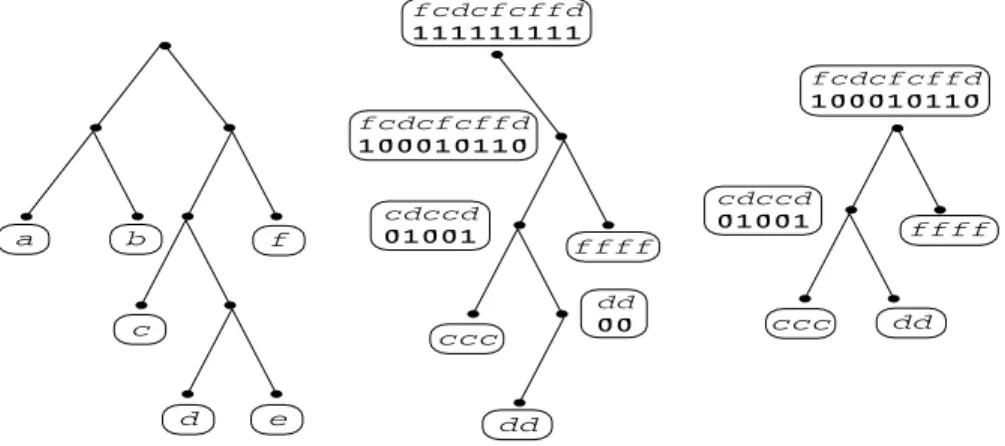
LetTbe a complete binary tree with||leaves. We associate one-to-one the symbols into the leaves ofTand refer to it as analphabetic tree. Given a stringsover, thefull Wavelet Tree Wf(s)is the labeled tree returned by the procedure TreeLabelof Fig.2(see also Fig.3). Note that we associate two strings of equal length to each internal nodeu∈Wf(s). The first one, assigned in Step 1, is a string overthat we denote bys(u). The second one, assigned in Step 3, is a binary string that we denote bys01(u). Note that the length of these strings is equal to the number of occurrences insof the symbols associated to the leaves of the subtree rooted atu.
If(s)=, the Wavelet TreeW
f(s)has the same shape asTand it is therefore a complete binary tree. If(s)⊂,Wf(s)is not necessarily a complete binary tree since it may contain unary paths. By contracting all unary paths, we obtain acompacted Wavelet Tree Wc(s), which is a complete binary tree with|(s)|leaves and|(s)| −1 internal nodes (see Fig.3).
As observed in [13], we can always retrievesgiven the binary stringss01(u)associated to the internal nodes of a Wavelet
Tree and the mapping between leaves and alphabetic symbols. Hence, Wavelet Trees are a tool forencoding arbitrary strings using an encoder for binary strings. The following fundamental property of compacted Wavelet Trees was established in [13] and shows that, in order to achieve the zero-order entropy ons, it suffices to achieve the zero-order entropy on the binary strings associated to the internal nodes of any Wavelet Tree associated tos.
Theorem 4.1 [13].For any string s drawn from the alphabet(s),and for any compacted Wavelet Tree Wc(s),we have
|s|H0(s)=
u∈Wc(s)
|s01(u)|H0(s01(u)),
where the summation is done over all internal nodes of Wc(s).
4.2. Analysis ofRleWavelet Trees
Letsbe a string over the alphabet(s). We define the algorithmRle−wtas follows. First we encode|s|with the codeword
Fig. 3.An alphabetic tree (left) for the alphabet= {a,b,c,d,e,f}. The corresponding full Wavelet Tree (center) for the strings=fcdcfcffd. The compacted Wavelet Tree (right) for the same string.
nodes are encoded in a predetermined order—for example heap order—such that the encoding of a nodeualways precedes the encoding of its children (if any).5We can always retrievesfrom the output ofRle
−wt: when we start the decoding of the strings01(u), we already know its length|s01(u)|and therefore no additional information is needed to mark the end of the encoding.
Theorem 4.2. For any string s over the alphabet(s),we have
|Rle−wt(s)|
max(2a,b+2a/3)|s|H0(s)+alog|s| +
|(s)|.
The bound holds regardless of the shape of the Wavelet Tree.
Proof.The output ofRle−wtconsists of|Pfx(|s|)|
alog|s| +bbits, in addition to the cost of encoding the binary string associated to each internal node of the Wavelet Tree, usingRle. That is:|Rle−wt(s)| = |Pfx(|s|)| + u∈Wc(s)
|Rle(s01(u))|, (13)
where the summation is done over internal nodes only. IfH0(s)=0, there are no internal nodes and there is nothing to prove. IfH0(s) /=0, we have that, by Lemma3.3,
|Rle(s01(u))|
max(2a,b+2a/3)|s01(u)|H0(s01(u))+3b+1, for each internal nodeu. The thesis then follows by Theorem4.1.4.3. Analysis ofGeWavelet Trees
The algorithmGe−wtis identical toRle−wtexcept that the binary stringss01(u)associated to the internal nodes ofWc(s)
are encoded usingGeinstead ofRle. The analysis is also very similar and provided in the next theorem.
Theorem 4.3. For any string s over the alphabet(s),we have |Ge−wt(s)|
max(a,b)|s|H0(s)+ |(s)|(alog|s| +b+2).The bound holds regardless of the shape of the Wavelet Tree.
Proof.The output ofGe−wt(s)consists ofPfx(|s|), followed by the encoding of the|(s)| −1 internal nodes. By Lemma3.4, we have
|Ge−wt(s)| =
u∈Wc(s)
|Ge(s01(u))| + alog|s| +b
max(a,b)u∈Wc(s)
|s01(u)|H
0(s01(u)) + |(s)|(alog|s| +b+2).
Fig. 4.ProcedureGe*−wtfor compressing a stringsover the alphabet(s)⊆. We assume that the shape of the alphabetic treeTused for buildingWc(s)
and the order in which internal nodes are compressed byGe*are hard-coded in the (de)compressor.
and the thesis follows by Theorem4.1.
Comparing the bounds in Theorems4.2and4.3, we see that the latter has a smaller constant in front ofH0(s)since max(a,b)
max(2a,b+2a/3). Indeed, ifab, as inγ-codes, we have max(a,b)(1/2)max(2a,b+2a/3).So far we have bounded the compression ofRleandGeWavelet Trees in terms of: (1) the entropy of the input string, and (2) the logarithm of the input string length. For most stringss, we have log|s| =o(|s|H0(s)), so
log|s|can be regarded as a lower order term. However, ifsis highly compressible, for examples=a1an2, we have|s|H0(s)=log|s|and alog|s| term cannot be considered lower order. It turns out that because of this additionallog|s|termRleandGeWavelet Trees are not the best algorithms for compressing low entropy (i.e., highly compressible) strings. Here we provide a variant ofGe Wavelet Trees that is well suited for highly compressible strings and that will be fundamental to obtain the higher order entropy-only bounds reported in Section6.
Consider the binary compressorGe*introduced in Section3and recall that it is a prefix-free encoder: the decompressor knows when the decoding of a string is complete without the need of additional information. Hence, we can compress an arbitrary stringsby first encoding the alphabet(s)and then building a compacted Wavelet Tree forscompressing internal nodes withGe*(see Fig.4). The output consists of||bits followed by the concatenation of the compressed internal nodes.6The resulting algorithm, calledGe*
−wt, still has the property of being prefix-free. The next lemma boundsGe*−wt’s compression in terms of the modified empirical entropy. The use of the modified empirical entropy makes it possible to prove a bound which is significant also for the highly compressible strings for which|s|H0*(s)=Olog|s|.
Theorem 4.4. For any string s,we have |Ge*−wt(s)|
Cab|s|H*0(s)+(||), (14)
where Cabis the constant defined by(9).
Proof.If|(s)| =1 we have|Ge*−wt(s)| =alog|s| +(||). The thesis follows since, by (2), we have|s|H*
0(s)=1+ log|s|
. If
|(s)|>1, by Lemma3.6and Theorem4.1, we have
|Ge*−wt(s)|
u∈Wc(s)
|Ge*(s01(u))| + ||
u∈Wc(s)
Cab|s01(u)|H0(s01(u)) + (||)
Cab|s|H0(s) + (||),and the thesis follows sinceH0(s)
H0*(s).From the above theorem and Lemma3.2it follows that combiningGe*−wtwith the prefix encoderTrn(defined at the beginning of Section3) the bound (14) holds withCab=1+log34≈2.2618. The following theorem shows that no prefix-free algorithm can achieve a substantially better bound, in the sense that the constant in front ofH0*(s)must be greater than 2.
Theorem 4.5 [12, Section 7].If a compression algorithmAis prefix-free,then the bound
|A(s)|
λ|s|H0*(s)+f(||) for every string s (15)with f(||)independent of|s|,can only hold with a constantλ >2.
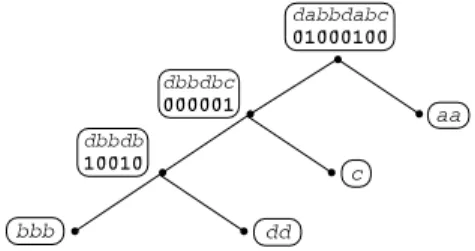
Fig. 5.The skewed Wavelet Tree for the strings=dabbdabc. Symbolbis the most frequent one and is therefore associated to the leftmost leaf.
4.4. Skewed Wavelet Trees and Inversion Frequencies coding
All results in the previous sections hold regardless of the shape of the Wavelet Tree. In this section we consider a variant ofGe−wt, in which we choose the Wavelet Tree shape and the correspondence between leaves and symbols. Although this approach leads to (minor) improvements in the compression bounds given in Theorem4.3, it establishes an important and unexpected connection between Wavelet Tree and Inversion Frequencies coding [3,4]. To our knowledge, the results presented here provide the first bound on the output size of IF coding in terms of the entropy of the input string. They also provide a theoretical justification for the strategy, suggested in [1], of processing the symbols in order of increasing frequency. Given a stringsover the alphabet(s), consider the algorithmGe−skwtdefined as follows. First, encode the length ofs and the number of occurrences of each symbol using a total of|Pfx(|s|)| + |(s)| log|s|+1bits. Then, build a Wavelet Tree completely skewed to the left such that the most frequent symbol is associated to the leftmost leaf. The other symbols are associated to the leaves in reverse alphabetic order (see Fig.5). Lettinguidenote the internal node of depthi−1, we finally useGeto encode the stringss01(u
1),. . .,s01(u|(s)|−1), in that order. The crucial observation is that when we encode (and later decode) the strings01(ui), we already know:
1. its length|s01(u
i)|, which is equal to the number of occurrences of the symbols associated to the subtree rooted atui; 2. the number of1’s ins01(u
i), which is equal to the number of occurrences of the symbol associated to the right child ofui; 3. that1is the least frequent symbol ins01(ui), since the most frequent symbol insis associated to the leftmost leaf. We can take advantage of this extra information to encodes01(u
i)with a “simplified” version ofGe. Indeed, with reference to Definition2, we omit the two initial bitsc0andc1, and the last codewordPfx(|s01(ui)| −pr|). Thus, the “simplified”Geencoding ofs01(ui)consists of the concatenationPfx(g1),· · ·,Pfx(gr). An analysis analogous to the one in the proof of Lemma3.4shows that the length of this encoding is bounded by max(a,b)|s01(u
i)|H0(s01(ui)). Summing up, we have the following result.
Theorem 4.6. For any string s over the alphabet(s), using the skewed Wavelet Tree and the “simplified” Gap Encoding detailed
above,we have
|Ge−skwt(s)|
max(a,b)|s|H0(s) +(a+ |(s)|)log|s| + |(s)| +b.Proof.From the above discussion, we get
|Ge−skwt(s)|
max(a,b)u∈Wc(s)
|s01(u)|H0(s01(u)) + (alog|s| +b)+ |(s)|( log|s|+1).
The thesis follows by Theorem4.1.
Comparing the bounds in Theorems4.3and4.6, we see that the latter has a smaller non-entropy term due to the use of the “simplified” Gap Encoder. Further study is needed to understand whether this advantage is outweighted (or improved) by the use of the skewed tree shape.
Assume now that(s)== {a
1,a2,. . .,ah}and thatah is the most frequent symbol ins. Consider now theGe−skwt algorithm applied tos(that is, consider a skewed Wavelet Tree whose leaves are labeledah,ah−1,. . .,a1from left to right). In this setting the Gap Encoding ofs01(u
i)coincides with the encoding of the positions of the symbolaiin the strings, with the symbolsa1,. . .,ai−1removed. In other words, we are encoding the number of occurrences ofai+1,. . .,ahbetween two consecutive occurrences ofai. This strategy is known asInversion Frequencies(IF) coding and was first suggested in [4] as an alternative to Move-to-Front encoding. Since also in IF coding we initially encode the number of occurrences of each symbol, from our analysis we get the following result.
Corollary 4.7. Assuming that the most frequent symbol is processed last,IF coding produces a sequence of integers that we can compress within the same bound given in Theorem4.6.
Note that in its the original formulation IF processes symbols in alphabetic order. However, [1] showed that processing symbols in order of increasing frequency usually yields better compression. Corollary4.7provides theoretical support to this heuristic strategy.
5. Compression of general strings: achievingHk
This section provides the technical details about the results claimed in point (B) of Section 1 concerning the combination ofRleWavelet Trees andbwt. We show that this approach can achieve higher order entropy compression, whereasGeWavelet Trees cannot.
We need to recall a key property of the Burrows–Wheeler Transform of a stringz[18]: Ifs=bwt(z)then, for anyk
0, there exists a partitions=s1s2,· · ·,stsuch thatt||k+kand|z|Hk(z)=ti=1|si|H0(si). In other words, thebwtis a tool for achieving thek-th order entropyHk, provided that we can achieve the entropyH0on eachsi. An analogous result holds forHk*as well.7In view of the above property, we establish our main result by showing that compressing the wholesvia oneRleWavelet Tree is not much worse than compressing each stringsiseparately. In order to prove such a result, some care is needed. We can assume without loss of generality that(s)=. However,(si)will not, in general, be equal to(s)and this creates some technical difficulties and forces us to consider both full and compacted Wavelet Trees. Indeed, if we “slice” the compacted Wavelet TreeWc(s)according to the partitions=s1,· · ·,st, we getfullWavelet Trees for the stringssi’s.
Recall from Section4.2that the total cost of encoding a Wavelet Tree withRleis given by (13). As a shorthand, we define
Wc(s)rle=
u∈Wc(s)
|Rle(s01(u))| and Wf(s)rle=
u∈Wf(s)
|Rle(s01(u))| (16)
where both summations are done over internal nodes only. Our first lemma essentially states that, for fullRleWavelet Trees, partitioning a string does not improve compression.
Lemma 5.1. Let s=s1s2be a string over the alphabet.We have
Wf(s)rle
Wf(s1)rle+Wf(s2)rle.Proof.Letube an internal node ofWf(s)and let(u)denote the set of symbols associated tou. That is, the set of symbols associated to leaves in the subtree rooted atu. If the stringsi, fori=1, 2, contains at least one of the symbols in(u), then Wf(si)contains an internal nodeuithat has(u)as the associated set of symbols. Assume first that the symbols of(u)appear only ins1. In this case, we have thats01(u)coincides withs011 (u1), which is the binary string associated tou1inWf(s1). Hence,
|Rle(s01(u))| = |Rle(s01
1 (u1))|. Similarly, if the symbols of(u)appear only ins2, we have|Rle(s01(u))| = |Rle(s012 (u2))|. Assume now thatu1andu2both exist. In this cases01(u)is the concatenation ofs011 (u1)ands012 (u2). Hence, ifs01(u)=
b1
1b 2
2,· · ·,b k
k, there exist an indexj, 1
jk, and a valueδ, 0δ < j, such that s011 (u1)=b11· · ·bj−1
j−1bδj, and s 01
2 (u2)=b j−δ j b
j+1 j+1· · ·b
k k. Summing up, we have
|Rle(s01(u))|=1+ k
i=1
|Pfx(i)| |Rle(s01
1 (u1))|=1+
j−1
i=1
|Pfx(i)| + |Pfx(δ)| |Rle(s012 (u2))|=1+ |Pfx(j−δ)| +
k
i=j+1
|Pfx(i)|. Hence
|Rle(s01(u))| − |Rle(s011 (u1))| − |Rle(s012 (u2))| = |Pfx(j)| − |Pfx(δ)| − |Pfx(j−δ)| −1.
Refining the proof of Lemma3.1it is easy to see that|Pfx(i1+i2)|
|Pfx(i1)| + |Pfx(i2)| +(a−b)for any pairi1,i2. Hence,|Pfx(j)|
|Pfx(δ)| + |Pfx(j−δ)| +(a−b). Sincea2 andb1, we get|Rle(s01(u))|
|Rle(s01
1 (u1))| + |Rle(s012 (u2))|.
The thesis follows summing over all internal nodes ofWf(s).
7When thebwtis used, log|z|additional bits must be included in the output file: these are required to retrievezgivens. In this section we ignore this
Theorem4.1bounds the cost ofcompactedWavelet Trees in terms of the entropy of the input string. In order to use Lemma5.1, we need a similar result for thefullWavelet TreeWf(s).
Lemma 5.2. For any non-empty string s over the alphabet,it holds
Wf(s)rle
max(2a,b+2a/3)|s|H0(s)+(|| −1)(alog|s|)+(||) .Proof.Assume firstH0(s) /=0. SinceWc(s)is obtained fromWf(s)contracting all unary paths, we have
Wf(s)rle=Wc(s)rle+cost of deleted nodes.
Comparing (13) and (16) we see thatWc(s)rle= |Rle−wt(s)| −Pfx(|s|). Hence, by Theorem4.2
Wc(s)rle
max(2a,b+2a/3)|s|H0(s)+
|(s)|.
Recall now that a nodeu∈Wf(s)is deleted if and only ifs01(u)contains only0’s or only1’s. Hence, each deleted nodeu contributes to the differenceWf(s)rle−Wc(s)rleby an amount 1+Pfx(|s01(u)|)
alog|s| +b+1. The thesis then follows since the number of deleted nodes is at most|| −1.Assume nowH0(s)=0, i.e.,s=σn, for someσ∈. In this case,Wf(s)contains at most|| −1 internal nodes. TheirRle cost is bounded byalog|s| +b+1, and the thesis follows.
We are now able to bound the size of aRleWavelet Tree over the strings=bwt(z)in terms of thek-th order entropy ofz.
Theorem 5.3. Let z denote a string over the alphabet=(z),and let s=bwt(z).For any k
0,we have
|Rle−wt(s)|
max(2a,b+2a/3)|z|Hk(z)+ ||k+1(alog|z|)+O
||k+1. (17)
In addition,if|| =O(polylog(|z|)),for all k
αlog|||z|,constant0< α <1,we have|Rle−wt(s)|
max(2a,b+2a/3)|z|Hk(z)+o(|z|). (18)Proof.LetCab=max(2a,b+2a/3), and lets=s1· · ·st denote the partition ofssuch that|z|Hk(z)=
t
i=1|si|H0(si). Since
=(z)=(s),W
f(s)coincides withWc(s). By (13), we have
|Rle−wt(s)| =Wc(s)rle+ |Pfx(|s|)| =Wf(s)rle+ |Pfx(|s|)|. (19)
By Lemmas5.1and5.2, we get
Wf(s)rle
t
i=1
Wf(si)rle
ti=1
Cab|si|H0(si)+(|| −1)(alog|si|)+(||)
Cab|z|Hk(z)+(|| −1) t
i=1
alog|si| +(t||) . (20)
Sinceti=1log|si|
tlog(|s|/t), from (19) and (20) we get|Rle−wt(s)|
Cab|z|Hk(z)+t(|| −1)alog(|s|/t)+alog(|s|)+(t||) . (21)Sincet
||k+k, we have|Rle−wt(s)|
Cab|z|Hk(z)+ ||k+1alog(|s|)+||k+1which implies (17), since|s| = |z|. To prove (18), we start from (21) and note that’s size and the inequalityt
||k+k implyt||log(|s|/t)=o(|s|)=o(|z|).Theorem5.3shows thatRleWavelet Trees achieve thek-th order entropy with the same multiplicative constant max(2a,b+
2a/3)thatRleachieves with respect toH0(Lemma3.3). Thus, Wavelet Trees are a sort ofboosterforRle(cf. [9]). After the appearance of the conference version of the present paper [8], Mäkinen and Navarro [17] proved thatRleis not the only compressor that allows to achieveHkusing Wavelet Trees. More precisely, [17] considers the Wavelet Tree over the entire stringbwt(z)in which the binary strings associated to the internal nodes of the Wavelet Tree are represented using the succinct dictionaries of [20]. Such Wavelet Tree takes at most
|z|Hk(z)+O
bits. Succinct dictionaries supportOlog||time rank and select queries [20], so the data structure of [17] is not simply a compressed file but a more powerful compressed full-text index [19]. Comparing (22) with (17), and recalling thata
1, we see that (22) has a smaller multiplicative constant in front of|z|Hk(z)but also an additionalO
(|z|log||log log|z|)/log|z|
term which can become dominant for strings with small entropy.
In proving Theorem5.3we used some rather coarse upper bounds. So we believe it is possible to improve the bounds (17) and (18). However, there are some limits to the possible improvements. As the following example shows, theo(|z|)term in (18) cannot be reduced to1even for constant size alphabets. This is true not only forHk, but also for the modified empirical entropyHk*.
Example 1.Let= {1, 2,. . .,m}, and letz=(123· · ·m)n. We haveH
1(z)=0,|z|H*1(z)≈mlogn, ands=bwt(z)=mn1n2n· · ·
(m−1)n. Consider a balanced Wavelet Tree of heightlogm. It is easy to see that there exists an alphabet ordering such that the internal nodes of the Wavelet Tree all consist of alternate sequences of 0nand 1n. Even encoding these sequences with lognbits each would yield a total cost of about(mlogm)logn≈(logm)|z|H1*(z)bits.
It is natural to ask whether we can repeat the above analysis and prove a bound forGeWavelet Trees in terms of the k-th order entropy. Unfortunately, the answer is no! The problem is that, when we encodeswithGe, we have to make some global choices—e.g., the shape of the tree inGe−wt, the role of zeros or ones in each internal node in the algorithm of [14]—and these are not necessarily good choices for every substringsi. Hence, we can still splitWf(s)intoWf(s1),. . .,Wf(st), but it is not always true thatWf(si)
λ|si|H0(si)+o(|si|). As a more concrete example, consider the stringz=(01)n. We haveH1(z)=0,|z|H1*(z)=logn, ands=bwt(z)=1n0n.Wc(s)has only one internal node—the root—with associated string 1n0n. We can either encode the gaps between 1’s or the gaps between 0’s. In both cases, the output will be of(n)bits, thus exponentially larger than|z|H*1(z). Of course this example does not rule out the possibility that a modified version ofGecould achieve the k-th order entropy. Indeed, in view of the remark following the proof of Theorem4.3, a modifiedGeis a natural candidate for improving the bounds of Theorem5.3.
6. Compression of general strings: achieving entropy-only bounds
This section contains the technical details of the results claimed in (C) of Section 1. In particular, we show how to use Wavelet Trees to achieve the best entropy-only bound known in the literature. Entropy-only bounds have the formλ|s|H*k(s)+
log|s| +gk, whereH*kis the modifiedk-th order empirical entropy (defined in Section2), andgkdepends only onkand on the alphabet size. Achieving an entropy-only bound guarantees that, even for highly compressible strings, the compression ratio will be proportional to the entropy of the input string. Too see this, recall that|s|Hk*(s)
log(|s| −k)(Lemma2.4). Hence, if a compressorAachieves an entropy-only bound, it is|A(s)|(1+λ)|s|Hk*(s)+gkfor any strings. The reason for which the term log|s|appears explicitly in entropy-only bounds is thatbwt-based algorithms need to include in the output file log|s|additional bits in order to retrievesgivenbwt(s). Keeping the term log|s|explicit provides a better picture of the performance ofbwt-based compressors when|s|H*k(s)=ω(log|s|). Entropy-only bounds cannot be established with the entropyHk. To see this, consider the family of stringss=an
1. We have|s|Hk(s)=0 for all of them and clearly we cannot hope to compress all strings in this family in1space.
For convenience of the reader, we recall the main technical result from [9, Section 5].
Property 1. LetAbe a prefix-free compressor that encodes any input stringx∈*within the following space and time bounds8:
1.|A(x)|
λ|x|H*0(x)+μbits, whereλandμare constants,2.the running time ofAisT(|x|)and its working space isS(|x|), whereT(·)is a convex function andS(·)is non-decreasing.
Theorem 6.1 [9, Th.5.2].Given a compression algorithmAthat satisfies Property1,one can apply the compression booster in [9] so that it compresses s withinλ|s|Hk*(s)+log|s| +gkbits,for any k
0.The above compression takes O(T(|s|))time and O(S(|s|)+ |s|log|s|)bits of space.We can combine Theorem6.1with Theorem4.4to obtain:
Theorem 6.2. Combining the algorithmGe*−wtwith the compression booster,we can compress any string s over the alphabet
in at most Cab|s|H*k(s)+log|s| +||k+1bits for any k
0.The constant C
abmultiplying H *
kdepends,according to(9),on
8In [9] instead of assumingAto be prefix-free, the authors made the equivalent assumption thatAappends a unique end-of-string symbol at the end of