ecently, the widespread growth of mobile wireless networks, applications, and services has ushered in the era of mobile computing, where handheld com-puting devices (or terminals) have become the pre-dominant choice for users [1]. Low-cost affordability of portable devices such as cell phones and palmtops and their widespread usage are motivating service providers to support seamless user mobility, that is, uninterrupted connectivity of their computing/communication devices (referred to as mobile nodes, MNs, in the rest of the article) as they move either within a single network or across different networks. At the same time, major efforts are underway to deliver applications and services to MNs over a packet-switched access network that is homogeneous with the Internet. So the current trend in mobile wireless network evolution is directed toward an all-IP network [2]. Work has already begun on such an end-to-end IP-based solution, commonly referred to as fourth-generation (4G) systems, that will combine mobility with multimedia-rich content, high bit rate, and IP transport with support for quali-ty of service (QoS) management and authentication, autho-rization, and accounting (AAA) security [3]. Standards and related technologies are being developed to help early deploy-ment of such systems and ensure interoperability among equipment from different manufacturers, thereby providing significant investment reductions compared to today’s 2.5G and 3G technologies technologies [1]. In addition, there will be less licensing costs as well, since 4G will utilize frequencies believed to be in the public domain.
Deployment of International Mobile Telephony (IMT) 2000 standards for 3G wireless networks gave existing 1G, 2G, and 2.5G operators the flexibility to evolve their networks (primarily designed for circuit-switched voice communica-tions) to support skeleton multimedia transmissions with a nominal bit rate of 384 kb/s (fast movers) to 2 Mb/s (slow movers) [1]. Certainly, this is significantly less than what 4G promises: global roaming across multiple networks (e.g., from a cellular network to a satellite-based network or to a high band-width wireless LAN [4]) with bit rates up to 100 Mb/s.
There-fore, realizing commercially viable IP mobility support over the current wireless infrastructure remains a challenging research area [3]. In particular, for real-time multimedia com-munications, user mobility poses several new dimensions to this challenge [4].
Conventionally, the link layer handles mobility manage-ment in 2.5G/3G cellular networks. However, link-layer-inde-pendent solutions for 4G require mobility management to be defined at the network layer (i.e., IP-oriented mobility support [2]). In this direction, Mobile IP (MIP) [5] was the proposed standard (and MIPv6 [6] is the proposed draft standard) by the Internet Engineering Task Force (IETF). MIP was origi-nally designed to serve the needs of globally mobile users who wish to connect their MNs to the Internet and maintain con-nectivity as they move from one place to another, establish new links, and move away from previously established links. Several IP micro/macro mobility protocols [7], proposed over the past several years within the IETF, complement MIP in better handling local movement (e.g., within a subnet) without much interaction with the MIP-enabled Internet. Specifically, the SeaMoby [7] Working Group is considering these proto-cols for low-latency handoff and IP paging. In this updated survey over [2], we begin with a description of MIP and then review all the related protocols that give the current trends in network evolution directed toward an all-IP network. Unlike the approaches in [3, 4, 7], this article focuses on all levels (micro, macro, and global) of mobility, and hence also includes protocols such as TeleMIP, Dynamic Mobility Agent (DMA), and Terminal Independent MIP (TIMIP) aimed at integrated mobility management for 4G.
The rest of the article is divided into five sections. After an introduction to traditional mobility management, a classification of mobility protocols is presented. We sketch the operations of the protocols briefly. A comparative study of the protocols, with respect to various network parameters, is given to point out their limitations and advantages. Finally, we conclude the article with a comprehensive view of these protocols against the desir-able design features for IP-based mobility in 4G.
R
R
Debashis Saha, Indian Institute of Management Calcutta
Amitava Mukherjee, IBM Global Services Calcutta
Iti Saha Misra, Jadavpur University
Mohuya Chakraborty, Netaji Subhash Engineering College
Abstract
This article presents an overview of a set of IP-based mobility protocols — Mobile IP, HAWAII, Cellular IP, Hierarchical MIP, TeleMIP, Dynamic Mobility Agent, and Terminal Independent MIP — that will play an important role in the forthcoming convergence of IP and legacy wireless networks. A comparative analysis with respect to system parameters such as location update, handoff latency and sig-naling overhead exposes their ability in managing micro/macro/global-level mobility. We use this observation to relate their features against a number of key design issues identified for seamless IP-based mobility as envisioned for future 4G networks.
Mobility Support in IP:
A Survey of Related Protocols
Mobility Management
It is well known that terminal mobility management [3] in cel-lular networks consists of two components (Fig. 1):
•Location management, which consists of two complementary operations: registrationor location update(LU) and paging, to enable a network to discover the current point of attach-ment of an MN for information delivery
•Handoff managementto enable a network to maintain a connection as an MN continues to move and change its point of attachment to the network [1]
Tracking an MN is performed through registration/LU pro-cedures in which an MN informs the network of its location at times triggered by movement, timer expiration, and so on. [3]. Locating an MN is performed through search procedures, when the network pages the MN. There is a trade-off between how closely the network tracks the current location of an MN, vs. the time and complexity required to locate an MN whose position is not precisely known [4].
Handoff management in a cellular environment is normally performed in three steps: initiation, connection generation, and data flow control. Whenever an MN changes its point of attachment with a base station (BS), it sends a request to the current BS for handoff to the target BS for initiation. After initiation, control is handed over to the target BS by the
cur-rent BS. The IP address of the MN also changes as it changes its point of attachment. This is connection generation. After obtaining a new address, data may be sent to that address, completing the task of data flow control.
In a cellular environment there are two kinds of handoff (Fig. 1): intracelland intercell. Intracell handoffoccurs when a user, moving within a cell, changes radio channels to minimize interchannel interference under the same BS. On the other hand, intercell handoffoccurs when an MN moves into an adjacent cell for which all of the MN’s connections are trans-ferred to the new BS. Intercell handoff may be performed in two ways: softand hard. If two BSs simultaneously handle the interchange between them while performing the handoff, it is a soft handoff (no discontinuity of connection). Soft handoff is achieved by proactively notifying the new BS before actual handoff. Thus, it minimizes packet loss, but delay incurred may be more. In hard handoff, one BS takes over from anoth-er in a relay mode (connection may be off for a vanoth-ery small period during the take over), so delay as well as signaling are minimized, but it does not guarantee zero packet loss.
With this introduction to mobility management, let us now classify the IP mobility protocols based on their level of oper-ation in the architecture.
Mobility Classification of Protocols
A network usually covers a large geographical area (or admin-istrative domain) consisting of several subnetworks (subnets). Mobility of an MN in a network may be broadly classified into three categories (Fig. 2):
•Micromobility(intrasubnet mobility): movement within a subnet
•Macromobility(intradomain mobility): movement across dif-ferent subnets within a single domain
•Global mobility(interdomain mobility): movement across different domains in various geographical regions
In general, the primary goal of mobility management is to ensure continuous and seamless connectivity between micro-and macromobility, which occur over short timescales. Global
■Figure 1. Classification of mobility management.
Paging Intracell Intercell Locations
update (or registration)
Terminal mobility management
Location management
Handoff management
Soft Hard
■Figure 2.Mobility classification of protocols.
Mobility Macro Micro Time (evolutionary path) MIP (1996) Hawaii (1996) TR45.6 (1996) CIP (1998) TMIP (2001) MIPv6 (2001) HMIPv6 (2001) HMIP (1996) DMA (2000) TeleMIP (2000) Global
mobility involves longer timescales, where the goal is to ensure that MNs can reestablish communication after a move rather than provide continuous connectivity.
Since MIP is generally targeted for global mobility, it intro-duces significant network overhead in terms of increased delay, packet loss, and signaling when MNs change their point of attachment very frequently within small geographical areas. To overcome these performance penalties, micro- and macro-mobility protocols offer fast and seamless handoff control, and IP paging support for scalability and power saving. A complete overview of three such protocols, HAWAII, Cellular IP (CIP), and Hierarchical MIP (HMIP), is given in [7]. Despite many apparent differences, the operational principle of the protocols is quite similar in complementing base MIP by providing local handoff control. Obviously, they are ineffi-cient in handling interdomain LUs, and thus are unable to handle global reachability perfectly [3, 4]. Accordingly, TeleMIP [8] and DMA [9] architectures are proposed to resolve this issue. These schemes involve a combination of local paging and global LUs with a goal of minimizing overall cost by achieving an acceptance balance between these two kinds of traffic. Figure 2 gives a clear idea of which class of mobility each of the existing protocols aims to support. Although targeted for micromobility, CIP uses MIP support for providing intradomain mobility management. So CIP [10] along with TIMIP [11] falls under micro- as well as macromo-bility. TeleMIP is strictly intradomain as it cannot support either micromobility or global mobility. HAWAII and DMA can support macromobility as well as global mobility but can-not handle micromobility. MIP supports global mobility but fails to handle micro- or macromobility. HMIP and TR45.6 are two minor extensions of MIP to support macromobilty as well. As MIPv6 is now replacing MIP, HMIP is being aug-mented to HMIPv6, and they belong to their parent classes.
A Brief Review of Protocols
In this section we depict IP mobility protocols in a categorical sequence of mobility. Their temporal evolution is indicated in Fig. 2.
Global Mobility
Mobile IP (1996) [5]— The essence of MIP lies in the reten-tion of permanently assigned IP address (known as home address) by MNs for application transparency. This is achieved by providing a care-of address (CoA) to an MN when it moves out of its home network (HN) to visit a foreign net-work (FN). While in an FN, the location of an MN is cap-tured by its CoA assigned by a foreign agent (FA) in the FN. A home agent (HA) in the HN maintains a record of the cur-rent mobility binding (i.e., the association of an MN’s home address with its CoA during the remaining lifetime of that association). The HA intercepts every packet addressed to the MN’s home address and tunnels them to the MN at its cur-rent CoA. This is known as triangular routing.
Once a correspondent node (CN) has learned the MN’s CoA, it may cache it and route its own packets to the MN directly, bypassing the HA completely. This is mainly done for route optimizationas triangular routing suffers from various problems due to poor route selection, including increased impact of possible network partitions, increased load on the network, and increased delay in delivering packets. Route optimization can improve service quality but cannot eliminate poor performance when an MN moves while communicating with a distant CN. Then the registration/LU delay contributes significantly to the handoff delay, leading to reduction in throughput. Also, frequent LUs incur extensive overhead for
location cache management in route optimization [8]. The delay is inherent in the round-trip as the registration request is sent back to the FA.
Mobile IPv6 (2001) [6] — With the huge (128 bits long) address space of MIPv6, a tiny part is reserved for all current MIPv4 addresses. Another tiny part is reserved for link-local addresses, which are not routable but are guaranteed to be unique on a link. Design of MIPv6 is adjusted to account for the few special needs of MNs that can perform decapsulation. A set of new destination options, called binding updateand binding acknowledgment, manage the cache entries of CNs. MNs must be able to send binding updates and receive bind-ing acknowledgments. Based on the lifetime field in the bind-ing updates it sends, every MN must keep track of which other MNs may need to receive a new binding as a result of any recent movement by the MN [5].
Global Mobility/Macromobility
Hierarchcal MIP (1996) [7] — As an extension of MIP, it employs a hierarchy of FAs to locally handle MIP registra-tions during macromobility. Registration messages establish tunnels between neighboring FAs along the path from the MN to a gateway FA (GFA) [7]. Packets addressed to the MN travel through this network of tunnels.
Wireless IP Network Architecture by TR45.6 (1996) [7]— It defines a new node, called a packet data serving node (which contains an FA). Network access identifiers identify MNs in an FN. MNs send registration messages to FAs, which in turn interact with AAA servers residing in the FN (or use a broker network) for authentication with the HN. For macromobility, the scheme proposes to use dynamic HAs (DHAs) that reside in the serving network and are dynamically assigned by visited AAA servers [10]. DHAs allow MNs to receive services from local access service providers while avoiding unnecessarily long routing.
HAWAII (1999) [7]— On top of using MIP for interdomain mobility, it supports a separate binding protocol to handle intradomain mobility. Four alternative setup schemes control handoff between access points. An appropriate scheme is selected depending on the service level agreement (or opera-tor’s priorities among QoS parameters, e.g., eliminating pack-et loss, minimizing handoff latency, and maintaining packpack-et ordering). It also uses IP multicasting to page idle MNs when incoming data packets arrive at an access network and no recent routing information is available. Path setup messages generate host-based routing information in tabulated form for MNs within a domain in some specific intermediate routers. The HA sends the encapsulated packets (after intercepting) to the current border router of the MN. The border router, after decapsulating the packet, again encapsulates and sends it to a nearby intermediate router. This router then decapsulates and finally sends the packet to the MN.
Dynamic Mobility Agent (2000) [9]— DMA architecture uses Intradomain Mobility Management Protocol (IDMP) to man-age macromobility and allows the use of multiple global bind-ing protocols for maintainbind-ing global reachability. A new node called a mobility agent (MA), introduced at network-layer granularity, reduces the generation of global LUs. The MA is similar to the FA of MIP, except that it resides higher in the hierarchy (than individual subnets) and provides an MN with a stable point of attachment throughout the domain. Each FA must be associated with at least one MA in that domain. It also uses subnet agents (SAs), which interact with appropriate
MAs to provide authentication. Here, an MN is associated with two current CoAs:
• Global CoA (GCoA): resolves the location of the domain and remains unchanged as long as the MN stays in the cur-rent domain.
• Local CoA (LCoA): identifies the MN’s present subnet of attachment (similar to CoA of MIP). LCoA has only local scope; an MN notifies the assigned MA of any change in its LCoA.
When an MN first moves into a domain, it is given an LCoA and assigned to an MA. It registers with the designated MA for a GCoA. The MN can then use different global binding protocols to inform the appropriate CNs about this GCoA. Packets from a remote CN, tunneled (or directly transmitted) to the GCoA are intercepted by the MA and then forwarded (by re-encapsulation) to the MN’s LCoA.
Hierarchcal MIPv6 (2001) [12]— It is the same hierarchical extension to MIPv6 for locally handling MIPv6 registrations as HMIP is to MIP.
Macromobility
Telemip (2000) [8]— This two-level architecture also uses the concept of the MA, and it is derived from the registration-area-based location management scheme [3] currently employed in cellular networks. An FN is divided into several subnets depending on its geographical location. Each subnet has at least one FA (say, a DHCP server). Whenever an MN changes subnets, it obtains a new local CoA (obtained from the FA using conventional MIP techniques) and subsequently informs the MA of this new local address binding. Under a load balancing scenario, MNs in a single subnet may be assigned to different MAs (using different hashing schemes). An MN will be assigned two CoAs:
• A domain-specific CoA (similar to GCoA) from the public space that is unchanged as long as the MN stays within a specific domain or region. This is typically the address asso-ciated with the MA.
• A subnet-specific CoA (similar to LCoA) for roaming in a partial subnet. This address may have only local scope and can be either the CoA of the FA or a locally valid collocat-ed address.
This address changes every time an MN changes its foreign subnet. When an MN enters a new domain, it will register the MA’s CoA with the HA during the initial LU process. The MA is thus aware of the exact (subnet-level) location of the MN and can consequently route the packet to the MN using a domain-specific routing protocol (without requiring source-specific routing). As long as the MN is under the control of a single MA, the MN does not transmit any LUs to the HA. The architecture thus ensures the localization of all intrado-main mobility update messages within the dointrado-main.
Macro/Micromobility
Cellular IP (1998) [10]— CIP supports local mobility (i.e., macro/micromobility) in a cellular network that consists of interconnected CIP nodes. Location management and handoff support are integrated with routing in CIP networks. An MN communicates to its HA with the local gateway’s address as the CoA. Consequently, after intercepting the packets from a CN, the HA sends them in encapsulated form to the MN’s gateway. The gateway decapsulates the packet and forwards it to the MN. To minimize control messaging, regular data pack-ets transmitted by MNs are used to refresh host location information. CIP monitors mobile-originated packets and maintains a distributed, hop-by-hop reverse path database used to route packets back to MNs. The loss of downlink packets when an MN roams between access points (APs) is reduced by a set of new handoff techniques. It tracks idle MNs in an efficient manner, so MNs do not have to update their location after each handoff. This extends battery life and reduces air interface traffic [7]. It supports a fast security model based on special session keys, where BSs independently calculate keys. This eliminates the need for signaling in sup-port of session key management, which would otherwise add additional delay to the handoff process.
TIMIP (2001) [11]— It is a combination of the principles of CIP, HAWAII, and MIP for micro/macromobility scenarios. Here, the IP layer is coupled with layer 2 handoff mechanisms at the APs by means of a suitable interface that eliminates the need for special signaling between MNs and APs. Thus, MNs with legacy IP stacks have the same degree of mobility as MNs with mobility-aware IP stacks. Like CIP, refreshing of routing paths is performed only in the absence of any traffic. Like HAWAII, routing reconfiguration during handoff within a domain changes the routing tables of the access routers located in the shortest path between the new and old APs only. However, in order to support seamless handoff, it uses context transfer mechanisms compatible with those currently under discussion within the IETF SeaMoby group [7].
A Comparison of Protocol Performance
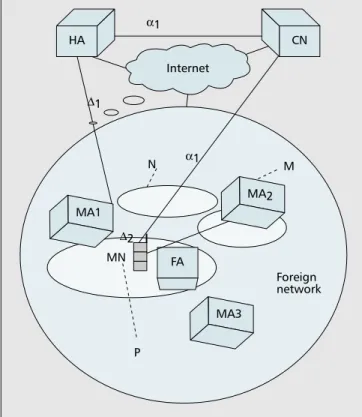
To compare the above protocols with respect to key network parameters, such as number of location updates, handoff delay, and signaling overhead, we first define a generic net-work architecture as shown in Fig. 3. There are Nnumber of subnets, M(< N) number of MAs, and Pnumber of MNs. Each subnet has an FA. It is assumed that N/M≈R(say, an MA handles all subnets within a single city), where R~ 5. So each MA can handle Rsubnets.Table 1 shows the overall number of LUs (i.e., correspond-ing routcorrespond-ing entries) generated by all MNs, as they visit all sub-nets one by one, for different mobility protocols under
■Figure 3. An example foreign network with N subnets.
Foreign network N P MN FA HA CN α1 α1 ∆1 ∆2 Internet MA1 MA2 MA3 M
consideration. To calculate the number of global LUs, we consider a situation, where there is only one domain root router and one gateway in the FN and HN, respectively. Obvi-ously, with minimum LUs, HAWAII, TIMIP and CIP are bet-ter propositions than other protocols. As we move from micro to global mobility, the frequency of location updates increases from Pto P*Nthrough P*N/Rand P*(N/R)*Las shown in Fig. 4. So, depending on a particular application area, one may choose appropriate values of Land Rto restrict location updates to a desired level. From this, the size of the subnets may also be obtained indirectly.
Comparison of the protocols with respect to delay parame-ters (e.g., update latency or handoff delay) and packet loss during message update is shown in Table 2. While calculating different parameters with route optimization, binding acknowl-edgment is used to acknowledge receipt of a binding update message. Clearly, TeleMIP and CIP stand ahead of the others, closely followed by HAWAII and TIMIP. As we have chosen L= 4 here, HMIP is nearly four times higher than TeleMIP.
Next we consider another important parameter, signaling overhead (in terms of kilobytes per second) against subnet residence time (in seconds) for comparison among MIP, TeleMIP, CIP, HMIP, HAWAII, and TIMIP. As found in ns-2 simulation, signaling overhead is directly proportional to the number of intermediate hops (routers) and inversely propor-tional to the duration of stay of an MN in a subnet. Figure 5 shows that, as expected, signaling overhead decreases as the frequency of subnet change decreases. It also shows that for high mobility (i.e., low subnet residence time), the overhead reduces considerably from HMIP to MIP and then to TIMIP/HAWAII, the minimum being for TeleMIP/CIP. The high signaling overhead of HMIP is due to the large number of intermediate access routers at different hierarchical levels, which indirectly lowers the duration of stay of an MN in a particular area.
Finally, combined together, we compare the protocols in Table 3 in terms of desirable characteristics (corresponding to rows in the table) for IP-based mobility envisaged in 4G. The key design issues considered here are not exhaustive, but rather representative. It reveals that the basic MIP and its direct extensions (e.g., HMIP and TR45.6) have some severe limitations: large handoff latencywhen MN and HA (or CN) are widely separated; data lossesuntil the handoff completes and a new route to the MN is established; require-ment for a large number of public addressesfor collocated
CoAs, which may be restricted due to security concerns; and difficulty of reserving network resources all along the path between CN and MN as an MN changes its CoA at every subnet transition. In CIP and HAWAII, however, an MN maintains a single CoA while changing subnets within a domain. However, this is achieved at the expense of requir-ing the establishment of source-specific routes within the administrative domain, so it may possibly increase signaling complexity. Although TR45.6 provides some flexibility in routing by assigning a DHA in the FN, it requires protocol upgrades at all CNs, which limits its market acceptance. HMIP shows an increase in update latency as the number of levels increases from TeleMIP. TIMIP has very low han-dover latency but quite high signaling overhead. Except for MIP and TR4.5, none of them provide AAA and security support, and real-time traffic management is absent in all protocols. Only DMA supports QoS.
Conclusion
This article demonstrates the potential advantages and disad-vantages of several IP-based mobility protocols (MIP, HAWAII, CIP, HMIP, TeleMIP, DMA, MIPv6, HMIPv6, and TIMIP) in managing micro-, macro-, and global mobility. It shows that TeleMIP is a relatively better architecture for man-aging macromobility, whereas CIP and HAWAII support micromobility management well. However, CIP and HAWAII require the IP protocol stack of MN to be changed to support special mobility signaling. This contrasts with TIMIP, where handover is performed from layer 2 notifications; so mobility signaling is completely implemented at MNs, making it trans-parent to the IP layer. Although security is a problem of TIMIP, it is advantageous in being independent of terminal, version, and operating system. This feature is most suitable for 4G technologies, which aim to provide seamless mobility management among heterogeneous architectures. So we may envision for 4G an integrated architecture combining the best features of MIPv6, TeleMIP, and TIMIP.
■Table 1. Analytical estimate of LUs.
Global MIP P*N TR45.6 P*N MIPv6 P*N Global/macro HMIP P*(N/R)*L HMIPv6 P*(N/R)*L TeleMIP P*(N/R) DMA P*(N/R) Macro HAWAII P Macro/micro TIMIP P CIP P
P= Number of MNs, N= Number of subnets, R= Number of subnets handled by an MA, M= N/R, L= Number of levels of hierarchy in HMIP and HMIPv6
Mobility Protocol LUs
Global (up to HN)
■Figure 4. Mobility-based location update pattern.
Micro/macro
Global/macro
Macro Global
P P*N/R P*(N/R)*L P*N
■Figure 5. Comparison of total network signaling overhead as
obtained in ns-2 (without route optimization). Subnet residence period Ts(s/subnet)
2 1000 Si g n al in g o v er h e a d per h op ( b y tes / s ) 500 0 1500 2000 2500 3000 3500 4000 4500 5000 1.8 1.6 1.4 1.2 1 0.8 0.6 0.4 0.2 MIP TeleMIP CIP HMIP Hawaii, TIMIP
References
[1] P. Stuckman, The GSM Evolution — Mobile Packet Data Services, Wiley, 2003.
[2] P. Bhagwat, C. Perkins, and S. Tripathi, “Network Layer Mobility: An Architecture and Survey,” IEEE Pers. Com-mun., vol. 3, June 1996, pp. 54–64.
[3] I. F. Akyíldíz et al., “Mobility Management in Current and Future Communications Networks,” IEEE Network, vol. 12, July/Aug. 1998, pp. 39–49.
[4] T. B. Zahariadis et al., “Global Roaming in Next-Genera-tion Networks,” IEEE Commun. Mag., vol. 40, no.2, Feb. 2002, pp. 145–51.
[5] C. Perkins, “IP Mobility Support,” IETF RFC 2002, Oct. 1996.
[6] D. Johnson and C. Perkins, “Mobility Support in IPv6,” IETF draft, draft-ietf-mobileip-ipv6-15.txt, July 2001, work in progress.
[7] A. T. Campbell et al., “Comparison of IP Micromobility Protocols,” IEEE Wireless Commun., Feb. 2002, pp. 72–82.
[8] H. Sollman et al., “Hierarchical MIPv6 Mobility Manage-ment,” IETF draft, draft-ietf-mobileip-hmipv6-05.txt, July 2001, work in progress.
[9] A. T. Campbell et al., “Design and Performance of Cellu-lar IP Access Networks,” IEEE Pers. Commun., Special Issue on IP-Based Mobile Telecommunications Networks, K. Basu, A. T. Campbell, and A. Joseph, Guest Eds., vol. 7, no. 4, Aug. 2000, pp. 42–49.
[10] S. Das et al., “TeleMIP: Telecommunications-Enhanced MIP Architecture for fast Intradomain Mobility,” IEEE Pers. Commun., Special Issue on IP-Based Mobile Telecommuni-cations Networks, K. Basu, A. T. Campbell, and A. Joseph, Guest Eds., vol. 7, no. 4, Aug 2000, pp. 50–58.
■Table 3. A comparison of protocols vis-a-vis design issues.
Global connectivity √ √ √ √ √ √ √ √ √ √
AAA and security √ X √ X X X X √ √ X
Global roaming facility √ √ √ √ √ √ √ √ √ √
Stable point of attachment X X X X X √ √ X X X
Real-time traffic X X X X X X X X X X
management
QoS support X X X X X X √ X X X
Dynamic address allocation X X X X X √ √ √ X X
Protocol layers L3 L3.5 L3 L3 L3 L3 L3 L3 L3 L2
Paging support X √ X √ √ X √ X X X
LU Datagram Update Update Data Update Update Binding Datagram Update Update
tunneling message message packet message message update tunneling message message
Route optimization Mobility X √ X X Non X Mobility X X
binding optimal binding
Mobility management Global Global/ Global Macro/ Global/ Macro Global/ Global Global/ Global/
Macro Micro Macro Macro macro macro
Handoff control Smooth Hard Hard Hard path Hard Soft (pro- Soft Tunnel- Hard/
handoff by and setup active based, soft
special Soft schemes multi- anticipated
tunnel casting) handoff
binding
Signaling overhead Higher Highest Higher Lowest Lower Lowest Low Higher Higher Lower
Latency High High Low Low Low Low Low High High Low
The tick (√) and cross (X) marks represent validity and nonvalidity, respectively, of the particular design parameter for the projected protocol.
MIP HMIP TR45.6 CIP HAWAII TeleMIP DMA MIPv6 HMIPv6 TIMIP
■Table 2. Comparison of delay and packet loss as observed in simulation (ns
With MIP route MIP ∆1(204.46 ms) α1* ∆1
optimization HMIP 4∆2(56.92ms) α1* 4∆2
HAWAII 2∆2(28.46ms) α1* 2∆2
CIP ∆2(14.23 ms) α1* ∆2
TeleMIP ∆2(14.23 ms) α1* ∆2
TIMIP 2∆2(28.46ms) (α1* 2∆2)
Without MIP MIP 2∆1(408.92ms) α1* 2∆1
route HMIP 4(∆1+∆2) (874.76ms) α1* 4(∆1+∆2)
optimization HAWAII ∆1+∆2(218.69 ms) α1* (∆1+∆2)
CIP ∆1+∆2(218.69 ms) a1 * (∆1+∆2)
TeleMIP ∆1+∆2(218.69 ms) a1 * (∆1+∆2)
TIMIP ∆1+∆2(218.69 ms) a1 * (∆1+∆2)
∆1: time required for a registration message from an MA to reach HA (~ 200 ms) ∆2: time required for a registration message from an MN to reach the MA in
the visiting domain (~ 10 ms)
α1: the rate at which a CN sends packets to an MN (per ms)
Architecture Protocol Parameters
[11] A. Misra et al., “Autoconfiguration, Registration, and Mobility Manage-ment for Pervasive Computing,” IEEE Pers. Commun., vol. 8, Aug. 2001, pp. 24–31.
[12] A. Grilo, P. Estrela, and M. Nunes, “Terminal Independent Mobility for IP (TIMIP),” IEEE Commun. Mag., vol. 39, no. 12, Dec. 2001, pp. 34–41.
Biographies
DEBASHISSAHA[SM] ([email protected]) is currently an associate professor in the MIS and Computer Science Group of the Indian Institute of Manage-ment Calcutta (IIMC), India. He was with Jadavpur University in the Com-puter Science and Engineering Department from 1990 to 2001. His present research interests include pervasive communication and computing, wire-less networking and mobile computing, and WDM optical networking. He is the founding leader of the research group Pervasive Communication and Computing in Kolkata, India. He has delivered tutorials and invited talks on networking at several international conferences and symposia. He has pub-lished more than 120 papers in various conferences and journals, and directed four funded projects on networking. He has co-authored a mono-graph and five books, including Networking Infrastructure for Pervasive Computing: Enabling Technologies and Systems(Kluwer, 2002) and Loca-tion Management and Routing in Mobile Wireless Networks(Artech House, 2003). He is the recipient of the prestigious Career Award for Young Teach-ers from AICTE, Government of India, and is a SERC Visiting Fellow, Depart-ment of Science and Technology (DST), GovernDepart-ment of India. He received his Bachelor’s degree from Jadavpur University, and his Master’s and Ph.D. degrees both from Indian Institute of Technology (IIT), Kharagpur, all in electronics and communications engineering. He has served on the organiz-ing/program committee of numerous international conferences, and is a regular reviewer of several international journals. He is a Senior Life Mem-ber of the Computer Society of India, a memMem-ber of both IEEE Computer and IEEE Communication Societies, and a member of IFIP WGs 6.8 and 6.10.
AMITAVAMUKHERJEE[SM] ([email protected]) is a senior con-sultant at IBM Global Services, Calcutta. Currently, he is a senior researcher at LCN/IMIT, Royal Institute of Technology, Sweden. His research interests are in mobile computing and wireless communication, pervasive computing and mobile commerce, optical networks, combinatorial optimization, and distributed systems. He received a Ph.D. in computer science and engineer-ing from Jadavpur University.
ITISAHAMISRA([email protected]) presently holds the post of reader in the Department of Electronics and Telecommunication Engineering, Jadavpur University. She received her B.Tech. degree in radio physics and electronics from Calcutta University (1989) and her Master’s in telecommu-nication engineering from Jadavpur University (1991). She completed her Ph.D. in engineering in the field of microstrip antennas at Jadavpur Univer-sity (1996). Her current research interests are in the areas of mobility man-agement network architecture and protocols, integration architecture of WLAN and 3G networks, and location management for cellular wireless networks. Her other research activities are related to microstrip antennas and design optimization of wire antennas using numerical techniques. She has authored several journal and international conference papers. She is the recipient of the prestigious Career Award for Young Teachers from the All India Council for Technical Education (AICTE) for financial year 2003–2004.
MOHUYACHAKRABORTYis a senior lecturer in the Department of Electronics and Communication Engineering at Netaji Subhash Engineering College, Kolkata, India. She received her M.Tech. in radio physics and electronics from Calcutta University in 2000. She is presently pursuing her Ph.D. in the field of mobile communication and networking at Jadavpur University. Her areas of interest include mobility management and QoS support in IP-based wireless/mobile networks.