PART 3
THE GUIDELINES AT A GLANCE
THE GUIDELINES AT A GLANCE
Figure 1:
Use Quantum Control under Different Land Use Zoning
ZONING PREDOMINANT USES ANCILLARY / SECONDARY USES
Residential with Commercial at 1st storey only
Residential Commercial¹ At 1st storey
only Commercial &
Residential
Residential Commercial Max 40%
Business 1 / Business 2
- Manufacturing - Production, assembly - Servicing, repair, workshop - Industrial training
- E-business2
- Core media activities - Warehousing, storage - Utilities4 - Telecommunication4 Min 60% (For B1 zone, uses cannot impose nuisance buffer greater than 50m on the surrounding site) - Ancillary uses (including ancillary office use) Max 40% Business 1-White / Business 2-White5
All uses permissible under the B1/B2 zone and White zone as a mixed use development.
Types of ancillary uses are subject to evaluation
Max 40% of total gross floor area for B1/B2 uses Business Park/ BP-White3 ‘White’ uses – 15% - High-tech manufacturing - Test laboratory
- Research and development - Product design/
development - Data processing - Industrial training
- Central distribution centre - E-business
- Core media activities
Min 60% of remaining 85% Examples: - Ancillary office - Childcare centre - Security facilities - Showroom - Industrial canteen Max 40% of remaining 85%
Hotel Hotel room
Hotel Related Uses
Min 60% Shopping and other commercial uses
Max 40% Place of Worship Praying area Min 50% Columbarium Max 20%
- Ancillary non-religious uses (combined childcare centre/ kindergarten not to exceed 300 sqm) Max 10% - Ancillary religious uses Remaining GFA NOTES:
1 Commercial uses that cause or are likely to cause disamenity to the residents are not allowed.
2 E-business activities include telecommunications, call centre, data farm/data centre and Internet Service Provider. Call centre can be located in Business Park and Business 1, but not Business 2 zones.
3 For Business Park-White, the allowable quantum of white uses is dependent on locational criteria.
4 Strategic utilities and telecommunication infrastructure cannot be integrated or sited in B1 and B2 zones. Such uses (eg. Water works, sewage disposal works and power station) should be located on sites zoned Utility.
5 For B1-W/B2-W zone, the site must achieve a minimum plot ratio for the B1/B2 uses before White uses can be allowed (eg. a site zoned as "4.2[B-2W", the permissible B1/B2 uses must achieve a minimum plot ratio of 2.5 before White uses can be allowed up to the maximum prescribed for the whole development). For proposals under the Warehouse Retail Scheme, sites will be rezoned from B1 or B2 to B1-W/B2-W zone and the GPR will be based on the actual proposal.
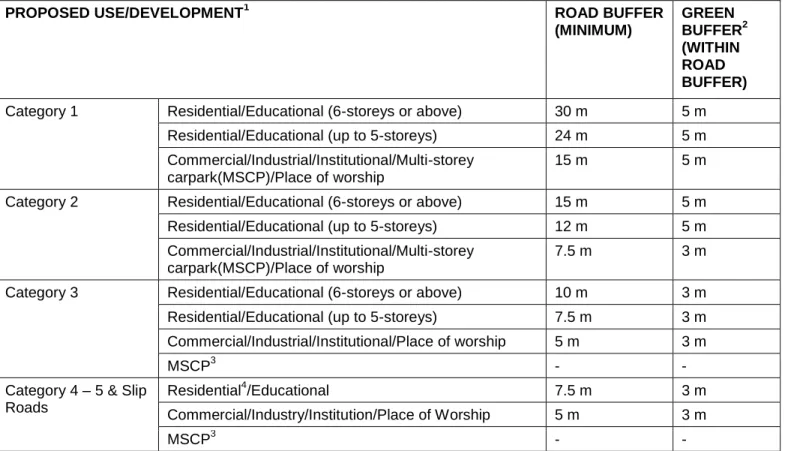
Figure 2:
Buffer Requirements Along Roads
PROPOSED USE/DEVELOPMENT1 ROAD BUFFER
(MINIMUM) GREEN BUFFER2 (WITHIN ROAD BUFFER) Category 1 Residential/Educational (6-storeys or above) 30 m 5 m
Residential/Educational (up to 5-storeys) 24 m 5 m Commercial/Industrial/Institutional/Multi-storey
carpark(MSCP)/Place of worship
15 m 5 m
Category 2 Residential/Educational (6-storeys or above) 15 m 5 m Residential/Educational (up to 5-storeys) 12 m 5 m Commercial/Industrial/Institutional/Multi-storey
carpark(MSCP)/Place of worship
7.5 m 3 m
Category 3 Residential/Educational (6-storeys or above) 10 m 3 m Residential/Educational (up to 5-storeys) 7.5 m 3 m Commercial/Industrial/Institutional/Place of worship 5 m 3 m
MSCP3 - -
Category 4 – 5 & Slip Roads
Residential4/Educational 7.5 m 3 m
Commercial/Industry/Institution/Place of Worship 5 m 3 m
MSCP3 - -
NOTES:
1 For the Central Area, the buffer standard for residential developments in the River Valley/Orchard/Newton Planning Area is 7.5m (minimum, of which 3m is for the green buffer). The buffer standard for residential developments outside these three Planning Areas as well as other types of developments within the Central Area will be determined by urban design considerations.
2 The following definitions are adopted for the interpretation of buffer zones
*A buffer is defined as a strip or an area of land which falls either between the road reserve and the building line or between the building lines of neighbouring structures.
*A physical buffer is a buffer within which car park, driveway, cycle tracks, jogging tracks, walkway and small ancillary structures e.g. guardhouses, flag-poles/ lamp posts, sign posts/ boards, bin centres, gas pressure regulator kiosks, gas governor houses-types A & B, overground (electricity) boxes, ring main compact units-reinforced concrete structure/ fenced-up area, below-ground-level structures and canopies for pump islands within petrol service stations may be permitted.
*A green buffer is the segment within the road buffer that is meant for tree planting and turfing only. Small structures e.g. guardhouse, flag poles, lamp posts may be permitted.
3 The road buffer for MSCPs facing a Category 3-5 road is based on that for the predominant use of the development
4 For landed housing with the sides/rear fronting a Category 5 road, the buffer standard is the same as the minimum boundary clearance requirement. There is no need to provide any green buffer.
5 Reserves for drains sewers and minor roads bordering along expressways or major arterials may be considered as part of required buffers for expressways and major arterials.
6 For a drainage reserve with a width greater than that of the buffer and bordering along expressways of major arterials, a planting strip is to be provided within the site nearer to the building line. An additional buffer zone will not be required. However; the Drainage Department, ENV may impose such requirements from time to time for technical reasons.
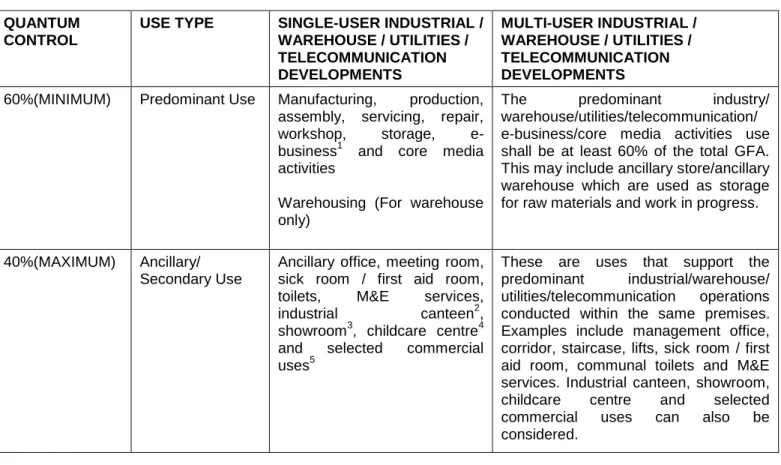
Figure 3:
Quantum Control for Industrial/Warehouse / Utilities / Telecommunication
Development
QUANTUM CONTROL
USE TYPE SINGLE-USER INDUSTRIAL / WAREHOUSE / UTILITIES / TELECOMMUNICATION DEVELOPMENTS MULTI-USER INDUSTRIAL / WAREHOUSE / UTILITIES / TELECOMMUNICATION DEVELOPMENTS 60%(MINIMUM) Predominant Use Manufacturing, production,
assembly, servicing, repair, workshop, storage, e-business1 and core media activities
Warehousing (For warehouse only)
The predominant industry/ warehouse/utilities/telecommunication/ e-business/core media activities use shall be at least 60% of the total GFA. This may include ancillary store/ancillary warehouse which are used as storage for raw materials and work in progress.
40%(MAXIMUM) Ancillary/ Secondary Use
Ancillary office, meeting room, sick room / first aid room, toilets, M&E services, industrial canteen2, showroom3, childcare centre4 and selected commercial uses5
These are uses that support the predominant industrial/warehouse/ utilities/telecommunication operations conducted within the same premises. Examples include management office, corridor, staircase, lifts, sick room / first aid room, communal toilets and M&E services. Industrial canteen, showroom, childcare centre and selected commercial uses can also be considered.
NOTES:
1 E-business activities include telecommunications, call centre, data farm/data centre and Internet Service Provider. Call centre can be located in Business Park and Business 1, but not Business 2 zones.
2 Industrial canteens are capped at a size of 700sqm or 5% of the total proposed GFA per development, whichever is lower.
3 Showroom is confined to the 1st storey of the development.
4 Childcare centre is levied Group E Civic & Community Institution (C&CI) rates for the purposes of computing development charge/differential premium.
5 Selected commercial uses are subject to locational criteria.
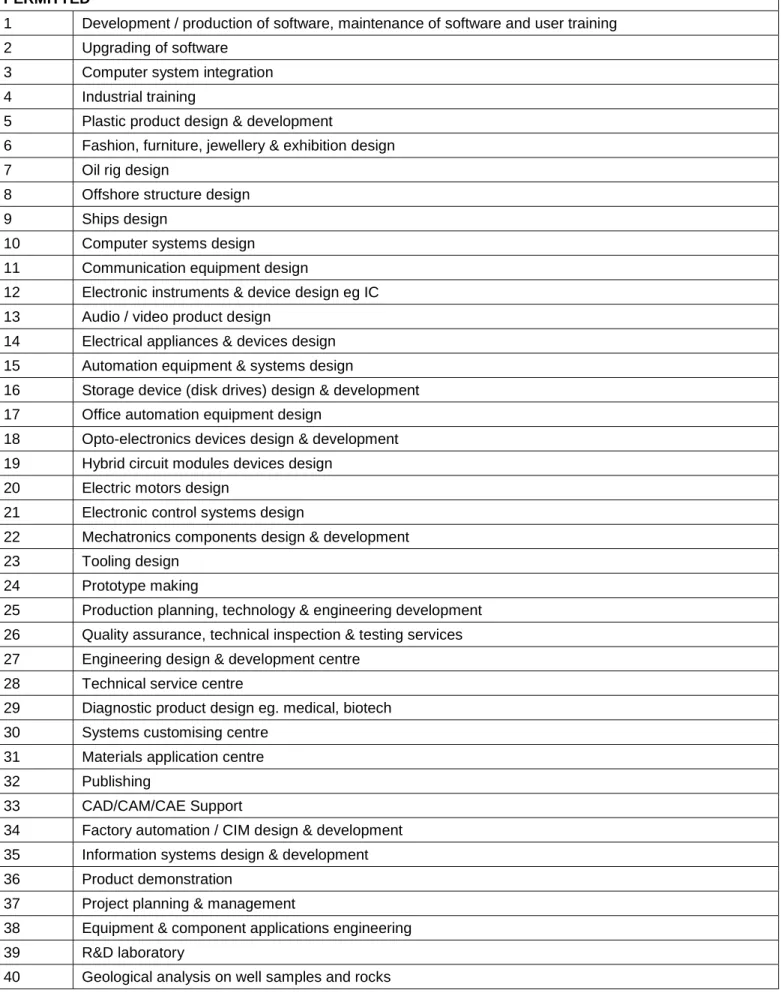
Figure 4:
Allowable & Conditional Activities in the Business Parks
PERMITTED1 Development / production of software, maintenance of software and user training 2 Upgrading of software
3 Computer system integration 4 Industrial training
5 Plastic product design & development
6 Fashion, furniture, jewellery & exhibition design 7 Oil rig design
8 Offshore structure design 9 Ships design
10 Computer systems design
11 Communication equipment design
12 Electronic instruments & device design eg IC 13 Audio / video product design
14 Electrical appliances & devices design 15 Automation equipment & systems design
16 Storage device (disk drives) design & development 17 Office automation equipment design
18 Opto-electronics devices design & development 19 Hybrid circuit modules devices design
20 Electric motors design
21 Electronic control systems design
22 Mechatronics components design & development 23 Tooling design
24 Prototype making
25 Production planning, technology & engineering development 26 Quality assurance, technical inspection & testing services 27 Engineering design & development centre
28 Technical service centre
29 Diagnostic product design eg. medical, biotech 30 Systems customising centre
31 Materials application centre 32 Publishing
33 CAD/CAM/CAE Support
34 Factory automation / CIM design & development 35 Information systems design & development 36 Product demonstration
37 Project planning & management
38 Equipment & component applications engineering 39 R&D laboratory
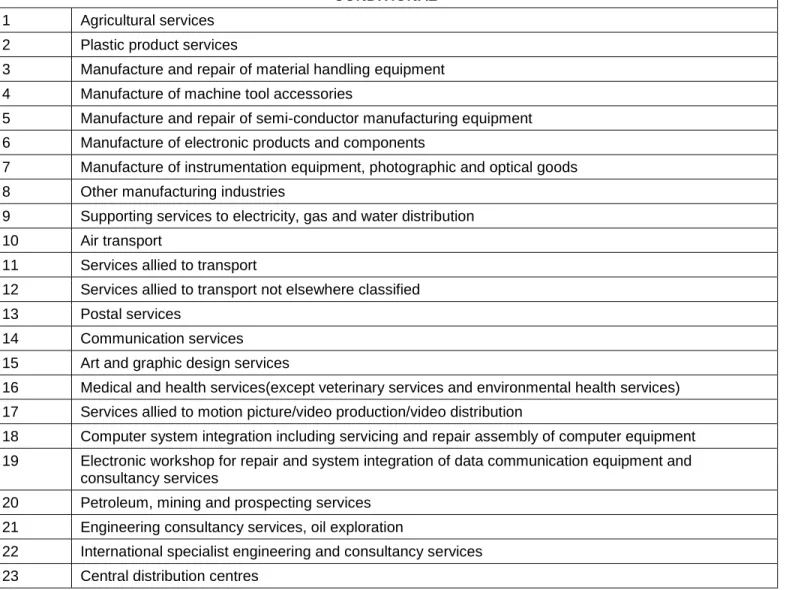
Figure 4:
Allowable & Conditional Activities In The Business Parks (continued)
CONDITIONAL1 Agricultural services 2 Plastic product services
3 Manufacture and repair of material handling equipment 4 Manufacture of machine tool accessories
5 Manufacture and repair of semi-conductor manufacturing equipment 6 Manufacture of electronic products and components
7 Manufacture of instrumentation equipment, photographic and optical goods 8 Other manufacturing industries
9 Supporting services to electricity, gas and water distribution 10 Air transport
11 Services allied to transport
12 Services allied to transport not elsewhere classified 13 Postal services
14 Communication services 15 Art and graphic design services
16 Medical and health services(except veterinary services and environmental health services) 17 Services allied to motion picture/video production/video distribution
18 Computer system integration including servicing and repair assembly of computer equipment 19 Electronic workshop for repair and system integration of data communication equipment and
consultancy services
20 Petroleum, mining and prospecting services 21 Engineering consultancy services, oil exploration
22 International specialist engineering and consultancy services 23 Central distribution centres
Figure 5:
Maximum Allowable Plot Ratio/Storey Height for Place of Worship Developments
LOCATION OF PW-ZONED
SITE
GROSS PLOT RATIO
CONTROL
STOREY HEIGHT CONTROL
Within landed and low-density
housing areas with residential
GPR ≤ 1.4
Up to 1.0
Up to 2 or 3 storeys based on the specific
storey-height control of the landed housing
estate
At the fringe of landed and
low-density housing areas with
residential GPR ≤ 1.4
Up to 1.4
*
Up to 4 storeys
*
Within HDB estates and in
areas with residential GPRs >
1.4
**
Up to 1.6
*
For GPR ≤ 1.4, up to 4 storeys
*
For 1.4 < GPR ≤ 1.6, up to 5 storeys, within
25m envelop control (including attic)
#Within or at the fringe of
industrial estates
**
Up to 1.6
*
For GPR ≤ 1.4, up to 4 storeys
*
For 1.4 < GPR ≤ 1.6, up to 5 storeys, within
25m envelop control (including attic)
#Within Central Area and within
other
commercial
centres,
including
party-walled
developments such as in the
Geylang area
Subject to evaluation
Subject to evaluation
NOTES:
* Subject to detailed localised planning and traffic assessment.
** Further intensification beyond GPR 1.6 could be considered in exceptional cases if there are special circumstances that warrant exceptions to the guidelines, provided that the relevant agencies have assessed that the potential impact arising from intensification are adequately addressed.
# An additional height allowance of up to 5m can be granted if purpose-built above-ground car park floors are provided. The additional height allowance would need to be designed sensitively and will be subject to detailed evaluation (e.g. site context, visual impact, etc).
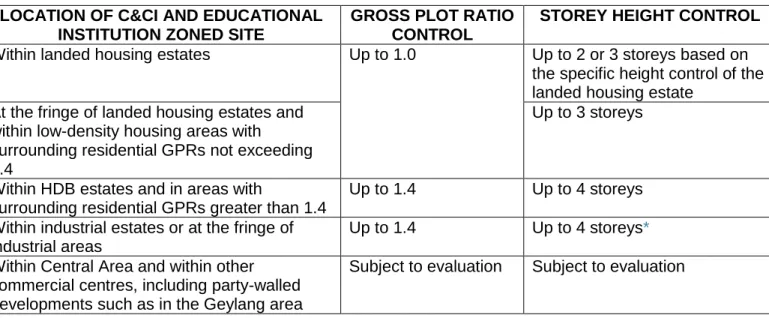
Figure 6:
Maximum Allowable Plot Ratio/Storey Height for Civic & Community Institution
Developments (except for home for the aged, home for the disabled and community club/centre)
and Educational Institutions (except for special education school)
LOCATION OF C&CI AND EDUCATIONAL
INSTITUTION ZONED SITE
GROSS PLOT RATIO
CONTROL
STOREY HEIGHT CONTROL
Within landed housing estates
Up to 1.0
Up to 2 or 3 storeys based on
the specific height control of the
landed housing estate
At the fringe of landed housing estates and
within low-density housing areas with
surrounding residential GPRs not exceeding
1.4
Up to 3 storeys
Within HDB estates and in areas with
surrounding residential GPRs greater than 1.4
Up to 1.4
Up to 4 storeys
Within industrial estates or at the fringe of
industrial areas
Up to 1.4
Up to 4 storeys
*
Within Central Area and within other
commercial centres, including party-walled
developments such as in the Geylang area
Subject to evaluation
Subject to evaluation
NOTES:
* Storey height higher than 4-storeys can be considered subject to evaluation
1 Existing C&CI developments are allowed to intensify up to the above plot ratio bands, as and when there are proposals for additions and alterations or redevelopment.
2 Existing C&CI developments with approved gross plot ratios exceeding the above plot ratio bands, are allowed to redevelop up to the previous approved gross plot ratio.
Figure 7:
Quantum Control for Warehouse Retail / Industrial Retail Building
QUANTUM CONTROL
USE TYPE
EXAMPLE OF ALLOWABLE USES
60%(min) 36%
(min)
Predominant
Warehouse/Industrial Use
All industrial uses allowed for developments in B1/B2 zone such as:
Manufacturing, production, assembly, servicing, repair, workshop, storage, e-business and core media
activities 24% (max) Ancillary Warehouse/Industrial Use
Ancillary office, meeting room, sick room / first aid room, toilets, M&E services
40%(max) Ancillary Retail Use Must be supporting & ancillary to the warehouse / industrial activities.
USES WHICH CANNOT BE ALLOWED Independent retail unrelated to the warehouse/ industrial use
NOTES:
WRS is applicable to sites zoned B1 or B2 in the outlying area (Refer to EDB press release - Annex 1). Other sites proposed for the scheme will be subjected to evaluation and approved on a case by case basis.