The advantages of tunnel boring : a qualitative/quantitative
comparison of D&B and TBM excavation
by Peter J Tarkoy, PhD, Geotechnical and Tunnel Construction Consultant and James E Byram, PhD, Senior Research Scientist
Introduction
Historical perspectivesT
UNNEL boring was originally attempted over 150 yearsago, simultaneously yet independently in England, Europe and North America. The original attempts are generally consid-ered failures, except for the 1.5km Shakespeare tunnel in Dover, a part of the original Channel tunnel, bored over 100 years ago. The imagination of scientists and engineers were far ahead of the technology necessary to turn their concepts into practical re-ality.Another major attempt to establish tunnel boring was made in the United States during the early 1950s and continuing into the 1960s with some success in very soft rocks. With advances in technology and a desire to excavate harder and harder rock, suc-cess was not always realized. Nevertheless, the use of Tunnel Boring Machines (TBMs) increased into the 1960s and 1970s with technological advances that allowed successful tunnel bor-ing in harder as well as less competent rock. With each advance in technology and success in the field, unsuccessful projects were not uncommon.
As the use of TBMs increased worldwide, they were also used in labour-rich and capital-poor countries because of inherent ad-vantages and because overseas TBM contractors became very competitive with local D&B excavation. In the late 1960s and early 1970s, the question often asked was:
"Can the tunnel be excavated by TBM?" Today, the question has become:
"Can you afford not to excavate with a TBM?"
Yet to remain impartial, TBMs cannot alone be considered a solution for concerns or problems of tunnel excavation, over-break, support, dealing with difficult ground or timely comple-tion. Avoidance of problems can only be accomplished with
project coordination, management and planning while using the • short lead times available for beginning conventional (drill most suitable methods and equipment. That the most appropriate and blast) tunnelling
methods most often consist of tunnel boring, does not in itself As we speak, a new TBM is being built and a used TBM is guarantee successful tunnel boring. being re-furbished to begin excavation in Hong Kong in less
With this in mind, let us look at the qualitative and quantita- thansixmonths. tive advantages of tunnel boring.
Recent developments
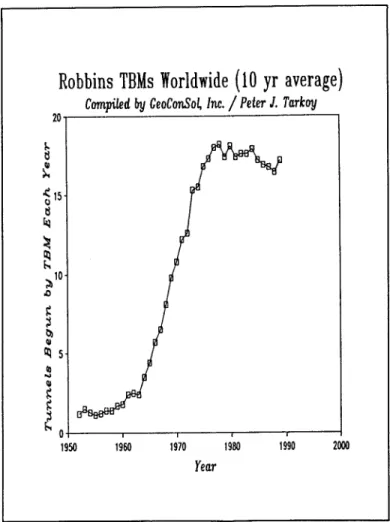
Tunnelling and especially tunnel boring has had a particular fascination for engineers and contractors alike. The use of tunnel boring has increased through the last two decades to the extent that more than 20 tunnel projects are begun each year by new and used TBMs worldwide (Fig 1).
Although tunnel boring accounts for 80 to 90% of all civil tunnel excavation in North America and an ever increasing por-tion of tunnels worldwide, tunnel boring has not been the method of choice in many parts of the world. For example, in Hong Kong, reasons that have prevented the implementation of tunnel boring, until recently, were:
• the existence of hard granitic and volcanic rock
• plentiful and low cost labour
Fig 1 Tunnels begun each year by Robbins TBMs
Former advantages of D&B excavation
Rock hardness greater than that found in Hong Kong and up to 400 MPa has been successfully bored in other parts of the world in the past 10-15 years. Hard rock boring has become more and more economical as a result of the increase in cutter diameters (by a factor of 1.5), cutterhead gauge velocities (by a factor of 2), cutter load capacity (by a factor of 7), and improve-ments in cutter metallurgy.
The availability of labour has dwindled in many countries. In Hong Kong the shortage of labour may be attributable to the many public works projects currently underway. Consequently, the cost and scarcity of skilled labour has dramatically in-creased. Furthermore, with the increase in the number of ongo-ing projects, Castle Peak Tunnel (9km), Hong Kong Electric's Second Cable Tunnel (5km), Tolo Harbour Effluent Export
to
PROFILE
1 Crown 2 - Fam 3 Springline
A-Crown B - Springlinc C - Invert
Fig 2 Face and work area stability considerations
Scheme (7.5km), Highway 3 (20km), the Master Sewerage Scheme (total of 30km of tunnels), it is expected that labour shortages, particularly skilled labour necessary for D&B exca-vation, will become crucial. A summary of anticipated projects have been summarized by Wallis (1989).
The short lead times can be dealt with in the following ways:
• use of reconditioned machines (short refurbishment time)
• early order of new machines
• partial pre-order of major machine components by the contractor
A study of TBM excavation rates will reveal that excavation by machine may allow time for the manufacture of the TBM, a delayed start of excavation, while still maintaining a timely project completion with less risk.
Basisof comparison
A simple comparison intended to identify the major cost con-siderations associated with drill and blast excavation and me-chanical tunnel boring will be the subject of this pa per. The comparison of conventional (D&B) and mechanical ('113M) ex-cavation will be made on the basis of similar physical, labour, level of skill, mechanical and other conditions. Wherever possi-ble, assumptions will reflect appropriate conditions and localex-perience will be used for construction performance, excavation rates and workmanship.
Basic assumptions
When comparing D&B and' IBM excavation costs, project as-sumptions will be the same, namely in terms of tunnel length and diameter. The only differences will be in terms of:
• number of working headings
• the excavation advance rate (per working heading)
• qualitative differences between D&B and TBM excavation
HONG KONG ENGINEER/JANUARY 1991
Fig 3 Recessed cutterhead and fully shielded TBM
• access structures (as needed only)
Case history data utilized
D&B advance rate experience is based on average Hong Kong excavation rates. The TBM advance rate is based on two ported case histories (Tarkoy, 1988; Tarkoy, 1989) and one re-cently visited site. Case history "TLHP" and "SRT" (Tarkoy, 1989) represent easily attainable advance rates possible under geological conditions similar to Hong Kong. Case "TLHP" rep-resents advance rates without effective and ambitious project management, whereas, project "SRT" represents effective plan-ning, rigorous project management and ambitious construction excavation. Similarly, the "SHEP" project is averaging nearly
lkm per month.
Major cost items
Major cost items affected by the excavation method and con-sidered in this analysis, are:
• cost savings resulting from qualitative advantages of me-chanical excavation
• l'BM excavation rates four to six times higher than D&B excavation
• overbreak (cost of delivered concrete, wastage and labour to fill overbreak)
• labour crew costs
• equipment costs (drills, jumbos, muckers, cars, trains, TBM, etc)
• associated supplies (drill bits, TBM cutters, blasting agent)
• support costs
• elimination of temporary construction structures (access adits and/or shafts)
The cost comparison has been prepared to be applicable only in Hong Kong. A full and realistic construction estimate should be prepared for establishing the method of excavation and sup-port.
Operational advantages
There are a number of inherent advantages to tunnel boring which are difficult to quantify yet have a considerable impact on the outcome of excavation rates and costs. These are difficult to value in a tender. These advantages cannot fully be appreciated except from firsthand tunnel boring excavation experience. Some of these are:
• structural stability and safety at the face and work area
Fig 4 Stability in workarea (water inflow)
• consistent, less skilled and easily trained operations (lab-our is assigned to limited tasks that are repetitive, become routine, and may even produce competition among the labourers)
• safer and more pleasant working environment than in D&B
Structural stability and safety
The stability and safety at the excavation face, heading, work area and the lifeline out of the tunnel has always been of great concern in tunnelling. Current technology and tunnelling tech-niques provide the ability to provide safe and stable conditions in all areas illustrated in Fig 2.
There is an inherent level of stability in having a tunnel boring machine at the heading, supporting the work area or blocking possible inrush of materials into the work area. For example, many sudden failures at the heading (typical in fault zones in Taiwan) occur as a result of an excavation blast initially in rock, transgressing into unstable material, soil or a fault zone. The final blast in competent ground triggers the deteriorating ground conditions and a full blown collapse or tunnel inrush may occur even under the watchful eye of the engineer (eg - second Tienlun Power Tunnel).
The avoidance of blasting and the stabilizing effect of a full face machine has often been immeasurable, yet striking. The major zones of concern are at the tunnel face, ahead and around the TBM cutterhead and in the work area, as illustrated in Fig 2. These areas of concern may be summarized as follows:
• Heading
Face - fullface cutterhead
Fig 5 Stability behind work area (water inflow)
Crown
• Work area Crown Springline Invert
cutterhead shield finger shield, full arch shield, full shield invert shoe, full shield
• Behind the work area
• temporary support
rock bolts, strapping, channels, and mesh shotcrete
steel ribs and lagging
pre-cast segments (primary and/or final)
• permanent support (pre-cast segments or cast-in-place close behind the excavation face)
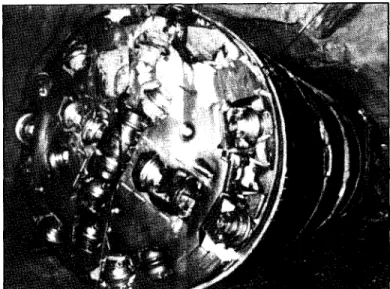
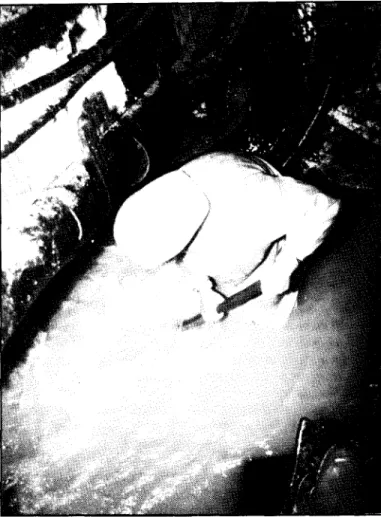
Stability and safety is of particular significance in the heading and work area and recent TBM designs, such as illustrated in Fig 3 have maneuvered some of the most adverse ground condi-tions successfully. The most common solution developed for very difficult rock conditions such as flowing sand, swelling claystones or squeezing rock has been the use of various types of recessed cutterhead and shielded tunnel boring machines as illustrated in Fig 3. Fig 4 illustrates the same TBM having en-countered 3001/sec flowing from the invert. Had the same tun-nel been driven by D&B it would certainly have been impossi-ble to work safely at the heading above voids with flowing water that were safely bridged, first by the shield and later by
the pre-cast segments.
0
75
d
\
50
-D&B and TBM Excavation Rate Experience Compiled by CeoConSol, Inc. / Peter J. Tarkoy
® DkB TBY (Adverse) ® TBY (Successful)
41
0 I
Project Designation
Fig 7 D&B and TBM excavation rate experience
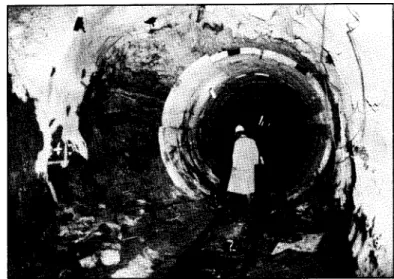
Shielded machines as illustrated in Fig 3 have also been used, with and without temporary and final continuous pre-cast con-crete lining, to protect against damage by water inflow (Fig 5) and support totally decomposed sandstone, some of which has entered the tunnel through grout holes (Fig 6).
Continuity of operation
Tunnel excavation is linear and TBM work crews perform consistent activities. For example, in conventional excavation, the entire crew generally performs cyclical operations including the drilling, loading, wiring, blasting, venting, scaling, installing support and mucking. This requires a variety of well developed competences and skills. In comparison, TBM crew members are generally assigned a much more limited and consistent set of tasks or responsibilities, such as:
• TBM operator
• mechanics and electricians
• general labour
installation of rail, utilities and support maintenance
• train operation
All require fewer skills that are performed repetitively. An added benefit of TBM excavation is that it does not inter-fere or conflict with installation of support or mucking.
Advantages in terms of skilled labour requirements
There are unique advantages and a lower labour skill require-ments for TBM excavation because of its continuous nature and assignment of crew members to specific and limited responsibil-ities. First, the training of unskilled labour is easier than for
HONG KONG ENGINEER/JANUARY 1991
Fig 8 Illustration of overbreak (TDLR)
comparative conventional excavation for the following reasons:
• each crew member has limited responsibilities and there-fore is required to learn fewer skills
• since the operation is continuous and the activities of crew members repetitive, learning is continually reinforced and accelerated
• fewer high skill level tasks (machine operator, mechanic, electrician)
Performance advantages
TBM performance advantages can be directly related to quan-titative benefits and differences which easily translate into costs and are amenable to direct comparisons. Quantitative perfor-mance and cost comparisons can be made for:
• excavation rates
• overbreak
• support
• labour
• equipment
• supplies
• elimination of temporary structures High excavation rates
One of the most significant advantages of tunnel boring are the high excavation rates which can be attained (four to six times higher than local D&B advance rates). D&B experience in
0
Fig 9 Illustration of overbreak (LD&T) s
15 20
I I
Q -I
L I I W
0 0 I N I
Y I- I - N
A i
Overbreak Experience
Compiled by CeoConSol, Inc. / Peter J. Tarkoy
T max J. min
X avg
Fig 10Overbreak experience
Hong Kong and TBM experience under similar conditions in other parts of the world are illustrated in Fig 7.
Overbreak
Overbreak is generally influenced by the following factors:
• lithology
• rock (intact and mass) properties
• quality of the blasting practices
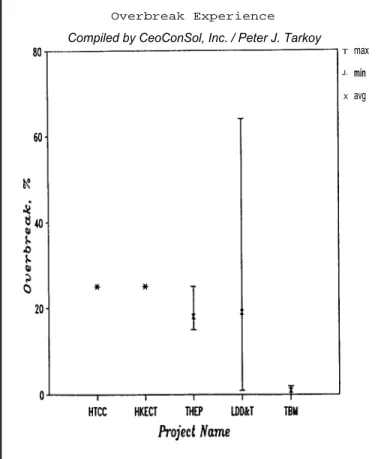
Typically, no less than 10% overbreak should be anticipated in drill and blast excavation. However, in ideal conditions, using controlled blasting practices, a lower percentage of overbreak can be attained. Most commonly, however, the overbreak in Hong Kong, Taiwan, and where poor blasting practices are used, is quite high. Comparative illustrations between overbreak
sus-Fig 11 Illustration of D&B and TBM steel supports
tained in D&B and TBM tunnels is shown in Figs 8 and 9. Fig 8 illustrates a transition from good rock excavated by drill and blast and weak rock excavated by TBM and lined by pre-cast segments. Fig 9 illustrates a D&B tunnel excavation where in some cases the overbreak exceeded 60% of the face area.
This overbreak will eventually have to be filled with concrete, require building of special bulkheads, result in additional con-crete wastage, and sustain a greater wastage, leading to substan-tial additional costs. Overbreak experience for several projects is illustrated in Fig 10.
Support costs
Tunnels excavated through similar geological conditions (por-tals starting from opposite sides of a river valley) have consis-tently required much more support when excavated by D&B than by TBM as illustrated in Fig 11. A study of seven sites where excavations by D&B and TBM encountered similar geo-logical conditions, revealed that the average steel rib support in TBM excavated tunnels is 1/12 that of D&B tunnels as
illus-trated in Fig 12.
Since there is generally 90-95% less steel rib support required for mechanically excavated tunnels, a considerable cost saving can be realized with mechanical excavation. The cost saving thus calculated will be for the steel ribs only, however, similar reduction of rock-bolt, shotcrete, NATM and other types of sup-port can also be realized. Labour cost savings associated with differences in support will not be included since they will be taken into account in advance rate comparisons and differences
D&B & TBM Steel Rib Support (7 Sites)
Compiled by CeoConSol, Inc. / Peter J. Tarkoy 6056M1
159
0kB TBM
® DkB IBM
Fig 12 D&B & TBM steel rib support
in crew composition.
Labour costs
Cost comparisons of D&B and TBM excavation must inevita-bly include the following differences in labour requirements:
• only one crew is required for a single TBM working face (TBM excavation rate roughly equivalent to four D&B working faces)
the TBM crew will be larger (1 foreman, 1 operator/me-chanic, 1 electrician, 2 labourers for utilities/rails/support, 1 conveyor operator, 2 locomotive operators, 2 brakemen for a total of 10 labourers at the heading and train; on a re-cent project in Norway, the same crew functions were
per-Fig 13 Unnecessary and unwanted access structure
Major Costs for D&B/TBM Excavation
Compiled by GeoConSol, Inc. / Peter J. Tarkoy® DkB 6 m/day ® IBM 20m/day ® TBM 40m/day
Fig 14 Major cost for D&B and TBM excavation
formed by only 4 men)
• less skill and more easily trainable because operations are more consistent and continuous
Cost of equipment and supplies
The major equipment costs in multiple D&B headings are as-sociated with the drilling jumbo, mucking equipment and other support plant (air, water, discharge pumps, etc). This is particu-larly costly when needed for isolated headings, access adits or shafts in remote areas. In addition, D&B excavation would in-clude cost of supplies such as spares, drill bits, drill steel and blasting powder and caps.
In contrast, TBM excavation costs will be for the boring ma-chine (partial depreciation of a new mama-chine or leasing costs for a rebuilt machine) and the cutter costs. It is unusual that a new machine can completely be depreciated on a single project. The purchase of a TBM requires long term investment for use of a machine in more than just one project.
Eliminationof temporary construction structures
The single most extraordinary saving that.can be realized with TBM excavation is in the possibility of eliminating temporary excavation structures such as access adits, tunnels and shafts. This becomespossiblewith a single'1.BM heading having the
same rate of excavation advance as four D&B Dings. In Hong Kong, the cost of an access adit or shaft, with associ-ated workings, has been bid at about HK$50 million (for a 3-3.5m tunnel) recently.
Some temporary access structures and associated blasting may also be highly undesirable to local surroundings as for example in the residential neighbourhood of Hong Kong illustrated in Fig
13. 0
Quantitative cost comparisons
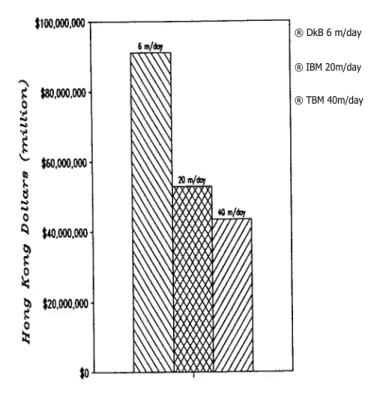
The results of the cost comparisons are presented in Fig 14. It is evident that TBM excavation has substantial cost advantages when temporary structures are eliminated. TBM excavation costs in Fig 14 reflect a savings of nearly HK$50 million for the elimination of a temporary access structure. The initial capital i nvestment for tunnel boring equipment and its backup system is sizable. The cost comparisons were based on partial deprecia-tion of a new TBM or alternatively on the full leasing cost of a refurbished TBM.
Conclusions
• TBM excavation offers major cost advantages at low prog-ress rates with the major cost savings from the elimination of temporary construction structures.
• TBM excavation provides considerable advantages at high progress rates with some cost savings from the elimination of temporary construction structures.
• Inclusion of the cost saving associated with the
elimina-HONG KONG ENGINEER/JANUARY 1991
tion of temporary excavation structures provides a sub-stantial cost advantage to TBM excavation.
References
1) Tarkoy, P J and Wagner, J R (1988). Backing up a TBM. Tunnels and Tunnelling 20(10):27-32 (October).
2) Tarkoy P J (1988). The Stuff that Claims Are Made Of. World Tunnelling 1(3):249-253 (September).
3. Tarkoy P J (1989). Differing Site Conditions Often Gener-ate Claims. The Military Engineer 81(531):72-75 (Septem-ber/October).
4. Tarkoy P J (1989). A Tale of Two Tunnel Bores, Proceed-ings International Congress on Progress and Innovation in Tun-nelling, Toronto, Canada, September 9-14, pp 1045-105 1.
5 Tarkoy P J (1990). Estimating and Improving Excavation Performance, 1990 Transactions of the American Association of Cost Engineers, 34th Annual Meeting, June 24-27, Boston.
6. Wallis S (1989). Hong Kong and its underground strategy, Tunnels & Tunnelling, January.