Teaching Scholars Programs:
Faculty Development for Educators
in the Health Professions
Donald C. Fidler, M.D., F.R.C.P.(I), Rashida Khakoo, M.D.
Lee Ann Miller, Ed.D.
Received May 19, 2006; revised November 8, 2006; accepted March 22, 2006. Dr. Fidler, Dr. Khakoo, and Ms. Miller are affiliated with the Teaching Scholars Program, West Virginia University Health Sci-ences Center. Address correspondence to Dr. Fidler, PO Box 9170, Morgantown, WV 26505; [email protected] (e-mail).
Copyright䊚2007 Academic Psychiatry
Objective:This article 1) provides an overview of formal Health Sciences Teaching Scholars Programs as presented in medical education literature and 2) presents information about an in-novative multidiscipline Teaching Scholars Program.
Method: Health Sciences Teaching Scholars Programs and similar programs were reviewed in the medical education liter-ature to identify similar and dissimilar characteristics. The WVU Teaching Scholars Program highlighted in this article is presented with a discussion of goals, objectives, target audiences, course length, session frequency, program topics, learning methods, and assessments of the programs. A summary of the WVU Teaching Scholars Program and two Teaching Scholars Programs at Mc-Gill University and the University of Toronto were presented at the Association for American Medical Colleges (AAMC) annual meeting in 2006 for input from the general medical education audience.
Results: Comparisons of Health Sciences Teaching Scholars Programs reveal that successful programs are uniquely shaped by their educational environments. Scholars report that they value learning new teaching methods and improving their edu-cational careers.
Conclusion:Teaching Scholars Programs are valuable for the development of enhancing both teaching and scholarship in Health Sciences Programs and must adapt to the uniqueness of their respective educational environments and must continue to nurture scholars beyond graduation.
Academic Psychiatry 2007; 31:472–478
S
tephen Abrahamson of UCLA discussed in his 1996 review article on medical education that medical edu-cation since World War II was increasingly short changed due to competing research and clinical priorities (1). In response to this “short changing,” many schools developed teaching scholars programs. In 1974, both the U.S. Federal Government and the Robert Wood Johnson Foundation helped fund parallel teaching scholars programs in family medicine programs. From 1974 to 2006, several major uni-versities participated: University of California Los Ange-les, University of Michigan, University of Pennsylvania, Yale University, University of North Carolina, University of Washington, University of Chicago, and Johns Hopkins University. Many of these programs expanded from Family Medicine to other medical school departments and health sciences disciplines with the emphasis of studying health care policy and studying patient care research (2). Al-though these programs were very successful, these pro-grams did not have the major goal of directly improving teaching and encouraging scholarship of education in the health sciences.Across the U.S. and Canada, numerous universities de-veloped programs to directly address improving teaching and encouraging scholarship of education in the health sci-ences. These programs developed through various venues. Many schools developed formal faculty development pro-grams and established formal offices of medical education. Some universities formed Medical Education Scholars Programs (MESP) (3). Other universities formed pro-grams called “Academies” (4) and other universities re-ferred to their faculty development programs as “grass-roots programs” (5). Dartmouth University reported indirectly developing scholar-like programs by developing the supporting infrastructure to “accelerate” educational research productivity (6).
A search of the medical education literature revealed that numerous universities initiated formal Teaching Scholars Programs which were most often formed within specific departments, most often within departments of in-ternal medicine. The medical education literature contains reports on such programs at several universities: Harvard, USCF, McGill, UCLA, University of Michigan, University of Washington, Johns Hopkins, and University of Iowa. Teaching Scholars Programs were also developed by the University of Utah in pediatrics, by the Medical College of Georgia in nursing, and by Harvard University in den-tistry. Numerous other universities developed similar pro-grams but did not report these in the medical education literature.
Reviewing these programs revealed that the programs reported common goals:
• Enhancing teaching methods • Promoting education research • Promoting the scholarship of teaching • Enhancing curriculum development • Enhancing assessments development • Promoting advising and mentoring • Promoting executive leadership skills (7)
Reviewing these programs revealed that the programs had similar outcomes:
• Increases in enthusiasm for teaching • Increases in educational research
• Increases in publications of educational abstracts, ed-itorials, chapters, and books
• Increases in presentations about education at profes-sional association meetings (8)
The University of Michigan also reported increases in promotions, education awards, new educational responsi-bilities, and new educational programs (3).
Teaching Scholars Programs and similar programs re-ported variations in funding from having no direct funding as presently exists at WVU, to investing $21,000 per scholar as reported at the University of Michigan (3). Pro-grams also reported variations in amounts of grant monies. Many universities reported having no formal grants whereas the combined Teaching Scholars Program and Biomedical Infomatics Program at University of Washing-ton reported having $1.2 million in grants (9).
Teaching Scholars Programs reported variance in fac-ulty-release time from 1-hr weekly sessions at the main
campus of WVU, monthly sessions at the University of Iowa (10), and one half day per week sessions at the Uni-versity of Michigan (3).
A review of the medical education literature revealed discussions about what should be considered “scholarly” work. Simpson (Medical College of Wisconsin) and Fincher (University of Georgia) reported in their “Project on Scholarship” that the Graduate Education Association of the Association of American Medical Colleges used a traditional definition for scholarly works as consisting of “goals, methods, results, and effective communication” (11). In a second paper, Simpson and Fincher maintained “Creative teaching with effectiveness that is rigorously sub-stantiated, educational leadership with results that are de-monstrable and broadly felt, and educational methods that advance learners’ knowledge are consistent with the tra-ditional definition of scholarship” (12).
Report on the Teaching Scholars Program at West Virginia University
In 1999, Dr. Rashid Khakoo (Assistant Vice President for Health Sciences Faculty Development), Dr. Donald Fi-dler, and a committee of teachers from preclinical and clinical faculty programs from the schools of dentistry, medicine, nursing, and pharmacy developed a cross-disci-pline Health Sciences Teaching Scholars Program. Begin-ning in 1999, the first eight scholars met face-to-face on a weekly basis from 8:00 a.m. to 12:00 noon from September to May. Throughout the program, classes varied from 8 to 11 scholars per year. A 4-hr weekly program posed a chal-lenge to many participating faculty members due to their clinical responsibilities, but financial reimbursement to members’ departments was helpful. In 2003, due to finan-cial limitations, the main campus in Morgantown down-sized to 1-hr weekly sessions.
Ultimately, due to time constraints, the program was revised as a combination of an online web course via the SOLE (Secure Online Environment Program) with 1 hour of face-to-face meeting time per week from September to May. Although the program lost 75% of its discussion time, the asynchronous online discussions helped to focus thinking and discussions about the subject matter beyond the classroom hours. More importantly, access to online materials occurred before, during, and after the program and reinforced scholars’ learning.
For faculty members who presented the Teaching Scholar Program modules, the experience of facilitating an online version of a previously face-to-face session for scholars provided a welcome opportunity for online
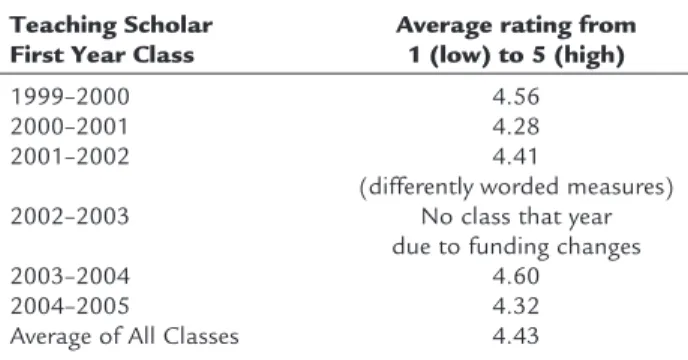
teach-TABLE 1. How Scholars Subjectively Ranked the Individual Learning Sessions
Teaching Scholar First Year Class
Average rating from 1 (low) to 5 (high)
1999–2000 4.56
2000–2001 4.28
2001–2002 4.41
(differently worded measures) 2002–2003 No class that year
due to funding changes
2003–2004 4.60
2004–2005 4.32
Average of All Classes 4.43
Note: The lowest score for a specific measure for a specific session was 1.00 and the highest was 5.00. The lowest averaged score of all participants for all measures for one session was 2.75 and the highest was 5.00.
ing. Many of those presenters gained significant web de-velopment skills.
In 2003 and 2004, the Teaching Scholars Program ex-panded to include the two branch campuses in Charleston and the Eastern Panhandle of West Virginia. The format was altered to fit the different environments of the branch campuses, creating 4-hr monthly sessions.
In 2005, the Teaching Scholars Program developed a 1-week summer program consisting of full-day sessions for six consecutive days. Faculty members from all three WVU campuses and applicants from other universities were in-vited to participate in the summer program. The summer program opened the Teaching Scholars Program to faculty members during a time of less course loads and also opened the program to individuals outside of the Univer-sity, which provided additional funding for future devel-opment.
Web-based programs were essential for assuring and maintaining similar content experiences for the four pro-grams. The three campus programs also developed a re-quired second year. During the second year, scholars col-laborated to implement and continue research projects which they designed during their first year of courses.
Use of the online hybrid program provided many inter-esting results. First, participation increased due to the wider reach of the Internet. For example, faculty from Charleston and Eastern campuses no longer needed to drive several hours to Morgantown to participate. The use of predistributed materials online facilitated preparation for sessions and made future access to materials more con-venient. Keeping the 1 hour weekly and the 4-hr monthly face-to-face sessions provided the “human touch” often missing in distance education. In addition, the nature of online access allowed greater flexibility and practicality for busy clinical faculty.
Information about the WVU Teaching Scholars Pro-grams is presented in the Appendix.
Evaluation of WVU Health Sciences Teaching Scholars Program
The directors developed two major assessments for the program: 1) online surveys of each learning session from all campuses, and 2) longitudinal surveys to assess the con-tinuing performances of the scholars during their post-pro-gram educational careers
Results
Online Surveys of the Individual Learning Sessions
Online surveys were done immediately after each weekly or monthly session with an 87% return rate. Our
administrator sends frequent emails to the entire class to remind them to answer the anonymous online surveys within a week of the session. Each session was assessed for eight measures:
• The objectives were clearly stated • The objectives were met
• The facilitator/lecturer was knowledgeable about the topic
• The facilitator/lecturer’s passion for the topic and teaching methods held my attention
• The facilitator/lecturer was respectful to participants • The workshop was useful for my role as being a health educator
• The teaching methods used by the facilitator/lecturer were a useful demonstration of excellent teaching methods • This presentation inspired me to try to make changes in my teaching
The averaged results of the total year’s sessions are shown in Table 1.
Longitudinal Survey of the Scholars Who Graduated From the WVU Health Sciences Teaching Scholars Program
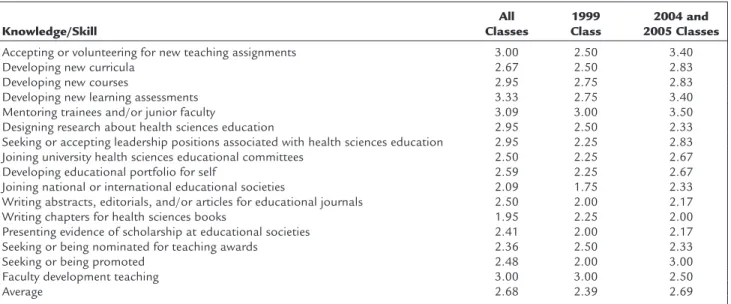
Former scholars received surveys by mail and were asked to rate measures about the degree they were or were not impacted by their participation in the teaching scholars program (Table 2). Former scholars returned the surveys by mail in a manner to assure anonymity as required by the IRB. Scholars rated the measures by using a scale where 1⳱ decrease or no increase, 2 ⳱no present in-crease but predict future inin-crease, 3⳱slight increase, 4
TABLE 3. Scale of How Graduated Scholars Ranked Implementing Knowledge and Skills for Improving Their Academic Careers Knowledge/Skill All Classes 1999 Class 2004 and 2005 Classes
Accepting or volunteering for new teaching assignments 3.00 2.50 3.40
Developing new curricula 2.67 2.50 2.83
Developing new courses 2.95 2.75 2.83
Developing new learning assessments 3.33 2.75 3.40
Mentoring trainees and/or junior faculty 3.09 3.00 3.50
Designing research about health sciences education 2.95 2.50 2.33 Seeking or accepting leadership positions associated with health sciences education 2.95 2.25 2.83 Joining university health sciences educational committees 2.50 2.25 2.67
Developing educational portfolio for self 2.59 2.25 2.67
Joining national or international educational societies 2.09 1.75 2.33 Writing abstracts, editorials, and/or articles for educational journals 2.50 2.00 2.17
Writing chapters for health sciences books 1.95 2.25 2.00
Presenting evidence of scholarship at educational societies 2.41 2.00 2.17
Seeking or being nominated for teaching awards 2.36 2.50 2.33
Seeking or being promoted 2.48 2.00 3.00
Faculty development teaching 3.00 3.00 2.50
Average 2.68 2.39 2.69
TABLE 2. Scale of How Graduated Scholars Ranked Their Implementing of Teaching Methods That They Learned From the Program
Program Material All Classes 1999 Class 2004 and 2005 Classes
Instructional materials (Slides, Power Points, handouts, etc.) 2.95 2.50 3.40
Web-based 3.00 2.25 3.33 Case-based 2.86 2.50 3.17 Evidence-based 2.82 2.50 2.83 Problem-based 2.77 2.75 3.00 Concept-mapping 2.41 3.00 2.17 Role-play 2.50 2.00 2.83 Video 2.36 1.75 2.33 Hand-held devices 1.91 1.25 1.33 Simulated patients 2.73 2.50 3.33 Competency-based 3.14 2.50 3.00 Small-group 2.77 2.75 2.50 Clinical teaching 2.71 3.50 2.67 Average 2.69 2.44 2.76
⳱moderate increase, and 5⳱large increase. At the time of this publication, 22 (or 44%) of 50 scholars had sub-mitted their anonymous surveys.
Scholars from the earliest graduation class (1999) ranked three measures higher whereas scholars from the two most recent graduation classes (2004 and 2005) ranked 10 measures higher of skills they implemented in teaching (Table 3).
Interestingly, scholars from the earliest graduation class (1999) ranked three measures higher whereas scholars from the two most recent graduation classes (2004 and 2005) ranked 16 measures higher of knowledge and skills they implemented in improving their academic careers. Al-though the “n” was small (three graduates of eight from
1999 and four graduates of 16 from 2004 and 2005), we did not see a trend that early graduates implemented more of what they learned by the fact that they had more years of time since graduation to implement what they learned. The trend appears to be quite the opposite. We surmise that since we began requiring an informal second year for scholars in 2003 and also strongly encouraged more par-ticipation in on-going projects, our more recent graduates are applying more of what they learned. We shall continue to collect data to further assess how scholars perform over the years post graduation.
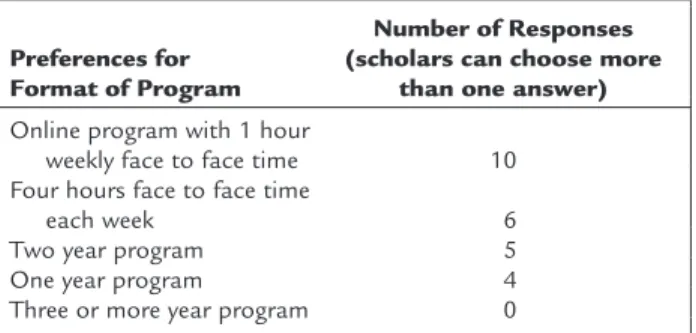
It was interesting that when we correlated the preferred format of the program with the year scholars participated (Table 4), the six scholars who selected that the program
TABLE 4. Scale of How Scholars Ranked Their Preferences for the Format of the Teaching Scholars Program
Preferences for Format of Program
Number of Responses (scholars can choose more
than one answer)
Online program with 1 hour
weekly face to face time 10 Four hours face to face time
each week 6
Two year program 5
One year program 4
Three or more year program 0
should be fours hours per week were all scholars who were in the program when the program was 4 hours per week. The scholars who selected that we should have online pro-grams were scholars who participated in the program when the online programs were most utilized. Most scholars pre-fer the 1-hr weekly (or perhaps 4 hours once per month) with online programs. We inadvertently left off the choice for “four hours 1 day per month” and shall include that in our future surveys.
Discussion
The directors of the Teaching Scholars Program used the online surveys of individual learning events to make decisions about including or excluding topics and in giving feedback to teachers about their organization and teach-ing performances durteach-ing the sessions. It is difficult to compare the scores from early years with scores from later years since less favored topics were dropped and new and often experimental “cutting-edge” topics were initiated. Throughout the many changes in the curriculum, the average scores for individual teaching sessions through-out the years remained high (above 4.43 through-out of 5.00).
In longitudinally assessing the self-assessment of careers of our former scholars, we found scholars expressed higher scores about valuing and enjoying topics but expressed lower scores about implementing what they learned. Al-though scholars reported modest gains about what they actually implemented, they expressed that their future plans include wishes to implement what they learned. This suggests that it is essential for teaching scholars programs to continue to keep in touch with scholars beyond gradu-ation to further stimulate and nurture scholars’ educa-tional interests.
Since the surveys were IRB exempted with the require-ment that we not be able to identify individual scholars,
our study suffers from the weakness that we could not com-pare specific scholars’ answers with what we know about their careers. For example: we do not know how junior faculty compare with senior faculty in implementing what they learned. We anecdotally know that during the im-mediate years after completing the program, a few scholars dropped out of academia whereas several other scholars began vigorously presenting faculty development seminars at WVU and at state and national educational society meetings. Many former scholars became very active as teachers/facilitators in the WVU Teaching Scholars Pro-gram. Many other scholars commented that they became more confident in accepting teaching assignments and in initiating new teaching projects due to learning specific skills from the Teaching Scholars Program.
Our study suffers from the weakness that we do not have a control group of comparable faculty members who did not participate in the teaching scholars program to com-pare with the results about our scholars’ careers.
At the 2006 Association of American Medical Colleges (AAMC) meeting, Donald Fidler, M.D., F.R.C.P.(I), from WVU, Susan Lieff, M.D., Med, F.R.C.P., from the Uni-versity of Toronto, Ontario, Canada, and Yvonne Steinert, Ph.D., from McGill University presented “Teaching Schol-ars Program: Faculty Development for Educators in the Health Professions.” Each presenter presented similar data as contained in this article about their own teaching scholars programs. Although the similarities were striking, the processes of developing the programs and the exact structures of the programs were highly specific to the edu-cational and cultural environments of their respective uni-versities. All three programs had similar positive outcome studies.
Our future plans include surveying other Health Science Teaching Scholars Programs in the U.S. and Canada to more broadly examine format, topic, and administrative issues.
Conclusions
Many university health science centers have approached faculty development through various methods. Establish-ing formal teachEstablish-ing scholars programs is one of several creative and effective methods for health science centers to focus on the quality of education and the scholarship of education. Using combinations of online instruction with face-to-face interactions is very helpful in developing teaching scholars programs in which health science pro-gram faculty members are active in clinical and research
APPENDIX
Goals and objectives:
• Excellence in teaching • Scholarship in teaching • Enthusiasm for teaching • Learner-centered behaviors • Active learning
• Knowledge of various teaching modalities • Development of new teaching modalities • Increased interests in teaching
• Increased numbers of committed faculty teachers • Skilled communications in educational settings • Dissemination of teaching skills
• Exploration of adult learning/teaching theories
• Translation of learning theories into successful teaching • Evaluations of teaching
• Critical thinking
• Technologies for teaching • Development of teaching aids
• Methods for studying teaching/learning • Interdisciplinary teaching
• Grantsmanship for sustaining teaching programs and research in teaching
• Exploration of non-traditional settings for teaching • Recognition of excellence in teaching
• Recognition of scholarship in teaching • Provision of significant incentives for teaching
Target audiences:
• WVU Morgantown Campus: The Teaching Scholars Program selects eight to twelve WVU Health Sciences faculty members yearly to serve as scholars. The scholars are chosen from both clinical and non-clinical Health Sciences Faculty from the four health sciences schools: Dentistry, Nursing, Pharmacy, and the School of Medicine including: (1) clinical departments, (2) basic science
departments, and (3) allied health departments.
• Charleston and Eastern Panhandle Campuses: The Teaching Scholars Program selects four to eight WVU Health Sciences faculty members yearly to serve as scholars at both campuses.
• Summer Program: The summer program is offered to all WVU Health Sciences faculty as well as to faculty from other universities.
Course length and frequency of meetings:
• WVU campus: weekly for one hour September through May.
• Charleston and Eastern Panhandle campuses: monthly for four hours September through May. • Summer program: eight hours per day for six consecutive days in June.
Program topics • SOLE orientation • Philosophy of education • Theories of education • Mentoring • Clinical teaching
• Transforming the learning environment • Development issues/multiple intelligence • Concept mapping
• Case based learning • Constructive feedback • Gender differences in feedback • Large group teaching
• Students with complex learning issues • Problem based learning
• Instructional design
• Clinical evaluations, objectives structured clinical examinations (OSCEs)
• Introduction to assessment & barriers • Assessment principles, approaches
• Writing test questions
• Developing a competency based curriculum • Simulated patients
• Rubrics, portfolios • Interactive online learning
• Interactive response system to promote active learning • Sampling and estimation
• Research designs • Ethics in research
• Quantitative research methods
• Getting started with scholarship in education • Survey research
• Acting/videos, streaming video • Qualitative research methods • Grant writing
• Defining and solving problems • Rising to the occasion • Finding challenge in change
Teaching and learning methods used in the Teaching Scholar Program:
• Small group lectures • Small group discussions • Laboratory computer sessions • Online readings
• Online journaling
• Online chat rooms • Online videos
• Online surveys and examinations • Role Plays
• Patient simulations (actors and computerized manikins)
Features of WVU Scholars Program
• Multidisciplinary program (basic science departments and Schools of Dentistry, Medicine, Nursing, Pharmacy, and other Allied Health Programs)
• Multi-campus program
• Additional condensed 1-week summer program • Integration of online web programs
duties and in which programs are spread out across mul-tiple campus sites or health care delivery sites. It is essen-tial for programs to have flexibility to adapt to ever-chang-ing fundever-chang-ing, cultural, and educational environments.
Note: IRB ruled that the research component was exempt from IRB review under Title 45, Part 46.101(b) (2) of the Code of Federal Regulations as use of survey data in such a manner as to prevent the identification of individual human subjects.
References
1. Abrahamson S: Time to return medical schools to their pri-mary purpose: education. Acad Med 1996; 71:343–347 2. Robert Wood Johnson Clinical Scholars Program:
Participat-ing Universities. Available at: http://rwjcsp.stanford.edu/uni-versities/index.html (accessed May 16, 2006)
3. Gruppen LD, Frohna AZ, Anderson RM, et al: Faculty de-velopment for educational leadership and scholarship. Acad Med 2003; 78:137–141
4. Thibault GE, Neill JM, Lowenstein DH: The Academy at Harvard Medical School: nurturing teaching and stimulating innovation. Acad Med 2003; 78:673–681
5. Thomas PA, Wright SM, Kern DE: Educational research at Johns Hopkins University School of Medicine: a grassroots development. Acad Med 2004; 79:975–980
6. Nierenberg DW, Carney PA: Nurturing educational research at Dartmouth Medical School: the synergy among innovative ideas, support faculty, and administrative structures. Acad Med 2004; 79:969–974
7. Wilkerson L, Irby DM: Strategies for improving teaching practices: a comprehensive approach to faculty development. Acad Med 1998; 73:387–396
8. Hafler JP, Lovejoy FH Jr: Scholarly activities recorded in the portfolios of teacher-clinician faculty. Acad Med 2000; 75: 649–652
9. Wolf FM, Schaad DC, Carline JD, et al: Medical education research at the University of Washington School of Medicine: lessons from the past and potential for the future. Acad Med 2004; 79:1007–1011
10. Rosenbaum ME, Lenoch S, Ferguson KJ: Outcomes of a teaching scholars program to promote leadership in faculty development. Teach Learn Med 2005; 17:247–252
11. Simpson DE, Fincher RM: Making a case for the teaching scholar. Acad Med 1999; 74:1296–129
12. Fincher RM, Simpson DE, Mennin SP, et al: Scholarship in teaching: an imperative for the 21st century. Acad Med 2000; 75:887–894