ADDING VALUE THROUGH HUMAN
RESOURCES: REORIENTING HUMAN
RESOURCE MEASUREMENT TO DRIVE
BUSINESS PERFORMANCE
Arthur K. Yeung and Bob Berman
What is excep-tional about the HR function, however, is that it is less prepared than many other functions (such as finance or management information systems) to quantify its im-pact on business performance. Introduction
In our recent survey of 65 senior human re-source (HR) executives in California, mea-surement of HR effectiveness and impact was ranked as the number one topic that HR ex-ecutives are most interested in exploring. As business competition escalates and corporate resources shrink, all staff functions (e.g., man-agement information systems, finance, hu-man resources, and research and develop-ment) are being pressured to demonstrate their value added and to refocus their re-sources for higher business leverage. Possible outcomes of refocusing staff functions are outsourcing, automation, elimination, and/or downsizing in order to conserve scarce organi-zational resources. The HR function is no ex-ception to this challenge. What is exex-ceptional about the HR function, however, is that it is less prepared than many other functions (such as finance or management information sys-tems) to quantify its impact on business per-formance. Conceptual linkages between HR and business performance are not well
devel-oped, and existing HR measures are not prop-erly formulated to capture the impact of HR on business performance. As such, efforts to refocus HR may not be well positioned to op-timize business performance.
To stimulate discussion and thinking on this timely and vital topic, this article address-es three issuaddress-es central to the HR–businaddress-ess performance relationship:
1. Do HR practices make a difference in business results?
2. In what ways can HR practices add val-ue to business performance?
3. What are the most appropriate HR measures that drive business perfor-mance?
Building upon a balanced scorecard framework (Kaplan & Norton, 1992, 1993), this article offers a framework highlighting the paths through which HR practices can im-pact business performance. In general, it can be said that HR practices play three major roles: (1) building critical organizational capa-Human Resource Management, Fall 1997, Vol. 36, No. 3, Pp. 321–335
Q1997 John Wiley & Sons, Inc. CCC 0090-4848/97/030321-15
Building upon the balanced scorecard framework, this article addresses three central is-sues of human resource (HR) measurement: (1) Do HR practices impact business re-sults? (2) How can HR practices add value to business performance? (3) What HR mea-sures can drive business performance? Using Eastman Kodak as a case study, this article identifies three paths through which HR practices contribute to business performance: (1) by building organizational capabilities; (2) by improving employee satisfaction; and (3) by shaping customer and shareholder satisfaction. Three clusters of measures are proposed: internal operational HR measures, internal strategic HR measures, and ex-ternal strategic HR measures. © 1997 John Wiley & Sons, Inc.
bilities; (2) enhancing employee satisfaction; and (3) improving customer and shareholder satisfaction. Based on the framework, three clusters of HR measures—internal opera-tional measures, internal strategic measures, and external strategic measures—are suggest-ed to help the HR function demonstrate and drive its business contribution. Examples from Eastman Kodak, Sears, and Motorola are used to exemplify some innovative measures in each cluster. Finally, implications for the HR function are discussed.
This article embodies three purposes: (1) to help HR professionals better articulate the value of the HR function; (2) to specify the paths through which HR can contribute to business performance; and (3) to stimulate HR professionals to develop innovative HR measures that can demonstrate the value added of HR practices, on the one hand, and drive business performance on the other. While this article helps frame the HR mea-surement issue and helps propose a conceptu-al framework, much more effort will clearly be required to develop the exact HR measures that address the unique needs of each com-pany.
Does HR Make a Difference in Business Results?
To many HR functions, this is the fundamen-tal question. Without the conviction that HR does make a difference, HR professionals will not, and cannot, be motivated to develop HR measures that drive business performance. Fortunately, in the last few years, several re-search studies have reported some important findings regarding the relationships between HR and business performance (Arthur, 1994; Huselid, 1995; MacDuffie & Krafcik, 1992; Ostroff, 1995; Pfeffer, 1994; U.S. Depart-ment of Labor, 1993). Table I summarizes the key findings of these studies in the area of HR–business performance relationships.
Several consistent themes emerge from these exemplary studies of the HR–business performance relationship. First, HR practices definitely make a difference in business re-sults, especially the use of HR practices that build employee commitment. Second, all of these studies examine the HR system as a
whole rather than individual HR practices. The synergy and congruence among HR prac-tices have an important impact on business performance. Third, these studies are quite ro-bust as they examine sample firms within an industry [e.g., the auto industry (MacDuffie & Krafcik, 1992), the steel minimill industry (Arthur, 1994)] and across multiple industries (Pfeffer, 1994), both within a region (Huselid, 1995) and across the nation (Ostroff, 1995). Building upon the premise that HR prac-tices make a difference in business results, our next challenging task is to offer a conceptual framework that outlines specific ways in which HR practices can exert an impact upon business performance.
How Can HR Practices Impact Business Performance?
To develop meaningful HR measures, a frame-work is needed to outline how HR can impact business performance. Based on the experi-ence of Eastman Kodak, this article proposes an integrative framework that builds upon a balanced scorecard framework (Kaplan & Norton, 1992, 1993) and a strategic HR framework (Ulrich & Lake, 1990). While the balanced scorecard framework defines whata business should focus on, the strategic HR framework offers specific tools and paths to identify howa firm can leverage its HR prac-tices in order to succeed. In this section, we will first briefly review the balanced scorecard framework, then the strategic HR framework, and finally the integrative framework.
Balanced Scorecard
The balanced scorecard framework defines what it takes for a company to succeed. Popu-larized by Robert Kaplan, a Harvard professor, and his associate, David Norton (Kaplan & Norton, 1992, 1993), it has increasingly been adopted by major companies such as Sears, AT&T, Eastman Kodak, American Express, and Taco Bell. Simply put, two key premises underlie the concept (Ulrich, 1997). First,for businesses to succeed in the long run, the ex-pectations of three stakeholders—sharehold-ers, customstakeholders—sharehold-ers, and employees—need to be
Summary of Major Research Studies in HR–Organizational Performance Relationships.
Research Studies Methodology Key Findings
MacDuffie & • Studied 70 automotive • Manufacturing facilities with “lean production systems” Krafcik (1992) assembly plants are much higher in both productivity and quality than
representing 24 those with “mass production systems” (Productivity: companies and 17 22 hours vs. 30 hours in producing a car; Quality 0.5 countries worldwide. defects vs. 0.8 defects per 100 vehicles).
• While the HR strategy of a mass production system is used to create a highly specialized and deskilled work-force that supports a large-scale production process, the HR strategy of a lean production system aims to create a skilled, motivated, and flexible workforce that can continuously solve problems.
• The success of a “lean production system” critically depends on such “high-commitment” human resource policies as the decentralization of production respon-sibilities, broad job classification, multiskilling practices, profit/gain sharing, a reciprocal psychological commitment between firm and employees, employment security, and a reduction of status barrier.
U.S. Department • Summarized all major Studies that demonstrate business impact by adopting of Labor (1993) research studies the following high-performance work practices are
regarding the HR-firm summarized:
performance • Employee involvement in decision making. relationship. • Compensation (profit/gain sharing).
• Training programs.
• Constellation of high-performance work practices. Pfeffer (1994) • Identified the five top- • Contradictory to traditional strategy literature, these
performing firms five companies are neither in the right industry (based (based on percentage on Porter’s industry structure analysis) nor are they of stock returns) market leaders in these industries (based on Boston between 1972 and Consulting Group’s learning curve).
and 1992 and assessed • Instead, these companies share a set of high commit-their common ment work practices such as employment security,
selectivity in recruiting, high wages, incentive pay, employee ownership, information sharing, participation and empowerment, teams and job redesign, cross-training, etc.
Arthur (1994) • Conducted a survey • Empirically identified two distinct HR configurations: research from 30 U.S. control and commitment systems.
steel minimills. • Control systems aim to reduce direct labor costs, or improve efficiency by enforcing employee compliance with specified rules and procedures and basing employee rewards on some measurable output criteria. • Commitment systems aim to shape desired employee
behaviors and attitudes by forging psychological links between organizational and employee goals.
• The mills with commitment systems had higher productivity, lower scrap rates, and lower employee turnover than those with control systems.
Huselid (1995) • Utilized both survey • Based on his sample, Huselid found that if firms research and financial increase their high-performance work practices by one data of 968 firms. standard deviation (SD), their turnover would be
reduced by 7.05%, productivity increased by 16%. TABLE I
satisfied. While a business may still succeed in the short run if it ignores the expectations of one of the stakeholders, in the long run, its business performance will suffer. Second, as depicted in Figure 1, all three stakeholders are interrelated. Employee attitudes and behav-iors impact the level of customer satisfaction and retention. In turn, customer attitudes and behaviors influence shareholder satisfaction and retention. Finally, shareholder satisfac-tion affects employee satisfacsatisfac-tion through bonuses, stock options, or further investment
in employee growth and development. If even one of the components breaks down, the sys-tem cannot work.
The strength of the balanced scorecard framework is that it provides a simple concep-tual and diagnostic tool to ensure that compa-nies utilize the right processes and people to drive customer and business performance.
Figure 1 also lists how Sears, Eastman Ko-dak, AT&T, and American Express make use of the balanced scorecard principle but with dif-ferent terms. In spite of difdif-ferent labels and Continued
Research Studies Methodology Key Findings
• In terms of financial impact, a one-SD increase in high-performance work practices leads to a $27,044 increase in sales, a $18,641 increase in market value, and a $3,814 increase in profit.
Ostroff (1995) • Conducted a survey • Developed an overall HR Quality Index based on the research jointly sponsored aggregate ratings of all HR activities adopted by a firm. by Society of Human • Based on the HR Quality Index, firms are grouped Resource Management into four categories based on their percentile (i.e., and CCHIncorporated. bottom 25%, second 25%, third 25%, and top 25%).
• Firms that score higher in the HR Quality Index con-sistently outperform firms with a lower index in four financial measures: market/book value ratio, productiv-ity (i.e., sales/employees), market value, and sales. TABLE I
The Sears exam-ple is distinctive as it not only translates “soft” business issues (people) into “hard” (financial results), but also identifies people as the driver of business growth and success.
measurement indices, the logic of the bal-anced scorecard framework is quite similar in all these companies.
It is intriguing to note that the ultimate power of the balanced scorecard framework does not lie in its conceptual elegance, but in its empirical validity. The following sections examine how the balanced scorecard frame-work is being validated at Sears and Eastman Kodak.
Sears. As part of its transformation under the new chief executive officer (CEO), Arthur Martinez, Sears believes that “Compelling Place to Work,” “Compelling Place to Shop,” and “Compelling Place to Invest” are three critical success factors that will in the long run sustain the success of the company. The logic is simple: by creating a “Compelling Place to Work,” associates’ behaviors will be changed in ways which, in turn, create a “Compelling Place to Shop.” As a result, customers are
more likely to visit Sears again and thus be re-tained as steady clientele. Through repeated shopping by loyal customers, Sears can then become a “Compelling Place to Invest,” as productivity and financial results both attract and retain shareholders. In order to make this model work, however, Sears understands that all senior managers must be evaluated on the basis of their performance on all three critical success factors, not just on financial results. Their bonuses should also be significantly tied to the measures in these critical factors. Table II lists the measures used to track the perfor-mance of managers at Sears.
To ensure that all senior managers “buy into” this model, Sears has undertaken an ex-tensive and comprehensive study to assess whether the model is in fact working as it pre-dicts. In the first and second quarters of 1995, a Sears task force collected hard data from 800 stores. It collected 300,000 data points and utilized vigorous statistical tools to assess Sears Measures in Operationalizing Balanced Scorecard.
I. Compelling Place to Work Attitudes about the job
1. I like the kind of work I do.
2. My work gives me a sense of accomplishment. 3. I am proud to say I work at Sears.
4. How does the amount of work you are expected to do influence your overall attitude toward the job? 5. How do your physical working conditions influence your overall attitude toward your job?
6. How does the way you are treated by those who supervise you influence your overall attitude about the job?
Attitudes about the company
7. I feel good about the future of the company.
8. Sears is making the changes necessary to compete effectively. 9. I understand our business strategy.
10. Do you see a connection between the work you do and the company’s strategic objectives? II. Compelling Place to Shop
1. Customer service.
2. Customer recommend products. 3. Customer loyalty.
III. Compelling Place to Invest 1. Revenue growth.
2. Profit contribution margin. 3. Sales per square feet. 4. Inventory turnover.
the strength of relationship among the three critical success factors: “Compelling Place to Work,” “Compelling Place to Shop,” and “Compelling Place to Invest.” The results, though preliminary, are impressive. Sears re-ported that for every 5% improvement in asso-ciates’ behaviors, customer retention was in-creased by 1.3%, revenues by 1.04%, and profit by 0.4%.
What does this mean to Sears? It means that if Sears succeeds in improving associates’ behaviors by 5% (e.g., from 50% to 55%), its revenue will be increased by $300 million (Sears’s current revenue is approximately $230 billion)! It is also important to note that this enormous increase in revenue does not re-quire additional head count or payroll, but simply an improvement in employee work en-vironment. Moreover, line managers (not HR) are critical to the creation of such a positive work environment.
The Sears example is distinctive as it not only translates “soft” business issues (people) into “hard” (financial results), but also identi-fies people as the driver of business growth and success. Based on the above logic and findings, the bonuses of all senior managers at Sears are now tied to a measure called Total Performance Index, of which 25% of the Index is based on “Compelling Place to Work,” 25% based on “Compelling Place to Shop,” and
50% based on “Compelling Place to Invest.” By restructuring the bonus system, Sears’ se-nior managers are encouraged to focus not only on the financial outcomes, but also on the process and capability that contribute to such outcomes.
Eastman Kodak. A similar transformation is under way at Eastman Kodak since George Fisher became CEO. Eastman Kodak, tradi-tionally a technologically driven company which capitalized on its brand name, focused on customer satisfaction through technical in-novation to drive shareholder satisfaction. The implicit assumptions were that employee sat-isfaction could be achieved when the compa-ny was financially successful and that em-ployee satisfaction was a byproduct, not a driver, of business success. Results from 1990 to 1993 (please refer to Figure 2), however, re-vealed that customer satisfaction alone drove neither market value nor employee satisfac-tion.
While many factors may have contributed to the declining performance of Eastman Ko-dak from 1990 to 1993, George Fisher decid-ed to restore employee satisfaction as the dri-ver for business success. As he strongly expressed it: “We will never achieve total cus-tomer satisfaction without a much higher lev-el of employee satisfaction. . . . My
mental responsibility is to make sure this is a strong company and that the employees who exist in this company have a great place to work.” As a result, he instituted a new para-digm, using employee satisfaction to drive cus-tomer satisfaction and then shareholder satis-faction. Along with other ongoing initiatives, the new paradigm appears to be working. While employee satisfaction has increased about 80% from 1993 to 1995, the market val-ue has also increased approximately 90% in the same period (please refer to Figure 3).
It is naive, however, to claim that the in-crease in Kodak’s market value is completely attributable to the increase in employee satis-faction. Causal relationship is also hard to es-tablish without vigorous statistical analyses and control (as in the case of Sears). Never-theless, the story of Eastman Kodak is power-ful in two ways: (1) it illustrates how CEO Fisher reconceptualizes the relationship among employees, customers, and sharehold-ers to drive business success; and (2) it pro-vides some empirical support of how such a paradigm shift can make a difference in busi-ness performance. Eastman Kodak offers an-other story based on the balanced scorecard principle of how companies use people to dri-ve their business performance.
The balanced scorecard provides a useful business framework that highlights what is re-quired for a company to succeed by meeting the expectations of employees, customers, and shareholders. The next critical questions are: Given the balanced scorecard framework, how can the HR function add value to business success? What kinds of HR practices should be designed to enhance business competitive-ness? In the next section, Eastman Kodak’s ex-perience will be used to illustrate how HR can contribute to business competitiveness.
Strategic HR Framework
Like many companies that attempt to align HR practices with business strategy, Eastman Kodak’s strategic HR framework involves three components (Ulrich & Lake, 1990). They are presented below, along with the most pertinent questions a company could ask in its efforts to formulate plans for each compo-nent.
1. Business strategy: What is the business strategy of our company? How do we win in the marketplace based on cus-tomer buying criteria, competition, FIGURE 3. The new paradigm of employee satisfaction at Eastman Kodak.
government regulations, supplier situ-ation, etc.?
2. Organizational capabilities: In order to implement the business strategy, what are the critical organizational capabili-ties we need to develop? Companies of-ten target two or three organizational capabilities that are critical but with which they have not totally succeeded. These capabilities might include com-petitive shared mindset, speed to mar-ket, innovation, etc.
3. Human resource practices: How should HR practices be designed and deliv-ered to build these organizational capabilities? Are our leaders and em-ployees competent, motivated, and empowered to contribute to the fullest extent in the development of these ca-pabilities?
In summary, the strategic HR framework aims to leverage and/or align HR practices to build critical organizational capabilities that enable Eastman Kodak to win in the market-place.
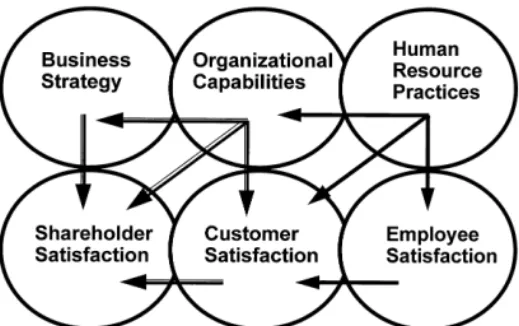
How can HR practices truly contribute to the critical business success factors as out-lined in the balanced scorecard framework? What are the most viable and effective HR measures which can demonstrate the value added of the HR function? To think through the impact of HR practices on business, East-man Kodak has connected its strategic HR framework to the business framework (see Figure 4).
Integrative Framework
By integrating the strategic HR framework with the business framework, the interrela-tionships among the six components can be identified in two linkage chains. In the first chain,HR practice can be conceptualized as key drivers in building organizational capabil-ities, enhancing employee satisfaction, and more innovatively, shaping customer satisfac-tion (Ulrich, 1989a; Ulrich & Lake, 1990). In turn, both organizational capabilities and em-ployee satisfaction can impact customer satis-faction.
In the second chain, organizational capa-bilities become key drivers which implement business strategy, impact customer satisfac-tion, and, eventually, contribute to sharehold-er satisfaction. In addition, both business strategy and customer satisfaction, if properly managed, should increase shareholder satis-faction.
The Kodak framework lays out three unique ways in which HR can contribute to business success: building organizational ca-pabilities, enhancing employee satisfaction, and shaping customer satisfaction. While pre-vious research and case studies have suggest-ed the strategic relevance of HR in each of these three areas, very few researchers have systematically addressed all three contribu-tions:
a. HR–organizational capability linkage:
The thesis that HR practices should be aligned to build organizational
capabil-The Kodak framework lays out three unique ways in which HR can con-tribute to business success: building organizational capabilities, enhancing employee satisfac-tion, and shaping customer satisfaction.
ity was suggested by Schuler & Jackson (1987) and Ulrich & Lake (1990). The argument for this linkage is simple: if companies intend to compete based on specific organizational capabilities (e.g., customer service for Nordstrom, inno-vativeness for 3M, quality for Motoro-la), they require a coherent set of HR practices to influence the mindset and behaviors of their leaders and work-force at all levels.
b. HR–employee satisfaction linkage: The impact of HR practices on employee satisfaction has also been widely publi-cized through a well-known example of New United Motor Manufacturing Inc. (Pfeffer, 1994). In 1982, the GM Fre-mont facility was closed due to severe employee problems. When approached by Toyota for a joint venture, GM agreed to reopen the facility in 1984 under a new entity called New United Motor Manufacturing Inc. (NUMMI). Without moving to a new facility, in-vesting heavily in new technology, or hiring a new group of employees (85% of NUMMI employees were rehired from the GM Fremont facility with the same UAW hierarchy), NUMMI was able to substantially improve employee satisfaction through radical changes in human resource philosophy and prac-tices. The effects of these HR philoso-phy and practice changes were dramat-ic. Between 1982 and 1986, employee absenteeism was reduced from 20% to 2%; grievances decreased from 2000 per year to two per year; and strikes went from two–four times per year to zero times per year. As a result, produc-tivity was increased by 100%; cost was reduced by 30%; and both quality and consumer satisfaction were enhanced substantially.
c. HR–customer satisfaction linkage:Some pioneering companies are leveraging HR practices to drive customer satis-faction (Ulrich, 1989a). For instance, Baxter Healthcare has offered free con-sulting and training sessions for its key customers. This has led to two outcomes: (1) key customers become
more successful; and (2) stronger rela-tionships with key customers are estab-lished. Another positive example of us-ing HR to drive customer satisfaction is Southwest Airline. To ensure that its crew members are customer-focused, the airline has been involving external customers in selecting the crew force. As a result, Southwest’s crew members tend to possess attributes that are de-sired by customers.
The integrative model in Figure 4 is unique in two ways. First,it tightly aligns the HR planning process with the business plan-ning process. For example, while the business framework (i.e., the balanced scorecard) high-lights whatEastman Kodak needs to focus on in order to succeed, the strategic HR frame-work provides specific tools and paths to iden-tify how Eastman Kodak can leverage its HR practices and organizational capabilities to succeed. Thus, the integrative model provides a simple but comprehensive roadmap for a company to think through its strategic focus.
Second,the model helps senior line and HR executives rethink the strategic roles within corporations which can be played by HR prac-tices. As human resources clearly have be-come an important source of sustainable com-petitive advantage (Pfeffer, 1994; Huselid, 1995), the model explicitly identifies the high value-added contribution of HR practices within corporations.
What Are the New HR Measures that Drive Business Performance?
If HR practices can impact business success through building up organizational capabili-ties, improving employee satisfaction, and shaping customer satisfaction, new HR mea-sures should be developed to drive business performance. As succinctly argued by Kaplan & Norton (1992, p. 71): “What you measure is what you get.” Unless HR measures are re-aligned to drive the activities and behaviors of HR professionals and line managers, HR prac-tices can hardly be expected to demonstrate any impact on the bottom line.
Dramatic changes in HR measures are ur-gently required to refocus the priorities and
re-sources of the HR function. Instead of being HR-driven (what makes sense to HR profes-sionals), the next generation of HR measures needs to be business-driven (how HR can im-pact business success). Instead of being activ-ity-oriented (what and how much we do), new HR measures should be impact-oriented (how much we improve business results). Instead of looking backward (what has happened), inno-vative HR measures should be forward look-ing, allowing managers to assess and diagnose the processes and people capabilities that can predict the future success of corporations (Ka-plan & Norton, 1992). Finally, instead of fo-cusing on individual HR practices (the perfor-mance of staffing practices, training and development practices, etc.), future HR mea-surement should focus on the entire HR sys-tem, taking into account the synergy existing among all HR practices.
Based on the integrative model in Figure 4, Eastman Kodak has developed three clus-ters of HR measures:
1. Internal operational measures: How well do we design and deliver our HR practices?
2. Internal strategic measures: How effec-tively do our HR practices build desired organizational capabilities? How effec-tively do our HR practices increase em-ployee satisfaction?
3. External strategic measures: How well do our HR practices increase customer and shareholder satisfaction?
Table III lists the possible combination HR measures that can be developed to in-crease efficiency, quality, and cycle time of HR practices; to build organizational capability; and to enhance employee, customer, and shareholder satisfaction. Examples in each cluster of HR measures are illustrated below.
Cluster 1: Internal Operational Measures
This cluster of HR measures encompasses tra-ditional HR measures for which the HR func-tion and HR professionals are (and have been in the past) held accountable. It focuses on the efficiency, quality, and speed of delivering HR practices and managing the HR function as a whole.
For HR practices, typical measures in-clude both process measures (such as cycle time, quality, and cost of HR processes/prac-tices) and result measures (such as offer/ac-cept ratios; different levels of training evalua-tion such as reacevalua-tion, knowledge, on-the-job behaviors, and business impact) (Cascio, 1987; Fitz-enz, 1984; Ulrich, 1989b). For the HR function, typical evaluative measures in-clude the HR ratio (number of HR profes-sionals to employee population), the
percent-Developing New HR Measures that Drive Business Performance.
Clusters Internal Operational Internal Strategic External Strategic
of HR Process Outcome Organizational Employee Customer Shareholder
Measures Measures Measures Capability Satisfaction Satisfaction Satisfaction Staffing Training/ Development Performance appraisal Rewards system Organization design Communications Others TABLE III
As the HR func-tion is trans-formed to be more business oriented (Yeung, Brockbank & Ulrich, 1994; Wintermantel & Mattimore, 1997), these traditional HR measures will no longer be adequate and accurate means to assess the performance of new HR roles and activities.
age of HR expenses to operating expenses, and the results of the client satisfaction surveys, etc.
In short, these internal operational mea-sures track the activity, cost, and quality level of HR services. When corporations conceptu-alize the HR function as a cost center, these measures make perfect sense (Wintermantel & Mattimore, 1997). As the HR function is transformed to be more business oriented (Yeung, Brockbank & Ulrich, 1994; Winter-mantel & Mattimore, 1997), these traditional HR measures will no longer be adequate and accurate means to assess the performance of new HR roles and activities.
Cluster 2: Internal Strategic Measures
The internal strategic HR measures assess the effectiveness of HR practices in building or-ganizational capabilities and enhancing em-ployee satisfaction. For instance, at Eastman Kodak three critical organizational capabili-ties are identified, and specific HR measures are developed to track the progress in these ca-pabilities. The targeted organizational capa-bilities include:
• Leadership effectiveness (both compe-tency and diversity).
• Workforce competencies (in terms of customer commitment and market fo-cus, working across boundaries, finan-cial excellence, and operational excel-lence).
• Performance-based culture.
While Eastman Kodak uses 360-degree assessment to measure leadership competen-cy, it also tracks leadership diversity through the race, gender, and nationality composition of its senior and middle managers. Workforce competencies are measured by three aspects of the development process: (1) the percent-age of employees with documented develop-ment plans to develop required competencies; (2) the number of hours devoted to develop-ment; and (3) the results of developmental programs as measured by four levels: reaction and planned action, learning, on-the-job be-havior, and business results. Performance-based culture is regularly assessed through the
tracking of aligned performance commit-ments, and employees’ surveys which include questions that focus on management account-ability for performance, clarity of performance expectations, adequacy of performance feed-back, and reward of goal achievement.
To ensure that HR practices are meeting employee needs and expectations, Motorola has developed an index called Individual Dig-nity Entitlement (Ulrich, 1997). Based on the following six questions, the index directly af-fects the annual performance review and bonuses of Motorola managers:
1. Meaningful job that contributes to mo-tivation: Do you have a substantive, meaningful job that contributes to the success of Motorola?
2. Behavior and knowledge to be success-ful:Do you have the on-the-job behav-iors and the knowledge base to be suc-cessful?
3. Training available to upgrade skills: Has training been identified and been made available to continuously upgrade your skills?
4. Career plan: Do you have a career plan and is it exciting, achievable, and being acted on?
5. Feedback: Have you received candid, positive, or negative feedback within the last 30 days which has been help-ful in improving your performance or achieving your career plan?
6. Personal Sensitivity: Is there appropri-ate sensitivity to your personal circum-stances, gender, and cultural heritage so that such issues do not distract from your success?
By tracking these six questions, Motorola can ensure that its HR practices are adding value through a more committed and compe-tent workforce.
Unlike internal operational measures, line managers should be held accountable for the internal strategic measures. As emphasized at Hewlett-Packard, managers are responsible for people management. While HR profes-sionals may design and develop all kinds of HR practices (such as performance appraisal, re-ward systems, succession planning, promotion process), the effectiveness of these practices
ultimately relies on implementation by line managers; therefore, line managers, more than HR professionals, should be held ac-countable for building critical organizational capabilities and enhancing employee satisfac-tion.
Cluster 3: External Strategic Measures
The external strategic measures assess the ef-fectiveness of HR practices in satisfying cus-tomers and shareholders. The purpose is to use HR practices to drive customer and share-holder satisfaction. Eastman Kodak has ex-perimented with several HR programs to achieve this goal.
The first, a program called Champions for Customer Success, is a customer-oriented program that serves two goals: (1) to create a learning situation that directly connects man-ufacturing employees with customers (e.g., print shops); and (2) to share best practices and expertise with customers in areas in which they need help, such as reducing paper waste, deploying total quality management (TQM), establishing self-managed teams, etc. By en-gaging manufacturing people with customers and by helping customers build their capabil-ity in those areas, the HR function intends to drive greater customer satisfaction and com-mitment to Kodak products. In addition, the program serves to build employees’ under-standing of customers’ needs. The simple mea-sures necessary for this program include: (1) incremental sales and earnings as a result of establishing these customer relationships; and (2) change in customer satisfaction and com-mitment.
Another HR effort that drives customer satisfaction is that of leveraging the executive education process. By inviting senior execu-tives from major customers to attend and share an executive education experience with Kodak executives, Eastman Kodak succeeds in achieving two goals: (1) creating a greater shared mindset with key customers; and (2) enabling Eastman Kodak to meet customer needs more effectively. The performance mea-sure is the degree of change in customer sat-isfaction and commitment as a result of the shared executive education experience.
Eastman Kodak also has changed a num-ber of processes to create a greater connection
between HR practices and shareholder satis-faction. For example, Kodak traditionally had a program called “wage dividend,” which was essentially an annual bonus payment that, over time, became a pure entitlement for em-ployees. Every year they could expect 7–8% of their base pay as a bonus at the end of the year; however, in the last few years, Kodak has changed the plan so that the wage dividend payoff is strictly a function of shareholder sat-isfaction as measured by return on net assets (RONA) within the corporation. This was sup-ported by a communication process driven by the HR community to help employees under-stand what RONA is and how it translates to their particular operation within the company. In this way, they could understand what they could do to influence their wage dividend by the end of the year. The HR measure for this program is to determine the change in em-ployee mindset from entitlement to contribu-tion. The purpose is to use the bonus system to drive shareholder value.
Kodak has also used a strategic investment approach to plan and evaluate incentive com-pensation plans (Boudreau & Berman, 1991). Using return on investment as a key metric, they have applied tools such as sensitivity analysis and break-even analysis to foster an alignment between HR systems and strategic imperatives from a shareholder perspective. Kodak has taken a similar approach to evalu-ating the effectiveness of various wellness pro-gram initiatives. By collecting a variety of health care experience data from both partic-ipants and nonparticpartic-ipants in these programs, Kodak has been able to assess the financial re-turn it is realizing from these wellness pro-grams.
While these examples highlight how East-man Kodak is beginning to refocus its HR practices to drive business performance, cor-porations still need to invest time and re-sources in developing a set of external strate-gic HR measures that can systematically align their HR practices with critical business re-sults.
Implications for HR
By reviewing some recent research studies re-garding the HR–business performance rela-tionship, and by building upon the use of the
First, HR mat-ters. Second, a framework is a prerequisite to the development of specific HR measures.
Third, the impact of HR measures on business suc-cess is most powerful if a complete process cycle is followed.
balanced scorecard framework in some com-panies such as Sears and Eastman Kodak, this article has answered the three questions posed at the outset: (1) HR does make a difference in business results; (2) HR practices can con-tribute to business performance through a multidimensional approach—building organi-zational capabilities, improving employee sat-isfaction, and increasing customer and share-holder satisfaction and commitment; and (3) new clusters of HR measures, in addition to the traditional HR measures, should be devel-oped to capture and drive the impact of HR on business performance. After gaining a broad understanding of these issues, several impli-cations for HR function and professionals can be developed.
First, HR matters. With this conviction as the springboard, the challenges which lie ahead for HR professionals are to ensure that: (1) their HR practices are aligned through dif-ferent paths to add value to business perfor-mance; and (2) their HR measures are prop-erly formulated to drive desirable activities and behaviors of both HR professionals and line managers. Because “what you measure is what you get,” a new set of HR measures are required to refocus the resources and energies of the HR function.
Second, a framework is a prerequisite to the development of specific HR measures. HR professionals need to understand how HR can contribute to business success before they can decide on HR measures that add business val-ue. The design and development of HR mea-sures typically involves deep thinking, reflec-tion, and discussion in the following three steps:
1. Determine what it takes for the corpo-ration to succeed. What are some im-portant business trends that impact the corporation? What will make or break the corporation in the current and fu-ture business environment? Who are the critical stakeholders? How can you, as an HR professional, meet their ex-pectations and needs? What are the scarce resource constraints for the cor-poration to succeed? These questions should be answered as part of the cor-porate strategic plan. Based on the bal-anced scorecard principle, this article suggests that employees, customers,
and shareholders are the three interre-lated stakeholders who deserve special attention.
2. Understand how HR can add value to the critical success factors.In what ways can HR create sustainable competitive advantage for the corporation? Will it be certain organizational capabilities such as speed, customer service, and innovation? Will it be the accumula-tion of intellectual capital? Will it be a pool of committed and competent em-ployees? Will it be a group of loyal and committed customers? This article suggests organizational capability, em-ployee satisfaction, and customer sat-isfaction as three possible avenues through which HR can make an im-pact. Different corporations may at dif-ferent times have difdif-ferent priorities. The soul-searching question remains, however: What is the highest value-added contribution of HR in this cor-poration? This question should be an-swered in the strategic HR plan. 3. Design the appropriate HR measures to
be aligned with the framework. Once the HR function identifies its unique contribution to the corporation, appro-priate measures need to be developed. This article suggests three clusters of HR measures: internal operational measures, internal strategic measures, and external strategic measures. As de-scribed in Table III, the HR measures should be developed in a way to rein-force and accomplish the intended contribution of HR. HR professionals, moreover, need to resist the temptation of adopting HR measures in good part because they are easy to collect or track. By all means, internal opera-tional HR measures are the easiest measures to assess; however, it does not mean they are the most important. On the other hand, it is much harder to assess the contribution of HR in inter-nal and exterinter-nal strategic measures, as a host of other factors are also influ-encing such measures. As “what you measure is what you get,” a weak mea-sure on the right issue is better than a strong measure on the wrong issue.
Third, the impact of HR measures on business success is most powerful if a complete process cycle is followed. While the development of appropriate HR mea-sures is a vital first step, the implementa-tion of the measurement process is equal-ly important. The full potential of HR measurement cannot be fully utilized un-til the following steps are taken:
1. Accurate data on desirable HR measures are collected on an ongoing and timely basis. It is important to ensure that crit-ical data are captured at the right mo-ment when HR programs or activities are designed and delivered.
2. HR measures are analyzed and feedback is presented in a timely manner. One common fallacy for many companies is to collect quantities of data, analyze them, and file them on a shelf. To drive behaviors and performance, all HR measures need to be widely dis-seminated to the right audience (both HR professional and line managers) for feedback purposes.
3. The purpose of HR measures is to stim-ulate change and improvement. HR professionals and line managers need to use the findings to create an open fo-rum to diagnose/solve problems and to improve organizational capabilities. The discussion and action planning which result from the HR measures are much more valuable than the results of the measures themselves.
4. Both HR and line managers are ac-countable for HR measures. Depending on their areas of responsibility, both HR managers and line managers should be assessed based on the HR measures. While HR professionals should be accountable for the internal operational HR measures (e.g., cost and efficiency of delivering HR ser-vices), line managers (like those in Sears and Motorola) should also be ac-countable for their approaches to man-aging employees, to building organiza-tional capability, and to enhancing customer satisfaction. The results of HR measures should constitute part of their performance review and bonus scheme.
Without moving through such a complete cy-cle, HR measures cannot drive the desirable behaviors of line managers in utilizing em-ployee contribution. As a result, the linkages between HR measures and business perfor-mance will be weakened.
When faced with the challenges of demonstrating its value added, the HR func-tion has to carefully think through its value proposition and its impact on business perfor-mance. By developing the right measures, HR can clearly demonstrate its strategic relevance within corporations, firmly establish its in-valuable status as a strategic business partner, and substantially contribute to business suc-cess.
Arthur K. Yeung is the Executive Director (Asia-Pacific) of the University of Michigan Business School and a faculty member at the Michigan Executive Education Center. His areas of specialization include HR process reengineering, strategic HR management, Asia-Pacific management practices, and organizational learning. He is an Associate Editor of
Human Resource Managementand has published more than 15 articles in leading HR jour-nals. Dr. Yeung is involved in leadership development programs for numerous corporations, including ABB, Philips, Carrier, Hewlett-Packard, ICI, and Allied Signal Inc.
Robert Berman is Director, Human Resources, and Vice President of the Consumer Imaging business of Eastman Kodak Company. He joined Kodak in 1982, and has served in a wide variety of assignments within Kodak’s HR community. His current responsibili-ties include leadership in the delivery of integrated strategic and operational HR services to Kodak’s global, $7 billion consumer products business. He is leading the organizational and individual capability strategies underpinning the growth strategies of the Consumer Imaging business. Mr. Berman has a B.S. in Business from the University of Minnesota and a Master of Industrial and Labor Relations from the New York State School of Indus-trial and Labor Relations at Cornell University.
Arthur, J. (1994). Effects of human resource systems on manufacturing performance and turnover. Academy of Management Journal, 37,670–687. Boudreau, J.W. & Berman, R.L. (1991). Using
per-formance measurement to evaluate strategic hu-man resource decisions: Kodak’s experience with profit sharing. Human Resource Management,Fall, 393–410.
Cascio, W. (1987). Costing human resources: The fi-nancial impact of behavior in organizations.New York: Van Nostrand Reinhold.
Fitz-enz, J. (1984). How to measure human resources management.New York: McGraw-Hill.
Huselid, M. (1995). The impact of human resource management practices on turnover, productivity, and corporate financial performance. Academy of Management Journal, 38,635–672.
Kaplan, R.S. & Norton, D.P. (1992). The balanced scorecard—Measures that drive performance. Harvard Business Review, January–February, 71–79.
Kaplan, R.S. & Norton, D.P. (1993). Putting the bal-anced scorecard to work. Harvard Business Review, September–October, 134–147.
MacDuffie, J.P. & Krafcik, J.F. (1992). Integrating technology and human resources for high-perfor-mance manufacturing: Evidence from the interna-tional auto industry. In Kochan, T. & Useem, M. (eds.), Transforming organizations.New York: Ox-ford University Press.
Ostroff, C. (1995). Human resource management:
Ideas and trends in personnel,June 21, Issue num-ber 356, CCH Incorporated.
Pfeffer, J. (1994). Competitive advantage through peo-ple: Unleashing the power of the work force.Boston, MA: Harvard Business School Press.
Schuler, R. & Jackson, S. (1987). Linking competitive strategies with human resource management prac-tices. The Academy of Management Executive, 1, 207–219.
Ulrich, D. (1989a). Tie the corporate knot: Gaining complete customer commitment. Sloan Manage-ment Review,Summer, 19–28.
Ulrich, D. (1989b). Assessing human resource effec-tiveness: Stakeholder, index, and relationship ap-proaches. Human Resource Planning, 12, 301–315.
Ulrich, D. (1997). Measuring human resources: An overview of practice and a prescription for results. Human Resource Management,this issue. Ulrich, D. & Lake, D. (1990). Organizational
capabil-ity: Competing from the inside/out.New York: Wi-ley.
U.S. Department of Labor (1993). High performance work practices and firm performance,August. Wintermantel, R. & Mattimore, K. (1997). In the
changing world of human resources: Matching measures to mission. Human Resource Manage-ment,this issue.
Yeung, A., Brockbank, W., & Ulrich, D. (1994). Low-er cost, highLow-er value: HR function in transforma-tion. Human Resource Planning, 17,1–16. REFERENCES
ENDNOTE We acknowledge the financial support of the California Strategic Human Resource Partnership in sponsoring the conference, “Measuring HR Effectiveness and Im-pact,” which brought together a group of thought
lead-ers and leading practitionlead-ers in this topic. Special thanks to Dave Ulrich at the University of Michigan, Rick Quinn at Sears, and Tapas Sen at AT&T who helped frame the ideas in this article.