Kernmodul Physiologie SS 2014
The present module intends to provide a deeper understanding of physiology, ranging from molecular and cell physiology to integrative human physiology. You will be exposed to present research areas in physiology at Charité and improve your scientific knowledge and research skills including data collection, analyses, interpretation, and discussing peer-reviewed international publications. In addition to real data collections to be performed in class and complementing the lectures and seminars, the goals of the module will cover very accessible topics that include, but are not limited to
• basics of biosignal recording, processing, and analyses (e.g. filtering, artifact correction, smoothing, mobile monitoring technologies, validation of new technologies, etc.),
• chronobiology, • brain function (EEG), • physical activity,
• body composition technologies,
• electrophysiological techniques in epithelial physiology,
• optical methods (confocal laser scanning microscopy, super resultion microscopy, freeze fracture electron microscopy),
• homology modelling of protein structure.
This framework of topics will be delivered by close collaboration between the Institut für klinische Physiologie, CBF and Institut für Physiologie, CCM, each covering their respective expertise in physiological research.
On the following pages you will get some detailed information on class requirements, dates and times.
We are looking forward to an exciting class and to welcoming you soon!
Dr. Andreas Zakrzewicz PD Dr. Dorothee Günzel
Please note:
(1) Max Number of Students
The class is limited to a max. of 10 students. You can sign up for the class via the Campus Management System.
Please make sure that you sign up for all three classes, i.e.
• CUB820, • CUB820a, and • CUB820b
Here is a link to the course catalog:
http://www.fu-berlin.de/vv/
and to our website:
http://www.charite.de/klinphysio/bioinfo/index.htm
Should you have any further questions on registering, please get in touch with our teaching secretary Mrs. Cornelia Marruhn (email: [email protected]).
(2) Successful completion of module
In addition to regular attendance you will have to pass an oral exam of about 20 min at the end of the term. The result of this exam will mainly determine your final mark. However, it is also a prerequisite of this module to deliver presentations to the class. You will be asked to give two presentations of approx. 20 min plus 10 min discussion. You will also chair sessions (lead the discussion). You will get credit for these presentations and they will be considered as part of your final mark!
(3) Dates and times
Typically, the lectures and seminars are held on Thursdays, 14.15 h to 15.45 h, and
16.15 h to 17.45 h, respectively.
The class termed Übung is scheduled as a block and will be given 4 times on Mondays, 14.00 – 18.00 h.
(4) Dates and times
Very importantly, please also check the exact location for each class.
The first half of the semester (until June 5) will be conducted at
Charite Universitätsmedizin Berlin, Campus Mitte.
Depending on the type of class different rooms might have been booked.
The second half of the semester (until July 17) will be conducted at Charite Universitätsmedizin Berlin, Campus Benjamin Franklin.
Please note that due to the holidays in this semester, one Übung has been swopped with the lecture/seminar.
(5) First and final class
The module will start with an introduction and seminar on Thursday, April 14. The final class will be your oral exam on July 17.
(6) Language
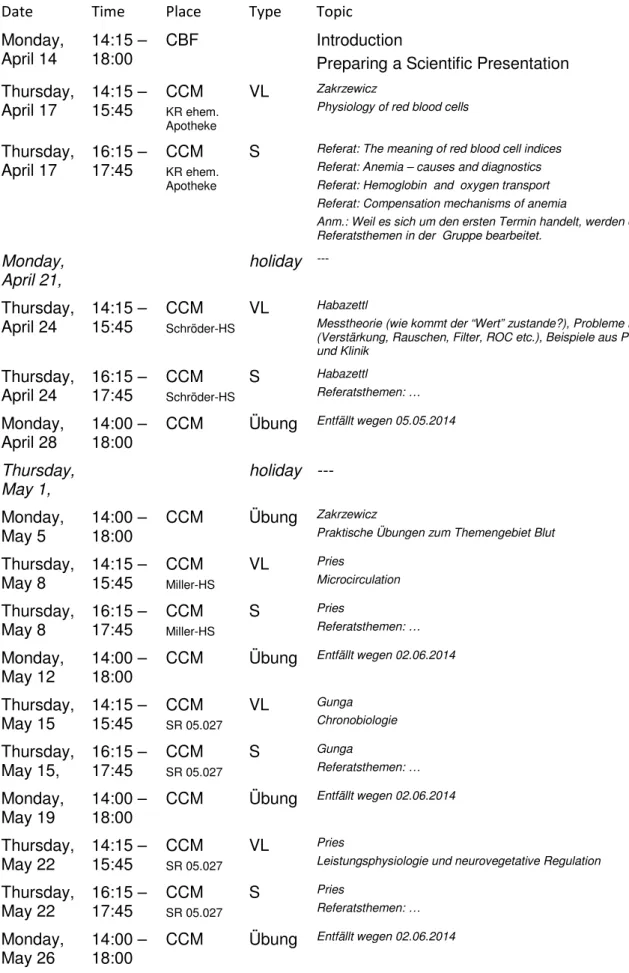
Table 1. Overview of Term
Date Time Place Type Topic
Monday,
April 14 14:15 – 18:00 CBF Introduction Preparing a Scientific Presentation Thursday,
April 17 14:15 – 15:45 CCM KR ehem. Apotheke
VL Zakrzewicz
Physiology of red blood cells
Thursday,
April 17 16:15 – 17:45 CCM KR ehem. Apotheke
S Referat: The meaning of red blood cell indices Referat: Anemia – causes and diagnostics Referat: Hemoglobin and oxygen transport Referat: Compensation mechanisms of anemia
Anm.: Weil es sich um den ersten Termin handelt, werden die Referatsthemen in der Gruppe bearbeitet.
Monday, April 21, holiday --- Thursday, April 24 14:15 – 15:45 CCM Schröder-HS VL Habazettl
Messtheorie (wie kommt der “Wert” zustande?), Probleme mit Signalen (Verstärkung, Rauschen, Filter, ROC etc.), Beispiele aus Physiologie und Klinik Thursday, April 24 16:15 – 17:45 CCM Schröder-HS S Habazettl Referatsthemen: … Monday, April 28 14:00 – 18:00 CCM Übung Entfällt wegen 05.05.2014 Thursday, May 1, holiday --- Monday, May 5 14:00 – 18:00 CCM Übung Zakrzewicz
Praktische Übungen zum Themengebiet Blut
Thursday, May 8 14:15 – 15:45 CCM Miller-HS VL Pries Microcirculation Thursday, May 8 16:15 – 17:45 CCM Miller-HS S Pries Referatsthemen: … Monday, May 12 14:00 – 18:00 CCM Übung Entfällt wegen 02.06.2014 Thursday, May 15 14:15 – 15:45 CCM SR 05.027 VL Gunga Chronobiologie Thursday, May 15, 16:15 – 17:45 CCM SR 05.027 S Gunga Referatsthemen: … Monday, May 19 14:00 – 18:00 CCM Übung Entfällt wegen 02.06.2014 Thursday, May 22 14:15 – 15:45 CCM SR 05.027 VL Pries
Leistungsphysiologie und neurovegetative Regulation
Thursday, May 22 16:15 – 17:45 CCM SR 05.027 S Pries Referatsthemen: … Monday, May 26 14:00 – 18:00 CCM Übung Entfällt wegen 02.06.2014
Thursday,
May 29 holiday ---
Monday,
June 2 14:00 – 18:00 CCM Übung
Pries
Praktische Übungen zum Themengebiet NVR
Thursday, June 5 14:15 – 15:45 CCM SR 05.027 VL Gunga Extreme Umwelten Thursday, June 5, 16:15 – 17:45 CCM SR 05.027 S Gunga Referatsthemen: … Monday, June 9 holiday --- Thursday,
June 12 14:15 – 15:45 CBF VL Introduction to Epithelial Physiology Thursday,
June 12 16:15 – 17:45 CBF VL Optical methods I Flow Cytometry, Confocal Laser Scanning Microscopy
Monday,
June 16 14:15 – 15:45 CBF VL Electrophysiology I , Ussing chamber Monday, June 16 16:15 – 17:45 CBF S Presentations Thursday,
June 19 14:15 – 15:45 CBF VL Electrophysiology II Epithelial ImpedanceSpectroscopy Thursday,
June 19 16:15 – 17:45 CBF S Presentations Thursday,
June 26 14:15 – 15:45 CBF VL Optical methods II: Super Resolution Microscopy , Freeze Fracture electron microscopy , Microfluorimetry
Thursday,
June 26 16:15 – 17:45 CBF S Presentations Monday
June 30 14:00 – 18:00 CBF Übung Group 1: Impedance spectroscopy Group 2: Confocal Laser Scanning Microscopy Thursday,
July 3 14:15 – 15:45 CBF VL Homology Modelling
Thursday,
July 3 16:15 – 17:45 CBF S Presentations
Monday
July 7 14:00 – 18:00 CBF Übung Group 2: Impedance spectroscopy Group 1: Confocal Laser Scanning Microscopy Thursday,
July 10 14:15 – 15:45 CBF S Presentations
Thursday,
July 10 16:15 – 17:45 CBF S Presentations Thursday,