David Crombie Roger Lenoir Neil McKenzie Arne Leeman FNB The Netherlands Molenpad 2, Amsterdam [email protected]
Abstract
The combination of accessible content management systems, accessible desktop systems and content modalities with internalised notions about accessibility, can be used to form a new generation of information processing environments. Because of the presence of explicit entities that can be used to represent the User (perception) models on one side, and content and application models on the other side, we can experiment with new interaction schemes. These new interaction schemes will, because of the knowledge preservation process that is included in the approach, create a consistent body of information including real-world applications for education purposes.
The paper shows, from the knowledge technology perspective, the development from traditional content consumption schemes towards knowledge consumption and even understanding consumption that may be stimulated to emerge. After all, understanding can be considered the dynamic systemic overview one can obtain of all the facts, the interactions between facts and the interactions between these interactions and it's surroundings. The mere process of conceiving and creating this systemic overview can be considered education to oneself. Allowing a system to include multiple perspectives on that systemic overview and additionally allow that system to create associations between these multiple viewpoints for any relation to be explicated, stimulates the emergence of mutual understanding. In other words, a system that facilitates communication from scratch.
1
Introduction
The word ‘accessibility’ can be viewed from many different angles. Within the traditional technological approach, accessibility points towards everything that requires extra effort to be able to provide digital content to people with print impairments.
Accessibility can also be viewed from a wider angle. Being able to see content in whatever modality; perceive its context; and attach a useful meaning to it requires that the user be able to access this content, its context and relevant software application in a way that meets that particular user's consumption preferences. These preferences may become requirements over time - we all get older. Being able to attach useful meanings to content is what lies at the very basis of preservation and education of thought. Attaching useful meanings to content underpins the basis of culture , commerce and civilisation. Being able to access software and the content and the potential for understanding it unleashes, requires us to be able to gain access to software and not be hindered by huge costs, complexity, lack of support and additional barriers [1, 2].
There are several key areas which need to be addressed in order to breakdown this barrier: 1. Raise awareness of Accessibility
2. Remove barrieres that keep content producers, distributors and consumers from fulfilling (web) accessible information systems
3. Synchronise industry standards with accessibility standards to promote these synergies to manifest themeselves more concretely
4. Provide a content management and provision system that keeps the costs as low as possible -ideally free except for consultancy- and freely retrievable (accessibility of software sources) as open source resources.
This paper mainly address the last point, but it does so with the first three points as objectives. The paper outlines specifically how content can be managed for accessible processing.
2
Key ingredients of Accessible Information Processing
A very useful interface to the approach we have described to accessibility is that ofOpen Source Information Processing, which we can add to the list of processes that is involved in the manifestation process of Open Source software development, distribution and application In the work we have undertaken in recent years, a methodology has emerged that touches upon the key areas mentioned above. This “accessibility methodology” can be modularised in separate processes that are briefly described below:
• Accessible Infrastructures – Freely available tools, software and operating systems for content production, distribution and consumption
• Accessibility Technology– OS Screen readers, screen magnification and speech technology with tight yet transparent integration with open source operating systems
• Content– Freely available content, commercial content, personal content,anycontent
• Knowledge Management and Interaction Design – Described and implemented knowledge and experience in processinganycontent to transform it into accessible content using a combination of the above points. This includes transformation of cognitive complexity as well. The main aim is toextract
specialised knowledge of the accessibility domain (amongst others) from the experts' heads and to
wrap these chunks of knowledge into components. These components serve not only as units of Business Logic and Business Intelligence, but also aslearning unitsfor the education of the Accessible Information Processing paradigm.
These ingredients will be explained in more detail below, with particular attention paid to theinterplaybetween these individual ingredients as we positioned them in the Accessible Information Processing context [3].
3
AndersLezen.nl - Content Management System for Accessible Content
Anderslezen.nl [4] is an example and an implementation of Accessible Infrastructures and Accessibility Technology which is currently in use with real users, and real content and represents current realistic state of the art.
One of the tasks set by the Dutch Ministry of Education, Cultural Affairs and Welfare is to unlock information for the print disabled. As part of this objective, FNB have designed and developed an easily accessible webportal for the print disabled. The webportal Anderslezen.nl [lit.different reading] is an online information node for people with a reading disability and as such covers four domains:
• Accessibility and service
• Document supply (products)
• Community (meeting point)
• Transfer of knowledge (information node)
The webportal is not intended to create a separate enclave on the internet for the print disabled. Rather the portal offers a concentration of relevant services and information for the target group and is an entry point to the internet as well. To other visitors, Anderslezen.nl offers the opportunity of exchanging specific information with the target group and of consulting an extensive database concerning the problems surrounding the accessibility of information.
Anderslezen.nl offers an opportunity to affiliated organizations to build and operate their own (sub)website within the portal. These sites can also be accessed through their domain names. The content management system (CMS) of Anderslezen.nl covers all the technical aspects, leaving the organisations free to concentrate on providing the content itself. All information can be obtained in two ways: either online via the website (pull) or offline by e-mail subscription (push). By subscribing to specific subjects, registered users can acquire a made-to-measure supply of information.
This webportal has been cognisant of WAI standards on technical accessibility and strives towards WAI prioirity 2 guidelines [5]. In addition to the work of Nielsen [6], we have aimed to render the functional aspects of the navigation model and user interface as well as simplicity of management on the organization side. From
4
AccessibleXOOPS - Accessible Content Management Systems
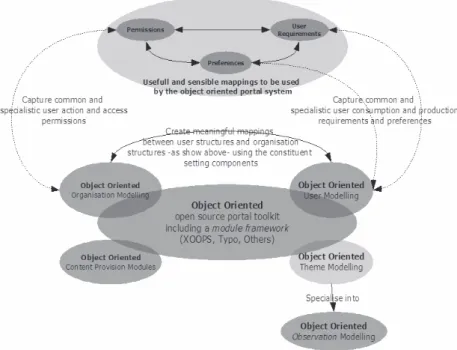
This section contains a description of an attempt to create an accessible Content Management System that allows accessibility in both the content consumption perspective and content administration perspective. XOOPS/AccessibleXOOPS provides an example and implementation of Accessible Infrastructures, Accessibility Technology and Knowledge Management and Interaction Design. Figure 1 below illustrates the XOOPS portal architecture.
Figure 1 The XOOPS architecture allows identification of almost all relevant entities that are required when approaching the problem of accessible information processing. The traditional “skinning” or “theming” functionality turns into a role/user and organisation dependent transformation tool. Since this kind of business logic includes user preferences that may capture Accessible Information Processing requirements an exceptionally high integration of Accessibility can be provided.
The eXtensible Object Oriented Portal System (XOOPS) provides generic structures for the representation of web portals including blueprints for systems that are required to maintain such portals. Module, notification, messaging and user profile entities are available. Extending the original XOOPS architecture with 3rd party (open source) modules provides a framework that can be used to represent any kind of resource and messaging/notification of changes in the structure or use of these resources. The following collection of modules can be used to erect agenericweb portal structure that includes use of:
1. User / Guest / Admin account system
2. Messaging between the above participants and their roles,
3. Notification between services/modules and the above participants and their roles, 4. Article management - including associated downloads and printing service,
5. news article management - used as messages that can be used to ‘point’ to a new or a change in existing resources in the article management system
The following modules – built-in and 3rdparty open sourced - are used: • System (built-in) • News (built-in) • WebLinks (built-in) • FAQ (built-in) • wfSection (3rdparty)
4.1
Relations between XOOPS modules and AndersLezen.nl functionalities
4.1.1
News
The News module provides means of collecting new articles, which are abstracted into a news story class, and means of organising these stories into topics. Both entities can be created by administrators and by registered users and visitors if they are permitted to do so. Comments can be posted and associated with stories and previous comments. Comments can be posted by administrators, registered users and visitors. Permissions to do so have to be granted by the administrator.
News stories can consist of one page or it can span multiple pages. A news story is made of an abstract and body text. Of no body text is present, only the abstract will be shown. If body text is available, a link to it called [more] will be shown below the stories abstract in the main page of the news module. The main page of the news module contains an overview of the last x stories posted as well as a means of navigating through the news topics. News stories can have a publish date and interval associated with them. New news stories can appear in the module’s main page (called the home page) or can be made to appear only in the tree structure of the topics and sub topics. The news topics can have images (icons) associated with them.
4.1.2
FAQ
The FAQ module consists of a means to represent questions and answers in a hierarchical way. FAQ categories can be defined. FAQ categories contain questions and answers. Questions and Answers have an associated order as well as the categories. The FAQ module provided a 1:1 mapping between questions and answers. No mechanism for sub categories is available. If allowed users can post comments to the category screens that display the questions and answers and with that provide comments to both. More detailed control over questions and answers and related functionalities can be achieved with the newsbb module, which provides a forum engine with associated functionalities.
4.1.3
BBNews forum
An integrated news forum engine with category, message, moderation, comment and notification services. Groups of for a can be created and each forum can concentrate on a subject. Per subject discussion ‘threads’ can be created. Discussion threads contains messages between registered users and visitors (if permitted)
4.1.4
WFSection
WfSection is a module that provides article and article category entities as well as File entities that represent (any) type of uploaded files that are related to articles. These entities are grouped and accessible through an article management system. Images can be associated with categories. Navigation means are provided to search through content and structure.
4.1.5
WebLinks
This is a module that provides a simple mechanism for storing weblinks. The weblinks module can be treated as a reference collection system. Weblinks are represented as links that can be stored in categories that can contain sub-categories. In addition to the link’s title and URL, a description of the external resource can be provided.
4.2 Incorporating accessibility features
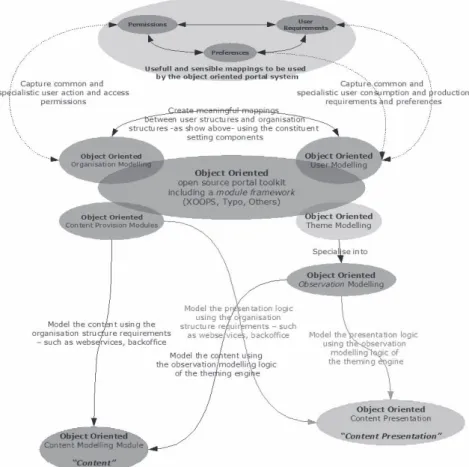
Figure 2 below illustrates the inclusion of accessibility features into the XOOPS system.
Figure 2.Accessibility within XOOPS. Because of the Object Oriented framework that supports the XOOPS portal framework and the representation of Accessibility requirements using this framework and the integration of Accessibility features with that framework provides building blocks for an accessible information processing environment.
The inclusion of accessibility into a Content Management System relies on proper 'connections' between processing entities and the transparency of these entities within the architecture as a whole. This naturally applies for any software architecture [3,8]. Clarity and transparency is of particular importance in the area of accessible information processing. For accessibility to emerge as a built-in property of any system, the developer or architect has to take a meta position on the system the designer develops. An accessible manifestation usually means that the application the developer envisions should be able to present itself using various different and independent 'presentation schemes'. A 'skin' is a good example of this. When a 'skin' in the traditional sense of the word is re-interpreted as 'a looking glass associated with a specific role with specific requirements' we arrive at the point of similarity.
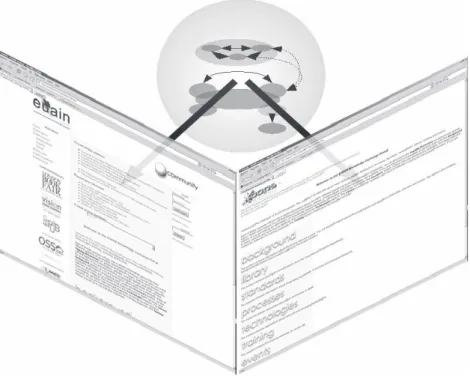
As the XOOPS Content Management System and its underlying framework is regarded as a Content Model, Content Transformation Model and User Model, the 'themes' XOOPS uses can be used as 'filters' or ‘Looking Glasses’ that process the content as well as the presentation of the content based on the user's and organisation's preferences. Because AccessibleXOOPS contains explicit entities that represent common user preferences as well as print impaired user preferences of the consumption process, explicit relations between all of these can be made. Because of the same source of content and content processing, the content and functionalities will be available to both the common consumers and the print impaired users instantaneous without additional tools and effort (see Figure 3 below).
Figure 3.XOOPS through the Looking Glass. XOOPS as a portal system, content model, user model and transformation engine serves as a centralised global information and processing model. Depending on the user profile that collects requirements and preferences the
manifestation of the content model can be personalised.
5
Conclusion
By merging the expert knowledge from the anderslezen.nl project and the accessibleXOOPS initiative, the best of both worlds can be provided as a low cost framework for industry partnes and publishers. The expertise gained in the anderslezen.nl project can serve as a source of implementation guidelines for the transformations required to maintain and produce accessible content. The AccessibleXOOPS initiative can be used to introduce an interface that not only enables industry to catch up with a system that is not propriatory to a specific infrastructure, organisation or (web)technology but conforms industry and open source standards for all it's constituent parts. The powerful combination of both yields a content management system that is able to transform 'common' content to 'accessible' content and provides web interfaces for visitors to an accessible information portal in all the roles these visitors can fulfill: ordinary visitor or portal administrator. The high-level application of the portal -it's use- can then be fine tuned towards the various stakeholder domains; consumers, producers and distributors.
6
References
[1] European Accessible Information Processing Network (EUAIN) see www.euain.org and Crombie, D., Lenoir, R., & McKenzie, N., (2005) Building new markets through accessible information processing, proceedings ELPUB 2005 (forthcoming)
[2] Crombie, D., Lenoir, R., and McKenzie, N., (2004) Accessibility from scratch : how an open focus contributes to inclusive design, Proceedings ICCHP, Lecture Notes in Computer Science, Vol 3118. Springer-Verlag, Berlin Heidelberg New York
[3] Crombie, D., Lenoir, R., McKenzie, N., and Miesenberger, K., (2004) Interfacing the interface: unification through separation, Proceedings European Research Council for Informatics and Mathematics: 8th User Interfaces for All Workshop, Lecture Notes in Computer Science, Vol 3196. Springer-Verlag, Berlin Heidelberg New York