Life Sciences
© The Author(s) 2011. This article is published with open access at Springerlink.com life.scichina.com www.springer.com/scp
*Corresponding author (email: [email protected])
• RESEARCH
PAPERS •
November 2011 Vol.54 No.11: 1019–1028doi: 10.1007/s11427-011-4234-2
Field evaluation of effects of transgenic
cry1Ab/cry1Ac
,
cry1C
and
cry2A
rice on
Cnaphalocrocis medinalis
and its arthropod
predators
XU XueLiang
1,2, HAN Yu
1, WU Gang
1, CAI WanLun
1, YUAN BenQi
1, WANG Hui
1,
LIU FangZhou
1, WANG ManQun
1& HUA HongXia
1*1Hubei Insect Resources Utilization and Sustainable Pest Management Key Laboratory, College of Plant Science and Technology, Huazhong Agricultural University, Wuhan 430070, China;
2Institute of Plant Protection, Jiangxi Academy of Agricultural Sciences, Nanchang 330200, China
Received June 16, 2011; accepted September 12, 2011
The impacts of transgenic
Bt
rice on target pests and their predators need to be clarified prior to the commercialization of
Bt
rice. In this study, the percentages of folded leaves of three transgenic
Bt
rice lines and non-transgenic parental rice line caused
by
Cnaphalocrocis medinalis
were studied over two successive growing seasons. In addition, the population densities, relative
abundance and population dynamics of
C. medinalis
and four species of its natural arthropod predators were investigated at
three sites in China. The results showed that rice line significantly affected the percentages of folded leaves and population
densities of
C. medinalis
larvae. Significantly higher percentages of folded leaves were observed on the non-transgenic rice
compared with the three transgenic
Bt
rice on most sampling dates. Significantly higher densities of
C. medinalis
larvae and
higher relative abundance of
C. medinalis
within phytophages were found on non-transgenic rice compared with three
trans-genic
Bt
rice at different sites across the study period. The population dynamics of
C. medinalis
larvae were significantly
af-fected by rice line, rice line×sampling date, rice line×year, rice line×sampling date×year. However, there was little, if any,
sig-nificant difference in the relative abundance, population density and population dynamics of the four arthropod predators
be-tween the three
Bt
rice lines and non-transgenic rice. The results of this study indicate that the
Bt
toxin in transgenic
Bt
rice can
effectively suppress the occurrence of
C. medinalis
, but has no significant effects on the occurrence of the four predatory
ar-thropod species.
transgenic
Bt
rice,
Cnaphalocrocis medinalis
, population dynamics, percentages of folded leaves, natural arthropod
predator
Citation: Xu X L, Han Y, Wu G, et al. Field evaluation of effects of transgenic cry1Ab/cry1Ac, cry1C and cry2A rice on Cnaphalocrocis medinalis and its ar-thropod predators. Sci China Life Sci, 2011, 54: 1019–1028, doi: 10.1007/s11427-011-4234-2
Rice is the staple food crop in Asia. Significant losses of
this valuable crop occur every year as a result of the
infesta-tions of stem borers and leaffolders, two groups of
lepidop-teran rice pests [1,2]. Traditionally these pests were
con-trolled by poisonous chemicals. However, the use of large
amounts, as well as the long-term applications, of these
chemicals resulted in environmental contamination and
sig-nificantly increased the costs of rice production. In addition,
lepidopteran pests quickly developed resistance to the
pesti-cides, which reduced the efficacy of chemical control [3,4].
Researchers were therefore prompted to seek more
eco-nomic and environmentally friendly strategies for
control-ling lepidopteran pests.
Bacillus thuringiensis
(
Bt
)
insecti-cidal
-endotoxin has been used as a biological insecticide
for more than 50 years, and it is now possible to introduce
different
Bt
genes into rice. The transgenic rice plants
ex-pressing
cry1Ab
or
cry1Ab/cry1Ac
develop resistance to
stem borers and leaffolders, resulting in effective control of
target lepidopteran pest infestations [5
8]. The deployment
of transgenic
Bt
rice resulted in yield increases of 6%–9%,
and an 80% reduction in insecticide use, compared with
conventional rice varieties [9].
The leaffolder,
Cnaphalocrocis medinalis
, is a widely
distributed lepidopteran pest on rice, and the main target
herbivore pest of transgenic
Bt
rice. Prior to the commercial
release of
Bt
rice, the resistance of transgenic
Bt
rice on
target lepidopteran pests should be evaluated. Thus, most
published studies have focused on the effects of transgenic
Bt
rice on the development and population dynamics of
such target lepidopteran pests [10
13]; however, little is
known about the potential prey-mediated effects of
trans-genic
Bt
rice on non-target predators through tritrophic
in-teractions. There are only a few reports of the effects of
transgenic
Bt
rice on predators of target lepidopteran pests;
for example, Chen
et al.
reported that Cry1Ab protein
de-rived from transgenic
cry1Ab
rice plants could be detected
in the spider
Pirata subpiraticus
, a predator of
C. medinalis
,
although the concentration of Cry1Ab detected did not
in-crease as its preying time inin-creased.
P. subpiraticus
lacks
binding receptors for Cry1Ab in its midgut, which could
explain why there was no significant difference in the
sur-vivorship and fecundity of
P. subpiraticus
preying on
Bt
rice-fed
C. medinalis
compared with those preying on
non-
Bt
rice-fed
C. medinalis
. However, the developmental
time of
P. subpiraticus
was significantly longer when it
preyed on
Bt
rice-fed
C. medinalis
compared with those
feeding on non-
Bt
rice-fed prey. In addition, a three-year
field trial indicated that
Bt
rice did not significantly affect
the density of
P. subpiraticus
[14]. When
C. medinalis
lar-vae fed with transgenic
cry1Ab
rice were used as prey, the
presence of the Cry1Ab had no marked effect on the
preda-tion rate of
P. subpiraticus
[15]. The population dynamics
of five dominant spider species (
Tetragnatha maxillosa
,
Dyschiriognatha quadraimaculata
,
Ummeliata insecticeps
,
Pardosa pseudoannulata
and
P. subpiraticus
) in transgenic
cry1Ab/cry1Ac
rice plots were similar to those in non-
transgenic control plots, as were the population densities of
these species [16]. All these reports are about the impacts of
Cry1Ab and Cry1Ab/Cry1Ac on non-target predators of
C.
medinalis
, but up to the present, there is no literature about
the impacts of Cry2A and Cry1C
Bt
toxin on population
density and dynamics of predators of
C. medinalis
in rice
paddy fields.
Hylyphantes graminicola
,
P. pseudoannulata
,
U.
insec-ticeps
and
P. fuscipes
are the main arthropod predators of
C.
medinalis
in rice fields [16
19]. In the current study, three
transgenic
Bt
rice lines (containing
cry1C
,
cry2A
and
cry1Ab/cry1Ac
) and a non-transgenic control were planted
at three sites in Hubei Province, China over a two-year
growing season. Arthropods were sampled by
vacu-um-suction machine and plant dissection, and identified to
species level. The suppressive effects of the transgenic rice
on infestations of
C. medinalis
, the population density,
rela-tive abundance and population dynamics of the four
preda-tory species of
C. medinalis
were assessed via field trials.
1 Materials and methods
1.1 Plant material
Three transgenic
Bt
rice lines (TT51, T1C-19 and T2A-1)
and the non-transgenic parental
indica
rice line Minghui 63
were selected for field evaluation. TT51 is a transgenic rice
line expressing a
Bt
fusion gene derived from
cry1Ab
and
cry1Ac
under the control of the rice
actinI
promoter [8].
T2A-1 expresses a synthesized
cry2A
gene, whereas T1C-
19 expresses a synthesized
cry1C
gene, both driven by the
maize
ubiquitin
promoter [12,20]. All the rice lines were
gifted by Lin YongJun, National Key Laboratory of Crop
Genetic Improvement, Wuhan, China.
1.2 Field experiment design
Field experiments were conducted during the 2009
2010
growing season at three different sites, where field trials of
Bt
rice were permitted, in Hubei Province, China. The first
site was in a suburb of Xiaogan (113.54°E, 30.56°N), the
second was in a suburb of Suizhou (113.22°E, 31.42°N) and
the third was in a suburb of Wuxue (115.33°E, 29.51°N).
The layout of the plots in the field followed a randomized
block design with three replications for each treatment.
Each experimental plot was 20 m
25 m, surrounded by 1 m
wide unplanted border. The entire experimental field was
bordered by five rows of non-transgenic control plants. In
each of the study years,
Bt
rice and non-transgenic control
rice were sown in early May and transplanted one month
later. Seedlings were manually transplanted with one
seed-ling per plant, with 13.3 cm between plants within a row
and 29.9 cm between rows. Agronomic practices for
grow-ing rice, such as fertilization and irrigation, were followed
by local farmers, except that no insecticides were applied at
any sites.
1.3 Sampling by plant dissection and vacuum-suction
machine
Thirty rice hills were randomly selected to investigate the
number of larvae and pupae of
C. medinalis
, and damage
caused by
C. medinalis
. The total number of leaves from the
30 selected rice hills and the total number of leaves with
rolls or visible scrapes were recorded to evaluate the
dam-age caused by
C. medinalis
. The leaves infested by
C.
me-dinalis
were dissected to count the number of larvae or
pu-pae presented.
Sampling of adult
C. medinalis
, as well as predators of
C.
medinalis
, was done as described by Chen
et al.
[21].
vac-uum-suction machine, based on a description by Carino
et
al.
[22] and supplemented by a square sampling box (50 cm
length
50 cm width
90 cm height) with a metal frame and
enclosed by Mylar film. The sampling box could enclose six
rice hills at a time. Samples were collected every 10
15 d,
starting one month after transplantation and continuing until
the rice was ripe (i.e., as measured by grain maturity and
harvest). On each sampling date, a square sampling box was
placed at random along the diagonal line of each test plot at
each site, with five sub-samples per plot. The sample
loca-tion in each plot was marked with a bamboo stake to avoid
resampling at the same location. Arthropods inside the
frame enclosure were collected using the vacuum-suction
machine at each sampling location for 5 min, and were
pre-served in 75% ethanol. All samples were taken back to the
laboratory and identified to species level.
1.4 Data analysis
Population density, relative abundance and population
dy-namics collected by vacuum-suction and dissection were
used to evaluate the impacts of the three transgenic
Bt
rice
on
C. medinalis
and its four predators. The arthropods were
divided into five guilds: phytophages, parasitoids, predators,
detritivores, and others. The relative abundance of each
ar-thropod species was calculated as number of the
spe-cies/total number of the guild to which it belongs. The
pop-ulation density of each species was the seasonal means
cap-tured by vacuum-suction. Population dynamics of each
spe-cies were measured by means at each sampling date.
Statis-tical analyses were performed with STATISTICA 7 [23].
All count data with percentages were transformed to
arcsine-square root values transformed before statistical
analysis.
2 Results
2.1 Percentages of folded leaves
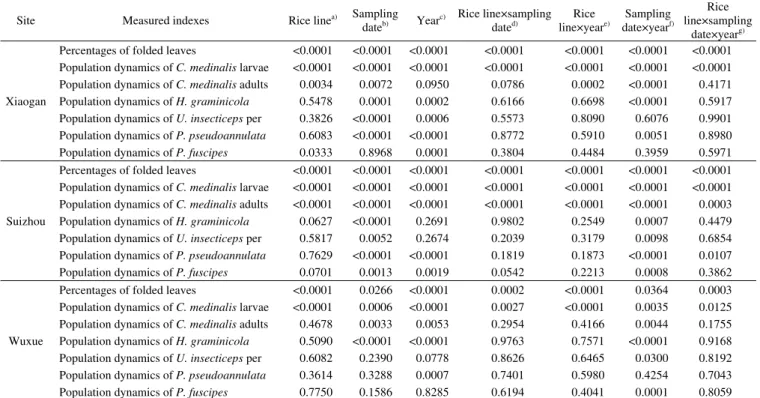
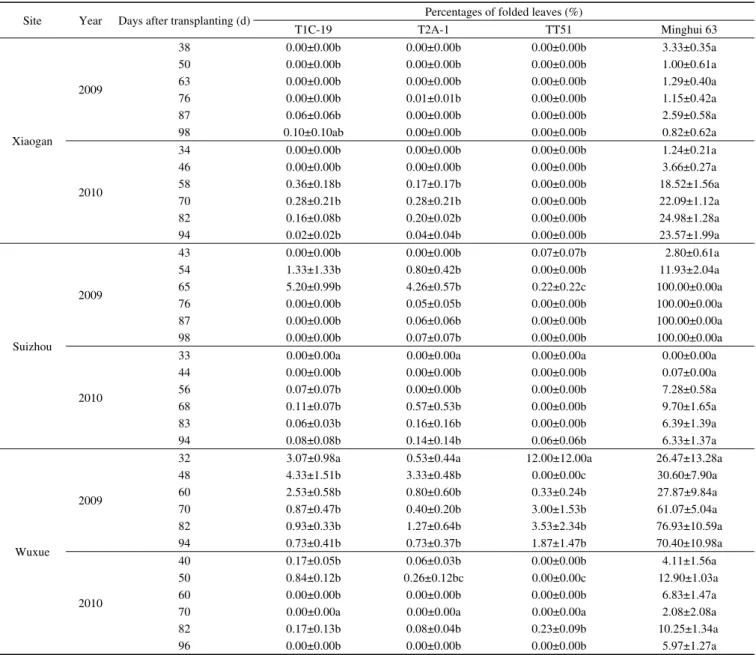
Rice line, sampling date, year, rice line×sampling date, rice
line×year, sampling date×year, rice line×sampling date×
year significantly affected the percentages of folded leaves
in the four rice fields (
P
<0.05) at the three experiment sites
(Table 1). At Xiaogan, significantly higher percentages of
folded leaves caused by
C. medinalis
were observed on
non-transgenic Minghui 63 compared with the three
trans-genic
Bt
rice lines at all sampling dates in 2009 and 2010
(
P
<0.01) except for those recorded at 98 days after
trans-planting (DAT) in 2009 (
P
=0.0796; Table 2). At Suizhou, in
2009 and 2010, the percentages of folded leaves caused by
Table 1 Three-way ANOVAs at three sites ofthe effects of rice line, sampling date, investigation year, and their interactions on the measured indexes of rice, herbivores and arthropod predator species (P-value)Site Measured indexes Rice linea) Sampling
dateb) Yearc) Rice line×sampling dated) line×yearRice e) date×yearSampling f)
Rice line×sampling
date×yearg)
Xiaogan
Percentages of folded leaves <0.0001 <0.0001 <0.0001 <0.0001 <0.0001 <0.0001 <0.0001 Population dynamics of C. medinalis larvae <0.0001 <0.0001 <0.0001 <0.0001 <0.0001 <0.0001 <0.0001
Population dynamics of C. medinalis adults 0.0034 0.0072 0.0950 0.0786 0.0002 <0.0001 0.4171
Population dynamics of H. graminicola 0.5478 0.0001 0.0002 0.6166 0.6698 <0.0001 0.5917
Population dynamics of U. insecticeps per 0.3826 <0.0001 0.0006 0.5573 0.8090 0.6076 0.9901
Population dynamics of P. pseudoannulata 0.6083 <0.0001 <0.0001 0.8772 0.5910 0.0051 0.8980
Population dynamics of P. fuscipes 0.0333 0.8968 0.0001 0.3804 0.4484 0.3959 0.5971
Suizhou
Percentages of folded leaves <0.0001 <0.0001 <0.0001 <0.0001 <0.0001 <0.0001 <0.0001 Population dynamics of C. medinalis larvae <0.0001 <0.0001 <0.0001 <0.0001 <0.0001 <0.0001 <0.0001 Population dynamics of C. medinalis adults <0.0001 <0.0001 <0.0001 <0.0001 <0.0001 <0.0001 0.0003
Population dynamics of H. graminicola 0.0627 <0.0001 0.2691 0.9802 0.2549 0.0007 0.4479
Population dynamics of U. insecticeps per 0.5817 0.0052 0.2674 0.2039 0.3179 0.0098 0.6854
Population dynamics of P. pseudoannulata 0.7629 <0.0001 <0.0001 0.1819 0.1873 <0.0001 0.0107
Population dynamics of P. fuscipes 0.0701 0.0013 0.0019 0.0542 0.2213 0.0008 0.3862
Wuxue
Percentages of folded leaves <0.0001 0.0266 <0.0001 0.0002 <0.0001 0.0364 0.0003
Population dynamics of C. medinalis larvae <0.0001 0.0006 <0.0001 0.0027 <0.0001 0.0035 0.0125
Population dynamics of C. medinalis adults 0.4678 0.0033 0.0053 0.2954 0.4166 0.0044 0.1755
Population dynamics of H. graminicola 0.5090 <0.0001 <0.0001 0.9763 0.7571 <0.0001 0.9168
Population dynamics of U. insecticeps per 0.6082 0.2390 0.0778 0.8626 0.6465 0.0300 0.8192
Population dynamics of P. pseudoannulata 0.3614 0.3288 0.0007 0.7401 0.5980 0.4254 0.7043
Population dynamics of P. fuscipes 0.7750 0.1586 0.8285 0.6194 0.4041 0.0001 0.8059
a) df=3, 96 in 2009 and 2010 at Xiaogan, Suizhou and Wuxue for each year. b) df=5, 96 in 2009 and 2010 at Xiaogan, Suizhou and Wuxue for each year. c) df=1, 96 in 2009 and 2010 at Xiaogan, Suizhou and Wuxue for each year. d) df=15, 96 in 2009 and 2010 at Xiaogan, Suizhou and Wuxue for each year.e) df=3, 96 in 2009 and 2010 at Xiaogan, Suizhou and Wuxue for each year.f) df=5, 96 in 2009 and 2010 at Xiaogan, Suizhou and Wuxue for each year.g) df=15, 96 in 2009 and 2010 at Xiaogan, Suizhou and Wuxue for each year.
Table 2 Percentages of folded leaves (mean±SE) of the three transgenic Bt rice lines and non-transgenic Minghui 63 caused by C. medinalis at different days after transplanting at three sites in 2009 and 2010a)
Site Year Days after transplanting (d) Percentages of folded leaves (%)
T1C-19 T2A-1 TT51 Minghui 63 Xiaogan 2009 38 0.00±0.00b 0.00±0.00b 0.00±0.00b 3.33±0.35a 50 0.00±0.00b 0.00±0.00b 0.00±0.00b 1.00±0.61a 63 0.00±0.00b 0.00±0.00b 0.00±0.00b 1.29±0.40a 76 0.00±0.00b 0.01±0.01b 0.00±0.00b 1.15±0.42a 87 0.06±0.06b 0.00±0.00b 0.00±0.00b 2.59±0.58a 98 0.10±0.10ab 0.00±0.00b 0.00±0.00b 0.82±0.62a 2010 34 0.00±0.00b 0.00±0.00b 0.00±0.00b 1.24±0.21a 46 0.00±0.00b 0.00±0.00b 0.00±0.00b 3.66±0.27a 58 0.36±0.18b 0.17±0.17b 0.00±0.00b 18.52±1.56a 70 0.28±0.21b 0.28±0.21b 0.00±0.00b 22.09±1.12a 82 0.16±0.08b 0.20±0.02b 0.00±0.00b 24.98±1.28a 94 0.02±0.02b 0.04±0.04b 0.00±0.00b 23.57±1.99a Suizhou 2009 43 0.00±0.00b 0.00±0.00b 0.07±0.07b 2.80±0.61a 54 1.33±1.33b 0.80±0.42b 0.00±0.00b 11.93±2.04a 65 5.20±0.99b 4.26±0.57b 0.22±0.22c 100.00±0.00a 76 0.00±0.00b 0.05±0.05b 0.00±0.00b 100.00±0.00a 87 0.00±0.00b 0.06±0.06b 0.00±0.00b 100.00±0.00a 98 0.00±0.00b 0.07±0.07b 0.00±0.00b 100.00±0.00a 2010
33 0.00±0.00a 0.00±0.00a 0.00±0.00a 0.00±0.00a
44 0.00±0.00b 0.00±0.00b 0.00±0.00b 0.07±0.00a 56 0.07±0.07b 0.00±0.00b 0.00±0.00b 7.28±0.58a 68 0.11±0.07b 0.57±0.53b 0.00±0.00b 9.70±1.65a 83 0.06±0.03b 0.16±0.16b 0.00±0.00b 6.39±1.39a 94 0.08±0.08b 0.14±0.14b 0.06±0.06b 6.33±1.37a Wuxue 2009
32 3.07±0.98a 0.53±0.44a 12.00±12.00a 26.47±13.28a
48 4.33±1.51b 3.33±0.48b 0.00±0.00c 30.60±7.90a 60 2.53±0.58b 0.80±0.60b 0.33±0.24b 27.87±9.84a 70 0.87±0.47b 0.40±0.20b 3.00±1.53b 61.07±5.04a 82 0.93±0.33b 1.27±0.64b 3.53±2.34b 76.93±10.59a 94 0.73±0.41b 0.73±0.37b 1.87±1.47b 70.40±10.98a 2010 40 0.17±0.05b 0.06±0.03b 0.00±0.00b 4.11±1.56a 50 0.84±0.12b 0.26±0.12bc 0.00±0.00c 12.90±1.03a 60 0.00±0.00b 0.00±0.00b 0.00±0.00b 6.83±1.47a
70 0.00±0.00a 0.00±0.00a 0.00±0.00a 2.08±2.08a
82 0.17±0.13b 0.08±0.04b 0.23±0.09b 10.25±1.34a
96 0.00±0.00b 0.00±0.00b 0.00±0.00b 5.97±1.27a
a) Means within a row indicated by different letters are significantly different (LSD test, df=3, 8; P<0.05) among the three transgenic Bt rice lines and non-transgenic Minghui 63 at the same site and the same year.
C. medinalis
were also significantly higher on non-trans-
genic Minghui 63 compared with the three transgenic
Bt
rice lines at all sampling dates (
P
<0.01), except for those
recorded at 33 DAT in 2010. Moreover, at Wuxue in 2009
and 2010, significantly higher percentages of folded leaves
infested by
C. medinalis
were observed in non-transgenic
Minghui 63 field compared with the three transgenic
Bt
rice
field on all sampling dates (
P
<0.01), except at 32 DAT in
2009 (
P
=0.3927) and 70 DAT in 2010 (
P
=0.4411; Table 2).
2.2 Relative abundance of
C. medinalis
and its natural
arthropod predators
Compared with non-transgenic Minghui 63, the transgenic
rice had no significant impacts on the relative abundance of
the four predators within the guild of predators at any site
and at any sampling date throughout the studying time,
ex-cept that a significantly higher relative abundance of
H.
graminicola
was observed in the T2A-1 field compared with
the non-transgenic Minghui 63 at Xiaogan in 2009 (Table 3).
The relative abundance of
P. pseudoannulata
was also
sig-nificantly higher in the T2A-1 field compared with Minghui
63 fields at Suizhou in 2009 (Table 3).
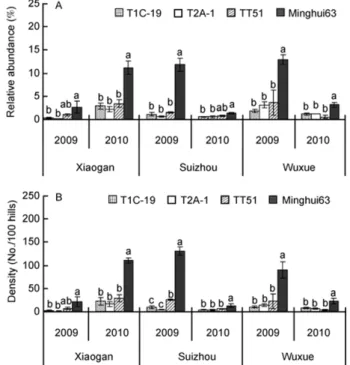
A significantly higher relative abundance of
C. medinalis
within the guild of phytophages was observed in the
non-transgenic Minghui 63 field compared with the three
transgenic
Bt
rice fields at any site and in any year (d
f
=3,8;
Table 3 Relative abundance (mean±SE) of four species of arthropod predators on the three transgenic Bt rice lines and non-transgenic Minghui 63 at three different sites in 2009 and 2010a)
Site Year Arthropod predator species Rice line
T1C-19 T2A-1 TT51 Minghui 63
Xiaogan
2009
H. graminicola 23.56±2.52ab 33.22±4.20a 22.40±1.93ab 21.15±4.59b
U. insecticeps 3.88±2.20a 3.40±0.54a 5.42±1.69a 5.40±0.93a
P. pseudoannulata 15.72±2.17a 16.90±2.13a 11.40±1.72a 10.56±3.13a
P. fuseipes 0.54±0.04a 0.59±0.40a 0.00±0.00a 0.55±0.10a
2010
H. graminicola 14.34±3.35a 12.08±2.01a 10.01±1.88a 15.37±0.89a
U. insecticeps 7.75±0.14a 6.03±1.46a 8.57±2.09a 8.17±2.69a
P. pseudoannulata 3.29±1.62a 0.50±0.25a 2.19±0.73a 2.14±0.52a
P. fuseipes 1.85±0.47a 0.64±0.36b 0.87±0.12ab 1.53±0.16ab
Suizhou
2009
H. graminicola 21.96±4.45a 26.89±2.48a 19.94±1.27a 21.23±3.05a
U. insecticeps 1.54±1.31a 5.21±2.81a 2.75±1.18a 5.13±1.63a
P. pseudoannulata 9.63±1.19ab 10.19±2.00a 5.17±0.98b 5.33±1.38b
P. fuseipes 2.00±0.41a 0.73±0.44a 1.84±0.20a 2.06±0.79a
2010
H. graminicola 27.81±3.06a 23.94±2.36a 27.59±1.62a 22.88±1.17a
U. insecticeps 6.39±0.30a 4.99±0.69a 5.20±2.35a 5.32±0.66a
P. pseudoannulata 1.49±0.74a 1.71±0.60a 1.35±0.22a 2.75±1.26a
P. fuscipes 1.49±0.74a 0.36±0.36a 0.83±0.32a 0.61±0.38a
Wuxue
2009
H. graminicola 32.22±3.95a 31.14±9.00a 25.13±3.47a 21.54±5.68a
U. insecticeps 0.61±0.42a 3.57±3.03a 1.72±1.01a 1.81±0.41a
P. pseudoannulata 4.59±3.04a 2.17±0.45a 2.41±0.44a 1.89±0.38a
P. fuscipes 0.75±0.34a 1.06±0.24a 0.66±0.33a 1.39±0.39a
2010
H. graminicola 14.98±2.95a 7.63±2.49a 8.76±3.74a 11.95±1.38a
U. insecticeps 1.26±0.22a 1.33±0.34a 0.35±0.35a 1.00±0.51a
P. pseudoannulata 0.56±0.56a 0.00±0.00a 0.00±0.00a 0.00±0.00a
P. fuscipes 1.95±1.40a 0.82±0.82a 2.42±0.87a 0.78±0.40a
a) Means within a row indicated with different letters are significantly different (LSD test, P<0.05) among the three transgenic Bt rice lines and non-transgenic Minghui 63 at the same site and in the same year.
relative abundance recorded between Minghui 63 and
TT-51 fields at Xiaogan in 2009 and at Suizhou in 2010
(Figure 1A).
2.3 Population densities of natural arthropod
preda-tors and
C. medinalis
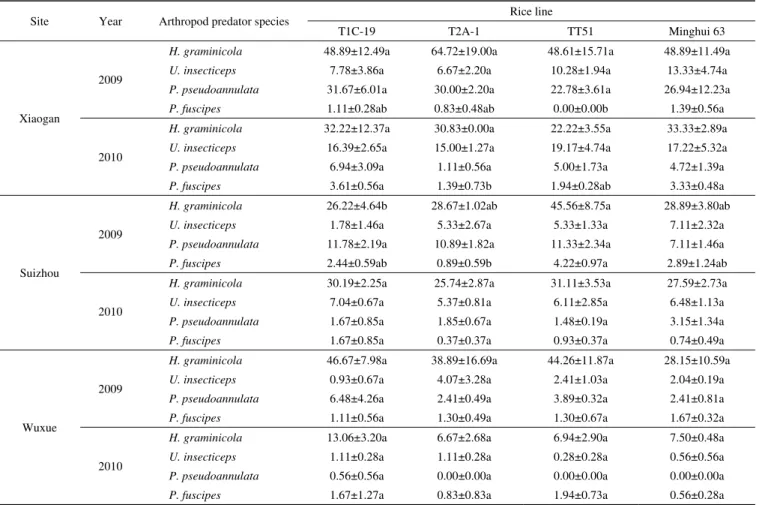
Compared with non-transgenic Minghui 63, the transgenic
rice lines had no significant impacts on the population
den-sity of the four predators at any site and in any year (d
f
=3,8;
P
>0.05), with the exception of a significantly lower
popula-tion density of
P. fuscipes
observed in the TT51 field at
Xiaogan in 2009 and in the T2A-1 field at Xiaogan in 2010
compared with non-transgenic Minghui 63 fields (Table 4).
The population density of
C. medinalis
(i.e., total number of
C. medinalis
collected
with vacuum-suction machine and
plant dissection) was significantly higher on the non-trans-
genic Minghui 63 compared with the three transgenic
Bt
rice lines at any site and in any year (d
f
=3,8;
P
>0.05),
ex-cept that there was no significant difference in the
popula-tion density of
C. medinalis
on Minghui 63 and TT-51 at
Xiaogan in 2009 (Figure 1B).
Figure 1 Relative abundance (A) and density (B)of C. medinalis on the three transgenic Bt rice lines and non-transgenic Minghui 63 at different sites in 2009 and 2010. Bars labeled with different letters differed signifi-
Table 4 Densities (mean±SE) of four species of arthropod predators (No./100 hills) on the three transgenic Bt rice and non-transgenic Minghui 63 at three different sites in 2009 and 2010a)
Site Year Arthropod predator species Rice line
T1C-19 T2A-1 TT51 Minghui 63
Xiaogan
2009
H. graminicola 48.89±12.49a 64.72±19.00a 48.61±15.71a 48.89±11.49a
U. insecticeps 7.78±3.86a 6.67±2.20a 10.28±1.94a 13.33±4.74a
P. pseudoannulata 31.67±6.01a 30.00±2.20a 22.78±3.61a 26.94±12.23a
P. fuscipes 1.11±0.28ab 0.83±0.48ab 0.00±0.00b 1.39±0.56a
2010
H. graminicola 32.22±12.37a 30.83±0.00a 22.22±3.55a 33.33±2.89a
U. insecticeps 16.39±2.65a 15.00±1.27a 19.17±4.74a 17.22±5.32a
P. pseudoannulata 6.94±3.09a 1.11±0.56a 5.00±1.73a 4.72±1.39a
P. fuscipes 3.61±0.56a 1.39±0.73b 1.94±0.28ab 3.33±0.48a
Suizhou
2009
H. graminicola 26.22±4.64b 28.67±1.02ab 45.56±8.75a 28.89±3.80ab
U. insecticeps 1.78±1.46a 5.33±2.67a 5.33±1.33a 7.11±2.32a
P. pseudoannulata 11.78±2.19a 10.89±1.82a 11.33±2.34a 7.11±1.46a
P. fuscipes 2.44±0.59ab 0.89±0.59b 4.22±0.97a 2.89±1.24ab
2010
H. graminicola 30.19±2.25a 25.74±2.87a 31.11±3.53a 27.59±2.73a
U. insecticeps 7.04±0.67a 5.37±0.81a 6.11±2.85a 6.48±1.13a
P. pseudoannulata 1.67±0.85a 1.85±0.67a 1.48±0.19a 3.15±1.34a
P. fuscipes 1.67±0.85a 0.37±0.37a 0.93±0.37a 0.74±0.49a
Wuxue
2009
H. graminicola 46.67±7.98a 38.89±16.69a 44.26±11.87a 28.15±10.59a
U. insecticeps 0.93±0.67a 4.07±3.28a 2.41±1.03a 2.04±0.19a
P. pseudoannulata 6.48±4.26a 2.41±0.49a 3.89±0.32a 2.41±0.81a
P. fuscipes 1.11±0.56a 1.30±0.49a 1.30±0.67a 1.67±0.32a
2010
H. graminicola 13.06±3.20a 6.67±2.68a 6.94±2.90a 7.50±0.48a
U. insecticeps 1.11±0.28a 1.11±0.28a 0.28±0.28a 0.56±0.56a
P. pseudoannulata 0.56±0.56a 0.00±0.00a 0.00±0.00a 0.00±0.00a
P. fuscipes 1.67±1.27a 0.83±0.83a 1.94±0.73a 0.56±0.28a
a) Means within a row indicated with different letters are significantly different (LSD test, P<0.05) among the three transgenic Bt rice and non-transgenic Minghui 63 at the same site and in the same year.
2.4 Population dynamics of
C. medinalis
The population dynamics of
C. medinalis
larvae were sig-
nificantly affected by rice line, sampling date, year, rice
line×sampling date, rice line×year, sampling date×year, rice
line×sampling date×year (
P
<0.05; Table 1). Sampling date,
sampling date×year had significant effects on the population
dynamics of
C. medinalis
adults at all the three experiment
sites (
P
<0.05). However, there were no consistent signifi-
cant effects of rice line, year, rice line×sampling date, rice
line×year, rice line×sampling date×year on the population
dynamics of
C. medinalis
adults at different experiment sites.
For example, rice line and rice line×sampling date had
sig-nificant influence on the population dynamics of
C. medi-
nalis
adults at Xiaogan and Suizhou (
P
<0.001), but no
signifi-cant impacts of rice line and rice line×sampling date were
observed at Wuxue.
2.5 Population dynamics of natural arthropod
preda-tors
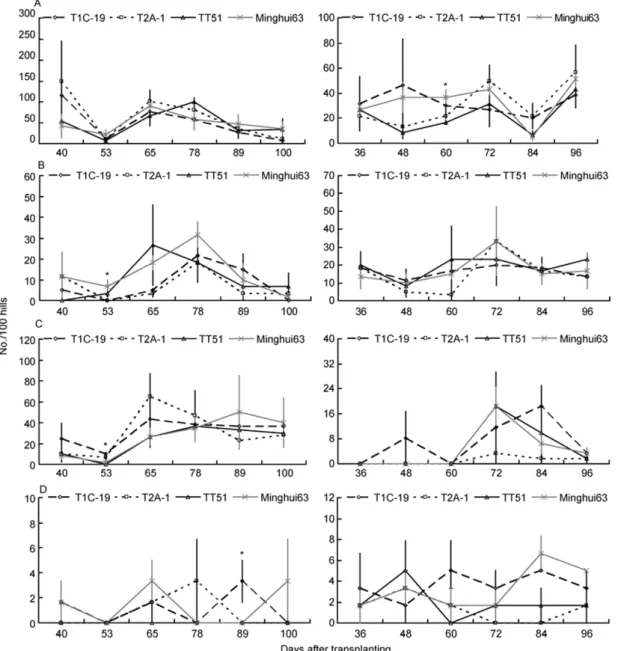
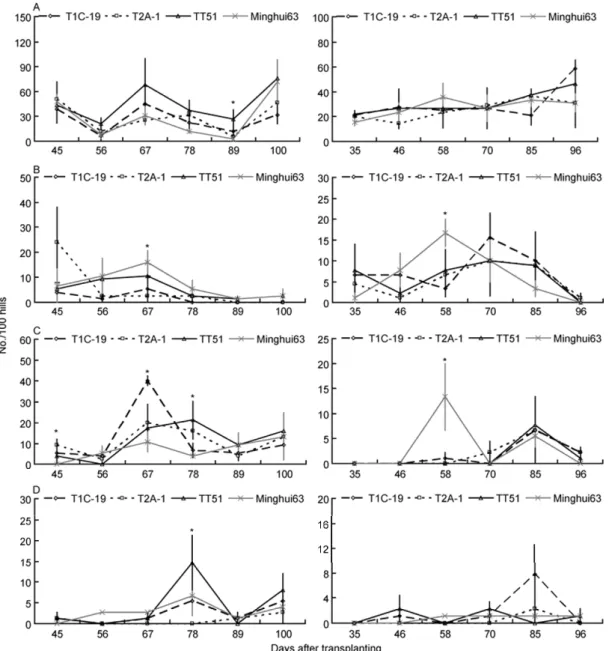
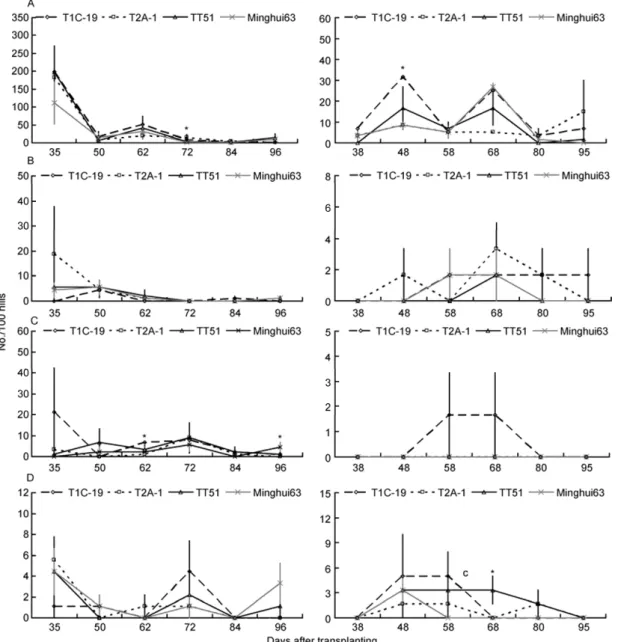
The population dynamics of the four natural predators were
very similar among the three transgenic
Bt
rice lines and
non-transgenic Minghui 63 at Xiaogan (Figure 2), Suizhou
(Figure 3) and Wuxue (Figure 4). The population dynamics
of
H. graminicola
,
U. insecticeps
,
P. pseudoannulata
and
P.
fuscipes
were not significantly affected by rice line, rice
line×year, rice line×sampling date and rice line×sampling
date×year at any sites (
P
>0.05), except that rice line×
sampling date×year significantly influenced the population
dynamics of
P. pseudoannulata
at Suizhou (
P
<0.05; Table
1).
However, there were no consistent significant effects of
sampling date, year, sampling date×year on the population
dynamics of
H. graminicola
,
U. insecticeps
,
P.
pseudoan-nulata
and
P. fuscipes
. For example, sampling date had
sig-nificant impacts on population dynamics of
P. fuscipes
at
Suizhou (
P
<0.05), but no significant influence was
ob-served at Xiaogan and Wuxue (
P
<0.05; Table 1).
3 Discussion
The rice leaffolder,
C. medinalis
, is an important rice pest in
agroecosystems and is widely distributed across the main
Figure 2 The population dynamics of the four arthropod predator arthropods (No./100 hills) on the three transgenic Bt rice lines and non-transgenic Ming-hui 63 at Xiaogan site in 2009 (left) and 2010 (right). * indicates that there are significant differences among rice lines (P<0.05); otherwise, there are no
significant differences among rice lines (LSD test, P<0.05). A, H. graminicola. B, U. insecticeps. C, P. pseudoannulata. D, P. fuscipes.
rice-growing areas of Asia [1]. It has frequent outbreaks and
is responsible for, on average, a 5%
10% loss of rice yield.
The loss can be as great as 60% during serious outbreaks [2,
24]. Transgenic
Bt
rice is a promising crop that can
effec-tively control the infestation of these lepidopteran pests [25].
Many previous reports using laboratory or field tests have
indicated that transgenic rice expressing
Bt
insecticidal
pro-tein genes are resistant to
C. medinalis
[26
30]. In our study,
the percentages of folded leaves
caused by
C. medinalis
significantly decreased on the three transgenic
Bt
rice lines
compared with non-transgenic Minghui 63 rice except for
four individual cases. From Table 2, the four exceptional
cases could be caused by very low percentages of folded
leaves (0%
0.82%) or high experimental variance (32 DAT
at Wuxue in 2009). This suggested that the more severe the
infestation caused by
C. medinalis
, the stronger the
sup-pressive effects of transgenic
Bt
rice.
In the present study there was little, if any, effect of the
transgenic
Bt
rice lines on the population density or
popula-tion dynamics of the four natural arthropod predators
com-pared with non-transgenic Minghui 63 rice. Likewise, the
relative abundance of the four natural enemy arthropods
within the predator guild was similar in the non-transgenic and
transgenic
Bt
rice fields. Therefore, although the densities of
C. medinalis
were significantly lower in the transgenic
Bt
Figure 3 The population dynamics of the four natural predator arthropods (No./100 hills) on the three transgenic Bt rice lines and non-transgenic Minghui 63 at Suizhou in 2009 (left) and 2010 (right). * indicates that there are significant differences among rice lines (P<0.05); otherwise, there are no significant
differences among rice lines (LSD test, P<0.05). A, H. graminicola. B, U. insecticeps. C, P. pseudoannulata. D, P. fuscipes.
plication of
Bt
rice, a similar result to previous reports
[10,18,31].
In most cases (75%), the population dynamics of
C.
me-dinalis
adults were not affected by rice line, rice line×sam-
pling date, rice line×year, rice line×sampling date×year, and
no consistent effects of rice line, rice line×sampling date,
rice line×year, rice line×sampling date×year on the
popula-tion dynamics of
C. medinalis
adults were observed at
dif-ferent experiment sites. Whether this resulted from the
sam-pling method, experimental variance or no antixenosis effect
of
Bt
rice on
C. medinalis
adults or dispersal of moths needs to
be further studied.
In China, agricultural biotechnology development
strate-gies (e.g., Genetically Modified Organisms Breeding Major
Projects) were carried out in 2008. In 2009, two transgenic
Bt
rice lines (TT51 and
Bt
-Shanyou 63) were awarded
re-lease certificates by Ministry of Agriculture of China, the
first safety certificates for transgenic
Bt
rice in China. As an
important staple food crop, an effective monitoring program
of resistance evolution in transgenic
Bt
rice was performed
to provide valuable and early warning information for the
government and researchers [32]. Our studies have provided
long-term and systemic evaluations of the effects of
trans-genic
Bt
rice on target lepidopteran pests and their natural
arthropod enemy in the field, which has helped expedite the
commercialization of transgenic
Bt
rice lines, such as TT51.
Figure 4 The population dynamics of the four natural predator arthropods (No./100 hills) on the three transgenic Bt rice lines and non-transgenic Minghui 63 at Wuxue in 2009 (left) and 2010 (right). * indicates that there are significant differences among rice lines (P<0.05); otherwise, there are no significant-
differences among rice lines (LSD test, P<0.05). A, H. graminicola. B, U. insecticeps. C, P. pseudoannulata. D, P. fuscipes. This work was supported by National Genetically Modified Organisms
Breeding Major Project: Technology of Environmental Risk Assessment on Transgenic Rice (Grant No. 2008ZX08011-001).
1 Cheng J A. Rice Pests. Beijing: China Agricultural Press, 1996 2 Nathan S S. Effects of Melia azedarach on nutritional physiology and
enzyme activities of the rice leaffolder, Cnaphalocrocis medinalis. Pestic Biochem Phys, 2006, 84: 98–108
3 Su J K, Chu B, Chen W M. Preliminary study on method of deter-mining rice leaf roller’s resistance to insecticides and resistance mon-itoring. Acta Agr Shanghai, 2003, 19: 81–84
4 Su J, Hu C Q, Zhai H L, et al. Establishment of a highly efficient and stable transforming system mediated by Agrobacterium tumefacien in indica rice. Fujian J Agr Sci, 2003, 18: 209–213
5 Fujimoto H, Itohet K, Yamamoto M, et al. Insect resistant rice gener-ated by introduction of a modified delta-endotoxin gene of Bacillus thuringiensis. Nat Biotechnol, 1993, 11: 1151–1155
6 Cheng X, Sardana R, Kaplan H, et al. Agrobacterium-transformed rice plants expressing synthetic cry1A(b) and cry1A(c) genes are highly toxic to striped stem borer and yellow stem borer. Proc Natl Acad Sci USA, 1998, 95: 2767–2772
7 Shu Q Y, Ye G Y, Cui H R, et al. Transgenic rice plants with a syn-thetic cry1Ab gene from Bacillus thuringiensis were highly resistant to eight lepidopteran rice pest species. Mol Breeding, 2000, 6: 433–439
8 Tu J M, Zhang G A, Datta K, et al. Field performance of transgenic elite commercial hybrid rice expressing Bacillus thuringiensis -endotoxin. Nat Biotechnol, 2000, 18: 1101–1104
9 Huang J K, Hu R F, Scott R, et al. Insect-resistant GM rice in farm-ers’ fields: assessing productivity and health effects in China. Science, 2005, 308: 688–690
10 Chen M, Ye G Y, Lu X M, et al. Biotransfer and bioaccumulation of Cry1Ab insecticidal protein in rice plant-brown planthopper-wolf spider food chain. Acta Entomol Sin, 2005, 48: 208–213
transgen-ic rtransgen-ice on target insect pests and non-target arthropods in China. In-sect Sci, 2006, 13: 409–420
12 Tang W, Chen H, Xu C G, et al. Development of insect-resistant transgenic indica rice with a synthetic cry1C* gene. Mol Breeding, 2006, 18: 1–10
13 Wang Y M, Zhang G A, Du J P, et al. Influence of transgenic hybrid rice expressing a fused gene derived from cry1Ab and cry1Ac on primary insect pests and rice yield. Crop Protect, 2010, 29: 128–133 14 Chen M, Ye G Y, Liu Z C, et al. Analysis of Cry1Ab toxin
bioaccu-mulation in a food chain of Bt rice, an herbivore and a predator. Eco-toxicology, 2009, 18: 230–238
15 Liu Z C, Ye G Y, Fu Q, et al. Indirect impact assessment of trans-genic rice with cry1Ab gene on predations by the wolf spider, Pirata subpiraticus. Chin J Rice Sci, 2003, 17: 175–178
16 Liu Y F, Zhang G R, Gu D X, et al. Enzyme-linked immunosorbent assay used to detect the food relationships of the arthropods in paddy fields (in Chinese). Acta Entomol Sin, 2002, 45: 352–358
17 Zhang Y P, Huang B Q. Discussion of the protection and utility of rice leaf-folder’s natural enemies (in Chinese). Nat Enem Insect, 2000, 22: 38–44
18 Zhang J, Liang G W, Zeng L. The differential dynamics of Cnaphalocrocis medinalis, planthoppers and their natural enemies in two rice paddy ecosystems (in Chinese). Acta Phytophyl Sin, 2011, 38: 1–8
19 Zhang J, Liang G W, Zeng L. Effects of rice-planting neighboring with vegetable crops on the population dynamics of Cnaphalocrocis medinalis, plant hopper, and their predatory enemies (in Chinese). Chin J Ecol, 2011, 30: 281–289
20 Chen H, Tang W, Xu C G, et al. Transgenic indica rice plants har-boring a synthetic cry2A* gene of Bacillus thuringiensis exhibit en-hanced resistance against lepidopteran rice pests. Theor Appl Genet, 111: 1330–1337
21 Chen M, Liu Z C, Y G Y, et al. Impacts of transgenic cry1Ab rice on non-target planthoppers and their main predator Cyrtorhinus li-vidipennis (Hemiptera: Miridae)—a case study of the compatibility of Bt rice with biological control. Biol Control, 2007, 42: 242–250
22 Carino F O, Kenmore P E, Dyck V A. The farmcop suction sampler for hoppers and predators in flooded rice fields. Int Rice Res Newsl, 1979, 4: 21–22
23 SAS Institute Inc. SAS/STA User’s Guide, Version 6. Gary: SAS In-stitute Inc., 1990
24 Pathak M D, Khan Z R. Insect pests of rice. Los Banos: International Rice Research Institute, 1994
25 Bashir K, Husnain T, Fatima T, et al. Field evaluation and risk as-sessment of transgenic indica basmati rice. Mol Breeding, 2004, 13: 301–312
26 Maqbool S B, Riazuddin S, Loc N T, et al. Expression of multiple insecticidal genes confers broad resistance against a range of different rice pests. Mol Breeding, 2001, 7: 85–93
27 Datta K, Baisakh N, Thet K M, et al. Pyramiding transgenes for mul-tiple resistance in rice against bacterial blight, yellow stem borer and sheath blight. Theor Appl Genet, 2002, 106: 1–8
28 Ye G Y, Yao H W, Shu Q Y, et al. High levels of stable resistance in transgenic rice with a cry1Ab gene from Bacillus thuringiensis Ber-liner to rice leaffolder, Cnaphalocrocis medinalis (Guenée) under field conditions. Crop Protect, 2003, 22: 171–178
29 Breitler J C, Vassal J N, Catala M M, et al. Bt rice harbouring cry genes controlled by a constitutive or wound-inducible promoter, pro-tection and transgene expression under Mediterranean field condi-tions. Plant Biotechnol J, 2004, 2: 417–430
30 Ramesh S, Nagadhara D, Reddy V D, et al. Production of transgenic indica rice resistant to yellow stem borer and sap-sucking insects, us-ing super-binary vectors of Agrobacterium tumefaciens. Plant Sci, 2004, 166: 1077–1085
31 Bernal C C, Aguda R M, Cohen M B. Effect of rice lines transformed with Bacillus thuringiensis toxin genes on the brown planthopper and its predator Cyrtorhinus lividipennis. Entomol Exp Appl, 2002, 102: 21–28
32 Han L Z, Wu K M, Peng Y F, et al. Efficacy of transgenic rice ex-pressing Cry1Ac and CpTI against the rice leaffolder, Cnaphalocrocis medinalis (Guenée). J Invertebr Pathol, 2007, 96: 71–79
Open Access This article is distributed under the terms of the Creative Commons Attribution License which permits any use, distribution, and reproduction in any medium, provided the original author(s) and source are credited.