Research Article
DPT immunization and SIDS
Kalyani Srinivas
1, G. Preeti
1, Sujatha Pasula
2*
INTRODUCTION
Immunization programs are undeniably among the most effective public health interventions. Morbidity and mortality attributable to various diseases is reduced in recent decades. However, the very success of these programs brings new problems. As immunization is the process in which the body's own protective mechanisms are primed to thwart the invasion or multiplication of pathogens, is effective and relatively inexpensive, simple, and easy to deliver. However use of vaccines is not entirely without risk. Vaccines, including the whole-cell pertussis (whooping cough) vaccine and the rubella (German measles) vaccine, the subjects of this report, typically contain small quantities of material derived from disease-causing organisms. The pertussis vaccine contains dead bacteria and is termed a killed or inactivated vaccine; the rubella vaccine contains
laboratory-weakened live viruses and is termed a live, attenuated vaccine.1
Although vaccines have markedly decreased many childhood illnesses, but every time vaccination is not without risk. Minor side effects are more common, than serious side effects but have been observed on rare occasions with few times. Whether there are increased risks of serious adverse events following whole-cell pertussis, however, is controversial. The fact that pertussis vaccination is mandatory in many states has heightened public awareness of controversy and concern about the safety of vaccine.
The committee agreed to consider seven additional adverse events as anaphylaxis, erythema multiform, Guillain Barre syndrome, inconsolable crying, thrombocytopenia, and shock and “unusual shock-like state” with hypotonicity, hyporesponsiveness, and
ABSTRACT
Background: Aim of this study was to determine whether DTP increased the risk of sudden infant death syndrome in children.
Methods: Present case-control study was done in Andhra Pradesh at all medical centers in outpatient and inpatient, who have scheduled vaccination from the time of birth from 2012 to 2014.
Results: It is found that mortality with SIDS in the period zero to three days following DTP to be 6.9 times that in the period beginning 30 days after immunization (95 per cent confidence interval, 1.4 to 28). The mortality rate of non-immunized infants was 4.5 times that of non-immunized infants of the same age (95 per cent CI, 1.9 to 12). Although the mortality ratios for SIDS following DTP is less as the period of time of vaccination increase, so that only a few cases of SIDS in infants could be due to DTP vaccine.
Conclusions: Present study agrees that benefit of DPT vaccination is more than risk associated with SIDS. It is conclude that there is no increased risk of SIDS with immunization with DTP.
Keywords: SIDS, DPT vaccination, Benefits
1Department of Pediatrics, Government Medical College, Nizamabad,Telangana, India 2Department of Biochemistry, Katuri Medical College, Guntur,Andhra Pradesh, India
Received: 15 May 2015
Accepted: 21 June 2015
*Correspondence:
Dr. Sujatha Pasula,
E-mail: [email protected]
Copyright: © the author(s), publisher and licensee Medip Academy. This is an open-access article distributed under the terms of the Creative Commons Attribution Non-Commercial License, which permits unrestricted non-commercial use, distribution, and reproduction in any medium, provided the original work is properly cited.
convulsions with respect to pertussis vaccines. Sudden Infant Death Syndrome (SIDS) has been reported as a possible complication of pertussis immunization on a number of occasions but there is hypothesis that pertussis vaccination might induce a fatal disorganization of respiratory control in susceptible infants.2
Minor systemic reactions are common,3 and pertussis
vaccine is thought to have rare but serious neurologic sequellae.4 Neither vital statistics on infant death nor case
reports are very helpful for the elucidation of a link between SIDS and pertussis vaccine, since the period of highest risk for SIDS coincides in the India with the recommended dates for first year of Diphtheria-Tetanus-Pertussis (DTP) immunizations.
The present study was designed to re-examine in present location that DTP vaccine might be associated with an increased risk of SIDS in the first year of life. Study focused on children possessing no obvious medical risk factors for SIDS and vaccinated for DPT vaccination as per vaccination schedule by the Ministry of Health.
METHODS
Present case-control study was done in State of Andhra Pradesh (undivided) of 23 district at all medical centers in outpatient and inpatient, who have scheduled vaccination from the time of birth. According to study population present study include infants born from 2012 to 2014.
Study comprising of panel of doctors specialized in pediatrics, microbiology, social preventive medicine to evaluate death cause in infant, who are appointed by state government of AP. Report given by these specialized doctors is retained by medical records. We have been fortunate in having access to complete medical records and notifications of death in a well-defined population.
The cases were compared with 2000 control infants, which were randomly selected from all births in the study regions. The method of selection of controls has been described in detail. Control infants were randomly selected and a particular date to ensure group matching for infant age, and to a particular time of day so that the distribution of this time for controls was similar to the expected distribution of the time of death for cases.
Obstetric records were examined and parents (or guardians) interviewed. Parents of SIDS cases were interviewed within one month of death and for controls within one week of a particular time and date. These infants remained under surveillance, and therefore in the study population, copies of death certificates and autopsy results were sought whenever cause of death was not evident from attending physicians’ notes.
SIDS was defined as any death for which no cause could be discerned among infants of normal birth weight and without predisposing medical conditions. The overall
incidence of SIDS was estimated by dividing the number of deaths by the number of infant years at risk in the age range 30 to 365 days. Cases with any history of risk of SIDS in family or to child were excluded from study.
In our study first two doses DTP immunizations were accompanied by Oral Polio Vaccine (OPV) and hepatitis-B. All DTP and OPV doses administered in each case was compared to all the reference children born in the calendar year closest to the case’s date of birth, and immunization status was evaluated from the primary medical record for the case and all of the corresponding reference children as of the case’s age in days at death.
Immunization status was categorized as “No pertussis vaccine till date,” “Last immunization in past three days,” “Last immunization in previous 4-7 days,” “Last immunization in previous 8-29 days,” and “Last immunization in previous 30 or more days earlier”. Variation in mortality from SIDS in relation to DPT immunization status was calculated by means of a matched case-control analysis was done.
RESULTS
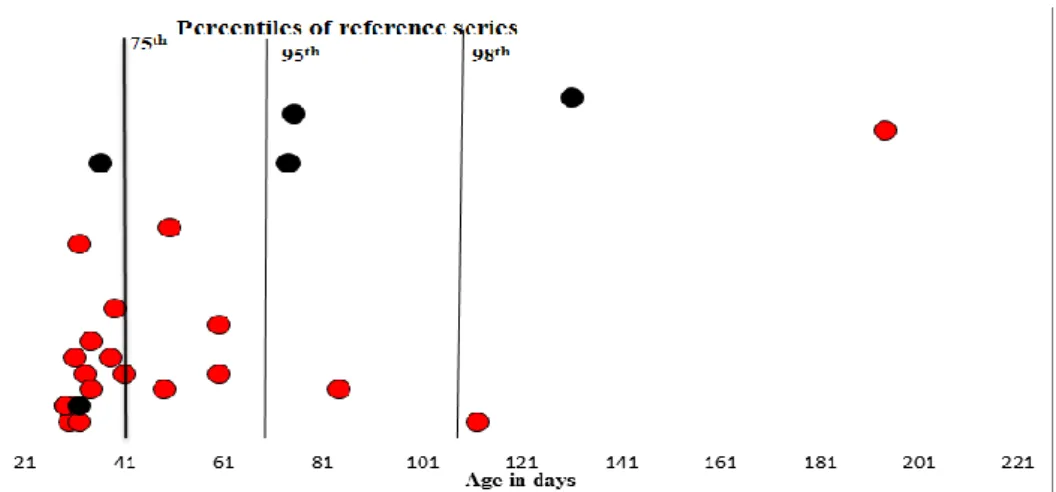
Details of the 24 case are listed in Table 1. Four of the 24 infants had not received pertussis vaccine at the time of their death (Table 1). This proportion is compared to that expected (1.44 out of 24) and further analyzed in Table 2. The relative mortality can be approximated by the cross product of Table 2, giving (4 x 22.56)/(20 x 1.44) = 2.45. The formal matched analysis yields an estimate of 4.5 fold increase in mortality of nimmunized over ever-immunized infants (95 per cent CI 0.87 and 7). At the time of their deaths, all but one of the non-immunized had passed the 95th percentile of the population
distribution of age at first DTP (Figure 1).
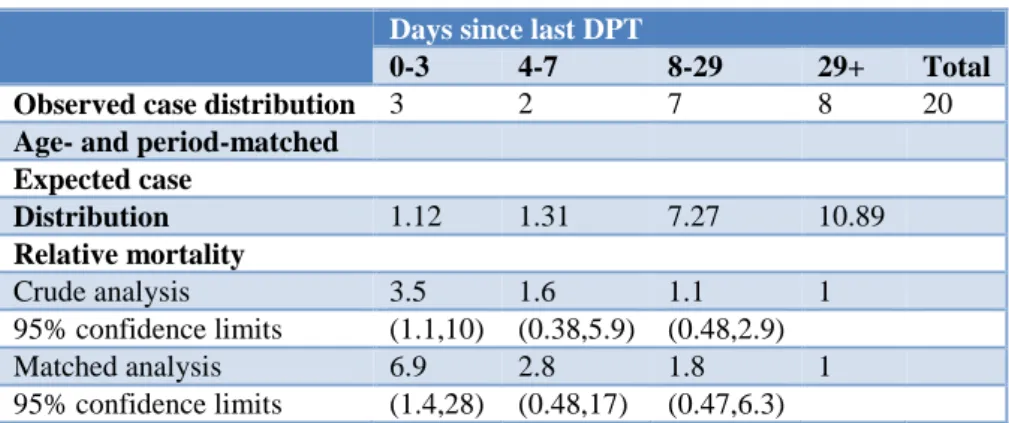
We analyzed SIDS mortality among immunized children by a procedure analogous to that above, except that non-immunized cases were deleted and non-non-immunized reference group members were omitted from every matched set. There was an important decline in SIDS mortality rates over the days following immunization (Table 3).
Three infants died within three days of DTP (two following the first immunization, one following the second) yielding an estimated age and period-adjusted relative mortality rate of 6.9 (95 per cent CI 1.1 to 28) by comparison to children immunized at least 30 days earlier.
Age-adjusted mortality declined gradually over the four weeks following immunization. It should be noted that the confidence intervals for relative mortality in the fourth through 29th days following immunization extend
Table 1:Deaths in children without any risk of SIDS.
Sex
Month and year of death
Age at death (days)
Last DPT given before (days)
Number of DPT vaccinations before death
Autopsy diagnosis
M 4/1/2012 131 21 2 SIDS
F 5/1/2012 32 2 1 SIDS
F 2/2/2012 34 3 1 SIDS
M 7/3/2012 41 4 1 SIDS
M 15/03/2012 84 3 1 SIDS
F 22/03/2012 39 8 2 SIDS
M 2/5/2012 60 4 1 SIDS
F 17/06/2012 31 5 1 SIDS
M 8/11/2012 34 6 2 SIDS
F 16/11/2012 30 1 2 SIDS
F 29/12/2012 31 2 1 SIDS
M 20/01/2013 32 1 1 SIDS
M 3/2/2013 29 2 1 SIDS
M 7/11/2013 112 1 1 SIDS
M 20/11/2013 49 3 1 SIDS
M 27/11/2013 29 2 2 SIDS
M 3/3/2014 60 7 1 SIDS
F 7/4/2014 38 5 1 SIDS
M 14/05/2014 50 13 1 SIDS
F 14/08/2014 194 19 1 SIDS
M 6/11/2014 32 12 2 SIDS
M 13/11/2014 74 17 1 SIDS
F 19/11/2014 36 17 2 SIDS
Table 2:Death due to SIDS with DPT immunization.
Never Ever Total
Observed case distribution 4 20 24 Age and period matched1; Expected case distribution 1.44 22.56 24
Relative mortality2; Crude analysis 2.45 1.0
95% Confidence limits (0.87,7)
Matched analysis 4.5 1.0
95% Confidence limits (1.9, 12)
1Based on immunization histories in a random sample of children born at Group Health hospitals.
2Calculated as: (4/1.44)/(20/22.56) = 2.45
Table 3:SIDS Mortality among the immunized to post-immunization interval.
Days since last DPT
0-3 4-7 8-29 29+ Total
Observed case distribution 3 2 7 8 20
Age- and period-matched Expected case
Distribution 1.12 1.31 7.27 10.89
Relative mortality
Figure 1:Timing of first DTP in immunized SIDS cases, and of death in the non-immunized. Black dots are on the non-immunized to emphasize that date of first DTP would have been later than the date indicated for death. Vertical lines give the percentiles of the cumulative distribution of age at first DTP in the reference series. Time of first DTP serves here as an index of timeliness of postnatal care. The proportions of cases beyond the 75th percentile
of the reference distribution are: non-immunized, 100%; recently immunized, 75%; others, 26%.
DISCUSSION
The major finding of the present study is an apparent 6.9 fold elevation in the risk for SIDS in the first four days following immunization with DTP in the first year of life. In addition, children without any DTP immunization had SIDS mortality more than four times higher than those who had been immunized. All of the children who died without immunization had already passed the normal ages of first DTP immunization at Group Health, as had a majority of those children who died within a few days of immunization.
Delay in immunization of high-risk infants might lead both to an elevated risk in the never-immunized and to a foreshortening of the interval between immunization and SIDS in the immunized. Both phenomena could operate in the absence of any causal connection between immunization and risk of SIDS death, and could account at least in part for the results obtained here.5 Review of
the individual non immunized cases suggested a high prevalence of factors that might well lead to a delay in immunization and which are known to predispose to SIDS.6,7 Although these elements are not in themselves
entirely sufficient to explain the observed risk elevation, both the pattern itself (high risk of SIDS associated with absence of immunization) and probable confounding by socioeconomic factors have been observed previously.8-10
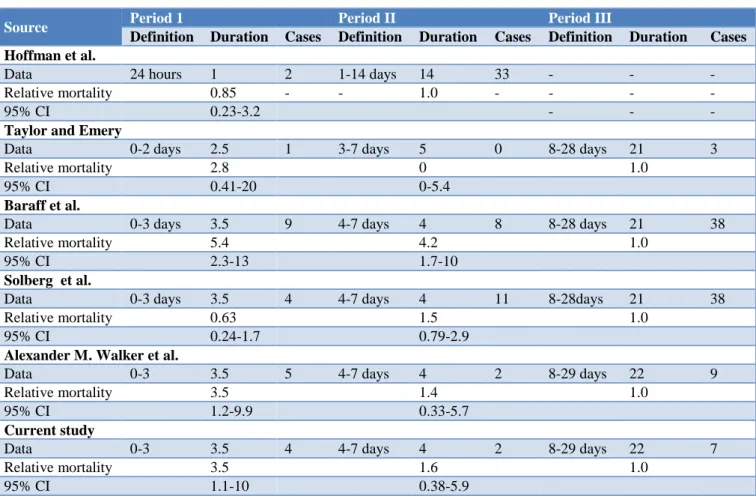
Data reported from a previous prospective study of SIDS compared,11-15 in Table 4.
Even if all the SIDS occurring within three days after immunization were due to DTP, immunization practice would not have accounted for more than about 10 per cent of SIDS cases in records. The possibility of compensatory decline in mortality after an initial rise cannot be ruled out. In the absence of infant immunization programs there would have been a
substantial risk of pertussis itself,8 a serious illness
requiring hospitalization for the great majority of infected children under six months of age and resulting in death for about one infant in a hundred.9
We have found that immunization is associated with a lower risk of SIDS; however, potential limitations of this study must be considered. In India, most immunizations are given by the general practitioners. As there is no central record of immunization, ascertainment of immunization status is difficult. Although general practitioners do keep records of immunizations given, they are unsatisfactory for assessment of immunization status of some children because of the mobility of many families between different practitioners. Community nursing records may be inaccurate as they rely on parental recall.
Evidence of immunization in this study was based on the records, which relies upon the family taking the document to the general practitioner and the general practitioner completing it. This could be produced for inspection by the majority of the interviewed parents of control infants (96%), but was available for significantly fewer cases. This probably reflects the loss or destruction of the immunization records by the parents following the death of their baby. We have shown that the missing data do not affect the study’s receiving immunizations. However, there is good agreement between the
immunization status of the infant and that of our records. Our study has been able to adjust for a more extensive
Table 4:Case studies of SIDS proceeded by DPT immunization.
Source Period 1 Period II Period III
Definition Duration Cases Definition Duration Cases Definition Duration Cases
Hoffman et al.
Data 24 hours 1 2 1-14 days 14 33 - - -
Relative mortality 0.85 - - 1.0 - - - -
95% CI 0.23-3.2 - - -
Taylor and Emery
Data 0-2 days 2.5 1 3-7 days 5 0 8-28 days 21 3
Relative mortality 2.8 0 1.0
95% CI 0.41-20 0-5.4
Baraff et al.
Data 0-3 days 3.5 9 4-7 days 4 8 8-28 days 21 38
Relative mortality 5.4 4.2 1.0
95% CI 2.3-13 1.7-10
Solberg et al.
Data 0-3 days 3.5 4 4-7 days 4 11 8-28days 21 38
Relative mortality 0.63 1.5 1.0
95% CI 0.24-1.7 0.79-2.9
Alexander M. Walker et al.
Data 0-3 3.5 5 4-7 days 4 2 8-29 days 22 9
Relative mortality 3.5 1.4 1.0
95% CI 1.2-9.9 0.33-5.7
Current study
Data 0-3 3.5 4 4-7 days 4 2 8-29 days 22 7
Relative mortality 3.5 1.6 1.0
95% CI 1.1-10 0.38-5.9
Immunization also attenuates the fall in the infant's body temperature at night, and this might suggest that infants would be less able to cope with thermal stress, which would be expected to increase the risk of SIDS. However, in a study of 21 normal infants monitored before and after immunization, although nearly all had a rise in rectal temperature on the night of the immunization, this was not associated with any increase in apnoea density. This observation supports the finding of Griffin et al.,18 who
found a lower risk of SIDS from zero to three days, four to seven days, and eight to 14 days after DTP immunization compared with the risk 31 days or more after immunization. Their study was prompted by the report from a much smaller study that there was a 7-3-fold increased risk of SIDS in the period from zero to three days after DTP immunisation.15
However, this was based on only four SIDS cases in this period. We cannot be certain that immunization actually protects against SIDS, as it is possible that there is residual confounding which has not been accounted for. However, we can confidently state that immunization is not a significant factor in the occurrence of SIDS. Furthermore, there appears to be no increased risk of SIDS with immunization on vaccination by DTP at 6 weeks of age.
CONCLUSION
Present study agrees that benefit of DPT vaccination is more than risk associated with SIDS. It is conclude that there is no increased risk of SIDS with immunization with DTP.
ACKNOWLEDGEMENTS
We express our immense gratitude to Joint Director and commissioner of family welfare, Hyderabad for his kind co-operation and encouragement which help us in completion of this project.
Funding: No funding sources Conflict of interest: None declared
Ethical approval: The study was approved by the institutional ethics committee
REFERENCES
Washington (DC): National Academies Press (US); 1991;382:6-9.
2. Peter G. Report of the committee on infectious diseases. In: Peter G, eds. American Academy of Pediatrics. The Red Book. 20th ed. Elk Grove Village, IL: American Academy of Pediatrics; 1986. 3. Cody CL, Baraff LJ, Cherry JD, March SM, Manclark CR. Nature and rates of adverse reactions associated with DTP and DT immunizations in infants and children. Pediatrics. 1981;68:650-60. 4. Miller DL, Ross EM, Aldershade R, Bellman MH,
Rawson NSB. Pertussis immunization and serious acute neurological illness in children. Br Med J. 1981;282:1595-9.
5. Byard RW, Buorne AJ, Burnell RH, Roberton DM. No association between DTP vaccination and SIDS. Med J Aust. 1991;155:135-6.
6. Mitchell EA, Stewart AW, Clements M, Ford RPK on behalf the New Zealand Cot Death Study Group. Immunisation and the sudden infant death syndrome. Arch Dis Child. 1995;73:498-501. 7. Jonville-BeÂra AP, Autret E, Laugier J. Sudden
infant death syndrome and diphtheria-tetanus-pertussis-poliomyelitis vaccination status. Fundam Clin Pharmacol. 1995;9:263-70.
8. Haglund B, Cnattingius S. Cigarette smoking as a risk factor for Sudden Infant Death Syndrome: a population based study. Am J Public Health. 1990;80:29-32.
9. Grether JK, Schulman J. Sudden infant death syndrome and birth weight. J Pediatr. 1989;114:561-7.
10. Stewart GT. Infection and immunization. Scot Med J. 1979;24:47-52.
11. Hoffman HJ, Hunter JC, Hasselmeyer EG. SIDS and DTP. In: Hoffman HJ, Hunter JC, Hasselmeyer
EG, eds. Proceedings of the 17th Immunization Conference. Atlanta, GA: Conference; May 1982. 12. Taylor EM, Emery JL. Immunization and cot deaths
(letter). Lancet. 1982;2:721.
13. Baraff LJ, Ablon WJ, Weiss RC. Possible temporal association between diphtheria tetanus toxoid-pertussis vaccination and sudden infant death syndrome. Pediatr Infect Dis. 1983;2:7-11.
14. Solberg LK. DPT vaccination, visit to child health center and sudden infant death syndrome (SIDS); evaluation of DPT vaccination. Oslo Health Council. NIH Library Translation NIH-85-152. Bethesda: CR Manclark, Laboratory of Pertussis, Food and Drug Administration; 1985.
15. Walker AM, Jick H, Perera DR, Thompson RS, Knauss TA. Diphtheria-tetanus-pertussis immunization and sudden infant death syndrome. Am J Public Health. 1987;77: 945-51.
16. Hoffman HJ, Hunter JC, Damus K, Pakter J, Peterson DR, van Belle G, et al. Diphtheriatetanus-pertussis immunization and sudden infant death: results of the National Institute of Child Health and Human Development Cooperative Epidemiological Study of sudden infant death risk factors. Pediatrics. 1987;79:598-611.
17. Hoffman HJ, Damus K, Hillman L, Krongrad E. Risk factors for SIDS: results of the National Institute of Child Health and Human Development SIDS cooperative epidemiological study. Ann NY Acad Sci. 1988;533:13-30.
18. Griffin MR, Ray WA, Livengood JR, Schaffner W. Risk of sudden infant death syndrome after immunization with the diphtheria-tetanus-pertussis vaccine. N Engl J Med. 1988;319:618-23.