WHAT INFORMS OUR VISUAL TASTE?
THE IMPACT OF PERSONALITY AND POLITICAL ORIENTATION ON VISUAL PREFERENCES
Shannon Zenner
A dissertation submitted to the faculty at the University of North Carolina at Chapel Hill in partial fulfillment of the requirements for the degree of Doctor of Philosophy in the
Mass Communication program in the Hussman School of Journalism and Media.
Chapel Hill 2020
Approved by:
Francesca Dillman Carpentier Nori Comello
Josh Ege
ABSTRACT
Shannon Zenner: What Informs Our Visual Taste? The Impact of Personality and Political Orientation on Visual Preferences
(Under the direction of Francesca Dillman Carpentier)
A survey of 976 participants was conducted to explore relationships between visual aesthetic preferences, personality traits, and political orientation. Two key visual aesthetic dimensions were used to evaluate visual aesthetic dimensions. The first dimension was the level of abstraction versus representativeness of a visual, the latter pole describing visuals that are clearly intended to reference a real object because the depicted object is easily recognizable, if not realistic. The second dimension was the level of curved versus angular visuals. Previous research has investigated these dimensions primarily with fine art materials. However, none of these studies have looked at these dimensions with graphic design materials. Therefore, this study adds to the existing literature by extending the measure of visual aesthetic preferences to graphic design domains, with the ultimate goal being to inform graphic design engaged in political and other advertising projects. Results of the survey indicate clear preferences for
representative images over more abstract images and curved shapes over more angular shapes. Most importantly, these preferences were the same for traditional visual
To my husband, Greg, for his unwavering love and support that made this impossible dream possible. You are a rock star.
To Francesca, the best advisor anyone could ever hope for. You were there for me when I had totally given up on myself and I will never forget that. Thank you for everything. To the amazing members of my committee, thank you for each insight and comment, for
your patience, and for giving of your time to support me.
To Rhonda Gibson, who always had my back. Thanks for being my fairy godmother during my time at UNC.
To Heidi, Ann and all the other faculty and staff at UNC who exemplify professionalism and what it means to be really decent human beings.
To Eleanor, thanks for being the chillest kid ever, and for putting up with an absentee mom during this entire process.
ACKNOWLEDGEMENTS
I’d like to offer a special acknowledgement to Dr. Francesca Dillman Carpentier, the W. Horace Carter Distinguished Professor in the Hussman School of Journalism and Media at the University of North Carolina at Chapel Hill. Not only was Dr. Dillman Carpentier an amazing advisor and supporter of my research, but her generous
TABLE OF CONTENTS
LIST OF FIGURES ... viii
LIST OF TABLES ... x
CHAPTER I: INTRODUCTION ... 1
CHAPTER II: VISUAL TASTE, VISUAL PREFERENCES ... 5
Moving from Taste to Preference as the Preferred Concept ... 10
Music and Interior Design ... 18
CHAPTER III: DECONSTRUCTING DESIGN QUALITY ... 22
Describing What We See ... 23
The Formal Language of Design ... 25
Angular vs. Curvilinear Preferences ... 26
Abstract vs. Representative Preferences ... 32
CHAPTER IV: PERSONALITY AND VISUAL PREFERENCE ... 38
What is Personality? ... 38
Linking Personality to Visual Preference ... 40
CHAPTER V: ASSOCIATING POLITICAL ORIENTATION WITH PERSONALITY AND VISUAL PREFERENCE ... 45
Defining Political Orientation ... 46
Linking Personality to Political Orientation ... 48
Linking Political Orientation to Visual Preferences ... 50
CHAPTER VI: PURPOSE OF STUDY ... 53
CHAPTER VII: METHOD ... 58
Overview ... 58
Participants ... 59
Procedure ... 61
CHAPTER VIII: RESULTS ... 69
Predicting the Abstract/Representative Dimension ... 70
Neuroticism ... 70
Extraversion ... 73
Openness ... 75
Agreeableness ... 78
Conscientiousness ... 80
Predicting the Angular/Curved Dimension ... 82
Neuroticism ... 82
Extraversion ... 85
Openness ... 87
Agreeableness ... 89
Conscientiousness ... 91
CHAPTER IX: DISCUSSION ... 94
CHAPTER X: LIMITATIONS ... 101
CHAPTER XI: CONCLUSION ... 104
REFERENCES ... 109
TABLES ... 129
APPENDICES ... 134
APPENDIX A: SURVEY MATERIALS ... 135
LIST OF FIGURES
Figure 1. The Approval Matrix published in New York Magazine ... 9
Figure 2. The framework for the psychology of aesthetics(Jacobsen, 2006) ... 14
Figure 3. Stimulus reproduced from Höfel & Jacobsen, 2003. ... 15
Figure 4. Stimulus reproduced from Ritterfeld & Cupchik, 1996 ... 19
Figure 5. On the left, branding for juice brand Frooti by Sagmeister & Walsh. On the right, branding for a skin rejuvenation service for women called ‘Lite Luxe’by Smack Bang Designs ... 24
Figure 6. Chart illustrating aspects of a line in lesson on Line, Space, Shape, and Form within Elements and Principles of Design by University. of Houston’s Kevin Rigdon ... 27
Figure 7. Images from website (Interior Design Basics, 2013) ... 28
Figure 8. Angular versus curved typeface stimuli and notes from figures 8 and 10 .... 31
Figure 9. Top left, an example of representative art, “Meerhaven” by Johann Anton Eismann. Right, an example of abstract art, “Girl Before a Mirror”, by Pablo Picasso. Bottom left, an example of nonrepresentative art, “Le Premier Disque” by Robert Delaunay. ... 32
Figure 10. Sketches from Pablo Picasso of a bull moving from representative. on the left to more abstracted on the right ... 33
Figure 11. A slide from Scott McCloud’s Understanding Comics, 1999 ... 34
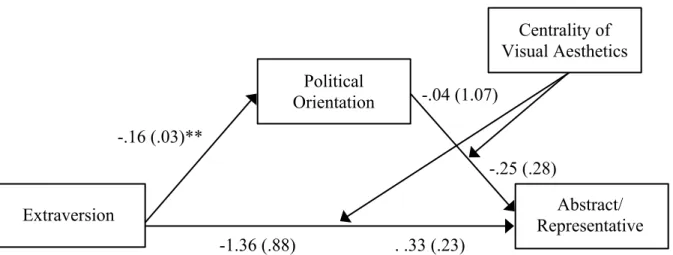
Figure 12. General model of relationship between personality, political orientation, and visual preference, as moderated by a person’s centrality of visual aesthetics (a proxy for visual expertise) ... 53
Figure 13. Model of relationship between neuroticism, political orientation, and the abstract/representative dimension, as moderated by a person’s centrality of visual aesthetics (a proxy for visual expertise) ... 73
Figure 15. Model of relationship between openness, political orientation, and the abstract/representative dimension, as moderated by a person’s centrality of visual aesthetics (a proxy for visual expertise) ... 78 Figure 16. Model of relationship between agreeableness, political
orientation, and the abstract/representative dimension, as moderated by a person’s centrality of visual aesthetics (a proxy for visual expertise) ... 80 Figure 17. Model of relationship between conscientiousness, political
orientation, and the abstract/representative dimension, as moderated by a person’s centrality of visual aesthetics (a proxy for visual expertise) ... 82
Figure 18. Model of relationship between neuroticism, political orientation,
and the angular/curved dimension, as moderated by a person’s centrality of visual aesthetics (a proxy for visual expertise) ... 84
Figure 19. Model of relationship between extraversion, political orientation,
and the angular/curved dimension, as moderated by a person’s centrality of visual aesthetics (a proxy for visual expertise) ... 87
Figure 20. Model of relationship between openness, political orientation,
and the angular/curved dimension, as moderated by a person’s centrality of visual aesthetics (a proxy for visual expertise) ... 89
Figure 21. Model of relationship between agreeableness, political
orientation, and the angular/curved dimension, as moderated by a person’s centrality of visual aesthetics (a proxy for visual expertise) ... 91 Figure 22. Model of relationship between conscientiousness, political
orientation, and the angular/curved dimension, as moderated by a person’s centrality of visual aesthetics (a proxy for visual expertise) ... 93 Figure 23. Model of relationship between neuroticism, political orientation,
LIST OF TABLES
Table 1. Participant Descriptives ... 130
Table 2. Descriptives of Image Variables ... 131
Table 3. Correlations Between All Variables ... 132
CHAPTER 1
INTRODUCTION
The arts have been studied since the ancient Greeks, with Plato even devoting an entire book, the Aesthetics, to the understanding of beauty. In sociology, Deinhard
(1970), and Adorno (1970) most famously, looked at the impact of the arts on society and culture, using visual arts and differences in preferences or taste in those arts as a focal subject of inquiry (see also Benjamin, 1935). Early research by Eysenck (1940) looked at
individual taste in aesthetic preference or art judgement. This work primarily looked at measuring taste (T) as “good” or “bad,” in other words as a skill or talent that some individuals were more (or less) inclined to have in discerning quality of art. Then in 1984, Bourdieu wrote a formative work on the consumption of the arts, titled
“Distinction”, which connected preferences for certain visuals over others with social status. In his book he discussed research that indicated a stratification of taste in art along societal lines based on social indicators such as education and class. His work along with others demonstrated that there were in fact differences in preference for art.
pop-art in this particular study) appealing (Cleridou & Furnham, 2014; Furnham & Walker, 2001).
Fewer studies have attempted to tie these individual differences in visual preferences to political leaning. In one early study, individuals who self-identified as conservative were observed to prefer paintings that were simpler and more representative (realistic) than complex or abstract, when compared to those who identified as liberal (Wilson, Ausman, & Mathews, 1973). Recently, a 2018 survey of British participants
linked these same preferences for realistic paintings to support for Brexit—a result similar to the correlation they found between support for Brexit and education level. The authors of this study had argued that, because Leave supporters scored higher on
conscientiousness but lower on neuroticism and openness (as the authors noted from other studies), and given “Leave” supporters’ general proclivity toward conservatism, supporters of Brexit would also show a preference for realistic art.
The above works focus on fine art. However, when it comes to strategies for appealing to particular groups, such as particular political groups, graphic designers, art directors, commercial illustrators, and other creative strategists must often create visuals to use in messages that are intended to reach, and possibly persuade, a target audience. The focus of this dissertation is therefore on visual design rather than fine art.
is typically agreed upon ahead of time by the client, internal agency strategists, and
sometimes by the designer/ad creator themselves. From there, it is the responsibility of
that designer, art director, or commercial artist to create visuals that will pass along that
message to the targeted audience by a chosen appeal (exciting, engaging, touching,
shocking them, etc.). Although many advertisers will follow up with some type of
data-driven or qualitative research to see if the message resonated with the intended audience,
much of the work done in the field is based upon the creative team’s experience.
Thus, the functional aspect of design is the key distinction between design and art.
Design does not differ from art in the need to be appealing to the viewer or to elicit an
emotion. Both art and design can appeal differently to different people. However, design
does differ from art in that it must convey an intended message that is effectively
received by the appropriate audience. Beyond mere reach (audience is exposed to the
message), the most successful design, and therefore the highest quality design, should
appeal to the intended audience at a minimum. As Berlyne (1974) argued, the extent to
which an audience can find meaning or value in a message is a main factor in predicting
the audience’s aesthetic inclination toward the message (Martindale, Moore, & Borkum,
1990). In other words, audiences for whom a message is intended should have greater
levels of liking of that message. Designers who understand their audience’s preferences
can produce better visual messages to suit those preferences.
The current dissertation will examine whether there are overarching patterns in
political orientation and visual preferences, in addition to corroborating prior studies that
have found links between visual preferences and personality characteristics. In addition to
visual preferences to visual design, representing visual styles such as level of
representativeness, using fonts and logos. In this way, the current dissertation extends the
study of artistic preferences to the profession of advertising. Advertising uses visual
design, built from art but with function, as noted earlier. As advertising mogul David
Ogilvy said, “Advertising is not an art form, it’s a medium for information, a message for
a single purpose: to sell.” In advertising, visual design is a critical part of the message
that is passed to a target audience for the purpose of selling, persuading, and/or calling to
action. Creative advertising teams tend to have both a copywriter to manage verbal
aspects and an art director to manage visual aspects of a campaign, working together to
ensure the whole (message) is greater than the sum of its parts. The goal of this
dissertation is to provide original research that can be used to guide graphic designers in
creating visual aspects of a message that optimally target and appeal to audiences defined
by political orientation. Part of this goal is to develop a measure using visual designs in
the form of fonts and logos to assess an individual’s preference for basic styles, using as a
point of comparison an existing assessment of visual preference using fine art.
In the next pages, literature on visual taste and preference is reviewed, which
includes a discussion of style dimensions (e.g., representativeness) studied within fine art
and how those dimensions can be reflected in visual designs. Following this section is a
review of literature linking visual preferences with personality and with political leaning.
After these sections, a model connecting personality characteristics, political leaning, and
visual preference is presented.
CHAPTER 2
VISUAL TASTE, VISUAL PREFERENCES
The idea of taste, having different tastes for specific forms of art and imagery, can
be found within philosophical discussions of beauty that go back as far as Plato’s
Republic. However, it wasn’t until the mid-eighteenth century with Hume (1757) in Of a
Standard Taste, Gerard (1759) in Essay on Taste, and finally Kant in Critique of
Judgement (1790), that the idea of taste began to be defined and differentiated as a
specific concept tied both to individual development and to societal norms. “It is natural
for us to seek a Standard of Taste, a rule by which the various sentiments of men may be
reconciled; at least, a decision, afforded, confirming one sentiment, and condemning
another,” wrote Scottish philosopher David Hume. Hume then tried to resolve what
appear to be two contradictory observations; one, that people disagree about what is good
and bad art, and two, that we need agree that some works of art are excellent and above
all other work. To this end, Hume discussed five principles for recognizing “true”
critics— “strong sense, united to delicate sentiment, improved by practice, perfected by
comparison, and cleared of all prejudice, can alone entitle critics to this valuable
character” (Hume, 1757, pg. 23).
From these works, rhetoricians built up the notion that taste is a faculty in “the
taste as a quality that can be held by an individual. Like Hume, these 19th-century
textbook authors discussed five capabilities needed to practice good taste, which Crowley
summarized as imagination, method (“a clear and distinct apprehension of things”),
perception, sympathy, and judgment. These capabilities were tied to emotional
experience, and if someone was to improve their taste, they needed only to have “more
and better experiences” (p. 14). Taste was therefore associated with education and
circumstance, and the universal standard of taste, like all frameworks of the time, was set
by men at the highest levels in each (Quackenbos, in Crowley, 1995).
Recent work in sociology has provided evidence of a link between the concept of
taste and socioeconomic status, showing that members of elite social classes had higher
levels of taste, based on the set standard defined by classical principles, whereas the
common people had lower levels of taste (Bourdieu, 1984; Holbrook, Weiss, & Habich,
2004; Kraaykamp, 2002). Specifically, high levels of taste were defined by classical
ideals of culture, such as classical music, opera, plays, ballet, and the art of the master.
Lower levels of taste were defined in terms of popular or folk culture—works that
reflected the lives and crafts of “common” people. Along with this perspective arrived the
terms “highbrow” and “lowbrow” culture. These early categorical definitions of
highbrow were tied to Anglo-Saxon Western European culture, while the material of the
lowbrow originated in minority and immigrant cultures.
The hegemonic categorization of taste as a construct built by “civilized men”
continues to be an issue within the academy and within the applied fields of marketing,
category is taken to be not literally all there is, but the highest, most significant, most
valuable, and, critically, the most real category—which sets up all others to be defined
and judged solely with reference to that hegemonic category” (2010, p. 53). This
reference against a hegemonic category defined based on class is alluded to in the Oxford
dictionary’s definition of taste as “the ability to discern what is of good quality or of a
high aesthetic standard” (Merriam, n.d.).
As sociology research progressed in the 1980s and early 1990s researchers
reported a generational shift in cultural consumption. Higher-status and younger
consumers were now more likely to also engage in lowbrow activities as confirmed in a
1982 national American survey and a replicated survey in 1992 (Peterson & Simkus,
1992). With this shift arrived a shift in terminology. The snob had morphed into the
omnivore—the person from a high social stratum who engaged in both highbrow and
lowbrow culture. Of significance, this same shift was not mirrored in lower-status
classes. While the those in the higher SES sought out culture at a variety of levels, those
from the lower SES did not.
Peterson and Simkus (1992), in their discussion of the shift to omnivorousness,
suggest that the high class might not just enjoy engaging in lowbrow culture, but their
engagement with this material might be at the level of intellectual appreciation. Bourdieu,
in his social critique On Distinction (1984), theorized a difference between personal
enjoyment and intellectualized appreciation. The distinction is important in that, although
an omnivore may embrace bluegrass music, comic books, and inexpensive canned beer,
performers, and links to other cultural forms, lowbrow and highbrow” (Peterson &
Simkus, 1992, p. 904).
The move to omnivorousness is exemplified on the inside back page of the New
York Magazine and is a striking, and often hilarious example of the merger of design,
cultural identity, and taste. Known as the “Approval Matrix” (see Figure 1) it is always
subtitled “Our deliberately oversimplified guide to who falls where on our taste
Figure 1. The Approval Matrix published in New York Magazine retrieved from
https://nymag.com/article/2020/02/the-approval-matrix-week-of-february-3-2020.html on 2/9/20.
off show on the Bravo channel (Losowsky, 2010). The matrix itself is a grid made up of
four quadrants labeled vertically from Highbrow to Lowbrow and labeled horizontally
from Despicable to Brilliant. Within those quadrants are cut-out images with short
captions across a background of blue-lined graph paper. The tone is tongue and cheek
and mocks the very notion of highbrow and lowbrow culture while also reinforcing it.
But the messages are not the only contrarian elements. The analog, simplified, DIY-style
of the visual layout runs intentionally contrary to the upscale styling associated with
“high culture” and with the visual brand of New York Magazine.
Moving from Taste to Preference as the Preferred Concept
As the research on taste developed, the concept of what was “good” versus “bad”
taste became less objectively defined. Taste became linked to a variety of psychological
factors. With this shift came studies that attempted to link responses to art to individual
differences outside of social stratum. For example, people with a preference for art that
was abstract, asymmetrical, and complex were identified as people with a greater
knowledge and familiarity with art and/or design (Axelsson, 2007; Kozbelt, 2006;
Locher, Smith, & Smith, 2001). Those with less knowledge showed a preference for
visuals they found familiar, as well as for art that was more prototypical, simpler, and
easier to process or comprehend (Reber, Schwarz, & Winkielman, 2004).
These studies exemplify aesthetic psychological research, which has offered the
perspective that aesthetic judgements, like other judgments, are impacted by cognitive,
emotional, and behavioral aspects but are also affected by the qualities of the object being
received from art as being a function of the proportion of complexity to order (Birkhoff,
1933). Eysenck most famously built upon this definition of aesthetic judgment by
identifying a “T” factor, described as “good taste” and measured as aesthetic sensitivity,
or the ability to identify differences in good design and harmony (Eysenck, 1940;
Eysenck, 1941; Eysenck, 1983). Eysenck also described a “K” factor that described a
preference for complexity and has been further associated with creative thinking and art
ability (Bezruczko, Manderscheid, & Schroeder, 2016; Bezruczko & Schroeder, 1994;
Eysenck & Furnham, 1993). In 1963, Meier developed a scale for Aesthetic Perception
and in 1985, Götz developed the Visual Aesthetic Sensitivity Test, both of which have
been widely used. Leder et al. (2004) later developed a model of aesthetic appreciation
and judgment related to the balance of visual features.
Based on critiques of each of these measures, including their lack of a conceptual
framework and unidimensionality, Myszkowski and Storme (2017) revised Eysenck’s
measure of aesthetic sensitivity, correlating this new measure of “good taste” with
intelligence, openness, and divergent thinking (Myszkowski, Storme, Zenasni, & Lubart,
2014; Myszkowski, Çelik, & Storme, 2018). Myszkowski and Zenasni (2016) also
proposed a measure that included both an “Aesthetic Quotient” or “AQ”, which is linked
to artistic knowledge, and “good taste” or “T” based on consensus and experts,
representing the type of categorization that fuels issues of classism.
Specifically, the measurement of “T,” or taste, supposes that there is an external
standard of beauty, a supposition which is potentially problematic for those in the field of
visual communication. Although these judgments may work in the area of fine art,
advertising, and graphic design decisions. These applied fields rely on the successful
appeal of messages targeting specific audiences based on the audiences’ standard of taste,
rather than some expert-defined standard. Holbrook (2005) and colleagues (Holbrook &
Addis, 2007) explored the concept of expert versus popular taste in films using IMDB
ratings, as compared to critic ratings. In both studies, the authors found only a weak
relationship between expert and popular judgment, concluding that evaluations by the
public were likely based on individual evaluations of enjoyability, rather than any type of
“excellence” as evaluated by the experts. These studies not only attest to the complexity
of taste as applied to individuals, but they also allude to (although they do not directly
address) the role that commoditization, branding, and audience targeting have in defining
taste in the modern market. The American television and film review aggregation
website, Rotten Tomatoes, has used a model emblematic of this division between expert
and audience to its benefit. The site displays two scores—a critics’ score and an audience
score—for each film/show evaluated.
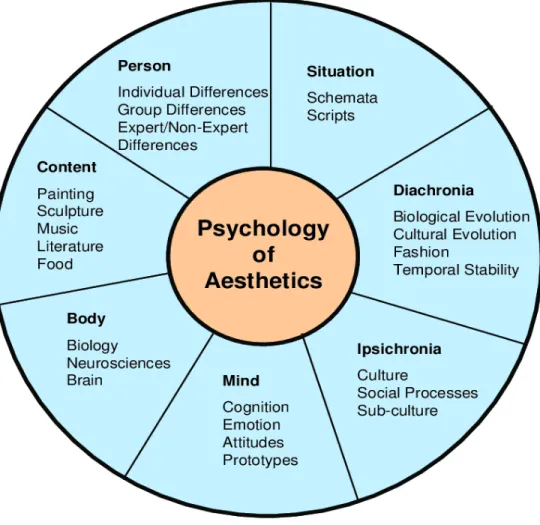
Jacobsen et al., (2006), an experimental psychologist, has offered an extensive
framework that provides a multidimensional view of the different factors that might
influence a person’s judgment of artistic work. His proposed framework for the
psychology of aesthetics is reproduced as Figure 2. Jacobsen (2006) describes his
ultimate goal as a unified theory for the mental processing of aesthetics using each of the
different viewpoints bulleted below. His work, and others since, has moved into the
world of neuropsychology, identifying physical manifestations of preferences and visual
taste, and defining a new area of research, neuroaesthetics (Chatterjee, 2011; Höfel &
art and ignores other forms of visual communication.
As shown in Figure 2, the psychology of aesthetics is categorized as follows:
• Diachronia: Aesthetic preferences that may change with time;
• Ipsichronia: Social/cultural processes that may shape a person's aesthetic
opinions;
• Mind: An individual's mental model of the visual stimulus or emotions, which
could influence aesthetic judgments;
• Body: Brain activities that could affect aesthetic evaluation processes;
• Content: The stimulus being evaluated, which could influence aesthetic
processing;
• Person: The evaluator's background, which may play a role in aesthetic
preference;
• Situation: The surrounding circumstances (including time and place) that
Figure 2. The framework for the psychology of aesthetics(Jacobsen, 2006).
In addition to identifying these domains of influence on aesthetic preferences,
Jacobsen (2006) notes a key challenge in studying visual aesthetics with experimental
methods as being “the conflict [lies] between the degree of experimental control on the
one hand and the range of generalizability of the findings on the other” (p. 156). As he
explains, experiments require that only controlled variations are made, and so
more complex objects that would afford more generalizable results. An excellent example
of the stimuli Jacobsen (2006) references is shown in Figure 3.
Figure 3. Stimulus reproduced from Höfel & Jacobsen, 2003.
Jacobsen’s (2006) model represents the most comprehensive framework to date,
dealing with the complexity of visual aesthetics and suggesting a model for studying the
types of visual design, such as signage or logos, which are common forms of output from
visual communication professionals. This framework is therefore useful as a guide for
markers of identity, contribute to preferences for one design versus another.
Specific to expertise, the notion of an expert, or one highly informed in visual
aesthetics, is important to predicting how people will view and accept certain forms of art
and elements of design. In a 1995 study, Smets and Overbeeke conducted four
experiments looking at how design was expressed in packaging for desserts. In their
fourth experiment, they found evidence that while designers and non-designers might
assess visuals in the same way functionally and using the same dimensions, design
students were better able to differentiate their judgments compared to non-design
students. Bloch, Brunel, and Arnold (2003) pointed to this study as rationale for
developing their scale to measure individual differences in the centrality of visual product
aesthetics (CVPA). Those with higher CVPA scores can be described as design-minded
or “sensitive” to design, whereas people with low scores are more apathetic to the
aesthetic aspects of a product’s design. This is important to the current study—when
considering the associations known between people of higher artistic knowledge or
“taste,” people who score higher in CVPA can be assumed to have a preference for an
aesthetic that is more complex and less conventional, which includes a preference for
abstract art.
Bloch, Brunel, and Arnold’s CVPA measure is used to assess the level of
importance, or significance, a person attributes to the look or aesthetics of a product or
object, compared to other aspects such as cost or functionality (2003). The CVPA
measure is comprised of three dimensions, value, acumen, and response. Assessment of
“value” focus on the worth a consumer ties to the aesthetics of a product, i.e. “Owning
component, acumen, is most directly related to expertise and asks questions such as,
“Being able to see subtle differences in product design is one skill that I have developed
over time.” Finally, the last component, response, looks at emotional response linked to
product aesthetics, i.e. “If a product’s design really “speaks” to me, I feel that I must buy
it.”
As a self-reported measure, CVPA allows access into the perceived aesthetic
expertise of the consumer which cannot be assessed by other measures of expertise such
as those that ask for levels of art and design education. Some have referred to those high
in CVPA as having a sensitivity to design that can act as a moderator, as was done in a
study looking at packaging design (Becker et al, 2011). In this packaging design study,
the researchers looked at the influence of a package’s shape curvature (how angular or
curved the package was) on the taste of the product (yogurt, in their experiment)
contained within that package. They found that those high in CVPA were more sensitive
to the impact of the packaging shape. Participants in their experiment found the taste of
the yogurt more sharp or bitter in the more angular package as compared to the rounder
package design. This finding suggests those high in CVPA might have a preference for
curved rather than angular shapes, or at least that their associations with curved shapes
are more favorable than associations with angular shapes. Those low in CVPA showed no
difference in their taste experience between the two conditions. Of note, the CVPA
measure, which was originally applied to the visual aesthetics of products (Bloch, Brunel,
& Arnold, 2003), has recently been adapted into a specific measure for web design,
named the Centrality of Visual Website Aesthetics measure (Pengnate, Sarathy &
To provide an example of research that has placed artistic aesthetics into the
context of a person’s psychology, I next review specific areas of work that have
attempted to correlate and predict people’s preferences for or enjoyment of different
artistic forms. Specifically, I review an example pertaining to music preference.
Following this example, I describe work that focused on aspects of interior design.
Music and Interior Design
Rentfrow and Gosling (2003) developed the Short Test of Musical Preferences
(STOMP) to identify preferences for differing musical categories and linked those
preferences to the Big Five personality traits of Neuroticism, Extraversion, Openness to
Experience, Conscientiousness, and Agreeableness (see Costa & McCrae, 2008; McCrae
& Costa, 1987). The STOMP bases its assessment of preferences for music genres on a
prior categorization of similarities of musical genres (e.g. blues, jazz, classical, and folk
were categorized as reflective and complex)—similarities that were used to define
characteristics that differentiated music types based on theme and emotional response to
that theme. The STOMP then connects preferences for these defining characteristics to
the participant’s dominant personality type(s) in order to associate major music
characteristics with personality. A version of the test can be seen and taken at
www.outofservice.com/music-personality-test/).
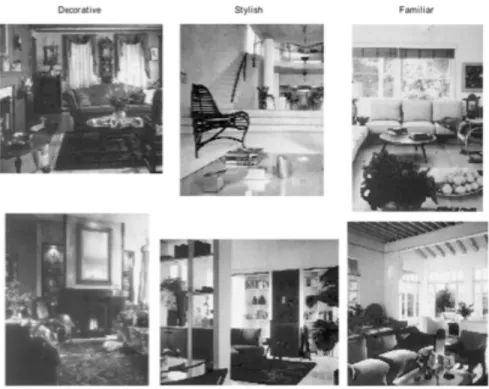
Ritterfeld, Cupchik (1996) and colleagues (Ritterfeld, 2002) used a similar
approach to link personality with preferences for interior design styles. In 1996, Ritterfeld
and Cupchik published three factors characterizing different styles of interior design
(living rooms specifically)—decorative, stylish, and familiar—by using a number of
difficult for participants to apply to those rooms. See Figure 4 for an example of the
living room stimuli.
Figure 4. Stimulus reproduced from Ritterfeld & Cupchik, 1996.
Ritterfeld and Cuperchik (1996) revised the categorization of interior design,
matching this new categorization to pre-existing categories of West German lifestyle
preferences. One lifestyle preference was that of “high culture,” defined by preferences
for perfectionism, education, and contemplation and exemplified by activities, for
example opera attendance, which showcased all three preferences (perfectionism,
education, contemplation). “Trivial” was another lifestyle preference, which was
preferences for the anti-conventional and activities such as drinking and risky sports.
These three lifestyle categories were correlated with three matched interior design styles
as follows: high culture: elegant, classic, and noble; trivial: traditional, harmonious, cozy,
comfy, and relaxed; sensation-seeking: individual, extravagant, and modern.
Ritterfeld and Cuperchik (1996) further established the link between lifestyle and
interior design preferences by asking research participants to rate their liking of (images
of) couches that were intended to typify the style characteristics associated with high
culture, trivial, and sensation-seeking lifestyle categories. During this procedure, the
authors found that, compared to couches that were liked by the participant, couches that
were disliked were judged faster and with more certainty. This observation was seen as
evidence that negative distinctions are more automatic, which has potential implications
for how sorting activities might be affected if participants are asked to focus on items
they dislike (engaging in more automatic processing) versus asking participants what
items they prefer (engaging in more deliberate, careful processing that might include
self-correction).
Marketers, advertisers, and graphic designers will often engage in research that
attempts to correlate preferences with individual differences during the initial stages of
message development to identify the best messages to use when attempting to appeal to a
particular target audience. The goals of these types of exercises are, again, about
maximizing audience appeal, such that successful designs are seen as having high value
or meaning (described by Berlyne, 1974) for the target audience, which is then
manifested as the audience’s aesthetic inclination toward the design, or more simply put,
marketing research tools (e.g., Simmons data) and focus group testing are commonly
employed to identify links between brands, lifestyle differences, and identity.
Unfortunately, I was unable to find a specific measure among scientific literature or
professional publications that attempted to assess visual preferences and connect these
visual preferences to individual characteristics. Yet, this type of assessment could add a
valuable dimension of insight to visual designers, especially when considering the
business of design.
An important observation from the reviewed research is that the researchers cited
above needed to identify dimensions, or characteristics, of fine art, music, and interior
design to connect with personality characteristics. Thus, the same exercise is needed for
visual design. In the following section, I review principles and dimensions of visual
design, and then I present what I argue to be two universal dimensions that can be
manipulated and examined in light of the existing literature that connects artistic
CHAPTER 3
DECONSTRUCTING DESIGN QUALITY
Visual design quality can be defined as the optimal arrangement of design
elements, such as use of lines, color, framing, and so on, that inform visual taste. It is
through these elements of design that we can connect the objective aspects of design
excellence, as defined by experts (e.g., balance) to an audience member’s subjective
responses to the design which, combined, define the audience member’s preference for a
specific visual aesthetic. Relevant to the current dissertation, this overall preference may
relate in meaningful ways to other aspects of a person that should be used to inform the
production of messages intended to target particular audiences.
Where design quality meets function is in its leveraging of a person’s personal
preference for a visual aesthetic; design quality can influence whether or not people seek
more information relevant to the designed message if their first impression of the
message is positive, in other words (Duck, Terry & Hogg, 1995; Champlin, Lazard,
Mackert & Pasch, 2014). For example, in advertising, design quality can influence
everything from value and price to perceptions of effort, authenticity, and perceived
product quality (Modig & Rosengren, 2013; Modig, Dahlen & Colliander, 2014; Napoli
et al., 2014). In print design, layout, color, object size, visual hierarchy, and font all
contribute to overall impressions. In video design, audio quality, resolution, timing,
user.
In information theory, research has placed an emphasis on the objective nature of
good design by looking at the balance of two sets of dimensional properties across design
elements—complexity versus simplicity, and novelty versus familiarity. With regard to
complexity, Berlyne (1974) noted a curvilinear relationship, also known as the inverted
U-shape function, between preference and complexity, in that the most well-liked designs
were not too simplistic and not overly complex. These findings have informed years of
research, most recently in the area of web design, about the functional aspects of visual
design.
In addition to appealing to a target audience member’s aesthetics, designs are also
only considered effective if they convey the intended meaning. Although this dissertation
does not specifically address meaning with respect to a brand identity, persuasive
argument, or the like, the idea of personal preference might itself be a signal that “this
message is for me,” contributing to its appeal. Therefore, I review the literature on the
conveyance of meaning with visuals.
Describing What We See
Any discussion on communicating visual messages would be incomplete without
a discussion of semiotics. Semiotics research has focused on the connection between
visual “signs” and identity, on the social or sign value of visual objects, as can be seen in
interior, fashion, and industrial design. Sadalla (1979, 1987, 1988), along with a handful
of other researchers, has explored the correlation between social status and taste, between
symbols of self-representation and the expression of identity. This research can be linked
life aesthetic material can be described in terms of semantic connotations which are
related to lifestyles” (Ritterfeld, 2002, p. 370). In other words, while both a Toyota Prius
and a Porsche Boxster are both functionally identical (they get you where you need to
go), they do so with differences in social meaning and lifestyle. Yet, there exists no social
scientific measure to identify these differences.
When a consumer sees the front entrance of a store, they should be able to make a
relatively accurate assessment of the store’s content without needing to be familiar with
the store. From signage to window displays to the colors used throughout, viewers are
deriving meaning from the visual components, including mood, style, values, and even a
price point. Consider the two visuals in Figure 5. When asked for their thoughts about
what they see, audiences are likely to use adjectives that sound experiential, such as “fun”
or “romantic.” In Figure 5, we might assume consumers would associate “fun” with the
left design and “romantic” with the design on the right.
Yet, the question becomes what precisely is it about a design that does the work
of communicating these meanings? Multimodal analysis is a systematic method for
understanding visual communication that is built upon the theories of semiotics. Kress
and Van Leeuwen (1996) pioneered the multimodality approach as a method that begins
with a visual’s basic components, and then compares those components with the others
on the “page.” It looks at the relationships between the components and how they work to
create meaning.
The Formal Language of Design
To understand the way in which designers discuss the language of visual design it
is important to begin where every art and design class has always begun, with the
elements and principles of design for two-dimensional spaces. The elements of design are
the physical elements, the building blocks of a visual design. The principles of design are
how the elements of design are organized. A design is created using the elements of line,
shape, space, color, value and texture and arranged using the organizing principles of
rhythm, movement, unity, variety, emphasis, proportion, balance and scale. It is
important to note that these terms are not exclusive and that the principles are related and
often overlap. A common metaphor used in art and design likens design elements to
words and punctuation, the elements of writing. Therefore, the principles of design are
like the rules of grammar, organizing the words and punctuation to provide meaning.
For this dissertation I begin by focusing on two related elements, line and shape.
A line is a point in motion, or all the points between an end and starting point. A line can
have many different qualities. It can be curved or straight, thick or thin, short or long,
horizontal, vertical, or diagonal. A shape is simply a flat two-dimensional area enclosed
by lines. A shape can take on the meaning conveyed by the quality of its defining lines,
and it is the differences between curved and angled lines, and the shapes those lines
create, that is the basis of the first of two key aspects of the study at hand.
Angular vs. Curvilinear Preferences
In design, curvature is often, but not always, associated with organic elements
because curves mimic the types of lines found in nature—fluid, rounded, and irregular. In
comparison, angular lines, which are rarely found in nature, are characterized as
inorganic and man-made. Semiotics literature discusses what these different types of
lines, angular and curved can convey. For example, sharply angled lines might suggest
anger, excitement, danger, and/or chaos. whereas clean geometric lines might suggest a
sense of order, conformity, and reliability. In comparison, curves may communicate
grace, dynamism, and spontaneity.
These descriptions are seen throughout design textbooks, websites, and other
resources. For example, see Figure 6 from a design lesson that shows a table describing
different variants of lines and the “psychological effects” of these lines. Note, for
instance, the psychological effects attributed to a restrained curve: flexible but controlled,
graceful, feminine, flowing. These are similar to the psychological effects attributed to
wavy lines. Full curves and bends are also associated with dynamism. Yet, in contrast,
straight lines and zigzags are associated with the notion of stiffness, masculinity, and
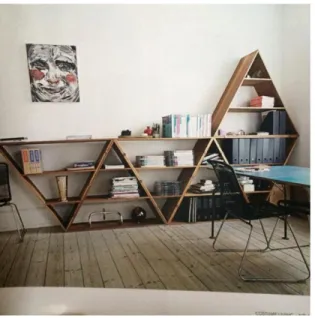
Figure 7 shows examples from an interior design blog, in which the author
describes the psychological effects of different types of lines in interior spaces: “Did you
know that lines can actually have a psychological effect on a room? Designers use
different kinds of lines all the time in order to create a particular mood or ambiance in the
room they are designing. Most interiors use a combination of lines, but often times one
line will be planned to dominate in order to accomplish a desired effect.”
Finally, from https://vanseodesign.com/web-design/visual-grammar-lines/, we see
these same descriptions of lines when discussing implications for web design: “Zigzag
lines are a combination of diagonal lines that connect at points. They take on the dynamic
and high energy characteristics of diagonal lines. They create excitement and intense
movement. They convey confusion and nervousness as they change direction quickly and
frequently. They can imply danger and destruction as they break down… Curved
Figure 7. Images from website (Interior Design Basics, 2013).
lines are softer than straight lines. They sweep and turn gracefully between end points.
They are less definite and predictable than straight lines. They bend, they change
direction. Curved lines express fluid movement. They can be calm or dynamic depending
on how much they curve. The less active the curve the calmer the feeling” (Bradley,
2010). Some of this teaching appears to be anecdotal, but there are aspects supported in
the psychology literature, specifically around the preference for curved shapes and lines
over straight and angular ones.
With regard to preferences, people show a small but consistent preference for the
round and curved over the sharp and angular when judging lines, shapes, abstract objects,
and artifacts. This overall preference for curvature is now firmly established (Bertamini,
Palumbo, Gheorghes, & Galatsidas, 2016; Gomez-Puerto, Munar, & Nadal, 2016; Leder,
Tinio, & Bar, 2011; Munar, Gomez-Puerto, Lopez-Navarro, & Nadal, 2014; Palumbo &
Bertamini, 2016; Palumbo, Ruta, & Bertamini, 2015; Silvia & Barona, 2009) and has
been tested with both explicit scales using self-reported ratings of visuals (Bertamini et
al., 2015; Palumbo, Ruta, & Bertamini, 2015) and implicit, indirect measures of
preference (Palumbo, Ruta, & Bertamini, 2015; Vartanian et al., 2013). The same
preferences show up when lines (Bertamini, Palumbo, Gheorges, & Galatsidas, 2016;
Salgado-Montejo, Tapia Leon, Elliot, Salgado, & Spence, 2015), abstract novel shapes
(Bar & Neta, 2006; Bertamini et al., 2016; Silvia & Barona, 2009; Velasco et al., 2016a,
2016b, 2016c), common objects (Bar & Neta, 2006), car interiors (Leder & Carbon,
2005), architectural environments (Dazkir & Read, 2012; van Oel & van den Berkhof,
2013; Vartanian et al., 2013), logos (Jiang et al., 2015) and fonts (Velasco et al., 2014,
preference have been suggested from evolutionary-based explanations (Carbon, 2010) to
emotional processing effects (Leder et al., 2011).
Notably, Bertamini et al. (2015; 2016) found a general appeal of curved things
that encourages an approach tendency from viewers, as opposed to a general threatening
quality of angular, sharp things, which seems to encourage avoidance. This finding
contradicts the threat hypothesis suggested in earlier findings (Aronoff, Barclay, &
Stevenson, 1988; Aronoff, Woike, & Hyman, 1992, Bar & Neta, 2006; 2007). To
illustrate, Bar and Neta (2006; 2007) used functional magnetic resonance imaging (fMRI)
data to suggest that the preference of curved objects over sharp-angled objects may be
due to amygdala involvement in fear processing. Although this hypothesis provides us
with an explanation for why there is a preference for curved over angular, the research to
date also suggests that not everyone shows this general preference for curves over angles.
Some of the first research to extend the idea of audience response to visuals, to
audience response to typeface specifically, was reported by Velasco et al., (2014). These
researchers attempted to link different typefaces, shapes, names, and sounds with
viewers’ literal taste—as in associating the typeface with sweet- versus sour-tasting
products. Velasco et al. (2014) found that rounder typefaces (e.g., Swis721 B1kRnd BT –
Black, 44pt) were found to be more regularly associated with sweet-tasting products as
compared to sour-tasting products, whereas more angular typefaces (e.g., Hollywood
Hills – Regular, 53pt) were more consistently associated with sour-tasting products.
Figure 8 shows the fonts used in two of the three Velasco, Hyndman, and Spence
experiments from a study in 2018 that explored this association even further. Participants
tastes, in addition to femininity and smoothness. Angular typefaces, on the other hand,
were associated with sour taste, in addition to loudness, masculinity, and roughness.
“Typefaces used in Experiment 1 at the Victoria & Albert Museum for the London Design Festival on 14th September 2014: A) Modified London 2012 and B) VAG Rounded.”
“The three pairs of rounded vs. angular typeface that were used in Experiment 2. A) VAG Rounded and Onyx slanted, upper case; B) Flemish Script and Klute; C) Candice and Engraver’s MT slanted, upper case. Each of the typefaces was typeset to sit within a central area on an A4 page so that they appeared visually balanced (based on the
suggestions of the designer). For example, the more condensed typefaces are shown a larger point size so that they appear equally prominent and it is therefore the typeface and not the scale being compared.”
Abstract vs. Representative Preferences
The second visual feature to be explored in this study, representative or
representative versus abstract representation, is less about a specific formal aspect of art
(i.e. line and shape) and more about an overall conceptual approach. Art forms can be
placed upon a continuum of abstraction from representative (a.k.a. figurative and
realistic) on one end to abstract and fully nonrepresentative on the other end. Art that is
found on the representative end of the abstract spectrum is more clearly derived from the
material world. Think of a photo or photorealistic art as exemplars of the representative
end of the spectrum. In the middle is abstract art, like that of Pablo Picasso, and on the
other end of the spectrum is non-representative art that has little to no resemblance to the
material world, (see Figure 9 for examples).
The word “abstract” is derived from Latin terms meaning to extract or to remove
(Merriam, n.d.), so in art and design an abstracted image often has elements removed or
simplified as in the examples from Picasso’s sketches (see Figure 10).
One important concept of abstraction is that as one moves along the continuum from
representative to abstract one is also moving from specific to universal as can be seen in
Scott McCloud’s sketches of a face (see Figure 11).
Figure 11. A slide from Scott McCloud’s Understanding Comics, 1999.
In graphic design, abstracted elements are a pathway to communicating
universally toward shared meaning, which is why typography, symbols, and icons are
elemental tools in a graphic designer’s toolbelt. Wang and Hsu (2007) suggest that as
compared to traditional artists, “designers pay more attention to recognizability by
observers” (p. 269) in their use of abstraction. A logo, derived from the Greek word,
logos for “word” (Merriam, n.d.) act as representations of a product or service. Nike’s
differences in visual preference?
Almost all of the research looking at preferences along the abstract continuum
have used traditional art examples for stimuli. In experiment after experiment, more
representative or representative art is preferred over more abstract art (Boselie & Cesaro,
1994; Carl, Richards, Heath 2018; Cotter et al., 2017; Feist & Brady, 2004; Heinrichs &
Cupchik, 1985; Kettlewell, Lipscomb, Evans, & Rosston, 1990; Reber, Schwarz, &
Winkielman, 2004; Salkind & Salkind, 1973, 1997). Several studies with children have
shown that this preference for realism begins at about 8 to 11 years of age but can appear
as early as kindergarten and continues to be a prevailing aspect for visual preference in
adults untrained in the arts (Ahmad, 1985; Taunton, 1980). These findings seem to
indicate that a preference for abstract art in adults is a learned or environmental
preference.
Rationale for this preference, like that for curves over angles, is often grounded in
evolutionary theory. The theory suggests that people prefer visuals that make them feel
safe, or that have a “survival value” and as representative work is more realistic it feels
more familiar and familiarity is preferred (Feist & Brady, 2004; Hekkert & Snelders,
1995; Martindale, 1996; Martindale & Moore, 1988). As evidence of this, Feist and
Brady point to a study of landscape art that found that more livable landscapes, such as
savannas, forests, and mountains, were preferred over less livable terrain, such as deserts
and frozen tundra (Orians & Heerwagen, 1992; Orians, 2001).
Some aesthetic research has shown that abstract art is rated higher in creativity
(Getzels & Csilcszentmihalyi, 1976). Researchers who looked at the differences in expert
art over representative art (Getzels & Csilcszentmihalyi, 1976; Winston, 1992; Hekkert &
van Wieringen, 1996a, 1996b). Additionally, experts are more likely to prefer novel
design (Haller, Couvoisier, & Cropley, 2011) over prototypical design. In explanation of
this difference, researchers suggest that contemporary artists are more likely to work in
abstract modes as compared to more classic artists. So, it may not be that abstract art is
more preferred by experts for its abstract form, but rather that it is valued for being less
prototypical, more novel, and more avant-garde. Or as Barrow wrote, “a taste for the
avant-garde or the abstract is the fruit of experience overriding instinct" (1995, p. 95).
It is difficult to know how much these patterns found with art might extend to
more contemporary visual design targets. For example, in evaluations of product design,
Mastandrea and Maricchiolo (2014) found that expertise moderated the liking of
modern-looking products, in that laypeople showed no preference between classic and modern
looks, but people with more artistic expertise preferred the modern over the classic
designs. Also corroborating the reviewed literature, previous research into logo strategy
has underlined the advantages of using pictorial logos (logos that are more
representative). Schechter (1993), for one, showed that logos reminiscent of a
decipherable object add more value to the brands they exemplify. Henderson and Cote
(1998) discovered that, compared to more abstract logos, more representative logos—
which were more likely to convey a familiar and recognizable meaning—were more
easily recognized by participants and were evaluated more positively. Likewise, Machado
et al., (2015) found that “natural” logos (more representative) were preferred to abstract
logos.
exaggeration and abstraction may facilitate processing even more by emphasizing central
features and discarding others” (2004, p. 368). For example, some research has shown
that caricatures of faces are sometimes better recognized than undistorted images (Mauro
& Kubovy, 1992; Rhodes, Brennan, & Carey, 1987). Much like the research into
complexity (i.e. Berlyne, 1970), there may be an inverted-U relationship between
abstraction and preference. Furthermore, there might be particular characteristics that
mark a person’s inclination to be more open to complexity. In short, what are the
characteristics that explain preferences that differ from the norm? Understanding, and
then predicting, which individuals might like the seemingly less popular abstract or
angular styles in visual design, based on their individual differences, is the subject of the
CHAPTER 4
PERSONALITY AND VISUAL PREFERENCE
Since the introduction of the Big Five personality framework in the 1980s, there
has been a dramatic increase in research on traits and the individual dimensions of
personality (Cawvey et al., 2017). As mentioned above, personality traits have also been
shown to predict certain preferences for representative versus abstract art, in addition to
other visual preferences. To understand these associations between personality and visual
preferences, we must first understand what is meant by personality within this context.
What is Personality?
Personality is multifaceted and includes factors such as values, motives, and
intelligence (Caprara & Vecchione, 2013). But it is the influence of personality over
behavior and attitudes that makes it worth studying (Mondak, 2010). Personality,
specifically through the Big Five factor measures, is also relatively universal across
cultures (McCrae & Costa, 1997, 1999). Personality is not an attitude or opinion or mood,
rather it is identified as a trait, an internal personal attribute. Considerable research has
shown that, unlike other factors that are temporary or ephemeral, like mood, personality
is stable and enduring over time (Block & Block, 2006; Jost et al., 2003a, 2003b). Even
as some personality traits shift over the course of our lives, these shifts are consistent. For
example, as we age, we become less neurotic and more conscientious (Costa & McCrae,
Early psychologists identified thousands of personality traits (Allport & Odbert,
1936). In order to deal with this complexity, personality psychologists have proposed
many models, but the Big Five or Five-Factor approach is the most prominent in political
psychology. The framework consists of five distinct dimensions or factors, commonly
referenced with the acronym O.C.E.A.N. or (1) openness to experience, (2)
conscientiousness, (3) extraversion, (4) agreeableness, and (5) neuroticism. These
dimensions were developed empirically through the rating of adjectives and factor
analysis in a study of Air Force officers (Tupes & Christal, 1958 in Cawvey et al., 2017).
Neuroticism. Neuroticism, or emotional instability in high levels, corresponds
with an increased risk of depression and anxiety. Adjectives used to represent those
scoring high in this final dimension range from apprehensive and volatile, to anxious and
sensitive. Conversely, those with a lower score are more likely to be surgeons or
members of the clergy, and are described as emotionally stable, calm, and relaxed.
(Francis & Kay, 1995).
Extraversion. Extraversion, and its converse, introversion, have been the most
extensively researched of all the Big Five dimensions. Extroverts are characterized by
their outgoingness, and interest in activities with others, compared to introverts, who are
seen as aloof, quiet, withdrawn, and shy, extroverts are bolder and more sociable
(Eysenck & Wilson, 1978).
Openness to Experience. Individuals who score high in openness to experience
(a.k.a. openness) are motivated to be curious about the world and show a willingness to
examine diverse perspectives. Openness and creativity are positively correlated.
willing to take risks (e.g., alcohol and drug use) (Booth-Kewley & Vickers, 1994). Those
who score low on openness are typically more conventional, favoring the concrete, and
showing a preference for the known over the unknown (Mondak, 2010). Notably, the
openness dimension, as compared to the other four in the Big Five, is most connected
with art interests, activities and knowledge, and a tendency toward openness is also
correlated with an appreciation of the arts (DeYoung, Quilty, Peterson, & Gray, 2014;
Furnham & Chamorro-Premuzic, 2004).
Agreeableness. Terms such as helpful, selfless, warm, kind, sympathetic, and
generous are used to represent agreeableness, whereas terms such as critical, harsh, and
blunt are used to represent a low score in agreeableness. Individuals who score low on
this dimension, are less successful in their interpersonal relationships because they are
more likely to be seen as less cooperative and more quarrelsome (Lounsbury, Loveland,
& Gibson, 2003).
Conscientiousness. Conscientiousness is characterized by adjectives such as
thorough, reliable, organized, punctual, task-focused, efficient, and hardworking.
Individuals high in this trait show a tendency to be more concerned with health and
fitness, and avoid personal risk (Booth-Kewley & Vickers, 1994). Those low in
conscientiousness are more likely to be cavalier, disordered, impetuous and are more
likely to be less successful in school and the workplace (Barrick & Mount, 1991).
Linking Personality to Visual Preference
It’s not surprising to imagine that personality differences would inform visual
taste, as individuals often use visuals (e.g. wearing a tie-dye shirt, shopping at Whole
described by identity signaling theory (e.g., Berger, 2008; Berger & Heath, 2007; Berger
& Heath, 2008; Gal, 2015). Even brands use visuals to convey a certain “personality”
(Bernritter, 2016; Giroux & Grohmann, 2015). In contrast, research on the psychology of
aesthetics has focused on characteristics of the art objects themselves. In design, the
formal elements are often described as conveying specific personality differences, i.e.
serif fonts are more formal than san-serif fonts (Hyndman, 2016; Mackiewicz & Moeller,
2005; Shaikh, Chaparro, & Fox, 2006). Some research has even looked at how differing
typefaces can be used to communicate different brand personalities (e.g., Grohmann,
Giese, & Parkman, 2013).
Research also shows that there are psychological determinants of aesthetic
inclination, specifically personality differences that inform visual liking. The bulk of the
research into personality differences and aesthetic taste has used the Big Five model
reviewed above. The extensive body of work is this area has found correlations across all
five of its domains, the most robust correlation being with openness to new experience.
Specifically, people high in openness to experience are generally higher in
creativity, have greater imagination, and divergent thinking (Eysenck, 1995; Feist, 1998;
McCrae & Costa, 1987; Zuckerman, 1979). They put a greater value on the arts, are more
knowledgeable, have a greater appreciation for visual quality and aesthetic relativism, are
more engaged, and are more likely to be trained in the arts (McCrae, 1996; McManus and
Furnham, 2006; Silvia, 2007). Openness is positively correlated with a greater liking of
stimuli across multiple genre, media, and art forms (Feist & Brady, 2004; Tran, Swami,
Seifriedsberger, Baráth, & Voracek, 2019). As such, because openness to experience
it is not surprising that it is seen as the most significant of the Big Five dimensions
associated with art. McCrae and Costa even wrote that, “artists can be considered prime
examples of individuals high in openness to experience” (1997, p. 825).
A number of studies have looked at art preferences in terms of fine art paintings
and different approaches to painting (e.g. abstract, realistic, pop). Correlations have been
found between high openness and a preference for pop art (Furnham & Walker, 2001)
and for abstract art (Cleridou & Furnham, 2014; Chamorro-Premuzic et al., 2009; Feist &
Brady, 2004; Furnham & Walker, 2001a). Feist and Brady (2004) theorized that this
preference for more modern and unconventional art might be due to non-conformist
tendencies seen in people high in openness. In addition to conventionality, some scholars
have shown that sensation-seeking, a construct often related to openness, might also play
a large role in causing positive responses to abstract art (Furnham & Avison, 1997;
Rawlings, Barrantes i Vidal, & Furnham, 2000; Rawlings & Bastian, 2002). These
individual differences in visual preference also extend to shape preferences. Preferences
for curves tend to be universal, but these preferences were significantly greater for people
scoring higher in openness to experience (Cotter et al., 2017).
Although not as consistently, the remaining Big Five dimensions have also been
associated with differences in visual taste. Conscientiousness has been negatively
associated with greater liking of stimuli across genres and media domains, as well as
visual and art activities (Chamorro-Premuzic et al., 2011; McManus & Furnham, 2006;
Tran, Swami, Seifriedsberger, Baráth, & Voracek, 2019). A preference for representative
art and dislike of contemporary (e.g. abstract and pop) art is associated with those high in
Of particular relevance to this study, more conscientious personality types show a
lesser preference for abstract logo designs (Machado, Torres, Vacas de Carvalho, &
Costa, 2018). The researchers explained this finding by looking at previous research
showing that people high in consciousness tend to value order and dependability
(Paunonen & Ashton, 2001). Thus, these people will prefer logos which are more familiar
(Liao & Wang, 2009; van Grinsven & Das, 2015).
Extraversion has been linked both positively and negatively with art judgment
ability, depending on the task used (Chamorro-Premuzic & Furnham, 2004; Furnham &
Chamorro-Premuzic, 2004). An appreciation of aesthetic quality, aesthetic relativism, and
abstract artworks, as compared to other art styles, is positively correlated with
extraversion (Furnham & Avison, 1997; Furnham & Walker, 2001; McManus, 2006;
Rawlings & Bastian, 2002). One study of specific art movements found that extraverted
participants displayed higher levels of preference for cubist art, as opposed to the more
agreeable, more conscientious and less open individuals who reported a higher preference
for impressionist art (Chamorro-Premuzic et al., 2009). However, when looking at logos,
people who scored higher on extraversion showed a greater preference for more
representative logo designs (Machado, Torres, Vacas de Carvalho, & Costa, 2018).
Despite the fact that agreeable people seem to value aesthetics more (McManus,
2006), agreeableness has been correlated with a lesser tendency to participate in art
activities, less of a preference for pop art (Furnham & Walker, 2001), and a greater liking
of representative art (Furnham & Avison, 1997). Like people who are more extraverted,
those who are more agreeable showed a higher preference for representative logo designs