Electrical Engineering Department
California Polytechnic State University
Senior Project Final Report
PolyOne Smartphone
June 2020
Gerome Cacho
Chris Lim
Chi Nguyen
Josh Zalmanowitz
Table of Contents
Abstract 3
General Introduction and Background 4
Product/Project Description 6
Product Research 7
Technology Research 8
Market Research 9
Customer Archetype 10
Market Description 14
Business Model Canvas Graphic 17
Marketing Requirements 18
Marketing Data Sheet 20
Block Diagram, Requirements, and Specifications Section 21
Engineering Requirements 22
Testing and Verification 23
Team Project Roles 24
Schedule 25
Cost (BOM) 26
Analysis of Senior Project Report 28
Summary of Functional Requirements 28
Primary Constraints 28
Economic 28
Manufacturability 29
Environmental Impact 29
Sustainability 29
Ethical 30
Health and Safety 30
Social and Political 30
Preliminary Design Analysis 32
Addendum 1 34
Hardware 35
Software 43
Addendum 2 45
Hardware 45
Layout 50
Future Additions to the Board 58
Software 59
Repository 59
Conclusions 60
Acknowledgment 60
Abstract
The PolyOne Smartphone aims to design, build and test the first Cal PolyOriginal
smartphone. The foundation for the project intends to explore the technology behind pre-existing smartphones and look in-depth between LTE and 5G communication mediums to weigh the feasibility and potential benefits. 5G is the latest generation of wireless technology, and promises faster data transmission speeds, lower latency, and the ability to connect more devices. These improvements will enable the implementation of new technologies that take advantage of the faster speeds and increased connectivity that were not available with 4G, as well as increase the potential for integration of 5G into other Internet of Things(IOT) systems such as home internet.
With the introduction of 5G, a major goal is to build an affordable prototype that explores the improvements that 5G brings and discover and address any issues that may come with it. Another goal of the PolyOne Smartphone is improved privacy. While the growth of IOT and the ability to be connected to the internet nearly anywhere makes many things easier and more accessible, there is also a concern with the exposure of personal information that comes with an easily accessible medium. The PolyOne Smartphone aims to address some of these privacy concerns in hardware to make it easier for users to control phone privacy.
The key features of this smartphone are network connectivity (Wifi, Cellular), a
General Introduction and Background
Figure 1: Smartphones over the years [1]
A smartphone is a mobile phone that performs many of the functions of a computer, has a touchscreen, has internet access, and is capable of running apps [5]. The first smartphone, the Simon Personal Communicator, was released in 1992 by IBM. For $1000, it offered a
monochrome LCD touch screen, an hour of battery life, email, fax, and could be used with a few apps. Although it did not sell well, it was very advanced for its time and would be the starting point for a revolution in personal electronics. The first “modern” smartphone would not appear until 2007 with the release of the iphone.
The iPhone was revolutionary for the no keyboard full screen design and provided users with internet access, 8 hours of battery life, and was one of the first devices that used 3rd party apps, giving phones the capability to be modified to personal tastes [6]. Around this time, smartphones began becoming more than just a phone, and moved towards a personal computer that is used in daily life. Today, smartphones are more prevalent than ever, with 81% of
Americans saying they own smartphones [4]. Since the original iPhone, there have been
communicate by allowing people to be connected 24/7. For many, it is difficult to do well in school or work without one because teachers and clients and bosses utilize smartphones to give instructions. Smartphones will only become faster and more powerful in the future, having the potential to enable new technologies and create a more connected world. This increase in
capability will only make it a more important tool in everyday life, and the PolyOne Smartphone intends to meet these needs by implementing the newest wireless technology while still
addressing privacy concerns that will come with a more connected world.
The infrastructure for 5G has begun to be developed in the United States, and the implementation of 5G will bring big changes to smartphone technology. 5G is the newest wireless protocol, replacing 4G. Mobile networks are what enable phone users to connect to the internet and hand off packets of signals such as voice, data, and texts.
Product/Project Description
The PolyOne Smartphone is a student designed smartphone built to explore the
implementation of 5G, provide a hardware solution to ensure personal information security and privacy, and provide longer battery life. The key features of this smartphone include but are not limited to a main cpu, some form of network connectivity in the form of Wi-fi or Cellular Data, calling functionality, a rechargeable battery that works with common power connection
protocols, and compatibility with popular applications.
Figure 3 [2] Figure 4 [3]
Product Research
Smartphones are one of the most popular electronic devices out in the world. As such, there are many different products that are out in the market, from Apple’s iPhones, Samsung’s Galaxy models, etc. Each model has increasingly grown complex over the years as a result of the technological advances in the electronics industry.
Figure 5, 6: Apple’s iPhone 11 and Samsung Galaxy A70 Smartphones
5G systems are an up-and-coming technology in today’s modern smartphones. From a consumer perspective, the newest models of Samsung’s Galaxy, OnePlus 7, and Huawei Mate product lines have 5G capability [16]. From a developer standpoint, AT&T, Verizon, Sprint, and T-Mobile all have 5G towers, but the distribution network is still limited, with coverage
exclusive to select major cities in America [17].
Technology Research
For the PolyOne Smartphone, the technology does exist for 5G communication. 5G is a new generation of wireless technology [18]. Actually called 5G-NR, it currently has a symbiosis relationship with its predecessor, 4G, to make the “initial connections before trading up to 5G where its available” [18]. 5G operates above and below 6GHz, where lower frequency bands have high ranges from towers, while high frequencies have a significantly faster speed than 4G. 5G relies on a type of encoding, known as OFDM [19], where a single data stream is separated into different narrow bands at different frequencies to reduce signal interference [19]. 5G currently is 30% more efficient than 4G when using the same airwaves, with the improvement attributed to better encoding methods. Overall, 5G stands to be around 10x faster than the current standard, 4G/LTE Advanced.
Figure 7: 5G vs Predecessors Speed Comparison
Market Research
When compared to other main smartphone manufacturers, the PolyOne smartphone will be very similar to the competition, yet unique in its own right. 5G is an up-and-coming
innovation that will revolutionize the smartphone industry with never-before seen data
transmission speeds. Currently, Huawei, Samsung, LG, and OnePlus each have 5G compatibility on their devices, with Apple expecting to adapt as soon as 2020. However, all of these
companies only have 5G capability in their top of the line models of smartphone. PolyOne aims to provide an affordable alternative to these products, which would save customers hundreds of dollars.
Privacy concerns have always been a cause for concern with the ascent of smartphone technology, but recent events have fueled renewed debate as to how often is our electronic device operating without its owners’ consent. The only safeguard is intricate data encrypting that protects our personal data from unauthorized users, but there is no clear safeguard for
Customer Archetype
The PolyOne Smartphone has many established main competitors in the market;
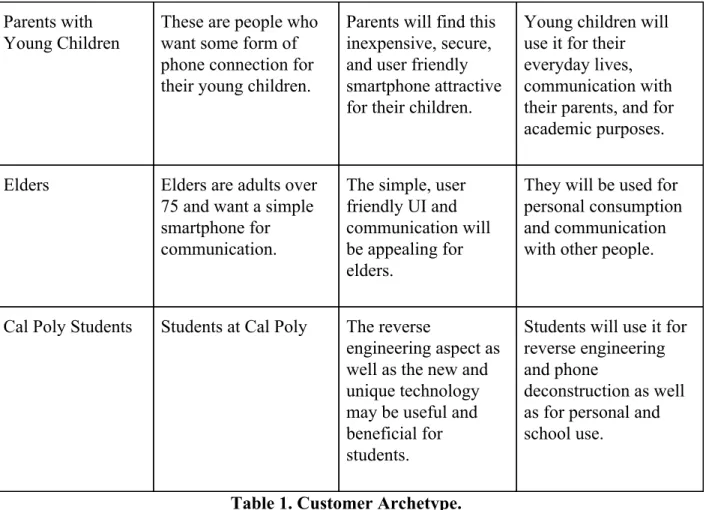
however, most of them are several hundred dollars more in cost and do not have 5G technology implementation and a hardware solution to provide protection for personal information and privacy. By putting a greater emphasis on low cost, simple user friendly UI, high speeds, and privacy protections, the PolyOne Smartphone will be able to cater to many different types of customers in the market. The types of customers include: Early Adopters, Heavy Usage/Privacy Concerned Phone Users, Parents with Young Children, Elders, and Cal Poly Students. With the growing trend towards high speed connections as well as low cost and simplicity, the PolyOne Smartphone will bring many features that these customers will find attractive and beneficial to their needs.
Type of Customer Description Reason Product Use
Early Adopters Early Adopters are generally people who enjoy and adopt new technologies or products that were recently introduced into the market.
The new 5G technology and implementation as well as the privacy protection solution will attract many Early Adopters as not many smartphones in the market have these features.
They will use this smartphone in their everyday lives, provide the company with vital feedback to help make improvements and refinements, and help move the product mainstream.
Heavy Usage & Privacy Concerned Phone Users
These customers are those who use their phone frequently throughout the day and require high speeds for their work and
personal consumption. Additionally, they value the need for data privacy.
The longer battery life, hardware solution for personal information and privacy protection, and the high speed 5G connection will be beneficial for these users.
Parents with Young Children
These are people who want some form of phone connection for their young children.
Parents will find this inexpensive, secure, and user friendly smartphone attractive for their children.
Young children will use it for their everyday lives, communication with their parents, and for academic purposes.
Elders Elders are adults over 75 and want a simple smartphone for communication.
The simple, user friendly UI and communication will be appealing for elders.
They will be used for personal consumption and communication with other people.
Cal Poly Students Students at Cal Poly The reverse
engineering aspect as well as the new and unique technology may be useful and beneficial for students.
Students will use it for reverse engineering and phone
deconstruction as well as for personal and school use.
Table 1. Customer Archetype.
Market Leader Description
Google LLC, also one of the Big Four tech companies, is known for their internet-related services and products, search engine,
software, and hardware products. The Pixel serves as the first smartphone developed by Google and recently introduced into the market in 2016. No 5G support has been announced for the Pixel smartphone line so far [11].
Huawei Technologies Co., Ltd. is a Chinese company responsible for selling
telecommunications equipment and consumer electronics including smartphones. In 2018, Huawei became the second largest
smartphone manufacturer in the world. Huawei’s Mate 20 X has 5G capability [12].
LG Electronics Inc. is a South Korean electronics company known for products for home entertainment, mobile communications, home appliances, and vehicle components. The LG V50 ThinQ was launched in 2019 and has 5G support [14].
OnePlus Technology Co., Ltd. is a Chinese company known for their smartphone line called OnePlus. OnePlus One was its first smartphone and introduced a lower cost for similar specifications of other flagship
smartphones. The OnePlus 7 Pro will have 5G support [13].
Table 2: Market Leaders/Industry Competitors
Market Description
Our product aims to provide a new Cal Poly designed smartphone that is focused on performance and privacy. Our designs will utilize the fastest network protocols to deliver the streamlined experience expected by smartphone users at a lower price point than the high end smartphone market demands.
The PolyOne smartphone will be driven by the desire for transparency regarding privacy. Our goal is to include hardware switches that allow the customer to fully decide when they want to turn off the microphone, camera, and GPS tracking.
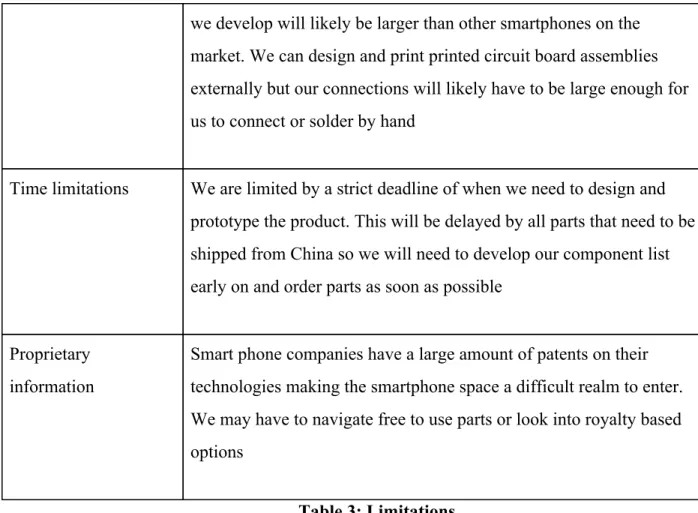
Limitations
Software Our team does not include any students proficient in software
development. This could prove to be a severe challenge if we want to implement an original operating system or any oritional applications.
5G Technology 5G technology is not fully established in the United States so we will run into some challenges preparing the device for 5G connectivity. Most smartphone companies have some connection to the people who are developing the 5G protocol so they have additional knowledge on how the protocol will operate
Parts that are not commercially available or are too expensive to buy for prototype units
Smartphone companies take advantage of economies of scale by ordering expensive parts in bulk and getting discounts per unit. If we order products individually, there is a high potential for the price to go up
we develop will likely be larger than other smartphones on the market. We can design and print printed circuit board assemblies externally but our connections will likely have to be large enough for us to connect or solder by hand
Time limitations We are limited by a strict deadline of when we need to design and prototype the product. This will be delayed by all parts that need to be shipped from China so we will need to develop our component list early on and order parts as soon as possible
Proprietary information
Smart phone companies have a large amount of patents on their technologies making the smartphone space a difficult realm to enter. We may have to navigate free to use parts or look into royalty based options
Table 3: Limitations.
Our key strength is our visibility regarding privacy and our hardware kill switches. Our competitors allow large companies to use location data to build profiles on their users, many times without the knowledge of the customer. With our phone, the customer will have full
control of the camera, the microphone, and the GPS data with the built in hardware kill switches.
An area of the market that we are not competitive is the high end ultra high performance smartphone market. This segment of the market is dominated by professionals with specialized camera softwares that create perfect photos and specialized microprocessors that allow for cutting edge speeds. Without the know-how or the manufacturing resources, we will not be able to compete in this market.
how the competitors choose to advertise. DIY enthusiasts may latch on to a competitor’s DIY smartphone product if it comes to market before ours. Also, new phones are theoretically coming out soon with more comprehensive (hardware based) privacy solutions. The customers who value privacy may opt for these phones when they come out. There would still be a market for parents who seek a simplistic smartphone for their kids and elderly people who want a simple alternative to the complicated smartphones available on the market.
To penetrate the market, we would have to put serious capital into advertising and manufacturing. If we accomplished a successful implementation of a prototype, we could enter the market initially as a DIY smartphone company where tech minded people can put their skills to the test by recreating our prototype on their own. To do this, we would need a few thousand dollars. We estimate our entire design to cost under $1,000. Marketing the final design will require another $1,000 to have a successful rollout.
To have the most successful implementation possible, we could utilize some
organizations as key partners. If the product is well suited to academic uses, we can convince Cal Poly to buy a device for each new student. Two key partners in the EE department are professor Murray and Dr. Derickson. We can also work closely with old age homes where we can host seminars on how to use our phones. One key partner from a local old age home in SLO is Pita, who organizes events for the elderly at the facility.
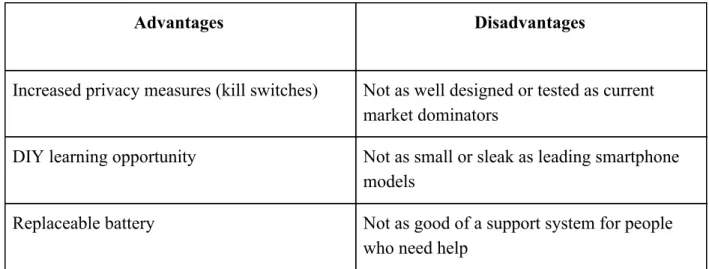
Advantages Disadvantages
Increased privacy measures (kill switches) Not as well designed or tested as current market dominators
DIY learning opportunity Not as small or sleak as leading smartphone models
Replaceable battery Not as good of a support system for people who need help
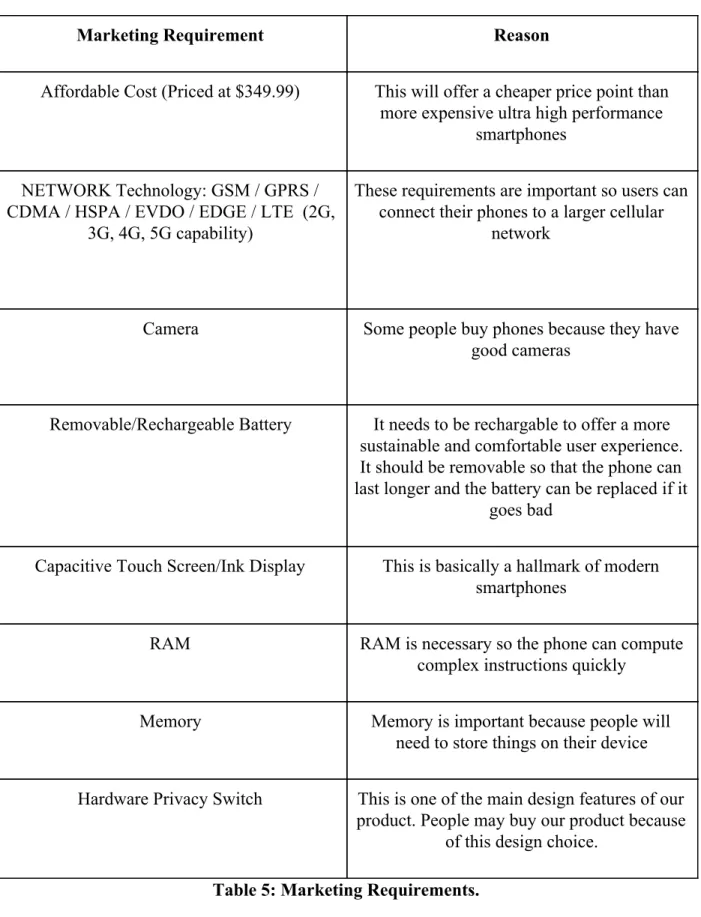
Marketing Requirements
Marketing Requirement Reason
Affordable Cost (Priced at $349.99) This will offer a cheaper price point than more expensive ultra high performance
smartphones
NETWORK Technology: GSM / GPRS / CDMA / HSPA / EVDO / EDGE / LTE (2G,
3G, 4G, 5G capability)
These requirements are important so users can connect their phones to a larger cellular
network
Camera Some people buy phones because they have good cameras
Removable/Rechargeable Battery It needs to be rechargable to offer a more sustainable and comfortable user experience. It should be removable so that the phone can last longer and the battery can be replaced if it
goes bad
Capacitive Touch Screen/Ink Display This is basically a hallmark of modern smartphones
RAM RAM is necessary so the phone can compute complex instructions quickly
Memory Memory is important because people will need to store things on their device
Hardware Privacy Switch This is one of the main design features of our product. People may buy our product because
of this design choice.
The PolyOne Smartphone design will implement features that improve usability as well solve current problems that customers see within the smartphone design. Like current
smartphones, the PolyOne Smartphone will have some features such as calling functionality, network connectivity, and apps compatibility. However, in order to stand out from other products in the market, the smartphone will prioritize implementing 5G technology, long battery life, and privacy protection solutions.
Importance Design Feature
High 5G Support
High Rechargeable Battery with Long Battery Life
High Hardware Switch for Privacy Protection
High Calling Functionality
High Network Connectivity
Medium Apps Compatibility
Medium Phone Size
Low Ink Display
Low Camera
Block Diagram, Requirements, and Specifications Section
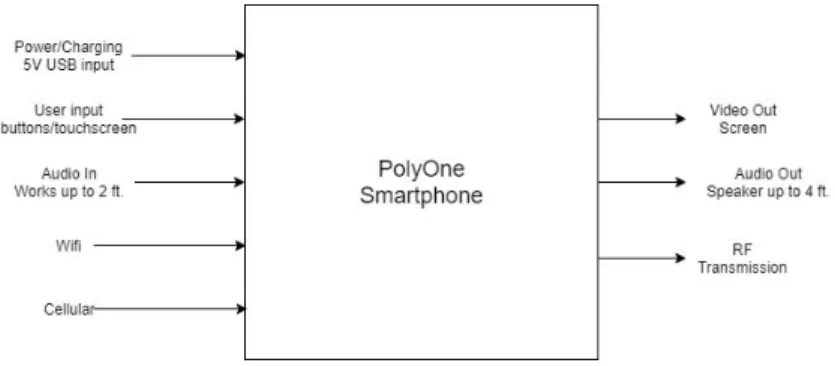
The high level black box diagram includes the inputs and outputs of the smartphone. The inputs consist of power, user input, audio input for calls, and any wireless communication needed. The outputs include video data displayed on the screen, audio output for calls, and wireless
communication.
Figure 8: Level 0 Block Diagram
The level 1 block diagram goes one level up in complexity and shows major functional blocks of the smartphone. Some things to note are that the hardware switch is included in user input and directly connected to power and that the power electronics and distribution is connected to all components needing power.
Engineering Requirements
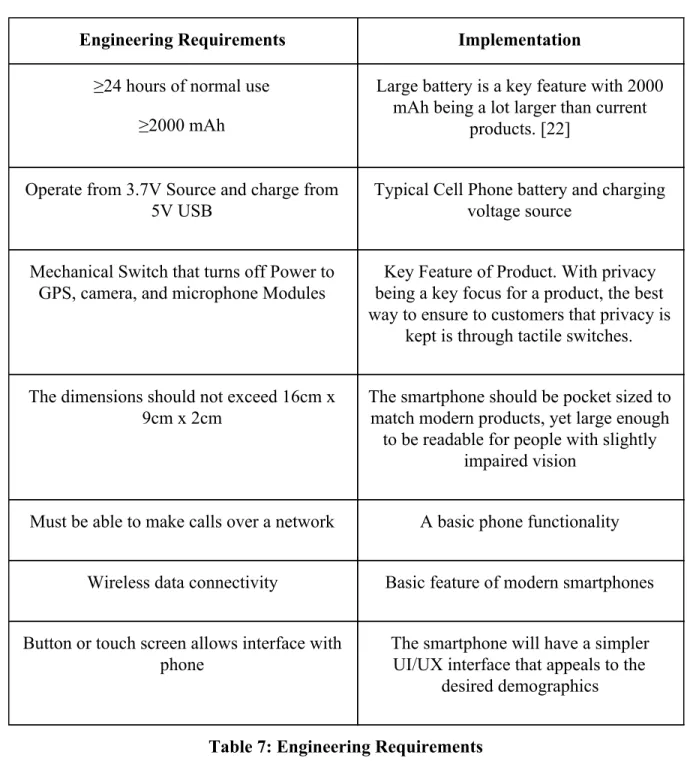
The engineering requirements quantify the marketing requirements and provide exact
specifications that we can meet so that we can be confident that we have successfully achieved the marketing requirement standards. The list is not all inclusive but does highlight some of the key requirements we want to emphasize.
Engineering Requirements Implementation
≥24 hours of normal use ≥2000 mAh
Large battery is a key feature with 2000 mAh being a lot larger than current
products. [22]
Operate from 3.7V Source and charge from 5V USB
Typical Cell Phone battery and charging voltage source
Mechanical Switch that turns off Power to GPS, camera, and microphone Modules
Key Feature of Product. With privacy being a key focus for a product, the best way to ensure to customers that privacy is
kept is through tactile switches.
The dimensions should not exceed 16cm x 9cm x 2cm
The smartphone should be pocket sized to match modern products, yet large enough
to be readable for people with slightly impaired vision
Must be able to make calls over a network A basic phone functionality
Wireless data connectivity Basic feature of modern smartphones
Button or touch screen allows interface with phone
The smartphone will have a simpler UI/UX interface that appeals to the
desired demographics
Testing and Verification
≥24 hours of normal use and ≥2000 mAh:
The 2000 mAh requirements is something that can be confirmed by setting up a test bench that draws power from the battery and we can measure the amount of time it takes until the battery discharges at a specific load. To test for 24 hours of normal use, the phone can be tested by a “user” or the battery can be tested by simulating the current draw. The first test would simply require a person to use the phone throughout the day as they would a normal phone and see if it lasts the full day. The advantage of this test is that the phone would be tested live and in an environment outside of a lab. The second test would require a programmable electronic load that could be programmed to simulate the power drawn during the day when the phone is used. The advantage to this test is that the battery can be stress tested and it is easier to obtain large amounts of data on more than one product. In addition, not needing to have a person operating the phone will allow us to run the test over multiple days and if we can get access to an oven we can test it at different temperatures.
Operate from 3.7V Source and charge from 5V USB:
This is a functional test. Can also test tolerances on input voltage charging (5V +/- XX%).
Mechanical Switch that turns off Power to GPS, camera, and microphone Modules:
This is a functional test. See if switch safely turns off components. This would require turning on and off the switch and 1) ensuring the correct modules turn on/off and 2) Using the switch does not damage the performance of the modules in long term.
The dimensions should not exceed 16cm x 9cm x 2cm:
This is a functional test.
Must be able to make calls over a network:
This is a functional test.
Wireless data connectivity:
This is a functional test.
Button or touch screen allows interface with phone:
Team Project Roles
Systems integration and i/o - Gerome Cacho
This role consists of obtaining major functional modules of the phone and the connection protocols associated with each part. This will require doing a breakdown of the phone kit to better understand smartphone systems. This role specifically will focus on the power distribution of the subsystem.
Systems integration and i/o - Chris Lim
This role consists of obtaining major functional modules of the phone and the connection protocols associated with each part. This will require doing a breakdown of the phone kit to better understand smartphone systems.
Systems integration and i/o - Chi Nguyen
This role consists of obtaining major functional modules of the phone and the connection protocols associated with each part. This will require doing a breakdown of the phone kit to better understand smartphone systems. This role specifically will focus on the audio and dsp subsystems.
RF Systems - Josh Zalmanowitz
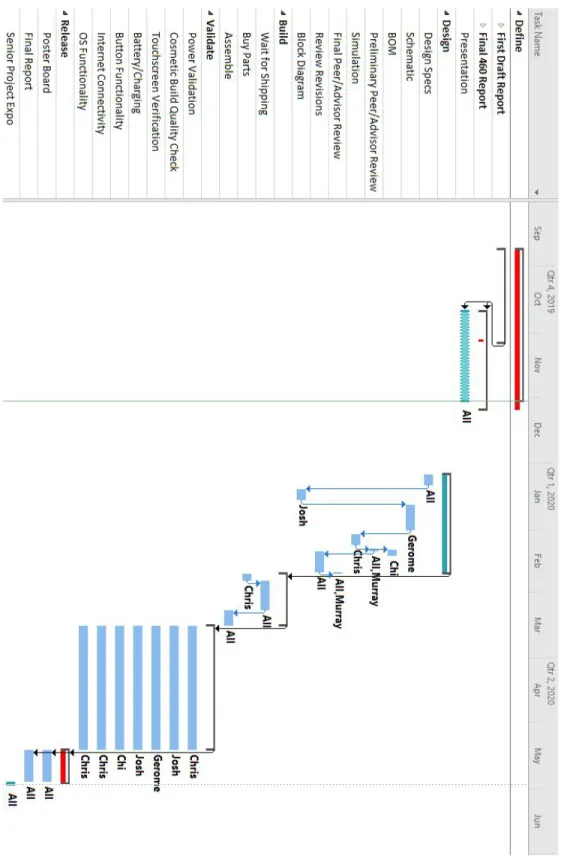
Schedule
Cost (BOM)
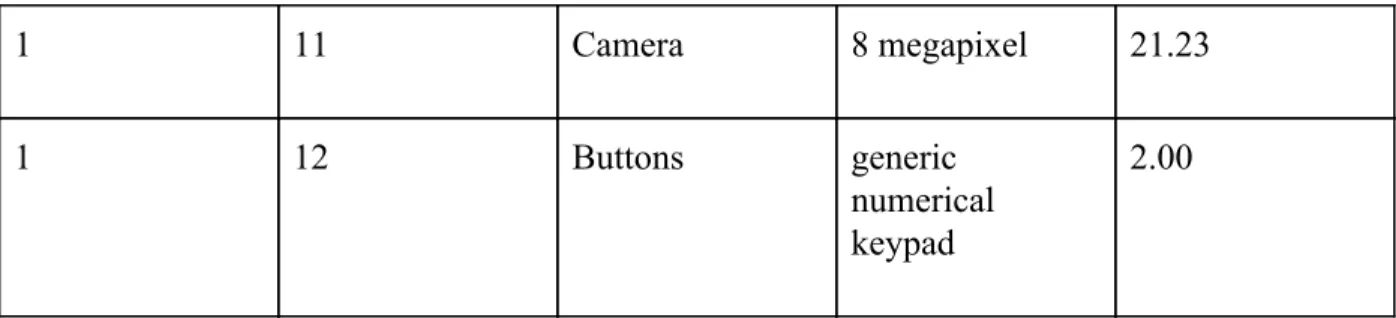
The PolyOne Smartphone will require funding from Cal Poly’s Electrical Engineering department. The funding will be used for the components listed below in Table 8.
Bom Level Part Number Part Name BOM notes Cost ($)
0 1 Poly1
Smartphone
The full smartphone device
235.9
1 2 Wifi Connection Included on RPi 0
1 3 Microphone Mini Mic for R.
Pi
6.99
1 4 Speaker Pimoroni
Speaker
19.99
1 5 GPS chip 12.99
1 6 Modem
(Cellular)
NOVA usb modem
75
1 7 Memory SD card reader 7.50
1 8 Battery and
power management
Battery
2000 mAh 3.7V
12.50
1 9 Microcontroller Raspberry Pi 35
1 10 LED or LCD
interface
R Pi touchscreen 320x240
1 11 Camera 8 megapixel 21.23
1 12 Buttons generic
numerical keypad
2.00
Analysis of Senior Project Report
Project Title: PolyOne Smartphone
Students’ Names: Gerome Cacho, Chris Lim, Chi Nguyen, Josh Zalmanowitz
Advisor’s Name: Prof. Richard Murray
Summary of Functional Requirements
The PolyOne Smartphone is a smartphone that aims to explore the benefits and
drawbacks of the 5G technology implementation as well as to provide a hardware solution for privacy protection and personal information security. It will be powered by a rechargeable battery of at least 2000mAh, have a mechanical switch for turning on and off GPS, camera, and microphone modules, and have basic phone functionalities such as calling/texting and wireless network connectivity. The main purpose of this smartphone is to have higher speed connection through 5G, have more user control privacy, and longer battery life.
Primary Constraints
One primary constraint that this smartphone is the software and OS. Our team does not have proficient experience in software development to create the phone’s own advanced OS or applications on it; it will need to use a very basic and simple OS. Another constraint is the dimensions and size of the phone. We will need to stick to a certain dimension to fit all the components that we need
Economic
a. Human Capital: The PolyOne Smartphone can generate capital by producing jobs in many sectors such as engineering, assembly, sales, marketing, and manufacturing. b. Financial Capital: Our target customers will be able to use our smartphones for personal
and work consumption at a much lower and affordable price compared to our competitors.
c. Natural Capital: This product will contain many electrical and mechanical components including a CPU, RAM, screen, battery, camera, and mechanical switches. Some of these parts will be difficult to recycle and dispose because of the material used to make them. d. Cost and Timing: The cost of the PolyOne Smartphone is heavily dependent on the
be built but the cost may change as we change the design and buy different smartphone kits. This would also affect the retail price.
If Manufactured on a Large-Scale Basis
Estimated Number of devices per year: 10k
Estimated manufacturing cost for each device: $135 Estimated purchase price for each unit: $349.99 Estimated profit per year: $2,150,000
Estimated Cost for User to operate devices: $1 (Electrical Cost)
Manufacturability
The PolyOne Smartphone will only need manufacturing of the physical outer casing. It will mainly require assembly of various components purchased from vendors and then wired and interfaced togethers with leads and soldering.
Environmental Impact
The PolyOne Smartphone will have a notable environmental presence at the beginning and end of life phases of the product due to the materials of the device. It must be noted that during the middle of life phase, the consumer life cycle, the energy consumed by the product will have an impact on the environment due to the added demand for electricity, but this effect is miniscule compared to the electricity demand from other electronics. Another environmental impact is that some of the components are made of rare materials like copper, tin, aluminum, gold, etc [23]. As these electronics are in widespread demand, the amount of material mined in the world’s quarries have grown exponentially to satisfy the demand. Additionally, electronics that are disposed worldwide account for nearly 70% of the toxic waste in landfills [24].
Sustainability
such as our decision to use a rechargeable mobile battery rather than a more sustainable plug in option that would never need replacement.
Ethical
The device has some ethical concerns, primarily regarding user health and environmental impact. In regards to user health, the extended use of the product can result in damaging effects. The PolyOne Smartphone is designed to have a higher battery life than the current market competitors, which could lead to a higher usage rate than the competitors. This could have adverse effects on vision. Additionally, extended smartphone sessions can lead to addiction and cause mental health detriments. There is also the societal impact of people using their phones instead of speaking face to face with one another. Environmental concerns stem from the
materials used in creating electronics and the fact that electronic waste (aka e-waste) accounts for nearly 70% of toxic waste in landfills today. The physical killswitches for the devices lead to a manual control of location data as well as camera and microphone usage. While this guarantees privacy for users who require it, there are also drawbacks as in the wrong hands, this device can potentially be used to mask the location and details of crimes and make criminals more
untraceable.
Health and Safety
The safety concerns regarding the PolyOne Smartphone are similar to any electronic device. With prolonged use of the device, which is further exacerbated by the larger battery of the PolyOne Smartphone compared to its competitors, the user puts themselves at a higher risk of vision issues such as myopia and asthenopia. It is up to the user to understand the risks and be able to properly use the device sparingly as to avoid overuse of their eyes.
There are also psychological effects to users’ health, as a larger battery would further increase the dependence on technology by the user. As the PolyOne Smartphone is marketed to the elderly and younger demographics due to the simplistic UI/UX design, having these age ranges further exposed to technology would have a severe impact on their socialization skills, especially the latter demographic. In addition, through longer use of the PolyOne Smartphone, this would further empower any users who have addiction to phone usage, social media, gaming, or gambling. As another feature of the PolyOne Smartphone is compatibility with mainstream applications, having prolonged access would only further impact people’s attachment to these channels.
Social and Political
such as poor vision, addiction, and mental health detriments. Proper and ethical use of the smartphone must be enforced and present or legal issues might occur.
Preliminary Design Analysis
For the initial process, a DIY phone kit was purchased in order to get more comfortable with the basic systems needed in a cell phone. When choosing a kit to purchase many factors were
considered including but not limited to cost, availability, brand, user reviews, wireless capability, prebuilt vs DIY, and ease of reverse engineering. It was important to get a kit that had discrete functional blocks and would allow us to look at separate functional blocks.
We finally decided on the CircuitMess Ringo 4G Kit | Build Your Own Mobile Phone | Do-It-Yourself Project and will base our phone design off of this kit.
The major portion of the design will be done in winter quarter when we design the hardware switch and look at the wireless 5G technologies. This will require further research on 5g and 4g technologies as well as looking at what is currently available on the market. The hardware switch will be either power focused or controlled by the microcontroller, and will have an emphasis on systems connectivity for controlling each of the modules that we want controlled by the privacy kill switch.
Initial Enclosure Design
The following pictures are of our initial phone enclosure design. The dimensions of this original design is 4 x3 x1.5 inch, which is much larger than that of our engineering specifications. This design will need to be reduced in size in the future but was a general idea for the enclosure that we desired early into the design phase.
Figure 12: Solidworks CAD model
Figure 13: Preliminary Enclosure Print
Addendum 1
Since the end of Fall Quarter, the PolyOne smartphone team has been hard at work identifying possible components to use in the implementation of the phone. Through a significant research effort, our team was able to find seven teams that have the same goal of creating a DIY phone. Some of the teams were more far along than others, but all seven provided useful
information to our group. One company that stood out among the rest was CircuitMess, a DIY enthusiast group located in Croatia. They have put significant effort into creating a phone that resembled the look of an old mobile video game console. They also incorporated a fully
integrated network board with input from a SIM card. Luckily for us, their work was all done in English. We were able to partner up with them to learn from their progress and use their product as a platform for our smartphone design.
Figure 15: Circuitmess Ringo Phone
Hardware
One of our main goals for this project is to improve on the initial design of Circuitmess’s Ringo Smartphone by recreating our own printed circuit board that integrates all the various components and modules of the phone. Manufacturing our own PCB would allow us to add additional components (i.e. sensors, camera) to the schematic, improve cosmetics, and understand the fundamentals of the smartphone through reverse engineering.
The Circuitmess team was able to send us PDFs of their schematics of the phone which includes the main board, brain board, display board, network board, and sound board; however, they were not able to send the PCB source files and layout files due to company privacy policy. As a result, we had to recreate the schematics using the KiCad software tool, which are shown below in the following pages.
KiCad software tool had a little bit of a learning curve, but as of 3/11/20, only the main board schematic wasn’t completed yet. There are some components that will be very hard to replace/remanufacture (ie Sound IC). We are looking at ways to incorporate the pre-existing sound board onto the newly designed main board to avoid having to remanufacture the sound board.
We were also able to photograph at a good resolution all of the boards in order to follow the traces in an effort to better understand the board layout and components. Some photos are shown below.
Figure 16: Brain Board Photo
Figure 18: Main Board Photo
Software
The Ringo smartphone uses the esp 32 SoC, and we plan on also utilising this SoC in our design. The esp 32 is built by Espressif, a China based company which sells SoC’s mainly for wireless communication and IoT. The chip runs off of arduino C, and we are able to upload code using Ringo Circuitblocks. It should also be possible to upload code using the Espressif IDE and possibly from a regular Arduino IDE.
Ringo provided us with all of the source code for the phone in a github repository. Currently, we are in the process of working through the source code with a focus on the integration of new peripherals and general architecture. Ringo and Espressif both provide resources for working with the code/SoC.
Ringo Circuitblocks provides a way to graphically code new applications for the phone, such as games or general use apps (alarm, clk, etc.). It also generates the actual code for us and displays it in Circuit blocks. Unfortunately, it does not seem possible to directly code using Circuit Blocks, which limits us to the functionality that the Ringo provides. This application is good only for writing programs that work with pre-existing functions of the Ringo Smartphone, and will not be an option for programming in new peripherals.
We were able to successfully write and run a simple application that displayed a colored square and a block of text on the phone screen. This involved converting the code to a .bin file and saving it to the phone SD card. This method allows us to “permanently” upload the code to the phone without having the phone connected to a computer.
CircuitBlocks is only able to upload code to the phone directly by overwriting the firmware temporarily and making the phone only able to run the uploaded application software. This prevents normal use of the phone when testing the application code. The main options for updating the firmware are the Arduino IDE and the Espressif provided software. Espressif also has a SDK that it provides to help with the ESP 32.
As mentioned previously, one of the main goals for learning the code is to be able to integrate new peripherals. One goal for the project is to add new sensors to the hardware and to be able to use them with the phone OS. In particular, we are interested in integrating GPS, a Camera, Pressure and Humidity, and a gyroscope. These components have already been ordered and are being experimented with.
Fig 25: GPS Module
Addendum 2
Hardware
Schematic Changes
When working with the schematic provided by Ringo Circuitmess, there were some issues finding and acquiring certain parts due to lack of availability, lack of documentation on the schematic, and difficulties in manufacturing. Due to this, many parts of the hardware needed to be replaced and redesigned. This section documents some of the changes made to the Ringo Circuitmess hardware.
Resistors
The circuitmess team was originally using resistor networks of 4 resistors for each component in their schematic. We decided to make the changes to just use single resistors with footprints of 0402 1005 metrics so it is much smaller and allows more space for layout. Additionally, many series and parallel resistors were combined.
Buttons
The original Ringo Circuitmess design involved using SPST 6mm through hole switches as its buttons. This led to a lot of issues during layout involving limited space, so we decided to make the change to SPST 3mm surface mount switches (B3FS--1002P). This freed up more space for layout so traces could go under the components.
Headphone Jack
The original headphone jack part PJ-3126-5A was replaced with a new part
35RASMT4BHNTRX. This component has the same specifications but is smaller and has better documentation.
SIM Card Holder
The original circuitmess schematic, shown below, did not state the part number for this
Figure 27: Sim Card Holder
Power Stages
There were two Power Stage components on the schematic that we were not able to identify a part number for so had to redesign to the schematic specifications.
The first component was a linear regulator and the main board that took an input voltage of 3.3V and provided an output voltage of 1.8V. We chose the TLV70218DBVR, which provided an output current up to 300 mA. It needed two 100 nF (1 input and 1 output) bypass caps as supplemental components.
Figure 28: Linear Regulator
To meet these specifications, the ADP2303ARDZ non synchronous Step-Down regulator was chosen. It provides up to 3A load current, has an internal switch, and has enable/disable control. All supplemental circuitry was sized according to the ADP2303ARDZ datasheet and the output voltage feedback network was set so that the output voltage was ~3.5 V.
Figure 29: Step-Down Regulator
Audio Board
For the audio board, and specifically the I2C audio amplifier, the issue we came across was that the IC was becoming obsolete, and it used a 9 pin bga package that would be difficult for us to manufacture and solder to the board. Initially, we attempted to quickly look for replacements but had difficulty finding anything that had the same input protocols for data and control.
Specifically, the original IC, the TFA9882, received audio and control settings using the I2S protocol. While the I2S audio protocol is a standard and there are many chips that use it, finding something with additional I2S control is very hard. Most of the audio amplifiers we found were using I2C control or had no control capability at all. For the current design, we decided to make the change to use a SMD connector to connect the TFA9882 to the main board as the BGA package would be difficult for manufacturing.
Figure 30: Audio Board Regulator
Future plans for the audio amplifier included adding some plug and play pins to the current mainboard to be able to hookup the previous and future versions of the soundboard. There are eight unconnected pins on the main board that are connected to the pinout provided for the original sound card. One future plan is to work with this plug and play version to design and test a new amplifier. Another improvement would be to upgrade the current mono audio to stereo.
Additional Changes
Final Main Board Schematic
Layout
To be able to reverse engineer the board, a great deal of understanding the schematic as well as the individual behaviors of the components was needed. The initial design of the board was a 2-layer board, wherein the Brain Board, Display Board, and Audio Board were soldered directly onto the Main Board. This configuration was changed for a slimmer design, where the external boards were instead flush with the main board. This design would call for cavities where the boards would be, and have connectors to the main board be relatively close in proximity with the external board.
Figure 32: Initial Design of the PolyOne Smartphone
As previously stated, the PolyOne Smartphone team decided to utilize the PCB design software KiCAD. As of the end of the Spring 2020 quarter, the team was able to fully recreate the main board, as well as integrate the Sound Board and portions of the Display Board onto the Main Board. Once the major components were placed and agreed upon (such as buttons, connecting pins, LCD ribbon cable connector, and PCIE connector), the overall routing and placement of the components commenced.
The largest issue that was faced during the layout was to be able to route the different
to the other side of the board. Most through-hole components that were provided on the main board of the original design were changed to their surface mount equivalent to be able to give more flexibility towards routing. The team also decided to reduce the number of RGB LEDs on the board to reduce occupied space. A significant feature of the board was the change from a two-layer to a four-layer board, giving a vast amount of flexibility to be able to route signals within the intermediary layers. There had to be a precise placement of through-hole vias, in which they did not interfere with a trace, or pad within any layer of the board.
Moving forward, to further improve the design would be the introduction of micro/buried vias to be able to only switch between two layers instead of puncturing directly through the board. A challenge to this could be an increased cost, as well as a much higher degree of difficulty in troubleshooting if the board did not perform as expected. Another improvement would be the complete integration of the Brain Board into the Main Board, as that would eliminate the need for the connectors as well as provide more flexibility to routing with a full rectangular board instead of an L-Shaped design. Another consideration for the future is the development of the overall software to handle the reduced number of LEDs to safeguard against the software crashing if it is looking for the now non-existent five LEDs.
As shown in Figure 33, the front side of the main board contains most user-interacting
components, such as the joystick and selection/back buttons in the top of the board. Completing the design of the top of the board is the LCD ribbon cable connector, U14. This is followed up by a section of 4 buttons arranged in a horizontal manner which have the same functionality as the original 4 buttons on the Ringo design (Power, Home, and two auxiliary buttons). This is followed up with the standard cell button 3x4 grid, which includes 0-9 as well as # and *. The cell phone’s microphone, headphone jack, and SIM card holder finish out the design.
Future Additions to the Board
There are many things that we thought would be interesting to add to the functionality of the board. Here is a short list of some things we thought of implementing but didn’t have time to.
● Touch Screen
○ Pros: possibly less i/o due to removal of buttons, cool feature, larger screen
○ Cons: Difficulty in coding, need to rearrange hardware
● Potentiometer
○ Pros: Added functionality for smart turn on and sleep modes with motion sensing
○ Cons: more hardware
● GPS
○ Pros: Added functionality for GPS
○ Cons: more hardware
● Bluetooth
○ Pros: Bluetooth connectivity
○ Cons: Not much (some esp models have bluetooth)
● Update Power Supplies (Use miniature switcher IC that has multiple output voltages)
○ Pros: Can consolidate many of the power IC’s into one and save on board space
Software
The Circuitmess Ringo smartphone’s main IC is the ESP-32 Wroom chip by Espressif. It can be programmed in various ways. The ESP-32 is coded in C.
One way is to use the Circuitmess provided Circuitblocks software. It can be downloaded from their site. The Circuitblocks software is a graphical coding software that uses a Scratch-like drag and drop code style to program with. It essentially lets you build your code with drag and drop blocks, and then generates the actual C code for you. The biggest drawback about using this approach is that you can only code applications that work with the blocks provided. In addition, there are only so many buttons and features that you have access to when using their graphical coding.
The second way to program the phone was to use the method described by Espressif. This involved downloading and setting up the coding environment from the Espressif site. This method can directly program features of the ESP-32 and controls the pins themselves. To set up the environment properly, visit the Espressif website.
Repository
This section contains comments on the locations of useful documents in the PolyOne Smartphone Google Drive folder.
Main Folder - contains all of the subfolders as well as important documents and documents that do not have a subfolder.
Ringo Files - This folder contains the KiCad projects for the phone, the phone schematics, and a list of useful links to help with coding the phone and obtaining more info on the phone.
Phone Photos - Up close photos of the pre-assembled Circuitmess smart phone PCBs.
Meeting Notes - Notes taken of weekly meetings
The following folders are less important and were used for EE 460
EE 460 - Contains documents used for 2019 EE460 Class
Conclusions
This project’s original goal was to build a prototype smartphone with the main goal either being 5G or some privacy hardware implementation. Throughout the process of the senior project, the main goal of the project shifted many times as we began to realize what really went into building a smartphone.
Although the original goals were never met, there was a lot of experience gained from the trial and error involved in attempting to reverse-engineer a smartphone and implement our own designs in it. Our decision to reverse-engineer the board became our main task for the project and required verifying the schematics, finding and procuring the necessary parts, and finally designing the layout and ordering the components. This project gave us much more insight into the components and systems involved in smartphones, and also insight into the scope of
undertaking such a task as building a smartphone.
Acknowledgment
References
[1] Knut, “How mobile phones have changed over the past ten years,” Technotification, 18-Jan-2015. [Online]. Available:
https://www.technotification.com/2015/01/10-years-of-mobile-technology.html. [Accessed: 21-Oct-2019].
Source for Figure 1
[2] “How RF Industries is Building 5G Wireless Networks,” How RF Industries is Building 5G Wireless Networks | Article | RF Industries. [Online]. Available:
https://www.rfindustries.com/resources/articles/how-RFIndustries-is-building-5G-wireless-netw orks.php. [Accessed: 21-Oct-2019].
Source for Figure 2 and 3
[3] J. Harper, “Is It Unreasonable to Expect Cellphone Privacy?,” The Wall Street Journal, 28-Nov-2017. [Online]. Available:
https://www.wsj.com/articles/is-it-unreasonable-to-expect-cellphone-privacy-1511912204. [Accessed: 21-Oct-2019].
Source for Figure 4
[4] M. Anderson, “Mobile Technology and Home Broadband 2019,” Pew Research Center: Internet, Science & Tech, 05-Jul-2019. [Online]. Available:
https://www.pewinternet.org/2019/06/13/mobile-technology-and-home-broadband-2019/. [Accessed: 21-Oct-2019].
Provides data about usage of phones in america and has multiple subcategories. Useful because we are interested in phone users and this data can help to identify our customers.
[5] “Smartphone: Definition of Smartphone by Lexico,” Lexico Dictionaries | English. [Online]. Available: https://www.lexico.com/en/definition/smartphone. [Accessed: 21-Oct-2019].
Used for definition of smartphone
[6] O. Andrew, “The History and Evolution of the Smartphone: 1992-2018,” Text Messaging Service for Small Business - Text Request. [Online]. Available:
Talks about the history of smartphones and major milestones. Also talks about what each generation of smartphones changed and gives insight into what the customers are looking for and how to define a foundation for a smartphone.
[7] “New Apple iPhone 11 Pro: 4 Colors in 64GB, 128GB & 256GB: T-Mobile,” T-Mobile. [Online]. Available: https://www.t-mobile.com/cell-phone/apple-iphone-11-pro. [Accessed: 21-Oct-2019].
Source for Figure 5
[8] “Samsung Galaxy A70 (2019) Price in Malaysia, Specs & Reviews,” Samsung, 20-Sep-2019. [Online]. Available:
https://www.samsung.com/my/smartphones/galaxy-a70-a705/SM-A705FZBGXME/. [Accessed: 21-Oct-2019].
Source for Figure 6
[9]“Getting to 5G: Comparing 4G and 5G System Requirements,” Qorvo, 07-Sep-2017. [Online]. Available:
https://www.qorvo.com/design-hub/blog/getting-to-5g-comparing-4g-and-5g-system-requiremen ts. [Accessed: 21-Oct-2019].
Source for Figure 7
[10] “AAPL.O - Apple Inc. Profile,” Reuters. [Online]. Available: https://www.reuters.com/companies/AAPL.O. [Accessed: 21-Oct-2019].
This source provided various metrics and information and Apple Inc. one of the market competitors.
[11] V. Savov, “Pixel 'phone by Google' announced,” The Verge, 04-Oct-2016. [Online]. Available:
https://www.theverge.com/2016/10/4/13161028/google-phone-announced-pixel-xl-price-release-date-specs. [Accessed: 21-Oct-2019].
This source provides various information about the Google Pixel, a competing smartphone product. Give information about the features of the Pixel that customers may be interested in.
Information about Huawei, another competitor in the smartphone business. Used for market research
[13] A. Williams, “OnePlus history: from viral marketing maverick to flagship killer,” TechRadar, 23-May-2018. [Online]. Available:
https://www.techradar.com/news/oneplus-history-from-viral-marketing-maverick-to-flagship-kill er. [Accessed: 21-Oct-2019].
Information about another competitor's product. Goes through the many versions and talks about key features.
[14] “Our Brand,” Our Brand | About LG | LG Global. [Online]. Available: https://www.lg.com/global/about-lg/our-brand. [Accessed: 21-Oct-2019].
Information about LG, another competitor in the smartphone business. Used for market research.
[15} “History: Company: Samsung US,” Samsung Electronics America. [Online]. Available: https://www.samsung.com/us/aboutsamsung/company/history/. [Accessed: 21-Oct-2019].
Information about Samsung, another competitor in the smartphone business. Used for market research
[16] R. Jones, “Best 5G phones: Every 5G Phone Announced and Still to Come in 2019,” T3, 20-Oct-2019. [Online]. Available: https://www.t3.com/news/best-5g-phones. [Accessed: 21-Oct-2019].
This source provided condensed information regarding 5G compatible smartphones. It lists the year’s released (and soon to be released) models of smartphones with tech specs and consumer reasons to buy. It also provides a brief intro onto 5G as a communication network.
[17] C. Sbeglia, “Where Do the Major US Carriers Stand in Deploying 5G?,” RCR Wireless News, 07-Aug-2019. [Online]. Available:
https://www.rcrwireless.com/20190806/5g/major-us-carriers-5g. [Accessed: 21-Oct-2019].
This source provides information on which carriers provide 5G compatible service. This is relevant to see the progress of 5G wireless communication and how far it still needs to develop from a service provider perspective until it can be mass utilized.
This source gives a deep dive onto 5G as a communication network. It dives into the intricacies that make 5G so effective as well as what distinguishes it from its predecessors (4G, 4G LTE, 3G, etc). It also provides insight into how it works from a physics and technological standpoint.
[19] M. Rouse and J. Burke, “What is Orthogonal Frequency-Division Multiplexing (OFDM)? - Definition from WhatIs.com,” SearchNetworking, Sep-2016. [Online]. Available:
https://searchnetworking.techtarget.com/definition/orthogonal-frequency-division-multiplexing. [Accessed: 21-Oct-2019].
This source provided information as to 5G’s specific method of transmittal; OFDM. It describes how OFDM works and what makes it unique compared to previous methods of communication.
[20] M. Gikas, “How to Protect Your Privacy on Your Smartphone,” Consumer Reports, 01-Feb-2017. [Online]. Available:
https://www.consumerreports.org/privacy/how-to-protect-your-privacy-on-your-smartphone/. [Accessed: 21-Oct-2019].
This source provided mainstream practices to remedy privacy concerns. This source was more utilized to show what was not a common practice, as there were no types of hardware solutions; only software solutions.
[21] “Cell Phone Sales Worldwide 2007-2018.” Statista, Gartner,
www.statista.com/statistics/263437/global-smartphone-sales-to-end-users-since-2007/. This source provides the statistics for smartphone sales from 2007 to 2018.
[22] “Battery,” Geek.com. [Online]. Available:
https://www.geek.com/smartphone-buyers-guide/battery/. [Accessed: 04-Dec-2019].
This source provides data on modern commercial smartphone battery sizes. This is used to showcase that the PolyOne Smartphone will have a greater battery life than the current market competitors.
[23] T. Haque, “Introduction to Electronics Recycling,” The Balance Small Business,
07-Oct-2019. [Online]. Available:
This source gives the overview of how electronics are recycled, and the statistics behind electronic waste (e-waste) and the entire recycling process.
[24] P. Holgate, “The Model for Recycling Our Old Smartphones is Actually Causing Massive
Pollution,” Vox, 08-Nov-2017. [Online]. Available:
https://www.vox.com/2017/11/8/16621512/where-does-my-smartphone-iphone-8-x-go-recycling -afterlife-toxic-waste-environment. [Accessed: 04-Dec-2019].
Analysis of Senior Project
Project Title: PolyOne Smartphone
Students: Joshua Zalmanowitz, Christopher Lim , Gerome Cacho, Chi Nguyen
Student Signatures:
_________________ _________________ ______________ ______________ Advisor: Richard Murray Advisor’s Initials: __________ Date: ____________
1. Summary of Functional Requirements – The PolyOne smartphone team has sought to
develop the first iteration of a fully functioning smartphone that future students can expand upon. At a minimum, we would like to have a design for a phone that can make phone calls and text messages. All designs should be ready to print at a PCB fabricator and easily reviewed by the next Sr. project team to take on this project.
2. Primary Constraints – Our team was constrained significantly by COVID-19. We were
restricted access to all laboratory spaces and therefore could not do any hardware testing outside of computer simulation during spring quarter (the later stages of our project). We were also constrained by our lack of expertise of software and firmware. Future students selected to continue this project should include at least one student with significant experience in firmware or software.
3.Economic – Our project team was able to remain in budget. Our primary expenditures were on manufacturing the PCB as well as research into the original design. We bought enough parts to make two phones and bought additional microprocessors and sensors so that we could test the sensors we are adding to our design.
4. Human Capital – The project took up a significant amount of time for all four of the project members. Chris and Josh spent weeks on the sourcing and programming of sensors while Chi and Gerome were concurrently designing and laying out the printed circuit board with all the parts we require using KiCad. The component and PCB manufacturing also requires a human cost, which is passed down to us in the prices of the parts.
5. Natural Capital – The phone is a fully integrated electronic design comprised of copper traces, a rechargeable lithium battery, tin and/or lead in the solder, and more. The PCB and component manufacturing process also uses machinery that releases greenhouse gases and adds to the problem of global pollution.
6. Manufactured on a Commercial Basis – If the phone were to be manufactured in
large numbers, all of the natural capital costs would be multiplied. There would be more greenhouse gas released from the PCB and component manufacturing and more natural resources used, notably copper and lithium.
7. Environmental – The lithium, copper, and tin and/or lead used in our product will be difficult to recycle for other products. Because our design prioritized a small and condensed package, the recyclability of the components drastically decreases.
8. Manufacturability – Our project relies on a complex global supply chain that provides
electrical components to designers. The manufacturability of our product relies on all of our
component’s availability on the open market. If we do have access to all components, the actual PCB fabrication is not incredibly complex. We purposefully spaced things out on our boards enough so that our manufacturers could have large margins of error. This helps us reduce cost and makes the job easier and faster for our manufacturers, who can guarantee a higher first pass yield of our boards.
9. Sustainability - The PolyOne smartphone design emphasizes a compact design with a
serious focus on user privacy. We intend to design the product to last longer than some of the other more mainstream phones.
10. Ethical – The project’s primary focus was on user privacy, which is a methodology that
stands in direct opposition to many of the currently available smartphones. We believe that user’s privacy rights will be expanded upon in the future through legislation but want to provide an option now for privacy minded consumers.
11. Health and Safety - The safety of our project is of upmost concern. The biggest
liability is the power management system. We put special care into the design of our battery system.
12. Social and Political – The cultural effect of smartphones is complex. To some, it
connects loved ones who are separated and to others it is a crippling addiction. Companies could take advantage of smartphone owners by taking their data. We intend to offer a privacy focused smartphone experience that puts the user in control. We believe this model will be years ahead of future privacy related legislation.
13. Development - The main software tool used for the project was KiCad. It is a free
software that we used to design and manufacture the smartphone PCB. A large portion of the project was dedicated to learning KiCad and then using it to make the entire smartphone schematic and layout in order to get the smartphone PCB fabricated.
14. Next Steps -
● Hardware:
a. There are multiple modules that we are interested in adding to the smartphone in order to increase functionality. Some of them are: GPS module, temperature and pressure sensors, camera, and touch screen
b. There are also many things we wish to upgrade to improve functionality or to decrease component size and/or cost. In particular, we are interested in improving the power and the audio circuitry.
● Firmware:
a. This project has mainly been focused on the hardware end due to the strengths of the original project group (all Electrical Engineers). Future steps for Firmware would be to look more into Firmware capabilities.
b. The main chip we are using has built in bluetooth capability that could be implemented with the phone.
● Software:
a. This project has mainly been focused on the hardware end due to the strengths of the original project group (all Electrical Engineers), but there were some advancements made in the Software area. Future steps for Software would be to look more into Software capabilities.
b. Once future hardware is introduced into the system, software will be essential to enable the hardware’s functionality within the OS
Audit Trail
Title File Name Document ID
Audit Trail Date Format Status
Analysis of Sr. Project
AnalysisofSeniorP...e Smartphone.docx
74ae73d5dfcc178ae3fcc383802048b431fb9a55 MM / DD / YYYY
Completed
06 / 10 / 2020
19:50:28 UTC
Sent for signature to josh zalmanowitz ([email protected]), Gerome Cacho ([email protected]), Chi Nguyen
([email protected]), Chris Lim ([email protected]) and Rich Murray ([email protected]) from [email protected] IP: 47.32.175.116
06 / 10 / 2020
19:50:36 UTC
Viewed by josh zalmanowitz ([email protected]) IP: 47.32.175.116
06 / 10 / 2020
19:55:42 UTC
Viewed by Rich Murray ([email protected]) IP: 75.128.14.215
06 / 10 / 2020
19:59:33 UTC
Viewed by Gerome Cacho ([email protected]) IP: 67.170.240.32
06 / 10 / 2020
20:11:46 UTC
Audit Trail
Title File Name Document ID
Audit Trail Date Format Status
06 / 10 / 2020
20:46:07 UTC
Viewed by Chi Nguyen ([email protected]) IP: 172.58.29.154
06 / 10 / 2020
19:50:50 UTC
Signed by josh zalmanowitz ([email protected]) IP: 47.32.175.116
06 / 10 / 2020
19:56:23 UTC
Signed by Rich Murray ([email protected]) IP: 75.128.14.215
06 / 10 / 2020
20:05:24 UTC
Signed by Gerome Cacho ([email protected]) IP: 67.170.240.32
06 / 10 / 2020
20:12:26 UTC
Signed by Chris Lim ([email protected]) IP: 99.51.144.92
06 / 10 / 2020
20:46:32 UTC
Signed by Chi Nguyen ([email protected]) IP: 172.58.29.154
The document has been completed.
06 / 10 / 2020
20:46:32 UTC
Analysis of Sr. Project
AnalysisofSeniorP...e Smartphone.docx
74ae73d5dfcc178ae3fcc383802048b431fb9a55 MM / DD / YYYY