INTELLIGENT NETWORKS
Introduction to SS7 Signaling
Lecturer:
I
NTRODUCTION TO
SS7 S
IGNALING
Signaling System No. 7 (SS7) is a set of telephony signaling protocols that are used to set up most of the world’s public switched telephone network (PSTN) telephone calls. SS7 primarily sets up and tears down telephone calls, but other uses include number translation, prepaid billing mechanisms, local number portability, short message service (SMS), and a variety of mass-market services.
DEFINITION:
SS7 is an architecture for performing out-of-band signaling in support of the call-establishment, billing, routing, and information-exchange functions of the PSTN. It identifies functions to be performed by a signaling-system network and a protocol to enable their performance.
Variants of SS7
W
HAT
I
S
S
IGNALING
?
Signaling refers to the exchange of information between call components required to provide and maintain service. As users of the PSTN, we exchange signaling with network elements all the time. Examples of signaling between a telephone user and the telephone network include: dialing digits, providing dial tone, accessing a voice mailbox, sending a call-waiting tone, dialing *66 (to retry a busy number), etc.
SS7 is a means by which elements of the telephone network exchange information. Information is conveyed in the form of messages. SS7 messages can convey information such as:
I’m forwarding to you a call placed from 212-555-1234 to 718-555-5678. Look for it on trunk 067.
Someone just dialed 800-555-1212. Where do I route the call?
The called subscriber for the call on trunk 11 is busy. Release the call and play a busy tone.
The route to XXX is congested. Please don’t send any messages to XXX unless they are of priority 2 or higher. unless they are of priority 2 or higher.
I’m taking trunk 143 out of service for maintenance.
W
HAT
I
S
O
UT
-
OF
-B
AND
S
IGNALING
?
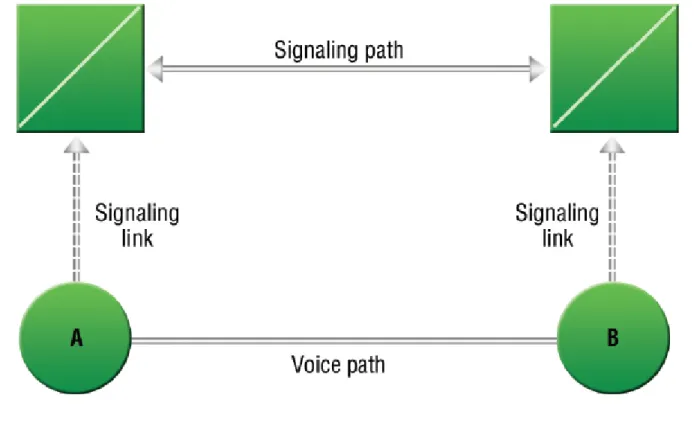
Out-of-band signaling is signaling that does not take place over the same path as the conversation.
We are used to thinking of signaling as being in-band. We hear dial tone, dial digits, and hear ringing over the same channel on the same pair of wires. When the call completes, we talk over the same path that was used for the signaling. Traditional telephony used to work in this way as well. The signals to set up a call between one switch and another always took place over the same trunk that would eventually carry the call. Signaling took the form of a series of multifrequency (MF) tones, much like touch tone dialing between switches.
W
HY
O
UT
-
OF
-B
AND
S
IGNALING
?
SS7 is a form of common channel signaling, that provides intelligence to the network, and allows quicker call setup and teardown – saving time and money. Out-of-band signaling has several advantages that make it more desirable than traditional in-band signaling.
It allows for the transport of more data at higher speeds (56 kbps can carry data much faster than MF outpulsing).
It allows for signaling at any time in the entire duration of the call, not only at the beginning.
It enables signaling to network elements to which there is no direct trunk connection.
Compared to in-band signaling, out-of-band signaling provides:
Faster call setup times (compared to in-band signaling using multi-frequency (MF) signaling tones).
More efficient use of voice circuits.
Support for Intelligent Network (IN) services which require signaling to network elements without voice trunks (e.g., database systems).
Improved control over fraudulent network usage.
S
IGNALING
M
ODES
Associated Signaling – Uses one dedicated path between switches as the
signaling link.
Examples: ISDN-PRI and E1-CAS.
Non-Associated Signaling – Uses separate logical paths and multiple nodes.
Quasi-Associated Signaling – Uses a minimal number of nodes (preferred for
A
SSOCIATED
S
IGNALING
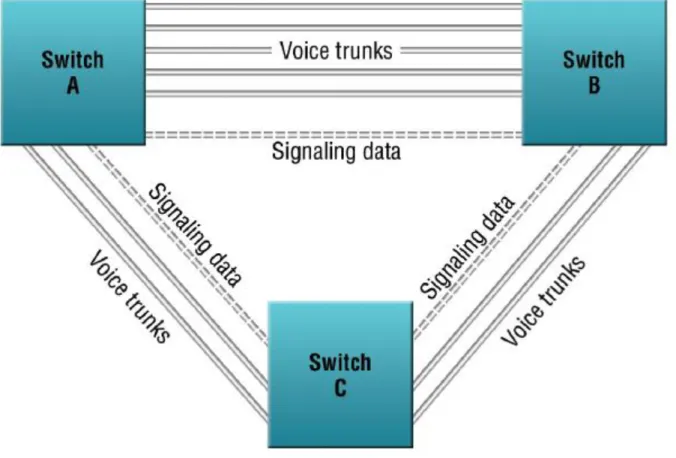
With this type of signaling, the signaling link directly parallels associated voice trunks. Thus, dedicated links must be provisioned between every interconnected switch.
N
ON
-A
SSOCIATED
S
IGNALING
With this type of signaling, voice/data and signaling are carried on separate, logical paths. Multiple nodes in the signaling path to the final destination can cause delays. Although used in the SS7 network, it is not preferred.
Q
UASI
-A
SSOCIATED
S
IGNALING
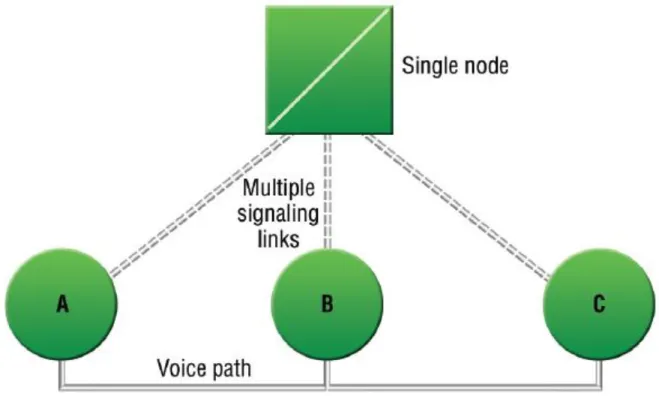
This type of signaling employs a minimal number of nodes, thus minimizing delays. Quasi-associated signaling is the preferred signaling mode for SS7.
S
IGNALING
P
OINTS
All nodes in the SS7 network are called Signaling Points (SPs). Each SP is identified by a unique address called a Point Code (PC). SPs have the abiliability to read a Point Code and determine if the message is for that node and the ability to route SS7 messages to another SP.
Each signaling point in the SS7 network is uniquely identified by a numeric point code. Point codes are carried in signaling messages exchanged between signaling points to identify the source and destination of each message. Each signaling point uses a routing table to select the appropriate signaling path for each message.
There are three kinds of signaling points in the SS7 network:
SSP (Service Switching Point or Signal Switching Point);
STP (Signal Transfer Point);
SS7 S
IGNALING
P
OINTS
Service Switching Point (SSP):
SSPs are switches, for example, Class 5 (local) and Class 4 (tandem) with SS7 interfaces. SSPs convert global title digits (i.e. a dialed number) from a subscriber line to SS7 signaling messages. SSPs setup, manage and release voice circuits required to make a call. SSPs send messages using the ISDN User Part (ISUP) and Transaction Capabilities Application Part (TCAP) protocols. To summarize, an SSP’s function is to use a global title to determine how to connect a call using its routing table.
Signal Transfer Point (STP):
An STP is a router and/or a gateway in the SS7 network. Messages are not originated by an STP. STPs switch SS7 messages between signaling points. If an originating SSP does not know the address of a destination SSP, the STP must provide it using Global Title Translation. Gateway STPs serve as the interface into another network and they can provide protocol conversion. STPs also provide traffic and usage measurements.
Service Control Point (SCP):
An SCP provides application access. It is an interface to applications such as databases. An SCP communicates with applications using primitives. A primitive is an interface that provides access from one level of a protocol
SS7 S
IGNALING
L
INKS
All SPs (signaling points) are connected using (typically) pairs of Links. Each Link type is identified with a letter as defined below:
Type A – Access Links (used to connect SSPs to STPs or STPs to SCPs)
SS7 S
IGNALING
L
INKS
Type B – Bridge Links (used to connect paired STPs to other paired STPs)
SS7 S
IGNALING
L
INKS
Type C – Cross Links (used to connect paired STPs)
SS7 S
IGNALING
L
INKS
Type D – Diagonal Links (used to connect paired STPs at one in the hierarchy to paired STPs at another level in the hierarchy)
SS7 S
IGNALING
L
INKS
Type E – Extended Links (connects SSPs to alternate or remote STPs for increased resiliance and load sharing)
SS7 S
IGNALING
L
INKS
Type F – Fully Associated Links (used to connect SSPs when significant traffic flows between them)