Chapter 11
Microbial Control I
© McGraw-Hill Education.
11-2
Controlling Microorganisms (1 of 2)
•
Controlling exposure to potentially harmful
microbes is essential to our lives, and it has
been a concern also in the past
•
Early protection attempts laid the foundation
for microbial control methods today:
–
Burning wood releases formaldehyde
–
Herbs, perfume, and vinegar contain mild
© McGraw-Hill Education.
11-3
General Considerations in Microbial
Control
•
Physical, chemical, and mechanical methods
to destroy or reduce undesirable microbes in
a given area (decontamination)
•
Primary targets are microorganisms capable
of causing infection or spoilage:
–
Vegetative bacterial cells and endospores
–
Fungal hyphae and spores, yeast
–
Protozoan trophozoites and cysts
–
Worms
–
Viruses
© McGraw-Hill Education.
11-4
Relative Resistance of Microbes
(1 of 2)
•
Highest resistance
–
Prions, bacterial endospores (
Bacillus,
Clostridium
)
•
Moderate resistance
–
Protozoan cysts; naked viruses
–
Bacteria with no endospores but resistant
walls:
–
Mycobacterium
,
Pseudomonas
,
Acinetobacter
,
other gram(-)
© McGraw-Hill Education.
11-5
Relative Resistance of Microbes
(2 of 2)
•
Least resistance
–
Most bacterial vegetative cells
–
Fungal spores and hyphae
–
Yeasts
–
Enveloped viruses
© McGraw-Hill Education.
11-6
The Resistance of Endospores
(1 of 2)
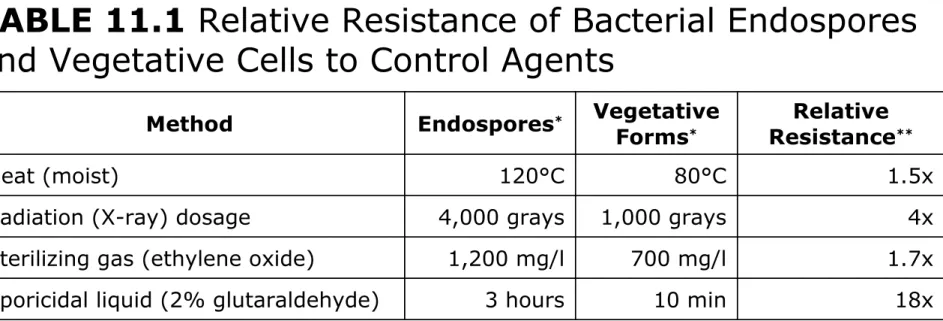
TABLE 11.1
Relative Resistance of Bacterial Endospores
and Vegetative Cells to Control Agents
Method
Endospores
*Vegetative
Forms
*Relative
Resistance
**Heat (moist)
120°C
80°C
1.5x
Radiation (X-ray) dosage
4,000 grays
1,000 grays
4x
Sterilizing gas (ethylene oxide)
1,200 mg/l
700 mg/l
1.7x
Sporicidal liquid (2% glutaraldehyde)
3 hours
10 min
18x
*
Values are based on methods (concentration, exposure time,
intensity) that are required to destroy the most resistant
pathogens in each group.
© McGraw-Hill Education.
11-7
The Resistance of Endospores
(2 of 2)
S.J. Jones, C.J. Paredes, B.Tracy, N. Cheng, R.Sillers, R.S. Senger, E.T. Papoutsakis, “The
transcriptional program underlying the physiology of clostridial sporulation,”
Genome Biol
.,
© McGraw-Hill Education.
11-8
Terminology and Methods of Control
(1 of 2)
•
Sterilization
–process to destroy all viable
microbes
•
Microbicidal agents
(germicides) –
antimicrobial agent aimed at destroying a certain
group of microorganisms (bactericide, fungicide,
virucide, sporicidal)
–
Disinfection
– use of a physical process or a
chemical agent (disinfectant) to destroy vegetative
pathogens but not bacterial endospores
–
Antisepsis
– application of chemical agents
(antiseptics) directly to exposed body surfaces,
© McGraw-Hill Education.
11-9
Terminology and Methods of Control
(2 of 2)
•
Agents that cause microbistasis
–
antimicrobial agent aimed at temporarily prevent
microbes from multiplying
•
Methods that reduce the numbers of
microorganisms
–
Sanitation
– any cleansing technique that
removes microorganisms from inanimate surfaces
to reduce the potential for infection and spoilage
–
Degermation
– reduction of microbial load from
© McGraw-Hill Education.
11-10
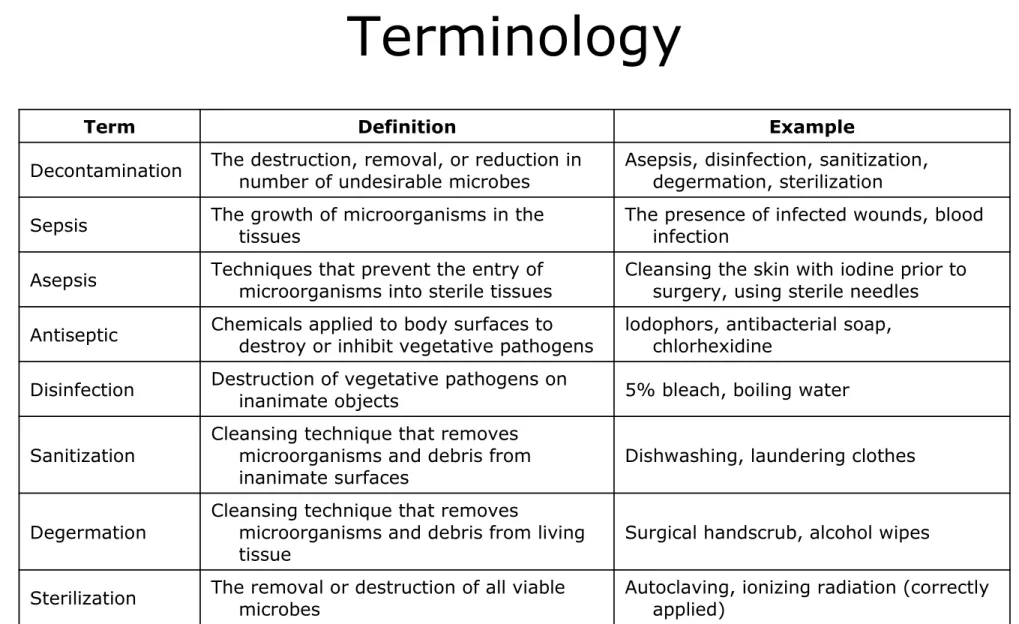
TABLE 11.2 Microbial Control
Terminology
Term Definition Example
Decontamination The destruction, removal, or reduction in number of undesirable microbes Asepsis, disinfection, sanitization, degermation, sterilization
Sepsis The growth of microorganisms in the tissues The presence of infected wounds, blood infection
Asepsis Techniques that prevent the entry of microorganisms into sterile tissues Cleansing the skin with iodine prior to surgery, using sterile needles
Antiseptic Chemicals applied to body surfaces to destroy or inhibit vegetative pathogens lodophors, antibacterial soap, chlorhexidine
Disinfection Destruction of vegetative pathogens on inanimate objects 5% bleach, boiling water
Sanitization Cleansing technique that removes microorganisms and debris from
inanimate surfaces Dishwashing, laundering clothes
Degermation Cleansing technique that removes microorganisms and debris from living
tissue Surgical handscrub, alcohol wipes
© McGraw-Hill Education.
11-11
Microbial Death
•
Hard to detect, microbes often reveal no
conspicuous vital signs to begin with
•
Permanent loss of reproductive capability,
even under optimum growth conditions
•
Factors
that affect microbial death:
–
Number of microbes
–
Nature of microbes in the population
–
Temperature and pH of environment
–
Concentration or dosage of agent
–
Mode of action of the agent
–
Presence of solvents, organic matter, or
© McGraw-Hill Education.
11-12
Practical Concerns in Microbial
Control
Selection of method of control depends on
circumstances:
•
Does the application require sterilization?
•
Is the item to be reused?
•
Can the item withstand heat, pressure, radiation,
or chemicals?
•
Is the method suitable?
•
Will the agent penetrate to the necessary extent?
•
Is the method cost- and labor-efficient and is it
© McGraw-Hill Education.
11-13
Antimicrobial Agents’ Modes of
Action (1 of 4)
Cellular targets of physical and chemical agents:
•
Cell wall
–becomes fragile and cell lyses
(some antimicrobial drugs, detergents, and
alcohol)
•
Cell membrane
– loses integrity
© McGraw-Hill Education.
11-14
© McGraw-Hill Education.
11-15
Antimicrobial Agents’ Modes of
Action (3 of 4)
Cellular targets of physical and chemical agents:
•
Protein and nucleic acid synthesis
–
prevention of replication, transcription,
translation, peptide bond formation, protein
synthesis (
chloramphenicol, ultraviolet
radiation, formaldehyde
)
•
Protein function
– disrupt or denature
© McGraw-Hill Education.
11-16
© McGraw-Hill Education.
11-17
Physical Methods of Control
•
The vast majority of microbes are readily
controlled by abrupt changes in their
environment
•
Some physical methods are:
–
Heat (moist and dry)
–
Cold temperatures
–
Desiccation
–
Radiation
© McGraw-Hill Education.
11-18
Mode of Action and Relative
Effectiveness of Heat (1 of 2)
•
Moist heat
– lower temperatures and
shorter exposure time; coagulation and
denaturation of proteins, which halts cellular
metabolism
•
Dry heat
– moderate to high temperatures;
dehydration, alters protein structure;
© McGraw-Hill Education.
11-19
Mode of Action and Relative
Effectiveness of Heat (2 of 2)
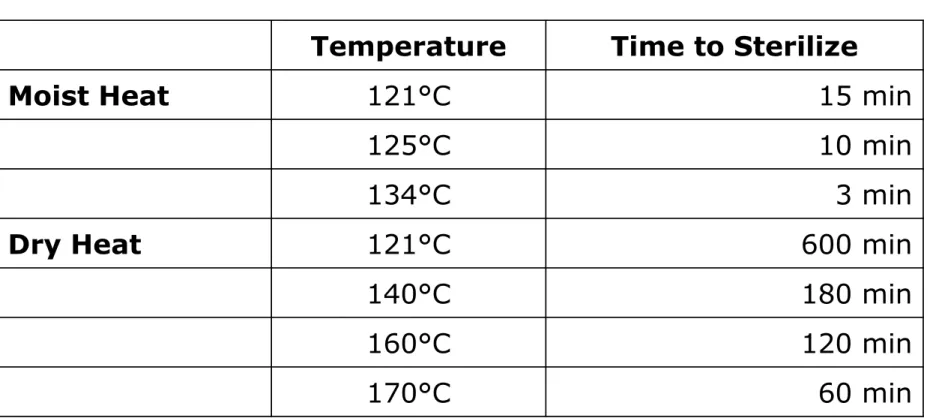
TABLE 11.3
Comparison of Times and
Temperatures to Achieve Sterilization with Moist
and Dry Heat
Temperature
Time to Sterilize
Moist Heat
121°C
15 min
125°C
10 min
134°C
3 min
Dry Heat
121°C
600 min
© McGraw-Hill Education.
11-20
Methods of Moist Heat Control
1. Sterilization with Steam Under Pressure
•
Autoclave
(15 psi/121
o
C/10-40min) Pressure
increases steam temperature
•
Steam must reach surface of item being sterilized
•
Item must not be heat or moisture sensitive
•
Produces denaturation of proteins, destruction of
© McGraw-Hill Education.
11-21
Methods of Moist Heat Control
4. Pasteurization
•
Heat is applied to kill potential agents of infection
and spoilage without destroying the food flavor or
value
–
Flash method
: 71.6
°
C, 15 sec
•
Not sterilization – kills non-spore-forming
pathogens and lowers overall microbe count;
does not kill endospores or many nonpathogenic
microbes
© McGraw-Hill Education.
11-22
Dry Heat: Hot Air and Incineration
(1 of 2)
Dry heat uses higher temperatures than moist
heat
•
Incineration
– flame, electric heating coil,
infrared incinerators
–
Ignites and reduces microbes and other
substances
–
Very common practice in the microbiology lab
•
Hot air (Dry) ovens
– heated, circulated air
(150
o
C-180
o
C, 12min-4h)
© McGraw-Hill Education.
11-23
Dry Heat: Hot Air and Incineration
(2 of 2)
Dry heat incineration.
Infrared incinerator with shield to
prevent spattering of microbial samples during flaming.
© McGraw-Hill Education.
11-24
Using Heat for Sterilization and
Disinfection (1 of 3)
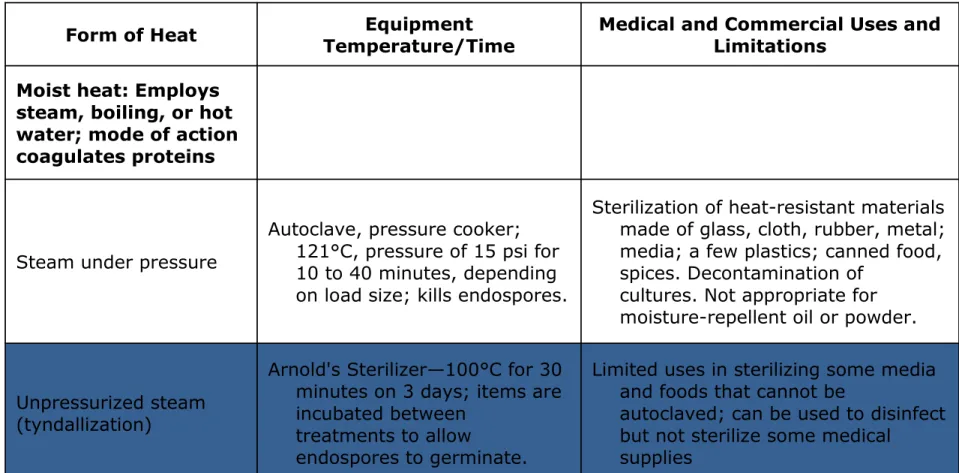
TABLE 11.4
Applications Using Heat for Sterilization and
Disinfection
Form of Heat Temperature/TimeEquipment Medical and Commercial Uses and Limitations
Moist heat: Employs steam, boiling, or hot water; mode of action coagulates proteins
Steam under pressure
Autoclave, pressure cooker; 121°C, pressure of 15 psi for 10 to 40 minutes, depending on load size; kills endospores.
Sterilization of heat-resistant materials made of glass, cloth, rubber, metal; media; a few plastics; canned food, spices. Decontamination of
cultures. Not appropriate for moisture-repellent oil or powder.
Unpressurized steam (tyndallization)
Arnold's Sterilizer—100°C for 30 minutes on 3 days; items are incubated between
treatments to allow endospores to germinate.
Limited uses in sterilizing some media and foods that cannot be
autoclaved; can be used to disinfect but not sterilize some medical
© McGraw-Hill Education.
11-25
Using Heat for Sterilization and
Disinfection (2 of 3)
The “TABLE 11.4” continues on this slide.
Form of Heat
Equipment Temperature/
Time
Medical and Commercial Uses
and Limitations
Pasteurization
Pasteurizer; flash method
works at 71.6°C for 15
seconds; ultrahigh
temperature (UHT) uses
134°C for a few seconds.
Disinfection of milk and dairy
products to destroy milk-borne
pathogens; UHT can sterilize for
longer shelf life. Fruit juices,
beer, and wine may be
pasteurized to destroy
contaminants and preserve the
products.
Boiling water
Water bath or pan heated to
100°C; items are placed
in water for 30 minutes
to kill vegetative
pathogens.
Limited to disinfection and
sanitization of heat-resistant
household objects such as eating
utensils, clothing, sick room
supplies, baby supplies, bedding,
and water in emergencies;
© McGraw-Hill Education.
11-26
Using Heat for Sterilization and
Disinfection (3 of 3)
The “TABLE 11.4” continues on this slide.
Form of Heat Temperature/TimeEquipment Medical and Commercial Uses and Limitations
Dry heat: Employs dried hot air, flame, or heat coil; works by
dehydration or combustion
Dry oven Electric or gas chamber heated to 150°C to 180°C for 2 to 4 hours
Materials that can withstand hot temperatures and dehydration;
glassware, metals, powders, oils. Poor choice for liquids, rubber, plastics; time-consuming.
Incineration Bunsen burner flame up to 1,800°C; small infrared incinerators to 800°C
Furnaces, incinerators up to 6,500°C For sterilizing tips of inoculation
© McGraw-Hill Education.
11-27
Effects of Cold and Desiccation
•
Cold
–
Microbiostatic – slows the growth of microbes
–
Refrigeration 0–15
o
C and freezing < 0
o
C
–
Used to preserve food, media, and cultures
•
Desiccation
–
Gradual removal of water from cells, leads to
metabolic inhibition
–
Not effective microbial control – many cells
retain ability to grow when water is
reintroduced
© McGraw-Hill Education.
11-28
Physical Methods of Control:
Radiation (1 of 2)
•
Radiation:
Energy emitted from atomic
activities and dispersed at high velocity
through matter or space
•
Types of radiation suitable for microbial
control:
1. Ionizing radiation
Gamma rays
X rays
Cathode rays
2. Noniodizing radiation
© McGraw-Hill Education.
11-29
© McGraw-Hill Education.
11-30
Cellular Effects of Irradiation (1 of 4)
1. Ionizing radiation
– deep penetrating
power sufficient energy to cause electrons to
leave their orbit
– Gamma rays, X rays, cathode rays
– Breaks DNA
2. Nonionizing radiation
– little penetrating
power
© McGraw-Hill Education.
11-31
© McGraw-Hill Education.
11-32
© McGraw-Hill Education.
11-33
© McGraw-Hill Education.
11-34
© McGraw-Hill Education.
11-35
Physical Methods of Control:
Filtration (2 of 2)
Filtration
: Physical removal of microbes by passing a gas
or liquid through filter
•
Used to sterilize heat sensitive liquids and air in
hospital isolation units and industrial clean rooms
© McGraw-Hill Education.
11-36
Chemical Agents in Microbial Control
•
Disinfectants, antiseptics, sterilants,
degermers, and preservatives
•
Some desirable qualities of germicides:
–
Rapid action in low concentration
–
Solubility in water or alcohol, stable
–
Broad spectrum, low toxicity
–
Penetrating
–
Noncorrosive and nonstaining
© McGraw-Hill Education.
11-37
Factors that Affect Germicidal
Activity of Chemicals
•
Nature of the material being treated
•
Degree of contamination
•
Time of exposure required
•
Concentration of the chemical agent.
Strength and chemical action of the germicide
expressed in various ways (dilution factor
© McGraw-Hill Education.
11-38
Germicidal Categories
•
Halogens
•
Phenolics
•
Chlorhexidine
•
Alcohols
•
Hydrogen peroxide
•
Aldehydes
•
Gases
•
Detergents & soaps
•
Heavy metals
•
Dyes
© McGraw-Hill Education.
11-39
Halogens (1 of 2)
The
halogens
used in germicidal preparations
are:
•
Chlorine
– Cl
2
, hypochlorites (chlorine
bleach), chloramines
–
Denaturate proteins by disrupting disulfide
bonds
–
Intermediate level
–
Unstable in sunlight, inactivated by organic
matter
–
Water, sewage, wastewater, inanimate
© McGraw-Hill Education.
11-40
Halogens (2 of 2)
•
Iodine
- I
2
, iodophors (betadine)
–
Interferes with disulfide bonds of proteins
–
Intermediate level
–
Milder medical and dental degerming agents,
© McGraw-Hill Education.
11-41
Applications of Halogens (1 of 4)
TABLE 11.7
Applications of Halogen Compounds
Form of Chlorine Primary Applications How Delivered/Concerns
Chlorine Gas (Cl2) Large-scale disinfection of drinking water, sewage, and wastewater.
Chlorination to a concentration of 0.6 to 1.0 parts of chlorine per million parts of water destroys most vegetative pathogens.*
Hypochlorites (HClO) Bleach
Used extensively in sanitization and disinfection of food equipment, treatment of swimming pools, spas, drinking water, and fresh foods; for wound antisepsis and routine
medical and household disinfection, deodorizing, and stain removal.
Common household bleach is a 5% solution of sodium hypochlorite; dilutions of 1:10-1:1,000 are highly effective germicides.
Chloramines (Dichloramine, Halazone)
An alternative to pure chlorine in treating water supplies; also as sanitizers and disinfectants; for treating wounds and skin surfaces.
© McGraw-Hill Education.
11-42
Applications of Halogens (2 of 4)
The “TABLE 11.7” continues on this slide.
Form of Iodine
Primary Applications
How Delivered/Concerns
lodophors
Most common iodine for skin and
mucous membranes; antiseptic
prep for surgery and injections;
for surgical handscrubs; to
disinfect equipment and
surfaces; possibly for burns; and
may be an alternative preventive
for eye infections in newborns.
A complex of iodine and a
neutral protein polymer
provides slow release and
reduced toxicity or irritation
of tissues; less prone to
staining. Common products
are povidone-iodine (PVI;
Betadine), which contain 2%
to 10% available iodine.
Elemental Iodine:
Aqueous or
Tinctures
Topical antiseptic prior to surgery;
sometimes for burned or injured
skin. Medium–level disinfection
for plastic instruments,
thermometers; tablet form
available for disinfection of
contaminated water.
Weak solutions of 1% to 3% in
water or in alcohol tinctures.
Aqueous solutions or tinctures
of 5% to 10%; somewhat
limited by their toxicity and
tendency to stain.
*
Some cyst-forming protozoans such as
Giardia
and
© McGraw-Hill Education.
11-43
Phenols and Its Derivatives (1 of 2)
Phenol
(carbolic acid) is an acrid, poisonous
compound
Disrupt cell walls and membranes and
precipitate proteins
•
Low to intermediate level
•
Bactericidal, fungicidal, virucidal (not
sporicidal)
–
Lysol and Triclosan – antibacterial additive to
soaps
•
Toxicity of phenolics makes them a
© McGraw-Hill Education.
11-44
© McGraw-Hill Education.
11-45
Alcohols (1 of 2)
•
Only
ethyl
and
isopropyl
are suitable for
microbial control
•
Intermediate level
–
Concentrations of 50% and higher dissolve
membrane lipids and coagulate proteins of
vegetative bacterial cells and fungi
–
Water is needed for proteins to coagulate,
© McGraw-Hill Education.
11-46
Alcohols (2 of 2)
A nurse takes advantage of an alcohol gel hand cleansing
station. These are very common in hospitals and clinics
to encourage hand antisepsis.
© McGraw-Hill Education.
11-47
Hydrogen Peroxide (1 of 2)
•
Produce highly reactive hydroxyl-free radicals
that damage protein and DNA while also
decomposing to O
2
gas – toxic to anaerobes
•
Antiseptic at low concentrations; strong
© McGraw-Hill Education.
11-48
Hydrogen Peroxide (2 of 2)
Disinfection of contact lenses with peroxide-based
cleaner. Note the bubbles produced, indicating the
release of oxygen gas.
© McGraw-Hill Education.
11-49
Aldehydes (1 of 2)
•
Kill by alkylating protein and DNA
–
Glutaraldehyde
In 2% solution (Cidex)
High level
Used as sterilant for heat sensitive instruments
–
Formaldehyde
Formalin – 37% aqueous solution
Intermediate to high level
© McGraw-Hill Education.
11-50
Aldehydes (2 of 2)
Technician treats surgical instruments with
glutaraldehyde prior to heat sterilization.
© McGraw-Hill Education.
11-51
Detergents and Soaps (1 of 2)
•
Detergents
: Polar molecules, surfactant
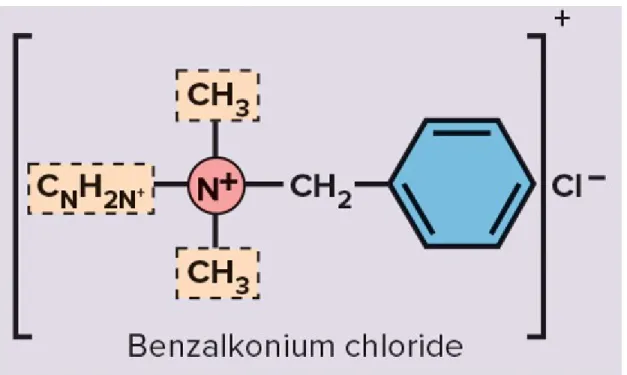
–
Quaternary ammonia compounds
(
quats
)
act as surfactants that alter membrane
permeability of some bacteria and fungi
– Very low level
•
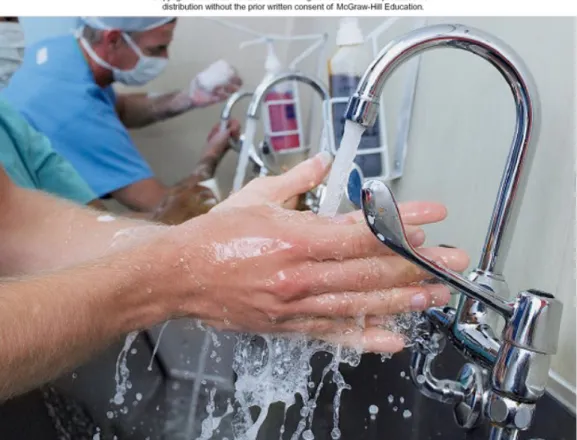
Soaps:
alkaline compounds
– Mechanically remove soil and grease
containing microbes
– Weak microbicides, destroy only highly
© McGraw-Hill Education.
11-52
© McGraw-Hill Education.
11-53
© McGraw-Hill Education.
11-54
TABLE 11.11 Applications of
Detergents and Soaps (3 of 3)
Soaps
© McGraw-Hill Education.
11-55
TABLE 11.12 Applications of Heavy
Metals
Form of Metal Primary Applications How Delivered/Concerns
Organic Mercury
Thimerosal (Merthiolate) and
nitromersol (Metaphen) are weak antiseptics and infection
preventives; can be preservatives in cosmetics and ophthalmic solutions.
Tinctures (0.001% to 0.2%) are fairly effective but a poor choice for broken skin because they are toxic and can delay healing.
Mercurochrome is now considered one of the poorest of antiseptics.
Silver Sulfadiazine Ointment
Added to dressings, it effectively prevents infection in second- and third-degree burn patients.
A yellow ointment containing silver salts and a sulfa drug.
Sliver Nitrate (AgNO3) Primarily as a topical germicide for mouth ulcers and occasionally root canals.
1% to 2% solutions have been used as antiseptics, but they discolor skin and other tissues.
Metallic Silver
Incorporated into catheters to prevent urinary tract infections in the
hospital; added to paint, plastics, and steel as a way to control
microbial survival on items such as toilet seats, stethoscopes, and even walls and floors in homes.
© McGraw-Hill Education.
11-56
Dyes as Antimicrobial Agents
•
Aniline dyes are very active against
gram-positive species of bacteria and various fungi
•
Sometimes used for antisepsis and wound
treatment
© McGraw-Hill Education.
11-57
Acids and Alkalis
•
Low level of activity
–
Organic acids prevent spore germination and
bacterial and fungal growth
–
Acetic acid inhibits bacterial growth
–
Propionic acid retards molds
–
Lactic acid prevents anaerobic bacterial growth
© McGraw-Hill Education.
11-58
TABLE 11.13 Active Ingredients of
Various Commercial Antimicrobial
Products
Product Specific Chemical Agent Antimicrobial Category
Lysol and Clorox Sanitizing Wipes Dimethyl benzyl ammonium chloride Detergent (quat) Tilex and Lysol Mildew Remover Sodium hypochlorites Halogen
Ajax and Dial Antibacterial Hand
Soap Triclosan Phenolic
Lysol Disinfecting Spray Alkyl dimethyl benzyl ammonium/ethanol Detergent (quat)/alcohol
ReNu Contact Lens Solution Polyaminopropyl biguanide Chlorhexidine Wet Ones Antibacterial Moist
Towelettes Benzethonium chloride Detergent (quat) Noxzema Triple Clean Triclosan Phenolic
Scope Mouthwash Ethanol Alcohol Purell Instant Hand Sanitizer Ethanol Alcohol
© McGraw-Hill Education. All rights reserved. Authorized only for instructor use in the classroom. No reproduction or further distribution permitted without the prior written consent of McGraw-Hill Education.
3-59 11-59