Objectives
Upon completion of Section 4,
students should be able to:
◆explain how the discovery of oil
changed the Arabian Peninsula;
◆describe how Saudi Arabia has
tried to balance modern-day
changes and economic growth
with respect for tradition;
◆explain why Oman and Yemen
are considered the least developed
countries in the region.
National Geography
Standards
The following National Geography
Standards are highlighted in this
section: 1, 4, 5, 6, 11, 12, 14, 16, 18
Bellringer
Ask students to make a list of the
images that come to mind when
they think of Saudi Arabia. Call on
volunteers to share their images.
L E S S O N P L A N
1.
Focus
Point out that Saudi
Arabia’s rulers have adopted the
motto “modernization without
Westernization.” Asks students to
speculate about what this means.
(The Saudis have tried to
modern-ize their country while preserving
Islamic religious values.)
2.
Instruct
Write the headings
Before Oil
and
After Oil
on the
board. Ask students to describe
what life was like on the Arabian
Peninsula before and after the
dis-covery of oil. Record their answers
under the appropriate heading.
3.
Close/Reteach
Ask students
to discuss the following questions:
How have the oil-rich nations of
the Arabian Peninsula improved
the lives of their citizens? How
are the oil-rich countries planning
for the day when the oil runs out?
Why has life changed less for
peo-ple in Oman and Yemen than it
has for people in other parts of
the Arabian Peninsula?
T
T
he Arabian Peninsula is a land of super-latives—of largests and leasts. Among the features that fall under the largest cate-gory is its desert, an enormous stretch of sand called the Rub‘ al-Khali, or the Empty Quarter. At 250,000 square miles (647,500 sq km), the desert is about the size of Texas. It is the world’s largest sand desert. Among the leasts in the Arabian Peninsula is water. The peninsula, without one single body of fresh water, has the least amount of water of any large landmass. Instead it has the world’s largest known petroleum reserves. Since oil is an important resource, the peninsula has seen the most change in the least amount of time of any place in the world.Oil Changes a Region
In the early twentieth century, people in Saudi Arabia, Kuwait, Bahrain, Qatar, and the United Arab Emirates existed in much the same way as they had for centuries. Along the coasts, they fished and traded using dhows—Arab sailing ships. In the fertile oases of the desert, they lived in
small towns and villages in houses made of sun-dried bricks. There they grew wheat, vegetables, and dates. They also tended small herds of camels, goats, and sheep. Groups of Bedouin herders roamed the deserts surrounding the fertile oasis settlements.
Oil Pays for Modernization The dis-covery of oil in the Arabian Peninsula in the 1930s greatly changed traditional ways of life. It brought enormous wealth to the region. Money from oil was used to pay for modernization. Hos-pitals, schools, roads, airports, and apartment buildings were built. Health and other services were provided free or heavily subsidized by the government.
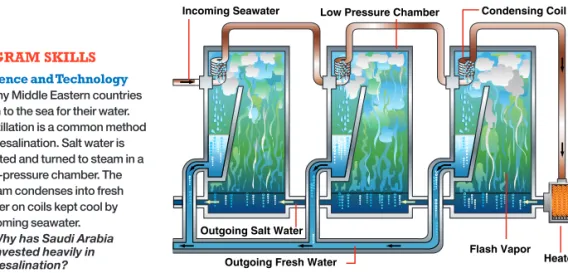
These countries also spent billions of dollars to create more of their scarcest resource—water. Industrial plants were constructed to remove the salt from seawater so that it could be used for drinking and irrigation. This necessary and ex-pensive process is called desalination.
Today most of the people have moved to cities such as Riyadh, Saudi Arabia’s capital, and Abu
Reading Focus
• In what ways did the discovery of oil change the Arabian Peninsula?
• How has Saudi Arabia tried to balance modern-day changes and economic growth with respect for tradition?
• Why are Oman and Yemen considered the least developed countries in the region?
Key Terms
Arabian
Peninsula
4
4
Main
Idea
The discovery of oil in the Arabian Peninsula has changed the lives of the people of this region.
Environmental Change
This Arab businessman has a clear view of how the oil industry is changing the Arabian Peninsula. desalinationinfrastructure falajsystem
Chapter 23 ■The Countries of Southwest Asia
488
RESOURCE DIRECTORY
Teaching Resources
Unit 6, Chapter 23
• Section 4 Guided Reading and Review, p. 30
Guide to the Essentials (English/Spanish)
• Section Summary, Chapter 23, Section 4
Mental Mapping booklet
• Unit 6 Checklist, p. 79
• Outline Map 23, p. 87
Technology
Guided Reading Audiotapes (English/Spanish),
Chapter 23, Section 4
Section Reading Support Transparencies,
Chapter 23, Section 4
World Geography Map and Photo Transparencies
• Central and Southwest Asia: Maps and Photos
Book on CD,
Chapter 23
Social Studies Skills Tutor CD-ROM
Companion Web site, www.phschool.com
• Chapter 23 Activities
488
S
ection
4
pp. 488–492
Vocabulary
Desalination
Refer to the list of
Key Terms on page 488. Write the
following sentence on the board:
Much of Saudi Arabia’s drinking water
comes from the desalination of seawater.
Ask students to define
desalination
based on its context in the sentence.
Then ask a volunteer to look up
de-salination
in the Glossary and read
its definition aloud. Point out that
desalinated water is expensive to
produce.
Summarizing Main Ideas
Ask students to list the Reading
Focus questions from page 488 on
a piece of paper, leaving several
lines of space between each entry.
Instruct students to find the answer
to each question as they read the
text. Then have them use the
answers to write a summary of
the section’s main ideas.
Dhabi, the capital of the United Arab Emirates.There many live in modern, air-conditioned houses and apartments. Some work in gleaming chrome-and-glass buildings as engineers, com-puter programmers, and executives of interna-tional corporations.
OPEC In 1960 Iran, Iraq, Kuwait, and Saudi Arabia joined with Venezuela to form the Orga-nization of Petroleum Exporting Countries (OPEC). These countries met regularly to decide how much oil to produce and at what price to sell it. Their goal was to decrease the influence of Western oil companies on their countries and to increase their profits. Between 1970 and 1980, high demand caused oil prices to soar. The impact of these soaring prices on the world economy
was great. Developing countries had to cancel social programs in order to pay for oil. Compa-nies in wealthier countries passed along their in-creased costs for fuel by raising prices. Runaway inflation resulted in many countries. OPEC has expanded to include more nations from Africa, Latin America, Southwest Asia, and Southeast Asia. As world demand for oil has increased, so too has OPEC’s power.
Planning for the Future The coun-tries of the Arabian Peninsula will not always be able to depend on oil to support their economies. Some experts believe that Saudi Arabian and Kuwaiti oil will last another fifty to sixty years. Qatar’s and Bahrain’s oil may last for only an-other twenty to thirty years.
489
Chapter 23 ■Section 4 APPLYING THE GEOGRAPHIC THEMES
쎲MovementMany of the oil-producing countries of the Arabian
Peninsula rely on the open passage of ships and oil tankers through the Persian Gulf.
• Find the Strait of Hormuz on the map. What two bodies of water does it connect?
Jabal an Nabi Shu‘ayb 12,337 ft. (3,760 m)
¯
Socotra
A R A B I A N
P E N I N S U L A
A N N A F U D S Y R I A N D E S E R T
RUB‘ AL-KHALI (EMPTY QUARTER)
P ersia
n
Gulf
Gulf of
Oman Strait of Hormuz
Gulf of Aden
R ed
Sea
Gulf of Aqaba
Jiddah Medina Yanbu
Mecca Tabuk
Al Mukalla
Aden As Sulayyil
Harad
Abha Ha'il
Kuwait
Riyadh
Abu Dhabi
Sanaa
Doha
Muscat Manama
Ad Dammam
QATAR
UNITED ARAB EMIRATES KUWAIT
S A U D I A R A B I A
Y E M E N
O M A N
BAHRAIN JORDAN
IRAQ
IRAN
AFRICA
30°N
50°E
20°N 30°N
20°N
40°E 50°E 60°E
Tropic of Cancer
N
S
W E
0
0 200 400 km 200 400 mi
Arabian Peninsula:
PHYSICAL-POLITICAL
KEY
Lambert Conformal Conic Projection
14,000
7,000
1,500
700
(sea level) 0 4,270
2,135
457
213
0 (sea level) Feet
Elevation Meters
National capital
Major city Mountain
Answer to Map Caption
the Persian Gulf and the Gulf of Oman
489
A C T I V I T YR E A D I N G S T R A T E G Y
CUSTOMIZE FOR...
Less Proficient Readers
Personal Glossary
Instruct students to read the
subsection Oil Changes a Region, which begins
on page 488, making note of any unfamiliar words.
Ask them to try to define the words by using
con-text clues. Have them check their definitions by
looking up the words on their list in the Glossary
or in a dictionary.
The Physical World
A Dry Country
There are no
bod-ies of fresh water in Saudi Arabia.
The country is so dry that only
about 2 percent of the land is suitable
for cultivation. Saudi Arabia mines
groundwater from “fossil” aquifers
to supply more than 75 percent of its
water demands. Irrigation with fossil
groundwater has enabled large-scale
wheat production in the desert.
The Physical World
A Land of Sand
Sand dunes
cover-ing nearly one third of Saudi Arabia
form the world’s largest continuous
sand area. Sand ridges and high
dunes hundreds of miles long are
characteristic of the area. The deserts
of Saudi Arabia are virtually
unin-habited and are some of the driest
regions in the world.
Alternative
Assessment
Mid-Point Monitoring
Class Discussion
You may wish to
monitor students’ progress on
con-ducting research to prepare for the
class discussion. Confer with
stu-dents to see if they will soon
com-plete their research.
Aware that they will run out of oil one day, these countries have invested large sums of money to develop other industries. Bahrain has estab-lished itself as an international banking center. Saudi Arabia, Qatar, and the United Arab Emi-rates have built steel and petrochemical industries. Such massive development efforts require workers. But because their own populations are so small and often lack necessary skills, the oil-rich countries have had to hire huge numbers of foreign workers. In some countries on the Ara-bian Peninsula, foreigners outnumber citizens. As one author wrote:
“
My hotel [in Jiddah, a city on the west-ern coast of Saudi Arabia] was typical. The receptionist was Lebanese. . . . Yemeni and Pakistani construction workers were building an extension to the hotel under a Palestinian foreman. When I came to leave, a Jordanian made up the bill. But it was a Saudi Arabian who drove me to the airport because taxi driving, like the army and police, is reserved for nationals.”
Saudi Arabia
Beginning in the late 1960s, the Saudi Arabian government spent billions of dollars of oil rev-enue to build the country’s infrastructure. An
infrastructure comprises a country’s basic support facilities, including its roads, schools, airports, seaports, and communication systems.
Saudi Arabia opened schools throughout the country and provided children with free educa-tion. Universities began educating Saudi Arab-ians in engineering, science, and medicine so that one day they could run their own country.
Developing the Economy Two giant centers of commercial industry—Yanbu on the west coast and Jubail on the east coast—were constructed in Saudi Arabia. There, oil and gas are collected, processed, and shipped. Besides petrochemicals, other new industries are being introduced and developed.
Saudi Arabia spent billions of dollars on irrigation and desalination to increase agricul-tural production so that it would not have to rely on other countries for food. By the early 1980s, Saudi farmers were supplying much of the country’s vegetables and poultry and most of its wheat.
Islam and Modernization In one generation, Saudi Arabia transformed itself from an ancient desert kingdom into a modern coun-try. However, it did so cautiously. The government tried not to let modernization upset the Islamic and other traditions to which life in Saudi Arabia is rooted.
Chapter 23 ■The Countries of Southwest Asia
490
Heater Flash Vapor Low Pressure Chamber Condensing Coil Incoming Seawater
Outgoing Fresh Water Outgoing Salt Water
Desalination
DIAGRAM SKILLS
쎲Science and Technology
Many Middle Eastern countries turn to the sea for their water. Distillation is a common method of desalination. Salt water is heated and turned to steam in a low-pressure chamber. The steam condenses into fresh water on coils kept cool by incoming seawater.
• Why has Saudi Arabia invested heavily in desalination?
490
B A C K G R O U N D
Answer to Diagram Skills
to increase agricultural production and
to decrease its dependence on food
imports
B A C K G R O U N D
RESOURCE DIRECTORY
Teaching Resources
Unit 6, Chapter 23
Daily Life
Women in Saudi Arabia
The
limitations on Saudi women affect
every aspect of their lives. In many
areas of Saudi Arabia, a woman is
expected to cover her face and hair
and to wear an Abaya—a long black
garment that covers her body
com-pletely. Without the company or
consent of her husband or her
clos-est male relative, a Saudi woman is
not allowed to travel long distances
or be admitted to a hospital. Other
activities—such as driving a car,
gathering in public, or marrying a
non-Muslim—are never permitted.
The family is still the most important social unit in Saudi Arabia. There are no public places of entertainment, such as movie theaters or night-clubs. Most people spend their free time at home with their families or visiting relatives.
Women, as wives and mothers, have an hon-ored position in Saudi society. But they are lim-ited members of society in other ways. Custom prohibits them from associating with men outside their immediate family. As a result, they must find professions where they are in contact only with other women, such as teaching in girls’ schools. Some Saudi women would like the freedom to make more choices.
Saudi Arabia has tried to create a harmonious balance between change and tradition. Any radi-cal changes in age-old traditions could upset more conservative members of society and cause social and political unrest. This balance between change and tradition can be seen in Saudi Arabia’s role as guardian of Islam’s most sacred cities, Mecca and Medina. Muhammad was born in Mecca, on the southwest coast of Arabia, around A.D. 570. Medina, which is about 200 miles (322 km) north of Mecca, is the city where Muhammad sought refuge after his departure, or hegira,from Mecca in A.D. 622.
Each year approximately two million Mus-lims from all over the world visit Saudi Arabia for the hajj, or pilgrimage to Mecca. Pilgrims to Mecca circle the cube-shaped holy shrine, known as the Kaaba, seven times, reciting prayers. Inside the Kaaba is a black stone that they believe was sent by God. During the hajj, hundreds of thousands of people are provided with sanitation and medical facilities. Saudi Arabia annually supports what Muslims believe to be the single most moving and meaningful religious ritual in Islam.
Deep tensions remain in Saudi society, how-ever. While many Saudis embrace the economic benefits and trappings of Western society, others believe that the nation must return to its Islamic roots. Many of these Saudis share an intense hatred of the West—principally Israel and the United States—and their influence is growing. Saudi-born terrorist Osama bin Laden and his al-Qaida supporters justified their attacks on the United States on September 11, 2001, by arguing that thousands of “infidel” American troops were stationed on Islamic soil. Critics accuse the
Saudi government of doing little to counter ter-rorist activity.
Oman and
Yemen
While life has changed greatly in Saudi Arabia, life for most people in the small southern Arabian nations of Yemen and Oman has changed little since ancient times. Although Yemen has some oil deposits, it only re-cently started to develop
491 Chapter 23 ■Section 4
Change and Tradition
Cultures Saudi Arabia has sought a balance
between its traditional culture and its attempt at modernization.
Place How has Saudi Arabia preserved its
culture? How has it modernized?
Facts
F
Facts
acts
More than six million trees have been planted near oases in the Saudi Arabian province of Al-Hasa to stop the advance of the desert.
B A C K G R O U N D
Answer to Photo Caption
Saudi Arabia has spent billions of
dollars to develop new industries,
infrastructure, and irrigation and
desalination in its attempts to
modernize the economy. Yet its
citizens live in a traditional Islamic
world. Women’s activities are limited,
and there are no nightclubs or movie
theaters.
491
Chapter 23
■Section 4
TEST PREPARATION
Have students read the subsection Islam
and Modernization beginning on page
490 to answer the following question.
When modernizing Saudi Arabia, the
govern-ment proceeded cautiously so as not to upset
the nation’s —
A
sacred cities
B
freedoms
C
pilgrims
D
traditions
Answers to
Section 4 Assessment
1. (a)
desalination, p. 488
(b)
infra-structure, p. 490
(c)
falaj
system,
p. 492
2.
They used oil profits to build
infra-structure and to bring in foreign
workers to help build new industries,
such as banking, steel, and
petro-chemical industries.
3.
Abrupt changes to traditions,
be-liefs, and practices could lead to social
and political unrest by provoking the
strongly conservative elements of
Saudi society.
4.
Oman and Yemen are less
mod-ernized. Yemen has only recently
started to develop its oil deposits.
5.
He was implying that although
Saudi Arabia would modernize, it
would not give up traditional Islamic
culture.
Activity Rubrics
Share rubrics
with students before they write their
fact sheets and paragraphs.
Attempted
The fact sheet and
paragraph are incomplete or
inaccurate.
Minimal
The fact sheet is accurate,
but the paragraph offers only a
sketchy explanation of the effects of
OPEC on the community.
Adequate
The fact sheet is
accu-rate. The paragraph adequately
ex-plains how OPEC affects the writer’s
community.
Exemplary
The fact sheet is
accu-rate, and the paragraph offers a
com-prehensive explanation of the effects
of OPEC on the writer’s community.
them. Oman began to use its oil revenues to im-prove life for its people in the early 1970s, but it has not undergone the large-scale modernization that countries like Saudi Arabia and Kuwait have.
Yemen is the poorest nation on the Arabian Peninsula. It was formed in 1990 when two smaller nations, North Yemen and South Yemen, agreed to merge. In 1993, Yemen’s parliamentary elections were the first on the Arabian Peninsula in which women were allowed to vote.
Although Sanaa is Yemen’s political capital, the port city of Aden is the economic center. Aden is located near the southern entrance to the Red Sea, and its port serves as a refueling center for
1. Key Terms Define (a)desalination,
(b)infrastructure, (c)falajsystem.
2. Planning for the Future How have the nations of the Arabian Peninsula used oil profits to develop new industry?
3. Cultures Why is Saudi Arabia cautious about the way in which it introduces changes into society?
4. Economic Activities How are Oman and Yemen different from the other countries on the Arabian Peninsula?
5. Critical Thinking Recognizing Points of View In 1966, King Faisal told the people of
Saudi Arabia, “We are going ahead with exten-sive planning, guided by our Islamic laws and be-liefs, for the progress of the nation.” What did the king probably mean when he said this?
SECTION
4
ASSESSMENT
Chapter 23 ■The Countries of Southwest Asia
492
Achieving Literacy
Government and
Citizenship Over thirty
years ago, Oman had only three schools and illiteracy was common. Today Oman’s school system supports around a half million stu-dents. The women shown here are participating in an adult literacy program.
Place In what other ways
is Oman trying to improve its standard of living?
Writing a ParagraphOPEC is a powerful organization. Go online to learn more about OPEC. Create a fact sheet about the organization. In a short paragraph, discuss ways in which OPEC’s power affects life in your community. Visit the World Geography section of www.phschool.com
for help in completing this activity.
Activity
Take It to the NET
huge oil tankers passing through the sea. Most of the land in both Oman and Yemen is arid. Despite the harshness of the desert, many people make their living by farming and herding. Many farmers depend on an ancient system of underground and surface canals called the falaj
systemfor water. These canals carry water from
the mountains to villages many miles away. Oman has used money from oil exports to improve its standard of living. The government has updated irrigation systems and built roads, hospitals, and schools. Oman is trying to reduce its dependence on oil and to develop its tourism and manufacturing sectors.