Master thesis Psychology, specialization Social & Organisational Psychology
Institute of Psychology
Faculty of Social and Behavioral Sciences – Leiden University Date: 06/01/2018
Student number: 1943952
First examiner of the university: Wolfgang Steinel, PhD Second examiner of the university: Jörg Gross, PhD
(Dis)honesty under payoff
uncertainty
On the influence of framing effects and the presence
of money
Kalina Valtcheva
Abstract
Introduction
It is a common occurrence for people to be dishonest in pursuing their self-interest. Nevertheless, they also resist the temptation to cheat in order to maintain a positive self-concept (Mazar, Amir, & Ariely, 2008). In this sense, it is widely believed that instead of aiming to maximize profit regardless of whether it requires cheating, people are generally honest and driven by social norms to condemn lying.
In some situations, the obtained outcome is dependent on whether or not one is being (dis)honest. Experimental studies have shown that in such cases, when presented with an opportunity, most people engage in cheating (e.g., Ariely, 2012; Shalvi, Dana, Handgraaf, & De Dreu, 2011). Provided that higher results lead to more attractive outcomes, people appear to exaggerate their performance in order to benefit themselves. However, these findings come from experiments in which dishonest behaviour leads directly to the desired consequence. More precisely, it is certain that by lying participants will achieve a particular outcome. In this line of thought, it is intriguing to examine situations of uncertainty in which cheating could either lead to winning or to no gain at all.
morally right decision and their self-interested preference to maximize gains (Ariely, 2012).
Laboratory studies aiming to examine cheating behaviours usually require participants to generate a random outcome, for instance, by rolling a die. The payment people receive is directly equivalent to the outcome of the roll in such a way that the higher the number they report, the more money they would be paid. An important aspect of these experiments using the die-under-cup paradigm, is that they allow for absolute privacy in the sense that the result can only be observed by the participant herself (e.g., Fischbacher & Föllmi-Heusi, 2013; Shalvi et al., 2011). Therefore, the lack of monitoring allows people to dishonestly report a higher result than the one observed, in order to secure a higher payoff.
Probability instead of certainty
The circumstances in everyday life are normally, however, more ambiguous than this line of research suggests. It is rarely the case that people know with certainty that cheating will lead to the desired outcome. Instead, being dishonest simply increases one's chances of acquiring a particular benefit rather than securing it - for example, job candidates may cheat on their CV in order to increase the chance of being invited for an interview. Therefore, the current study introduces a slight modification to the original dice-under-cup task.
In this experiment a bowl containing six white balls is added to the procedure. Depending on the outcome of the die-roll, these white balls are being replaced by yellow balls. In particular, the number that the participant reports leads to the substitution of the corresponding number of balls. Then, the participant is required to randomly draw a ball from the container and can either earn 6€ or nothing. If the drawn ball is yellow, the person receives 6€, if it is white, however, she wins no money at all. In such a setting, the outcome of the die-roll determines the probability of winning rather than the monetary value of the outcome and thus over-reporting increases the chance of getting a monetary incentive.
The operating mechanisms in probabilistic settings
regret (Zeelenberg, Beattie, van der Pligt, & de Vries, 1996). After a decision has been made, people engage in comparisons between the current result and the outcome of the forgone option. If the actual consequences are worse than what could have been, had the individual chosen differently, she is likely to experience regret. This idea that people are regret-averse, leads to the assumption that in a probabilistic setting they would prefer to choose a sure win rather than risk not winning at all. Therefore, they will aim to remove the uncertainty and make sure they gain by overreporting six in the die-roll task.
Hypothesis 1: People will over-report ‘6’ and under-report all lower outcomes.
There is, however, the possibility that people are driven by a different motivation, which is likely to lead to dissimilar results. In particular, it is reasonable to assume that the introduction of a probabilistic setting to the die-under-cup paradigm would facilitate lying by allowing for self-justifications to be made. When people have rationales for their behaviour, it makes an unethical act feel less dishonest (Shalvi et al., 2011a). Thus, when the outcome of the die-roll is not fully dependent on a person's report, it should be easy to justify winning by attributing it to luck rather than cheating. In particular, even though reporting a six leads to a certain win, it can not be attributed to anything other than cheating. Nevertheless, any number lower than six reduces the 100% chance of winning and makes it uncertain and easily justifiable. Therefore, in an attempt to increase the chance of getting the desired outcome and at the same time be able to justify it, people will choose to report a five instead of a six.
The power of framing
Since the two hypotheses make opposing predictions, it is important to consider the contextual characteristics that influence their relative impact. More precisely, in some situations the motivation to avoid uncertainty should be a stronger predictor of behaviour and should lead to overreporting of six. In other cases, however, the need for justifying cheating by attributing outcomes to luck should be dominant and cause underreporting of six. Thus, the way a situation is presented is a powerful determinant of which mechanism prevails.
The major impact of framing on individual behaviour is supported by a considerable number of studies. For instance, in a series of three experiments using hypothetical situations, Kern and Chugh (2009) showed that decision-makers behave more unethically if the consequences of the decisions were framed in terms of losses instead of gains. Furthermore, a study by Kirchler and Maciejovsky (2001) demonstrated that self-employed and business entrepreneurs' tax compliance is highly dependent on the reference point. In particular, expecting refunds was associated with high tax compliance whereas expecting to make additional payments led to lower compliance. Another relevant study by Cameron et al. (2008; cited in Cameron & Miller, 2009) implemented a self-reporting procedure to an anagram-solving task, which allowed participants to overstate their performance in order to secure a higher gain. The study showed that framing the outcome as a reduction of losses rather than a win, led to an increase in cheating behaviour. Closely related to the current research, Schindler and Pfattheicher (2017) used a multi-round modification to the dice task paradigm (Fischbacher & Föllmi-Heusi, 2013) that allowed to demonstrate that people behave more dishonestly in order to avoid a loss than they do to secure an equivalent gain.
participants would over-report '6' to make sure they do not suffer a loss and thus experience regret. Since loss aversion appears to have a strong influence on cheating behaviour, people will be less concerned with making external attributions of their actions. Nevertheless, in order to be able to self-justify their behaviour by attributing winning to luck, people would over-report '5' (and maybe '4') rather than '6' in the gain condition.
Hypothesis 3a: Loss framing will lead to over-reporting of '6's as opposed to all other outcomes.
Hypothesis 3b: Gain framing will cause over-reporting of '5's (and maybe '4's), and under-reporting of '6's.
Remote prizes
A previous study using the same procedure (Douma, 2017) could not support this set of hypotheses. More precisely, the observed distribution in the gain frame condition showed a somewhat higher frequency of ‘4’s and ‘5’s, and a lower frequency of ‘6’s, yet this pattern was not significantly different from a uniform distribution. The results in the loss frame condition did not differ from a uniform distribution either, with the frequencies of reported ‘4’s, ‘5’s and ‘6’s varying between 14.7% and 17%. Particularly the loss frame condition revealed the striking appearance of entirely honest reports. This interesting finding brought into question the procedure used for the study and whether there could have been something undetected that influenced the results.
could receive 6€ without them actually seeing the prize. Nevertheless, in the loss condition they were each given 6€ to keep in their wallet while rolling the die. Could this minor difference have affected the results?
When considering dishonest behaviour it appears that increasing the psychological distance between the act and the outcome leads to more cheating (Ariely, 2012). Therefore, people seem to be rather hesitant to be dishonest when actual money is present, but are more apt to cheat when being slightly remote from it. Being one step removed from money appears to have an effect on people’s sense of morality and thus cheating in such situations makes it easier to preserve one’s self-image.
Hypothesis 4: In a loss frame without the presence of money, people will over-report ‘6’.
Method
A laboratory experiment with a between-subjects design was conducted in order to test the predictions. The experiment resembled the die-under-cup task (Shalvi et al., 2011a). However, some modifications to the procedure were made and two additional questionnaires were introduced – one at the beginning of the experiment, and one immediately following the ball draw.
Participants
directly approaching potential participants on campus. The data was gathered from 225 people - 162 of whom were women, 60 men and 3 individuals that did not indicate their gender (Mage = 21.13 years, SDage = 4.04).
Most participants were introductory psychology students and received course credit for participation. The monetary compensation for taking part in the study, however, was dependent on the outcome of the die-under-cup task. Thus, participants could either receive an additional cash prize of €6 or go home with no additional cash prize. All participants were required to sign the informed consent before they proceeded with the experiment.
Manipulation of framing
white – they left with no money. This modification to the original procedure was intended to transform the study setting from a certainty paradigm to a probabilistic one.
Participants read that they would be given a paper cup, which had a die inside, a cover on the top and a small hole on the bottom. They would then have to shake the cup in order to roll the die, then look through the hole to see their result and report it. The reported number would then determine the number of white balls that would be substituted by yellow balls in the ball container. In the gain frame, individuals read that based on the outcome of the roll, they had a chance of winning 6€. Therefore, if they picked a yellow ball – they would earn 6€. In the two loss conditions participants were informed that they had 6€, which they could lose provided that they drew a white ball. The difference between the two loss conditions refers to the presence or absence of the money people could lose. More specifically, in the first of the two manipulations participants were given 6€ to put in their wallets before rolling the die, while in the other, they did not receive any actual money prior to the die-roll but were simply told they possessed it. Therefore, the latter manipulation was intended to be an exact equivalent to the gain condition with the sole exception of the wording.
Procedure
manipulation of the independent variable. In other words, depending on the condition that participants were randomly assigned to, the informed consent was framed either as a gain scenario, in which they could win 6€ (Appendix 1), or a loss scenario, in which they would face potentially losing 6€ (Appendix 2). After reading and signing the informed consent, participants in the loss condition with presence of money were given 6€ by the experimenter, were told that it was theirs now and were asked to put the money in their wallet. In the other two conditions no money was distributed prior to the manipulation.
Then, participants were invited into an individual cubicle, where they had to fill in the first questionnaire (Appendix 3), handed in by the experimenter. The purpose of this questionnaire was to increase face validity of the research goal to investigate uncertainty. Participants were instructed to remain in the cubicle with the door closed and only open it when they were finished filling in their responses. One of the experimenters handed over the questionnaire and requested to stay in the cubicle and to open the door when finished. Then, the experimenter collected the questionnaire, provided the person with the instructions of the actual procedure and closed the door again. Participants were once again asked to stay in the cubicle with the door closed until they finish reading and then open the door again.
The die-roll procedure was designed in such a way that ensured participants that the outcome of the roll could not be observed by anybody but themselves. Not only they were alone in their cubicle with the door closed but the hole on the cup was just big enough for them to have to peak in the cup in order to see the outcome so nobody else could know what the die showed. Furthermore, in order to guarantee that the die was fair, participants were told they were allowed to roll it an extra two times but to ignore the outcomes of these throws and only report the first one. These subsequent rolls also served as an additional guarantee that participants’ actual outcome from the die-roll could never be known by the experimenter.
In case a participant in the gain condition or the loss condition where no money was distributed drew out a yellow ball, she received 6€ from the experimenter. If a participant in the other loss condition got a yellow ball, she was told she could keep the 6€ given by the experimenter. In that same condition, drawing a white ball resulted in participants having to give back the money, whereas in the other two manipulations they were merely told they did not win or they lost the amount of money that was never shown. Finally, all participants were then asked to fill in a last questionnaire, which was printed on a different coloured paper depending on the colour of the ball they had drawn (Appendix 8). The idea was to check for differences in feelings, expectations, motivation and possible explanations of behaviour of those who received 6€ and those who did not. All individuals then signed a sheet for receiving money (and/or ECTS) and read the debriefing form of the study (Appendix 9).
Instruments
The present study only required the use of a six-faced die, which was placed in a paper cup. The cup had a paper cover on top of it and a small hole on the bottom. Also, a paper box with 6 white table tennis balls was used. The box served as a ball container and additional 6 yellow table tennis balls were present to substitute (some of) the white ones when necessary. In addition, two questionnaires were used.
Dependent measures
the observed number of reported outcomes was different than an equal distribution in each of the conditions and compare. Since the probability to roll any of the numbers should be the same, observing substantially higher or lower frequencies of any number would indicate dishonesty.
Questionnaires. In addition to the actual task, participants were asked to fill in two questionnaires. A custom questionnaire was created as a mixture between the Work Locus of Control Scale (Spector, 1988) and the FAD-plus Free Will and Determinism scale (Paulhus & Carey, 2011) and required participants to rate 44 statements.
The FAD-plus scale assessed on a 5-point Likert scale (1=“strongly disagree” to 6=“strongly agree”) beliefs regarding the extent to which different events are caused by free will or determinism (e.g., “No one can predict what will happen in this world.”). The FAD-Plus scale consists of 27 items divided into 4 subscales – Free will (7 items), Scientific determinism (7 items), Fatalistic determinism (5 items), Unpredictability (8 items). However, in the current sample the Scientific determinism scale was found to be not reliable enough (N = 220, α = .51), so the items forming it were excluded from further analyses. The other three subscales had sufficient reliability – Free will (N = 220,
α = .69), Fatalistic determinism (N = 218, α = .81) and Unpredictability (N = 220, α = .72)
one general scale (N = 216, α = .75). All items phrased in terms of external locus of control were reverse-coded, so higher scores on this scale represent stronger internal locus.
Furthermore, another questionnaire was used at the end of the experiment, straight after the ball draw procedure was completed. The main idea was to measure relevant constructs, such as Dishonesty, Trust and Uncertainty avoidance, which could possibly aid in the interpretation of the die-roll task results. This questionnaire used a 9-point Likert scale ranging from “fully disagree” to “fully agree”. There were 32 statements related to attitudes, perceptions and feelings about the procedure and the outcomes. A principal component analysis was performed on all items with the exception of the first one, which served as a manipulation check. Following this, three relevant subscales were created.
Dishonesty (N = 219, α = .78) included four statements – “I thought about reporting a high number, even if I would roll a low number.”; “I felt that it was important to accurately report the number I really rolled.” (reverse-coded); “It was important to report my dice roll honestly.” (reverse-coded) “I think that it is okay to report a higher number in this experiment.”
Uncertainty avoidance (N = 223, α = .80) included two statements – “Facing the uncertain outcome of the lottery was very unpleasant.”; “I felt uncomfortable not knowing whether I would draw a winning ball.” Initially there was one more statement part of the scale - “I strongly wanted to draw a winning ball”. However, removing the statement increased the reliability level from a = .68 and after thorough consideration it appeared to measure a distinct construct (e.g., desire to win).
Results
It is worth mentioning that not all participants had filled in the manipulation check statement, which might have had an influence on the result of the analysis. However, the majority of people indicated an answer (N = 168), so this explanation is unlikely.
Overreports of six. All hypotheses were tested with non-parametric chi-square tests to check whether the observed number of reported outcomes was significantly different than what would be expected by chance. In other words, since all die numbers should be rolled with equal frequency, the probability of each outcome should be the same, forming a flat line distribution of results. Therefore, there is a 16.7% chance to roll each of the six outcomes.
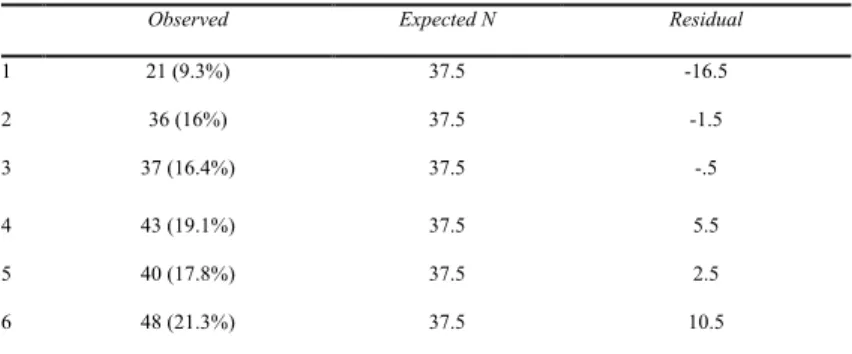
Overreports of ‘5’ (and ‘4’). The second hypothesis predicted that people would over-report ‘5’ (and ‘4’) and under-over-report ‘6’ in order to be able to attribute potential success to chance rather than own cheating behaviour. This hypothesis was tested using the same chi-square test, χ2(5, N = 225) = 11.24, p = .047. The pattern of results presented in Table 1 does not support this prediction. There were slight over-reports of ‘5’ (17.8%) and ‘4’ (19.1%) but also over-reports of ‘6’ (21.3%), which contradicts this prediction.
Effects of framing. The third hypothesis was divided into two predictions, depending on the framing of the procedure.
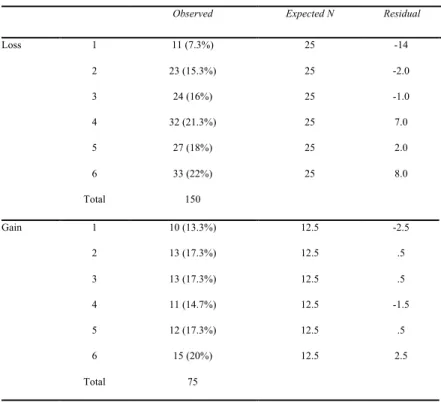
According to Hypothesis 3a loss framing (both loss conditions) would result in overreports of ‘6’. To test this prediction, a chi-square test was performed on the data from the one hundred and fifty participants that were assigned to one of the two loss conditions (M = 3.93, SD = 1.58). There was a significant difference between expected and observed frequencies of reports, χ2(5, N = 150) = 12.72, p = .026. However, based on the information found in Table 2, it can be concluded that this is due to under-reports of
Table 1. Observed and expected reported outcomes of all data
Observed Expected N Residual
1 21 (9.3%) 37.5 -16.5
2 36 (16%) 37.5 -1.5
3 37 (16.4%) 37.5 -.5
4 43 (19.1%) 37.5 5.5
5 40 (17.8%) 37.5 2.5
‘1’ (7.3%), as opposed to over-reports of ‘6’ (22%). Thus, Hypothesis 3a was not supported.
Nevertheless, it is worth noting that, whereas reports in the gain condition were somewhat honest, in the loss conditions there were over-reports of ‘4’ and ‘6’ (and not so much ‘5’) and under-reports of all other outcomes (see Table 2).
Table 2. Observed and expected reported outcomes by condition framing
Observed Expected N Residual
Loss 1 11 (7.3%) 25 -14
2 23 (15.3%) 25 -2.0
3 24 (16%) 25 -1.0
4 32 (21.3%) 25 7.0
5 27 (18%) 25 2.0
6 33 (22%) 25 8.0
Total 150
Gain 1 10 (13.3%) 12.5 -2.5
2 13 (17.3%) 12.5 .5
3 13 (17.3%) 12.5 .5
4 11 (14.7%) 12.5 -1.5
5 12 (17.3%) 12.5 .5
6 15 (20%) 12.5 2.5
Total 75
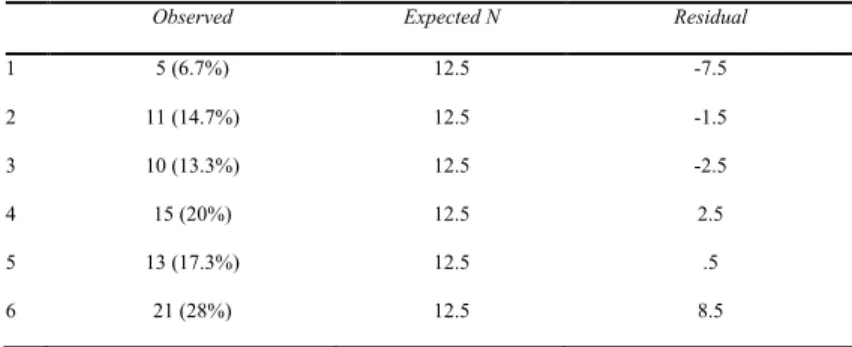
Overreports of six in the no-cash loss condition. Finally, the last Hypothesis 4 predicted that in the loss condition, in which no money was given to participants prior to the ball draw, there would be a higher number of reported 6s than what would be expected by chance only. Hence, another chi-square test was run on the data gathered from the seventy-five people who were assigned to this manipulation (M = 4.11, SD = 1.62). The results showed that the observed data distribution was significantly different than a fair die distribution, χ2(5, N = 75) = 11.48, p = .043. Furthermore, as can be seen in Table 3, the biggest difference between expected and observed outcomes was exactly in the reporting of ‘6’s, which suggests that the significance of the chi-square statistic is due to this discrepancy. Thus, Hypothesis 4 was supported by the data. The findings in the cash loss condition were non-significant, χ2(5, N = 75) = 5.40, p = .369, so the overall significance in the loss condition was due to the effects of the no-cash loss.
The results of this analysis also show a great difference between the expected and the observed reports of ‘1’s, which might also contribute to the significance of the test statistic. Even though this pattern was not part of the predictions, it might be interesting to discuss some plausible explanations.
Table 3. Observed and expected reported outcomes of no-cash loss condition
Observed Expected N Residual
1 5 (6.7%) 12.5 -7.5
2 11 (14.7%) 12.5 -1.5
3 10 (13.3%) 12.5 -2.5
4 15 (20%) 12.5 2.5
5 13 (17.3%) 12.5 .5
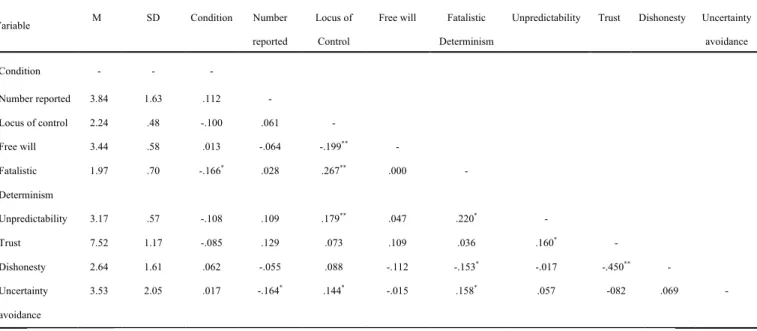
Relationships between measures. A correlation analysis was performed on the seven scales computed from the questionnaires (Locus of control, Free will, Fatalistic Determinism, Unpredictability, Trust, Dishonesty, Uncertainty avoidance), participants’ reported number and the experimental condition (gain condition=1, cash loss condition=2, no-cash loss=3).
A Spearman's rank-order correlation test on the relationship between the experimental condition and each of the questionnaire scales and reported outcome. A Pearson correlation analysis between all scales and reported outcomes was run. The most interesting and substantial finding of this analysis was that there is a medium to large negative correlation between Dishonesty and Trust (r = -.450, p < .001). Therefore, stronger positive attitudes towards behaving in a dishonest way during the experiment were related to lower perceptions of trust between the participant and the experimenter.
Table 4 Correlations questionnaire scales, reported outcome and experimental condition
Discussion
The present work contributes to our understanding of cheating in a probabilistic setting. This study examined dishonest behaviour when facing potential gains or losses in the presence of uncertainty. This experiment was conducted using a die-under-cup paradigm, which gave participants the opportunity to cheat anonymously by exaggerating the outcome of the die-roll without suffering any consequences. They could then potentially go home with monetary incentives depending on the colour of a ball drawn. A novel modification to the usual task was the introduction of uncertainty, in the sense that the outcome of the die roll did not directly translate into the corresponding amount of money (Shalvi et al., 2011a) but simply increased one’s odds of obtaining 6€. Potential
Variable M SD Condition Number reported
Locus of
Control
Free will Fatalistic
Determinism
Unpredictability Trust Dishonesty Uncertainty
avoidance
Condition - - -
Number reported 3.84 1.63 .112 -
Locus of control 2.24 .48 -.100 .061 -
Free will 3.44 .58 .013 -.064 -.199** -
Fatalistic
Determinism
1.97 .70 -.166* .028 .267** .000 -
Unpredictability 3.17 .57 -.108 .109 .179** .047 .220* -
Trust 7.52 1.17 -.085 .129 .073 .109 .036 .160* -
Dishonesty 2.64 1.61 .062 -.055 .088 -.112 -.153*
-.017 -.450**
-
Uncertainty
avoidance
3.53 2.05 .017 -.164* .144* -.015 .158* .057 -082 .069 -
**. Correlation is significant at the 0.01 level (2-tailed).
consequences of distributing money prior to the procedure were tested by introducing a new no-cash loss manipulation to an otherwise replication study of previous work by Douma (2017). The introduction of this new condition provided support for the idea that people overstate their results to avoid experiencing a loss but not to secure an equivalent gain.
When presented with an uncertain situation, individuals tend to seek ways to resolve this unpredictability. The current study tested whether individuals would aim to secure their chances of obtaining the desired financial outcome by over-reporting ‘6’s and under-reporting all lower outcomes. This idea was partially supported by the findings. In fact, ‘6’s were indeed slightly over-reported but the more substantial observed effect was under-reporting of ‘1’s, suggesting that participants did exaggerate their performance but only to the extent to avoid almost certainly going home empty-handed.
highly salient when the outcome of the die-roll is ‘1’, reporting any other number increases one’s chances of success and makes regret more unlikely.
An interesting finding is that there were over-reports of ‘5’s and ‘4’s, even though the effect was only slight and not significant. This pattern suggests that overall, people tried to increase their chances of succeeding by exaggerating their performance. These findings are in line with previous work on cheating, specifically the concept of ‘ethical manoeuvring’ (Shalvi, Handgraaf, & De Dreu, 2011). This idea that people have a tendency to compromise between the desire to be moral and to serve own self-interest by not engaging in neither major, nor minor lies, explains the prevalence of ‘4’s and ‘5’s.
Past research on framing effects in the die-under-cup paradigm supports the idea that people behave more dishonestly when faced with a potential loss rather than a gain, by overstating their outcomes (Schindler & Pfattheicher, 2017; Shalvi et al., 2011a). Although not by a large extent, the current results are in line with these findings – individuals in the two loss conditions exaggerated their performance by reporting higher numbers more often. The main finding was, however, that they also under-reported ‘1’s, which was not the case in the gain condition. Overall, these findings imply that people try to avoid a potential loss to a stronger extent than they aim to secure an equivalent gain, by being more dishonest (e.g., Kern & Chugh, 2009; Kirchler, & Maciejovsky, 2001). In addition, as already suggested in previous work (Grolleau, Kocher & Sutan, 2016), acting in an unethical way could be considered as more acceptable by third parties provided that the norm of being honest is not as strict in the domain of losses.
could be attributed to the remoteness of money. Dishonest behaviour is facilitated by extending the psychological distance between the lie and its consequences (Ariely, 2012). Although individuals appeared to restrain themselves from cheating when money was given to them prior to performing the task, they did not mind exaggerating their outcomes when merely anticipating receiving payment. The new setting provided individuals with an opportunity to preserve self-concept and own sense of morality, while at the same time serving self-interest.
In order to get a more in-depth understanding of the findings, the interactions between different factors were explored. Most importantly, the negative relationship found between trust and dishonesty implies that people who did not trust or feel trusted by the experimenter were more likely to engage in cheating. Past research on the influence of trust in subsequent behaviour shows that people who are lied to or distrusted by another person, tend to react with the same negativity towards that person and are more likely to engage in cheating (Houser, Vetter & Winter, 2012; Tyler, Feldman & Reichert, 2006). The results support the notion of negative norms of reciprocity, which favor retaliation as a suitable means to reciprocate to being subjected to negative treatment by another person (Gouldner, 1960; cited in Tyler et al., 2006).
alterations when trying to recall past events. Memories for emotional experiences are partially reconstructed and influenced by current judgment, meaning that an obtained financial outcome increases positive mood and thus makes it difficult to recall being uneasy about potentially going home without any money.
In general, the findings of the present study are in line with previous research by Douma (2017). More precisely, in her study people appeared to be honest with the presence of only slight over-reports of ‘4’s and ‘5’s, which completely corresponds to the present findings. Threfore, even though some predictions were not supported, it seems that the present work was able to replicate the past study’s conclusions and provide some additional interesting findings thanks to the introduction of a new manipulation.
Limitations and directions for future research
Furthermore, the main part of the findings came from correlational analyses so no definitive conclusions of causality could be made. Thus, it would be interesting to conduct a study with a different experimental design in order to explore various alternative explanations for the observed effects. Directly manipulating relevant concepts such as trust and uncertainty avoidance by introducing them in the experimental conditions could potentially aid in answering important questions about the nature of the effects.
Moreover, the sample used in the present study consisted mainly of first year psychology students, who were granted 1ECTS for participation, regardless of the outcome of the ball draw. It seems therefore plausible, that they did not perceive the possible monetary outcome as an important stimulus when reporting their outcomes. However, this is unlikely the case, since cheating behaviour was present in one of the manipulations. Nevertheless, a possible idea would be to use a different sample, in which participants are not dependent on ECTS or, alternatively, make all distributed outcomes contingent on the colour of the ball drawn.
Conclusion
The current work contributes to the comprehension of dishonest behaviour in the face of uncertain gains as opposed to losses. In particular, this research was successful in replicating previous findings using the same procedure and demonstrating differences in actual cheating due to the introduction of a new condition. Overall, the study supported the idea that people tend to overstate their performance to avoid suffering a loss but not to obtain an equivalent gain.
References
Ariely, D. (2012). The (honest) truth about dishonesty: How we lie to everyone---especially ourselves. New York: Harper.
Ariely, D., Huber, J., & Wertenbroch, W. (2005). When do losses loom larger than gains? Journal of Marketing Research, 42, 134–138.
Cameron, J. S. & Miller, D. T. (2009). Ethical standards in gains versus loss frames. In D. deCremer (Ed.), Psychological perspectives on ethical behavior, 91-106. New York: Information Age Publishing.
Douma, L. (2017). Considering a white lie for own monetary benefits. Dishonesty under payoff uncertainty (Unpublished master’s thesis). University of Leiden, The Netherlands.
Gino, F., & Pierce, L. (2009). The abundance effect: Unethical behavior in the presence of wealth. Organizational Behavior and Human Decision Processes,109(2), 142-155. Grolleau, G., Kocher, M., & Sutan, A. (2016). Cheating and loss aversion: do people lie more to avoid a loss? Management Science, 62(12), 3428-3438.
Houser, D., Vetter, S., & Winter, J. (2012). Fairness and cheating. European Economic Review, 56(8), 1645-1655.
Kahneman, D., & Tversky, A. (1979). Prospect theory: An analysis of decision under risk. Econometrica, 47, 263–291.
Kahneman, D., & Tversky, A. (1984). Choices, values, and frames. American psychologist, 39(4), 341-350.
Kern, M. and Chugh, D. (2009). Bounded ethicality: The perils of loss framing. Psychological Science, 20(3), 378-384.
Kirchler, E., & Maciejovsky, B. (2001). Tax compliance within the context of gain and loss situations, expected and current asset position, and profession. Journal of Economic Psychology, 22(2), 173–194.
Mazar, N., Amir, O., & Ariely, D. (2008). The dishonesty of honest people: A theory of self-concept maintenance. Journal of marketing research, 45(6), 633-644.
Schindler, S., & Pfattheicher, S. (2017). The frame of the game: Loss-framing increases dishonest behavior. Journal of Experimental Social Psychology,69, 172-177.
Shalvi, S., Handgraaf, M. J. J., & De Dreu, C. K. W. (2011). Ethical manoeuvring: Why people avoid both major and minor lies. British Journal of Management,22(S1), 16-27. Zeelenberg, M., Beattie, J., van der Pligt, J., & de Vries, N.K. (1996). Consequences of regret aversion: Effects of expected feedback on risky decision making. Organizational Behavior and Human Decision Processes, 65, 148-158.
Appendix 1 Informed Consent Gain Frame
Informed Consent
Thank you for participating in our study on uncertain events!
In this experiment, you can win six Euro. Whether you win, will depend on a random ball draw. You will draw a ball out of a box that contains yellow and white balls. If you draw a yellow ball, you win € 6. If you draw a white ball, you win nothing. Before the ball draw you will first fill in a questionnaire.
All your responses during this experiment will be anonymously coded and treated confidentially.
You can stop at any time if you wish. If you any complaints, please contact dr. W. Steinel, [email protected]
Please sign below to indicate that you understood and agree with this procedure. Leiden, __________________
Appendix 2 Informed Consent Loss Frame
Informed Consent
Thank you for participating in our study on uncertain events!
In this experiment, you start with six Euro. Whether you may take this money home, however, will depend on a random ball draw. You will draw a ball out of a box that contains yellow and white balls. If you draw a yellow ball, you may keep the € 6. If you draw a white ball, you lose the money. Before the ball draw you will first fill in a questionnaire.
All your responses during this experiment will be anonymously coded and treated confidentially. You can stop at any time if you wish. If you any complaints, please contact dr. W. Steinel, [email protected]
Please sign below to indicate that you understood and agree with this procedure. Leiden, __________________
Appendix 3 First questionnaire
Experiment: Uncertain Events
Participant number: _____________
Please give us the following information about yourself
I am a □ Man □ Woman
□ Different or I don’t want to tell I am ________ years old.
How often have you participated in similar experiments at the Faculty of Social Sciences? □ Never: This is my first time
□ Once before: This is the second experiment I participate in □ Twice before: This is the third experiment I participate in
□ Three times before: This is the fourth experiment I participate in □ I have been participating in more than three experiments before
How much do you agree with the following statements? strongly strongly disagree agree
A job is what you make of it. 1 2 3 4 5 6 On most jobs, people can pretty much accomplish whatever they set out to
accomplish. 1 2 3 4 5 6
If you know what you want out of a job, you can find a job that gives it to you. 1 2 3 4 5 6 If employees are unhappy with a decision made by their boss, they should do
something about it. 1 2 3 4 5 6
Getting the job you want is mostly a matter of luck. 1 2 3 4 5 6 Making money is primarily a matter of good fortune. 1 2 3 4 5 6 Most people are capable of doing their jobs well if they make the effort. 1 2 3 4 5 6 In order to get a really good job you need to have family members or friends in
high places. 1 2 3 4 5 6
Promotions are usually a matter of good fortune. 1 2 3 4 5 6 When it comes to landing a really good job, who you know is more important
than what you know. 1 2 3 4 5 6
Promotions are given to employees who perform well on the job. 1 2 3 4 5 6 To make a lot of money you have to know the right people. 1 2 3 4 5 6 It takes a lot of luck to be an outstanding employee on most jobs. 1 2 3 4 5 6 People who perform their jobs well generally get rewarded for it. 1 2 3 4 5 6 Most employees have more influence on their supervisors than they think they
do. 1 2 3 4 5 6
The main difference between people who make a lot of money and people
who make a little money is luck. 1 2 3 4 5 6
How much do you agree with the following statements? strongly strongly disagree agree
I believe that the future has already been determined by fate. 1 2 3 4 5 People’s biological makeup determines their talents and personality. 1 2 3 4 5 Chance events seem to be the major cause of human history. 1 2 3 4 5 People have complete control over the decisions they make. 1 2 3 4 5 No matter how hard you try, you can’t change your destiny. 1 2 3 4 5 Psychologists and psychiatrists will eventually figure out all human behavior. 1 2 3 4 5 No one can predict what will happen in this world. 1 2 3 4 5 People must take full responsibility for any bad choices they make. 1 2 3 4 5 Fate already has a plan for everyone. 1 2 3 4 5 Your genes determine your future. 1 2 3 4 5 Life seems unpredictable—just like throwing dice or flipping a coin. 1 2 3 4 5 People can overcome any obstacles if they truly want to. 1 2 3 4 5 Whatever will be, will be—there’s not much you can do about it. 1 2 3 4 5 Science has shown how your past environment created your current intelligence
and personality. 1 2 3 4 5
People are unpredictable. 1 2 3 4 5
Criminals are totally responsible for the bad things they do. 1 2 3 4 5 Whether people like it or not, mysterious forces seem to move their lives. 1 2 3 4 5 As with other animals, human behavior always follows the laws of nature. 1 2 3 4 5 Life is hard to predict because it is almost totally random. 1 2 3 4 5 Luck plays a big role in people’s lives. 1 2 3 4 5 People have complete free will. 1 2 3 4 5 Parents’ character will determine the character of their children. 1 2 3 4 5 People are always at fault for their bad behavior. 1 2 3 4 5 Childhood environment will determine your success as an adult. 1 2 3 4 5 What happens to people is a matter of chance. 1 2 3 4 5 Strength of mind can always overcome the body’s desires. 1 2 3 4 5 People’s futures cannot be predicted. 1 2 3 4 5
When I am in conflict with someone else, the BEST outcome for me occurs when:
□ I behave competitively and they behave cooperatively. □
□ We both behave cooperatively. □
When I am in conflict with someone else, the WORST outcome for me occurs when:
□ I behave cooperatively and they behave competitively. □
□ We both behave competitively. □
Appendix 4 Instructions Gain Frame English and Dutch
Please read the instructions entirely and carefully.
In this experiment, your payoff will depend upon your decisions. All your decisions will be anonymous. You will indicate your decisions on a decision sheet that will be given by the experimenter during the experiment. There is no good nor bad answer.
From now and until the end of the experiment, we ask you to remain silent. If you have any questions, open the door and the experimenter will come to answer your questions privately.
General framework of the experiment
In this experiment, you can win a prize of €6. There will be 6 coloured balls, either white or yellow, which are placed into a bowl. You have to randomly draw one ball which determines whether you win €6. If the ball you draw is yellow you win €6; if the ball you draw is white you win nothing. At the beginning of the experiment, there are 6 white balls in the bowl. The number of yellow balls that will replace these white balls depends on your dice roll.
Before randomly drawing a ball, you will have to roll a regular, six face dice. More precisely, you have an opaque cup with a cover. The small hole located in the cover allows you to see the dice. You must shake the cup to throw the dice. Then put it down and, without moving the cup, take a look through the hole to observe the outcome of your throw. The number displayed by the dice will determine the number of yellow balls that will replace the white balls in the bowl (the decision sheet indicates the number of yellow and white balls according to each possible outcome of the dice).
The first roll will determine the number of yellow balls located in the bowl. After the first roll, we ask that you roll the dice under the cup 2 more times so that you can verify for yourself that the dice is legitimate.
Lees de instructies volledig en nauwkeurig door.
Het bedrag wat je in dit experiment kunt verdienen hangt volledig af van je eigen beslissingen. Al je beslissingen zijn anoniem en niet bekend bij de proefleider. Je wordt gevraagd om je beslissingen aan te geven in de beslissingstabel, die je later tijdens het experiment zult ontvangen van de proefleider. Er zijn hierbij geen goede of foute beslissingen.
Vanaf nu tot het einde van het experiment willen we je vragen of stil te blijven. Als je vragen hebt kan je de deur openen en zal de proefleider je vraag privé beantwoorden.
Experiment
Tijdens dit experiment kan je €6 winnen. Er zullen 6 gekleurde balletjes, wit of geel, in een bak gestopt worden. Je zult gevraagd worden om één bal te pakken, zonder dat je ziet welke kleur deze heeft. Als de bal geel is win je €6; als de bal wit is win je niks. Aan het begin van het experiment zullen er 6 witte ballen in de bak zitten. Het aantal gele ballen dat de witte ballen zal vervangen hangt af van het aantal ogen dat je gooit met een dobbelsteen.
Voordat je straks een bal pakt uit de bak, rol je dus eerst een dobbelsteen. Dit is een gewone dobbelsteen met 6 zijden. Deze dobbelsteen bevindt zich in een papieren beker die is afgedekt. In deze afdekking zit een gat, zodat je kunt zien wat je hebt gegooid. Om de dobbelsteen te rollen schud je de beker om de beker vervolgens neer te zetten. Zonder de beker te bewegen, kijk je door het gaatje in de afdekking van de beker om te zien wat je hebt gegooid. Het aantal ogen dat je hebt gegooid wordt het aantal gele ballen dat de witte ballen zal vervangen in de bak. (in de beslissingstabel kun je zien welk aantal ogen zorgt voor de verdeling in witte en gele ballen). Het aantal ogen dat je de eerste keer gooit met de dobbelsteen is het aantal witte ballen dat vervangen wordt door gele ballen. Vervolgens vragen we je de dobbelsteen nog tweemaal te gooien om voor jezelf vast te stellen dat de dobbelsteen goed werkt.
Appendix 5 Instructions Cash Loss Frame English and Dutch
Please read the instructions entirely and carefully.
In this experiment, your payoff will depend upon your decisions. All your decisions will be anonymous. You will indicate your decisions on a decision sheet that will be given by the experimenter during the experiment. There is no good nor bad answer.
From now and until the end of the experiment, we ask you to remain silent. If you have any questions, open the door and the experimenter will come to answer your questions privately.
General framework of the experiment
You just received €6 which is now yours. A ball draw will determine whether you lose this money. In this experiment 6 coloured balls, either white or yellow, will be placed into a bowl. You have to randomly draw one ball which determines whether you lose your €6. If the ball you draw is yellow you may keep your €6; if the ball you draw is white you lose your money and you need to hand in your €6. At the beginning of the experiment, there will be 6 white balls in the bowl. The number of yellow balls that will replace these white balls depends on your dice roll. Before randomly drawing a ball, you will have to roll a regular, six face dice. More precisely, you have an opaque cup with a cover. The small hole located in the cover allows you to see the dice. You must shake the cup to throw the dice. Then put it down and, without moving the cup, take a look through the hole to observe the outcome of your throw. The number displayed by the dice will determine the number of yellow balls that will replace the white balls in the bowl (the decision sheet indicates the number of yellow and white balls according to each possible outcome of the dice).
Lees de instructies volledig en nauwkeurig door.
Het bedrag wat je in dit experiment kunt verdienen hangt volledig af van je eigen beslissingen. Al je beslissingen zijn anoniem en niet bekend bij de proefleider. Je wordt gevraagd om je beslissingen aan te geven in de beslissingstabel, die je later tijdens het experiment zult ontvangen van de proefleider. Er zijn hierbij geen goede of foute beslissingen.
Vanaf nu tot het einde van het experiment willen we je vragen of stil te blijven. Als je vragen hebt kan je de deur openen en zal de proefleider je vraag privé beantwoorden.
Experiment
Je hebt zojuist €6 ontvangen wat nu van jou is. Je trekt zo een balletje, en daarvan hangt af of je dit geld verliest. Tijdens dit experiment zullen er 6 gekleurde balletjes, wit of geel, in een bak gestopt worden. Je zult gevraagd worden om één bal te pakken, zonder dat je ziet welke kleur deze heeft. Als de bal geel is mag je je €6 houden; als de bal wit is moet je je €6 inleveren. Aan het begin van het experiment zullen er 6 witte ballen in de bak zitten. Het aantal gele ballen dat de witte ballen zal vervangen hangt af van het aantal ogen dat je gooit met een dobbelsteen.
Voordat je straks een bal pakt uit de bak, rol je dus eerst een dobbelsteen. Dit is een gewone dobbelsteen met 6 zijden. Deze dobbelsteen bevindt zich in een papieren beker die is afgedekt. In deze afdekking zit een gat, zodat je kunt zien wat je hebt gegooid. Om de dobbelsteen te rollen schud je de beker om de beker vervolgens neer te zetten. Zonder de beker te bewegen, kijk je door het gaatje in de afdekking van de beker om te zien wat je hebt gegooid. Het aantal ogen dat je hebt gegooid wordt het aantal gele ballen dat de witte ballen zal vervangen in de bak. (in de beslissingstabel kun je zien welk aantal ogen zorgt voor de verdeling in witte en gele ballen).
Het aantal ogen dat je de eerste keer gooit met de dobbelsteen is het aantal witte ballen dat vervangen wordt door gele ballen. Vervolgens vragen we je de dobbelsteen nog tweemaal te gooien om voor jezelf vast te stellen dat de dobbelsteen goed werkt.
Appendix 6 Instructions No-Cash Loss Frame English and Dutch
Please read the instructions entirely and carefully.
In this experiment, your payoff will depend upon your decisions. All your decisions will be anonymous. You will indicate your decisions on a decision sheet that will be given by the experimenter during the experiment. There is no good nor bad answer.
From now and until the end of the experiment, we ask you to remain silent. If you have any questions, open the door and the experimenter will come to answer your questions privately.
General framework of the experiment
You start with €6. A ball draw will determine whether you lose this money. In this experiment 6 coloured balls, either white or yellow, will be placed into a bowl. You have to randomly draw one ball which determines whether you lose your €6. If the ball you draw is yellow you keep the €6 and may take the money home; if the ball you draw is white you lose the €6. At the beginning of the experiment, there will be 6 white balls in the bowl. The number of yellow balls that will replace these white balls depends on your dice roll.
Before randomly drawing a ball, you will have to roll a regular, six face dice. More precisely, you have an opaque cup with a cover. The small hole located in the cover allows you to see the dice. You must shake the cup to throw the dice. Then put it down and, without moving the cup, take a look through the hole to observe the outcome of your throw. The number displayed by the dice will determine the number of yellow balls that will replace the white balls in the bowl (the decision sheet indicates the number of yellow and white balls according to each possible outcome of the dice).
The first roll will determine the number of yellow balls located in the bowl. After the first roll, we ask that you roll the dice under the cup two more times so that you can verify for yourself that the dice is legitimate.
Open the door after you are done reading these instructions, then the experimenter will give you a "decision sheet" as well as the cup so you can roll the dice. After rolling the dice three times, tick on the "decision sheet" the number displayed by the first roll. Leave the cup next to the computer. Give the decision sheet to the experimenter, so the experimenter can prepare the draw (i.e., replace as many white balls by yellow ones as the number you have rolled in the first dice roll), then you may randomly draw a ball from the bowl. If this ball you draw is yellow you keep the
Lees de instructies volledig en nauwkeurig door.
Het bedrag wat je in dit experiment kunt verdienen hangt volledig af van je eigen beslissingen. Al je beslissingen zijn anoniem en niet bekend bij de proefleider. Je wordt gevraagd om je beslissingen aan te geven in de beslissingstabel, die je later tijdens het experiment zult ontvangen van de proefleider. Er zijn hierbij geen goede of foute beslissingen.
Vanaf nu tot het einde van het experiment willen we je vragen of stil te blijven. Als je vragen hebt kan je de deur openen en zal de proefleider je vraag privé beantwoorden.
Experiment
Je begint met €6. Je trekt zo een balletje, en daarvan hangt af of je dit geld verliest. Tijdens dit experiment zullen er 6 gekleurde balletjes, wit of geel, in een bak gestopt worden. Je zult gevraagd worden om één bal te pakken, zonder dat je ziet welke kleur deze heeft. Als de bal geel is houdt je de €6 en mag je het geld mee naar huis nemen; als de bal wit is verlies je de €6. Aan het begin van het experiment zullen er 6 witte ballen in de bak zitten. Het aantal gele ballen dat de witte ballen zal vervangen hangt af van het aantal ogen dat je gooit met een dobbelsteen.
Voordat je straks een bal pakt uit de bak, rol je dus eerst een dobbelsteen. Dit is een gewone dobbelsteen met 6 zijden. Deze dobbelsteen bevindt zich in een papieren beker die is afgedekt. In deze afdekking zit een gat, zodat je kunt zien wat je hebt gegooid. Om de dobbelsteen te rollen schud je de beker om de beker vervolgens neer te zetten. Zonder de beker te bewegen, kijk je door het gaatje in de afdekking van de beker om te zien wat je hebt gegooid. Het aantal ogen dat je hebt gegooid wordt het aantal gele ballen dat de witte ballen zal vervangen in de bak. (in de beslissingstabel kun je zien welk aantal ogen zorgt voor de verdeling in witte en gele ballen).
Het aantal ogen dat je de eerste keer gooit met de dobbelsteen is het aantal witte ballen dat vervangen wordt door gele ballen. Vervolgens vragen we je de dobbelsteen nog tweemaal te gooien om voor jezelf vast te stellen dat de dobbelsteen goed werkt.
Appendix 7 Decision Sheet Gain and Loss
Number displayed by
the dice
Number of
yellow balls Number of white balls
You win (if you draw a
yellow ball)
Tick the number rolled
(X)
Aantal ogen op
de dobbelsteen Aantal gele ballen Aantal witte ballen
Als je een gele bal pakt win
je:
Kruis het aantal ogen
aan (X)
1
5
€6
2
4
€6
3
3
€6
4
2
€6
5
1
€6
6
0
€6
Number displayed by
the dice
Number of
yellow balls Number of white balls
You will lose (if you draw a white ball)
Tick the number rolled
(X)
Aantal ogen op
de dobbelsteen Aantal gele ballen Aantal witte ballen
Als je een witte bal pakt verlies
je:
Kruis het aantal ogen
aan (X)
1
5
-€6
2
4
-€6
3
3
-€6
4
2
-€6
5
1
-€6
Appendix 8 Post-hoc questionnaire
Please fill in this short questionnaire! Ppnr:
The following questions are about how you felt in the beginning of this study, that is, after you read the laminated instructions, and before you filled in the questionnaire.
The uncertain event, that is, the result of dice roll and ball draw was about...
avoiding a loss of 6 Euro 1 2 3 4 5 6 7 8 9 achieving a gain of 6 Euro
+
How much do you agree with the following statements? fully fully
disagree agree
Facing the uncertain outcome of the lottery was very unpleasant. 1 2 3 4 5 6 7 8 9
I felt uncomfortable not knowing whether I would draw a winning ball.
1 2 3 4 5 6 7 8 9
I strongly wanted to draw a winning ball. 1 2 3 4 5 6 7 8 9
I felt that the experimenter trusted me. 1 2 3 4 5 6 7 8 9
The behavior of the experimenter showed that she fully trusted me. 1 2 3 4 5 6 7 8 9
I was convinced that the experiment would take place exactly as announced beforehand (i.e., in the informed consent and the instructions).
1 2 3 4 5 6 7 8 9
I was convinced that my subsequent behavior (the dice roll and the ball draw) would really have financial consequences.
1 2 3 4 5 6 7 8 9
I doubted that the experimenter would really do what the instructions announced.
1 2 3 4 5 6 7 8 9
I fully trusted the experimenter. 1 2 3 4 5 6 7 8 9
I thought that the experimenter behaved in a naïve way. 1 2 3 4 5 6 7 8 9
It was important that I behaved in a trustworthy manner. 1 2 3 4 5 6 7 8 9
Which number did you hope you would roll? Please mark it. 1 2 3 4 5 6
After you filled in the questionnaire and before you rolled the dice…
fully fully
disagree agree
I would have been very happy if I had rolled a 4. 1 2 3 4 5 6 7 8 9
I would have been very happy if I had rolled a 6. 1 2 3 4 5 6 7 8 9
I was hoping that I would roll a high number. 1 2 3 4 5 6 7 8 9
I was hoping to replace as many non-winning balls by winning balls as possible.
1 2 3 4 5 6 7 8 9
I felt that drawing a yellow (winning) ball would be very desirable. 1 2 3 4 5 6 7 8 9
I felt that drawing a yellow (winning) ball would be very important. 1 2 3 4 5 6 7 8 9
Drawing a white (non-winning) ball would feel really bad. 1 2 3 4 5 6 7 8 9
I thought about reporting a high number, even if I would roll a low number.
1 2 3 4 5 6 7 8 9
I knew that nobody would ever know which number I actually rolled.
1 2 3 4 5 6 7 8 9
I thought that the experimenter would know which number I really rolled.
1 2 3 4 5 6 7 8 9
I felt that it was important to accurately report the number that I rolled.
1 2 3 4 5 6 7 8 9
It was important to report my dice roll honestly. 1 2 3 4 5 6 7 8 9
I think that it is okay to report a higher number in this experiment. 1 2 3 4 5 6 7 8 9
How do you feel now? fully fully
disagree agree
I am happy. 1 2 3 4 5 6 7 8 9
I am disappointed. 1 2 3 4 5 6 7 8 9
I think that I made the right decisions in this experiment. 1 2 3 4 5 6 7 8 9
In hindsight, I would behave differently. 1 2 3 4 5 6 7 8 9
I feel fairly treated. 1 2 3 4 5 6 7 8 9
If you have any remarks, please write them on the backside.
Thank you for your participation in this study!
Dr. W. Steinel, Social & Organisational
Psychology *
Appendix 9 Debriefing Form
Thank you for participating in this study!
The general purpose of this research is to investigate whether people report a different outcome of a dice roll than what they actually rolled when this behavior increases the likelihood to get a desired outcome (6 Euro cash), and whether this depends on framing (i.e., whether the ball draw is about winning 6 Euro or about not losing 6 Euro).
In this study we recruited students at Leiden University who were randomly assigned to the loss frame condition and gain frame condition. You were asked to perform a different version of the dice under the cup paradigm. Specifically, you were asked to choose randomly a ball out of a container filled with six balls after rolling a regular six face dice. Firstly, the container was filled with six white balls. After the dice-roll, these balls were replaced with yellow balls depending on the report of the die roll. Every participant had to pick up randomly one ball from the container. In the gain frame condition the participant got the cash amount if he/she catch the yellow ball. If he/she catch the white ball, he/she did not receive the cash amount of six Euros. In the loss frame condition the participant got the cash amount before the dice roll. If he/ she catch the yellow ball, he/she could keep the money. If he/she catch the white ball, the had to turn the 6 euros back.
In the loss-frame manipulation we expect that people will over-report 6 to fully remove the uncertainty and will under-report the outcomes below 6; in the gain-frame we expect that people will under-report 6 because this remove the chance to attribute extrinsically the desired outcome to luck and over-report 5 and maybe also 4.
If you have further questions about the study, please ask the experimenter. You can also receive a research report; if you want this, please leave your email address on the reverse side of this form. If you have any complaints, you can contact dr. W. Steinel ([email protected]).
You now have knowledge of relevant information concerning the research. We ask you to treat these information as confidential until the end of the study: