Ciao: A Graphical Navigator for Software and Document
Repositories
Yih-Farn R. Chen Glenn S. Fowler EleftheriosKoutsoos
RyanS. Wallach
AT&T Bell Laboratories 600 Mountain Avenue Murray Hill, NJ 07974
f
chen,ek,gsf,rsw
g@research.att.com
Abstract
Programmers frequently have to retrieve and link information from various software documents to ac-complish a maintenance task. Ciao is a graph-based navigator that helps programmers query and browse structural connections embedded in dierent software and document repositories. A repository consists of a collection of source documents with an associated database that describes their structure. Ciao sup-ports repositories organized in an architecture style called Aero, which exploits the duality between a class of entity-relationship (ER) databases and directed at-tributed graphs (DAG). Database queries and graph analysis operators in Aero are plug-compatible because they all take an ER database and produce yet an-other ER database by default. Various presentation l-ters generate graph views, source views, and relational views from any compatible ER database. The archi-tecture promotes the construction of successively more complex operators using a notion of virtual database pipelines. Ciao has been instantiated for C and C++ program databases, and program dierence databases. The latter allows programmers to explore program structure changes by browsing and expanding graphs that highlight changed, deleted, and added entities and relationships. The unifying ER model under ciao also allows users to navigate dierent software reposito-ries and make necessary connections. We have linked program dierence databases and modication request (MR) databases so that users can investigate the con-nections between MRs and aected entities. Ciao has been applied to several large communications software projects and we report experiences and lessons learned from these applications.
1 Introduction
Software maintainers frequently face the need to re-trieve and link information from various software doc-uments to accomplish a task. The task is often accom-plished without adequate tools to explore or preserve
source
document abstractor repository operators viewers views
Figure 1: Repository-Based Reverse Engineering
the original software structure. The situation is anal-ogous to maintaining a complex building with missing blueprints. This paper describes ciao, a graph-based navigator that helps large software projects to regen-erate their software blueprints and trace architecture evolution.
Ciao uses a repository-based reverse engineering approach[6]. A software repository consists of a collec-tion of source documents1and an associated database
that describes the components and relationships in those documents. The repository allows various ab-stractions to be generated directly without repeated processing of the original software documents. Fig-ure 1 shows a high-level view of the repository-based reverse engineering process.
The abstractor maps a software document to a repository according to a data model. Each opera-tor retrieves necessary information in the reposiopera-tory to compute a particular abstraction, which is either passed to viewers to generate views, stored back in the repository, or passed to yet another operator for fur-ther computation. The feedback links from operators to the repository and other operators allow program-mers to build successively higher levels of abstractions. The separation of operators and viewers makes it easy to generate multiple views on the same abstraction.
Section 2 briey describes Aero, an architecture style[26][17] that follows this approach with an
em-1In this paper, a source document refers to any software
phasis on converting source documents to a database using the Entity-Relationship model[4]. We shall use instantiations of Aero repositories for C and C++ to demonstrate the capabilities and interoperability of Aero operators.
Ciaois a navigator that can be instantiated to work with various Aero repositories. Software reuse at this architecture level simplies the construction of graphi-cal navigators for dierent repositories. Section 3 uses a sample ciao session to demonstrate how users for-mulate queries, generate graphs, interact with graph nodes, and perform various graph analysis tasks. Sec-tion 4 describes instantiaSec-tions of ciao to examine program structure dierences. It also discusses how the information can be linked to modication request (MR) databases to establish connections between MRs and program entities.
Integrating software tools with an underlying repository has been recognized as a promising approach[30][31]. However, there has been a lack of ex-perience reports on applying repository-based reverse engineering tools to large legacy code, where the tools are needed most. Section 5 describes our experience in applying ciao to several software projects. Some of these projects involve millions of lines of code and have existed for nearly a decade. Finally, Section 6 concludes with a summary and outlines our plan to apply ciao to other application domains.
2 Aero: An Architecture Style for
Repositories
While repository-based systems have been available for examining or reengineering software written in var-ious languages[1], there is not a clear agreement on how the repository should be organized. One popular approach is to store variants of complete parse trees in the repository, such as those used in Reprise[28], ALF[23], Genoa[12] Cobol/SRE[24], and the IBM pro-gram understing project[3]. Because of the nature of the representations, tree traversal routines are fre-quently used to generate various abstractions.
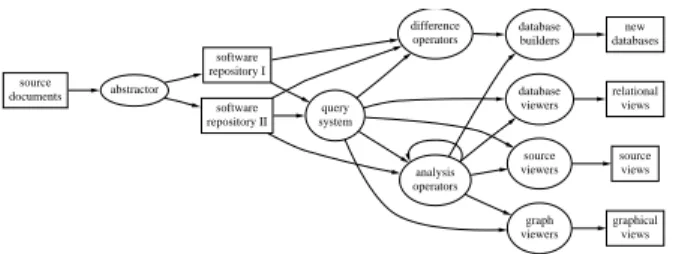
The other popular approach, which we adopted in the construction of the C Information Abstraction System (CIA)[7][9] and its extension for C++[18], and elsewhere in XREFDB[22], is to structure the reposi-tory as a relational database so as to reuse the large body of existing database languages and tools to man-age the repository. Figure 2 shows an architecture style called Aero that characterizes our system as an expansion of the general repository-based reverse en-gineering architecture shown in Figure 1.
The word Aero stands for four primary concepts in the architecture style: Attribute, Entity, Relation-ship, and Operator. The style emphasizes an open ar-chitecture with reusable operators that consume and produce sets of entities and relationships in standard forms. Such a plug-compatible architecture allows Unix pipes and shell scripts[2] to easily connect op-erators recursively to provide dierent levels of ab-stractions. Moreover, new databases are created when necessary to store computation results so as to use a new level of query, analysis, and visualization services.
source
documents abstractor software repository I
query system
difference operators
software repository II
analysis operators
new databases
source views relational
views
graphical views source viewers
graph viewers database viewers database builders
Figure 2: Aero: An Architecture Style for Software and Document Repositories
This architecture is language-independent and con-sists of three major components: Repositories (with associated abstractors and query systems), Operators, and Viewers. We examine each component in the fol-lowing sections and introduce output representations of the operators and viewers as they appear in ciao.
2.1 Repository
A repository consists of a collection of sourcedocu-ments and their associated database. The abstractor maps source documents to the database according to their corresponding data model. Our C and C++ ver-sions of the abstractor act like a compiler except that they create a database rather than an object le. The similarity has allowed us to maintain the repository automatically using most conguration management systems such as nmake[14]. The abstractors store ve kinds of program entities: functions, global and static variables, macros, types, and les, and their inter-relationships in the databases. Each entity carries a set of attributes to describe, among other things, its data type, storage class, location, and a checksum computed from its token sequence. The checksum at-tribute allows us to perform fast program compari-son at the entity level and constructs the dierence database described in Section 4.
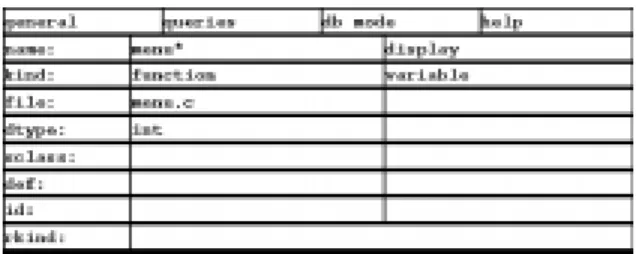
The query system associated with the repository consists of queries that retrieve a subset of entities and relationships from the database, respectively, ac-cording to a given specication. We use cql [15], an ecient interpretive query language, to implement all our queries. A query specication may involve logical connectives and regular expressions to constrain the attribute values. For example, a typical maintenance query with the following specication can be run on the database created for a graph editor:
Retrieve functions dened in menu.c that
match the name pattern \menu*", refer to the
variable display, and return a data type of int.
The query can be formulated as a command with selection clauses that limit entity and relationship at-tribute values. Alternatively, it can be represented in a simple ciao query table shown in Figure 3. The query returns three function entitiesmenu align, menu middle, andmenu leftand their associated
struc-Figure 3: A query formulated in a ciao query table
tured as a virtual database, an archive format sup-ported by cql. The virtual database consists of an entity section, a relationship section, and a directory section that describes the oset, length, protection mode, and timestamp of each section (portions of the database, represented in \...", have been omitted for
brevity):
;vdb;CIAO for cc: 1.0 ENTITY
2348;menu.c;f;2348;;n;1;9133;1554;df;51ae87fc;n
4491;display;v;4435;Display *;g;189;0;189;df;517a8141;y 2421;menu_left;p;2348;int;g;804;805;871;df;ed661571;y ...
RELATIONSHIP
p;2421;v;4491;862@863@866;;; ...
DIRECTORY
ENTITY;13;320;MODE=0444;DATE=795475170 RELATIONSHIP;346;94;MODE=0444;DATE=795475170 DIRECTORY;0000000450;0000000116
By combining both the entity set and relationship set in a single archive le, the virtual database be-comes a standard data exchange form that can be sent on a pipeline. The retrieved virtual database is a subset of the original database and can be presented by various viewers, including the database viewer, the source viewer, and the graph viewer, all explained in the next section.
2.2 Viewers
There are three classes of basic viewers that corre-spond to the three major representations of the docu-ment information: relational views, source views, and graph views.
A database viewer simply takes a virtual database and presents its relational view. Piping the query re-sult in the last section to a database viewer gives us the following view, in whichpstands for function and vstands for variable:
$ query_op | database_viewer
k1 file1 name1 k2 file2 name2 == ======== ============== == ======== ========= p menu.c menu_align v main.c display p menu.c menu_middle v main.c display p menu.c menu_left v main.c display
tool text text viewer vdb
operator vdb
query db
Figure 4: A pipeline with virtual databases sent on the pipe
Here we introduce the notion of a virtual database pipeline, where an operator pipes its output database to another operator to create new views or abstrac-tions. In this paper, we use the Unix shell prompt character \$" to specify the beginning of a pipeline
and the \|" character to denote the pipe connector.
Both queries and operators can be applied to either the original database or a virtual database on the pipe. A sequence of operators and queries, mixed in any order, can be connected on the pipe, as long as they both take and generate a virtual database. Output generated by viewers can be piped further to regular text processing tools to get line counts or other information. Figure 4 shows a typical virtual database pipeline.
Piping a virtual database to a relationship source viewer gives us the source lines where relationships oc-cur. Alternatively, an entity source viewer can be used to view the source of the function or variable deni-tions. The following is an example of a relationship source view, which shows all the source lines where the matched functions refer to the variabledisplay.
Note that each function may refer to the same variable in multiple places.
$ query_op | source_viewer <menu.c:menu_left>
000862; XSetFunction(display, menu_gc, GXcopy); 000863;
XCopyPlane(display, save_just_pm.pm, menu_sw, ... 000866;
XCopyPlane(display, dot_pm.pm, menu_sw, menu_gc, ... <menu.c:menu_align>
...
<menu.c:menu_middle> ...
The same virtual database can also be visualized as a graph. There are two steps involved. First, a graph builder maps the ER database to a graph description, then a layout tool maps that description to an actual graph drawing. In our system, we use dagger[5] to map each C or C++ program entity to a node and each re-lationship to an edge, both decorated with associated display attributes. We then pass the graph descrip-tion to dot[16], an automatic layout tool, or dotty[21], a graph browser. Figure 5 shows the graphical view of the same relationships above and is generated with such a pipeline:
$ query_op | graph_builder | layout_tool
display menu_left
menu_align
menu_middle
Figure 5: A simple graphical view
ciaopen
NULL
NIL
reg
Ciastream_t FILE
CIA_BEGIN
struct _iobuf ciaclose
strcpy
fopen strcat
getenv
malloc
strlen
ciaopen
struct _ciastream_ fclose
free
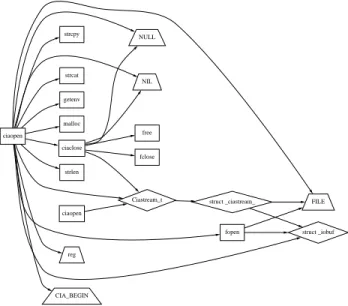
Figure 6: A Reachability Graph rooted at the C func-tionciaopen
can be used to generate a large variety of graphs sim-ply by changing the query specication.
2.3 Operators
Each analysis operator provides an abstraction that can be visualized or used by other operators to build more complex abstractions. One abstraction that is reused by many other tools is the reachable set pro-vided by our closure operator. It computes all the entities and relationships that are reachable starting from a specied set of root entities. Closure also emits a virtual database, so the same set of queries, oper-ators, and viewers can be applied to its output. For example, Figure 6 is a reachability graph generated with the following pipeline:
$ closure_op | graph_builder | layout_tool
The picture shows all program entities reachable from a C function ciaopen. To distinguish between
dif-ferent entity kinds, functions are mapped to boxes, variables to ovals, types to diamonds, macros to trape-zoids, and les to parallelograms.
Several operators are built on top of closure: The deadobj operator uses closure to detect unreachable program entities. TestTube[10], a system for selective regression testing, uses closure and another abstrac-tion computed by the dierencing operator (see Sec-tion 4) to help nd test cases that need to be rerun after a program change. The focus operator uses clo-sureto retrieve only selected levels of reachable sets in both the forward and reverse reference directions of an entity.
If we pipe the output of the closure operator to a source viewer, followed by the application of an NCSL (non-commented source lines) tool, then we get a new tool that counts the NCSL lines of all source code that a root entity depends on directly or indirectly. Such a tool has been used in constructing objective reuse metrics[8]:
$ closure_op | source_viewer | ncsl_tool
Sometimes an analysis operator builds an internal graph structure from the ER database so as to ap-ply graph algorithms to the data eciently. One such operator is incl[32], a tool that analyzes an include hi-erarchy to detect header les that are unnecessary for the compilation of a source le. Incl rst constructs an internal graph directly from the database and then walks the entity reference paths to determine which les are not needed. Such information has been used in certain projects to restructure their header hierar-chies. Again, the analysis results can be saved in a virtual database and displayed graphically.
Many analysis tools, like incl, generate abstractions that, when stored in a database or fed back to the orig-inal one, will speed up future queries that compute more complex abstractions. After a new database is built, we can then recursively apply the architecture design in Figure 2 to instantiate query and visualiza-tion operators for the new database.
We have examined all major components in the Aero architecture style and discussed the use of database pipelines to construct new abstractions or views. The dierence operator is discussed in detail in Section 4. While our system was initially built for C and C++ programs, the underlying architecture has been applied to other forms of software documents, in-cluding the dierence database and the modication request (MR) database described in Section 4. In the next section, we show how the various operators and views presented in this section are intergrated in ciao.
3 Ciao: A Graphical Navigator for
Aero Repositories
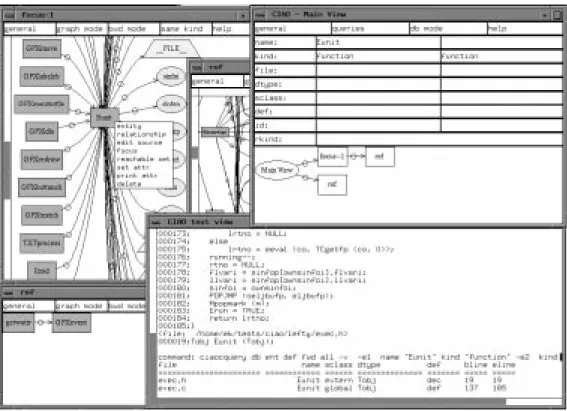
Figure 7: A Snapshot of Ciao for C
what operator and viewer, determined by the three presentation modes (graph, text, and database), to apply to that set to produce a desired view. This allows users to generate multiple views on the same query result. Several views were generated on the en-tityEunitin this picture: the leftmost graph shows all
entity interactions with Eunitby using the focus
op-erator under the graph mode, the text viewwindow
in the center of the snapshot shows both the scrol-lable source text and formulated database records of
Eunit. The focus graph identies all the entities that
refer toEunitand all entities thatEunitdepends on.
Focus graphs are used heavily during the navigation of a program's static structure because they provide quick access to entities related to a focal point.
After a directed graph is created, users can invoke queries and operators directly from each node in the graph. A pop-up menu is attached to each node list-ing only the legal operators that can be applied to the corresponding entity. For example, the incl oper-ator (see Section 2), can only be applied to le nodes, while the relationship operator that shows references to and from a particular entity, can be applied to any entity. Operators applied to an entity may generate more graph windows for further interactions. Direc-tion of a relaDirec-tionship query can be specied as either forwardor backward, indicating that the entity is con-sidered a parent, or a child, respectively, in a relation-ship. The graph window in the bottom left of the snapshot was created by selecting a reverse relation-ship operator under the graph mode at a GFXevent
node in the focus graph.
As many graphs can be generated easily from ciao and the user may lose control over what has been gen-erated, a navigation graph, similar to the Meta-Graph in ICUE (also based on CIA)[29], under the query ta-ble shows the derivation of all the open graph views. Menus attached to the nodes in this graph allow the user to bring the corresponding graphs to the fore-ground or delete them directly. Ciao also maintains a cache of all the queries formulated and their asso-ciated graphs. The cache allows previously generated graphs to be retrieved instantly.
The architecture of ciao is language-independent and can be instantiated to work with languages other than C. Figure 8 shows a C++ instantiation with a type inheritance graph. Note that the main query table has more entity and relationship attributes, but the style of the interface remains the same.
4 Examining Structure Dierences
with Ciao
ex-Figure 8: A Snapshot of Ciao for C++
ample, the following query result shows how entities in the le incl.c were changed, deleted, and added
from one version to the other.
$ diff_query_op | diff_database_viewer
tag kind file name ======= ======== ============ ================ changed file incl.c incl.c changed function incl.c subsys deleted function incl.c dagprint changed function incl.c exprint added macro incl.c DELETE changed macro incl.c DEQUEUE added macro incl.c INSERT same function incl.c symbolcmp same variable incl.c Maxlev added variable incl.c Nodelist deleted variable incl.c Queue ...
Figure 9 shows an example ciao session in progress on a dierence database. The query table has been set so that the relationships betweenmkgraphand all
other functions in the program are displayed. The window at the bottom right of the gure shows a por-tion of the output of this query in the form of format-ted records from the dierence database. Relation-ships for both versions of the program are shown; the
tagindicates whether the relationship was deleted in
the new version, added to the new version, or exists in both versions. The window on the left side of the g-ure is the result of the same query in graphical form. Here, dierences in the entities between versions of the program are indicated by the color or shading of the graph nodes. Green (or light grey) indicates the func-tion was unchanged, yellow (or medium grey) means the function changed between versions, and red (or
dark grey) indicates that the function was added in the new version. The relationship dierences are in-dicated by the kind of edges connecting the nodes. A solid line indicates the relationship is present in both versions, a dotted line indicates the relationship is present only in the rst version, and a dashed line indicates the relationship was added in the second ver-sion. Once a graph has been displayed, queries may be run from any of the nodes. The gure shows how the user can select the reachable set (closure) query from the node for the functionciaopen(). The
reachabil-ity graph generated by this query can be automatically merged with the original graph if the query is run un-der inplace mode. The merged graph, generated from another window showing the functions reachable from
mkgraph(), is shown in the window on the right.
Rela-tionships between all types of entities are shown. The white color (or shading) of function t search
indi-cates that it was deleted in the second version of the program. By gradually expanding graphs using the in-placemode, programmers can eectively explore and visualize the structure changes of selected entities and relationships. An operator \di old & new" is also provided so that users can visualize the textual dier-ences of the two versions of an entity.
Figure 9: A Snapshot of Ciao for a sample relationship query on program dierences
version of the le is desired, the system retrieves the original version and applies the appropriate deltas to it.
SABLIME[11], a change control system used in AT&T, provides a front end to the SCCS system whereby problem descriptions can be linked to the software changes used to x them. Each Modica-tion Request (MR) stored in SABLIME contains user-dened elds to specify why the software change oc-curred, the names of the les which were changed in conjunction with it, and the information needed for SCCS to retrieve the version of the le that was cre-ated as a result.
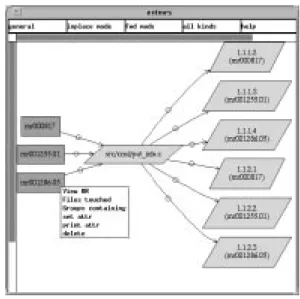
In ciao, program databases and MR databases are linked through the \MRs aecting" query, which maps the selected entity onto its resident le, then queries the change management system for MRs which af-fected that le. Figure 10 shows how ciao can be used this way to browse entities and relationships in a software change control system. In this graph, MRs, source les, and versions of those les stored in SCCS les are represented as graph nodes, and relationships between the entities are shown. Three modication requests have aected the le src/cmd/put info.c,
and the system has created three SCCS versions in two parallel branches (SABLIME keeps an ocial branch, in which new SCCS versions are created only after an MR has been placed in a particular state in the database, and an MR branch, in which new SCCS ver-sions are created when the individual les are checked in after editing). The SCCS version ID and the MR that created it are shown in each SCCS version node. Menus are associated with each entity, allowing the user to add information about related entities to the graph. The menu associated with an MR is shown. The user can view the text of the MR from the change control system's database, add other les touched by the MR to the graph, or show the MR's relationship to
Figure 10: Graphical view of information stored in a change control system.
user-dened groups of MRs in the system. For exam-ple, users can nd other les that are touched by MR
mr001255.01and expand the graph further by
select-ing the \Files touched" menu item under the inplace graph mode.
when a new MR is submitted.
5 Experience and Performance
In this section, we describe the set of design de-cisions that either have contributed to ciao's success or hindered its development. We also provide per-formance gures to demonstrate the feasibility of our implementation of the Aero architecture style.
5.1 The Entity-Relationship Model
The design of our system has beneted repeatedly from the entity-relationship model, which not only helped us cut through the complex C and C++ syntax to get a clean structure model, but also helped us to unify all the tool interfaces. The duality between our entity-relationship databases and directed attributed graphs allowed us to visualize and apply graph algo-rithms to the code structure through simple transfor-mation steps. Moreover, operating at the ER database level allows us to treat dierent languages in a uni-form way in their corresponding query and analysis operators. For example, instead of creating new and separate operators to compute the C++ inheritance hierarchy (or friendship) graph shown in Figure 8, the same pipeline that creates a C type dependency graph is reused. Only a selection clause is added in the query specication to limit the type to type relationship to inheritance (or friendship). The only language-specic processing is the mapping of virtual inheritance rela-tionships to edges properly labeled with \v", This can
be done through the specication of a small graph dec-oration database. Our experience shows that reusing existing operators with slight adaptations requires a carefully-designed data model that leaves most of the language-specic tasks to the abstractor.
5.2 Database Overhead and Query
Per-formance
Although hardware performance has improved sig-nicantly in the past decade, our experience strongly suggests that eective use of storage space and ade-quate query performance remain critical to the accep-tance of repository-based reverse engineering tools in large software projects.
To help evaluate the database overhead, we con-sider the following metrics for the C language: source size (S), database and index size (D), entity set size (E), relationship set size (R), expansion factor (D/S), and connectivity factor (R/E). Our metrics tool, cia-stat, collects these numbers and other statistics auto-matically. As an example, Table 1 compares the met-rics obtained from three software projects. Note that the expansion factor, the major metrics value concern-ing the database overhead, varies widely dependconcern-ing on the structure of the program, but it usually stays well below 150%. A relatively low connectivity factor is usually an indication of a large number of unused en-tities { as we have observed in project C.
One key decision that contributes to the compact-ness of our program database is a careful tradeo be-tween entity granularity and the database size. The current database keeps complete dependency informa-tion among externally and statically visible program
sqrt DBClearElt free ceil strcpy XDrawString floor XLoadQueryFont DBChangeJustify PTModifyTextPoints UNRembMod GRSetTextPos GRFontStrlen strlen PTMakePoint malloc XSetFunction XSetFillStyle sprintf XChangeGC DISScreenAdd rect_bounding GRSetCurve GRCurve GRDisplayJustify GRPutText GRSetLineStyle GRArc GRVector GRSetStippleStyle GRStippleFill XSetForeground XCopyArea GRBezier GRBSpline GRSetBSpline GRSetBezier max XFillRectangle GRGetCharYSize PeriodicSpline NaturalEndSpline Paramaterize XCopyPlane GROpenFont GRfontfound XTextWidth pow cos sin log10 point RoundEnd XDrawLine fprintf XFillPolygon BezierCubics UniformCubicBSpline DISScreenErase perror GRBlankPoints GRErasePoint GRDisplayPoint GRCurrentSetOn GRCurrentSet XDrawPoint XNextEvent LGMJustify CP CSP error UNForget LGShowPoints TxPutMsg get_any_button TxClearMsg menu_chstipple MNReverse align_down menu_align menu_middle MNReverseJustify TxMsgOK printf
Figure 11: A Closure Graph from Project B
entities while ignoring local declarations and their in-ternal relationships { such information is usually not essential in the context of large software projects.
With plug-compatible query and analysis opera-tors, the shell script language ksh became our pri-mary language for building new reverse engineering tools. For example, both deadobj and focus are simple shell scripts that use queries and the closure operator to perform their tasks. Since basic queries are used as fundamental building blocks in many scripts, they must run eciently. As an example, we ran three typ-ical queries (entity, relationship, closure) for each of the three databases listed in Table 1 on an SGI Indy R4400 workstation running IRIX 5.2 and listed the execution time (user + system time) of each query in Table 2.
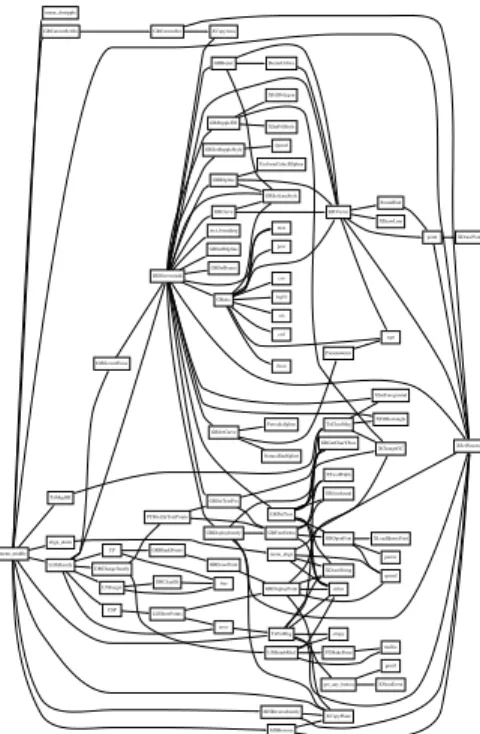
As the table indicates, even for project C, which involves over 46,000 entities and 47,000 relationships, basic entity and relationship queries return results in-stantly. The closure computations, while more com-plex, also return results within seconds. The layout tool dot is also very ecient. It took only 1.12 sec-onds on the same machine to map the closure set (85 entities and 142 relationships) retrieved for project B to the layout shown in Figure 11.
5.3 Virtual Database Pipeline
ei-Proj number number source database ent. set rel. set exp. conn.
of les of lines size size size size factor factor
A 111 20,724 487 KB 356 KB 2,380 3,558 73.1% 149%
B 147 24,415 617 KB 722 KB 4,840 6,635 117% 137%
C 6,228 861,939 13.4 MB 6.37 MB 46,299 47,879 47.5% 103%
Table 1: Source and database size metrics from three software projects Proj entity relationship closure closure
query query query set size
A 0.13s 0.28s 1.23s 180
B 0.12s 0.19s 0.59s 85
C 0.13s 0.18s 2.80s 531
Table 2: Performance of sample query and analysis tools
ther a reachable E set or R set. It depends on what the next operator expects. By unifying the input and output representations to a virtual database, opera-tors become completely plug-compatible. The default result of a closure operator becomes a virtual database that stores the complete set of reachable E and R sets. Users can then apply any operator, including an en-tity query, a relationship query, or even another clo-sure operator starting at a dierent root entity, to the resulting virtual database to retrieve desired informa-tion.
5.4 Software Visualization
Selectivity is essential to successful visualization of complex software structures. We frequently deal with graphs that are hundreds of times more complex than the one shown in Figure 112. Fortunately, the virtual
database pipeline allows us to selectively retrieve dif-ferent facets of a software structure using a variety of query, analysis, and visualization operators.
Initially, we used pre-dened functions to map en-tity and relationship attributes in C and C++ to display attributes such as colors, shapes, and edge styles. This approach was not satisfactory because a programmer might decide to change the mapping to emphasize certain aspects of a program graph. For example, in a general C++ type dependency graph involving inheritance, friendship, and reference rela-tionships, the edge styles (solid, dashed, dotted) may be used to represent these three types of relation-ships rather than the three kinds of access specica-tions (public, protected, and private) of inheritance relationships. We have generalized the graph decora-tion process by using a small, customizable decoradecora-tion database that species the mapping from selected en-tity attributes to decoration attributes.
While we have presented only database, source, and graph viewers in this paper, additional visualiza-tion services such as that provided by SeeSoft[13] (by changing SeeSoft's granularity from a line to an entity)
2An example from an operations systems project can be
found on the cover of the July/August 1994 issue of the AT&T Technical Journal.
can also be built on top of a software database.
6 Summary and Future Work
Ciao is an extensible and customizable graphicalinterface for querying and browsing Aero repositories, which store source documents and their associated ER databases. We have demonstrated the exibil-ity of the ciao interface in the navigation of C, C++, program dierence, and MR databases. The virtual database is the standard data exchange format be-tween plug-compatible ciao operators. Many complex applications and graphical views are built by simply connecting ciao operators on a pipeline. Exploring software structure changes and their impact is par-ticularly eective with the graphical navigation facil-ities provided by ciao. Linking the program dier-ence database with the MR database has allowed us to start making connections between software features and actual program entities. Since the Aero architec-ture style is strongly language-independent, plans are under way to build dierent instantiations of ciao for many other types of repositories, including those of shell scripts, World-Wide-Web (WWW) home pages, and business information.
7 Acknowledgements and Availability
Thanks to all those colleagues in the SoftwareEngineering Research Department and Communica-tion InformaCommunica-tion Systems Research Department who have provided well-designed and reusable software components to make this work possible. Many of the ciao-related tools described in this paper can be obtained by visiting the World-Wide-Web site http://www.research.att.com/orgs/ssr/book/reuse.
References
[1] Robert S. Arnold. Software Reengineering: AQuick History. Communications of the ACM, 37(5):13{14, May 1994.
[2] Morris I. Bolsky and David G Korn. The Korn-Shell { Command and Programming Language. Prentice Hall, 1988.
[3] E. Buss, R. De Mori, W.M. Gentleman, J. Hen-shaw, J. Johnson, K. Kontogianis, E. Merlo, H.A. Muller, J. Mylopoulos, S. Paul, A. Prakash, M. Stanley, S.R. TIlley, J. Troster, and K. Wong. Investigating Reverse Engineering Technologies for the CAS Program Understanding Project. IBM Systems Journal, 33(3):477{500, 1988. [4] P. P. Chen. The Entity-Relationship Model { To-ward a Unied View of Data. ACM Transactions
[5] Yih-Farn Chen. Dagger: A Tool to Gener-ate Program Graphs. In Proceedings of the USENIX Unix Applications Development Sympo-sium, pages 19{35, 1994.
[6] Yih-Farn Chen. Repository-Based Reverse Engi-neering: An Experience Report. In The Fourth Reengineering Form, pages 33{1{33{10, 1994. [7] Yih-Farn Chen. Reverse engineering. In B.
Krish-namurthy, editor, Practical Reusable UNIX Soft-ware, chapter 6, pages 177{208. John Wiley & Sons, New York, 1995.
[8] Yih-Farn Chen, Balachander Krishnamurthy, and Kiem-Phong Vo. An Objective Reuse Metric: Model and Methodology. In Fifth European Soft-ware Engineering Conference, 1995.
[9] Yih-Farn Chen, Michael Nishimoto, and C. V. Ramamoorthy. The C Information Abstraction System. IEEE Transactions on Software Engi-neering, 16(3):325{334, March 1990.
[10] Yih-Farn Chen, David Rosenblum, and Kiem-Phong Vo. TestTube: A System for Selective Regression Testing. In The 16th Internation Con-ference on Software Engineering, pages 211 { 220, 1994.
[11] S. Cichinksi and G. S. Fowler. Product Adminis-tration through Sable and Nmake. AT&T Tech-nical Journal, 67(4):59{70, July 1988.
[12] P. Devanbu. Genoa|a language and front-end independent source code analyzer generator. In Proceedings of the Fourteenth International Con-ference on Software Engineering, pages 307{317, 1992.
[13] Stephen G. Eick, Joseph L. Steen, and Eric E. Sumner. SeeSoft { tool for visualizing line ori-ented software. IEEE Transactions on Software Engineering, 11(18):957{968, 1992.
[14] Glenn Fowler. A Case for make. Software { Prac-tice and Experience, 20:35{46, June 1990. [15] Glenn Fowler. cql { A Flat File Database Query
Language. In USENIX Winter 1994 Conference, pages 11{21, January 1994.
[16] Emden R. Gansner, Eleftherios Koutsoos, Stephen C. North, and Kiem-Phong Vo. A Tech-nique for Drawing Directed Graphs. IEEE Trans-actions on Software Engineering, pages 214{230, March 1993.
[17] David Garlan, Robert Allen,
and John Ockerbloom. Exploiting Style in Archi-tectural Design Environments. In Proceedings of the ACM SIGSOFT Symposium on Foundations of Software Engineering, December 1994. [18] Judith Grass and Y. F. Chen. The C++ Infor-mation Abstractor. In The Second USENIX C++
Conference, pages 265{275, April 1990.
[19] Judith E. Grass. Cdi: A Syntax Directed Dif-ferencer for C++ Programs. In USENIX C++ Conference Proceedings, pages 181{193, August 1992.
[20] Eleftherios Koutsoos
and David Dobkin. LEFTY: A Two-view Edi-tor for Technical Pictures. In Graphics Interface '91, Calgary, Alberta, pages 68{76, 1991.
[21] Eleftherios Koutsoos and Steve North. Applica-tions of Graph Visualization. In Proceedings of Graphics Interface, pages 235{245, May 1994. [22] Moises Lejter, Scott Meyers, and Steven P. Reiss.
Support for Maintaining Object-Oriented Pro-grams. IEEE Transactions on Software Engineer-ing, 18(12):1045{1052, December 1992.
[23] Rob Murray. A Statically Typed Abstract Rep-resentation for C++ Programs. In Proceedings of the USENIX C++ Conference, pages 83{97, August 1992.
[24] Jim Q. Ning, Andre Engberts, and W. Koza-czynski. Automated Support for Legacy Code Understanding. Communications of the ACM, 37(5):50{57, May 1994.
[25] David L. Parnas. Software Aging. In The 16th Internation Conference on Software Engineering, pages 279 { 287, 1994.
[26] Dewayne Perry and Alexander Wolf. Foundations for the Study of Software Architecture. ACM SIGSOFT, 17(4):40{52, October 1992.
[27] Marc J. Rochkind. The Source Code Control Sys-tem. IEEE Transactions on Software Engineer-ing, Vol.SE-1, 1(4):365{370, December 1975. [28] David Rosenblum and Alexander Wolf.
Repre-senting Semantically Analyzed C++ Code with Reprise. In USENIX C++ Conference Proceed-ings, pages 119{134, April 1991.
[29] Peter G. Selfridge and George T. Heineman. Graphical Support for Code-Level Software Un-derstanding. In The Ninth Knowledge-Based Software Engineering Conference, 1994.
[30] David Sharon and Rodney Bell. Tools that Bind: Creating Integrated Environments. IEEE Soft-ware, 12(2):76{85, March 1995.
[31] Ian Thomas. PCTE Interfaces: Supporting Tools in Software-Engineering Environments. IEEE Software, 6(6):15{23, November 1989.