Electrical Engineering Department
California Polytechnic State University
Senior Project Report
Lawn Buddy
June 5th 2020Andrew Brown
Jacob Maljian
Jayson Johnston
Table of Contents
Table of Contents 2
Tables 3
Figures 3
Acknowledgements 5
Abstract 5
Introduction and Background 5
Product/Project Description 7
Product/Technology/Market Research 8
Customer Archetype 10
Market Description 11
Marketing Requirements 13
Engineering Requirements 19
Design 21
Test Plans 29
Development and Construction 30
Integration and Test Results 34
Conclusion 39
References 41
Appendix A. Analysis of Senior Project 43
Appendix B. Parts List and Cost 47
Appendix C. Schedule 52
Appendix D. PC Board Layout 56
Tables
Table 1. Customer Archetype 10
Table 2. Robotic Lawn Mower Competitors 12
Table 3. Top Level Marketing Requirements 15
Table 4. Pairwise Comparison of Top Level Marketing Requirements 16
Table 5. Pairwise Comparison of Ease of Use Sub-Requirements 17
Table 6. Pairwise Comparison of Autonomous Sub-Requirements 18
Table 7. Pairwise Comparison of Safety Sub-Requirements 18
Table 8. Engineering Requirements 19
Table 9. Group Member Responsibilities 29
Table 10. GPS Module Data Points Analysis 37
Table 11. Total BOM 47
Table 12. PCB Components BOM 48
Figures
Figure 1. Business Model Canvas 13
Figure 2. Marketing Datasheet 15
Figure 3. Hierarchy of Marketing Requirements 17
Figure 4. Overall System Block Diagram 21
Figure 5. Motor Controller Block Diagram 21
Figure 6. Sensing Block Diagram 22
Figure 7. Internal Power Distribution Block Diagram 22
Figure 8. 36V to 12V Buck Conversion Circuit Schematic 22
Figure 9. 36V to 5V Buck Conversion Circuit Schematic 23
Figure 10. 5V to 3.3V LDO Conversion Circuit Schematic 23
Figure 11. Motor Controller Schematic 1 24
Figure 12. Motor Controller Schematic 2 25
Figure 14. Android Application Flow 27
Figure 15. Android Application Flowchart 28
Figure 16. Pathing Algorithms Flowcharts 28
Figure 17. Optical Sensor Measurement Data 35
Figure 18. Mobile Application Lawn Tracing Example 36
Figure 19. Onboard GPS Module Precision Example 36
Figure 20. Latitude Distribution 38
Figure 21. Longitude Distributions 38
Figure 22. Define Stage Gantt Chart 52
Figure 23. Design Stage (Motor and Control through Wireless Comms) Gantt Chart 53
Figure 24. Design Stage (Power Management through User Experience) Gantt Chart 54
Figure 25. Build Stage Gantt Chart 54
Figure 26. Validate and Release Gantt Chart 55
Figure 27. Power Board Top Layer 56
Figure 28. Power Board Bottom Layer 56
Figure 29. Motor Controller Top Layer 57
Acknowledgements
We would like to acknowledge Professors Rich Murray and Andrew Danowitz for their vision
and guidance in the formation of this project.
Abstract
Grass lawns are a common hallmark of the American home. In 2019, a survey from the National Association of Landscape Professionals found that 81% of all Americans owned a lawn [1].
Mowing is a time consuming and costly chore that is part of maintaining a grass lawn. The
manual labor in mowing a lawn can exceed 40 hours per year [2]. People commonly incur weekly costs on mowing services to save time. Traditional gas powered mowers are physically
demanding and use engines that need routine maintenance. They operate loudly enough that
users should be wearing hearing protection and the noise commonly disturbs neighbors. Air pollution from gas emissions are also a concern for both the user and for the environment.
An electric autonomous mower utilizes rechargeable batteries for power. Without a gas-engine, it is significantly quieter and requires little maintenance. No user is necessary to push the mower
and there are no gas emissions. The mower returns to a docking station for charging its
self-contained battery and leaves to mow as scheduled by the user. Collision avoidance and object detection are part of the mower’s completely autonomous navigation. These features
allow the user to spend their time freely after the initial setup. Additional functionality such as
blade mowing patterns and routine check-up reminders can be controlled through a wireless remote interface.
Introduction and Background
Home and lawn ownership is a way for Americans to enhance their quality of life by having the
brings responsibility. One of the biggest chores in lawn maintenance is mowing. People will often pay for services to save time and labor rather than mowing the lawn themselves. According
to a 2017 survey from NALP (National Association of Landscape Professionals), 40% of
Americans with a yard paid for lawn or landscape work within the previous year [3]. Out of that group, mowing accounts for 50% of services [3]. In 2019, 81% of Americans owned a lawn [1].
People seem to enjoy having lawns but are either unable or averse to mowing.
Besides time spent on the actual mowing, there are certain efforts to it that may seem daunting or bothersome to many people. The Lawn Institute suggests the best mowing time for grass health
is early morning or evening. These are inconvenient times for suburban Americans working the traditional 9am-5pm on weekdays. On the weekend, these times are likely to disturb neighbors
and the local community from the traditional loud gas lawn mower noise. Gas lawn mowers can
also be physically demanding to push around for any person, with sizes that vary between 50lbs (for lightweight small models) and 100lbs. Other lawn mowing basics to keep track of are
mowing patterns, adjusting blades for proper height, and maintaining the gas lawn mower itself.
These are all inconveniences that the average American has to consider, just for the one task of mowing as a part of lawn ownership.
Electric lawnmowers address many mowing concerns. Gas-powered lawn mowers typically produce 10 times as much noise as their battery-powered counterparts and require hearing
protection for safety. Electric mowers are also 10-30 lbs lighter because they use electric motors
instead of gas engines. Starting the mower is as simple as ensuring the mower is powered and pushing a button. A gas mower requires checking various components before pulling rigorously
on the starter cord.
Gas-powered engine maintenance from spark plugs, fuel and air filters, gasoline, oil, and other parts are eliminated altogether. Usability is improved on an electric mower because there is no
prepping, priming, and pulling to start an engine. Because electric mowers do not directly produce any greenhouse gas emissions, they are better for the user’s health and for the
Electric battery-powered lawnmowers provide lightweight simplicity with reduced noise for grass lawn owners. However they do not address the time it still takes to mow a lawn, and one of
their biggest drawbacks is the amount of time they can stay powered. Autonomous robot
technology is the way to resolve this problem. Many households already use this technology with robotic vacuums. The user provides some settings for the robot and it has a charging station
“home” that it can return to when necessary or when it is not in use. A robotic mower would save
time for the user by largely operating on its own to mow a lawn and incorporate all the advantages of a standard push electric lawnmower. The home docking station allows for the
mower to maintain its own battery charge if needed for larger lawns. Minimal maintenance and interaction is required, and the user no longer has to pay for mowing services. The autonomous
lawnmower robot is an efficient solution that is familiar, simple, and very user-friendly.
Product/Project Description
The Lawn Buddy mower bot eliminates one of the biggest burdens of maintaining a grass lawn.
There is no need for a user to push around a large machine, because the bot uses autonomous technology to navigate the lawn. After an initial setup, Lawn Buddy leaves its home charging
station to mow the lawn as scheduled, and returns to its station when it is done or when its on
low battery.
Because the bot is electric, it produces significantly less noise, less than 85dB [4]. This is within the NIOSH (National Institute for Occupational Safety) range of safe hearing without additional
protection, compared to gas-powered lawn mowers that are typically outside of the safe range at
90dB or above [4].
As a result, Lawn Buddy can mow the lawn on any day with minimal user interaction and
Product/Technology/Market Research
Several autonomous lawn mowers exist on the market today. In terms of form factor, many of
them are reminiscent of the Roomba, flat disks that are low to the ground. They also commonly feature a large set of wheels in the back with good tread.
The Lawn Buddy is differentiated in form factor because it looks like a traditional lawn mower. This gives a sense of familiarity for customers with traditional mowers to transfer over. All
autonomous mowers, including the Lawn Buddy, use electric battery powered motors . Electric
mowers also inherently produce much less noise than traditional gas mowers, so the Lawn Buddy will also operate in the safe hearing range for humans with no ear protection (below
85dB). Market released autonomous mowers have range that allow them to mow up to a 1.25 acre lawn in one charge [4]. The Lawn Buddy targets owners with a more standard lawn size
(0.25 acres) so that the cost remains affordable.
Autonomous mowers on the market today are almost exclusively designed for home use. They
use a simple mapping system so that the mower knows where and where not to mow [5]. This is
implemented with wire laid along the boundary. When the mower approaches that boundary, it changes direction so as not to leave the desired mowing region. Some mowers use the same wire
border system to avoid obstacles in the middle of the lawn area. Other more advanced mowers have some form of internal obstacle detection system to avoid obstructions within the mowing
region. A key technology differentiator of the Lawn Buddy is how the mowing region is defined.
It will not using a physical guide wire and instead will be guided by a digital border system. With the advancements in GPS sensing, accuracy is now within a single meter for the average
GPS module [7]. Accuracy within a single meter, combined with optical proximity sensing
allows the mower to contain itself within a user defined space and navigate obstacles within that space. As a result, the Lawn Buddy does not require extra hardware to be placed in the lawn
in the world of AI allow for the intelligent routing of the robot. Some of the original autonomous vehicles meant for the home, such as Roomba, would simply bounce from wall to wall in
somewhat random patterns. For floors inside the house, this is reasonable because you can not
see the route taken by the robot after the fact. Mowing a lawn, however, leaves a path in the grass that follows the mower, so typically the mowing is done in a way which leaves a pleasing
pattern. The Lawn Buddy will use software like this to create a pleasing mowing pattern.
Wireless communications such as Bluetooth, WiFi, and more allow for information which resides on one device to seamlessly be passed to another. The Lawn Buddy will use wireless
communications, likely Bluetooth as the user need only be paired to the mower for setup, to pass information like the GPS coordinates for the mowing region to the mower from the user's
personal device. Information such as error messages will also be passed back to the user’s
device.
Time and money are huge factors for lawn owners in how they maintain their land. As
mentioned before, 50% of Americans that paid for professional yard services did so for lawn mowing [3]. The same survey revealed 41% of those that paid for lawn work did so to save time,
and 62% of those that didn’t pay for services wanted to save costs [3]. Lawn Buddy inherently saves time with its autonomous capabilities for mowing. Professional lawn mowing services
range from $30 on the low end and $509 on the high end per visit. Lawn Buddy is priced to have
the upfront and competitive cost of $899 to save on service costs and be less expensive than similar autonomous mowers currently on the market. Notable positive customer reviews for
commercial autonomous mowers mention saving time, ease of use, integration with existing
home smart systems, and successful object avoidance as benefits of these mowers over non autonomous mowers [7]. Major negative reviews reveal issues with the robot leaving wire
Customer Archetype
The project’s main competitors are selling similar products that can cost upwards of $1200. This
cost can be a barrier to many possible customers, thus narrowing the customer archetype. By selling a simple-to-use, affordable, and reliable robotic lawn mower, we can market towards four
types of customers: American Homeowners with limited time, Lawn Owners with physical
limitations, Environmentally Conscious Homeowners, and Early Adopters. There is a trend towards more green and environmentally friendly products and thus a market for electric lawn
care products such as lawn mowers. Table 1 expands on the customer archetype.
Description Reason Product Use
Lawn Owners with limited time
These people tend to work 40+ hours a week and often hire third-party lawn care professionals and spend hundreds of dollars each year.
Lawn care, even just lawn mowing can be expensive, loud, and polluting. Due to their limited time, lawn owners typically hire third-party lawn care professionals.
Our electric and robotic lawn mower eliminates high annual cost, high noise, and pollution from traditional lawn mowers.
Lawn Owners with physical limitations
Elderly, physically disabled, or people for whom physical labor is difficult.
These people often cannot perform physical tasks such as lawn care yet still want to feel independent.
The ease-of-use will allow for these individuals to
independently care for their lawn.
Environmentally Conscious Homeowners
Today, more people are trying to cut back their carbon footprint.
They are are trying to cut their carbon footprint.
An electric mower will eliminate the use of gasoline and thus limit air pollution.
Early Adopters The smart home is becoming more and more popular and people are willing to adopt new smart devices.
They want to be on the cutting edge of technology and further their smart home system.
This product will be bluetooth enabled to connect with user and further the automation of their home.
The market for robotic lawn mowers is projected to reach US $1.26 Billion by 2025 [8] because of the rise in popularity of “smart” devices, simplicity of use, and monetary savings that comes
from robotic lawn mowers. Many potential customers have concerns over the cost of hiring
third-party lawn care professionals, the environment, and noise produced by traditional gas lawn mowers. We believe our product can ease these concerns and tap into the market. Since there are
a few robotic lawn mower manufacturers and the market is not dominated by a single company,
we believe our product has a chance at breaking through the market.
Market Description
The Lawn Buddy is a user friendly autonomous lawn mower that is capable of mowing the average yard on a single charge. It features full autonomy and minimal need for human
intervention during use. The Lawn Buddy is equipped with obstacle avoidance so that it does not damage itself, property, or create a dangerous situation for people and animals. The Lawn Buddy
charges on an included dock that can be set up in or outdoors. The mower autonomously docks
and features removable batteries for charging. The Lawn Buddy allows lawn owners to spend less money on hiring maintenance personnel or maintaining a traditional gasoline mower.
The autonomous mower itself is adapted from an existing electric mower, but converted to run on 18 volt power tool batteries. The mower features a traditional rotating blade with a
combination of motors used to control its movement. The Lawn Buddy has many sensors that control its fully autonomous movement by detecting obstacles and knowing the perimeter of the
lawn. Unlike most autonomous mowers currently on the market, the Lawn Buddy does not
require additional hardware to be used, which cuts down installation troubleshooting, time, and costs. Instead the Lawn Buddy includes a wireless software interface that allows the user to
select their desired mowing area via GPS positioning. Users will also be able to select a schedule
The current method for setting up existing commercial autonomous lawn mowers in a yard requires additional guidewires to be installed at the lawn’s edges as a perimeter. This adds
additional material and labor costs to the customer, which for some may not be worth the
investment. Additionally, the existing autonomous lawn mowers on the market cost a substantial amount, ranging from $1000 to $3000, as seen in Table 2. The Lawn Buddy aims to provide
competitive pricing to give the average consumer a more affordable and feasible option.
Husqvarna: Sells lawn and forestry tools worldwide. Main products include chainsaws, Trimmers, leaf blowers, riding lawn mowers, and robotic lawnmowers [9]. Their robotic lawn mower retails starting at $1,599.95 [10].
WORX: Sells a range of power tools and lawn tools. Best known for their lawn
trimmers, lawn mowers, and chainsaws. Their robotic lawn mower retails for $1,199.99 [11]
Robomow: US based company that sells only robotic lawn mowers. Their product retail price starts at $1,299 [12]
Honda: Car, engine, and robotics
manufacturer. Their robotic lawn mower, Miimo, retails starting at $2,500 [13]
Table 2. Robotic Lawn Mower competitors
Autonomous lawn mowers have not reached massive appeal in the US like they have in Europe
[14], but there is a large potential market to be served. The average lawn size in the US is 10,871 ft2 (about ¼ acre) [15]. This is an accessible target market for a more affordable autonomous
lawnmower for a typical property owner with an average yard. Maintaining a low retail price is
expected to be challenging. It could potentially take 500+ hours of research and development, and cost between $1000 and $2000 in materials and parts.
Partnering with a company allows for a more readily available supply of materials for
production. Since a major goal of the Lawn Buddy is to keep its retail price down, a company
like Ryobi could be a good fit since they are known as a cost effective option in power tools. Once a prototype is finalized, major retailers such as The Home Depot, Lowes, Amazon, and
Walmart will need to be engaged so that the Lawn Buddy can be accessible to the general public
The disadvantage of prioritizing a more affordably priced solution to autonomous lawn care is that the Lawn Buddy will take more time to develop similar high-tech features to its competitors.
Focusing less on these supplemental features also reduces user time spent learning how to use
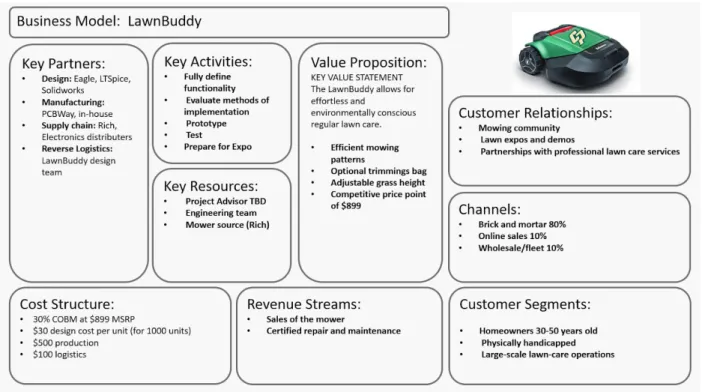
the product. Figure 1 shows the business model for the Lawn Buddy.
Figure 1. Business Model Canvas
Marketing Requirements
In the continental United States alone, there are around 40 million acres of lawn which needs to be regularly maintained [16]. This acreage is split across private property like homes, and public
spaces like parks and golf courses. While most of the public lawnscape is maintained by
professionals or teams of lawn care specialists, the majority of private lawns are still maintained by property owners or lawn care specialists hired by property owners [3]. Many owners take
great pride in their lawns’ appearance, but many abhor lawncare and may choose to do the bare minimum (or less) to manage their lawn. This market is the prime entry point for the Lawn
The US lawn mower market is expected to reach $13B by 2024 [17]. Figure 7 below graphically shows the global lawn mower market from 2014 to 2025 is expected to reach roughly $28.5B by
2024[17].By 2025, electric mowers will potentially be one of the most popular, if not the most
popular, types of mowers produced. Electric mowers are perfect for at home use due to the ease which the power producing unit is obtained (electricity), their cost, their quietness, and for the
environmentally conscious, they provide a more eco-friendly method for servicing the lawn. The
Lawn Buddy targets the “electric” and “robotic” segments of the market, and by 2025, the goal is to capture 20% of the combined electric and robotic mower market segments.
The Lawn Buddy’s target market is private residential lawn owners, with a particular appeal to
those who are short on time, want to save money, the environmentally conscious, those with
physical or temporal limitations, and early adopters wanting to utilize the latest home
technology. As the product matures and technology refined, the future possibility for “fleets” of
electric mowers to replace laborers in the professional lawn care market is also a worthwhile
Figure 2. Marketing Datasheet
There are several requirements that the Lawn Buddy must meet to be successful with customers in the target market. These marketing requirements are: ease of use, battery requirements,
autonomy, lawn quality, and safety. These marketing requirements mimic many of the
functionality seen in autonomous mowers which are currently offered on the market, such as the WorxⓇ Landroid [18] and Husqvarna’s Automower
Ⓡ [19]. Table 3 below describes the
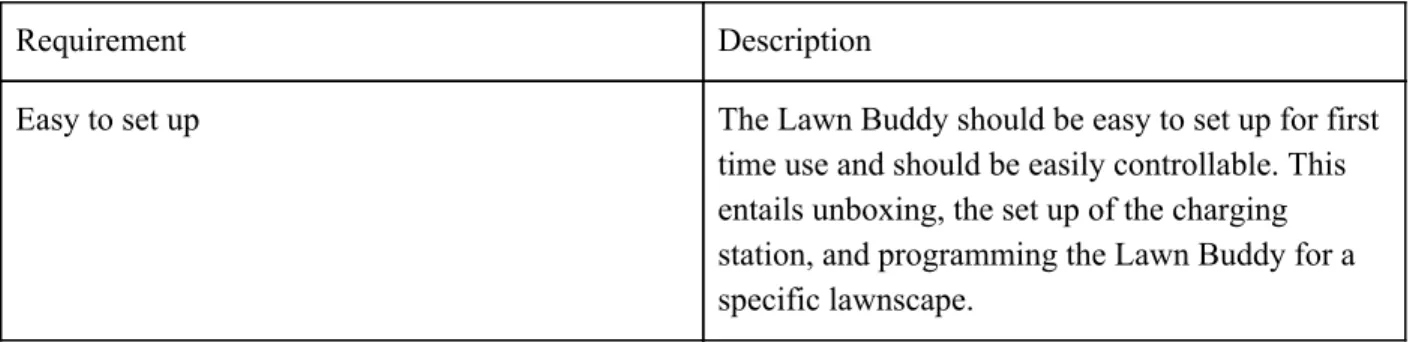
marketing requirements in greater detail.
Requirement Description
Easy to set up The Lawn Buddy should be easy to set up for first time use and should be easily controllable. This entails unboxing, the set up of the charging station, and programming the Lawn Buddy for a specific lawnscape.
Requirement Description
While mowing, requires no human interaction There should be no need for a human to push the mower, move the mower in case of being stuck, or monitor for safety precautions.
Must be able to mow an entire lawn in one charge
The mower should be capable of mowing an entire lawn before returning to the charging station.
Lawn appears well kept The quality of the lawn shall be presentable, with the minimum level of quality meeting those of an average HOA.
Safe to use and will not cause damage to person or property
Obstacles, including people, shrubs, walls, fences and anything else shall not be broken, cut or harmed in any way.
Table 3. Top Level Marketing Requirements
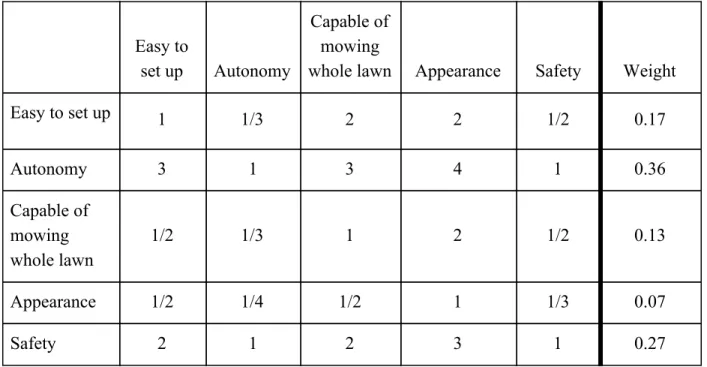
Some marketing requirements have a higher priority than others. The pairwise table below in
Table 4 provides a relative weighing of these requirements to determine how specifications are developed in the engineering phase.
Easy to
set up Autonomy
Capable of mowing
whole lawn Appearance Safety Weight
Easy to set up 1 1/3 2 2 1/2 0.17
Autonomy 3 1 3 4 1 0.36
Capable of mowing whole lawn
1/2 1/3 1 2 1/2 0.13
Appearance 1/2 1/4 1/2 1 1/3 0.07
Safety 2 1 2 3 1 0.27
These top-level marketing requirements are broken down further into sub-requirements as shown in the full objective tree below in Figure 9.
Figure 3. Hierarchy of Marketing Requirements
The pairwise table for the “easy to setup” sub-requirements is below in Table 5. The most important feature is lawnscape mapping. Second most important is routine setup, or how easy it
is to control the robot to do regular mowings.Unboxing experience and charging dock setup are relatively less critical features.
Unboxing Dock setup
Lawnscape
mapping Routine setup Weight
Unboxing 1 2 1/3 1/2 0.17
Dock setup 1/2 1 1/4 1/3 0.09
Lawnscape
mapping 3 4 1 2 0.45
Routine setup 2 3 1/2 1 0.29
The pairwise comparison in Table 6 below shows the “autonomy” sub-requirements.
Self-propelling functionality is the most important aspect, as the mower is not autonomous if
customers have to push it. The mower’s ability to avoid getting stuck and ability to dock and
undock itself are of nearly equal importance. These are functionalities that customers desire. But users commonly expect autonomous home technologies to require occasional help getting
unstuck and docking/ undocking.
Self-propelling Avoids getting stuck
Dock and
undock Weight
Self-propelling 1 3 2 0.55
Avoids getting
stuck 1/3 1 1
0.22
Dock and
undock 1/2 1 1
0.23
Table 6. Pairwise Comparison of Autonomous Sub-Requirements
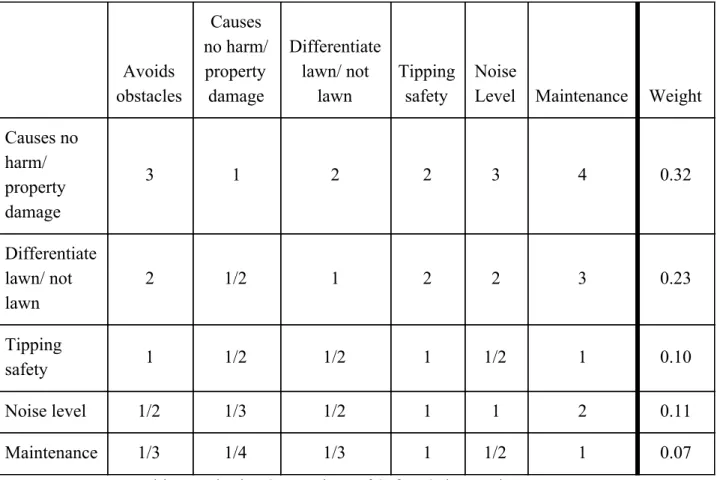
The pairwise in Table 7 below shows the “safety” sub-requirements. Due to major concerns of damage to property or bodily damage, it is very important that the mower has sufficient safety
features. Being able to differentiate lawn versus non-lawn areas is also essential so that the
mower does leave the property. Obstacle avoidance is also crucial in any autonomous navigation system. A self-balancing system to avoid tipping ranks similarly to the mower operating at a
safe noise level (without hearing protection). The least weighted aspect is the maintenance
associated with maintaining a mower defined as safety and ease of use when compared to a traditional gas mower.
Avoids obstacles Causes no harm/ property damage Differentiate lawn/ not lawn Tipping safety Noise
Level Maintenance Weight
Avoids
obstacles 1 1/3 1/2 1 2 3 0.17
Avoids obstacles Causes no harm/ property damage Differentiate lawn/ not lawn Tipping safety Noise
Level Maintenance Weight
Causes no harm/ property damage
3 1 2 2 3 4 0.32
Differentiate lawn/ not lawn
2 1/2 1 2 2 3 0.23
Tipping
safety 1 1/2 1/2 1 1/2 1 0.10
Noise level 1/2 1/3 1/2 1 1 2 0.11
Maintenance 1/3 1/4 1/3 1 1/2 1 0.07
Table 7. Pairwise Comparison of Safety Sub-Requirements
Engineering Requirements
The use of various sensors, voltage regulators, programmable microcontrollers, and other
software have been carefully chosen to meet the marketing requirements laid out in the previous
section. The implementation of each marketing requirement is seen below.
Requirement Implementation
Easy to set up A simple to use UI will be able to be
downloaded to the users computer, where the user will be able to set a mowing area by outlining their lawn on a map. GPS on the mower will make it possible for the mower to know where it should mow. A routine
mowing time will be able to be programmed.
Requirement Implementation
While mowing, requires no human interaction The mower will be self-propelled by DC motors. GPS allows for the mower to determine it’s mowing region without continued user input. Optical proximity sensors on the mower will be able to detect objects and navigate around them without the user steering. The proximity sensor, in tandem with an accelerometer, will allow the mower to shut itself off in the case of tipping or an object suddenly appearing in the mowing path.
Must be able to mow an entire lawn in one pass
18V rechargeable power tool batteries will be used to power all systems on the mower. High efficiency switching voltage regulators will be used to distribute power to subsystems.
Lawn appears well kept The Lawn Buddy will have programmable routines to regularly trim the yard. Using intelligent mowing patterns implemented via software on the microcontroller will also leave the yard looking well kept.
Safe to use and will not cause damage to person or property
The Lawn Buddy’s various sensors, as
previously mentioned, will prevent the mower from running into any objects or animals, and will cause the mower to shut off if too close to an obstruction or tilting over.
Design
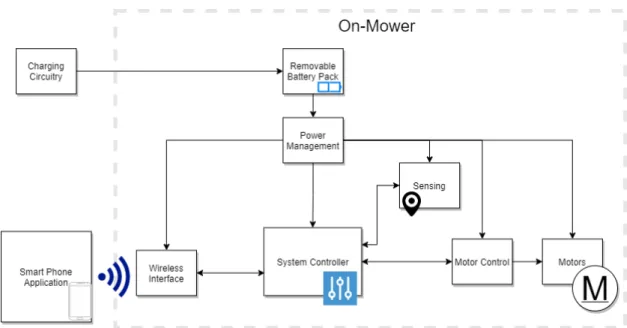
Figure 4. Overall System Block Diagram
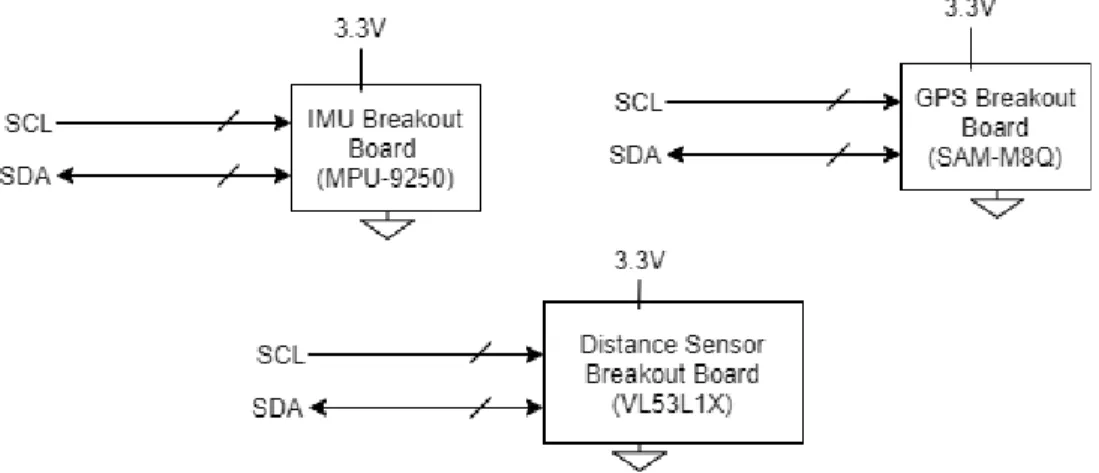
Figure 6. Sensing Block Diagram
Figure 7. Internal Power Distribution Block Diagram
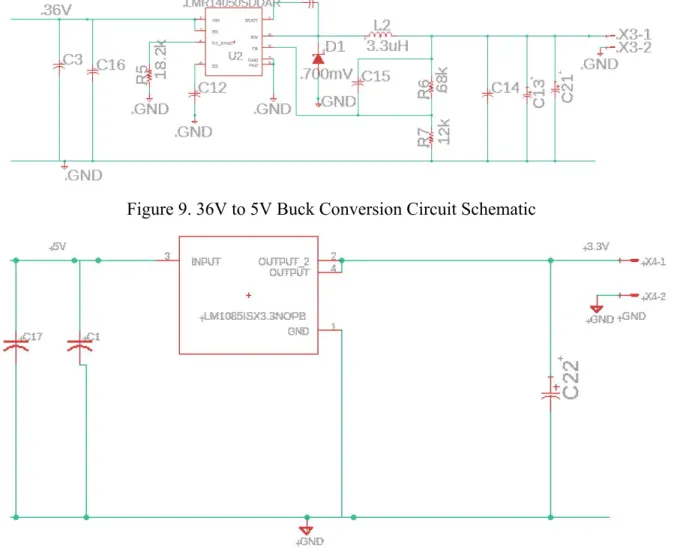
Figure 9. 36V to 5V Buck Conversion Circuit Schematic
Figure 15. Android Application Flowcharts
Name Responsibility (Design, Build, and Validate)
Andrew Brown Mobile Application, System Controller
Software, Wireless Interface
Jacob Maljian Motors, Motor Controller
Jayson Johnston Sensing, Power Management
Table 9. Group Member Responsibilities
Test Plans
Original test plans were made with the assumption that lab equipment would be available to us. Due to the COVID-19 pandemic, several components and sub-systems had to go untested due to
the lack of lab equipment and funding to purchase equipment for at-home use. What was able to be completed and what could not be completed is broken down below.
- Motor Controller:
- Complete: Visual inspection of PCB and components.
- Incomplete: Power up with 5 and 12 V and verify no shorts or electrical issues.
Program microcontroller with Tag Connect. Verify communication is working properly by sending and receiving I2C commands. Verify proper control of the
motors by sending a specific speed and/or distance to the controller and check that the motors turn the correct amount and at the correct speed. Check at multiple
speeds and verify correct operation. Verify the operation of the encoders by
turning the motors at a constant, known speed, and reading the data from the controller. Verify interrupt handling. Send distance commands and verify that
- Sensing:
- Complete: Verify communication between Pi and GPS and proximity sensors,
Proximity sensors, and other sensors. Verify correct operation of I2C to GPS and
proximity sensors. Verify GPS provides correct location data to Pi and Pi
processes data properly. Verify proximity sensor provides correct distance data to
Pi by measuring exact distances and reading the measurement from the Pi.
- Incomplete: Verify IMU records accurate physical data. Test sensors on board mower.
- Power Regulation:
- Complete: Continuity and visual check
- Incomplete: Verify mower power regulation from batteries (36V) to 12V, 5V, and
3.3V. Measure current draw and verify that it is below rated for batteries and power regulators. Check for heating, load regulation, and overall power
consumption (losses). Connect power board to mower, power all electronics off of
batteries.
Development and Construction
Some subsystems of the Lawn Buddy required in-depth development and construction before being integrated in the system whole. Other systems required little attention during this phase,
namely the charging circuitry, sensing components, motors, and wireless interface. These components were selected as finished platforms from the provider. The subsystems which
required specialized development were the power management, motor control, and system
controller subsystems.
When comparing solutions for the power management subsystem, it was determined that
off-the-shelf solutions did not provide the specific voltage and power ratings we desired without exceptional cost and size. Additionally, team members wanted to learn PCB design, and
Design specifications called for a 36V input with 12V, 5V, and 3.3V outputs at 7A, 3A, and
0.5A respectively. After some debate, it was determined that the 12V and 5V levels should be
produced via buck conversion from the 36V input and the 3.3V output should be produced via linear conversion from the 5V output. This provided good efficiency for the large step-downs,
while also optimizing cost in space in a less power wasting conversion from 5V to 3.3V. Due to
the team’s inexperience with power electronics design, the use of the industry tool from TI called WEBENCH® was used to design 3 sub-circuits for each conversion. Those three circuits can be
seen in figures 14 through 16, but have been edited to consolidate input and output capacitors for the three conversion stages combined. The circuits were lifted from WEBENCH® and placed into
Autodesk’s EAGLE EDA PCB suite for combination and PCB layout. Prior to PCB layout, a
complete BOM was created with a focus on designing for availability of parts from DigiKey. Most specifications for passive components came recommended from the WEBENCH® tool, but
the altered input and output components were chosen for appropriate capacitance, voltage rating,
and type (electrolytic). Electrolytics were chosen for their high capacitance-to-footprint ratio and good low frequency performance. A full BOM for the power supply PCB can be found in
Appendix B. Components layout was optimized foremost for short connections and large copper pours for input and output signals. Low voltage control signals and feedback were less
optimized, believing this would provide the best output signal stability and not cause excessive
heat strain. A single layer PCB was chosen for cost optimization and 2 position 3.5mm connections headers were chosen for conformity across subsystems. The power supply PCB
layout is found in Appendix D.
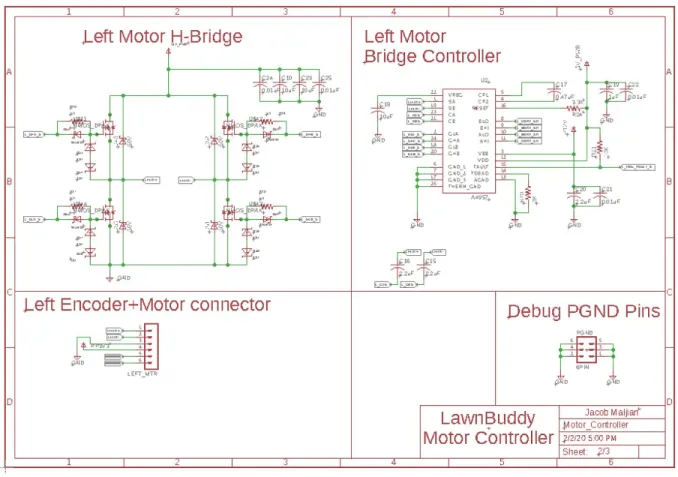
The main design for the motor controller was adapted from a Robotics Club design. Jacob, the
EE tasked with this part, designed the H-bridge motor controller for the Autonomous Golf Cart in the Robotics Club. This design was adapted to meet our specifications and design
requirements. The first change was configuring the STM 32 to communicate via I2C with the
included in the initial circuit. The STM 32 microprocessor is powered off of the 3.3V from the Pi. The H-bridge is powered off of the 12V from the mower power supply.
H-bridges are a very simple and useful design for controlling brushed DC motors, however, if
controlled improperly, run a risk of shorting the power rails and damaging the electronics. To address this issue, we used an Allegro H-bridge controller which has built-in safety features. If,
for some reason, the microprocessor sends an erroneous signal, the controller will enter a “safe
mode” where the bridge stays in an “off” state. In addition to this protection, a resistor and schottky diode are connected to the gate to incorporate a deadtime during turn-on (resistor
creates RC time constant with the gate capacitance) and rapid turn-off (schottky diode bypasses resistor). Additionally, to protect the low-power circuitry, like the STM 32, the design
incorporated an optoisolator to isolate the low-power signal ground from the power ground of the
bridges. The circuit can be seen in figures 17 through 19. A full BOM for the motor controller can be found in Appendix B.
In the PCB design, the components were laid out to account for power and current. The transistors of the H-bridge were placed close together so a large copper pour could be used (to
account for high current) and maintain a small footprint. The Power Ground plane and Signal Ground plane were physically separated and were only connected via an opto isolator. To
connect the 12V to the bridges, a large copper trace was used to accommodate for the high
currents. A two layer PCB was chosen to make the design as compact as possible and allow for simpler trace routing. The motor controller PCB layout can be found in Appendix D.
When designing and developing the software of the system, the use cases, or the actions a user would take when interacting with the system, were the basis for decisions that were made. It’s of
utmost importance that the system be simple to use.
Initializing the software is a simple process. All that the system requires is the user pairing their
involves the user slowly walking around the perimeter of their lawn. Once this is done, users are shown the region that will be transmitted to the mower. If users are unsatisfied with the region,
they can repeat this process. Upon a press of a button, the latitude and longitude coordinates of
the positions of the user that makes up this region are transmitted via bluetooth to the raspberry pi. Screenshots of the application can be seen in figure 20.
Sensor input to the Raspberry Pi proved to be more involved than initially thought. Most sensors provided libraries to easily extract data from them for the Arduino. In hindsight, an Arduino
could have been utilized for quicker progress in this area.
An important part of the system controller is controlling the path the mower takes. There are
many different algorithms that can be used to determine the path, each with ranging simplicity and speed.
The first algorithm will be referred to as the random line algorithm. This algorithm involves the process that most people imagine a simple automated vacuum cleaner takes: move in a straight
line, and if an object is run into, stop and turn to a random angle in the opposite direction before continuing. Eventually, this will cover the entire area, but can not guarantee complete completion
in a specific amount of time. This algorithm, however, would be good in applications where a
slightly less than perfect job would not be noticeable.
The second algorithm will be referred to as the random spiral algorithm. This algorithm is an
efficiency improvement on the first algorithm. In this algorithm, the mower would travel in a straight line a random distance and then move, turning in an increasing radius, creating a spiral.
Once the mower would reach either an obstacle or perimeter of the mowing area, it would stop, point towards a random direction, and repeat this process. It is hypothesised that this would be
quicker at this algorithm would be quicker at covering the center open areas of the mowing area,
simulated in 2018 and was shown that the random line algorithm was consistently able to achieve 100% coverage of areas in less turns than the spiral line algorithm [20].
The third algorithm will be referred to as a predetermined path algorithm. Like it suggests, the predetermined path algorithm calculates and follows a predetermined path, regenerating a path
when an obstacle is encountered. This algorithm would work well as long as sensors onboard the
mower are very accurate.
In this project, the first two algorithms are implemented, but not fully tested. Flowcharts of these algorithms can be seen in figure 22. The COVID-19 pandemic and subsequent quarantine caused
a lack of university resources and separation from project materials, resulting in a slight
redistributing of responsibilities. As such, we were unable to implement the third algorithm.
Integration and Test Results
Due to the restricted access of development and testing equipment, limited testing of the Lawn
Buddy could occur. The only subsystems capable of being tested were the optical sensor, mobile
application, and on-board GPS module. Three tests were conducted to test these subsystems.
The first test was to collect distance measurement data from the optical sensor. Figure 22 shows that the optical sensor followed a slope of approximately unity. This shows it would be sufficient
Figure 17. Optical Sensor Measurement Data
The second test conducted tested the mobile applications GPS tracking capabilities. These
tracking capabilities are critical in defining the mowing region. It is important the application
provides as accurate data points as possible such that the mowing region is confined to only the desired lawn space. Users trace their lawn space by activating the app’s tracing function and then
walking the edge of their lawn, hitting stop when back to the original space. Figure 22 shows one test. A team member activated the app and walked along the edge of their lawn. The red dots
are the GPS locations collected by the phone, while the blue line is the approximate edge of the
lawn space. The accuracy of the app appears to vary based on distance from house. This is hypothesized to be the WiFi connection of the cellular device. WiFi connection improves
accuracy of GPS data. As the user approaches the northern edge (furthest from the WiFi router),
Figure 18. Mobile Application Lawn Tracing Example
The third test conducted tested the on-board GPS modules precision. The module sat in a
stationary position and collected approximately 500 GPS data points. Figure 24 shows the results
of this test, where the red points are the GPS points collected and the black dot is the
approximate actual location of the module. The figure shows a clear bias of GPS data points to
the west and south of the actual location.
To understand the GPS accuracy better, Table 10 shows the (approximate) actual GPS location
versus the mean, median, and mode. This breakdown suggests the latitude is more accurate than
longitude. The breakdown also suggests, for a full implementation, using the mean or median of GPS data over a certain time would produce more accurate location data than the mode.
Delta from Actual (O)
Actual Latitude (O) 35.264721
Actual Longitude (O) -120.637065
Mean Latitude (O) 35.26471709 3.91483E-06
Mean Longitude (O) -120.6370923 2.73496E-05
Median Latitude (O) 35.26472467 -3.66667E-06
Median Longitude (O) -120.637096 3.1E-05
Mode Latitude (O) 35.26473183 -1.08333E-05
Mode Longitude (O) -120.6371043 3.93333E-05
Table 10. GPS Module Data Points Analysis
Figures 24 and 25 show the latitude and longitude points, respectively, plotted as a histogram.
This representation supports the previous claim that latitudinal data is more accurate than
Figure 20. Latitude Distribution
Figure 21. Longitude Distributions
GPS data collected in the previously discussed tests is incredibly important for a full
sensor fusion to compensate for the accuracy. Trying to track position in a relatively small space is very difficult to do accurately based solely on GPS data with current technology. A proposed
solution to improve position tracking has two facets. Addressing the mobile app GPS tracking,
the user could be asked to walk the edge of their lawn multiple times, and then combine paths to get the most accurate boundary. Addressing the on-board GPS module, accuracy could be
improved by collecting data over a period (like 1 second) and then applying some mathematical
massaging based on the known distribution. Also, use of the optical sensor would be critical in keeping the mower to a confined lawn space.
Conclusion
The Lawn Buddy autonomous lawnmower project was intended to combine multiple disciplines
of electrical engineering into a product which has promising commercial promise. Aspects of embedded hardware design, controls, power electronics, motors, and more were needed to create
a suitable mowing machine. The team came into the project with varying levels of knowledge
and confidence on these facets. In designing the mower, members learned important principles and industry tools which helped in the process of this project and which will help in future
endeavors. Challenges included lack of technical knowledge and most notably, working as a
completely remote team due to the COVID-19 pandemic.
By far the biggest hurdle to overcome over the course of the project (besides COVID-19) was a lack of knowledge related to either the fundamental design principles of a topic or inexperience
with the tools. This most notably applied to sensing and power electronics technologies as well
as some PCB design. With the sensing technologies, it was a big challenge to nail down exactly what kinds of sensing we wanted to use for the best performance. Original considerations highly
favored an accelerometer and camera/ optical sensor fusion that focused solely on distinguishing
grass from non-grass. This seemed to create a huge challenge for the mower to navigate from it’s home site to the lawn. Physical bumper sensors were also considered for obstacle detection or
consideration, ultimately settling on the GPS, IMU, and optical combined solution. The team also had a severe lack of power electronics design understanding due to the original team
member responsible for that portion leaving the group. In order to complete this sub-system, the
team had to combine their knowledge of basic level conversion topologies and supplement with an industry design tool. PCB design also posed a big challenge to part of the team that had not
done any previously. Overcoming this challenge was truly a team effort, as some had to walk
others through the basic design steps of a PCB and also help educate on how to use the tools. Ultimately, two PCB designs were designed and built.
Trumping all other challenges was the onset of the COVID-19 pandemic mid-project. This,
unfortunately, had a very large impact on the project’s outcome. Besides introducing severe
stresses in the team’s personal lives, the pandemic also forced the team to work completely remotely from each other and severed them from access to most university resources. The loss of
university lab and testing equipment was certainly a huge blow. Originally, it was hard to see
how we would test almost any of our subsystems. Access to power supplies, scopes and multimeters would be critical in verifying several subsystems. We were able to source some
basic meters and power sources but the results were hard to judge as valid just based on the equipment being used. Also, the team lost access to the Robotics Lab on campus, which held
power tools for project assembly, and more importantly, a very expensive debugging system
which was planned to be used for programming the motor controller. The project budget did not have room for buying a new $1000 debugging system which resulted in the motor controller
going uncompleted and the mower to not be able to move. Despite this, the team tried their best
to implement what could be done while not being able to be physically in the same location and without university resources.
This project has promise to be continued in the future, continuing off the work performed over
the last year. There is some solid foundational work done here. A future team could focus solely
factors as well. Autonomous vehicles are a hugely up-and-coming development and there are certainly commercial applications for them in the lawn care industry.
References
[1] B. Guell. “New Research Confirms Americans Still Value Lawns And Green Spaces” https://www.landscapeprofessionals.org/LP/Media/2019-press-releases/Research_Confir ms_Americans_Still_Value_Lawns_and_Green_Spaces.aspx (accessed Oct. 20, 2019)
[2] Time Spent in Primary Activities, Bureau of Labor Statistics, 2018. [Online]. Available: https://www.bls.gov/tus/a2-2018.pdf
[3] “National survey finds 40 percent of Americans with a yard hired professionals for lawn or landscape work in the last year.” Landscape Business.
https://landscape-business.com/national-survey-finds-40-percent-of-americans-with-a-yar d-hired-professionals-for-lawn-or-landscape-work-in-the-last-year/ (accessed Oct. 20, 2019)
[4] J. R. Hagerty. “Lawn Mowers Cut Decibels for a Price.” The Wall Street Journal. https://www.wsj.com/articles/lawn-mowers-cut-decibels-for-a-price-1395768975 (accessed Oct. 20, 2019)
[5] E. Oswald. “The best robotic lawn mowers for 2019.” Digital Trends.
https://www.digitaltrends.com/cool-tech/best-robot-lawnmowers/ (accessed Oct. 20, 2019)
[6] “How on Earth do Robot Mowers Work?” Lawnmowers Direct.
https://www.lawnmowersdirect.co.uk/blog/garden-machinery/lawnmowers/earth-robot-m owers-work/ (accessed Oct. 20, 2019)
[7] “GPS Accuracy.” National Coordination Office for Space-Based Positioning, Navigation, and Timing. https://www.gps.gov/systems/gps/performance/accuracy/ (accessed Dec 5., 2019)
[8] “Robotic Lawn Mower Market.” Markets and Markets.
https://www.marketsandmarkets.com/Market-Reports/robotic-lawn-mower-market-52805 135.html (accessed Oct. 20, 2019)
[9] “Autonomous Mower.” Amazon Search.
[10] “Husqvarna Main Page.” Husqvarna. https://www.husqvarna.com/us/ (accessed Oct. 20, 2019)
[11] “Robotic Lawn Mowers.” Husqvarna.
https://www.husqvarna.com/us/products/robotic-lawn-mowers/ (accessed Oct. 20, 2019)
[12] “Robotic Mowers.” Sylvania Mower Center.
https://sylvaniamowercenter.powerdealer.honda.com/products/miimo (accessed Oct. 20, 2019)
[13] “Robotic Mowers.” Sylvania Mower Center.
https://sylvaniamowercenter.powerdealer.honda.com/products/miimo (accessed Oct. 20, 2019)
[14] M. Potuck “Husqvarna Automower: The iOS controlled mower that cuts your lawn so you don’t have to” 9To5Mac
https://9to5mac.com/2017/09/08/autonomous-robotic-mower-review-husqvarna/ (accessed Oct. 20, 2019)
[15] “The United States Ranked by Yard Size” HomeAdvisor
https://www.homeadvisor.com/r/average-yard-size-by-state/ (accessed Oct. 20, 2019)
[16] C. Ingraham. “Lawns are a soul-crushing timesuck and most of us would be better off without them.” The Washington Post.
https://www.washingtonpost.com/news/wonk/wp/2015/08/04/lawns-are-a-soul-crushing-t imesuck-and-most-of-us-would-be-better-off-without-them/ (accessed Oct. 20, 2019)
[17] “United States Lawn Mower Market Analysis & Forecasts 2019-2024.” Cision. https://www.prnewswire.com/news-releases/united-states-lawn-mower-market-analysis--forecasts-2019-2024-shifting-consumer-focus-toward-smart-technology--emergence-of-r obotic-lawn-mowers-300819523.html (accessed Oct. 20, 2019)
[18] “Landroid M Cordless Robotic Lawn Mower.” Worx.
https://www.worx.com/landroid-robotic-lawn-mower-wg794.html (accessed Oct. 20, 2019)
[19] “Autonomous Mower.” Amazon Search.
https://www.amazon.com/Husqvarna-315X-AUTOMOWER-Robotic-Mower/dp/B07C4 D3WZB/ref=sr_1_7?keywords=autonomous+mower&qid=1571690238&s=lawn-garden &sr=1-7 (accessed Oct. 21, 2019)
Appendix A. Analysis of Senior Project
Project Title: Lawn Buddy Autonomous Lawn MowerStudents: Andrew Brown, Jacob Maljian, Jayson Johnston Advisor: Dr. Andrew Danowitz
1. Summary of Functional Requirements
a. The Lawn Buddy is an autonomous electric lawn mower. It is self propelled and only requires user interaction at initial setup, programming routine mows, to adjust the mowing height, and charging The mower is battery powered and capable of docking and undocking at a charging station. An on-mower
microcontroller will process information from various sensors to ensure safe and efficient mowing by controlling the DC motors. Information will also pass wirelessly to and from the microcontroller to a remote desktop where a UI will allow for user programmability and error monitoring.
2. Primary Constraints
a. One major constraint on the project is the development cost and absence of
funding. The project is not sponsored by a third party so all funding for the project is going to come from the team and EE department. Several of the necessary components for implementation, such as motors, GPS sensors, and
microcontrollers are big ticket items which could drain much of the available funds.
b. The biggest remaining constraint is the implementation of the software necessary to perform autonomous mowing in a semi-intelligent fashion while also
monitoring the surroundings to ensure safe mowing. Fairly complex software is needed to implement this functionality.
3. Economic
a. What economic impacts result
i. Human Capital: The Lawn Buddy helps drive the automated economy, replacing menial tasks with autonomous robots that will increase production and allow more time for self improvement and pursuit of higher wages.
iii. Natural Capital: The Lawn Buddy will use several electronic components which are difficult to recycle or dispose of properly, including
rechargeable batteries, DC motors, and other electronic components. The Lawn Buddy development team will try it’s best to minimize waste. iv. Costs: The target development cost of the Lawn Buddy is $250, however
costs could reach $500 this unless corporate partnerships can be secured. Regardless, the target MSRP price of $899 should ensure a healthy profit between $400 and $650 per unit.
4. If manufactured on a commercial basis
a. Estimated number of devices sold per year: 2000 b. Estimated manufacturing cost of each device: $250 c. Estimated purchase price for each unit: $899 d. Estimated profit per year: $1,298,000
e. Estimated cost for user to operate device: $0.05 (electrical cost) 5. Environmental
a. What environmental impacts are associated with manufacturing or use of the product?
i. The manufacturing of the Lawn Buddy may have environmental issues in several aspects. One is the manufacturing of the rechargeable batteries, which will likely Lithium-ion based, a compound which is known to be toxic and difficult to dispose of properly. Another issue may come from the disposal of other chemicals used in manufacturing, such as the chemicals used in PCB printing and soldering. Environmental impacts of using the product mostly relate to the effect of mowing and
micro-ecosystems which exist in grass lawns. Users should be conscious of the effects mowing their lawn may have on local populations of small mammals, reptiles, and insects.
b. Which natural resources and ecosystem services does the project use (directly and indirectly) and does it improve or harm?
i. The Lawn Buddy will use components that will most likely be harvested from third world and developing countries, which typically has an overall negative impact on those local ecosystems and wellbeing.
c. Does the project impact other species?
i. The project will likely have a direct effect on species which inhabit the grassy lawn of users, as stated previously.
6. Manufacturability
7. Sustainability
a. Describe any issues or challenges associated with maintaining the completed device.
i. The completed device will require the continued charge and discharge of rechargeable batteries. This has costs in electricity, but also the continued cycling of the batteries will eventually cause them to fail and new batteries will be needed. The replacement of these batteries has financial costs, but also environmental costs if the batteries are not disposed of properly. b. Describe how the product impacts the sustainable use of resources.
i. Many of the components which make up the Lawn Buddy will use both renewable and non-renewable resources, including silicon and heavy metals. The Lawn Buddy will attempt to maximize the use of recycled components and RoHS compliant parts whenever possible.
c. Describe any upgrades that would improve the design of the project.
i. The Lawn Buddy could be improved with the addition of a robotic arm used for trimming, edging, and more.
d. Describe any issues or challenges associated with upgrading the design.
i. Upgrading the Lawn Buddy will require the work of dedicated technicians due to the complexity of the initial product and robotic arm. At this
moment, it is not in development plans to build the Lawn Buddy to easily accept upgrades.
8. Ethical
a. The LawnBuddy has ethical implications with intellectual property, product development, and proper use of product. There are ethical concerns when developing the minimum viable product. First is the safety of the engineering team. As with any lawnmower, there are moving components that can cause serious harm, like the cutting blade. It is important that team members make strong efforts to preserve proper safety practices when working on the mower. Another ethical dilemma concerns the use of intellectual property in design. Product developers should be wary where they receive inspiration or intermediate designs from so as to not infringe on IP laws. It is important that the development team discourage improper use of the LawnBuddy by users. The intention of LawnBuddy’s use is exclusively for mowing lawns or else it may pose risk of damage to property, people, or animals.
9. Health and Safety
taken when testing the mower and ample warning will be given to customers on proper use.
10. Social and Political
a. Like most home automation devices, the Lawn Buddy may become somewhat of a status symbol, a prominent one too since it will be seen often in the front yard. It is not the intention of the development for it to be so. The Lawn Buddy is capable of improving the lives of anybody with a patch of grass regardless of wealth. Over subsequent iterations, it is the goal of the Lawn Buddy team to make the device accessible to all.
Appendix B. Parts List and Cost
Item Description Supplier
Manu-
facturer Part No
Unit
price Quantity Cost
GPS
I2C enabled breakout
board SparkFun SparkFun SAM-M8Q $43.05 1 $43.05
IMU
I2C enabled breakout
board SparkFun SparkFun MPU-9250 $16.11 1 $16.11
Distance Sensor
I2C enabled breakout
board SparkFun SparkFun VL53L1X $23.65 1 $23.65
PCBs
Motor controller, power
management JLCPCB JLCPCB N/A $29.60 2 $59.20
32GB SD
Card Pi onboard storage Amazon SanDisk N/A $7.62 1 $7.62
Batteries
Rechargeable power tool
batteries Amazon Ryobi N/A $19.40 4 $77.58
Mounting Hub
(2-pack) Motor mounting Pololu Pololu 1083 $8.59 1 $8.59
L-Bracket
(Pair) Motor Mounting Pololu Pololu 1084 $8.59 1 $8.59
Gearmotor Motor Pololu Pololu 2828 $39.95 2 $79.90
Micro-HDM I to HDMI
adapter Connecting Pi to monitor Amazon
AmazonBas
ics HL-007332 $6.99 1 $6.99
Raspberry Pi System controller Amazon
Raspberry
Pi Raspberry Pi 4 $49.88 1 $49.88
Lawn
Mower Stripped gas push mower
Rich
Murray N/A N/A $0.00 1 $0.00
PCB
Components See detailed BOM Digikey Various Various $105.34 1 $105.34
Total: $486.49
Item Description
Suppli- er
Manufac-
turer Part No
Unit
price Quantity Cost
36V-12V Buck
IC REG CTRLR BUCK
14TSSOP Digikey
Texas Instruments
LM3150MH/NO
PB-ND $3.78 1 $3.78
36V-5V Buck
IC REG BUCK ADJUSTABLE 5A
8SOPWR Digikey
Texas Instruments
296-44322-1-N
D $2.80 1 $2.80
5V-3.3V LDO
IC REG LIN 3.3V 3A
DDPAK/TO263-3 Digikey
Texas Instruments
LM1085ISX-3.3
/NOPBCT-ND $1.97 1 $1.97
Capacitor
CAP CER 0.1UF 50V
X7R 1206 Digikey Kemet 399-1250-1-ND $0.32 2 $0.64
Capacitor
CAP CER 0.015UF 50V
X7R 1206 Digikey Kemet
399-17464-1-N
D $0.47 1 $0.47
Capacitor
CAP CER 0.47UF 25V
X7R 1206 Digikey Kemet
399-14693-1-N
D $0.88 1 $0.88
Capacitor
CAP CER 22UF 25V
X6S 1206 Digikey
Murata Electronics
490-14468-1-N
D $1.24 1 $1.24
Capacitor
CAP CER 8200PF 50V
X7R 1206 Digikey Kemet 399-1233-1-ND $0.34 1 $0.34
Capacitor
CAP CER 270PF 50V
NP0 1206 Digikey Kemet
399-14675-1-N
D $0.48 1 $0.48
Capacitor
CAP CER 33UF 16V
X5R 1206 Digikey
TDK
Corporation 445-6002-1-ND $1.06 2 $2.12
Resistor
RES SMD 191K OHM
1% 1/4W 1206 Digikey Yageo
311-191KFRCT-ND $0.10 1 $0.10
Resistor
RES SMD 10K OHM
1% 1/4W 1206 Digikey Yageo
311-10.0KFRCT
-ND $0.10 1 $0.10
Resistor
RES SMD 18.2K OHM
1% 1/4W 1206 Digikey Yageo
311-18.2KFRCT
-ND $0.10 1 $0.10
Resistor
RES SMD 68K OHM
1% 1/4W 1206 Digikey Yageo
311-68.0KFRCT
-ND $0.10 1 $0.10
Resistor
RES SMD 12K OHM
1% 1/4W 1206 Digikey Yageo
311-12.0KFRCT
-ND $0.10 1 $0.10
Inductor
FIXED IND 3.3UH 5A
15 MOHM SMD Digikey Bourns Inc.
SDR1005-3R3M
LCT-ND $0.87 1 $0.87
Diode
DIODE SCHOTTKY
60V 5A SMC Digikey Diodes Inc.
B560C-FDICT-ND $0.49 1 $0.49
Capacitor
CAP ALUM 10UF 20%
Item Description
Suppli- er
Manufac-
turer Part No
Unit
price Quantity Cost
Capacitor
CAP CER 1UF 50V
X7R 1206 Digikey Kemet 399-8147-1-ND $0.32 6 $1.92
Capacitor
CAP CER 6.8UF 16V
X5R 1206 Digikey Kemet
399-13206-1-N
D $0.92 2 $1.84
Capacitor
CAP CER 10UF 16V
X5R 1206 Digikey Kemet 399-5091-1-ND $0.35 1 $0.35
Capacitor
CAP CER 2.2UF 100V
X7R 1206 Digikey Yageo 311-3450-1-ND $0.79 1 $0.79
Power MOSFET
MOSFET N-CH 200V
18A DPAK Digikey
STMicroele
ctronics 497-5810-1-ND $1.71 2 $3.42
Comparator
IC COMP R-RINOUT
SINGLE 8-MSOP Digikey ADI
LT1711CMS8#P
BF-ND $5.35 1 $5.35
Resistor
RES SMD 174K OHM
1% 1/4W 1206 Digikey Yageo
311-174KFRCT-ND $0.10 1 $0.10
Resistor
RES SMD 2.05K OHM
1% 1/4W 1206 Digikey Panasonic P2.05KFCT-ND $0.10 1 $0.10
Capacitor
CAP CER 82PF 50V
NPO 1206 Digikey Yageo 311-4424-1-ND $0.28 1 $0.28
Inductor
FIXED IND 6.8UH
7.9A 15 MOHM SMD Digikey Bourns Inc.
SRR1210-6R8Y
CT-ND $1.33 1 $1.33
Resistor
RES SMD 10K OHM
1% 1/10W 0603 Digikey Yageo
311-10.0KHRC
T-ND $0.10 2 $0.20
Resistor
RES SMD 3.3K OHM
1% 1/10W 0603 Digikey Yageo
311-3.30KHRC
T-ND $0.10 2 $0.20
Resistor
RES SMD 3K OHM
0.1% 1/10W 0603 Digikey Panasonic
P3.0KDBCT-N
D $0.35 2 $0.70
Resistor
RES SMD 300 OHM
5% 1/4W 0603 Digikey ROHM
RHM300DCT-N
D $0.10 4 $0.40
Capacitor
CAP CER 0.47UF 50V
X7R 0603 Digikey
Taiyo
Yuden 587-3170-1-ND $0.19 2 $0.38
Capacitor
CAP CER 2.2UF 50V
X7R 0805 Digikey
Taiyo
Yuden 587-4963-1-ND $0.37 6 $2.22
Capacitor
CAP CER 10UF 50V
X5R 1206 Digikey
Taiyo
Yuden 587-3248-1-ND $0.45 6 $2.70
Capacitor
CAP CER 1UF 50V
X5R 0603 Digikey
Murata Electronics
490-12330-1-N
D $0.29 4 $1.16
Capacitor
CAP CER 0.1UF 50V
Item Description
Suppli- er
Manufac-
turer Part No
Unit
price Quantity Cost
Diode
TVS DIODE 12V 19V
SOD323 Digikey
ON Semiconduc
tor
SD12T1GOSCT
-ND $0.32 16 $5.15
Diode
DIODE SCHOTTKY
40V 1A SOD123 Digikey Diodes Inc.
1N5819HW-FDI
CT-ND $0.30 12 $3.61
Connector
CONN RCPT HSG
6POS 2.50MM Digikey Molex WM13235-ND $0.30 3 $0.90
Connector
CONN HEADER VERT
6POS 2.5MM Digikey Molex WM9807-ND $0.53 2 $1.06
Connector
CONN SOCKET 16-18AWG CRIMP
GOLD Digikey Molex
WM11558CT-N
D $0.48 6 $2.88
Connector
CONN SOCKET
22-28AWG CRIMP TIN Digikey Molex WM3320CT-ND $0.07 25 $1.67
Connector
CONN HEADER R/A
2POS 3.5MM Digikey Molex WM11586-ND $0.77 5 $3.85
Connector
CONN RCPT HSG
5POS 2.50MM Digikey Molex WM3338-ND $0.32 3 $0.96
Linear Regulator
IC REG LINEAR 5V
100MA 8SOIC Digikey
ON Semiconduc
tor
MC78L05ABD
R2GOSCT-ND $0.44 1 $0.44
Connector
CONN HEADER VERT
5POS 2.5MM Digikey Molex WM4270-ND $0.53 1 $0.53
Motor Driver
IC MOTOR DRIVER
3V-5.5V 24QFN Digikey
Allegro MicroSyste
ms 620-1491-1-ND $2.84 2 $5.68
COnnector
CONN RCPT HSG
2POS 3.50MM Digikey Molex WM11562-ND $0.31 7 $2.17
Isolator
OPTOISOLTR 2.5KV
4CH TRANS 16-SO Digikey Toshiba
TLP291-4(TPE)
CT-ND $1.04 1 $1.04
Motor Controller
IC MCU 32BIT 32KB
FLASH 48LQFP Digikey
STMicroele
ctronics 497-14648-ND $2.80 1 $2.80
Power MOSFET
MOSFET N-CH 100V
25A DPAK Digikey
STMicroele
ctronics 497-3156-1-ND $1.50 8 $12.00
Resistor
RES SMD 4.7K OHM
1% 1/10W 0603 Digikey Yageo
311-4.70KHRC
T-ND $0.10 4 $0.40
Resistor
RES SMD 5.1 OHM 1%
1/10W 0603 Digikey Yageo
YAG3372CT-N
Item Description
Suppli- er
Manufac-
turer Part No
Unit
price Quantity Cost
Capacitor
CAP CER 10000PF 50V
C0G/NP0 0603 Digikey
Murata
Electronics 490-9666-1-ND $0.22 8 $1.76
Resistor
RES SMD 220 OHM
1% 1/10W 0603 Digikey Yageo
311-220HRCT-ND $0.10 4 $0.40
Diode
DIODE SCHOTTKY
60V 1A SOD123F Digikey
STMicroele ctronics
497-17154-1-N
D $0.45 8 $3.60
Total: $93.52
Appendix C. Schedule
Figure 24. Design Stage (Power Management through User Experience) Gantt Chart
Appendix D. PC Board Layout
Figure 27. Power Board Top Layer
Figure 29. Motor Controller Top Layer