EFFECTS OF PAUSE INSERTION ON THE INTELLIGIBILITY OF LOW QUALITY SPEECH
Peter J. Scharpff & Vincent J. van Heuven
Phonetics Laboratory/Dept. of Linguistics Leyden Univecsity, P.O. Box 9515 2300 RA Leiden, The Netherlands
1. INTRODUCTION
The intelligibility of the Output of text-to-speech Systems today is generally poorer than that of natural human speech. One way of improving the quality of eynthetic speech is to insert speech pauses at selected positions in the utterances rather more frequently than the human reader would choose to do. Pause insertion has been reported to improve intelligibility in deaf-speech [1] äs well äs in speech synthesized from diphones [2]. In the studies cit^d here, the pauses were inserted at breaks in the syntactic structure of the spoken sentences, without explicit motivation for this particular pausing strategy. Although the choice is intuitively appealing, there may be other pausing strategies that are perceptually äs adequate but easier to use in text-to-speech applications. The present research, therefore, aims to esta-blish an optimal pause insertion strategy for low-quality speech synthesis. There are at least two criteria that have to be considered when choosing a pausing strategy. Firstly, the pauses should convey äs much useful Information to the listener äs possible; secondly, the positions where the pauses are to be inserted should be detectable by a simple algorithm that can easily be incorporated in a text-to-speech System. Generally, the more useful the Information signalled by the speech pause, the harder it is to find its Position automatically. In our experiments we Bystematically examined the effects of four pausing strategies, which will be discussed in our next sections in ascending order of complexity. The first strategy is one without pauses. The second strategy has pauses at word boundaries at regulär intervals of six words. Here the listener gets Information about some word beginnings in the sentence. In the third strategy we have marked word boundaries before Content words so that Information is given to the listener about beginnings of relatively important words in a sentence. In the last strategy we marked boun-daries so äs to reveal the prosodic structure of the sentence. The speech pauses in this version are located at the end of intonational or phonological phrases. We expect this last strategy to be the most helpful to improve the intelligibility of low quality speech.
intelligibility in general; pauses after monosyllabic words will contribute mcre to intelligibility than those after longer words (cf. [2,5]).
In this paper we shall consider the following main question: what pausing strategy do we have to apply (e.g. in a reading machine) so that it facili-tetes recognition of artificial speech for a listener?
2. METHOD AND MATERIALS
The effect of speech pause insertion on intelligibility is not easy to mea-sure. Using hifi quality speech we can measure no such effect: everything is intelligible äs it is. Moreover, in short sentences the urge of pausing does not exist. Therefore we selected long sentences in low quality speech so äs to maximize the effect of speech pause insertion.
We generated 36-word (68-syllable) sentences, all possible news bulletin messages. An example of such a sentence is:
(a) In de stukgoedsector in de rotterdamse haven zijn gedwongen ontslagen niet meer te vermijden, ondat er volgens de werkgevers, en ook volgens de betrokken bond, op dit moment in die bedrijfstak minstens honderd personeelsleden overbodig zijn.
'In the general cargo sector in the port of Rotterdam forced lay-offs cannot be avoided, because according to the employers, and also accor-ding to the union involved, at this moment in this branch of trade there are at least one hundred employees redundant'.
There were 15 Stimulus sentences preceded by 3 examples. Each sentence was synthesized from diphones at an Information rate of 2 kBaud. Diphones are speech fragments that consist of the last half from one speech sound and the first half of the one following that sound thus containing the natural transi-tion between the two sounds (cf. 16,1]). Intonatransi-tion contours were generated äs illustrated in figure l, with a rise on each accented syllable and a gradual fall spanning the time interval between two consecutive rises; the final two accents were joined into a hat contour (8).
Example of a sentence with a synthetic 'sawtooth' contour. 0 1 D D D l D D D D D 1 0 A O 0 0 Figure 1.
The 'sawtooth' contour, with the transcription from 't Hart & Collier [8].
EFFECTS OF PAUSE INSERTION
(...) ontslagen niet meer [ 200 ms ] te vermijden (...)
0 1 0 0 0 B 0 0 1 D Figure 2.
Exäraple of an inserted pause: in this case the second pause of sentence (a) in Version (1) - eee below. The underlined syllable was lengthened with 40%.
We selected four speech pause insertion strategies:
(1) pauses inserted at regulär intervals of 6 words. Although all pauses were inserted at word boundaries, most did not coincide with phrase boundaries. It has been found that speech pauses are likely to occur at what is called Intonational Phrase (IP) boundaries, and that iPs should have roughly uniform lengths within one sentence [10,11]. IPs are constituents or phrases within the sentence that are not only syntacti-cally but also prosodisyntacti-cally motivated. How long IPs should be in general is unknown; we chose an arbitrary fixed length of 6 words. The result was five pauses per sentence; this number was also inserted in each of the following versions of the sentences.
(2) pauses inserted immediately betöre selected content words. In order to obey the principle of uniform iP-length, we selected content words in the neighbourhood of the pause locations in version (1). This strategy mimicks a speech style in human spontaneous speech sometimes used by Professional talkers. It is unclear whether this is an appropriate strategy for reading text, but at least the positions are relatively easy to find automatically.
(3) pauses inserted at prosodically motivated locations. The pauses were all located at IP-boundaries, or - if no more IP-boundaries were avail-able - at Phi-boundaries (boundaries between Phonological Phrases) in which case the similar length condition was applicable. An algorithm that derives these locations from Orthographie text is complicated, and entails a syntactic analysis of some depth.
(0) a control condition with no pauses inserted. The extra time that lis-teners get in versions (1) through (3) when speech pauses were inserted, was compensated for in this version by a slight decrement of the speech
tempo (about 6%), so that all versions were of the same length.
By way of Illustration we have marked the pause positions äs defined by strategies (1) through (3) in our sample sentence in (a'):
"tFFECTS OF PAUSE INSERTION
Each sentence was presented to 4 groups of 10 listeners in a fully blocked design. Subjects were instructed to listen to a sentence, to write down what they had heard with a blue pen, to listen again to the same sentence and to fill any gap with a red pen. To facilitate the writing task and to decrease possible memory problems we already printed the function words on the answer sheets.
3. RESULTS AND CONCLUSIONS
t.et us first of all analyse the ovecall effect of the four pause strategies on t-he intelligibility of the synthetic speech used in our experiment1 :
Table I.
Scores (in rau2 ) of correctly recognized morphemes3 (-inflection) in 4 pause strategies In parentheses the total nutnber of cases per cell.
(0) no pause s
( 1 pauses af ter each six words
(2) pauses before content words
!3) pauses at prosodic boundaries
correct after Ist presentation
50 (371)
49 (371)
49 (371)
53 (371)
correct after 2nd presentation
81 (371)
78 (371)
75 (371)
84 (371)
Taking the version without speech pauses äs our base-line, we observe that a (modest but significant) improvement of intelligibility with 3 rau is obtained only when pauses are inserted at prosodic boundaries (condition 3). Conditions (2) and (3) show a small decrease of intelligibility relative to the base-line version, which is significant only for second presentation of the Stimulus.
The difference between first and second presentation is roughly 30 rau, which effect is highly significant. This improvement is additive to all other effects with the exception noted above. Therefore the remainder of the data analysis is restricted to first presentations only.
EFFECTS OF PAUSE INSERTION
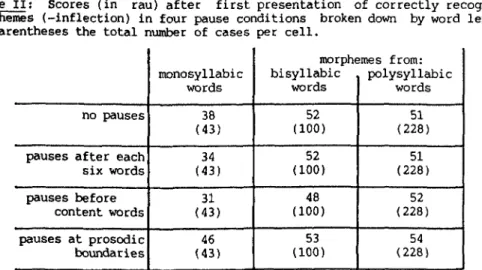
Table II; Scores (in rau) after first presentation of correctly recognized morphemes (-inflection) in four pause conditions broken down by word length. In parentheses the total number of cases per cell.
no pauses
pauses after each six words pauses before
content words pauses at prosodic boundaries
monosyllabic words
38
(43)
34
(43)
31
(43)
46
(43)
morph« bisyllabic
words
52
(100)
52
(100)
48
(100)
53
(100)
>mes from: polysyllabic
words
51
(228)
51
(228)
52
(228) 54 (228)
As predicted, the effect of Speech pause insertion at prosodically motivated locations is very large for. monosyllabic words. Not only compared with less obvioue Strategie» like (1) and (2), but aleo in comparieon with the no-pause version the improvement is substantial. We claim that this is the result of the fact that speech pause insertion after monosyllabic words in any case leads to considerable improvement of the recognition of such words and that this effect is optimized when speech pauses occur at prosodic boundaries in a sentence.
The next question we want to explore concerns the position of a word within a (phonological) phrase. Is the recognition of words at the end of a (phono-logical) phrase easier when the phrase boundary is overtly marked? Consider: Table III: Scores (in rau) after first presentation of correctly recognized morphemes (-inflection) from words followed or not followed by a speech pause and broken down by position of the words within a phrase, across all con-ditions. In parentheses the total number of cases per cell.
not followed by a speech pause followed by
a speech pause
not final o r penult
49
(341)
31
(27)
phrase-penult
49
(327)
37
(41)
phrase-final
47
(564)
70
(184)
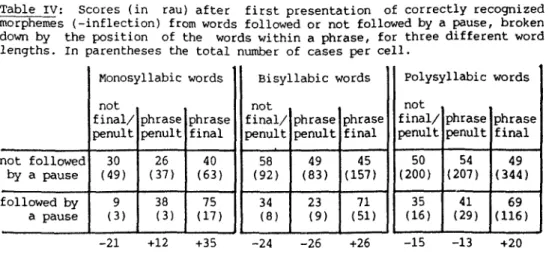
Phrase final words were recognized significantly better when followed by a speech pause than when they were not followed by a pause. When phrase-penult words were followed by a speech pause we found a negative effect of this pause. The same thing happened when we inserted pauses after non-phrase-final or non-phrase-penult words. We can conclude from this observation, that the intelligibility of the long sentences äs we used them in this experiment has substantial benefit from speech pauses inserted after phrase-final words. We already saw that monosyllabic words benefit from speech pauses inserted at prosodic boundaries. After concluding that pausing after phrase final words is the best strategy for improving intelligibility, we predict that recognition of short (monosyllabic) words will be easier when they are phrase final and followed by a pause. Consider the next table.
Table IV: Scores (in rau) after first presentation of correctly recognized morphemes (-inflection) from words followed or not followed by a pause, broken down by the Position of the words within a phrase, for three different word lengths. In parentheses the total number of cases per cell.
not followed by a pause followed by a pause Monosyllabic words not final/ penult 30 (49) 9 (3) phrase penult 26 (37) 38 (3) phrase final 40 (63) 75 (17) Bisyllabic words not final/ penult 58 (92) 34 (8) phrase penult 49 (83) 23 (9) phrase final 45 (157) 71 (51) Polysyllabic words not final/ penult 50 (200) 35 (16) phrase penult 54 (207) 41 (29) phrase final 49 (344) 69 (116)
-21 +12 +35 -24 -26 +26 -15 -13 +20
Pauses inserted after phrase-final words maximally improve the intelligibility of low quality speech. This effect is - äs we predicted - stronger äs the words are shorter. Importantly, phrase-penult monosyllabic words still benefit from a pause, whereas the longer words that are not phrase-final suffer severely. Short words are presumably very sensitive to pause insertion, and by marking the word-ending of those words the pause helps to recognize them, even when the pause does not coincide with a prosodic boundary.
EFFECTS OF PAUSE INSERTION
Scores (in rau) after first presentation of correctly recognized
morphemes (-inflection). Versions without pauses and with pauses at prosodic boundaries. Broken down by position of the words within a phrase. In paren-theses the total number of cases per cell.
no pauses
pauses at prosodic boundaries
not final or penult
50 (92)
50 (92)
phrase-penult
49 (92)
50 (92)
phrase-final
51 (187)
56 (187)
Clearly, phrase-penult words do not benefit any more from the pause inserted after the following phrase-final word. We conclude that the effect of the speech pause does not Stretch over more than one word.
4. DISCUSSION
The results of the experiraents show that it is very helpful for listeners to insert speech pauses, but only if they are inserted at the right locations: the intelligibility of low quality speech improves when speech pauses are inserted at prosodic boundaries, but deteriorates when other locations are cnosen. Therefore we suggest that when speech pauses are to be inserted we can best do this at prosodic boundaries. If the algorithm used to derive these locations in printed text should be too compllcated for a given text-to-speech application, the only suitable alternative is to insert no pauses at all.
A speech pause has a positive effect on the recognition of only the word immediately preceding it, which in our pausing strategy should be a phrase-final word; there is no effect of this pause insertion on recognition of non-phrase-final words.
Acknowledgement:
τηίε work is supported by the Linguistics Foundation, which is funded by the Netherlands Organisation of Scientific Research, NWO (grant 300-161-035), and by the Speech Technology Foundation, which is funded by the Netherlands Stimulation Project for the Information Sciences, SPIN.
Notes;
ΓΠAlthough the total experiment also contained material in comparable natural speech conditions, in this paper we will limit the presentation to the recognition of synthesized speech.
scale; thus differences in percent are not comparable: the scale is not linear and additive. An arcsine transformation is often used to avoid this problem. A disadvantage here is that the arcsine values do not seem to have any obvious relation to the original percentages. Therefore we applied a simple linear transformation of the arcsine transform, that produces values that are numerically dose to the original percentages. We will present all our results in rationalized arcs: le units (rau); for details: cf. [12].
[3] Dutch words are very often morphologically complex, each containing several units that are separately stored in the mental lexicon. There-fore we expressed intelligibility in terms of correctly recognized mor-phemes excluding inflections.
5. REFERENCES
[1] B A M MAASSEN, Artificial Corrections to Deaf Speech Studies in Intel-ligibility, doct. diss., Cath. Un. Nijmegen (1985)
[2] S G NOOTEBOOM, Ά Functional View of Prosodic Timing in Speech', in J A Michon & J L Jackson (eds.): Time, Mind, and Behavior, Springer, Berlin etc., p242 (1985)
[3] W D MARSLEN-WILSON, 'Speech Understanding äs a Psychological Process',
in J C Simon (ed,): Spoken Language Generation and Understanding, Reidel, Dordrecht, p39 (1980)
[4] F GROSJEAN, 'Spoken Word Recognition Processes and the Gating Paradigm', Perc. Psych., 28, p267 (1980)
[5] P J SCHARPFF, 'Effects of Context and Lexical Redundancy on Continuous Word Recognition', Proc. llth ICPhSc, 5, p43, Tallinn (1987)
[6] S A G ELSENDOORN, 'Exploring the Possibilities of Speech Synthesis with Dutch Diphones', IPO An. Prog. Rep., Γ7, p.63 (1982)
[7] B A G ELSENDOORN & J 't HART, 'Heading for a Diphone Speech Synthesis System for Dutch', IPO An. Prog. Rep., 19, p32 (1984)
[8] J 't HART S R COLLIER, 'Integrating Different Levels of Intonation Analysis', J. Phon., 3, p235 (1975)
[9] D H KLATT, 'Vowel Lengthening is Syntactically Determined in a Connected Discourse', J. Phon., 3, p!29 (1975)
[10] M NESPOR & I VOGEL, Prosodic Phonology, Foris, Dordrecht (1986)
[11] E 0 SELKIRK Phonology and Syntax: The Relation between Sound and Struc-ture, MIT Press, Cambridge MA (1984)