w
w
w
.
s
c
o
t
l
a
n
d
.
g
o
v
.
u
k
9 780755 948246
ISBN 0-7559-4824-6 © Crown copyright 2006
This document is also available on the Scottish Executive website: www.scotland.gov.uk
Astron B43115 01/06
Further copies are available from Blackwell’s Bookshop
53 South Bridge Edinburgh EH1 1YS
Telephone orders and enquiries 0131 622 8283 or 0131 622 8258
Fax orders 0131 557 8149
Email orders
rt
o
f
th
e
2
1
s
t
C
e
n
tu
ry
S
o
c
ia
l
W
o
rk
R
e
v
ie
w
C
h
a
n
g
in
g
L
iv
e
s
S
c
o
tt
is
h
E
x
e
c
u
ti
v
e
changing
lives
changing
lives
ISBN: 0-7559-4824-6 Scottish Executive St Andrew’s House Edinburgh
EH1 3DG
Produced for the Scottish Executive by Astron B43115 1/06 Published by the Scottish Executive
Further copies are available from Blackwell's Bookshop
53 South Bridge Edinburgh EH1 1YS
Page Foreword by William Roe
Chair of 21st Century Social Work Review Group 2 Introduction for users and carers to Changing Lives
from the User and Carer Panel 4 Remit, approach & definitions 6
Executive Summary 8
Chapter 1 Messages from the 21st Century Social Work Review 10 Chapter 2 Social work now and in the future 13 Chapter 3 A changing context for social work: challenges
and opportunities 17
Chapter 4 The role of the social worker 26 Chapter 5 Building capacity to deliver personalised services 32 Chapter 6 Building the capacity of the workforce 49 Chapter 7 Building capacity for sustainable change 65
Annex A Methods and evidence 77
Annex B Review group and sub group membership 84
Annex C References 91
Annex D Summary of recommendations 93
2
foreword
Changing Lives
I am delighted to present Changing
Lives. This report is the culmination of
12 months of intensive work which has taken us across the length and breadth of Scotland. The range of opinion and evidence we’ve needed to consider has been vast. I would like to record my warmest thanks and appreciation to everyone who helped us in our work.
We have listened to the views of
people who use and deliver social work services and to many other
professionals and organisations. We have seen examples of excellent practice as well as much that gives us cause for concern.
We’ve considered research, evidence of best practice and views from leading opinion makers, people who use
services and their carers and from the general public. We have debated the big issues that affect not only social work, but all public services. We have considered the implications of a changing population, of changing expectations and of an increasingly fragmented society.
Throughout our work, the evidence we have considered has been remarkably consistent in its messages. We can therefore draw our conclusions, and the recommendations flowing from them, with confidence.
Our choice of Changing Lives as a title reflects the very strong and consistent messages of the need for
transformational change. Social work is life-changing work. But now, at the start of the 21st century, social work itself needs to change so that it can match our country’s expectations for high quality, accessible, responsive and personalised services. In the four decades since the present pattern of social work services was created, our society has changed out of all recognition. Looking forward 20 years, we see a Scotland that will change yet further and faster. Social work services will need to match that pace of change, in what they do, how they are led, organised and delivered, and how they contribute to improving the well-being of people and communities.
Our lives are changing: we are becoming increasingly well informed and demanding consumers, yet our changing lives and circumstances present increasingly complex problems in a fragmented and ageing society.
The lives of people who use services and their carers need to change,
giving them a stronger role in the way services are designed and delivered. We will expect services which are personalised to meet our needs and
3
aspirations, where solutions to our problems are co-produced with professional workers.
Partnerships between social work services and other public, private and voluntary agencies need to change: Social work services alone cannot solve society’s problems. We need to harness all our resources and expertise to design services around the needs of people, delivering the right outcomes for the people who use them. That means finding new ways of working that position social work services alongside the work of their partners in the public, voluntary and private sectors. Together we will need to shift the balance towards a much greater focus on preventing problems and intervening early to resolve them.
Our workforce is changing: The workforce of the future will need to work smarter, developing new roles and new ways of working, if it is to meet changing demands. Workers will need to be supported and developed by their employers to take on new responsibilities, to be innovative and to strive for excellence. We will need clear and visionary leadership at all levels to make sure that everyone’s knowledge and skills are used effectively.
Technology will change our lives:
Technology is not a panacea for all our problems but it offers major opportunities to re-think how we organise and deliver services. 21st century social work services will need to be at the forefront of using technologies to support their life-changing work.
In Changing Lives we set out a new
direction for social work services in Scotland based on the strong core values of inclusiveness and meeting the whole needs of individuals and families. We seek to equip social work services to rise to the challenge of supporting and protecting our most vulnerable people and communities in the early part of the 21st century. Social work has a bright and exciting future. Changing Lives gives us a once in a generation opportunity to deliver the kind of social work services Scotland needs.
Putting our recommendations into practice will not be easy. It will require long term commitment and vision from the Scottish Executive, from the leaders of the profession, from all those who work in or with social work services and from the people who use services, either voluntarily or as a result of statutory orders. If fully implemented, they will change the way services are designed and delivered, enabling workers to make a fundamental
difference to the lives of the individuals, families and communities they serve. They will deliver life changing services that are fit for the future. Services we can all be proud of.
William Roe – Chair
21st Century Social Work Review
In the summer of 2004 I was handed a
challenging brief by Scottish Ministers, to
chair the 21st Century Social Work Review.
The review group was asked to take a
fundamental look at all aspects of social
work and make recommendations on how
services should be developed to meet the
future needs of Scotland’s people.
4
About this introduction
This introduction, for the report on the social work review, is written for users of social work services and family carers. It will explain where the review and report came from and why it is important to you. This is not a summary of the report. This introduction concentrates on some of the messages in the report that we think are important for you. Why was there a 21st Century Social Work Review?
The review of social work happened because people felt services weren’t working well enough: Scotland has changed, and what people needed from services has changed as well. Also, there are fewer taxpayers and more people needing services, so there is not enough money to fund these services. The purpose of the review was to find better ways of working for services and social workers, and to find ways of using resources better.
Where does the report come from? The report comes from the work done in the review on how social work services and social workers could give better services to people. Lots of people were asked about what they thought of social work services and social workers.
One of the key groups that worked with the review was a panel of people who use social work services and carers called the User and Carer Panel. This introduction has been written by the Panel.
If you use services, or are a carer, this is what you can expect from services in future:
The report says that social work services have to be more responsible for the services they provide.
The person is at the heart of everything. This means that your service should start from where you are. It means services must see
“service users” as people, and not just see their labels. Social workers need to think about what difference it makes to the person using services or carer.
changing lives
from the User and Carer Panel
introduction for users and carers to
You will have more continuity in your service – skilled workers will get the chance to stay on the front line. And there will be committed support for workers to develop existing and new skills. So there is a better chance that you will have a more
understanding worker.
You can expect a better match between you and your social worker. To make this happen you will need to have more say in your own assessments. That way, you will be more likely to get the right service earlier.
You can expect services to get better at preventing a crisis, rather than waiting for it to happen. This means services working with other agencies better. There will be a quicker response from services. Also social work will be based more where people are, like community centres for example.
To make all this happen, you can expect that social workers will have more responsibility, and have more power to make their own decisions. Social workers will have less red tape: this means social workers doing more social work, and less paperwork. The result will be a speedier, more efficient service.
People that use services and family carers will have more control over the services they are getting. “Citizen leadership” will become important, this means people having more of a say and taking more of a lead in planning services, like:
● More say in your own assessments
● More flexible services like Local Area Coordination
● More panels like the User and Carer Panel!
Finally, the Panel feels that we’ve made a difference by being part of the
review. We feel that our voice has been heard and our ideas have been
included in the report. The Panel welcomes the report. However, there’s still a lot to do before these changes will happen – we’d better get started!
6
Remit, approach &
The 21st Century Social Work Review was commissioned by Ministers in the summer of 2004.
Its overall aim was to take a fundamental look at all aspects of social work in order to strengthen its contribution to the delivery of
integrated services.
It had six main objectives:
● To clearly define the role and purpose of social workers and the social work profession
● To identify improvements in the organisation and delivery of social work services
● To develop a strong quality
improvement framework and culture, supported by robust inspection
● To strengthen leadership and management giving clear direction to the service
● To ensure a competent and confident workforce
● To review and if necessary to modernise legislation.
The review has been led and overseen by an independent review group, supported by a series of working groups reporting to it:
● Role of the social worker sub group
● Performance improvement sub group
● Leadership and management sub group
● Stakeholder group
● Users and carers panel.
Annex C sets out the membership of the various groups.
Annex B summarises the various sources of evidence considered in reaching our conclusions. The main sources of evidence are available in full on the accompanying CD or the 21st Century Social Work Review website www.21csocialwork.org.uk
Terminology and scope
Although the review has looked across the breadth of social work services, it has not been our remit to look in detail at the full range of social care services. When we refer to social work
services, we refer to all services provided by local authorities and to commissioned services provided by the voluntary and private sectors to meet the identified needs of the communities they serve.
When we refer to social workers we refer to those people who hold a recognised social work professional qualification and a current registration with the Scottish Social Services Council.
When we refer to the social service workforce, we refer to the whole workforce of people engaged in the delivery of social work services, whoever their employer may be. The social service workforce as defined in
legislation includes the early education and child care workers, which is subject to a separate review and excludes other professionals such as occupational therapists. For our purposes, we consider the workforce to be made up of social workers, occupational
therapists and other professionals, social work and occupational therapy assistants, care workers, residential care staff and support staff.
8
Extensive consultation across Scotland and consideration of a wide range of evidence draws us to three over-riding conclusions:
Doing more of the same won’t work. Increasing demand, greater complexity and rising expectations mean that the current situation is not sustainable:
Tomorrow’s solutions will need to engage people as active
participants, delivering accessible, responsive services of the highest quality and promoting wellbeing. Social work services don’t have all of the answers. They need to work closely with other universal providers in all sectors to find new ways to design and deliver services across the public sector: Tomorrow’s solutions will involve professionals, services and agencies from across the public, private and voluntary sectors in a concerted and joined-up effort, building new capacity in individuals, families and communities and focusing on preventing problems before they damage people’s life chances irreparably.
Social workers’ skills are highly valued and increasingly relevant to the changing needs of society. Yet we are far from making the best use of these skills:
Tomorrow’s solutions will need to make the best use of skills across the public sector workforce, refocusing on the core values of social work. Social workers will need to make effective use of therapeutic relationships and find new ways to manage risk.
Findings
We found countless examples of
services transforming people’s lives and protecting them and their communities. These provide many strengths to build upon. However, we should not be complacent about the scale of the challenge facing social work. We found a profession and services under great pressure, lacking in confidence and not delivering to their full potential, resulting in a growing mismatch between the values of social work and the experience of people who use and work in services. In chapter 2 we
summarise our findings and aspirations.
Context
We all aspire to live in a society that is healthy, prosperous, tolerant, safe, fair and inclusive. Social work services have a vital contribution to make to that. Services are provided in a context of changing need and opportunities. Demographic, social and political trends pose challenges and opportunities that will influence the future design and delivery of services. In chapter 3 we summarise some of these trends and their implications for social work services. Together, these trends pose challenges of growing need, demand and expectations, as well as new opportunities offered by increasing integration and new technologies.
Executive
9
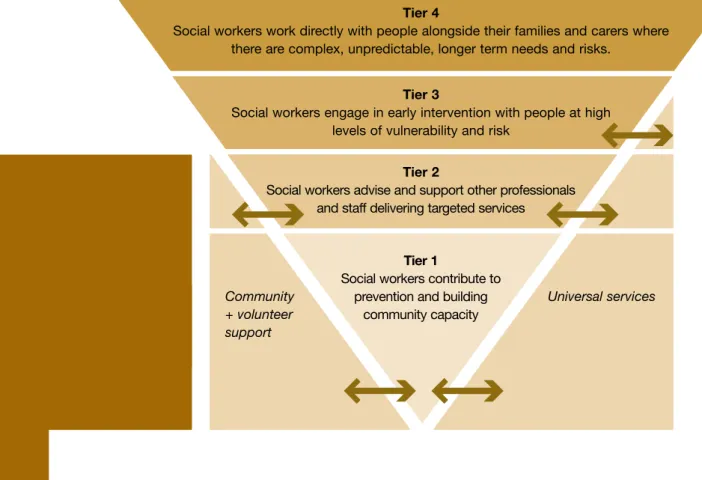
The role of the social workerSocial workers have a distinctive set of knowledge, skills and values that need to be better used in supporting our most vulnerable people. Chapter 4 sets out a tiered approach to practice that recognises those things only a social worker can do, those they are best equipped to do and those to which they should contribute.
Building capacity to deliver personalised services
Personalisation is driving the shape of all public services, with a growing public expectation that services will meet their needs, helping them achieve personal goals and aspirations. This may pose a particular challenge for social work, given the need also to manage growing demand and complexity as well as the need to protect the public by taking measures to control some people’s liberty. To be effective in meeting that challenge, social work services will need to engage individuals, families and communities and to work in new ways with other parts of the public sector, focusing increasingly on prevention. Chapter 5 sets out five
recommendations that will build our capacity to design and deliver personalised social work services through building individual, family and community capacity; refocusing on prevention and earlier intervention; creating whole system response to problems; and making effective use of the mixed economy of care.
Building the capacity of the workforce
We are not making the best use of social work skills. Developing
personalised services revitalises and refocuses services on the core values of social work. Achieving that will mean making full and effective use of the whole workforce, creating new roles, developing confidence and trust and shifting the balance of power and control. Chapter 6 sets out four recommendations that will develop social workers as accountable,
autonomous professionals; create new governance arrangements to support devolved responsibility; place a new emphasis on individual and
organisational learning; and change the skill mix of social work teams,
introducing a new paraprofessional role.
Building capacity for sustainable change
The major changes set out in our report will require a real and lasting
commitment to transform services at all levels and in all parts of the system. They will involve major cultural change across the public, voluntary and private sectors and new solutions to changing needs. Chapter 7 sets out our final four recommendations which seek to embed these changes in new ways of working. The recommendations will develop enabling leadership and effective management at all levels, including a new focus on citizen leadership which will enable people who use services to have real influence; a new focus across the sector on performance improvement and the delivery of agreed outcomes; a structured approach to re-designing services and delivering change; and new legislation to provide a foundation for future practice.
“Services should meet the needs of people. People shouldn’t have to fit services.
Social workers should be allowed the time to get to know their clients really well,
so that they really understand the different needs of each individual.”
10
Doing more of the same won’t work. Increasing demand, greater complexity and rising expectations mean that the current situation is not sustainable.
Social work services don’t have all of the answers. They need to work closely with other universal
providers in all sectors to find new ways to design and deliver
services across the public sector Social workers’ skills are highly valued and increasingly relevant to the changing needs of society. Yet we are far from making the best use of these skills
These are the three over-riding conclusions we have reached at the end of our intensive deliberations of the past year. They are based on our consultations with many hundreds of people throughout Scotland, across all sectors of the social service workforce, with other professionals, with people who use social work services and their carers and on our analysis of existing and commissioned research evidence.
Doing more of the same won’t work
The demand for social work services is increasing and changing as people’s needs are becoming more complex and challenging. The expectations of citizens
of the 21st century are for more
accessible, responsive public services of the highest quality. The result is that we expect more and more of a fixed resource, placing ever increasing pressure on social work services to deliver. Professional roles too often become focused on managing access to existing services rather than on helping people find solutions to their problems. In this way, people become passive
recipients of services rather than active participants in their care. We have concluded that this is an unsustainable direction for social work services and that simply pouring ever more public resources into a service based on welfare models rather than the promotion of individual wellbeing will not, in itself, achieve a sustainable future.
Social work doesn’t have all of the answers
Social work services alone cannot sort out all of the problems facing society now and in the future. Tomorrow’s solutions will need to involve
professionals, services and agencies from across the public, private and voluntary sectors in a concerted and joined-up effort. They will need to build new capacity in individuals, families and communities to meet their own needs, drawing on strengths, hopes and aspirations. They will also require a long-term commitment across government and the public sector to prevent the problems facing individuals, families and communities today, before
messages
Chapter 1:
from the 21st Century Social
Work Review
11
they damage people’s life chances irreparably. This approach must make the best use of those universal services, such as health, early years education and police, which touch everyone’s lives, and those of social work services which are targeted to provide support in very specific circumstances.
Social workers’ skills are highly valued and increasingly relevant
The International Federation of Social Work describes the mission of social work as being to “enable all people to develop their full potential, enrich their
lives and prevent dysfunction”. While
we believe this is still valid to society today, we have found that in reality:
● a culture of blame has developed in response to systemic failures to protect individuals and the wider community, which is forcing social workers into monitoring behaviour rather than actually helping people to make changes;
● heavy and inequitable caseloads often prevent social workers from tackling the complexities that lies behind the immediate need;
● demands exceed resources, resulting in social workers acting as gatekeepers, processing people through systems rather than working directly with individuals and families; and
● the constant pressure to deal with crises leaves little time for early intervention or for increasing the capacity of individuals, families and communities to find their own solutions. It is in this context that the 21st
Century Social Work Review was commissioned to examine how social work services can adapt to meet present and future needs.
A new direction for social work services
The recommendations we set out in this report represent a new direction for social work services in Scotland which reinvigorates social work’s core values of:
● respecting the right to self determination;
● promoting participation;
● taking a whole-person approach;
● understanding each individual in the context of family and community; and
● identifying and building on strengths. They will set social work on a
sustainable course, building the
capacity of services and the workforce and providing a firm foundation for meeting the current and future needs of Scottish society. Our conclusions fall into three main themes, which provide a structure for the report:
“Users and carers are
citizens
. We expect to be respected as whole people and
supported to achieve our aspirations. What needs to happen is that everyone in
society recognises us as their neighbours with every right to be included. A good
standard of housing and income matters to us, the same as everyone else.”
Users and Carers Panel
Building capacity to deliver personalised services
The first five recommendations aim to develop services which people find easy to use and which are better equipped to help them find their own solutions.
They will make sure that social work services:
1. are designed and delivered around the needs of people who use services, their carers and communities;
2. build individual, family and
community capacity to meet their own needs;
3. play a full and active part in a public sector wide approach to prevention and earlier intervention;
4. become an integral part of a whole public-sector approach to
supporting vulnerable people and promoting social well-being; and 5. recognise and effectively manage
the mixed economy of care in the delivery of services.
Building the capacity of the workforce
The next four recommendations aim to develop and deploy the social service workforce in ways that make the most effective use of the knowledge, skills and values of social work.
They will make sure that: 6. services develop a new
organisational approach to managing risk, which ensures the delivery of safe, effective and innovative practice;
7. social workers are enabled and supported to practise accountably and exercise their professional autonomy;
8. employers develop a learning culture that commits all individuals and organisations to lifelong learning and development; and
9. services are delivered by effective teams designed to include the appropriate mix of skills and expertise and operating with delegated
authority and responsibilities.
Building capacity for sustainable change
The final four recommendations aim to ensure the delivery of real and
sustained change in the way services are designed and delivered.
They will make sure that social work services:
10. develop enabling leadership and effective management at all levels and across the system;
11. are monitored and evaluated on the delivery of improved outcomes for people who use services, their carers and communities; and 12. develop the capacity and capability
for transformational change by focusing on re-designing services and organisational development. And finally, we conclude that:
13. the Scottish Executive should consolidate in legislation the new direction of social work services in Scotland.
We have not recommended
organisational change. Such decisions need to be taken locally, in order to respond effectively to local need. Our recommendations will however require transformational change in the way services are designed and delivered. They will require both services and roles to change in order to meet people’s needs better and make best use of the skills of the whole workforce. A multi-agency approach, driven by committed and imaginative leadership across the public, voluntary and private sectors will be needed to fully implement the
recommendations. We know that this will not happen overnight. However during the course of the review process we have found a strong consensus behind the need for change. We encourage the Scottish Executive and service providers to respond quickly and constructively to this report by taking early, decisive action and putting in place the processes required to deliver lasting change.
13
The social service workforce delivers essential services day in and day out to some of our most vulnerable people. Theirs is life changing work. We have found countless examples of social work services which transform people’s lives and protect them and their communities from harm. We have found dedicated staff going way beyond what is expected of them, sacrificing their own time and personal energies to support people in need. Most of this work goes unnoticed and unremarked and it is important that we celebrate the skillful and innovative work seen in current practice.
It is also important that we are clear about the size of the challenge to develop social work services which meet growing and increasingly
complex demands. This chapter looks at the strengths we can draw on in meeting that challenge and the areas where we want to see change. This is based on evidence (summarised in Annex A) from a wide and diverse range of sources including from:
● practitioners and leaders in the public, voluntary and private sectors;
● people who use services and their carers;
● partner professions and agencies;
● observing practice; and
● research.
Throughout, the findings have been remarkably consistent and we describe them below.
Strengths to build on
We found many strengths in social work services, which need to be kept and developed as a basis for delivering future services. In particular we found:
● many examples of good practice across the whole range of social work services, often not
acknowledged or celebrated;
● a social work profession with a strong and highly relevant
knowledge, skills and value base, and a passion for social justice, which is attracting an increasing number and diversity of new recruits;
● professionals working in the most challenging of circumstances, balancing conflicting needs and views, juggling resources and making the finest of professional judgements about risk to both individuals and society;
● a strong drive for change through the creation of an honours degree in social work, the Scottish Social Services Council and the Scottish Institute for Excellence in Social Work Education, working together to raise the professionalism of the workforce and improve the competence and quality of social workers’ practice;
social work
Chapter 2:
● services which deal skillfully with complex problems, helping people to find a way through their
difficulties;
● a real commitment to developing joint services and a recognition among partners of the distinctive contribution that social service workers make to multi-agency working;
● a mixed market of services across the public, voluntary and private sectors each with the scope to learn from each other;
● an appetite for performance improvement and revitalised inspection; and
● that most people who use services were generally satisfied with the service they received.
Challenges to tackle
Despite the excellent work which is done on a daily basis we have found a profession and services under great pressure which are not delivering to their full potential. This has resulted in a growing mismatch between the value base of social work and the experience of people who use services and of workers. In particular, we found:
● unreasonable expectations of what social work services can do to sort out the problems society faces;
● an aversion to risk in society as a whole, which poses a very real challenge for social workers, who must always be making fine
judgements about risk. All too often this means local authorities
restricting practice in order to protect themselves from media and political criticism, which in turn limits opportunities for people who use services and for their carers;
● a social work profession lacking in confidence in its own skills and unclear about its distinctive contribution;
● highly skilled professionals carrying out work that didn’t require their level of skills and expertise and little opportunity for the best practitioners to advance their careers and still keep working with people who use services and their carers;
● the decision making ability and professional autonomy of social work professionals constrained by line management arrangements that require escalation of decision making up a chain of command in order to manage budgets or risk;
● the professional leadership of social work services eroded by pressures to manage services and budgets. This means front line workers have little idea of the values or
professional priorities of their employers;
● services and professionals
overwhelmed by bureaucracy and systems, often gathering information for local and national use which is of little value;
● a lack of focus on learning within organisations both in terms of matching the skills of individuals with the needs of the service and in making sure that organisations themselves learn from best practice and from mistakes;
● a relationship between voluntary and private sector providers and local authority staff involved in delivering care which is inequitable, inconsistent and lacks a strategic approach; and
● people who use services having little say over how they were delivered, often having to accept what was available rather than what was needed.
Services for the 21st Century: our aspirations
This section sets out the way our recommendations, if they are implemented in full, will make a real difference to the people who use and work within social work services.
People who use services should:
● influence the design and planning of services and how they are delivered;
● find it easy to contact services and receive a helpful and prompt response;
● know what to expect from services;
● have their strengths, interests and aspirations built on by services;
● be active partners in finding and developing solutions to problems;
● be able to get the help they need when they need it;
● regard social work services involvement as a positive option rather than a last resort;
● have a consistent and reliable relationship with their worker; and
● have someone to advocate on their behalf.
Carers should:
● be recognised as active partners and care providers, able to influence how services are designed, planned and delivered;
● be able to choose how much involvement they have in providing care; and
● be able to have a wider life outside their caring role.
Social service workers should:
● be able to use their skills and knowledge effectively;
● work to their full potential and be able to make sound decisions, supported and challenged by quality professional consultation;
● use evidence based practice and continue to learn throughout their careers;
● have a range of career options that allows progression in practice as well as in management;
● work in supportive teams and feel empowered to find innovative and creative solutions to meet people’s needs; and
● have access to technology that helps them do their job effectively.
Employing organisations should:
● trust their employees to practise safely and effectively;
● support the development of the whole workforce;
● promote and celebrate excellence, learning from good practice and from mistakes; and
● resource employees to deliver first class services.
The general public should:
● have confidence in the work of social work services;
● understand how and when services may be able to help them;
● be clear about how to access services;
● have a realistic expectation of what services may be able to do to help them; and
● value help and support from social work services.
Partner professions and agencies should:
● understand the distinctive contribution that social work services can make;
● have effective joint service planning and design arrangements in place to make sure that best use is made of social work skills; and
● respect and value the contribution that social workers make to achieving shared priorities.
Political leaders at national and local levels should:
● understand and value the
contribution of social work services to protecting vulnerable people and promoting wellbeing;
● provide clear and consistent leadership;
● be able to take well informed decisions about social work services; and
● present a positive public image of social work services.
17
a changing
context for social work:
challenges and opportunities
Chapter 3:
We all aspire to live in a society that is healthy, tolerant, safe, inclusive and fair. Such a society needs a vibrant economy and excellent public services. Social work services have an essential contribution to make in achieving that goal. Their role has three main
dimensions:
● supporting the most vulnerable and excluded members of our society to live fulfiling lives, working in
partnership with individuals, families and communities and with other public, voluntary and private services;
● protecting individuals, families and communities at risk of harm from themselves or others through the use of statutory powers, then
working to reduce and minimise that risk through helping people to change their behaviours;
● working with others to close the opportunity gap between the richest and poorest in our society, through helping individuals and families to take control of their lives, and develop hope and aspirations for the future.
Effective social work services promote independence and resilience, enabling some of our most vulnerable, excluded and even dangerous people to play an active part in society, through
achieving change. In this way, they contribute not only towards the goal of delivering excellent public services, but towards developing the economy, helping people to become self reliant once more.
In looking to the future delivery of social work services in Scotland, this chapter explores trends that will influence future demands.
Demographic, socio-economic and political trends have driven significant change in social work services since the landmark legislation of 1968 that underpins social work today. These trends and new ones will continue to pose new challenges and opportunities, influencing the future design and delivery of services. We summarise the major trends that we believe will affect how services are delivered in future, then consider the implications for the three main branches of social work practice:
● children and families;
● community care; and
● criminal justice.
An ageing population
In 1968 people aged over 60 years made up 18% of the population. By 2030, 25% of us will be over 60. In particular, the number of people aged over 75 has risen dramatically and is projected to increase by a further 60% by 2028. This poses a massive challenge for health and social services but also offers us a pool of abilities, talent and wisdom to call on in promoting the capacity of communities to care for themselves. Although life expectancy continues to increase, large sections of the population will spend an increasing number of their later years in ill health. For example, 60% of people aged 65-74 report two or more long term conditions. While this will not present significant problems to many of these people, it poses
challenges for health and social work services in anticipating and supporting those people who will need help, promoting self care and improving long term management of problems.
Children in need
Not only has the percentage of the population under 16 fallen, by 11% between 1968 and 2001 with a further predicted fall of 18% by 2028, the numbers of children in our community are already drastically reduced. The pre-school population is now barely half what it was in 1968. (277,000 rather than 478,000). In the same period the
numbers of children looked after by local authorities has risen by 4%. On this basis, there may be fewer children in future, but a higher percentage of them are likely to be in need, placing more pressure on local authorities to carry out their corporate parenting role and to find alternative approaches to protecting children at risk. Services will be under pressure to provide more effective transitions within and between services, particularly for those leaving care where we know outcomes are very poor: 60% leave school with no
qualification, and a similar proportion don’t enter employment, education and training. As many as 20% become homeless within a year. This is a challenge to the whole public sector, requiring an integrated approach to preventing predictable problems.
Changing needs
Medical advances mean that many more infants born very prematurely or with significant disabilities will survive into adulthood, some of whom will require life long care and support. Service providers will be under pressure to provide services that strengthen the capacity of these young people to lead fulfiling lives and to make smooth transitions within and between services. Further advances may rid us of physical conditions that have caused great need in the past, but the World Health Organisation sees chronic mental health conditions such as stress, depression and anxiety as among the biggest challenges Western Europe will face in the next generation. The long term consequences of
substance abuse and other lifestyle choices, particularly amongst young people, will also shape future demand for services.
Fractured relationships
Strong relationships are an essential protective factor in determining mental health and wellbeing, yet as people have more choice in how and where they live, whether to marry or have children, more people than ever are living alone for all or part of their lives. The trend towards more fluid and fractured family relationships is likely to lead to more complex, and possibly weaker, extended family supports and more people living in isolation. Figures from a Scottish Children’s Reporters Administration study (Gault, 2005) suggest that significant numbers of children grow up within complex and transitory groupings of parents, successive partners, extended family and sometimes local authority care. The study showed only 21% of children referred to the reporter were living with both birth parents, 16% were in foster care, and 10% were living with relatives other than parents, a trend reflecting the growing inability of some parents to cope, often related to substance misuse and mental health problems.
Social polarisation
Although society as a whole has become more affluent and aspirations have grown, the gap between affluent and poor continues to widen. The gap in life expectancy between the most and least affluent areas grew by 45% over the last 20 years and is projected to grow by a further 19% by 2010 to 9.2 years, driven by poverty and lifestyle choices. This increasing social polarisation means that some families have experienced four generations of deprivation, worklessness and
declining life expectancy. There is a strong correlation between low socio economic status and the likelihood of becoming addicted to drugs and alcohol, or of being a victim or perpetrator of crime. 50% of
Scotland’s prisoners come from local authority ward areas containing only 17% of the population. Growing polarisation in terms of health,
educational attainment and income leads to deprivation often being concentrated in defined communities, leaving social work resources
particularly stretched. Society will need to find long term and more effective ways to change these communities if an inexorable rise in social problems and the caseload of social work services is to be halted. Social work will have a significant role in this, promoting community responsibility, resilience and capacity and linking people to resources within their community.
Shrinking workforce
The shape of Scotland’s working age population is changing. The number of people aged 15 and under is predicted to fall by 18% between 2003 and 2028 and the number of people of working age is projected to fall from 3.16 to 2.89 million. Competition to recruit to public sector services to meet growing need will be fierce and the capacity of the working age population to fund public services will be reduced. Employers will be under increasing pressure to develop, retain and make the most of a skilled workforce. Globalisation of services is already occurring with the use of call centres in other countries, and the opportunity to purchase and use social work services provided abroad is likely to develop further.
Cultural diversity
Scotland is becoming a more ethnically and culturally diverse country with an explicit “fresh talent” policy to
encourage more people to live in Scotland to counteract the predicted decline in Scotland’s workforce. The population is now predicted to drop below 5 million by 2036, although this is later than previous predictions as the birthrate and immigration have recently increased. The influx of new Scots provides both opportunities for the social services workforce, but also a challenge in supporting immigrant and refugee populations.
Choice, independence and personalisation
As demanding consumers of goods and services, users of public services will increasingly expect the same variety, choice and flexibility that they expect from the business sector. They will demand a more personalised approach, much greater involvement at all levels and more transparency about the level of services available. Because people are becoming better informed they have growing expectations that services will be delivered where and when they want them. Partnership for a Better Scotland (2003), recognises this, with a commitment to ensure that “public services are designed and delivered around the needs of
individuals and the communities within which they live.” This will require more honesty about what the state can or cannot provide, a realism about
capacity and a clear willingness to say no to unreasonable demands.
Personalisation is an increasingly credible approach across all aspects of service delivery. The implications of personalised approaches to compulsory aspects of social work services,
involving social control, will pose particular challenges, requiring rigorous approaches to enabling lasting change.
Technology
Technological progress will bring many opportunities and challenges. Easier mobile working can free up workers to spend more time with their clients, while information sharing tools can support integrated working. We live in an information rich age, which both influences people’s expectations and provides new opportunities to deliver services. Technology can help in the effective planning of services, matching services to demand more accurately. It can also help vulnerable people to lead independent lives, and improve
communication with workers and people who use services. The danger is that the “digital divide” will
disadvantage those unable to afford its
benefits. The challenge is to use technology to enhance rather than replace human relationships, to help workers ‘work smarter’, to promote social inclusion and to ensure the protection of the vulnerable.
Changing communities and fear of crime
Social networks and communities are changing and will continue to change. Technology will allow greater access to online socialisation for a majority of the population, creating new communities of interest, and changing traditional
concepts of community. Some sections of the population, who neither want nor are able to benefit from this, may become more marginalised. Social tensions and increasing wealth may result in the growth of phenomena such as American style gated communities, which isolate themselves from the mainstream through physical barriers.
Political priorities will continue to be driven by fear of crime and antisocial behaviour, potentially undermining further any sense of community. Social work providers face a significant challenge within this context of strengthening the capacity of communities to become more self sustaining.
Managing risk
Social workers have to deal with uncertainty, yet they operate in a risk averse and increasingly litigious society. At the same time they will have to face increasing demand for more
independently provided and personalised services which may be less subject to regulation and so potentially more risky. Service providers will need to manage this tension, working with partners and users of services to develop a common understanding of the measurement, recording and reduction of risk. They will also need to help people understand that the sort of society in which there is no risk is neither achievable nor desirable.
Regulated services
The creation of the Social Work Inspection Agency, the Care
Commission and the Scottish Social Service Council has changed the organisational landscape in which social work is practiced in Scotland. They are part of a bigger shift towards setting clear and measurable standards as a means to both ensure public safety and drive up the quality of services. This provides an opportunity to promote and ensure excellent public services. It also provides a challenge for both government and services in making sure that over regulation does not inhibit the development of services. Regulators and services will need to demonstrate how they can work together to deliver coherent, trusted and responsive services.
A devolved nation
Post devolution, Scotland has begun to pursue its own distinct evolution of services and to determine the underlying balance of rights and responsibilities between the individual, the family and the state appropriate to Scotland, which will shape services. The ability to respond quickly and distinctively to the needs of Scotland’s people has led to a plethora of new policy and legislation. Maintaining and developing effective political leadership will be essential if we are to see these aspirations come to fruition. Crucially, that leadership needs to be visible and credible at both national and local levels, making the most effective use of central direction and local
responsiveness to needs.
Integration and social work services
All public services are increasingly working towards integrated service delivery. The theme of services designed and delivered around the needs of individuals, families and communities is at the heart of much policy and has already had significant impact on social work services. Developments in community care are perhaps the furthest advanced, through the Joint Future initiative and single shared assessment. Similar approaches underpin community schools and proposals for integrated assessments for children. Joint approaches to planning through children’s service plans, community care plans and ultimately community plans provide a vehicle for joint development. Structural approaches such as the creation of community
justice authorities and community health partnerships take that
integration further into new partnership arrangements. All of this has a direct impact on the structure, planning and delivery of social work services. A significant challenge for social work services will lie in maintaining and developing the distinctive contribution of social service workers, while
promoting joined up approaches to service design and delivery. The three branches of social work will face distinctive challenges, reflecting the changing needs and expectations of society:
Children and families
Family breakdown, fluid and unstable relationships, more children suffering chaotic lifestyles due to substance abusing parents, or from adults who have never learned to parent, and the growing numbers of disabled children living longer have all combined to create a growing number of children with a level and complexity of need barely imagined in 1968. Our understanding and recognition of child abuse, in particular child sexual abuse, mental health problems amongst children and the impact of domestic abuse on child development have grown significantly. Several high profile
tragedies, service failures and enquiries have given child protection a very high political and media profile. This has led to a lack of acceptance of risk in the media and the public eye and a scapegoating of social work services when things go wrong. However there is also a growing understanding among partners that social workers alone cannot protect all children in need and that the universal services of health and education must take a greater role in delivering targeted services. Social workers are increasingly working in integrated early years services alongside health visitors and child care workers and in schools alongside teachers and school nurses, a trend which seems certain to continue. While residential child care remains the option of choice for a few children, many more are accommodated in residential provision due to a shortage of foster placements. The increasing complexity of problems faced by these children emphasises the need for highly skilled practitioners in the residential child care setting.
Youth crime and anti-social behaviour are high on the political agenda. Society is facing the consequences of rearing a group of disaffected, alienated young people with little stake in our society, though there is also some evidence of a growing intolerance of young people. Addressing this is the responsibility of all public services, not just social work services, which often deal with the consequences of alienation. Social workers will be major players in an integrated approach to youth justice. Their skills in engaging, persisting with and managing change in the most resistant individuals will be vital within partnership approaches to one of our society’s most stark challenges. The pressure on children and family social workers has been made worse, in recent years, by shortages of social workers able and willing to work in this demanding and highly pressurised environment. While the situation is improving, it has left a legacy in some authorities of unallocated cases, high thresholds before a service can be provided, inexperienced frontline staff, managers and a culture of crisis intervention.
Community care
Since the closure of large institutions in the 1990s, social workers, occupational therapists and social care staff have made huge positive contributions to the development of better adult care services, increasingly in partnership with NHS colleagues. This has meant:
● new assessment processes;
● new ways of delivering rapidly expanding services;
● opening up a diverse provider market; and
● managing huge budgetary transfers. Many people who were receiving institutional care have exceeded society’s expectations of their ability to live fulfiled lives in the community. Innovative services have evolved to enable them do so. The increasing aspirations of previously marginalised groups and the
subsequent increased demand for services are a consequence of past successes.
Adults with learning disabilities increasingly expect to live ordinary lives in the community. Services have to be open to developing their
aspirations, but must protect those who may be vulnerable from bullying and challenging behaviour. This goes beyond individual casework and will challenge society’s attitudes, especially around sexual relationships and
parenting. For people with mental health problems, many of the themes are similar. The incidence of suicide and self harm in Scotland challenges how we make services available. Services will be shaped by the increasing emphasis on rights and responsibilities of people experiencing mental illness, and the needs of their carers and families. An integrated approach to improved mental health will require further development of partnership working with health, housing and other services. People with physical and sensory impairment will continue to challenge services to personalise care. Good work is already being done using technology to increase capacity for independent living, driven by a rights based approach to services. Similar challenges face the delivery of services for older people, in helping them maintain healthy, fulfiled and independent lives in the face of greater prevalence of long term conditions. This means that services must work together to promote self care and enable early responses to problems, reducing isolation and finding truly personalised solutions to people’s needs. People with substance misuse
problems have needs which cross service boundaries, further challenging services to develop personalised approaches that make effective use of specialist expertise while meeting people’s health needs, addressing the impact of the substance misuse on
children and families and protecting the community from any associated
offending behaviour.
A better informed public will have growing expectations of public services and will be more knowledgeable and confident in producing their own care solutions with appropriate support. Developments such as direct payments will place more emphasis on self
assessment and self-care strategies to support independent living, and on the role of unpaid carers and local
communities as providers of care. The introduction of an unregulated
workforce, in the shape of workers employed directly by people who use services, needs to be fully understood and managed.
All this will only be achieved by stronger partnership between social work services, health, housing and others, within a mixed economy of public voluntary and private sector provision in which all parties have a stake.
Criminal justice
Demand on criminal justice social work services will continue to grow, driven by the need to reduce serious and violent crime, the desire from communities for decisive action on anti-social behaviour and the need for a wider and more robust range of non custodial options to tackle an ever increasing prison population. Increased awareness of sexual abuse will
challenge services to balance public protection with the rights and needs of their clients, requiring closer
partnership between police and criminal justice social workers to manage high risk offenders.
The development of partnership
approaches will drive service development in the foreseeable future. Work on the throughcare of prisoners, for example, has seen increased partnership between social work and the Scottish Prison Service. Prison social work services will play a more dynamic role in making sure there is continuity of assessment, supervision and treatment between custody and community. community justice authorities will bring social work in public, voluntary and private sectors into new partnerships, with a vital role for social workers in engaging with those whose behaviour makes them a risk to communities. Evidence to the review has demonstrated how social workers can use their distinctive knowledge and skills to change the behaviour of those who are motivated to change and to control those who are not. The use of such skills in personalising work with offenders has to be balanced with the strong enforcement required for public protection.
The challenge facing social work is to develop a common understanding and language of risk with partner agencies, and a shared research and evidence base. The perspective of victims will play an increasing part in the criminal justice system in informing sentencing, contributing to treatment and in
receiving services in their own right. An emphasis on public protection will require that crime and the fear of crime are reduced and that standards of monitoring of dangerous individuals are improved whether provided in the public voluntary or private sector, by social work or other staff.
Conclusion
The needs, demands and expectations of society for social work services have changed and will continue to change. If social work services and the public sector as a whole are to be sustainable in future then they must also change. Our recommendations in chapters 5-7 aim to secure this future.
26
the role of
Chapter 4:
the social worker
Introduction
A central part of the work of the review has been to define and clarify the distinctive contribution of the social worker in an environment increasingly focused on integrated teamwork. This work has been taken forward by a specialist sub group informed by a number of significant pieces of research and evidence gathered throughout the review. Although some functions of the social worker are derived explicitly from the duties of local authorities, social work is not defined by its organisational setting. Social workers can and do work across a wide range of settings within public, voluntary and private sector
organisations, with a small but growing number working independently. This chapter describes the role of the social worker in all these settings.
What is social work?
The social work profession promotes social change, problem solving in human relationships and the
empowerment and liberation of people to enhance well-being. Utilising theories of human behaviour and social systems, social work intervenes at the points where people interact with their environments. Principles of human rights and social justice are fundamental
to social work. (International Association
of Schools of Social Work (2001)). Taking this definition as a starting point, the social worker’s task is to work alongside people to help them build resilience, maintain hope and optimism and develop their strengths and abilities. Social workers must meet people on their own terms, in their own environment whilst retaining the professional
detachment needed to help people who use services to understand, come to terms with or change their behaviour.
Social workers also have a role as agents of social control. They must confront and challenge behaviour and manage situations of danger and uncertainty. In this role they have statutory powers to act to protect individuals or communities. They are closely associated with the
management of risk and with the distressing consequences of things going wrong in people’s lives. This balance between care and control is perhaps the defining feature of social work and provides a dynamic tension which influences workload, priorities and public perceptions of the role.
A single profession
A key question that the review was asked to address is whether social work is in fact a single profession, or has it become so specialised that it forms a number of similar but distinctive professions. We concluded that it is and should remain a single generic profession, underpinned by a common body of knowledge, skills and values, set out in the Framework for Social Work Education in Scotland (2003). Despite this, social workers increasingly
work in specialist settings. The challenge is to ensure that they are able to build up the knowledge, skills and competence relevant to their own field, work within the boundaries of their competence and strive to extend their knowledge and skills. In some areas, particularly remote and rural communities, generic social work roles will be the best, or indeed the only, solution. The particular challenge here is to make sure that they maintain a broad range of expertise, backed up by access to specialist expertise or
consultancy, either locally or nationally.
Developing therapeutic relationships
Work done for the review, specifically McNeill et al (2005) and Kerr et al (2005) on the skills required in criminal justice social work and with older people respectively, both concluded that the quality of the therapeutic relationship between social worker and individual or family is critical to achieving successful outcomes. The findings of these pieces of research apply equally well to all areas of social work. The therapeutic approach and the working alliance that goes with it are key elements in developing a
personalised approach to helping those with the most complex needs gain control of their lives and find acceptable solutions to their problems. Crucially, this is as important in compulsory aspects of services as it is in those actively sought by service users.
McNeill et al (2005) found three consistently identified common elements in successful interventions which lead to behaviour change or reduction in problem behaviours:
● accurate empathy, respect or
warmth and therapeutic genuineness;
● establishing a therapeutic
relationship or working alliance (mutual understanding and agreement about the nature and purpose of intervention); and
● an approach that is person centred,
or collaborative and client driven (taking the client’s perspective and using the client’s concepts).
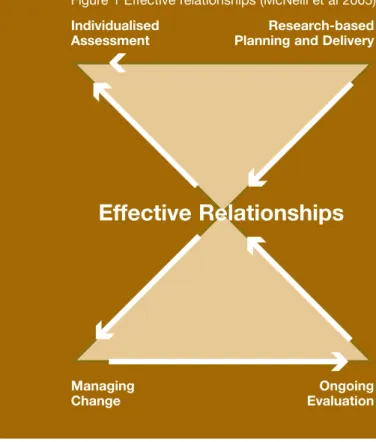
Working to achieve change is at the heart of what social workers do. Identifying needs and risks through assessment and developing and implementing action plans to address these will achieve nothing without an effective therapeutic relationship between worker and client. Although the diagram opposite relates to the supervision of offenders (McNeill
et al 2005), it clearly illustrates the
centrality of the therapeutic relationship. The principles it describes are equally applicable to all areas of social work practice.
Yet social workers consistently told us that it is this very aspect of their work
Figure 1 Effective relationships (McNeill et al 2005)
Effective Relationships
Individualised Assessment
Research-based Planning and Delivery
Managing Change
Ongoing Evaluation
which has been eroded and devalued in recent years under the pressures of workloads, increased bureaucracy and a more mechanistic and technical approach to delivering services. We must now legitimise and restore the centrality of working for change through
therapeutic relationships as the basis of strengthening the profession for the 21st Century.
What do social workers do?
Statham et al (2005) identified three main functions that define what social workers do. They:
● intervene between the state and the
citizen – assessing and determining eligibility for publicly funded services and assessing risks which determine the need for statutory intervention;
● maximise the capacity of people using
services – enabling individuals as far as possible to become ‘expert clients’ or informed clients’; and
● contribute to policies and practice that
support social and personal well-being – building the platforms from which personalised services can be developed and through which
individuals can promote their own well being or manage long term conditions.
In addition they consider that there are public benefits for local communities and wider society from social work intervention which they identify as:
● building on the capacity of
individuals and networks to increase their independence and use
mainstream rather than specialist services;
● maximising parents’ and their
children’s life opportunities;
● reducing community tensions
through promoting mutual understanding; and
● using innovative approaches to
reducing socially disruptive behaviour.
They deliver these functions through fulfiling six core roles, identified by Clark et al (2005):
● case worker working with individuals to help them address personal issues;
● advocate on behalf of the poor and socially excluded;
● partner working together with disadvantaged or disempowered individuals and groups;