Final Report
of the
Task Force on Self-Supporting
Degree Programs
TASK FORCE MEMBERS
Dean Harold G. Levine, Chair School of Education
Served on Committee on Governance Professor Trish Berger
Animal Science
Chair of Committee on Academic Quality and Experience Dean Steve Currall
Graduate School of Management Served on Committee on Governance Served on Committee on Costs and Fees
Dean Jeffery Gibeling Graduate Studies
Served on Committee on Academic Quality and Experience Professor Ellen Gold
Public Health
Served on Committee on Academic Quality and Experience Assistant Dean Jana Katz-Bell
School of Nursing and School of Medicine Chair of Committee on Governance
Professor André Knoesen Electrical and Computer Engineering Served on Committee on Governance
Dean Dennis Pendleton UC Davis Extension
Served on Committee on Academic Quality and Experience Professor Christopher Reynolds
Music
Served on Committee on Costs and Fees Assistant Dean Steven Roth
Division of Social Sciences Chair of Committee on Costs and Fees
Professor Jane-Ling Wang Statistics
Final Report
Task Force on Self-Supporting Degree Programs
TABLE OF CONTENTS
EXECUTIVE SUMMARY ... 4
TASK FORCE CHARGE ... 5
SUPPORT OF CAMPUS MISSION ... 6
BACKGROUND ON SELF-SUPPORTING DEGREE PROGRAMS ... 7
TASK FORCE PROCESS ... 9
REFERENCE TOOLS FOR CAMPUS SSDPS ... 10
New SSDP Proposal Process and Timeline ... 10
Identification of SSDP Program Requirements and Primary Unit Responsible ... 12
Proposed Financial Model for SSDPs ... 12
TASK FORCE RECOMMENDATIONS ... 14
CONCLUSION: CAMPUS ACTION STEPS ... 30
APPENDICES ... 31 Appendix A: Task Force Charge Letter ... A-1 Appendix B: Office of the President Policy on Self-Supporting Graduate Degree Programs ... B-1 Appendix C: Analysis of Charge and Existing Policies ... C-1 Appendix D: New SSDP Program Proposal Process and Timeline Flowchart ... D-1 Appendix E: SSDP Requirement and Responsibility Matrix ...E-1 Appendix F: Proposed Financial Model for SSDPs ... F-1
EXECUTIVE SUMMARY
On May 10, 2011, Provost and Executive Vice Chancellor Hexter and Senate Chair Powell established a joint Senate-Administration Task Force to provide advice and recommendations regarding self-supporting degree programs (SSDPs) at the University of California (UC), Davis. The specific charge to the Task Force included an examination of the academic quality and experiences of students and faculty within an SSDP, a thorough review of costs and fees in a fully self-supporting environment, and a clear delineation of the governance of these programs from both an academic and administrative point of view.
During a six-month period, the Task Force examined current campus procedures and policies with regard to SSDPs, heard presentations from individuals hosting SSDPs on campus as well as from the UC Office of the President (UCOP), sought advice on self-supporting program structures at other public universities, and pursued an active, iterative process of recommendation development and debate. The Task Force’s recommendations include the following:
A process for complete programmatic and administrative review of new SSDPs. A methodology to ensure that campus costs of SSDPs are appropriately recovered. An efficient administrative infrastructure for both new and existing SSDPs. Proposals to ensure that standards of high academic quality are maintained.
Proposals to ensure that student experiences are consistent with state-supported programs. Consideration of the impacts of SSDPs on faculty workload, merit/promotion, and compensation. Identification of issues related to the level of self-supporting fees in light of revenue generation opportunities, market factors, and their relationship to other campus fees.
In addition to the specific recommendations above, the Task Force developed three reference ―tools‖ to aid both administrators and program proposers in developing SSDPs. The first tracks the review and approval process; the second itemizes administrative and academic expectations at UC Davis; and the last helps clarify the financial model envisioned for SSDPs at the Davis campus.
The Task Force reached consensus on all recommendations.
Given the increased interest in SSDPs and mounting expectations regarding the revenue generating potential of these programs, the Task Force believes that it is imperative that the campus take quick action to provide guidance to the campus community on how to implement new SSDPs and strengthen current programs.
TASK FORCE CHARGE
On May 10, 2011, Provost and Executive Vice Chancellor Hexter and Senate Chair Powell established a joint Senate-Administration Task Force to provide advice and recommendations regarding self-supporting degree programs (SSDPs) at the University of California (UC), Davis. The full charge letter is provided as Appendix A.
As stated in the charge, the Task Force was asked to accomplish the following:
1. Recommend a process for the programmatic and administrative review of new SSDPs that can be accomplished in a complete and expeditious manner. The role and scope of each entity involved in the review should be clearly defined.
2. Review existing SSDPs on campus to assess if they are truly self-supporting from the campuswide perspective and recommend a methodology to ensure that all campus costs of SSDPs are
appropriately recovered.
3. Review the existing administrative processes and structure for these programs and make
recommendations about efficient methods to provide appropriate administrative infrastructure for these programs (new and existing) on our campus.
4. Assess and identify issues related to maintaining the academic quality of both self-supporting and related state-supported degree programs as SSDPs expand and make recommendations on ways to ensure that quality standards are maintained.
5. Assess and identify issues related to the impact of SSDPs on the student experience for both self-supported and state-self-supported students and make recommendations on ways to address these issues. This should include reviewing issues related to providing academic and non-academic services and financial support to students in SSDPs.
6. Assess and identify issues related to the impact of self-supporting programs on faculty and make recommendations on ways to address these issues.
7. Assess and identify issues related to the level of self-supporting fees in light of revenue generation opportunities, market factors, and their relationship to other campus fees and make
recommendations to address these issues.
The work of the Task Force took place in the context of increased interest in the establishment of SSDPs at UC Davis. This interest is driven by factors that include:
Continued state budget reductions and a lack of state support for new degree programs. The UC Commission on the Future's recommendation to expand SSDPs.1
Updated UC policies regarding SSDPs that provide additional clarity and some increased flexibility in the types of programs that can be offered as self-supporting.
The changing global landscape of educational opportunities and delivery methods for prospective students, in particular working professionals and mid-career individuals.
In establishing this Task Force, the Provost recognized that within the framework of the UC policy, UC Davis has significant flexibility in determining the process and scope of campus level review, approval, and administration of SSDPs. Yet, the campus community requires clarity and guidance on what is expected of SSDPs in the areas of governance, administrative and financial management, and establishing and maintaining quality programs that meet the expectations of students and faculty.
In response, the Task Force approached the charge in a manner that provides recommendations,
guidance, and tools to support the better integration SSDPs into the mission of UC Davis. The results are a balance of incentives and safeguards that the Task Force hopes will encourage the development of innovative SSDPs in appropriate disciplines, while instituting practices that ensure full consideration of the inherent risks of this model.
SUPPORT OF CAMPUS MISSION
―The mission of UC Davis, as a comprehensive research university, is the generation,
advancement, dissemination and application of knowledge to advancing the human
condition throughout our communities and around the world. . . .‖
2SSDPs at UC Davis support the campus mission and ―Vision of Excellence‖ by:
Supporting the efficient, professional administration of SSDPs to advance the university’s academic mission.3
Expanding the opportunities for non-traditional students to engage in the diverse opportunities to learn and be inspired to lead and excel in solving the challenges of our world.4
Advancing the academic mission through leveraging instructional resources to serve more students and generate additional financial support for other academic endeavors.
Nurturing the economic prosperity of our region by providing high quality educational opportunities for mid-career professionals critical to ensuring a strong workforce for emerging industries and the business community.5
Fostering innovation and entrepreneurial efforts in teaching through the use of emerging technologies, multi-modal learning, curricular innovations and pedagogical advancements.6
The Task Force recommendations provide a framework that will allow SSDPs to excel in these areas as an integrated part of the campus vision in support of the overall mission.
BACKGROUND ON SELF-SUPPORTING DEGREE PROGRAMS
Systemwide PoliciesSince 1979, the UC system has recognized that providing graduate education to students who cannot participate in a regular graduate program due to the need to work is consistent with the University’s mission to provide graduate professional education. This is documented through a series of policies that authorized the provision of graduate degrees through part-time enrollment, alternate course delivery locations and methods, alternate fee structures for such programs, and further defined the type of students who might benefit from such programs. These programs now operate under the UCOP ―Policy on Self-Supporting Graduate Degree Programs‖ dated September 13, 2011, and have come to be known as ―Self-Supporting Degree Programs.‖ This policy is attached as Appendix B.
The introduction to the systemwide policy provides the following high level description of an SSDP: Self-supporting programs allow the University to serve additional students above and beyond the resources provided by the state while fulfilling demonstrated higher education and workforce needs. Currently, there are populations of working adults not served by UC state-supported programs who would be willing to enroll in self-supporting graduate degree programs. This policy is designed to facilitate the establishment of self-supporting programs by the University and its campuses while ensuring that these programs do not use state resources. The programs will receive no state-support; however, they have the potential to generate resources that would enhance the quality, access, and affordability of core academic program and departments.7
This policy also establishes some requirements and high-level guidance for SSDPs, including the key issues summarized below:
SSDPs should meet one or more of the following criteria: primarily serve a non-traditional student population, be offered through an alternative mode of delivery, be alternatively scheduled, and/or be offered in an alternative location.8
Ph.D. programs and an academic Master’s degree program solely or primarily leading to a Ph.D. program cannot be self-supporting.9
SSDPs should be held to the same standards of quality as regular programs, as determined by the campus Graduate Council.10
Establishment of any new self-supporting graduate program shall be approved by the campus Graduate Council, Divisional Senate, Systemwide Academic Senate, campus administrators, Chancellor, and UC President according to established procedures.11
SSDP program tuition and fees should be based on a full and accurate assessment of all program costs and must be reviewed and approved by the UC President and should be levied such that they will cover all program costs.12
While the systemwide policy provides a general framework and some specific criteria for SSDPs, many areas exist in which a campus could establish more specific guidance or develop a comprehensive strategy for such programs offered on their campus. For the areas within the purview of each campus, it can also develop procedures to improve consistency and timely review of new SSDP proposals.
7 University of California, Office of the President, ―Policy on Self-Supporting Graduate Degree Programs,‖ p. 1. 8 University of California, Office of the President, ―Policy on Self-Supporting Graduate Degree Programs,‖ p. 1. 9 University of California, Office of the President, ―Policy on Self-Supporting Graduate Degree Programs,‖ p. 2.
SSDPs at UC Davis
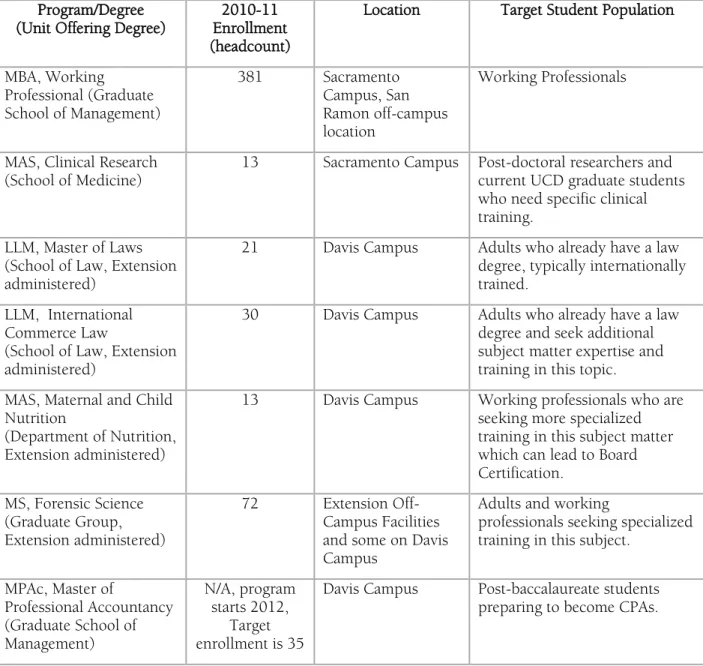
OP reports that over 40 SSDPs exist systemwide, enrolling over 4,000 students annually, and generating over $100 million in revenues. UC Davis currently has six programs enrolling approximately 400 students annually and generating over $10 million in revenue. A seventh program recently received systemwide approval and will launch in Fall 2012. Currently we are aware of an additional eleven new SSDPs under consideration by campus units. Table 1, below, provides some basic information on current SSDPs at UC Davis.
Table 1: Current UC Davis SSDPs Program/Degree
(Unit Offering Degree) Enrollment 2010-11 (headcount)
Location Target Student Population
MBA, Working Professional (Graduate School of Management) 381 Sacramento Campus, San Ramon off-campus location Working Professionals
MAS, Clinical Research
(School of Medicine) 13 Sacramento Campus Post-doctoral researchers and current UCD graduate students who need specific clinical training.
LLM, Master of Laws (School of Law, Extension administered)
21 Davis Campus Adults who already have a law degree, typically internationally trained.
LLM, International Commerce Law
(School of Law, Extension administered)
30 Davis Campus Adults who already have a law degree and seek additional subject matter expertise and training in this topic. MAS, Maternal and Child
Nutrition
(Department of Nutrition, Extension administered)
13 Davis Campus Working professionals who are seeking more specialized training in this subject matter which can lead to Board Certification. MS, Forensic Science (Graduate Group, Extension administered) 72 Extension Off-Campus Facilities and some on Davis Campus
Adults and working
professionals seeking specialized training in this subject.
MPAc, Master of Professional Accountancy (Graduate School of Management) N/A, program starts 2012, Target enrollment is 35
Davis Campus Post-baccalaureate students preparing to become CPAs.
Many of the schools or colleges developing new SSDPs have no past experience with such programs. A number of the new SSDPs under consideration are currently (or approved but inactive) state-supported academic programs that would transition to a self-supporting model, a procedure that has not been used on our campus in the past. Additionally, some of these programs are contemplating the use of online instruction, also a relatively new instructional delivery mechanism for the campus.
Currently, UC Davis does not have specific guidelines, outside of the Graduate Council procedures, that inform the campus community on standards or expectations for the establishment, administration, governance, and financial model that self-supporting degree programs should follow. Historically, campus administrative approval of SSDPs has occurred on an ad hoc basis, with specific requests addressed to the Provost or Chancellor. In some cases, it is not clear if current SSDPs offered by UC Davis went through any administrative/financial approval outside of their school of college. With the exception of the annual UCOP fee approval process, no standard review occurs for the financial model, administrative structure, enrollment planning, consistency with academic planning, or other aspects of a new SSDP program. As the number of SSDPs on campus is likely to grow, the lack of a standard
guidance and campus review and approval process is a cause of concern. The work of the Task Force focused on addressing this campus need for guidance and tools to facilitate the establishment and effective administration of SSDPs.
TASK FORCE PROCESS
To address the many diverse issues posed in the charge, the Task Force established three committees, listed below. Each committee was assigned several specific charges to consider, and all committees were expected to provide input into the process issues posed by Charge 1, which asked the Task Force to develop a process for academic and administrative review of new SSDPs. Each committee had both faculty and administrative representation.
Committee on Academic Quality and Experience: Charges 4, 5, and 6
Committee on Costs and Fees: Charges 2 and 7
Committee on Governance: Charge 3
The Task Force and its committees engaged in a comprehensive process to assess and reach consensus on key issues regarding SSDPs at UC Davis. This process was characterized by the activities described below. Fact Finding and Assessment Activities
To provide context and lay the groundwork for detailed discussions on the issues raised in the charge, the Task Force work began by engaging in fact finding and assessment efforts that broadly reviewed available information on SSDPs and similar programs. This included the following activities:
Researching the history and policies surrounding SSDPs in the UC system. This included the
development of a comprehensive background paper and conducting a survey of other UC campuses. Researching similar models for providing graduate education to working professionals at other public universities. This included a custom research project conducted by the Education Advisory Board (EAB), consultation with staff at the University of Washington, collecting and summarizing policies and sample documents from the University of Washington, and collecting relevant policies from other institutions identified by the EAB project.
Researching existing campus policies and processes that might apply to SSDPs.
Inviting a presentation from, and discussion with, staff at UCOP regarding the fee-setting process for SSDPs.
Collecting comparative data on SSDP program fees and the application of student service fees to different categories of students.
Analyzing and Defining the Task Force Charges
For each of the charges, the Task Force identified key issues relevant to the charge and further defined these issues for discussion by the group. The Task Force then determined if systemwide and/or campus policies already existed that addressed these issues. Based on this analysis, the committees focused their efforts on administrative and academic issues for which the campus has discretion to establish guidelines or policies, or where campus level clarification seemed necessary. This analysis is provided in Appendix C. Deliberation and Development of Recommendations and Tools
Once the initial fact-finding and analysis stages were completed, each of the three committees met to develop specific recommendations on each charge. In addition to recommendations, the committees also developed a reference tool or model related to their topic that can provide concrete guidance to members of the campus community who are administering, developing, or reviewing an SSDP. These reference tools are presented in detail later in this report.
Consensus Building
Upon completion of the committee process, each committee presented their recommendations and findings to the full Task Force. The recommendations were consolidated and analyzed for areas of overlap and disagreement. Task Force members were also provided with an opportunity to raise issues that may not have been fully addressed in the committees. Given the number and complexity of the issues considered across all committees, the areas of disagreement between committees were relatively few in number. These unresolved issues were consolidated into a single document and the Task Force held two final meetings to develop workable agreements. Ultimately, the Task Force reached consensus on all recommendations.
REFERENCE TOOLS FOR CAMPUS SSDPS
In addition to the specific recommendations, the Task Force developed three reference ―tools‖ to aid both administrators and program proposers in developing SSDPs. The first tracks the review and approval process; the second itemizes administrative and academic expectations at UC Davis; and the last helps clarify the financial model envisioned for SSDPs at the Davis campus. These tools also provide a more detailed context and graphical representation to support aspects of the Task Force recommendations presented later in this report.
New SSDP Program Proposal Process and Timeline
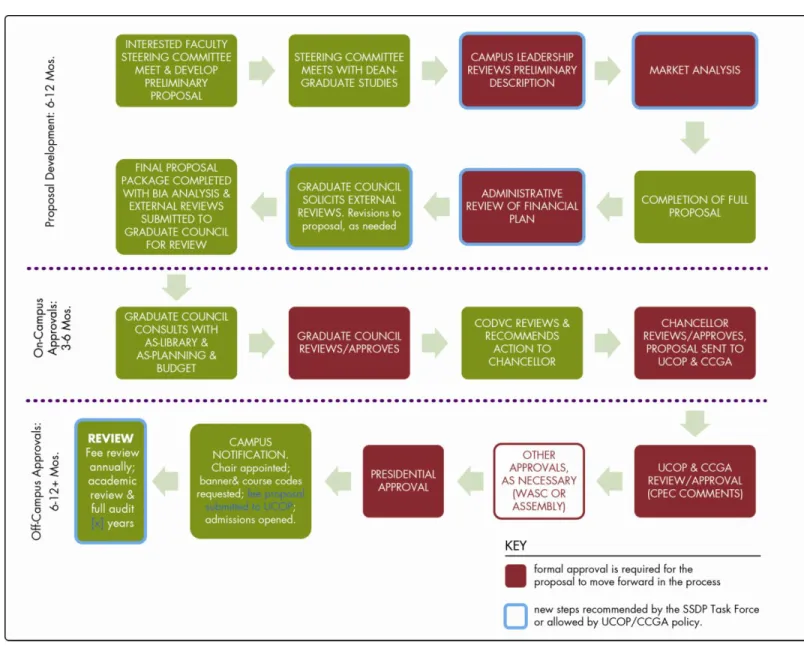
Charge 1 to the Task Force asked for a clear process that a new program must follow to become an SSDP at UC Davis. Figure 1 (also provided as Appendix D) identifies the academic and administrative review process recommended by the Task Force. Task Force members noted that the formal approval process, both locally and systemwide, generally moves more quickly when the proposal submitted is of high quality. Therefore, the Task Force flowchart emphasizes the development of high-quality SSDP proposals early in the process by adding a limited number of additional review steps during the proposal
development phase. In addition, the Task Force recommends that campus leadership evaluate the program’s overall contribution to the strategic mission of the campus and thereby to safeguard against the development of SSDPs primarily on the basis of financial incentives.
could result in a proposal not moving forward in the approval process as an SSDP. In cases such as this, programs may still choose to move forward as a new state-supported program.
Figure 1: New Self-Supporting Degree Proposal Process and Timeline
Identification of SSDP Program Requirements and Primary Unit Responsible
Since SSDPs are expected to fully fund all costs of operation, the Task Force believes that it is important that the scope of the activities required to administer an SSDP be defined for the campus community. Additionally, since administrative support for SSDPs can be provided by a campus entity outside of the academic unit offering the degree (e.g. University Extension), it was important to define which activities must be the primary responsibility of the academic unit vs. an administrative unit, although close ongoing coordination between these units would be expected and encouraged.
The ―SSDP Requirement and Responsibility Matrix,‖ provided as Appendix E, was developed by the Task Force as a tool for existing and potential SSDPs to use to evaluate the expected workload and
administrative roles in offering an SSDP. This tool primarily supports the recommendations made to address Charge 3 and provided a framework for Task Force discussions regarding the roles and
responsibilities of campus units and the scope of the administrative infrastructure necessary for an SSDP. It should be noted that, in some cases, an academic unit would also provide some or all of the
administrative support for an SSDP directly (e.g., the Graduate School of Management currently provides all of the administrative support for the Working Professional MBA programs). Additionally, it is
expected that individual SSDPs may determine that an additional activity is required to effectively support or administer the program. Therefore this matrix should not be viewed as establishing a required
program structure, but as a guide to ensure that SSDPs are aware of the expected baseline level of workload and that these critical activities are provided by an appropriate campus entity.
Proposed Financial Model for SSDPs
The Task Force Committee on Costs and Fees evaluated the current financial models used by SSDPs at UC Davis, models used at other UC campuses, and information from the University of Washington on how they support ―fee-based degrees‖. This resulted in the development of a proposed financial model for use by SSDPs at UC Davis that was adopted by the Task Force and forms the basis for
recommendations addressing Charge 2. This model would standardize and define the budget categories, terminology, and structure used by these programs to manage the financial aspects of an SSDP. This proposal also takes into consideration the need to align a proposed financial structure with the proposed governance structure for SSDPs, as is outlined in the ―SSDP Requirement and Responsibility Matrix‖, and how this model might operate under the new incentive-based budget model that will be implemented for the campus in fiscal year 2012-13. The full document describing this model is provided as Appendix F. The proposed financial model is based on the following guiding principles and goals:
Principle 1: Program budgets must address all costs of operating a UC Davis SSDP. Goal: Ensure that SSDPs are not supplemented by state or tuition funds.
Goal: Ensure that all necessary costs are identified to support long-term program viability (especially as new programs are considered).
Goal: Support the expectation that true costs are considered as part of the annual student fee setting process for these programs.
Principle 2: Keep budget and accounting mechanisms simple.
Goal: Keep administrative burden for program operations reasonable.
Goal: Reduce use of direct cost agreements between academic and support units. Goal: Provide more consistency between SSDPs in the process and costs for receiving
comparable central campus services.
Goal: Basic budget structure must be flexible enough to accommodate variations in programmatic design and delivery.
Principle 3: SSDP programs should receive, and pay for, all appropriate central campus services and infrastructure as other degree programs offered by UC Davis.13 (Note: This is a separate issue from the level
of access that SSDP students have to campus student services and activities, which will be addressed under a separate discussion.)
Goal: Reduce or eliminate inconsistencies between the services provided and paid for by SSDPs across the campus.
Goal: Recognize that SSDPs operate in an environment that is supported by a comprehensive campus infrastructure that was developed and paid for by other fund sources over time. Principle 4: The inherent risks and opportunities of offering an SSDP should be recognized and
addressed in the financial model for these programs.
Goal: Support the expectation that, over time, SSDPs will generate surplus revenue that is reinvested in other academic programs.
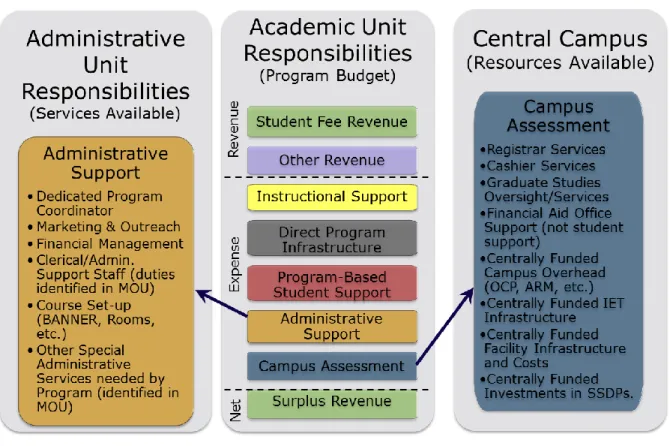
Goal: Establish a mechanism for campus investment in SSDPs from appropriate fund sources. Figure 2, below, provides a schematic representation of the proposed financial model for SSDPs by the budget category and campus entity that would likely provide the services or resources needed for SSDPs to operate. It also represents the flow of resources and responsibilities that would need to be in place to implement this model. This model assumes that an SSDP would have a single, distinct, program budget managed by one campus entity (the ―Academic Unit‖) which would cover all program costs, but that services and resources could be provided by a variety of campus units. A full description of the figure and definitions of the terms used in the proposed model is provided in Appendix F.
TASK FORCE RECOMMENDATIONS
CHARGE 1Recommend a process for the programmatic and administrative review of new self-supporting
degree programs that can be accomplished in a complete and expeditious manner. The role and
scope of each entity involved in the review should be clearly defined.
Reference
Number
Task Force Recommendations
1.1 Eligibility to Propose an SSDP. All graduate degree programs that meet the criteria of the UC Policy should be eligible to propose a SSDP.
1.2 Impetus for an SSDP. The impetus for SSDPs must come from the faculty themselves. A group of faculty with expertise in an area that seems likely for development of an SSDP may be charged to determine whether they have interest in developing a program (and provided with seed money from a dean/dept/other), but faculty interest must be the determining factor in beginning such an initiative. If faculty are interested, the next determining factors must be whether a market need exists for the program, and whether the program has strategic value to the campus as determined by the campus strategic plan or a body charged with such a task.
1.3 Approval Process. New SSDPs will follow the same proposal development and review process as any graduate degree with the following additions or modifications:
Campus leadership will screen preliminary proposals for alignment with strategic vision (See Recommendation 1.4).
A market analysis must be completed and show that the program is viable as an SSDP (See Recommendation 1.5.).
An administrative review of the program’s financial plan will be completed prior to submission for review (See Recommendation 1.6).
External reviews will be solicited and completed by Graduate Council prior to formal review by Graduate Council (See Recommendation 1.8.).
The full process proposed is outlined in Appendix D.
1.4 Screen Proposals for Strategic Vision. The Task Force recommends that the Provost establish a process to conduct a pre-screening of new graduate degree proposals by campus leadership to determine if they are aligned with the strategic vision of the campus prior to their submittal to Graduate Council for review. It is envisioned that this could occur by requiring the Lead Dean sponsoring a new program to submit a short ―letter of intent‖ type document that would provide a brief description of the proposed program and some explanation of how it is strategically aligned with the campus vision. This recommendation is intended to address concerns about how to protect the UC Davis brand, ensure that proposed programs are appropriate for our campus, and guard against degree establishment solely on the basis of financial
incentive. Additionally it is expected that early screening may reduce the workload and timeframes of establishing new degrees by eliminating some proposals early in the process, leaving more time for staff and faculty to focus on more viable programs. See Appendix D.
Reference
Number
Task Force Recommendations
1.5 Market Analysis. Any academic unit proposing a new SSDP must complete a
comprehensive market analysis based on empirical data that, at a minimum addresses: the target audience for the program, demand for the program, level of fees that potential students may be willing to pay for the program, other programs that exist that would compete for the target audience, and potential program enrollment. It may also be appropriate for existing programs to formally re-evaluate their market periodically. The Task Force recommends that centralized resources be made available to support the initial market analysis and business modeling. This could be accomplished through a shared service model. See additional related recommendations in 2.4. See Appendix D. 1.6 Administrative Review of SSDP Financial Plan. The Task Force recommends that an
administrative review of a proposed SSDP budget and business model be conducted by the appropriate campus entity (such as Administrative Resource Management/Budget and Institutional Analysis) prior to formal submittal of the proposal to Graduate Council for review. The findings of this review should be included with any program submittal so that they can be considered by the Council in their evaluation of the program proposal.
This administrative review should, at a minimum:
Assess the proposed program budget to ensure that all necessary costs are identified and can be recovered through the proposed program fees. Ensure that the activities reflected in the ―SSDP Requirements and
Responsibilities‖ (Appendix E) are reflected in the financial plan and funded appropriately for the size of the program.
Review the market study conducted to ensure that a market truly exists for the program,
Review enrollment and revenue assumptions, and
Generally evaluate the business model for the proposed program. If this review finds that the proposal would not result in a financially viable
self-supporting degree program, it should not continue on in the approval process as an SSDP. The Task Force notes that if a proposal continues in the approval process, and
significant changes are made in the business model in response to academic quality concerns, it will be necessary to have a follow-up administrative review later in the process to establish that the changes have not affected the proposal’s viability to operate as a SSDP.
It is recommended that the administrative review should be completed within 30 days of the submittal of a complete proposed financial plan (including the market study) for the SSDP. Entities proposing a new SSDP would be encouraged to consult with BIA while developing their proposal to ensure its completeness prior to submittal. Additionally it is recommended that standard tools and guidance be provided to potential SSDPs to assist in developing their business model and budget early in the development process (See also recommendations 2.4 and 2.1). See Appendix D.
Reference
Number
Task Force Recommendations
1.7 Academic Quality Review of Proposed SSDPs. Proposed SSDPs must have both an academic quality review and financial review process. For academic quality, the Graduate Council’s proposal review process will serve this purpose. In addition, an important aspect of the Graduate Council review will be to determine how faculty teaching and service will be compensated and how this will affect an individual faculty’s other teaching or administrative responsibilities (particularly for regular graduate programs).
1.8 Expediting the Review Process. The Task Force recommends that to expedite the review of SSDPs at the system-level, the campus should take advantage of the approved option that allows for the external reviews to be conducted while the proposal is at the campus-level, prior to formal submission to Graduate Council and the Coordinating Committee on Graduate Affairs (CCGA). It should be noted that this will result in additional costs at the campus level. The Task Force strongly recommends that those preparing a proposal for a new SSDP consider the following practices, which may expedite the process at the campus level:
Submitting an initial proposal that is clearly written, thorough, and reflects strong initial planning and analysis.
Responding quickly to questions from external reviewers and Graduate Council.
Dedicating staff to shepherd the proposal through the review process.
Submitting proposals to Graduate Council and CCGA during the Fall or Winter quarters.
The Task Force further recommends that campus and Graduate Council consider the following steps to increase the timeliness of external reviewers completing reviews:
If, after a period not to exceed 30 days from receiving the proposal, no response is received from an external reviewer, steps should be taken to replace that individual.
The level of pay for reviewers to ensure that reviews are given priority and completed in a timely manner.
Ongoing consideration of other ways to expedite the review process.
1.9 Process to Transition from State to Self-Support. Any existing state-supported program that wishes to transition to a self-supporting model or add a self-supporting track must meet the criteria for self-supporting programs as outlined in the UC policy and must go through the same approval process as all other new programs. Currently, CCGA considers a change from state-supported to self-supporting a substantive change that requires their review and approval. To the extent that aspects of the current program are not changed, the timeline for proposal preparation and campus review may be shorter as compared to proposals that do not already exist as state-supported. Transition to self-supported may be appropriate for a state-funded program that is discontinued for lack of financial support but can still demonstrate quality, faculty interest, market need, and strategic value to the campus. Programs discontinued for
Reference
Number
Task Force Recommendations
1.10 Use of State Funds During Transition Period. The Task Force recommends that only programs transitioning from state-supporting to self-supporting be allowed to transition to self-support over time. New programs would not be allowed to use any state funds even during start-up.
1.11 Multiple Tracks. A unit may offer a degree program with two tracks – one self-supporting and one state-supported – if both tracks use same degree requirements (in order to offer the same degree title); additionally, the base ―student quality standard‖ (e.g. admission, progress, degree certification standards) must be identical between the tracks. Additional standards on top of the base standards (e.g. work experience for admission to the self-supporting track) are allowable pending Graduate Council review of the degree requirements to be sure the base quality standards are the same.
In addition to the above, in proposing such a dual track program, justification must be provided as to how the self-supporting track meets the SSDP policy requirements (including criteria noted in Section I.A. of the UCOP policy), and include strong rationale outlining the need for two tracks.
The new campus budget model should help units proposing such a dual track model to account separately for state-supported and self-supported students. However, Graduate Council and BIA will need to determine how an audit and academic review of such a program should be conducted.
1.12 Required Memoranda of Understanding (MOUs) (summary of statements found elsewhere in recommendations). Prior to implementing an SSDP, the academic unit offering the program must enter into one or more MOUs that address the following issues:
Agreement between the academic program’s Lead Dean and an administrative entity that provides support services to the program. This MOU should clearly define the roles and responsibilities of each and close ongoing coordination would be expected and encouraged. In a situation in which the Lead Dean is also responsible for the administrative aspects of a program, clear
documentation should be provided of the administrative activities that will occur associated with the SSDP and how they will be accounted for and provided for in a manner that is clearly separate from any similar support provided to self-supporting programs that are also under the purview of that Dean. (See Recommendation 3.5 for more information on this topic.) Agreement between the Lead Dean and any department(s), graduate groups, and/or other dean’s participating in the SSDP regarding the distribution of surplus revenue generated by the program and responsibility for risk should the program not be self-sustaining. (See Recommendation 2.3 for more information on this topic.)
Agreement between the Lead Dean and any participating department (s), graduate groups, and/or other dean’s regarding the teaching commitment of faculty for the SSDP and method of compensation (See Recommendations 2.7 and 6.1 for more information on this topic.)
Reference
Number
Task Force Recommendations
1.12
continued Agreement between the Lead Dean and another academic unit which may provide SSDP students with access to state-funded courses through either cross-listing or open campus on how this access will be provided and how student revenue/costs will be distributed. (See Recommendation 7.4 for more information on this topic.)
If, after an SSDP is implemented, a new department/graduate group/or dean starts participating in the SSDP, an MOU would need to be updated or established to include this unit.
The Lead Dean may determine that other issues critical to effectively offering the SSDP should be included in an MOU.
It is expected that the MOU(s) would be in effect for a limited time period and then be re-evaluated and updated upon expiration. If significant changes in program design or participation occur prior to expiration, the MOUs should be updated to reflect these changes.
The MOU(s) for each SSDP should be kept on record by the ―Coordinating Body‖ located in the Office of Graduate Studies (described in Recommendation 3.5). 1.13 Periodic Reviews of SSDPs. SSDPs are subject to regular Graduate Council program
reviews (typically 3 years initially and 7-8 years thereafter) and annual UCOP reviews of self-supporting status for purposes of setting program fees. In addition, the Task Force recommends that the following regular reviews occur:
A campus audit and/or administrative review
A review and update of the MOU with all campus units involved in the program. The Graduate Council and administration should coordinate the program review and the audit/MOU review to ensure SSDPs are not overburdened with conflicting review periods; ideally, the reviews would occur together. The Graduate Council may wish to review SSDPs more often than state-supported programs, however the Task Force does not recommend a review period shorter than every 3 years for the first review and every 5 years thereafter for favorable reviews.
The Task Force also recommends that during the program review Graduate Council make a determination as to whether SSDP responsibilities have detracted from state-supported graduate programs based on a review of faculty participation. This review would track changes in individual faculty participation in graduate programs over time; a SSDP would need to provide documentation provided by the faculty member that includes: what courses have been taught each year since the last review, from where the compensation for those courses came (department expectation, overload, etc.), what other administrative service the faculty member has participated in for all graduate programs and SSDPs and the source of the compensation for those activities.
Reference
Number
Task Force Recommendations
1.14 Discontinuing a SSDP. The Task Force recommends that the discontinuation of an SSDP follow the same process in place for discontinuation of any other graduate program. The process for discontinuing a degree program is outlined in PPM200-25 and suspension of admissions can be either initiated by Graduate Council for cause or voluntarily suspended at the request of the program according to Graduate Studies Policy GS2006-01. Under these policies, the Graduate Council can initiate the discontinuation of a program based on quality concerns, and a Dean and/or faculty group can initiate the discontinuation of a program for other reasons. Because the factors that are considered in the discontinuation of an SSDP are the same as those considered in program establishment, lack of financial viability is a valid and
appropriate criterion for discontinuing the program. The Task Force assumes that the ―financial reserve‖ in the program’s budget model will be sufficient to cover the costs of program discontinuation.
1.15 Applicability of Task Force Recommendations to Current SSDPs. The Task Force recommends that existing SSDPs conform to any new policies or guidelines established as a result of the Task Force recommendations within a reasonable period of time, not to exceed 3 years. It is expected that the next program review after new campus policies or guidelines are established will evaluate the status of implementation of these changes on existing SSDPs. Should implementation of these policies result in any change in degree requirements, the program is expected to follow Graduate Council Policy GC2000-02 to ensure that current students are not adversely affected by these changes. The Task Force recommends that during the transition to the new campus budget model, campus treat SSDPs in a similar manner to all other academic programs in the first year.
CHARGE 2
Review existing supporting degree programs on campus to assess if they are truly
self-supporting from the campuswide perspective and recommend a methodology to ensure that all
campus costs of self-supporting degree programs are appropriately recovered.
Reference
Number
Task Force Recommendations
2.1 Financial Model for SSDPs. Adopt the financial model for SSDPs that is outlined in Appendix F. This model addresses the issues of cost recovery and separate budgeting/ accounting for SSDPs as well as integrating the financial structure with the likely governance structure for these programs.
2.2 SSDP Budget. All self-supporting degree programs should be required to establish an annual budget that identifies all costs associated with the program and allocates those costs to specific expenditure categories. The required funding categories are intended to ensure that the SSDP is provided appropriate support and planning to cover all necessary central costs. See categories outlined in Appendix F.
2.3 Generation and Use of Surplus Revenue. Each SSDP should be expected not only to ―break even‖ (including campus assessments) but to generate surplus funds. Over time, SSDPs should be expected to result in an added financial benefit to the unit offering the SSDP. Administrative units offering an SSDP should maintain a reserve for the
program.
All surplus revenue from an SSDP will remain with the academic unit that offers the program. In general, it is expected that the Dean of the School or College offering the program will have discretion over the use of surplus revenue. These funds will be generally available to support the academic mission of that unit. However, the Task Force recommends an expectation that a portion of the surplus revenue from an SSDP will be dedicated to student support for graduate academic students within the unit. In the case of a program that is based in a department or graduate group, an MOU must specify revenue- and risk-sharing agreements between the Dean, Department, Graduate Group, and/or other contributing units/deans. These agreements must be in place between all parties prior to initiating an SSDP program. (Refer to Appendix F for the definition of ―surplus revenue.‖)
2.4 Campus Investment. Campus should establish a centralized investment fund to support the start-up of new SSDPs. Resources for this fund could come from a portion of the campus assessment paid by these programs. This fund would be managed centrally and support activities such as market studies, limited-term program development support, and program start-up costs. This fund would provide an incentive for units to consider establishing an SSDP and help ensure the quality of those that go forward in the approval process. See Appendix F.
Reference
Number
Task Force Recommendations
2.5 Responsibility for Financial Risk. Campus should expect the academic unit offering the SSDP to be responsible for the long-term financial risk if an SSDP ultimately is not able to maintain a self-supporting model. The academic unit would be expected to bear the cost of ensuring that students in the program be given the opportunity to complete their studies, meet all long-term financial commitments of the program, and maintain any faculty hired or supported on the basis of SSDP funding. As a result, it is strongly recommended that SSDPs maintain an appropriate reserve at the academic home’s decanal level that could be a source for any potential ―shut-down‖ costs and act as a buffer if program enrollment fluctuates. See Appendix F.
2.6 Campus Assessment. In general, SSDPs would be expected to pay a campus assessment similar to all other academic programs on campus under the new campus budget model. This assessment would be expected to address all ―overhead‖ and should eliminate the need for additional direct payments to central campus units. SSDPs would have the same access to all campus resources as other academic programs. This recommendation is made with the caveat that the campus assessment should not be applied to SSDP expenditures for direct program infrastructure (such as leased space for off-campus programs) and that additional exclusions from the assessment may be appropriate for SSDPs depending upon what is ultimately funded through the assessment. See Appendix F.
2.7 Determining Value of Faculty Participation in SSDPs. Generally, it is recommended that the value of faculty workload should be prorated based upon the total teaching load, taking into consideration mentoring of graduate students, and faculty salary. However, it is recognized that: 1) teaching workloads vary by
department/college/school/division, 2) there are several methods to compensate faculty for teaching, and 3) each program may need to determine the most appropriate method.
The options for faculty compensation are:
Prorating the faculty salary based on teaching in SSDP in proportion to the total teaching load (freeing up a portion of regular salary for other use by
Department/School/College/Division).
Course ―swap‖ whereby a portion of a faculty member’s normal teaching commitment is exchanged for teaching in a SSDP (freeing up a portion of regular salary for other use by Department/School/College/Division). Overload payments per campus policies.
Additional compensation through ―summer salary.‖
Compensation directed to a faculty research account (Supports other faculty activities, perhaps graduate students).
Additional compensation that could be distributed through a negotiated compensation plan, such as the Health Sciences Compensation plan in the School of Medicine, or any other similar plan that may be implemented in the future. Department/School/College/Division compensation plan policies and implementation procedures may need to be revised to address the distribution of revenue from an SSDP prior to using this method of compensation.
Reference
Number
Task Force Recommendations
2.7 continued
SSDPs must also develop a compensation policy/plan regarding academic contributions other than teaching; these include 299/research funding for lab support, administrative service (program committees), course development, adviser, and student committee service. An allocation for these services should be provided to the department of the participating faculty member for distribution in accordance with the
department/school/college/division policy.
2.8 Use of Non-State, Non-Fee Based Funds. It is recommended that SSDPs should
generally not be established on the basis of other available time-limited non-state funds. SSDPs need to be based on a sustainable long-term model with student fees as the primary fund source. SSDPs should only be supplemented by non-state funds that are not based on student fees in the following circumstances:
As seed funding for program implementation.
For limited-term or supplemental expenses if the funds are limited-term in nature (i.e. grant sources).
Only for ongoing costs if the funds are from a permanent source such as an endowment.
Additionally, regardless of the external funds available to support the program, students should be expected to pay fees at a level determined in the same manner as other SSDPs (program cost and market). Should external funds be available for student support this should be implemented as a program expense, not as an offset for student fee revenue. This recommendation is intended to ensure that any additional non-state funds used to support an SSDP are applied in a manner that would not jeopardize the long-term viability of a program by committing to ongoing costs or artificially low fee levels that are not sustainable.
CHARGE 3
Review the existing administrative processes and structure for these programs and make
recommendations about efficient methods to provide appropriate administrative infrastructure
for these programs (new and existing) on our campus.
Reference
Number
Task Force Recommendations
3.1 Administrative Structures. All SSDP programs must show that they have appropriate administrative structures in place to adequately administer the program, similar to those provided for a state-supported program. This can be accomplished through partnering with an entity that provides administrative support functions for the program.
3.2 Roles and Responsibilities. To ensure that SSDPs are aware of all activities that the program must perform to be self-supporting, and whether the responsibility for those activities is academic or administrative in nature, the Task Force has developed the ―SSDP Requirement and Responsibility Matrix.‖ It is recommended that this matrix be adopted as the document that defines roles and responsibilities for these programs and as a tool for use by current and proposed SSDPs to establish program expectations. See Appendix E.
3.3 Identification of ―Lead Dean.‖ All SSDPs must clearly identify an academic dean who will be the ―Lead Dean‖ responsible for all academic aspects of the program and will be responsible for ensuring that appropriate administrative support for the program is established and maintained.
3.4 Definition of ―Lead Dean.‖ The Task Force found that although the term ―Lead Dean‖ for graduate groups and other academic programs is familiar on our campus,
information on how this is defined is not easily accessible and may not be generally understood. Therefore, the Task Force recommends that the appropriate campus entity, Graduate Council/ Graduate Studies, update or create a definition of the role of ―Lead Dean‖ for graduate programs.
3.5 Central Services Model for SSDP Administration. The Task Force recommends that the campus establish a centralized ―Coordinating Body‖ to ensure that integrated
administrative support is provided to SSDPs to enhance their consistency and
efficiency. The Task Force also recommends that this Coordinating Body be located in the Office of Graduate Studies; and that, working with University Extension and other units on campus, it provide central campus services, if needed, while avoiding the unnecessary replication of procedures and processes already successfully in place at UC Davis.
CHARGE 4
Assess and identify issues related to maintaining the academic quality of both self-supporting
degrees and related state-supported degree programs as self-supporting degree programs expand
and make recommendations to ensure that quality standards are maintained.
Reference
Number
Task Force Recommendations
4.1 SSDP Admission Standards and Academic Progress. The academic standards for
admission to the SSDP and progress must be the same as standards for regular academic programs as established by UCOP, CCGA, Graduate Studies, Graduate Council, etc. 4.2 SSDP Students and Degrees. SSDPs should primarily serve working mid-career
professionals.
As the Master for Advanced Studies (MAS) degree title has been used in the past to denote self-supporting programs, the Task Force recommends the continued use of this title as well as other appropriate disciplinary titles for SSDPs (M.A., M.S., etc.).
Also, SSDPs should seriously consider whether offering a thesis/research plan is prudent; it may be more appropriate to offer only the master’s Plan II
(project/comprehensive exam) depending on the workforce training requirements and the nature of the discipline.
Concerning non-degree programs, such as Graduate Academic Certificate (GAC) programs, SSDP students may participate following regular admission practices. Students will pay the appropriate fees based on what type of program offers the course (SSDP or state-supported) and whether the student is registered as self-supporting or state-supported, as discussed in Recommendation 7.4.
4.3 Definition of Degree Eligible to be Self-Supporting. The UC Policy specifically states that a degree that is not an academic master’s degree program that solely or primarily leads to a PhD is not eligible to become an SSDP. The Task Force recommends that the Graduate Council be requested to define the meaning of an ―Academic Master’s Leading Solely or Primarily to a Ph.D.‖ in the context of the UCOP Policy on Self-Supporting Degree Programs as it would apply to UC Davis. In the event that Graduate Council is unable to define campuswide criteria for this, the Task Force recommends that each program seeking SSDP approval be required to address this issue in their proposal. 4.4 Definition Full and Part-time Enrollment in an SSDP. Davis Divisional Bylaw 80.B.11
outlines the authority of Graduate Council ―to set policies and standards for admission to full- and part-time graduate status.‖ Davis Divisional Regulation 702 stipulates that full-time graduate students are those enrolled in 12 units a quarter, while part-time graduate students enroll in 6 units or less per quarter. Therefore, the Task Force
recommendation is to apply these same criteria in effect for ―regular‖ graduate programs to SSDPs. The Task Force also recommends that SSDP proposals outline whether the program will be full-time, part-time, or if the program would support both full-time and part-time students, as is reasonable to enroll their intended audience.
Reference
Number
Task Force Recommendations
4.5 Dual Enrollment/Double Major between Regular vs. SSDP. Students cannot dual enroll or double major in an SSDP and state-supported degree program. Admission to each type of program must be separate and distinct and follow the admission practices approved by the Graduate Council and the Dean of Graduate Studies. Accordingly, students cannot use the ―Petition for Change of Graduate Major, Degree Objective, or For Double Graduate Major‖. This does not apply to GACs (see recommendations 4.2 and 4.7 below).
4.6 Cross-Enrollment in Regular vs. SSDP Courses. State-supported students may enroll in self-supporting courses and self-supporting students may enroll in state-supported courses. The student would need to meet the following criteria:
1. Meet all prerequisites of the course;
2. In some cases, may need permission from the instructor to enroll; and, 3. Pay extra fees to access that course as discussed in Recommendation 7.4. 4.7 Online Courses. Graduate Council and the Committee on Courses of Instruction
CHARGE 5
Assess and identify issues related to the impact of self-supporting programs on the student
experience for both self-supported and state supported students and make recommendations on
ways to address these issues. This should include reviewing issues related to providing academic
and non-academic services and financial support to students in self-supporting degree programs.
Reference
Number
Task Force Recommendations
5.1 Financial Aid for SSDP Students. Return-to-aid should not be a requirement for an SSDP; however, the proposal must articulate its aid process (no aid or dedicated set aside funds for financial aid/fellowships for its students, etc.) according to the requirements of CCGA. As CCGA has stated in the past, it believes access and affordability are important values to UC education; therefore, it is important for the SSDP proposal to justify and outline through market research that potential students will be able to afford the fee proposed. It is also important for a proposal to show a commitment to diversity, and outline a plan of recruitment (and perhaps aid, if necessary) that will ensure a diverse student body.
5.2 SSDP Student Access to TA/GSR Appointments. Adhere to the current Graduate Studies policy on TA/GSR appointments for students in SSDPs: GS2011-02.
5.3 SSDP Students and Campus Fees & Related Services. The Task Force recommends that each SSDP be able to determine on a program-by-program basis whether or not their students will pay campus fees and have access to campus student services. The range of fees and services available to these students should be based on a limited, tiered
approach to maintain some consistency between programs. For example, SSDPs could be expected to choose from specified (and delimited) levels of access: e.g., all services, only academically necessary services (e.g. library access), or no services. Some members of the Task Force were not comfortable supporting a recommendation that would result in SSDP students being treated differently than other graduate students who are registered ―In Absentia.‖ Therefore, it is further recommended that, prior to issuing a policy with regard to fees and services for SSDP students, the campus reexamine the issue of the level of campus fees paid by students ―In Absentia‖ from an equity perspective.
CHARGE 6
Assess and identify issues related to the impact of self-supporting programs on faculty and make
recommendations to address these issues.
Reference
Number
Task Force Recommendations
6.1 Teaching Policy. An SSDP must establish a teaching policy that defines how the teaching responsibilities for the SSDP will be divided among the faculty involved in the program, establishes an expectation about how much teaching participating faculty will provide to the SSDP, and how compensation for this teaching will be provided. (Specific options for providing compensation to faculty participating in an SSDP are discussed in Recommendation 2.7.)
It is acknowledged that teaching policies are generated at the
department/school/college/division of the individual faculty, so expectations of faculty in graduate groups are disparate. Departments may vary in whether graduate teaching is in an overload capacity or included as part of regular load, hence teaching in a SSDP will vary, as well. To address this issue, each department/school/college/division with faculty participating in an SSDP must develop a teaching policy for graduate education that addresses teaching in department-based programs, graduate groups, and SSDPs. The balance of demands between teaching and research should also be considered in developing this policy. This policy must be in place prior to implementing an SSDP and must be included in the proposal to establish a new SSDP. If a faculty member wishes to participate in an existing SSDP, his/her department must establish a teaching policy, as described above, prior to their participation in the program.
Agreements regarding the teaching commitment of individual faculty involved in an SSDP must be made with the department where the faculty has an appointment. 6.2 Non-Regular Faculty Teaching. Graduate Council should develop a policy regarding
standards for proportion of non-regular faculty (e.g. clinical/adjunct faculty, lecturers, visitors) in graduate programs (which would include SSDPs).
6.3 Use of SSDP Funds to Hire Faculty. Units should be able to use SSDP income to hire faculty, but there needs to be a responsible unit to backstop the salary.
CHARGE 7
Assess and identify issues related to the level of self-supporting fees in light of revenue
generation opportunities, market factors, and their relationship to other campus fees and make
recommendations to address these issues.
Reference
Number
Task Force Recommendations
7.1 SSDP Fee Levels—Compared to Regular Fees. To ensure that the UC Davis ―brand‖ is maintained and that state funds do not subsidize SSDPs, SSDP fees should never be lower than the tuition and fees paid by state-supported students. In addition, the Task Force finds that SSDP fee levels are more appropriately compared to those paid by nonresidents, since the concept of nonresident tuition is that it is charged in lieu of state-support.
7.2 Consideration of Market in Fee Setting for SSDPs. The Task Force does not
recommend a required differential between SSDP fees and tuition. However, SSDPs should be encouraged to maximize revenue by setting fees at a level consistent with what the market can bear in addition to the level that covers program costs.
7.3 Fees Charged to Nonresidents. The Task Force does not recommend that SSDPs be required to charge different fees for nonresidents. However, a program could choose to propose a fee differential for nonresidents. This recommendation is based upon the expectation that SSDP fees are likely to be more comparable to the level of fees paid by nonresidents enrolled in state-supported programs since the concept of nonresident tuition is that it is charged in lieu of state-support and that level of support may be needed to cover the costs of an SSDP.
7.4 Fees for Cross-Enrollment in Regular vs. SSDP Courses. A regular student cross-enrolled in an SSDP course (as described in Recommendation 4.7), will pay an additional fee established by the SSDP to cover the incremental per unit differential between the cost of the SSDP and regular UC tuition. In the case of a self-supporting student who wishes to take a state-supported course, the SSDP program they are enrolled in would be required to reimburse the campus unit that offered the course for the cost of teaching the SSDP student. This reimbursement should be at a rate that is at least equivalent to the per student revenue sharing rate used for the ―open campus‖ program and would come from the SSDP fees paid by the student. It is also possible for a self-supporting program and a state-supported program to offer a course that is cross-listed and includes students from both programs. In this case, each student pays the fees associated with the program in which they are enrolled, and it is the responsibility of the programs and academic units offering the course to appropriately divide the cost of offering the course between the fund sources. The governing principle is that SSDP and state-supported students are accounted for separately to ensure that state funds do not supplement self-supporting students. It is expected that the new campus budget model will facilitate the flow of revenue for cross-listed courses.
7.5 Use of Filing Fee Status in SSDPs. The Task Force generally discourages the use of filing fee status for SSDPs, however, it is recognized that there may be instances where it is necessary or appropriate. Therefore, the Task Force recommends that the
Reference
Number
Task Force Recommendations
proposed policy on filing fee usage must be included in the proposal for a new SSDP. 7.6 SSDP Student Access to the Planned Educational Leave Program (PELP): Although
PELP is defined as an interruption in full-time education, the Task Force recommends that PELP remains an option to all eligible students in self-supporting programs, even those with part-time enrollment. The regular processes and criteria should apply to SSDP students seeking to PELP as to ―regular‖ academic graduate program students. 7.7 UCOP Fee Setting Process. The Task Force found that, from the campus perspective,
the UCOP process for evaluating SSDP budgets for fee setting purposes is not based on the actual data that determines if an SSDP is truly self-supporting, was not value-added and did not align with actual campus budgets and processes, and did not provide any assessment of the market comparison of fee levels. The Task Force recommends that the Provost request that UCOP allow the evaluation of the self-supporting status of these programs be based on a campus template or methodology and that fee setting and approval for SSDPs be delegated to the campus level.
CONCLUSION: CAMPUS ACTION STEPS
As was indicated in the Task Force charge letter, the increased interest in SSDPs and expectations regarding the revenue generating potential of these programs make it imperative that the campus take quick action to provide guidance to the campus community on how to implement new SSDPs and strengthen current programs. If adopted, the recommendations and tools in this report provide a clear path for SSDPs at UC Davis. As such we recommend that:
The Provost and Executive Vice Chancellor:
Generally endorse the governance, administrative, and financial expectations reflected in this report after soliciting appropriate campus review and feedback.
Formally establish a centralized ―Coordinating Body‖ to ensure that integrated administrative support is provided to SSDPs to enhance their consistency and efficiency as described in Task Force Recommendation 3.5.
Consider an initiative that would provide seed funding to support academic units interested in establishing a new SSDP. These funds could be used to support the critical workload associated with proposal development. In this environment, the availability of even a modest amount of campus resources to support these activities may incentivize the successful development of new revenue generating SSDPs.
The Academic Senate and Graduate Council:
Implement the proposed changes to the process for establishing a new SSDP as described in the Task Force Recommendations for Charge 1.
Formally address the following issues raised by the Task Force for Graduate Council consideration:
o Update or create a definition of the ―Lead Dean‖ role for graduate programs and make it widely available to the campus community as described in Task Force Recommendation 3.4.
o Define the meaning of ―Academic Master’s Leading Solely or Primarily to a Ph.D.‖ as described in Task Force Recommendation 4.3.
o Develop a policy regarding standards for proportion of non-regular faculty in graduate programs as described in Task Force Recommendation 6.2.
Establish a policy regarding online graduate level courses as indicated in Task Force Recommendation 4.8.
Faculty and Academic Administrators:
Assess the opportunities for the development of successful SSDPs within disciplines.
Review current SSDPs in light of the Task Force recommendations, consulting with Academic Senate leadership as necessary, and assess any changes that might be needed to strengthen these programs and address areas where policies, agreements, and structural changes may be necessary to meet the expectations reflected in the Task Force recommendations.