STOCKPORT
TECHNICAL
SCHOOL
1
2
Foreword
As Principal of Stockport College, I have pleasure in setting out the vision and plans for the new Stockport Technical School. This new school will be part of an “educational zone‟ for Stockport incorporating both the Stockport Technical School and the Stockport Creative & Media Studio School as two separate schools, situated close by to each other, with the opportunity for some shared facilities.
Stockport College has always been at the forefront of helping young people to get jobs. During these uncertain times we need to prepare and improve young people’s skills so that they can get the best job they can. We hear constantly that employers are not recruiting because young people do not have the level of communication skills, team working skills and a sense of a work ethic that employers are looking for. We want to give our learners‟ the best opportunity we can to secure their future employability.
Issues such as climate change and the rapid development of technology are a part of our everyday lives, and there is a growing need to develop young people with the right skills, to meet the needs of the economy and expectations of employers.
Our proposal is to address these issues through the creation of Stockport Technical School which will focus on preparing young people to enter sectors such as Engineering, Science and Technology. The School will ensure that employers have access to a pool of talented young people with the ambition, skills, abilities and enthusiasm for a career in the industry.
Throughout the learning experience will be the development of key employability skills through working with employers. Young people can expect to be work ready for jobs such as: a Laboratory Assistant, Motor Mechanic, Engineering Technician or as a Computer Programmer. With higher level studies careers could include: a Computer Software Engineer, a Computer Scientist, a Mechanical Engineer or a Medical Scientist.
Stockport College is already a provider of high quality education to young people from the age of 14. With Ofsted “Outstanding‟ and Beacon status, the College is well placed to lead the development of the Stockport Technical School. We will work closely with our partners Man Diesel and Jacobs UK Operations North to ensure that the curriculum is developed and is responsive to sector, employer and community needs. Working with employers within the Engineering, Science and Technology sectors, learners at the School will receive “real life‟ work experiences preparing them to progress their chosen careers.
Learners will leave the School with a range of academic and technical qualifications which will enable them to progress, this is anticipated: 60% of learners will go on to Higher Education, 30% into Apprenticeships and 10% into employment with training.
3 I really believe that the Stockport Technical School will have a positive impact on the lives of learners, communities and the Engineering, Science and Technology industries in Stockport and the surrounding areas, and look forward to discussing our proposals with you in the future.
<Redacted> <Redacted>
4
Contents
Section A: Applicant details and declaration
Section B: Outline of the school
Section C: Education vision
Section D: Education plan
Section E: Evidence of demand and marketing
Section F: Capacity and capability
Section G: Initial costs and financial viability
Section H: Premises
Section I: Due diligence and other checks
Appendices:
No. Information provided
1 Example timetable
2 Letters and questionnaire sent to parents/guardians, employers and schools
3 Letters of support from employers/partners and Employer Support Matrix
4 Procedure for non compliance of Behavioural Policy
5 Premises - Site maps
5
Section A: Applicant details and declaration
Main contact for this application
1 Name: <Redacted> Vice Principal Curriculum & Quality
2. Address: Stockport College <Redacted> Stockport Cheshire <Redacted>
3. Email address: <Redacted>
4. Telephone number: <Redacted>
About your group
5. Please state
how you would describe your group: Parent/community group Teacher-led group Academy sponsor Independent school State maintained school Other
6. If Other, please provide more details:
College of Further and Higher Education
7. Has your group submitted more than one Free School
application in this round? Yes No
8. If Yes, please provide more details:
We have also submitted a bid for a studio school for the creative and media industries, also to be based in Stockport.
9. In addition to any support/advice from the New Schools
Network, did you put together this application with support from another company or organisation?
Yes No
10. If Yes, please list the name(s) of the organisation(s) and describe clearly the role they played in developing your application. Please also describe the role (if any) you envisage for them in setting up and/or running the Free School if your application is successful:
6 The College received support from the professional services firm KPMG in developing our bid. A Partner from the firm has agreed to be chair of the Governing body and a member of the trust, and it is envisaged that the KPMG education team will provide on-going support to the school.
Details of company limited by guarantee
11. Company name: Stockport Technical School 12. Company address: <Redacted> Stockport Cheshire <Redacte d>
13. Company registration number: 7962246
14. Does the company run any existing schools, including
any Free Schools? Yes No
15. If Yes, please provide details:
Company members
The members of the company are its legal owners. We require that there are a minimum of three members. The founding members are those that establish the company and sign the memorandum of association that is submitted (with the company's articles of association) when registering the company with Companies House. Further members may subsequently be appointed.
16. Please confirm the total number of company members: 4
17. Please provide the name of each member below (add more rows if necessary):
1. Name: <Redacted>
7
3. Name: <Redacted>
8
Company directors
The company directors are appointed by the members and will eventually form the governing body that will oversee the management of the school. At the point of setting up the company, members are required to appoint at least one director – this may be one of the members. All directors at the point of application must complete a Section I personal information form. All individuals on the governing body must be formally appointed as directors of the company and registered with Companies House.
18. Where directors have already been appointed please provide the name of each and the positions they will hold (add more rows if necessary):
1. Name: <Redacted> - Chair 2. Name: <Redacted> - Director 3. Name: <Redacted> - Director 4. Name: <Redacted> - Director
19. Please provide the name of the proposed chair of the governing body, if known:
<Redacted>
Related organisations
20. Through its members, directors or otherwise, does the company limited by guarantee have any formal or informal links (eg. financial, philosophical or ideological) with any other organisations within the UK or overseas? These may include: other Free School groups; other institutions; charitable bodies; and/or commercial or non-commercial organisations.
Yes No
21. If Yes, please provide the following information about each organisation: their name;
their Companies House and/or Charity Commission number, if appropriate; and
the role that it is envisaged they will play in relation to the Free
9
Stockport Technical School is to be sponsored by Stockport College which is a Further and Higher Education Institution
22. Please specify any religious organisations or institutions connected to your application (local, national and international). In particular, please describe in specific terms the religious affiliations of your group, including where appropriate any denomination or particular school of thought that influences your group (eg Pentecostalism, Deobandism, Reform Judaism, etc).
None
Existing providers
23. Is your organisation an existing independent
school wishing to become a Free School? Yes No
24. Is your organisation an existing independent school wishing to establish a new and separate Free School?
Yes No 25. Is your organisation an existing state maintained
school or Academy wishing to establish a new and separate Free School?
Yes No 26. If Yes to any of the above three questions, please
provide your six digit unique reference number here:
27. If you are an existing independent or state maintained school or an Academy, please state the age range and current number of pupils on roll and your capacity:
28. If you are an existing independent or state maintained school or an Academy, please provide the date of your most recent inspection and a link to the report on the Ofsted or other inspectorate website:
29. If you are an existing independent or state maintained school or an Academy, please provide a link to your performance data for the last 3 years:
10 30. If you are another type of organisation involved in education, eg an
Academy sponsor, please describe that organisation. Please ensure you include your company registration number:
Stockport College is a College of Further and Higher Education which offers programmes for young people and adults from 14 upwards, with programmes ranging from Entry Level to Level 5 and beyond.
Please tick to confirm that you have included all the items in the checklist.
Declaration to be signed by a company member on behalf of the company
I confirm that the information provided in this application is correct to the best of my knowledge. I further confirm that if the application is successful the company will operate a Free School in accordance with the requirements outlined in the “How to Apply‟ guidance and the funding agreement with the Secretary of State. I acknowledge that this application may be rejected should any information be deliberately withheld or misrepresented that is later found to be material in considering the application.
Signed:
<Redacted>
Position: Member of company Print name: <Redacted>
11
Section B: Outline of the school
1. Proposed school
name: Stockport Technical School
2. Proposed academic
year of opening: 2013
3.
Specify the proposed age range of the school: 4-11 4-16 4-19 11-16 11-19 14-19 16-19 Other
If Other, please specify:
4. Date proposed
school will reach expected capacity in all year groups:
2017 5.
Will your proposed school be:
Boys only Girls only Mixed
6. Do you intend that your proposed school will be designated as having a religious
character? Yes No
NB Please refer to the glossary of terms in the ‘How to Apply’ guidance for more information about religious character/designation.
7. If Yes, please specify
the faith,
denomination, etc of the proposed school:
8. Do you intend your proposed school to have a faith ethos (but will not be
designated as having a religious character)? Yes
12 No
9. If Yes, please specify
the faith,
denomination, etc of the proposed school:
10. Postcode of the
preferred site of the proposed school:
<Redacted>
11. Local authority area
in which the proposed school would be situated:
Stockport
12. If the preferred site is
near to a local authority boundary please specify the names of the neighbouring local authorities:
13. This application form is designed to be used for mainstream applications and 16-
19 applications (as defined at Annex A of the “How to Apply‟ guidance). If the school you are proposing does not really fit the definition of a mainstream or 16-19 school but does not fit the definitions of special or alternative provision schools either, you need to use the template that is the closest fit and explain how your school would differ. If this applies to your application please briefly outline the main differences below. You will also need to address these differences in more detail in the relevant sections of the application.
13
Section C: Education vision
”Our vision for Stockport Technical School is to provide innovative,
dynamic, and empowering education and training for young people
who have an interest and aptitude for engineering and
technological based careers. With a focus on engineering and
emerging technologies, our aim is to develop young people who
are skilled, professional and enterprising - who can make a
significant contribution to reinvigorating engineering and science
in Stockport, Greater Manchester and the North West of England.”
The school will:-
• Meet the needs of the economy as identified by local employers, such as
Man Diesel, Jacobs and Stockport NHS, who have indicated that skills shortages in young people will inhibit future growth;
• Develop skills, motivation and aspiration in young people through the
delivery of an innovative technical, academic and employer focussed curriculum; and
• Utilise the skills and experience of Stockport College in the delivery
of Science, Technology, Engineering and Mathematical (STEM) related education from the age of 14 upwards in an area where there is a decline in activity in the local Stockport schools.
The CBI annual skills report 2010 identified 59% of employers, in the UK, as having difficulties in recruiting STEM-skilled employees. In addition, 22% of engineering establishments in the North West reported skill gaps in the current workforce. By developing the skills which employers demand, the School will provide a fantastic opportunity to support the high-profile STEM-related employers in the region. It will also benefit the increasing number of smaller STEM-related employers in the region, such as The Stopford Workshop, which incorporate new and exciting sectors e.g. nuclear decommissioning and nano-materials. A focus on these skills also provides young people with the foundations to enter a number of attractive career options. The North West region is home to the UK’s largest manufacturing sector, accounting for 11% of all engineering companies. As previously stated feedback from employers suggests that they are facing real skills shortages in key areas, such as science and emerging technologies. Therefore it is essential that learners receive a relevant technical education, in such areas, to sustain the UK’s future economy. According to labour market information, sciences and manufacturing are key sectors which are particularly important to the local economy and which are in need of skills development. STEM skills have an increased focus for Northwest priority sectors such as manufacturing, biomedical, chemicals and automotive skills.
14 SEMTA (the Sector Skills Council for Science, Engineering, and Manufacturing Technologies) also reported skills gaps in the industries which offer opportunities to STEM-skilled individuals in the North West. Over the period 2008-2014 it was stated that there is expected to be a net requirement within the engineering industry in the North West for in the region of 6,600 people qualified at Level 2, 7,100 people at Level 3, 7,900 people at Level 4 and 2,200 people at Level 5.
Large local employers, such as Cromwell Tools and Balluff Sensors Worldwide report significant difficulties in the recruitment of appropriately skilled young people. Instead, they state that they have become over reliant on an ever -ageing workforce as young people are deterred from becoming the engineers, scientists and technologists of tomorrow.
In addition, learners who wish to access an engineering curriculum have limited opportunity to do so before the age of 16. Stockport College is the only educational institution within the Borough which offers a full range of engineering and manufacturing learning beyond the age of 16 with some opportunities also being provided for vocational learning to young people aged from 14 to 16 through a school link programme. This delivers GCSE Engineering provision with one school alone sending 56 learners. A further 19 learners from a number of schools are studying the Higher Diploma in Engineering, whilst a further 64 learners access motor vehicle provision. However, as this is part of existing secondary school curriculum offers, the opportunity for learners to have an in-depth experience are limited in scope.
This year the schools within Stockport have already reduced the vocational offer, which they make to their learners and have indicated their intention to make further reductions, in the future. This means that for learners who remain within the mainstream there will be less choice and opportunity to undertake a STEM based curriculum. In Stockport there is currently only one school which has facilities to deliver engineering. The head teacher has stated that they are supportive of the Technical School, and has agreed to become a Governor. This will also open up opportunities for the School to become involved with Stockport Technical School, to undertake programmes in partnership, and embark on joint projects in order to enrich the curriculum for their learners.
It is proposed that the School will be further enhanced by the development of a new Engineering and Technology Centre, located on the same site as the current Stockport College engineering provision. This development is intended to create an innovative learning environment focusing on engineering, emerging technologies, advanced manufacturing and the low carbon economy. In addition the centre will put in place resource management practices in education and industry which will enable good practice to be shared across all primary and secondary schools within Stockport and the surrounding areas.
15 The School will offer a distinctive curriculum which is complementary to that offered by Stockport College, it is different in that it focuses on emerging technologies, and is offered in a small school environment. The curriculum will combine academic, technical and employer focused education, an innovative combination that is currently missing from existing local provision.
This unique curriculum will ensure that all learners, interested in pursuing a career in technology related industry have a pathway, which is appropriate for their individual ability, needs and aspirations. This will be made possible through a number of educational pathways, which combine the development of practical, work ready skills along with a solid grounding in key subjects such as English, science and mathematics.
It will include a full range of academic and vocational subjects including GCSEs, A Levels, and vocational learning. The curriculum will address latent demand through offering engineering, manufacturing and IT, underpinned by a core entitlement covering science, English, mathematics and technology, complemented by employability and enterprise skills. The curriculum will be responsive to emerging industrial demands which are identified within the Low Carbon Industrial Strategy, the Digital Britain White Paper, and The Advanced Manufacturing Strategy.
The variety of pathways on offer, will appeal to a wider audience. For example, learners who may become disillusioned with the traditional academic route of GCSEs on offer in local schools, will be able to undertake stimulating, alternative and additional qualifications such as Motor Vehicle Technology, not on offer locally, thus re energising their interest in education and therefore reducing the NEET population of Stockport.
The Stockport Borough Council Monthly Performance Report (November 2011) showed that attitude, behaviour, motivation and attendance were the main reasons given by young people for disengaging with education and work. The programmes offered through the School will provide an alternative to the mainstream curriculum, build self esteem and confidence and will develop learners into functional members of society.
With the number of people studying STEM-based subjects at further education decreasing proportionally, those with the necessary skills to thrive in employment are scarce. The July 2011 FE STEM Data project report from the Royal Academy of Engineering showed that the number of young people undertaking science, technology, engineering, and mathematics between 2007/08 and 2009/10 had reduced significantly across Entry Level, Level 1, Level 2 and Level 3, whilst at Level 4 numbers had declined across all areas except mathematics.
Other key features include; a range of industry standard work environments with learners engaged on “live‟ industry briefs; an extended school day/term, to mirror “real‟ life, ensuring learners are work ready; highly experienced and skilled staff and
16 a focus on the development of wider skills such as analytical, numerical and problem solving abilities. These distinct features coupled with a culture of aspiration and high achievement will ensure that individuals leaving the school are thoroughly prepared for higher education, employment and life.
The School will deliver transformational learning including the development of transferable skills, which are central to employability, lifelong learning, personal fulfilment, and social and economic prosperity. It will embed the elements of health, citizenship, entrepreneurship and employability through close links with local employers and engineering and science stakeholders, such as The National Forum of Engineering Centres (NFEC).
Innovative teaching and learning strategies will be implemented. Key features will include development of technical skills through learning zones, high level questioning techniques, modelling and enquiry based teaching. Learners will engage in co- operative learning and assessment for learning will be a consistent theme. Learners will be able to develop and carry out independent research within the learning zones. Work based learning will also be an important feature. Learners will be given the opportunity to apply theory to practice, producing a learning journal where they will be able to self assess their skills and knowledge and reflect on what they have learned and how to improve on their technical and/or practical skills. Work based learning opportunities will also enable the learners to develop their employability and specific technical skills as appropriate to local industry.
The School will harness partnerships with small and large employers within the region, ensuring that it has an employer led curriculum in place. MAN Diesel and Jacobs UK Operations as partners in the School, and as members of the Board of Governors and the Steering Group, will have an important role in providing the focus for the development of skills and knowledge necessary to enhance employability. Learning will be supported in the workplace and community settings as well as on the School premises. Parents and the business community will be key partners in supporting learners’ learning.
The School will support learners to achieve their full potential through clear progression pathways into further and higher education, apprenticeships and employment with training thereby meeting the local and regional demands for technological based employees. The School will encourage learners to work independently through a range of industry endorsed projects and curriculum. Delivery and assessment will be creative, with every learner engaged on an appropriate pathway to meet their career aspiration.
With a distinctive focus on developing multidisciplinary skills through both academic and practical experiences, the School will improve youth employability in engineering
17 and emerging technologies in Stockport, Greater Manchester and the North West of England. In order to do this the School will:
• Make sure the curriculum is fit for purpose – offering flexibility in pathways to respond to individual learner needs whilst establishing the skills, which will benefit the learners in their future careers. Each learner will have an individual learning programme, which will increase choice and flexibility of provision, and will mean that the curriculum is more tailored to their individual needs;
• Meet the right skills gaps – through continuous engagement with
employers ensuring that the School is the first choice for them to work with young people.
• Develop skills employers say are lacking – there has been evidence
of lack of maths and English skills in young people. CBI found that more than two-fifths of firms are not satisfied with the basic literacy of school and college leavers, whilst one-third were reportedly unhappy with the levels of numeracy. It was reported that in 2010 only 55% of young people manage a grade C or better at GCSE in English and maths. By basing the curriculum around the English Baccalaureate, the School with have a focus on improving the standards of English and mathematics amongst its learners.
The School will increase the opportunities for young people to study STEM related subjects and curriculum, which in turn will lead to opportunities for employability and higher earnings, and will provide progression opportunities to advance to further education, higher education and employment.
The School presents a significant opportunity to re-brand and reposition engineering provision across Stockport, Greater Manchester, and the North West of England. It will also present the opportunity to develop a joined-up strategy for the development of:
• 11-19 provision, with full progression routes, working in true partnership with
key stakeholders, and linking into the strategies developed by Stockport Borough Council in order to engage the NEET group;
• Core Skills in English and mathematics, and the transferable skills sought by
employers; and
• Vocationally related skills for learners from the age of 14, with a focus towards
a contextualised occupational curriculum in engineering and the emerging technologies sector.
Stockport is home to a highly skilled population with over a third (34%) of working age residents qualified to degree level or equivalent. Although the average Key Stage 2 and GCSE results in Stockport are also strong, with an A*-C pass rate of 62%, five schools in the Borough perform with a pass rate ranging from 27% to 53% and 9% of the total population have no qualifications. A high quality alternative
18 curriculum offer based around STEM will benefit the learners of Stockport, and will support the improvement in achievement rates across the Borough.
19 The School will:
• Increase young people’s choice and chances through STEM;
• Have a positive effect on young people in Stockport and the surrounding
areas through the development of a strategic plan for the delivery of engineering and emerging technologies education and training;
• Serve to develop skills in entrepreneurship within an engineering
context;
• Develop skills and in knowledge in emerging technologies.
• Ensure that all learners engage in vocationally relevant, meaningful work
• experience from the age of 16;
• Provide a curriculum which combines key academic learning with engineering,
advanced manufacturing, and business enterprise skills;
• Deliver the English Baccalaureate at Key Stage 4;
• Combine academic and skills based learning from the age of 16 to enhance
progression to Higher Education and employment; and
• Ensure that the needs of disadvantaged learners and potential learners are
addressed to improve their life chances and to enhance social mobility.
Ultimately learners will be supported to exceed expectations and to maximise their life chances. The School will provide inspiration, capture aspiration, and will consistently encourage ambition, whilst ensuring that learners are supported appropriately in achieving and surpassing their aims.
The School will provide a range of inspirational mentors from industry, who will assist learners with their projects, advise on career development and provide mentees with the opportunity to think differently through exposure to different environments. Mentors will also be used to encourage under-represented groups to apply to the school. This will help to address the challenge of disproportionate gender representation. For example, women achieve currently only 8% of engineering qualifications.
Employers, such as Balluff Sensors Worldwide have agreed to provide work experience for learners at the school. This will have a number of key benefits, e.g. opportunities to develop the skills employers expect, increased confidence, practice at making employment applications and attending interviews, help with future decision making about careers, and opportunities for networking and future paid employment.
Employers including Man Diesel have also agreed to provide apprenticeships, which will allow learners to earn while they learn. This route will also benefit the employer
20 by ensuring that their future workforce has the practical skills and qualifications needed now and in the future.
Stockport Technical School will develop partnerships to ensure that the School is a resource for the whole community. This will enable the local community to access the School for such activities as: homework clubs; industrial projects and realistic work environments.
The School will address areas of educational underperformance and lack of learning opportunities, through the provision of quality learning programmes which combine core academic subjects with technical learning, linked to progression and real employment opportunities, in a learning environment which fosters and supports aspiration and entrepreneurial attitudes and behaviours.
The School will deliver a curriculum which is contextualised to provide both an academic and an engineering focus, with key industry partners being involved in curriculum design, delivery, and in providing employment experience to ensure that the learning programmes effectively address the needs of key employment sectors. A comprehensive career progression map will enable all learners to choose appropriate routes to higher qualifications, apprenticeships and employment.
Stockport has persistently high levels of youth unemployment, despite its strong position in the overall labour market. In 2010/11 5.8% of 16-18 year olds, in the borough, were not in education, employment or training (NEET), one of the highest proportions in Greater Manchester.
The proposed Strategic Aims for Stockport Technical School are to:
1. Pursue excellence in everything we do.
2. Provide high quality curriculum opportunities which combine key academic learning with vocational skills development to develop transferable skills.
3. Develop skills in entrepreneurship.
4. Develop and provide an inclusive and supportive culture that is safe, effective, friendly and stimulating.
5. Provide a high quality, inspiring and sustainable learning environment, making the most effective use of the School and College estate.
6. Develop and enhance effective external partnerships.
7. Attract, develop and retain a highly qualified, skilled and professional workforce that will work together to be outstanding in all that we do.
8. Ensure the financial health and solvency of Stockport Technical School, enabling investment in the vision through effective utilisation of resources and the sharing of support services.
9. Provide a curriculum that is both responsive to local industry needs and proactive in providing opportunities that stimulate and build local capacity and progression.
21 The quantifiable strategic aims for the School are:
1) We will ensure that 100% of all 14-16 learners will have work related experience;
2) We will ensure that 100% of all 16-19 learners will have work experience;
3) We will ensure that 100% of all of all learners will be mentored by industry
experts to help improve the CV’s and employability prospects;
4) We will ensure that all learners will be involved in “live briefs” from industry;
5) We will ensure that all learners will take part in enrichment activities as part of
their individual learning plan;
6) 10% of learners will be included within a Gifted and Talented programme; and
7) We will aim for success rates to be 10% above the Stockport average by the time
the School reaches full capacity.
The outcome for the Stockport economy will be a:
8) Reduction in the number of 14-16 year old learners who are at risk of becoming
NEET by 10% in Stockport;
9) Reduction in the level of 16-18 year old NEETS by 10% in Stockport;
10) 30% of learners from the School will go on to an apprenticeship; 11) 60% of learners from the School will go onto Higher Education; and
12) 10% of learners from the School will go into employment with further training. These quantifiable strategic aims will be key features of the measures of success which learners and teachers will all be expected to contribute towards.
These aims are both ambitious and appropriate as it is our intention that the School will attract a broad range of learners from the most talented group who wish to enter STEM as a career, through to those learners who were at risk of becoming NEET, and therefore not contributing to society. These learners may take a more technical route through an apprenticeship programme, or a direct route to work.
Corporate values
The Stockport Technical School will adopt a range of core values by which the organisation will be managed and operated. In delivering its vision the Corporate Values which the School will be guided by are:-
• We respect all individuals and promote diversity and equality of
opportunity; We lead to excellence by example;
• We work together to be
outstanding; We act with integrity;
• We will put the learners and learning at the heart of everything we do;
• We will set and exceed high standards; and
22 These Corporate Values will be enshrined under ten key headings of:
Excellence Relentless pursuit of excellence in everything we do to ensure that every learner who passes through the School can realise their full potential
Integrity Striving to ensure decency, fairness and honesty at all times in order that the positive relationships between learners and staff reinforce a culture of excellent behaviour
Commitment Having a commitment to learning and to being the best we can
Respect Demonstrating exemplary behaviour and respect towards people and property
Effectiveness Investing in the Vision through efficient use of resources and ensuring financial solvency and through the success for our learners
Enterprise Forward looking, entrepreneurial and innovative in our approach to all School activities, promoting positive attitudes and values
Responsiveness Responding flexibly to the needs of the internal and external environment
Standards Setting high standards and exceeding them in all we do
Togetherness Working together to support each other in exceeding our expectations and being outstanding in all that we do
Customer Service Providing an environment that is safe, healthy, friendly and welcoming, whilst exceeding the expectations of learners, stakeholders and communities
Realisation of these corporate values, would represent a step change improvement in the delivery of the teaching of technical education for young people within Stockport and the surrounding areas.
23 The School has an ambition to create an infrastructure of provision that is distinctive and meets the needs of individual customers, whether they are learners, parents and carers, employers or other key partners and stakeholders.
Overall the School aims to ensure that learners who wish to follow a career in STEM are given the opportunity to make the best of their individual life chances, through the development of higher level skills and increased social mobility.
In the light of this overwhelming evidence of need, Stockport College is proposing a Technical School aged 14-19 located adjacent to the College.
24
Section D: Education plan D1: Curriculum plan
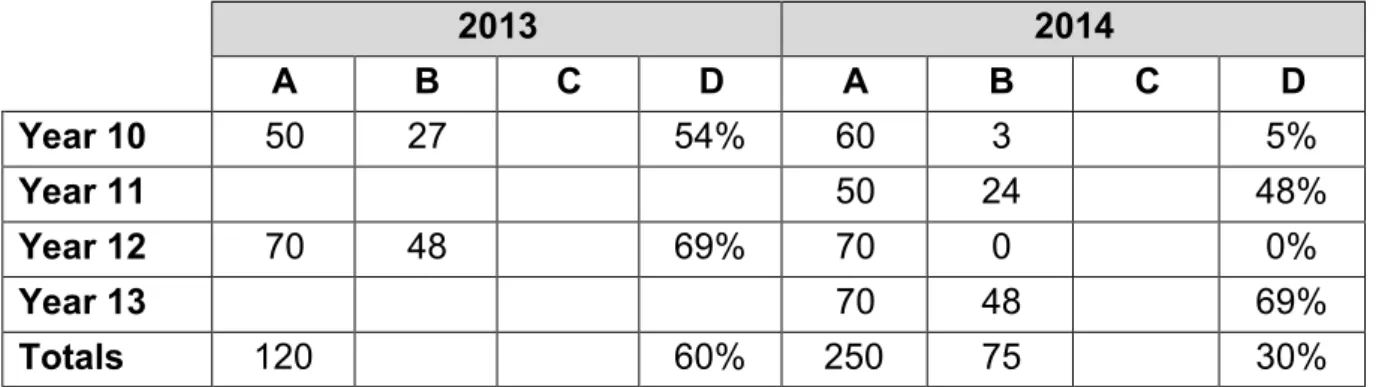
The table below summarises the School’s projected learner numbers. Section E of this document evidences the demand for the School, these projections are both conservative and achievable. It is anticipated that learner numbers will grow from 120 in 2013 to 320 by 2017 as the School reaches its full operating capacity. The table below shows how these numbers will be built up over this planning period.
2013 2014 2015 2016 2017 Year 10 50 60 90 90 90 Year 11 50 60 90 90 Year 12 70 70 70 70 70 Year 13 70 70 70 70 Totals 120 250 290 320 320
The projections assume exceptional retention rates. This is consistent with the current Stockport College approach where excellent retention is a key strategic aim. It is anticipated that learners completing courses at both key stages 4 and 5 before benefitting from the numerous progression routes available following attendance at the School.
The proposed curriculum model for 14-19 learners
The development of the curriculum model for the School will be cognisant with the report by Alison Wolf on vocational education and the review of the National Curriculum. In particular some of the recommendations of the Expert Panel for the National Curriculum Review will be reflected upon.
The curriculum is designed to be inclusive, offering exciting opportunities for all learners to demonstrate that a career in engineering is not an exclusively white male option. For example, a broad curriculum has been developed to offer encouragement to all learners including those from under represented groups. Currently, girls make up under half (42.4%) of A level learners in STEM subjects, women make up approximately a third (33.5%) of all higher education learners in these disciplines and only 14% of engineering undergraduates. Of those women who acquire any engineering sector discipline at degree level, only 27% pursue a Science, Engineering and Technology (SET) career compared to 54% of male SET graduates. The UK is facing a shortage of engineers and scientists and according to the Confederation of British Industry (CBI), the number of UK learners graduating in SET subjects needs to increase by 97,000 by 2014 in order to keep up with demand. This being the case, in order to highlight the opportunities available in engineering the design of the curriculum will offer flexibility and multiple routes through education
25 to support learners to meet their individual needs as they set out for a career in their chosen field.
Overview of Curriculum Design
The principles which underpin the approach to curriculum design are:
• The importance of a strong essential skills core curriculum;
• A high quality curriculum with a good range of academic and vocational
learning pathways which are aligned to the Vision of the School;
• The centrality of technology as a focus for the context and approach to the
• curriculum and the high importance placed upon the preparation of learners
for the world of work;
• A curriculum which is clearly planned with appropriate links between subject
areas and learning, set in wider contexts, to provide integrated learning experiences for learners;
• Focus upon the individual learner with the setting of challenging targets,
tracking learners and consulting with and reporting to parents; and
• A corporate approach to planning of teaching and learning i.e. Curriculum
• Maps, Tutor Guides, Learner Guides.
Subject areas will be grouped under broad faculties with flexible learning spaces providing a mixture of directed learning areas, specialist teaching areas and facilitated learning areas (resource-based, library type areas). Each Area of Learning will have its own “look and feel‟ and a centre of attraction which includes a facility for displays, possible open plan learning areas, and clustered where appropriate to include staff work rooms.
Key Stage Four
The majority of learners will follow a curriculum that facilitates the delivery of the English Baccalaureate group of GCSEs. In this instance it includes English, Mathematics, Geography, a Modern Foreign Language and either single Sciences or a double or triple award science. A minority of learners will follow a curriculum that will not enable the achievement of the English Baccalaureate. This group will not follow Geography or a Modern Foreign Language but will devote additional time to English and Mathematics to enable them to achieve 5 at least GCSEs. Learners in Key Stage 4 will spend a minimum 60% of their time following the core subjects. All learners will have the opportunity to undertake some vocationally related study around the core themes of technology. This will facilitate progression at 16 to either a technology focussed offer in the School, vocational study in the College itself or appropriate apprenticeships.
Four pathways will be included at KS4. There will be: 1) A pathway offering the English Baccalaureate
26 2) A pathway offering the core GCSEs of English, mathematics and science plus a
choice of extra GCSEs such as Double Award Engineering, Product Design, Design Technology, Systems and Control and Computer Science.
3) A vocational pathway offering GCSEs of English and Mathematics plus a vocational focus such as green technologies, engineering, motor vehicle engineering, BTEC Science and BTEC Computer Science.
4) An apprenticeship pathway offering GCSE Mathematics and English (or Functional Skills as appropriate), a relevant vocational option plus substantial work experience.
To provide further context we have outlined the key components of each pathway in the table below:
Note – core subjects to be studied by all learners are shown in bold.
GCSEs BTEC
Diploma/Certificate Specialist Diploma Apprenticeship Pathway
Computer Science Electronics Engineering English Language French German Geography History Mathematics Physical Education Separate Sciences or Core and Double Award Science Diploma in Applied Science Diploma in Engineering – to include Environmental Awareness, Computer Aided Design, PC Maintenance, Systems Control and future energy systems e.g. Bio Mass Technology Diploma in Software Developers Diploma in Motor Vehicle Maintenance Principal Learning in Manufacturing and Product Design Principal Learning in ICT Functional English/Mathematics
and ICT or GCSE
Mathematics/English/ICT Work Experience
Vocational Option – Engineering or Motor Vehicle
27
GCSEs BTEC
Diploma/Certificate Specialist Diploma Apprenticeship Pathway
Systems and Control Electronics Design Technology
Key Stage Five (post 16)
The School will provide learners with the opportunity to progress to Higher Education programmes (either full time or part time) including those relevant to the STEM theme. Progression to Higher Education will be available in a wide range of disciplines. This might include engineering, science, entrepreneurship or other degree routes.
The core of the curriculum offer will be built around “A‟ Levels in relevant subjects, contextualised to develop skills and knowledge relating to the engineering and manufacturing sectors, whilst creating a rounded curriculum experience which develops the skills vital to a wide range of employment opportunities for the learners. Three pathways will be offered at KS5. There will be:
1) A traditional pathway offering A levels, which include Biology, Chemistry, Physics, Engineering, Computer Science, Product Design and Mathematics. Additional options for technical qualifications will be available e.g. Performing Engineering Operations.
2) A vocational pathway. 3) An apprenticeship pathway.
To provide further context we have outlined the key components of each pathway in the table below:
Academic Qualifications Technical/Vocationally
Related Qualifications Apprenticeship Qualifications A Level Biology
A Level Chemistry A Level Computing A Level Engineering
Diploma in Engineering Diploma in Motor Vehicle/ Cycle Diploma in ICT Diploma in Science - Engineering Motor Vehicle Laboratory Technician IT users
28
Academic Qualifications Technical/Vocationally
Related Qualifications Apprenticeship Qualifications A Level Mathematics
A Level Physics
A Level Product Design A Level Computing
pathways in Medical and Forensic Science Award in Understanding the Fundamental Principles and requirements of Environmental Technology Systems Award in the Installation of Solar Thermal Hot Water Systems
Award in the Installation of Small Scale Solar
Photovoltaic
Award in the Installation of Heat Pump Systems Award in the Installation of Water Harvesting and Recycling Systems
Environmental Conservation
The schools framework will reflect the national qualifications framework, offering qualifications in engineering, green technologies, sustainability and ICT (with linked apprenticeship routes), underpinned by a core entitlement covering mathematics, English, science and technology, supplemented by employability, work experience, industry specific project work and enterprise.
All pathways will have a number of common themes. There will be: Project work linked to the school’s Eco Science Park;
Enterprise; Employability;
Interpersonal and communication skills;
Work Experience provided by industrial partners; Enrichment; and
29
Overview of ICT
The role of ICT in the School is seen as pivotal in supporting outstanding learning and teaching, particularly to support a focus on STEM. Our vision for ICT in the School is that it should serve the following purposes:
Support excellent teaching;
Reinforce and extend learners‟ learning;
Build technological literacy around key subject areas; Support rapid and effective assessment of learners; Help to develop a personalised learning experience; Assist with special needs provision;
Enable learners to monitor and evaluate their own performance including progress toward individual learning plans, attendance, punctuality, and assessment through the use of dash board technology;
Enable effective monitoring of each individual learner’s progress towards targets
and the tracking of assessments, using dashboard technology; Facilitate effective communication with parents/guardians; and
Facilitate gathering of learner satisfaction feedback to inform quality improvement.
The School will provide full wireless networking access for learners and staff to support the effective use of ICT in all aspects of the School.
Implementation of the ICT Policy
During the implementation phase, the School will further develop its policy on the use of ICT and develop appropriate infrastructure and technological solutions to enable the policy to be delivered. The School will have a range of options in terms of procurement and partnership arrangements; therefore it is seen as important that these are assessed professionally during the next phase of development. Wherever possible, in order to provide best value for money and the sharing of best practice, the systems and expertise within Stockport College will be shared and utilised within Stockport Technical School.
D2: School timetable and calendar
The School will be open from 8.15am to 4.45pm Monday to Friday with a rationale of allowing learners to experience more realistic working hours. Operating in these hours would also allow an early finish (3.30pm) for learners on Fridays.
The academic year will be based on 40 weeks per year with an academic year
running between 2nd September 2013 and 7th August 2014. This allows the year to
be broken down and managed into 5 learning blocks of 8 weeks, which will help the administration and management of vocational activity in particular.
30 To provide an illustration of how the timetable will operate and the variety in teaching learners will receive we have provided an example timetable in Appendix 1 which demonstrates the core elements; the optional elements; and the flexible components of the timetable which include tutorial activity. These elements will help to ensure that learners‟ individual needs are met. The timetable shows how the school day is broken down into seven teaching periods as well as registration.
In addition to the normal working day starting at 8.15, there is also an optional breakfast club between 7.45 and 8.15 which gives learners the chance to eat and interact over a coffee, whilst also providing them with additional time to receive support on their homework if needed.
Homework will be set as a key part of the school day and will have a clear and strong approach, where every learner is expected to do at least one hour of homework each evening. Support and extra resources are provided to help any learner who falls behind. For example, they will receive extra support in the flexible session at the end of each day, as well as during the breakfast club and registration. In order to provide extra clarity over what a typical week would look like for the learner we have included two case studies showing how learners‟ weeks may vary depending on the pathway they have chosen:
Case study 1: Key stage 4 learner undertaking Pathway 1 (English Baccalaureate)
• Each day will begin at 8.15 am with registration and homework check. (The
learner will start at 7.45 if they choose to attend the breakfast club)
• The learner will undertake core GCSE topics of Mathematics (4 hrs per week);
English (4 hours per week); Science (6 hrs per week).
• A further 10 hrs of study will be around GCSEs including humanities where
the learner can select from subjects such as Geography; History; plus a Modern Foreign Language.
• The learner will undertake 1 hr of Religious Education and 2 hrs of Physical
• Education each week.
• The learner will undertake 4 hrs per week of extra curricular activity. This
could be around the Duke of Edinburgh awards; language clubs; STEM clubs; or extra GCSEs – this activity is flexible and tailored to the individual learner.
• There will also be 2 hrs per week of work related study which will benefit from
the excellent employer demand for involvement in the School. This experience will be topical and varied. For example, a recent group of learners at the lead partner Stockport College worked with the NHS (a major employer in the Stockport area) to conduct research into MRSA and the causes behind it. GCSE & A Level Biology Learners study 'drugs resistance' as a topic, within the syllabus. This research is particularly topical and of interest to the NHS in the development of treatments of infections such as MRSA.
31
• Data could be shared with the learners, lectures given from hospital staff and
visits to the hospital so learners can see what hospitals do to minimise the spread of infection. The learners could then take this further, into Chemistry and look at what cleaning fluids the hospitals use and analyse them to see
which ones are most effective at killing germs.
Case study 2: Key stage 4 learner undertaking Pathway 3 (Vocational)
• Each day will begin at 8.15 am with registration and homework check.
(The learner will start at 7.45 if they choose to attend the breakfast club)
• The learner will undertake core GCSE topics of Maths (4 hrs per
week); English (4 hours per week); Science (6 hrs per week).
• 10 hrs of study per week are selected from the vocational qualifications
such as the Diploma in Engineering and related topics such as energy and CAD
• The learner will undertake 1 hr of Religious Education and 2 hrs of
Physical Education each week.
• The learner will undertake 4 hrs per week of extra curricular activity.
This activity is flexible and tailored to the individual learner meaning learners could receive extra support on core GCSEs if needed.
• There will also be 2 hrs per week of work related study which will benefit
from the excellent employer demand for involvement in the School. This experience will be topical and varied for learners. For example, a recent group of learners at the College worked with on a biomass project with a team of consulting engineers to explore the possibilities of reducing carbon emissions within older buildings to create long term savings. As part of this activity a consumption and usage profile of each building was identified and solution options were identified and evaluated to determine economic viability.
Organising learners Tutorials
The School will operate vertical Progression Coaching (tutorial) groups. These groups will be facilitated by a Progression Coach. This role is essential in ensuring that learners understand their targets, are clear about the expectations of the School and have the appropriate support to manage issues and achieve success. Because the curriculum has been designed to offer flexibility around individual needs it is also important to ensure learners have a sense of support and belonging. Appropriately trained staff in the School will take on the role of a Progression Coach for a small group of learners. All learners will have a one-to-one session with their Progression Coach every three weeks. The example timetable in Appendix 1 shows how this session has been included as part of the final session of the teaching day. Learners with the greatest support needs will be provided with appropriate and, where necessary, intensive support, to enable them to overcome any barriers to learning and to achieve. The Progression Coach provides a significant amount of pastoral
32 support and can help identify issues such as bullying, learning support needs, or learners not being challenged enough. In these instances the Progression Coach will help to put action plans in place to remedy issues.
The Progression Coaching (tutorial) groups will have a small number of learners taken from each year group. The mixed age group is intended to support mentoring opportunities for one another and can make it much easier for the ethos of the School to be demonstrated to learners. Furthermore, it provides opportunities for older learners and high achieving learners to be able to demonstrate valuable peer support skills which will be attractive to potential employers. This approach is aimed at having a positive influence on reducing bullying and creating an equal status organisation.
In addition to what might be perceived as “normal” tutorial activities the Progression Coaches will coach individual learners throughout their time at the School. This will ensure that every learner is set individual stretching targets, and is consistently supported to achieve and where possible exceed these targets. Progression Coaches will also have a clear responsibility to support learners in developing the vital attitudes and behaviours, identified by employers as key to employment opportunity and progression.
Classes
Class sizes for teaching are based around two cohorts of 25 learners for core curriculum areas. For learners at key stages 4 and 5 the learners will be organised into cohorts, based on age.
The optional elements will be delivered in smaller groups, up to a maximum of 25 learners per class. These sessions will be led by a course tutor and will be organised vertically across year groups.
Additional activity
This activity will primarily be in the final session of the day. The School is committed to supporting individual ability and aspirations so will provide opportunities for learners to organise aspects of the additional activity, such as subject related clubs. This is a key opportunity for gifted and talented young people to demonstrate wider skills which will be attractive to employers. Whilst the School will offer the support to learners to develop the organisational skills where appropriate, all sessions will be supervised by a member of teaching staff.
D3: Strategy for meeting the needs of pupils with differing abilities
The School’s vision is to develop a high achievement culture with motivated and skilled learners, irrespective of their start in life. This vision applies equally to
33 learners who are the most gifted and able to those with any kind of special educational need.
The School has a policy for gifted and talented learners. This identifies “gifted‟ learners as those who have abilities in one or more subjects, in the statutory curriculum, other than art and design, music and PE; “talented‟ learners are those who have abilities in science, engineering, modern foreign language and product design. The term “gifted and talented‟ should be seen as relative and refers to the top 5% to 10% of any school, regardless of the ability profile of pupils at the school. It will also be recognised that those pupils who are gifted and talented do not always show their ability. Such pupils are gifted and talented even though their abilities may be hidden or remain as potential.
Gifted and talented learners are identified by making a judgement based on an analysis of various sources of information including:
• Test scores (such as end of key stage levels);
• Teacher nomination (based on classroom observation,
discussions with pupils, work scrutiny);
• Progression coach
nomination; Peer or self-nomination; Parental nomination; and
• Predicted test/ examination results.
This information will be collated by the gifted and talented co-ordinator and the assessment co-ordinator (roles which will be undertaken by nominated members of the teaching staff) and will be made available to all staff. The gifted and talented register will be regularly reviewed and updated.
In order to allow “gifted and talented‟ learners to achieve their full potential the School will implement a number of approaches, both in class, and out of class.
Organisational and in-class approaches include:
• The coherent management of pupil groupings (whether in mixed ability
groups or ability sets) and recognition that whilst there may be a higher concentration of gifted and talented pupils in some groups, there will be pupils who have gifts and talents in all groups;
• The provision of opportunities for gifted and talented pupils to work with
pupils of similar ability. This will mean that it is appropriate for pupils to work with older pupils occasionally. Opportunities for this activity can be facilitated through relationships, developed in the vertical tutorial groups which feature learners of different ages;
• Mentoring support from industry partners and additional provision for pupils
of exceptional ability;
34
• Differentiation within subject areas;
and
• The development of independent learning by allowing pupils to organize
their own work, to carry out tasks unaided, evaluate their work and become self- critical.
Out of class activities are recognised as providing important opportunities for learners who have potential in gifted and talented areas. It is vital that learners are given opportunities to practice and extend their skills through:
• Enrichment days;
• Out of class clubs;
• Science and sporting activities; and
• Extra curricular activities in partnership with the
Studio School in areas such as Music and Performing Arts.
These activities will be coordinated by a nominated member of teaching staff. However, the School will also provide opportunities for gifted and able learners to demonstrate wider skills through the organisation of out of class activities. With the support of teaching staff, learners will be encouraged to take a lead role in organising school clubs.
The curriculum range offered through the School will allow gifted and talented learners to achieve the English Baccalaureate, whilst developing technical skills and undertaking enhancement activities will present challenge to them. The tutorial group structure will also mean these learners have opportunities to develop personable and mentoring skills, which would be valuable to future employers.
In addition to this, the School will operate a system of professional mentors. There are a number of employers who have expressed an interest in working as part of the Technical School particularly in the engineering curriculum area, Appendix 3 sets out an Employer Support Matrix. These employers would act as mentors to the learners allowing them to build working relationships with employers during the course of their study with opportunities for project work and vocational experience.
As far as possible, learners with special educational needs will be supported through the normal provision of the School, which includes a strong teaching model and early intervention (particularly through Progression Coaches), embedding additional support and individual attention for learners who are having difficulty reaching their targets, whether through a physical disability, language barriers, or other special educational needs. Support will be put in place as soon as it is identified that there is a need. The School is committed to ensuring flexibility in its approach, providing the resources and appropriate ICT equipment to help learners achieve their goals. This might be around resources such as around on-line learning resources, electronic whiteboards, and hand-held devices. All teachers will be trained and prepared to teach learners with special needs.
35 The School will aim to be fully inclusive in its sporting, cultural, social, recreational, and community activities.
It is recognised that there will be learners who have needs requiring additional or special provision of various kinds, in class or in other school-related activities. The School will be a fully inclusive organisation and for these learners the School will have regard to, and will be in full compliance of, the SEN Code of Practice (2001) and any guidance issued by the Secretary of State relating to the sections 316 and 316A of the Education Act 1996, including the new rights and duties introduced by the SEN and Disability Act (SENDA) 2001 and Regulations. It will also have regard to the guidance set out in DfES Circular 6/94 and any subsequent guidance.
As recommended by BB94, BB98 and BB99 (Building Framework for School Projects) multi-purpose areas will be created to support the access and inclusion of learners with SEN and disabilities. These will have good quality acoustics, lighting, ramps and steps. These areas will provide:
• SEN resource base for learning, behaviour, therapy support and case
conferences;
• Appropriate ICT equipment and programmes;
• Access arrangements for Key Stage tests and public examinations;
• Office space for staff, administration and records; and
• Storage space for educational and mobility
equipment.
Consideration of these factors is a key development for the School and will be used as a challenge to the approach being designed. This will ensure the School remains an exciting proposition with opportunities for all types of learners.
D4: Measures of success for pupil achievement
The vision outlines how the School will support young people to develop the skills they need for a career in STEM in a high achievement culture. It should also ensure employers want to engage in it to meet their business objectives through working with appropriately skilled young people. Because of this, it is essential to be able to demonstrate success.
The School will use National Curriculum levels and sub-levels and GCSE grades to track learner progress. This approach will be put in place because it will ensure there is consistency with external standards being applied to the learners. Additionally, it will provide comparability with other UK schools. Assuming the outcomes are favourable, this could then help to provide powerful marketing material to support the
36 projected growth in demand over subsequent years. Furthermore, this will support teacher familiarity and the use of available teaching and testing materials.
All learners will be set progression targets across all areas of study. Learners will have clear expectations of their anticipated achievements based on their starting point at the time of joining the School. These targets will be monitored closely by their Progression Coach. Learners not making the expected levels of progress will be supported through a programme of mentoring and support, to enable them to get back on track. Importantly, the approach to learner monitoring means any necessary support action can be implemented swiftly.
The targets which learners are set will support the achievement of the strategic objectives outlined in the vision for the School.
The aim is for success rates to be 10% above the Stockport average, by the time the School reaches full capacity.
The progression targets set a specific attainment level for each learner in each curriculum area. These targets will be defined by their baseline assessments and are designed to ensure that:
• Each learner will have a stretching, yet achievable, target based on their prior
attainment. Targets will be reassessed with each learner in light of their individual progress;
• Each learner will achieve at least a grade C at GCSE or equivalent;
• Each learner who takes the traditional academic pathway at KS5 will achieve
at least a grade C at A Level or equivalent; and
• Each learner will have a significant amount of work experience to support their
progression.
Targets will be set for each learner based on their individual levels of attainment – in some cases, for example in setting targets with learners who suffer from learning difficulties, lower targets may be set, but appropriate support will be provided to maximise each such learner’s progress.
In addition, learners will be set targets around attendance, and excellent behaviour. The importance of teaching and learning is recognised and will take place in a high achieving School environment. All teachers at the School will be monitored to ensure they are providing:
• A creative approach to learning, using innovative approaches and effective