Market entry Guide
singapore
2
1 introduction 3
2 Modes of Setting up a Business in Singapore 5
2.1 as a new business or company 5
2.2 as a foreign business entity 11
2.3 Foreign investment in Singapore 14 2.4 average time (in days) required for Setting up a Business 16
3 Procedures for immigration 19
3.1 Procedure for Obtaining Visa 21
3.2 Procedure for residence Permit 26
3.3 Procedures for Work Permit 28
3.4 average Living Costs for expatriates 39
3.5 average rent for Office Space 40
4 Social Security System in Singapore 41
4.1 Social Security 41
5 Free trade Zones (FtZs) in Singapore 46
5.1 introduction 46
5.2 advantages Offered by FtZs 46
5.3 Facilities available at FtZs 48
6 Opening a Bank account in Singapore 49
6.1 Overview of retail Banking 49
6.2 Procedure to Open a Bank account 50
7 recruitment of Local Staff 54
7.1 Brief Overview of Labour Laws 54
7.2 Major recruitment agencies and Websites 59
7.3 average Salary 59
8 taxation 63
8.1 taxation in Singapore 63
8.2 taxes and duties 63
8.3 tax incentives 67
8.4 avoidance of double taxation agreement 71
9 appendix 74
3
1 Introduction
Singapore is a Sovereign Republic Island city state; its legislation is based on the English Common Law. The Prime Minister is the head of the executive branch, forming the Government.1 As per April 2012 estimates, Singapore had a total population of 5,2 mil-lion in 20112; however, about 25 percent of the total population consists of foreigners. The country has four official languages: Chinese (35 percent), English (23 percent), Malay (14,1 percent) and Tamil (3,2 percent).
The country possesses the best road, water and air transportation system in the world. 3
The country has a free market economy, and its per capita GDP (PPP) is higher than that of numerous developed countries such as the US, Ireland, Hong Kong, the Netherlands and Canada.4 The economy is extremely export-oriented, with its main export industries including consumer electronics, information technol-ogy products and pharmaceuticals.5
The total GDP at current market prices was EUR 186.752 million (SGD 326.832,4 million) in 2011. About 70 percent of the total GDP at current prices was contributed by the service industries, includ-ing transportation, wholesale and retail trade, hotels and restau-rants and financial services.
The country’s Gross National Income at current prices increased 6,9 percent year-on-year and reached EUR 120,790 million in 2008. Also, the total Official Foreign Reserves of the country reached EUR 176.221,6 million (SGD 308.403,2 million) in 2011 and the total export value in 2011 was EUR 294.123,1 million (SGD 514.741,2 million). The value to the total items imported by the country in 1 Singapore Government Online – About Singapore Government
2 Statistics Singapore - Monthly Digest of Statistics Singapore – April 2012 3 Australian Government - Department of Foreign Affairs and Trade – Singapore Country Brief
4 CIA World Fact book - Singapore 5 Department of statistics Singapore
4 2011 was recorded at EUR 262.646,9 million (SGD 459.655,1 million). 6 As per the World Bank report of ‘Doing Business 2009’, Singa-pore ranked first in the world for the ease of doing business. As per the World Bank report Doing Business (2012), Singapore ranked first in the world for the ease of doing business. As per the Globalisation Index 2011, Singapore ranked first in the world for foreign trade and investment. The Global Competitiveness Index rankings of 2007–08 revealed that Singapore is also the most competitive country of Asia and the fifth most competi-tive nation of the world, lagging behind the US, Switzerland, Denmark and Sweden. 7
6 EDB Singapore - Singapore Rankings 7 Doing Business Singapore 2012
5
2 Modes of Setting up a Business in Singapore
8 This section discusses the common investment vehicles available to foreign investors, the procedures to be followed in order to es-tablish them and related regulations for each investment mode. Table 1 lists the most common modes of setting up businesses by foreign investors and the legal procedures and implications involved in each process.Table 1: Different Modes of Setting up a Business
in Singapore
MODES OF SETTING UP A BUSINESS As a new business or
company · · Sole ProprietorshipPartnership
· Limited Liability Partnership (LLP) · Limited Partnership (LP) · Company
As a foreign business
entity · · Branch of A Foreign Company Representative Office in Singapore Enterprise One (One Network for Enterprises) 2.1 As a new business or company
There are two general modes of establishing a business in Singa-pore, as a new business or company, or as a foreign business. The following discussion throws light on the five types of business structure specified under the first category.
2.1.1 Sole Proprietorship
A sole proprietorship is the simplest form of business. The char-acteristics for this business structure are:
| It is owned by a person or a company;
| It is not considered as a legal entity; 8 Source: Enterprise One (One Network for Enterprises)
6 | Profits are taxed at a personal income tax rate.
Except in some cases such as undischarged bankrupts, any person or company can register as a sole proprietorship in Sin-gapore. In case the owner is not an “ordinary resident”9 of Sin-gapore, he/she is supposed to appoint a local manager. All sole proprietorships must be registered with the Accounting and Corporate Regulatory Authority (ACRA).
2.1.1.1 Steps to register as a sole proprietorship10
| To appoint a local manager, in case none of the owners register-ing is an ordinary resident of Sregister-ingapore;
| To check the availability of the business name to make sure that it is not identical to an existing entity, obscene or reserved one. One can check its availability in the online directory of businesses on Bizfile;
| Correct Singapore Standard Industry Classification code (SSIC) is required at the time of registration. It can be searched on the ACRA website. One can also seek assistance by calling the ACRA HelpDesk at 00 65 6248 6028 between 7am and 12 midnight, Monday - Sunday (including public holidays);
| To provide a local address for the place of business in Singapore to be approved for business use by the Urban Redevelopment Authority (URA);
| To ensure that Medisave contributions are up to date with the Central Provident Fund Board (CPF Board). This can be done by using NETS/cashcard, cheque, cash, e-payment etc. The amount to be paid can be judged by logging into Central Provident Fund Board. A unique Singpass, required to login to CPF account, can be obtained online at Singpass.gov;
9 Not an “Ordinary Resident” is one who: Does not have a local address and Cannot remain in Singapore for long period of time
7 | Lastly, Online Business Licensing Service (OBLS) can be used to
collectively assess the licences and permits required to be ob-tained and register business. An application form from Bizfile. gov can also be downloaded to register.
2.1.2 Partnership
A partnership refers to a business firm owned by more than one individual or company. In Singapore, a partnership cannot have more than 20 owners, and must be registered with the ACRA. The main characteristics of this business structure are: | It can have a minimum of 2 and a maximum of 20 owners; | It is not a legal entity;
| The profits form a part of personal income of partners and are taxed accordingly.
2.1.2.1 Steps to register as a partnership
The steps to register as a partnership are the same as those for a sole proprietorship (detailed in section 2.1.1). In case of a company, there must be at least one director who is above 18 years of age and is either:
| a Singapore Citizen;
| or a Singaporean Permanent Resident; | or an Employment Pass holder;
| or an Approval-in-Principal Employment Pass holder; | or a Dependent Pass holder.
2.1.3 Limited Liability Partnership (LLP)
This form of business structure was introduced in Singapore in April 2005. All LLPs must be registered with ACRA. The main characteristics for this business structure are:
| It has limited liability features of companies and a rational flexibility of partnerships;
8 | It can have a minimum of two partners without any upper
limit;
| It is a legal entity;
| In case of an individual partner: personal tax rates would be ap-plicable and a corporate tax rate would be valid in case where a partner constitutes a company.
2.1.3.1 Steps to register as an LLP
The steps to register as an LLP are the same as those for a part-nership (detailed in section 2.1.2).
2.1.4 Limited Partnership (LP)
A limited partnership (LP) does not have any separate legal entity. The partners who do not manage operations of an LP have lim-ited personal liability. The main characteristics of this business structure are as follows:
| The partners in an LP can be individuals, Singapore registered companies or unregistered foreign companies;
| At least two members should be present in the LP. Among the partners, there should be one general partner and one limited partner;
| A general partner has unlimited personal liability and can be appointed as the manager of the partnership;
| The liability of a limited partner is restricted to his/her invest-ment in the partnership;
| An LP can be formed through registration of a new LP only, and cannot be formed through converting a company, business or Limited Liability Partnership;
| The partners have to pay taxes on their share of income from the LP. The individual partners pay tax at personal income tax rate while corporate partners pay tax at the corporate tax rate.
9
2.1.4.1 Steps to register as a LP
An LP is registered with the ACRA. The registration steps are similar to those of the sole proprietorship detailed in section 2.1.1 above.
2.1.5 Company11
A company is a business entity registered as per the Companies Act. A company has the following characteristics:
| A company is a separate legal entity;
| The owners of a company are its shareholders; | Each shareholder should have at least one share; | The profits of a company are taxed at corporate tax rates. 2.1.5.1 Types of Companies
Three types of companies can be incorporated in Singapore. They are briefly outlined below:
| Private/public companies limited by shares;
| The liability of companies limited by shares is restricted to their share capital. A private company can have a maximum of 50 shareholders;
| Public companies limited by guarantees;
| Non-profit, religious and charitable organisations are usually formed as the public companies limited by guarantees. Such companies do not have any share capital;
| Unlimited companies;
| Unlimited companies have no limitations on their membership or liability.
10
2.1.5.2 Registration of a Company
A company has to be registered with ARCA. The steps followed for registration of a company are similar to those of the sole proprietorship. The following is the procedure for registering a company:
| The eligibility requirements below must be met:
· At least one of the directors in the company should be above 18 years of age and be any of the following:
- Citizen of Singapore
- Permanent resident of Singapore - Employment Pass holder
- Approval in principal Singapore Pass holder - Dependent Pass holder
· The director of a company should not be convicted of dishon-esty or bankrupt.
· A company should have at least one shareholder and one direc-tor. The shareholder and director can be the same person. | The company name has to be decided on. The name should
not be identical to any entity already established or liable to be considered as vulgar or obscene. The name should not be reserved.
· A company can check the availability of a proposed name through the online directory of ACRA, accessible on the web-site Bizfile - Company Name.
| The company should find the right Singapore Standard In-dustry Classification code (SSIC) applicable as per its business activity. The SSIC code can be searched through the website of ACRA – SSIC Code.
11 | The company should have a local address for the business
place. The company can operate its business from premises approved by the Urban Redevelopment Authority.
| A company has to apply for the right licence and permit. The website Oneline Business Licensing Service provides informa-tion about the right licence and permit and other related re-quirements to be met before registration.
| The registration can be done independently or through any professional service firm. The procedure to be followed for self-registration is provided on the website EnterpriseOne - DIY or Self-Registration.
2.2 As a foreign business entity
A foreign business entity can be set up as a branch of the foreign company or Representative office in Singapore. This procedure is outlined below.
2.2.1 Branch of a Foreign Company12
Procedure for the registration of a Branch of a Foreign Company: | As per the Companies Act, the foreign company must appoint two local agents residing in Singapore. The local agents act on behalf of the company;
| The company should engage a professional firm or service bu-reau for assistance in preparing and filing the application for registration;
| The company name should be approved if it is available. | The Branch office can be registered through the website Bizfile. | The applicable fees for registration formalities include the
fol-lowing:
12
· Name Approval Fee – EUR 8,6 (SGD 15);
· Registration Fee for a Foreign Company with share capital – EUR 171,4 (SGD 300);
· Registration Fee for a Foreign Company without share capital – EUR 685,7 (SGD 1.200).
A company is normally incorporated within 15 minutes of its registration. However, a longer duration of 14 days to two months may occur if the application requires approval from various refer-ral authorities. The list of referrefer-ral authorities for different busi-ness activities can be accessed through this link: ACRA – Referral Authorities Table.
2.2.2 Representative Office of a Foreign Company (RO)13 A company can use its representative office (RO) to carry out only the following activities:
| Market Research | Feasibility Studies
| Acting as a liaison for the parent company
If a company wishes to set up its RO for banking and insurance activities, the registration authority is the Monitory Authority of Singapore (MAS).
The following steps are required for the registration of an RO with MAS:
| An application is made by the Chief Executive or equivalent position holder of the bank or its Singapore office, if operating. | The application is addressed to the following person:
13
· Mr Leo Mun Wai Executive Director
Banking Supervision Department Monetary Authority of Singapore 10 Shenton Way
MAS Building Singapore 079117
| The application form can be downloaded from the link MAS – Application to Set Up Representative Office.
If the company wishes to set up its RO to carry out business activities other than banking and insurance, it should complete registration through International Enterprise Singapore (IES). The following steps are required for the registration of an RO with IES14:
| An online application is made through the website of IES. | The following documents must be submitted with the application: · A digital copy of the parent company’s Certificate of Incor-poration, in English language. If the original document is in a language other than English, an official translation of the same must be submitted.
· A digital copy of the latest audited accounts of the parent company.
If the company does not have digital copies of the required docu-ments, the applicant can submit a hardcopy of the documents at the head office of IES.
| The applicant has to pay a processing fee of EUR 114,3 (SGD 200)by cheque, bank draft or credit card.
| The cheque or bank draft can be mailed to the following address:
14
· International Enterprise Singapore 230 Victoria Street #07-00 Bugis Junction Office Tower Singapore 188024
Attn: Off-Shore Trade Group (Representative Office)
2.3 Foreign Investment in Singapore15
Singapore has an extremely open investment environment. The Economic Development Board of Singapore acts as an investment promoting agency that focuses on securing major investments in high-value manufacturing and service areas to replace the labour intensive activities which have moved to offshore nations. The following are general characteristics of the foreign invest-ment policy of the country:
| The foreign investors are not bound to enter into joint ventures or surrender their managerial controls to the local people; | The local and foreign investors are subject to the same law; | The government has limited or restricted investments in some
sectors;
| The screening of investment proposals is done with the objective of determining the eligibility of the proposal for the incentives; | There is no restriction on the transfer or repatriation of profits
or capital to overseas nations.
The restrictions on foreign investment exist for some of the sec-tors mentioned below:
| Telecommunications – SingTel imposes certain uneconomical technical interconnection requirements, making the operations by overseas companies expensive. The companies of overseas operators face problems in accessing inter-exchange ducts. Also, the decisions made by Infocomm Development Authority and the Ministry of Information, Communication and Arts are 15 US Department of State - Singapore
15 not published in detail, which results in the lack of transpar-ency of the rules and regulations governing the telecommu-nications industry.
| Media – Section 44 of the Broadcasting Act restricts the foreign in-vestor’s ownership in the companies’ broadcasting to the domestic market of Singapore to 49 percent or less, with some exceptions. The individuals cannot hold more than 5 percent of shares in a broadcasting company without the Government’s approval. · The Newspaper and Printing Presses Act restricts the equity share
ownership by both foreign and local investors to 5 percent. The director of a Newspaper and Printing company should be a citizen of Singapore.
| Banking – Legal differences exist between the foreign and Sin-gapore banks and the kind of licences issued to the foreign banks and local banks. A foreign bank can hold three types of licences—full service, wholesale and offshore. The banks operating on offshore licence can upgrade to the wholesale licence on fulfillment of the criteria set by the Central Bank, the Monetary Authority of Singapore.
| Securities and Asset Management – The Government of Sin-gapore removed restrictions on trading by the foreign-owned stockbrokers in 2002. However, foreign investment is not al-lowed to exceed more than 70 percent of the paid-up capital of the dealers who are members of the Singapore Exchange. | Legal Services – There is a restriction on foreign firms prevent-ing them from practisprevent-ing Sprevent-ingaporean law and hirprevent-ing lawyers from Singapore to practice Singaporean law or litigate in the Singaporean courts.
| Engineering and Architectural Services – Singapore removed the restrictions requiring that the chairman and two-thirds of the board of directors should be engineers, land surveyors or architects, and they should be registered with the local professional bodies.
16 | Accounting and Tax Services – The law requires that at least
one partner in the public accounting firm should live in Sin-gapore. The public accountants who hold membership of the Institute of Certified Public Accountants of Singapore and who are registered with the Public Accountants Board can only prac-tice in the country. However, the accountants registered with the American Institute of Certified Public Accountants are also recognised by the board.
| Real Estate – As per the Residential Property Act, the foreigner can own condominiums or any unit in a building of at least six levels without prior approval of Singapore Land Authority. However, landed houses and apartments in the buildings with less than six levels can be purchased only after Singapore Land Authority’s approval.
| Energy – A US company faced issues in its access bid due to delays in review of its applicant by the Energy Market Authority. No non-incumbent operator has been able to secure access to Singapore’s part of the Sumatra-Singapore pipeline. 2.4 Average Time (in days) Required
for Setting up a Business
A number of legal formalities have to be followed before the actual setting up of a company. The formalities include registra-tion, licencing, requirement of minimum capital, etc.
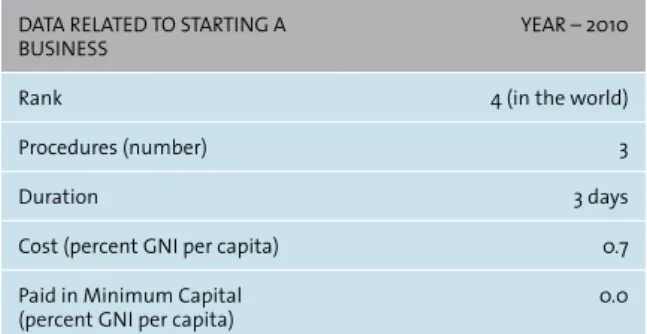
17 Table 2 lists the data released by the World Bank related to start-ing a business Sstart-ingapore.
Table 2: Starting a Business in Singapore
DATA RELATED TO STARTING A
BUSINESS YEAR – 2010
Rank 4 (in the world)
Procedures (number) 3
Duration 3 days
Cost (percent GNI per capita) 0.7
Paid in Minimum Capital
(percent GNI per capita) 0.0
Source: The World Bank Group - Document: Doing Business 2012 Singapore Figure 1 illustrates the obstacles inherent in starting business ventures in various countries.
18
Figure 1: Obstacles in Starting Businesses
in Various Countries (2011)
Source: World Bank 2012 Doing Business Procedures Essential for Starting a Business Taiwan Malaysia Republic of Korea Japan Hong Kong China Singapore New Zealand Number of Procedures 0 5 10 15
Time Required for Starting a Business Taiwan Malaysia Republic of Korea Japan Hong Kong China Singapore New Zealand Time (days) 0 10 20 30 40
19
3 Procedures for Immigration
The following documents are required by a person who enters Singapore:
| Visa
| Passport valid for at least six months
| Adequate funds for the duration of stay in the country | Confirmation of the onward or return air ticket
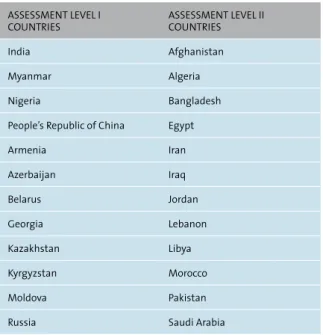
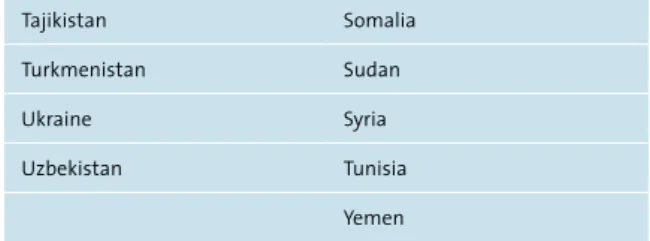
The countries requiring a visa for entering Singapore have been divided into Assessment Level 1 and Assessment Level 2. These are shown in the following table:
Table 3: List of Countries Included in the Assessment Level 1
and Assessment Level 2
ASSESSMENT LEVEL I
COUNTRIES ASSESSMENT LEVEL II COUNTRIES
India Afghanistan
Myanmar Algeria
Nigeria Bangladesh
People’s Republic of China Egypt
Armenia Iran Azerbaijan Iraq Belarus Jordan Georgia Lebanon Kazakhstan Libya Kyrgyzstan Morocco Moldova Pakistan
20 Tajikistan Somalia Turkmenistan Sudan Ukraine Syria Uzbekistan Tunisia Yemen
ICA - Nationals of Assessment Level I Countries; ICA - Nationals of Assessment Level II Countries The list of nationals included in the Level 1 and Level 2 assess-ments include the holders of the following docuassess-ments:
Table 4: List of Persons Included in the Assessment Level I
and Assessment Level II
ASSESSMENT LEVEL I
COUNTRIES ASSESSMENT LEVEL II COUNTRIES Holder of Hong Kong
Document of Identity Holders of Palestinian AuthorityPassport Holder of Macao Special
Administrative Region (MSAR) Travel Permit
Holder of Temporary Passport issued by the United Arab Emirates
- Holder of Refugee Travel
Document issued by Middle- East countries
ICA - Nationals of Assessment Level I Countries; ICA - Nationals of Assessment Level II Countries
21
3.1 Procedure for Obtaining a Visa16
A person can apply for a visa online through a local contact via the website of Submission of Application for Visa Electronically (SAVE). The local contact uses a Sing Pass account for making the application.
Otherwise, the application can be made overseas through the nearest Singapore Overseas Mission.
3.1.1 Business Visit Visa
A business visit visa is issued to a person who visits Singapore to attend business discussions or negotiations.
The following documents are required while applying for a visa for business visit:
| Original form 14 A duly filled in
| A recent passport size photograph must be pasted on the top right corner of the application form 14 A. The photograph must meet the following requirements:
· The photograph must be no more than three months old; · The photograph must be in colour and taken with a white
background with a matt or semi-matt finish;
· The applicant’s full face must be clearly visible and without headgear (headgear worn in accordance with religious or racial customs is acceptable but must not hide the facial features). | A copy of the applicant’s passport identity page;
| The passport should be valid for at least six months from the date of entering the country;
| Checklist 4 must be attached to the form 14A;
| Form V39A (Letter of Introduction for Visa Application) duly filled in by the applicant:
· The letter of introduction (LOI) must be issued by a local con-16 Immigration and Checkpoints Authority - Nationals of Assessment Level II Countries
22 tact such as a citizen of Singapore or a permanent resident of Singapore. The Singapore Citizen or Singapore permanent Resident must be at least 21 years old and can act as a local contact;
· If the applicant has to attend business negotiations or discus-sions, the form should be issued by the Singapore registered corporation;
· In case a local contact cannot be found, the Embassy or the Ministry of Foreign Affairs can be approached for issuing the respective form;
| The computerised copy of the Singapore registered company’s profile should include the names of the directors and partners in the company issued by the Instant Information Service, Ac-counting and Corporate Regulatory Authority no later than three months from the date of application.
3.1.2 Social Visit Visa17
A social visit visa is issued to a person who comes to the country to meet family, friends or for travelling purposes. The documents required for this visa type are similar to a business visit visa up until checklist 4. (Explained in section 3.1.1 above).
The additional documents required for application are detailed below:
| The original and a copy of the local contact’s Singapore Identity Card;
| Form V39A (Letter of Introduction for Visa Application) duly filled in;
| The requirements for a person to act as a local contact are similar to those explained above in section 3.1.1;
| A person belonging to the countries in Assessment Level 1 17 Immigration and Checkpoints Authority - Nationals of Assessment Level II Countries
23 should also submit the following additional documents:18 · If the applicant is employed he should submit a letter issued by
the employer granting him leave of absence. The letter should include information about the duration of employment, em-ployee’s designation and salary;
· If the applicant is a PRC national and unemployed, they should submit a copy of their household booklet.
3.1.3 Visa for Medical Treatment19
The documents required for obtaining a visa for medical treat-ment are similar to the business visit visa up until checklist 4. (Explained in section 3.1.1 above).
The additional documents required for application are detailed below:
| A supporting letter issued by the hospital including the pur-pose of visit and the medical condition of the applicant; | Form V39A (Letter of Introduction for Visa Application), duly
filled in, is to be submitted if the applicant has not selected the hospital for his/her treatment in Singapore;
| The requirements for a person to act as a local contact are similar to those explained above in section 3.1.1.
If a person belongs to a country included in the list of Assess-ment Level I countries, the following docuAssess-ments are required while applying for a visa for medical treatment:20
| Form 14A duly filled in
| One recent passport-size photograph. The photograph should show the full face of the applicant, it must not be more than three months old. The photo should be in colour and taken with a white background;
18 Immigration and Checkpoints Authority - Nationals of Assessment Level I Countries 19 Immigration and Checkpoints Authority - Nationals of Assessment Level I Countries 20 Immigration and Checkpoints Authority - Nationals of Assessment Level I Countries
24 | The applicant can be requested to present additional
docu-ments if necessary;
| Documents should be in English language; otherwise an official translation of the same documents has to be submitted. 3.1.4 Multiple Journey Visa21
The multiple journey visa is suitable for business executives who need to visit the country multiple times in a short span. The holder of a multiple journey visa can stay in the country for 14–30 days per visit, depending upon the mode of entry in the country. The visa may be issued for a period of one, two or five years as per ICA policies.
The following persons are issued a multiple journey visa: | Those who visit the country for business purposes or for
mak-ing investments related to their business;
| Those who visit the country to explore investment or business opportunities;
Candidates aspiring for a visa to enter Singapore have to follow the following procedure:
3.1.4.1 Documents Required for Obtaining a Multiple Journey Visa
The person should obtain a Letter of Introduction (LOI) issued by a Singapore-registered company. The following documents are submitted with the LOI:
| Form V39A filled in by a Singaporean company and Form 14 (application for a visa);
| Form V52 filled in by a Singaporean company and giving details of the visit;
| An extract issued by the Accounting and Corporate Regulatory Authority, including the business profile of the company; 21 EDB – Entering Singapore for Business
25 | Photograph of the applicant;
| Copy of the bio-data and the last three pages of the passport, in case the application is submitted at Immigration and Check- points Authority in Singapore.
The completed forms and above documents have to be submit- ted at the ICA office in Singapore or the Singaporean mission overseas, if the application is made abroad.
3.1.5 Long-Term Visit Pass for Entrepreneurs22
The pass is suitable for the entrepreneurs aspiring to study the business opportunities in the country for a long duration. The entrepreneur is allowed to leave the country and re-enter on a Long-Term Visit Pass (LTVP).
The applicant should meet the following eligibility criteria while applying for an LTVP:
| The applicant has to present the proof of a project-plan for an emerging business in Singapore or the existence of a Singapore joint-venture partner;
| The applicant should be a representative of a parent company that has a good track record and enjoys global presence or wants to expand globally.
The pass is granted for a maximum duration of six months.
3.1.5.1 Documents Required for Obtaining a Long-Term Visit Pass
| Application form – Letter of Support issued by the Economic Development Board (EDB).
· The form can be downloaded from the link EDB – Application Form. | A write-up with the following information:
· Purpose of stay · Area of business interest 22 EDB – Entering Singapore for Business
26
· Preliminary business idea
· The proposed development strategy with timelines and plan of operations
· A CV informing about the applicant’s skills and experience; · Other information, if required.
After receiving the Letter of Support from EDB, the applicant should submit the application for Long Term Visit Pass (LTVP) Immigration and Checkpoints Authority.
Other Visas:
| The requirement for the two-week collective gratis visa issued to People’s Republic of China (PRC) group tours can be accessed through the website Immigration and Checkpoints Authority - PRC Group Tours.
| The requirements for the visa issued to the Cruise Passengers in Singapore can be accessed through the website Immigration and Checkpoints Authority - For Cruise Passengers in Singapore.
3.2 Procedure for a Residence Permit23
The following people are eligible for permanent residence permit in Singapore:
| The spouse or unmarried children of a citizen of Singapore or permanent resident of Singapore. The age of unmarried chil-dren should be less than 21 years;
| Elder parents of the citizen of Singapore; | Holders of P, Q or S work pass;
| Investors or the Entrepreneurs
The following documents are required when applying for per-manent residence in Singapore:
Documents required for the spouse or children of a Singapore citizen or permanent resident of Singapore:
27 | Duly filled in form 4;
| The list of supporting documents required can be downloaded from the accompanying notes to Form 4.
Documents required for the Aged Parents of a Singapore citizen or permanent resident of Singapore:
| Duly filled in form 4;
| The list of supporting documents required can be downloaded from the accompanying notes to Form 4.
Documents required for the holders of P, Q or S work pass: | Two sets including one original and one photocopy of the duly
filled in form 4;
| The list of supporting documents required can be downloaded from the accompanying notes to Form 4.
Procedure for the Investor or Entrepreneur:
| The investor or entrepreneur can apply for permanent resi-dence at the office of the EDB as per the provisions of the Global Investor Programme.
EDB Address:
Singapore Economic Development Board 250 North Bridge Road
#28-00 Raffles City Tower Singapore 179101 Tel: + 65 6832 6832
28
3.3 Procedures for a Work Permit24
The following are the types of work permit schemes available to foreigners:
| Employment Pass
| Personalised Employment Pass | S Pass
| Work Permit for foreign worker | Work Permit for foreign domestic worker | Others
Each of the work passes is briefly described below: 3.3.1 Employment Pass (EP)
Foreign professionals and executives willing to work in Singa-pore can apply for an EP. These are available for foreigners who earn a fixed monthly salary of over EUR 1.714,2 (SGD 3.000) and possess recognised qualifications. For details on the recognised qualifications, please refer to the website MOM - Recognised Qualifications.
The EP has three categories, namely P1, P2, and Q1. These pass types have different salary and skills requirements which are described in the table below:
29
Table 5: Eligibility for Different Types of Employment Pass
TYPE OF VISA ELIGIBILITY FACTOR 1 ELIGIBILITY FACTOR 2 ELIGIBILITY FACTOR 3
P1 Fixed monthly salary over EUR 4.571,
2 (SGD 8.000) Professional Job Managerial Job
Executive Job Specialist job
-P2 Fixed monthly salary over EUR 2.571,
3 (SGD 4.500) Professional Job Managerial Job
Executive Job Specialist job
Recognised qualifications
Q1 Fixed monthly salary at least EUR 1.714,
2 (SGD 3.000) Recognised qualifications Other factors such as skills and years of experience may be considered instead of recognised qualifications.
3.3.1.1 Application for EP
| The application for an EP can be made online through the web-site EP Online.
| The payment for online applications can be made by Visa card, MasterCard or eNETS Debit.
A person who wants to manually apply for the EP has to fill in the EP Application Form and submit it with the administrative fee at a SingPost Office.
The form includes a list of occupations, and the form should follow the names as they are provided on this list. The list of occupations has been included in the following files:
Occupations starting from A - I List of Standard Occupation Oc-cupations starting from J - R List of Standard Occupation Occupa-tions starting from S - Z List of Standard Occupation
30 3.3.2 Personalised Employment Pass (PEP)
The PEP is granted on the basis of an employee’s skill set. If the holder of a PEP leaves his/her current job, he/she can remain in Singapore for a period of up to six months to search for another job opportunity in the country. The PEP pass is valid for five years. The following persons are eligible for a PEP:
| Foreign professionals whose last drawn fixed monthly salary was not less than EUR 3.999,8 (SGD 7.000). The salary should pertain to a period of six months prior the date of application. | Former P1 Pass holders living overseas;
| P1 Pass holders; | P2 Pass holders:
· The individual should have at least two years of work experi-ence on a P or Q1 Pass;
· The individual’s fixed salary in the preceding year should not MOM – EP
Table 5: Eligibility for Different Types of Employment Pass
TYPE OF VISA ELIGIBILITY FACTOR 1 ELIGIBILITY FACTOR 2 ELIGIBILITY FACTOR 3
P1 Fixed monthly salary over EUR 3,374
(SGD 7,000) Professional Job Managerial Job
Executive Job Specialist job
-P2 Fixed monthly salary over EUR 1,687
(SGD 3,500) Professional Job Managerial Job
Executive Job Specialist job
Recognised qualifications
Q1 Fixed monthly salary over EUR 1,205
(SGD 2,500) Recognised qualifications Other factors such as skills and years of experience may be considered instead of recognised qualifications.
3.1.1.1 Application for EP
| The application for EP can be made online through the website EP Online.
| The payment for online applications can be made by Visa card, MasterCard or eNETS Debit.
A person who wants to manually apply for the EP has to fill in the EP Application Form and submit it with the administrative fee at a SingPost Office.
The form includes a list of occupations, and the form should follow the names as they are provided in this list. The list of oc-cupations has been included in the following files:
Occupations starting from A - I List of Standard Occupation Occupations starting from J - R List of Standard Occupation Occupations starting from S - Z List of Standard Occupation
31 be less than EUR 19.427,6 (SGD 34.000).
| Q1 Pass holders
· The individual should have at least five years of work experi-ence on a Q1 Pass;
· The individual’s fixed salary in the preceding year should not be less than EUR 19.427,6 (SGD 34.000).
| Foreigners graduated in the institutions of higher learning in Singapore:
· The individual should have at least two years of work experi-ence on a P or Q1 Pass;
· The individual’s fixed salary in the preceding year should not be less than EUR 19.427,6 (SGD 34.000).
3.3.2.1 Application for PEP
| The application can be made online by holders of a Singpass through the link PEP Online. The administrative fee for the pass is EUR 11,4 (SGD 20).
| Foreign professionals working overseas have to submit the form manually.
· The application is made through the Personalised Employment Pass Application Form.
· The form and administrative fee must be submitted at any SingPost Office.
3.3.3 S Pass
Foreign mid-level skilled workers earning a fixed monthly salary of more than EUR 1.142,8 (SGD 2.000) can apply for the S Pass. The S pass is based on a point system, with criteria including salary level, education qualifications, skills, job type and work experience.
32 holders who can be employed by a company depending on the industry of the employer.
| An employer who has not previously applied for a WP or S Pass should submit an application for its Industrial Classification. | The industry classification application can be made online
through the website WP Online. The online application requires a SingPass.
| The manual application for an Industry Classification can be made through the application form for Industrial Classification.
3.3.3.1 Application for S Pass
The application for an S Pass can be made either online through EP Online or manually by filling in the S Pass application form. The application fee for an online submission can be paid online using GIRO, Visa, MasterCard or eNETS Debit and the fee for manual application is payable at any SingPost office.
3.3.4 Work Permit (WP)
A foreign worker who wants to work in Singapore and earns a basic monthly salary of up to EUR 1028,5 (SGD 1.800) is eligible to apply for a WP.
Steps followed for the application for a WP:
| The employer has to apply to the Controller of Work Permits before actually hiring the worker;
| The worker should be at least 16 years of age;
| The employer should meet certain obligations as described in the Conditions of Work Permits;
| The employer can hire a limited number of S pass and WP hold-ers depending on the Industry Classification of their business activities;
| An employer who has never applied for the WPs or S Passes has to apply for the Industry Classification prior to the applying for
33 the WP or S Passes.
· Modes of applying for the Industry Classification: - An application can be made online through the SingPass Personal Access website;
- A manual application can be made through the application form for Industrial Classification.
| It is necessary for a company to make a contribution to the Central Provident Fund (CPF) account for its local employees for at least a month before applying for the Industry Classification. | The application for a work permit can be made through the
following channels:
· An online application can be made through the website WP Online; · A manual application can be made by filing an application in
the form WP application form.
For more details regarding the cancellation and renewal of the WP, kindly visit the website MOM Work Permit.
3.3.5 Work Permit [Foreign Domestic Worker (FDW)] The work permit for a Foreign Domestic Worker is applied by the employer in Singapore. The Work Permit is usually valid for two years.
The obligations of an employer hiring a FDW are explained on the website MOM – Employer’s Guidelines.
The following points are a general guideline for employers con-sidering a FDW:25
| Female;
| The employer cannot apply for the work permit of a person who visits Singapore on a social visit;
| The worker should be from an ‘approved source country’. The approved source countries include Bangladesh, Hong Kong, 25 MOM - Work Permit (FDW)
34 India, Indonesia, Macau, Malaysia, the Republic of the Union of Myanmar, the Philippines, South Korea, Sri Lanka, Taiwan, and Thailand.
| A person applying for the WP as a first-time FDW in Singapore, should ensure that the worker is at least 23 years and less than 50 years of age.
· A first-time FDW should possess at least eight years of formal education and necessary certificates to establish the fact. · If the FDW has already worked in Singapore before, he or she
35
Table 6: Application for Work Permit (FDW)
SCHEME FOR APPLICATION REQUIREMENTS MODE OF APPLICATION APPLICATION FORM
Simple Application Employer has to apply for the work
permit of a FDW Online WP Online
Manual WP Application Form
– The form can be submitted at the SingPost office.
Joint Income Scheme The employer should be a Singaporean Citizen or Singaporean permanent resident; He/she must be 21 years old and above; The employer must not be an undischarged bankrupt; The employer should combine his/ her own salary with the salary of any family member other than the spouse;
The family member must reside at the same address.
Online WP Online
Manual WP Application form for the
Joint Income Scheme – The form can be submitted at the SingPost office.
Sponsorship Scheme Requirements to be met before filing an application under this scheme:
The employer must be at least 60 years of age;
The employer should not be earning an income;
The employer should not stay with the employed adults;
The employer must use the income of his/her children or their spouses; A maximum of two sponsors is allowed.
Online WP Online
Manual WP Application Form for
Sponsorship Scheme – The form can be submitted at the SingPost office.
36
MOM – Work Permit (FDW)
Table 6: Application for Work Permit (FDW)
SCHEME FOR APPLICATION REQUIREMENTS MODE OF APPLICATION APPLICATION FORM
Simple Application Employer has to apply for the Work
permit of a FDW Online WP Online
Manual WP Application Form
– The form can be submitted at the SingPost office.
Joint Income Scheme The employer should be a Singaporean Citizen or Singaporean permanent resident; He/she must be 21 years old and above; The employer must not be an undischarged bankrupt; The employer should combine his/ her own salary with the salary of any family member other than the spouse;
The family member must reside at the same address.
Online WP Online
Manual WP Application form for the
Joint Income Scheme – The form can be submitted at the SingPost office.
Sponsorship Scheme Requirements to be met before filing an application under this scheme:
The employer must be at least 60 years of age;
The employer should not be earning an income;
The employer should not stay with the employed adults;
The employer must use the income of his/her children or their spouses; A maximum of two sponsors is allowed.
Online WP Online
Manual WP Application form for
Sponsorship Scheme – The form can be submitted at the SingPost office
37 The table below lists the other types of work passes issued in Singapore:
Table 7: Other Work Passes
WORK PASS BRIEF DESCRIPTION
Dependent’s Pass The dependent pass is issued to foreigners holding an Employment Pass
and selected S Pass.
EntrePass The pass is issued to foreign entrepreneurs who wish to conduct
business in the country.
Employment Pass Eligibility Certificate The holder of this certificate can stay in Singapore for a period of one year while searching for a suitable job opportunity.
The holder of this certificate is not eligible to work in the country. Long-Term Visit Pass The holders of P1 or P2 passes can apply for the Long-Term Visit Passes
for their family members including spouse, unmarried daughters over 21 years of age, parents and parents-in-law.
Miscellaneous Work Pass The pass is issued to foreign nationals who work on short-term assignments in the country.
Training Employment Pass The pass is issued to foreign nationals who attend practical training for professional, managerial, executive or specialist jobs.
Training Work Permit The pass is issued to those foreign nationals who are unskilled and semi-skilled and wish to join practical training for up to 6 months in Singapore. Passes for Confinement Nannies This is the pass for Malaysians who wish to work as confinement
nannies.
Work Holiday Programme (WHP) The WHP is meant for university students and recently graduated foreigners aged between 17 and 30 years, who want to work in Singapore for a duration of up to 6 months.
Work Passes for Foreign Spouses of Singapore Citizens This pass is issued to a foreigner married to a citizen of Singapore, who wishes to work in any economic sector of Singapore.
Employment of Foreign Students The foreign student who studied in an approved institution can work in Singapore without a Work Permit.
Employment of Long-Term Visit Pass Holders If the holder of a Long-Term Visit Pass wants to work in Singapore, he/she should apply for a work pass.
38
MOM – Other Work Passes The table below lists the other types of work passes issued in
Singapore:
Table 7: Other Work Passes
WORK PASS BRIEF DESCRIPTION
Dependent’s Pass The dependent pass is issued to foreigners holding an Employment Pass
and a selected S Pass.
EntrePass The pass is issued to foreign entrepreneurs who wish to conduct
business in the country.
Employment Pass Eligibility Certificate The holder of this certificate can stay in Singapore for a period of one year while searching for a suitable job opportunity.
The holder of this certificate is not eligible to work in the country. Long-Term Visit Pass The holders of P1 or P2 passes can apply for a Long-Term Visit Pass for
their family members including spouse, unmarried daughters over 21 years of age, parents and parents-in-law.
Miscellaneous Work Pass The pass is issued to foreign nationals who work on short-term assignments in the country.
Training Employment Pass The pass is issued to foreign nationals who attend practical training for professional, managerial, executive or specialist jobs.
Training Work Permit The pass is issued to those foreign nationals who are unskilled and semi- skilled and wish to join practical training for up to 6 months in Singapore. Passes for Confinement Nannies This is the pass for Malaysians who wish to work as confinement
nannies.
Work Holiday Programme (WHP) The WHP is meant for university students and recently graduated foreigners aged between 17 and 30 years, who want to work in Singapore for a duration of up to 6 months.
Work Passes for Foreign Spouses of Singapore Citizens This pass is issued to a foreigner married to a citizen of Singapore, who wishes to work in any economic sector of Singapore.
Employment of Foreign Students Foreign students who studied in an approved institution can work in Singapore without a work permit.
Employment of Long-Term Visit Pass Holders If the holder of a Long-Term Visit Pass wants to work in Singapore, he/she should apply for a work permit.
39 3.4 Average Living Costs for Expatriates
As per the latest survey conducted by the Economist Intelligence Unit (EIU) in March 2009, Singapore is the tenth most expensive city in the world and third most expensive city in Asia.26 The average monthly rent for an apartment located in the middle of the city is between EUR 314,3 (SGD 550) and EUR 400 (SGD 700). The rent may vary depending on the facilities provided. The monthly rental of a four bedroom house with swimming pool is between EUR 5.714 (SGD 10.000) and EUR 14.285 (SGD 25.000). All food items in raw form are generally affordable for people. On average, EUR 100 are spent by a Singaporean on food per month. The supermarkets in the country however are very expensive. The average cost for food per day for an individual varies from EUR 5,7 (SGD 10) to EUR 8,6 (SGD 15). Clothing and jewellery are also relatively high-priced in the country. Clothing stores sell both imported and locally made apparel. The night markets and hawkers sell low-priced clothes but bulk buying is essential to receive any discounts. The monthly shopping costs of clothes and wares amount to around EUR 171,4 (SGD 300) in Singapore. Owning and maintaining a private vehicle can be quite costly. Transportation by public transport is a good alternative as the country has one of the best public transport networks in the world. The average bus fare per trip ranges between EUR 0,4 (SGD 0,71) to EUR 1 (SGD 1,80), with the average train ticket price ranges between EUR 0,6 (SGD 1) and EUR 1 (SGD 1,79). Also on average, the use of bus and MRT (Mass Rapid Transit) can charge approximately EUR 57,1 (SGD 100) per month. The cost of medical consultations in clinics is between EUR 17,1 (SGD 30) to EUR 22,9 (SGD 40). However, the range varies depending on the type of treatment required.27
26 Enter Singapore – Living Expenses in Singapore 27 Focus Singapore – Cost of Living in Singapore
40 The following table gives an overview of other expenses gener-ally incurred by expatriates:
Table 8: Cost of Living in Singapore
ExPENSE ITEM DESCRIPTION COST
Education Annual expenditure of a state-run or state-funded school
EUR 1,687 – EUR 7,230
Nightclub Expenditure per
person per visit EUR 14,29(SGD 25) Movie Tickets Price of movie tickets
at multiplex cinemas EUR 4,6 – EUR 5,7 (SGD 8 and SGD10) Utilities bill Monthly bill of gas,
water and electricity EUR 114,3 (SGD 200) Wireless
Internet ADSL Charges of ADSL per month EUR 40 SGD 70 Focus Singapore – Cost of Living in Singapore 3.5 Average Rent for Office Space
Singapore has widened from 29,8 percent in the last quarter of 2011 to 32,1 percent in the first quarter of 2012.28 The average monthly gross rents for Grade A office space recorded a steeper fall of 5 percent in quarter one 2012.29 The country is developing new office space measuring 770.000 square metres, which are expected to be completed by 2013. As a result of the increase in office space availability, the supply of office space may continue to be higher than demand in the near future
28 iproperty.com
41
4 Social Security System in Singapore
4.1 Social SecurityThe social security organisation of Singapore is the Central Provident Fund Board (CPF). The organisation covers needs in retirement, health care, family protection, asset enhancement and home ownership. Under the scheme, both the employer and employee have to make contributions to the plan.
The table below shows contributions made to the CPF for em-ployees earning a wage of more than EUR 857 (SGD 1.500) per month and the allocation of their contributions.
Percentage of Wage Contributed to the CPF and its Allocation to Different Accounts
AGE GROUP EMPLOYER
CONTRIBUTION (PERCENTAGE OF WAGE) EMPLOYEE CONTRIBUTION (PERCENTAGE OF WAGE) TOTAL
CONTRIBUTION ORDINARY ACCOUNT (RATIO OF PROPORTION) SPECIAL ACCOUNT (RATIO OF PROPORTION) MEDISAVE ACCOUNT (RATIO OF PROPORTION)
35 years and below 16 20 34.5 0.6667 0.1449 0.1884
Above 35 – 45 Years 16 20 34.5 0.6088 0.1739 0.2173 Above 45 – 50 Years 16 20 34.5 0.5509 0.2028 0.2463 Above 50 – 55 Years 12 18 28.5 0.4562 0.2456 0.2982 Above 55- 60 Years 9 12.5 20 0.575 0 0.425 Above 60 – 65 years 6,5 7.5 12.5 0.28 0 0.72 Above 65 Years 6,5 5 10 0.1 0 0.9
42
CPF – Annual Report 2008 - Overview
4 Social Security System in Singapore
4.1 Social Security
The social security organisation of Singapore is the Central Provident Fund Board (CPF). The organisation covers needs in retirement, health care, family protection, asset enhancement and home ownership. Under the scheme, both the employer and employee have to make contributions to the plan.
The table below shows contributions made to the CPF for em-ployees earning a wage of more than EUR 723 (SGD 1,500) per month and the allocation of their contribution
Percentage of Wage Contributed to the CPF and its Allocation to Different Accounts
AGE GROUP EMPLOYER
CONTRIBUTION (PERCENTAGE OF WAGE) EMPLOYEE CONTRIBUTION (PERCENTAGE OF WAGE) TOTAL
CONTRIBUTION ORDINARY ACCOUNT (RATIO OF PROPORTION) SPECIAL ACCOUNT (RATIO OF PROPORTION) MEDISAVE ACCOUNT (RATIO OF PROPORTION)
35 years and below 14.5 20 36 23 6 7
Above 35 – 45 Years 14.5 20 36 21 7 8 Above 45 – 50 Years 14.5 20 36 19 8 9 Above 50 – 55 Years 10.5 18 30 13 8 9 Above 55- 60 Years 7.5 12.5 21,5 11,5 1 9 Above 60 – 65 years 5 7.5 14 3,5 1 9,5 Above 65 Years 5 5 11,5 1 1 9,5
43 | For details regarding the contribution made by members
earn-ing less than EUR 857 (SGD 1.500) per month, please access the website CPF – Annual Report 2010 – Annex D
| Contribution by foreigners:
Foreign employees have to make contributions to the CPF only when they become permanent residents of Singapore.30
4.1.1 Overview of the CPF Accounts31
The contribution made by members of CPF is allocated to three separate accounts, an Ordinary Account, Special Account and Medisave Account. The money kept in each of these accounts can be used for different purposes. The interest rate offered by these accounts is also different.
4.1.1.1 Ordinary Account
The amount kept in an ordinary account can be used for purchas-ing a home, education, payments of CPF insurance and other investments.
4.1.1.2 Medisave Account
The amount kept in Medisave can be used for paying hospitalisa-tion expenses and approved medical insurance.
4.1.1.3 Special Account (SA)32
The special account (SA) can be used for making investments into the retirement-related financial products. People aged under 55 years make contributions to the special account. The money kept in an SA earns a higher return than the money in an ordinary account. It is also possible to transfer the contribution amount from an ordinary account to a special account provided the fol-lowing conditions are satisfied:
30 JustLanded – Article: Social security and employee benefits 31 CPF - Overview
44 | The member should be less than 55 years of age;
| The member has less than the prevailing minimum sum of EUR 56.911 (SGD 99.600) in their SA, including the amount withdrawn under the CPFIS-SA.
The interest rates provided on the amount deposited in the three different accounts from January to December 2010 were:33
| Ordinary Account: 2.5 percent | Medisave Account: 4 Percent
| Special and Retirement Account: 4 percent
From 1 January 2008, the interest provided on the amount kept in Medisave, SA and retirement account is pegged to the 12-month average yield earned on a 10-year Singapore Government Secu-rity plus 1 percent. The Government will maintain the floor rate of 4 percent until 31 December 2010.
4.1.2 CPF Schemes34
The table below provides information about the major schemes offered by CPF and the eligibility criteria:
33 CPF – Annual Report 2008 – Annex D 34 CPF – CPF Schemes and Services
45
Table 10: Major CPF
NAME OF
THE SCHEME ELIGIBLE PERSON BENEFITS CPF LIFE The following are eligibility
conditions for the CPF Life Scheme:
· At least 55 years of age · Saving in the Retirement
Account Lifelong income Life Bonus Workfare Income Supplement Scheme
The following conditions must be met by a person to become eligible for the Workfare Income Supplement Scheme: · Citizen of Singapore · More than 35 years of age
as of 1st January 2010 · Living in a property with
Annual Value (AV) of EUR 5.302 (SGD 11.000) or less · Earning average monthly income of less than EUR 723 (SGD 1.500) during the work period
· Worked for at least 3 months in the 6-month period or for 6 months in 2009
· If the person is self-employed, then he should have made Medisave contributions for the work performed during 2009. Workfare Payment Please access the website CPF - Workfare to know more details about the payment scheme. CPF – CPF Schemes and Services
46
5 Free Trade Zones (FTZs) in Singapore
5.1 IntroductionFree Trade Zones are designated areas established under the Free Trade Zone Act. The payment of customs duties and taxes are not levied on imported goods arriving in these zones, and no taxes are charged to store goods in these zones. However, certain du-ties and taxes need to be paid when the imported goods leave the premises of these zones to enter into a customs territory for public consumption.
In total, there are five such zones in Singapore. They are located at: | Port of Singapore (Keppel)
| Jurong Port
| Sembawang Wharves | Pasir Panjang Wharves
| Airport Logistics Park of Singapore (ALPS)35
The FTZs are divided into two categories; four of them are placed near a sea port and cater to cargo entering Singapore through sea routes. The fifth is located at the airport; basically to look after air cargo.36
5.2 Advantages Offered by FTZs37
FTZs are beneficial for all types of traders, re-exporters and trans- ship-pers. The following advantages make these zones even more lucrative: | These zones are characterised by simple and straightforward
procedures and minimal paperwork for the movement of goods.
35 Enterprise One - Free Trade Zones (FTZs) 36 Western Economic Diversification Canada 37 Enterprise One - Free Trade Zones (FTZs)
47 | Exporters/importers dealing intoxicating liquor, petroleum
products, tobacco products or motor vehicles (known as duti-able goods) are duti-able to store them in FTZs. This is not applicduti-able to goods such as liquor and cigarettes.
| No customs duty or taxes are charged from the traders dealing in dutiable goods.
| A Goods & Services Tax (GST) is applicable to all goods imported into Singapore, but importers dealing in goods through FTZs are exempted from GST.
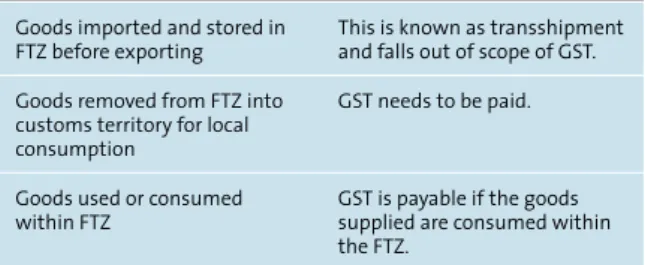
The following table provides the conditions for the payment or non-payment of GST:
Table 11: Conditions for Payment or Exemption from GST
CONDITIONS FOR PAYMENT OR ExEMPTION FROM GST Goods imported and stored in
FTZ before exporting This is known as transshipment and falls out of scope of GST. Goods removed from FTZ into
customs territory for local consumption
GST needs to be paid.
Goods used or consumed
within FTZ GST is payable if the goods supplied are consumed within the FTZ.
Inland Revenue Authority of Singapore - Transhipments and Free Trade Zones FTZs benefit both local and foreign traders. However, the follow-ing conditions must be met by traders:
| The movement of goods (imports, exports or transshipments) requires permits which are applied through TradeNet. | Foreign traders need to work in conjunction with local freight
48
5.3 Facilities Available at FTZs38
The following facilities are made available to traders at FTZs: 1. Depositing and storage of goods
Non-dutiable goods can be stored at these zones if they are be-ing transhipped or re-exported. All dutiable goods can be stored except for intoxicating liquor and tobacco products, which must be stored in licensed warehouses.
2. Repacking, sorting and re-conditioning
With the prior approval/permission of Singapore Customs, activi-ties such as re-packaging, sorting and re-conditioning of goods can be completed here. This facility particularly helps traders who want to combine or consolidate shipments from different countries to be sent to a new destination.
The application for re-packaging, re-conditioning and extrac-tion of trade samples for assessment should be made through e-filing. This online service is available here.39
38 Enterprise One - Free Trade Zones (FTZs) 39 Singapore Customs
49
6 Opening a Bank Account in Singapore
6.1 Overview of Retail BankingAll commercial banks operating in Singapore are licensed under and governed by the Banking Act. The Monetary Authority of Singapore (MAS) is the Central Bank of Singapore. Its functions include, but are not limited to issuing currency, managing foreign reserves, and supervision of financial services.
The banking structure in Singapore permits banks to carry out functions other than commercial banking. This includes other business areas regulated by MAS, such as financial advisory serv-ices, insurance broking and capital market services. Commercial banks need to comply with the conditions stated in the Financial Advisers Act (FAA), Insurance Act (IA) and Securities and Futures Act (SFA) to carry out their related functions.
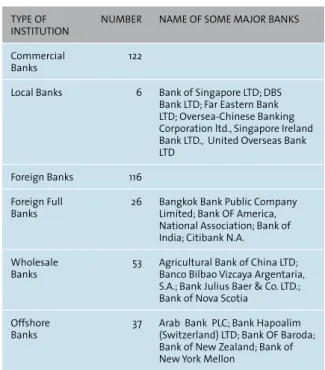
Commercial banks are not entitled to conduct any non-financial activity. This provision is in accordance with the amendment made to the Banking Act in 2001. Commercial banks are classi-fied as full banks, wholesale banks or offshore banks. Full banks carry out all banking activities as prescribed in the Banking Act. Wholesale banks are similar to full banks except that they do not perform Singaporean Dollar retail banking activities. Offshore banks can engage in similar types of activities as the other two; however, only for businesses transacted through their Asian Cur-rency Units (ACUs).
50 Table 12 lists the major bank categories in Singapore.
Table 12: The composition of Singapore Banking Structure
TYPE OF
INSTITUTION NUMBER NAME OF SOME MAJOR BANKS Commercial
Banks 122
Local Banks 6 Bank of Singapore LTD; DBS Bank LTD; Far Eastern Bank LTD; Oversea-Chinese Banking Corporation ltd., Singapore Ireland Bank LTD., United Overseas Bank LTD
Foreign Banks 116 Foreign Full
Banks 26 Bangkok Bank Public Company Limited; Bank OF America, National Association; Bank of India; Citibank N.A. Wholesale
Banks 53 Agricultural Bank of China LTD; Banco Bilbao Vizcaya Argentaria, S.A.; Bank Julius Baer & Co. LTD.; Bank of Nova Scotia
Offshore
Banks 37 Arab Bank PLC; Bank Hapoalim (Switzerland) LTD; Bank OF Baroda; Bank of New Zealand; Bank of New York Mellon
Monetary Authority of Singapore - Number of Financial Institutions in Singapore ass of May 2012
6.2 Procedure to Open a Bank Account40
The banks in Singapore provide various services on corporate accounts. These services include an option of multi-currency ac-counts, facility of internet banking, credit cards, trade financing, freedom to transfer funds from one nation to another. Banks follow a simple procedure to open an account.
The following is the detail of requirements for opening a corpo-40 Janus Corporate Solutions - Guide Me Singapore
51 rate bank account for Singaporean companies as well as overseas companies.
6.2.1 Procedure to Open a Corporate Bank Account of a Singapore Company
The company has to submit the following documents with the bank:
| Duly filled in corporate account opening forms signed by the authorised signatories;
| The resolution passed by the company’s Board of Directors sanctioning the opening of a bank account and the signatories of the account;
| One copy of the Certificate of Incorporation, certified by the company secretary or one of the directors;
| A copy of the company’s business profile issued by the company registrar and certified by the company secretary or one of the directors;
| A copy of the company’s Memorandum of Association and Article of Association certified by a director of the company or the company secretary;
| A certified copy of the passport and residential address proof of directors, ultimate owners and signatories of the company; | Other documents may be required depending on the bank. Some banks may require a majority of the company’s directors
or the account signatories present in Singapore at the time of opening a bank account and signing papers.
There may be a requirement in some banks regarding the de-posit of a minimum sum at the time of opening an account.
52 6.2.2 Procedure to Open a Corporate Bank Account
of an Overseas Company
The procedure and documents required for opening a corpo-rate bank account of the overseas company are similar to the requirements for a Singaporean company. However, the banks may practise more due diligence while opening an account of an overseas company.
The banks will require more information regarding the business activities of the company, source of funds, bank reference letters, the value of transactions, carried by the company and proof of the beneficial owners of the company.
In addition, a company will have to submit the following docu-ments:
| Certificate of Incumbency
| Certificate of Good Standing of the overseas company 6.2.3 Personal Accounts41
The following are major personal accounts in Singapore and the documents required for opening such accounts:
6.2.3.1 Current Account
A person has to submit the following documents while applying for the current account:
| Identity card or the passport;
| Passport and a relevant pass issued by the Immigration and Checkpoint Authority of Singapore (ICA) if the applicant is a foreigner;
| A bank may also require the applicant to meet an age criteria. For instance, DBS Bank requires the account owner not to be less than 18 years of age and no minimum initial deposit in the account is required.