DCC Release Management Strategy
Version 1
24/03/2015
Document Control
VersionNumber
Date Version
1 24/03/2015 Initial Draft for publication
Documentation Approval
Name Role Date Signature
Dave Broady DCC Operations Director
Matthew Roderick
Contents
1 Introduction ... 4
2 Scope and Applicability ... 4
3 Governance ... 5
4 DCC Release Concepts ... 5
4.1 Definition ... 5
4.2 Release Types ... 5
4.3 Planned Release Schedule ... 6
5 Release Management Strategy Models ... 7
5.1 Standard Release Management (SRM) ... 7
5.1.1 Release Requirements Open: 24 months prior to Release Go Live ... 8
5.1.2 Requirements Refinement: 18 to 15 months prior to Release Go Live . 8 5.1.3 Development of Technical and Regulatory Material: 15 months prior to Release Go Live ... 9
5.1.4 Requirements Freeze, Plan and Contract: 12 months prior to Release Go Live 9 5.1.5 Develop Design and Design Freeze: 9 months prior to Release Go Live 10 5.1.6 Build and Test (System): 6 months prior to Release Go Live ... 10
5.1.7 Test (User) and Go Live: 3 months prior to Release Go Live ... 10
5.1.8 Service Decommission Notification ... 11
5.2 Accelerated Release Management (ARM) ... 11
1
Introduction
Changes and future releases to Data Communication Company (DCC) Services, their service components and associated documentation, will be implemented through a planned schedule of releases throughout the lifetime of the DCC Licence. This document defines DCC’s Release Management Strategy that will operate during the Smart Metering Implementation Programme (SMIP) and, potentially, throughout the operational life of the licensee. The Release Management Strategy will be updated periodically to ensure it remains current and relevant.
The DCC Release Management Strategy describes how DCC will operate its Release Management beyond the commencement of DCC live operations. The Release Management Strategy is at a conceptual level, with details relating to DCC’s Release Management documented within the DCC Release Management Policy (pursuant to Section H8.9 of the Code).
2
Scope and Applicability
The Release Management Strategy includes the principles for prioritisation, governance arrangements, the release lifecycle (including requirements definition, development and test activities) and a schedule for the frequency of planned releases. This document also outlines the different Release Management Strategy approaches that will operate following the commencement of DCC live operations, namely:
Standard Release Management (SRM), which is the default approach to plan, build, test and deployment of DCC releases; and
Accelerated Release Management (ARM), which is additional to the planned release schedule to meet urgent requirements, where demand warrants.
All DCC Services1 will be within the scope of the Release Management Strategy. For SEC Parties, this provides certainty regarding deployment dates and gives sufficient time to plan and implement required changes to their systems, processes and documentation.
DCC Services within scope include: DCC User Interface;
Registration Data Interface; Self Service Interface;
Smart Metering Key Infrastructure, including the SMKI Repository; DCC Key Infrastructure, including the DCCKI Repository;
Parse and Correlate; and ________________________ 1
Non User Gateway.
3
Governance
New Requirement requests and Changes (either in the form of a Modification Proposal for SEC related changes or Change Request for non-SEC related changes) to DCC’s Services can be raised against the requirements baseline. These will be reviewed and impact assessed via the Modification Process (Section D2, SEC) for SEC related changes and via the DCC Change Management process for non-SEC related changes. Part of this assessment of requirements will include determining when new requirements should be implemented in the DCC Services. This scheduling will take into account of factors such as SEC Parties’ priorities, technical complexity and implementation timescales as well as direction from SEC governing bodies. This process aims to ensure an economic and efficient use of resources, as well as minimising the impact and risk to the DCC Services.
It is envisaged that resolution of any disputes in respect of scheduling of change delivery will be the responsibility of the SEC Panel.
Full details of Release Management process and procedures will be documented in the DCC Release Management Policy (pursuant to SEC section H8.9).
SEC Modification Process:
https://www.smartenergycodecompany.co.uk/modifications/about-modifications
4
DCC Release Concepts
4.1
Definition
A Release is a group of approved changes which are implemented as one package, allowing implementation of multiple changes simultaneously.
4.2
Release Types
The categorisation of DCC releases will be based on the scale of new or amended functional requirements together with the impact and associated risk to DCC Services:
Major Release:
contains significant areas of new functionality and/or complex defect fixes.
A major release would be caused by, for example, a material modification of obligations under SEC. Or material changes of SMETS, GBCS and/or CHTS specifications.
Minor/Defect Release:
contains minor enhancements and defect fixes, some of which may have been temporarily addressed as emergency fixes.
A minor release would be caused by, for example, a permanent fixes identified as a result of Incident and Problem Management and/or minor functional enhancements to DCC Services.
Emergency Releases:
contains the corrections to one or more high impact, material defects (known errors).
An emergency release would be caused by, for example, a material security vulnerability identified in the DCC Services, with a fix required immediately.
All releases supersede previously deployed releases.
4.3
Planned Release Schedule
DCC will align the Release Schedule with the other Industry Code release schedules, where practicable and appropriate.
There will be three planned releases each year:
The last Thursday in February – type: minor/defect; The last Thursday in June – type: major; and
The first Thursday in November – type: minor/defect.
These dates have been aligned with other energy codes (e.g. BSC, MRA, UNC, iGT/UNC, SPAA and DCUSA) release schedules. .
The planned release dates for the three years post DCC live are:
February Release June Release November Release
- - 06 Nov 16
26 Feb 17 25 Jun 17 05 Nov 17
25 Feb 18 30 Jun 18 03 Nov 18
Most changes will be allocated to one of these planned releases, based on the categorisation. However, DCC recognises that ‘standalone’ releases may
occasionally be required to meet a specific requirement of a particular change and which will need to be implemented outside of one of the planned releases. These exceptional releases will be delivered via Accelerated Release Management (ARM). Further detail of the ARM process is set out in section 5.2 of this document.
5
Release Management Strategy Models
5.1
Standard Release Management (SRM)
The Standard Release Management (SRM) approach will use a defined and staged approach, with supporting milestones that will provide clarity and certainty for SEC Parties.
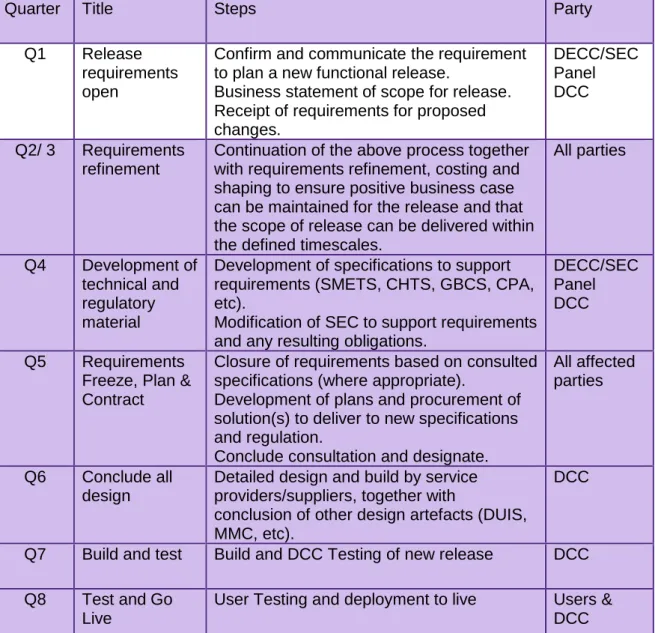
The overall management of new requirements and the subsequent Release Management process has seven clear stages from Release Requirements Open through to Release Go Live. The below table describes the activity, per quarter, in the lead up to a major SRM releases. Minor releases will involve the same activities within an accelerated schedule.
Quarter Title Steps Party
Q1 Release requirements open
Confirm and communicate the requirement to plan a new functional release.
Business statement of scope for release. Receipt of requirements for proposed changes. DECC/SEC Panel DCC Q2/ 3 Requirements refinement
Continuation of the above process together with requirements refinement, costing and shaping to ensure positive business case can be maintained for the release and that the scope of release can be delivered within the defined timescales.
All parties
Q4 Development of technical and regulatory material
Development of specifications to support requirements (SMETS, CHTS, GBCS, CPA, etc).
Modification of SEC to support requirements and any resulting obligations.
DECC/SEC Panel DCC
Q5 Requirements Freeze, Plan & Contract
Closure of requirements based on consulted specifications (where appropriate).
Development of plans and procurement of solution(s) to deliver to new specifications and regulation.
Conclude consultation and designate.
All affected parties
Q6 Conclude all design
Detailed design and build by service providers/suppliers, together with
conclusion of other design artefacts (DUIS, MMC, etc).
DCC
Q7 Build and test Build and DCC Testing of new release DCC Q8 Test and Go
Live
User Testing and deployment to live Users & DCC Figure 1 – Overall generic DCC SRM Release Cycle
5.1.1
Release Requirements Open: 24 months prior to Release Go
Live
As part of the Standard Release Management process a release for major and functional changes will occur the last week of June (annually). Requirements for a release would open 24 months prior to its Release Go Live. As part of this process a new Release record will be created for the Release, approximately two years prior to the planned scheduled Release Go Live date.
The new Release will appear on DCC’s Change Schedule published on the Self Service Interface (SSI) (or other appropriate means) and DCC’s Change Management webpage, as a notification to DECC, SEC Panel, Users and other interested parties that the new Release is open for new requirement proposals.
5.1.2
Requirements Refinement: 18 to 15 months prior to Release
Go Live
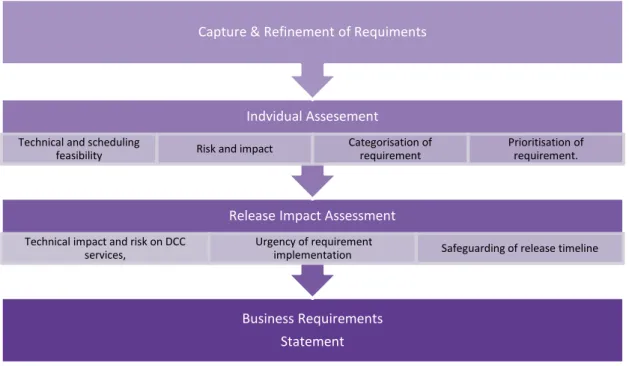
All changes will be assessed and scheduled for triage in a controlled, efficient and effective process to accurately prioritise and categorise each new requirement in terms of value added benefit to the Parties and cost effectiveness.
Figure 2 – Requirements Refinement Stages
The prime objective of the Requirements Refinement stage is to continue the gathering of new requirements and to refine requirement details in terms of:
Cost and technical development; and
Business Requirements Statement
Release Impact Assessment Technical impact and risk on DCC
services,
Urgency of requirement
implementation Safeguarding of release timeline Indvidual Assesement
Technical and scheduling
feasibility Risk and impact
Categorisation of requirement
Prioritisation of requirement. Capture & Refinement of Requiments
Safeguarding to ensure the scope of the release can be delivered within the timetabled schedule.
The Requirements Refinement process, will take into account existing Change Requests that have previously been assigned to a ‘future release’. All requirements will be assessed for:
Technical and scheduling feasibility; Risk and impact;
Categorisation of requirement; and Prioritisation of requirement.
As part of the Change Management process, allocation of changes (aka Requirements) into the target DCC Release will be based on:
Technical impact and risk on DCC services; and
Urgency of requirement implementation, as defined by either SEC Panel (SEC related changes only), DECC and/or DCC.
On completion of the Requirements Refinement process, DCC will issue a draft Business Requirements statement, specifying the scope for the release and detailing each of the changes that have been accepted for inclusion.
5.1.3
Development of Technical and Regulatory Material: 15
months prior to Release Go Live
During the DCC Change and Release Management processes, where the impact assessment of a requirement(s) has ascertained that a Technical and/or Regulatory document requires modification, DCC will establish communication with appropriate document owners to develop and amend these documents to support the requirements.
In the case of a SEC modification (or SEC Subsidiary document), DCC will comply with the Modification Proposal to the SEC Panel, to support the requirement(s) and any resulting obligations.
5.1.4
Requirements Freeze, Plan and Contract: 12 months prior to
Release Go Live
At the Requirements Freeze date, all allocated changes to be included in the release will be fixed and no further changes to the release specification will be accepted (other than as explained below).
The closure of requirements will be based on consulted Regulatory and Technical documents, as described in section 5.1.3.
Following the Requirements Freeze date, development of release and deployment planning will commence (as part of the DCC Release Management process) and planning of procurement activities will commence.
If a new requirement of sufficient priority is submitted to DCC after the Requirements Freeze date, then the following options may be considered:
A lower priority change may be deferred from the release in order that the higher priority change can be added. The lower priority change will be allocated to the next appropriate release.
An additional release maybe scheduled by DCC as per Accelerated Release Management, with the same requirements freeze principles applying. Such a release will apply only to urgent requirements and defect corrections.
Where a change is considered an Emergency Release, lead times are void and key dates will be subject to agreement between DCC, SEC Panel and/or DECC. Emergency releases shall only apply to defect fixes.
5.1.5
Develop Design and Design Freeze: 9 months prior to
Release Go Live
The Develop Design phase comprises finalisation of the detailed designs with DCC Service Providers, consultation with Parties (where appropriate) and conclusion of all related designs and artefacts.
The Design Freeze date occurs at the conclusion of the Develop Design phase. The design for the release will be fixed from the Design Freeze date, with no further changes to the design being possible.
On completion of the Design Freeze, DCC will issue the Scope of Business Requirements statement, specifying the detailed scope for the release together with all User facing design material.
System build activities may also commence at this stage.
5.1.6
Build and Test (System): 6 months prior to Release Go Live
All system build activities will be assured against the approved release Design Specifications and will be managed by the DCC Release Management function. Release documentation will be developed and the technical environment and test facility will be allocated.
Quality assurance of all build components will be managed via DCC assurance. Once the build has been completed, system testing (Unit and Integration) will commence.
During the Build and Test phase, DCC will seek to provide an informal test environment for Parties to use where practicable together with the modifications any formal testing requirements.
5.1.7
Test (User) and Go Live: 3 months prior to Release Go Live
User testing will be available once DCC testing has concluded successfully. If appropriate, Parties may have to conduct a subset of User Entry Process Testing (UEPT) and SMKI and Repository Entry Process Testing (SREPT) testing.
The DCC Release Management will manage planning for the deployment and completion of all Release documentation.
The details of all DCC releases will be made visible to Users via the Self Service Interface (SSI) and DCC Website Release Schedule. This will be a rolling 52 week view, updated and published weekly. Release Notes for each release will also be available, detailing as a minimum:
List of changes;
Statement of Business Requirements; Service(s) impacted by Release;
Documents to be amended as a result of the Release; and Key dates.
Full details of the Release Management process cycle will be documented in the DCC Release Management Policy.
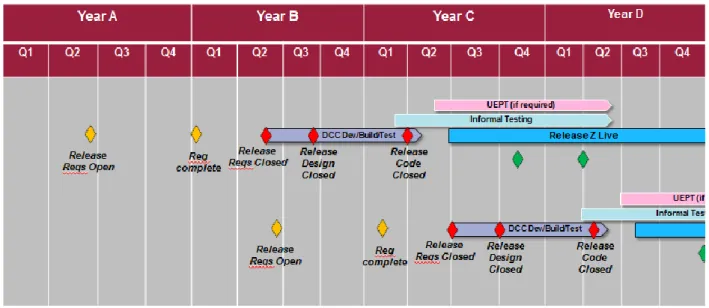
Figure 2 – Graphical representation of Release Management Strategy
5.1.8
Service Decommission Notification
DCC will notify SEC Parties of the decommissioning date of a specific version of a DCC Service at least twelve months in advance of decommissioning of that version. As a minimum, services versions will be supported for two years2.
5.2
Accelerated Release Management (ARM)
Once DCC has commenced Live Operations, the intention is to operate the Release Management phases as set out in Section 5.1, however DCC acknowledges that ________________________
2
Exceptional scenarios may cause this to change. Service version life may be extended if new versions compromise the ability to interact with deployed metering assets.
early operational experience may require urgent enhancements or changes to the DCC Service. Therefore ARM will be made available.
The ARM process will follow the same Release Management process as the RMS, however key milestone dates may be amended to meet the nature of the accelerated requirements. As a consequence of additional resources requirements to meet this accelerated release, further costs may be incurred.
6
User Engagement
DCC will engage directly with Users and other relevant stakeholders to collaborate in the development of Releases to the DCC Solution. This is likely to take a similar format to DCC’s current design forums, which will supplement the provision of details of forthcoming releases via the SSI and DCC website.