Table of Contents
Introduction……….1
Chapter 1: Universal versus Particular………4
Chapter 1 Illustrations………24
Chapter 2: Mimic and Subvert.………..……26
Chapter 2 Illustrations………42
Chapter 3: The Grid as Boundary and Fragmenting Force.…..……….…46
Chapter 3 Illustrations………64
Conclusion……….……73
Introduction
“What I’ve tried to do with the photo work is create contradictions—an edge between the subject and the interpretation about how a ‘subject’ is viewed or contextualized… I prefer gaps and contradictions so that not all the viewer’s questions are answered.”1
- Lorna Simpson As her words indicate, Lorna Simpson creates artwork that evades a singular interpreta-tion.2 In order to make artwork that refuses definitive interpretations, Simpson employs a formal element that is a visual reflection of the mindset with which she approaches the world. As she professed in the same interview the quote above originated from, Simpson views the world around her not through one ideological framework but with the understanding that through frag-mentation, the act of disassembling and reconstructing, the fallacies and contradictions that many societal frameworks are built upon can be revealed. The artist’s ability to create contradictory and compelling works can be seen in her consistent use of fragmentation. I have taken Simpson’s notion of fragmentation, a simple descriptor of how she views the world and creates art, and morphed it from being a nebulous concept of her artistic practice into a two-part definition that describes its usage in her work.3 The fragmentation, in all its various forms, is a crucial formal
element in accomplishing Simpsons’ mission of creating work that inspires questions more than they answer them and is also emblematic of her broader artistic practice.
* I would like to thank Dr. John P. Bowles for his advice and assistance throughout this process. I would also like to thank my parents for their graciousness, generosity and continuous love and support. Lastly, I am grateful for my friends and their encouragement.
1 Issac Julien and Thelma Golden. “Conversation with the Artist,” in Lorna Simpson (New York: Abrams, in
associ-ation with the American Federassoci-ation of Arts, 2006), 134, 139.
Within Simpson’s work there are two distinct types of fragmentation. They are often used simultaneously in the same work but can also be seen separately. The first type of fragmentation occurs when Simpson takes the body, in most cases the body of a black woman, and fragments it using different photographs to represent distinct portions of the body. For example, the top pho-tograph in a work depicts the woman's head to her shoulders, the middle phopho-tograph shows from mid-way down the woman's arms to her knees, while the bottom and last image captures from the tops of her shins to the floor on which she stands. In these works bearing this type of frag-mentation, Simpson uses the frame, which takes the form of a grid, to emphasize the fragmenta-tion present. Three to four smaller frames, each holding one photograph that portrays a segment of the body, composes a larger frame.
The second form of fragmentation present in her work is when Simpson crops the figure's body in a photograph so that only a portion of it is fully visible. For example, Simpson photo-graphs only the neck and collarbones of a woman or shows solely the back of a woman’s head. This kind of photograph is typically placed inside one frame, rather than the multiple smaller frames used in the previous type of fragmentation. These two methods of fragmenting the body are not interchangeable, but for the purposes of this thesis they are understood under the banner of "fragmentation" and have similar meanings.
the formal element of fragmentation I deconstruct this interpretive binary. Building on the dis-cussion of the black female body in the first chapter, the second chapter relates Simpson’s work to photographic styles used in the past. By establishing connections between Simpson and pho-tographers who preceded her work further meaning inherent in Simpson’s art is elucidated. In the third and final chapter, I contemplate the implications of the gridded frame that serves as the mechanism by which the fragmentation is reinforced in her artworks. Each chapter tackles a dif-ferent aspect of the fragmentation present in Simpson’s early photographic work. All the chap-ters are all linked in that I explore the multiple functions of the fragmentation and the meaning it conveys.
Chapter 1: Universal versus Particular
If Simpson wishes for her work to inspire multiple interpretations and evade definitive conclusions, she accomplishes this by incorporating the intersectionality of race and gender in her art. This exploration of intersectionality takes the form of the black female figure who is fea-tured prominently in her work. The bulk of this thesis, and this first chapter, focuses on under-standing the black women in Simpson’s work by evaluating their context both in regards to their location in Simpson’s work but also past representations and understandings of the black female body in America. Simpson has commented multiple times on her desire to universalize her fig-ures. Too often there is a tendency to read work by black artists as autobiographical which pre-vents a more universalized interpretation from taking place.4 Simpson refutes any attempt to read her work as autobiographical, stating that the black women in her work are, “representative and not specific, and therefore not me.”5 If we begin with Simpson’s statement that the black female figure in her work does not illustrate the artist but is representative: who does the figure repre-sent?
Coco Fusco’s understanding of the black female figure is more in line with how the artist sees her work. Fusco believes that it is possible to remove the black female figure from her cul-tural history, context, and experience in order to make her a cipher for otherness.6 Fusco is not
4 These tendency stems from the impulse to read both photography and art created by black artists as
autobiograph-ical. For Simpson’s full quote on this issue see Joan Simon, “An Interview with Lorna Simpson” in Lorna Simpson: Standing in the Water (New York: Whiney Museum of American Art, 1994), 189.
5 Ibid.
6 Coco Fusco, “Uncanny Dissonance: The Work of Lorna Simpson,” in English is Broken Here, (New York: New
alone in her more broad interpretation of Simpson’s work. Rather, her understanding of Simp-son’s art is emblematic of an oft-spouted interpretation that the female figure in SimpSimp-son’s work is a universal character and not simply representative of black women.7 Interpreting the black figures in Simpson’s art as not just representatives of otherness, Fusco argues that the black fe-male figure represents a group that is more isolated and marginalized and thus deserving of the label, “the other of the other.”8 In the same way that Fusco exemplifies the universal argument, bell hooks’s argument is representative of a more narrow interpretation of Simpson’s work where the experiences and identity of black women are solely exposed.9
Both scholars assert that Simpson’s work counters hegemonic notions of black feminin-ity. They depart from each other in their interpretation of which representation, universal or par-ticular, is present in Simpson’s work. Fusco sees “the other of the other” manifesting itself in the depiction of a black woman and thus suggests a more universal interpretation. hooks, meanwhile, refuses to separate the black woman depicted from the intersectional experience her race and gender mandate. Therefore, hooks falls into the “particular” camp.
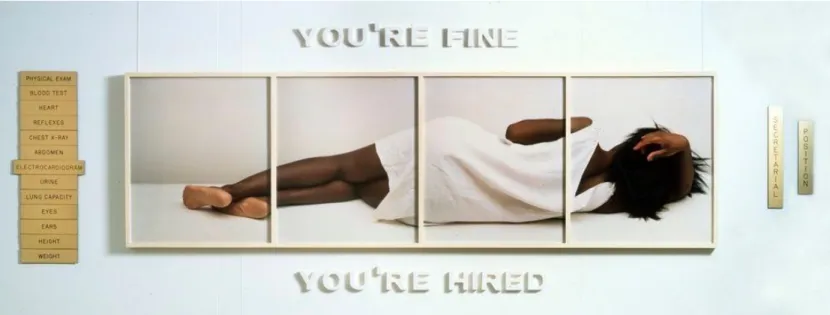
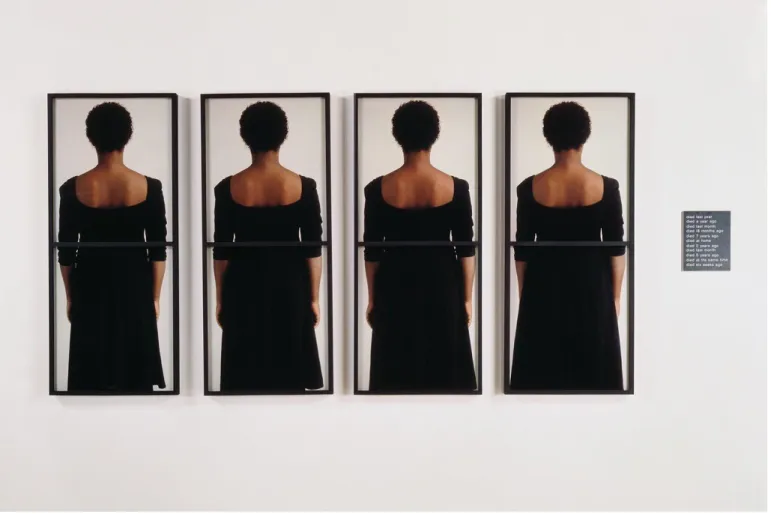
Pivotal to both interpretations is the fragmentation of the black body in Simpson’s work. The fragmentation present in You’re Fine (figure 1) and Time Piece (figure 2), two works evalu-ated in this chapter, lends itself to a variety of interpretations. It supports both Fusco and hooks’s claim, but in doing so it dissolves the binary of the universal versus particular interpretations
7 Huey Copeland argues that in her work Simpson is able to represent both the universal and the particular.
Specifically, he sees Simpson “aim[ing] for a ‘restating of the universal,’” in which the artist demonstrates the ways that typically black women have been denied representation in the past. While Copeland ultimately argues that it Simpson’s ability to depict figures that traverse the boundary of universal versus particular, his argument summarizes generally well known interpretations of Simpson’s work. Huey Copeland, “‘Bye, Bye Black Girl’: Lorna Simpson’s Figurative Retreat,” Art Journal 64 (2005), 68.
8 Fusco, English is Broken Here, 98.
these two scholars, and those belonging to each respective camp, suggest. The relationship be-tween the fragmentation and embodiment discourse links both of these interpretations together. Embodiment rhetoric and discourse focuses not on the abstract and theoretical concepts that for-mulate identity, but on the lived experiences of black women and the ways in which the reality of moving through space with a gendered and racialized body establishes identity.10
To make her case for the particular reading of Simpson’s work, bell hooks analyzes and interprets You’re Fine. Created in 1988 from Polaroid pictures, ceramic tiles and engraved plaques all set on a white background, You’re Fine depicts a black woman reclining on the floor. Each of the four photographs that compose the work is placed into one of four sections of the frame that holds each image. The reclining woman faces away from the camera wearing a white shift, her straight, unbound hair grazing the white floor on which she lays. The shift she wears is sleeveless, showing her arms and the hem falls below her buttocks leaving the lower half of the back of her thighs exposed to the camera’s lens. While the floor is as white as the whole back-ground of the work, in each photo she faces a light gray backdrop. The continuity created by the matching background makes the photographs seem expansive rather than closely cropped images of a woman’s body.
The four Polaroids depicting the woman neatly fragment her body. The first photograph, located in the right-most frame, shows the top of woman’s head to below her shoulders. Also present in this first photograph is the woman’s right hand that hovers over the back of her head. The second Polaroid continues the representation of the woman’s body as it shows from under-neath her biceps past the swell of her hip. While her right arm is depicted in the first photograph, in the second her left elbow rests in the serpentine curve of her body, the hand unseen. The
10 Brittney Cooper, “A’n’t a Lady?: Race Women, Michelle Obama, and the Ever-Expanding Democratic
woman’s legs, seen in the third photo, are bisected two-thirds down her calf by wooden structure of the frame. This photo portrays most of the figure’s legs, the majority of which is uncovered by the white shift. The fourth and final photograph is located in the left-most frame and displays the remaining portion of the woman’s body from the lower part of her calf to the cream colored soles of her feet which are angled away from the camera.
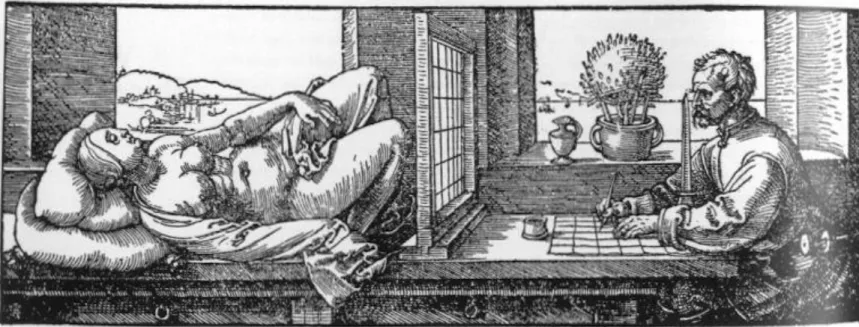
The positioning of the female figure does not evoke so much as it creates the archetypical reclining female nude pose seen on various canvases throughout time. The reclining female has a long tradition within art and is closely associated with the patriarchal objectification of women. There is no lack of images where the front of the female’s nude body faces the viewers as she lies upon a chaise or a grassy hill.11 Typically showing the female figure from the back, as was also common, lends the image a more predatory feel as the female is not always aware that she is being lasciviously gazed upon. Some classic examples of a reclining female nude seen from be-hind include Jean Auguste Dominique Ingres La Grande Odalisque (1814) and Velázquez’s
Rokeby Venus (1647-1651). More recently, artists, including as Simpson, have taken up the re-clining pose and subverted its conventional interpretations. Alice Neel’s Pregnant Woman
(1971) depicts a reclining female nude, whose body is rendered grotesquely in jaundiced yellow and sickly green. Even as her body is on display for viewers, the figure in Pregnant Woman con-fronts each speculative gaze with a direct stare. Unlike Pregnant Woman,the woman in You’re Fine faces away from the camera. These two images are united in that each artist deliberately employs an exploitive pose of the female body only to subvert it. While there is much to unpack
in Simpson’s inclusion of this specific position and its connotations, I have chosen instead to fo-cus on the ways in which this reclining female differs from her predecessors. In the same way that Neel has disrupted the viewer’s experience by rendering her woman with steely stare, Simp-son’s use of fragmentation is equally as disruptive and prevents an unencumbered viewing of this reclining black woman.
The fragmentation is located in the disconnect between the continuation of the woman’s body from one photograph to the next. Simpson has deliberately mismatched the placement of these Polaroids next to each other within their respective frames. The first and second photo-graphs, depicting her head and torso, are misaligned so that the top of the woman’s bicep hovers millimeters above the rest of her arm displayed in the second image. Similarly, the two photo-graphs of the woman’s calf and ankle do not perfectly match up. This misalignment reinforces the fragmentation already established by the segmentation of the body which has been distrib-uted over four photographs. While altogether the images provide a holistic representation of the figure’s body, the four frames as well as the purposeful misalignment highlights the fragmenta-tion present in this work.
While Fusco does not include You’re Fine in her essay on Simpson’s work, her general interpretation of the artist is still applicable to this specific piece of art. According to Fusco’s es-timation, Simpson’s work does not represent the particular experiences of black women, but in-stead the black women frequently depicted can be understood as a cipher representing “the other of the other.”12 For Fusco, Simpson's work should be interpreted universally rather than solely as a representation of the black female experience. The use of the word “universal” to characterize this aspect of the binary is misleading. Those belonging, intentionally or otherwise, to the univer-sal camp, such as Fusco, are not suggesting that Simpson's work be read as representing a com-mon human experience or identity. Universal can be an apt descriptor; however, because it im-plies that the interpretation of the work apim-plies to more than just the experiences of black women in America. In her essay Fusco suggests the idea of “the other of the other” as the extent to which Simpson's figures can be universalized. According to Fusco’s definition, one belongs to “the other of the other” provided you are neither white nor male.13 White males are not arbitrary choices with which “the other of the other” is defined. Fusco claims these two characteristics (white and male) are the source of the hegemony of American society.14 Throughout history, white men have shaped representations of people of color to fit their own purposes. An example of this occurred after slavery ended and white supremacy needed to be justified. Thus, the under-standing of black masculinity shifted from the black man as a child who needed to be protected to the brute Negro, a figure of “hyper-masculine savagery.”15 What this example proves is that in
12 Fusco is quite direct about this assertion, stating, “Her [Simpson’s] images do not…illustrate a communal black
experience as some might seek to find.” Fusco, English is Broken Here, 98.
13 Ibid. 14 Ibid.
15 Kevin Thomas, “Deconstructing Hegemonic Masculinity: Understanding Representation of Black and White
determining the conception of blackness, the white men were interested in upholding their supe-riority and mandating that black identity be that which constrains to their own needs.
To bolster her interpretation of universality, Fusco focuses particularly on the similar background in many Simpson works. The figure in You’re Fine and other Simpson photographic works from this time are placed in a neutral background. In You're Fine the neutral background is the gray of the backdrop and white floor on which the woman lies. The neutrality of the back-ground allows the figure shown in the work to become removed from her daily life and the cir-cumstances that define her and thus enter into a fantasy-like dreamscape, a world devoid of markers belonging to any one group's identity.16 By locating this woman in a blank background Simpson prevents the reading of this woman as a representation of black female identity because she is not linked to any other characteristics other than her own body. Fusco argues, therefore, that Simpson’s work is about showcasing how identity is constructed by using a black woman as an example, not an illustration of black identity.
The use of the dreamscape inspired by the neutral background in You’re Fine convinces Fusco that Simpson is not deliberately striving to represent black women’s identity and experi-ences. Had Simpson desired to represent black identity she had the opportunity to do so. Simp-son began her career documenting women in the streets in the mode of documentary photog-raphy.17 Fusco believes that documentary photography “often seeks to redeem the subjects of a marginalized world.” Simpson rejected the identity markers of real life in her photography in the
16 Ibid.
17 Enwezor argues that even from her early documentary photography Simpson’s interest in the “photographic
studio. Had Simpson truly wanted to represent black women’s experiences, Fusco argues, she could have continued to photograph women where they actually lived, in their homes and on the streets, and thus concretely represented black female identity by depicting their lived reality.18 Simpson made the choice, however, to leave the streets and the actualities of daily life and pho-tograph women in her studio, purposefully removing all context and signifiers that could link the female figure in her work with the specificity of black women’s experiences and identity.
Another compelling aspect of the universal argument is to articulate what is lost by too narrowly interpreting Simpson’s work. Simpson’s works like You’re Fine are meant to invite questions and close looking by creating images that deal with intersectionality. Conceived of by black feminists, intersectionality explains that identity is not formulated by separate characteris-tics but instead is the result of the “overlapping spheres” of gender, race, sexual orientation and social class.19 By pinning down Simpson’s artworks as representations of a specific subset of the
population, which is seen in hooks’s particularist interpretation, potential meanings of the works can be lost. This is often a criticism employed by scholars discussing Simpson’s work, including the artist herself. Brooke Belisle characterizes Simpson’s retort to Deborah Willis’s suggestion during an interview that Simpson’s work explicitly represents “the deep sense of isolation that many black women experience,” as one of deflection.20 In response to Willis’s interpretations,
Simpson says that she wants to “expand rather than limit” interpretations of her work and that she prefers to use “the figure of the black woman to talk about many different things.”21 Due to provocative nature of Simpson’s work and its demand for close inspection and attention, it would
18 Fusco, English is Broken Here, 98. 19 Thomas, “Deconstructing Hegemonic,” 1.
20 I could not find access to this particular interview and instead relied on the summary provided by Brooke Belisle
in her essay “Felt Surface, Visible Image: Lorna Simpson’s Photography and the Embodiment of Appearance,” Pho-tography & Culture 4 (2011): 161.
be a mistake to only see the experiences of black women represented. As the figures are not placed in actual reality and instead located in a dreamscape they should be interpreted, Fusco be-lieves, more broadly.22 By functioning as ciphers, those whose marginalization is so severe they belong to the subcategory of “otherness” is made visible and discussed.23
It would be fair to say that bell hooks disagrees with most of Fusco’s assertions. hooks does understand Simpson’s works to be a portrayal of otherness, but specifically the experiences of one part of the group of other: black women. Her “particular” interpretation does not go so far as to suggest that represented in You're Fine is the circumstances and experiences of one specific black woman. Instead, hooks suggests that the black woman in You’re Fine represents black women as a collective group.24 Although within the broad category of “black women” there are unquestionably a variety of experiences and identities. Those belonging to the particular under-standing of Simpson's work insinuate that by being black and female there is a communal his-tory, culture and experience.
hooks finds evidence of the particular in the positioning and placement of the black wom-an's body in You’re Fine. Returning to the white men who conceive of and propagate hegemonic notions of masculinity and femininity, American society has long perpetuated the black female body as one that is not self-defined.25 Understandings and representations of black identity have
22 Again, Fusco’s interpretation is broader in that she understands the black women in Simpson’s works as ciphers
for otherness rather than representatives for the human condition in general. Fusco, English is Broken Here, 98.
23 Ibid.
24 bell hooks, Art on My Mind (New York: The New Press, 1995) 97.
25 Fatima Tobing Rony understands photography as a means of representation that has been abused in the past. “We
shifted throughout time to reinforce white supremacy. Combatting this ongoing hegemonic prac-tice, hooks argues that the woman in You’re Fine fights against these false representations of black identity. Central to this rebuttal of the white patriarchal conception of black femininity is the agency Simpson restores to her figures. This agency is conveyed in two ways by position of the woman who faces away from the camera.26 First, by turning away from the camera she de-nies the lens her face. This symbolic act of protecting her identity ensures her anonymity and in-forms spectators that her body is something that only she can control. In this instance, she is choosing not to share her body with the camera. Secondly, with her back turned away from the camera she is able to establish her own gaze independent of those that look upon her. Because the viewer cannot see her face it is impossible to know where she looks, what she sees in the space that lies before her, or how she feels.27 The establishment of her own space where she can emote or act as she pleases without worrying about the eyes of spectators grants this woman agency and a sense of autonomy that the hegemonic conceptions of black femininity deny her.28
Further contributing to a particular reading of You’re Fine is Simpson’s restoration of mystery to the black female body.29 hooks asserts that the determination of black bodies as hy-per-sexual or violent has led to the complete loss of subtlety and mystery in black individuals. Black women, in the eyes of mainstream America, have been deemed unworthy of examination because they have determined as “lacking in complexity.”30 Simpson’s decision to include plaques that allude to the physical examination that takes place in a doctor’s office and equate it
26 hooks, Art on My Mind, 94. 27 hooks, Art on My Mind, 94-5. 28 Ibid.
29 hooks, Art on My Mind, 97.
30 By fragmenting the figure in her work Simpson forces viewers to take another look. The act of looking multiple
with employment takes on new meaning in light of hooks’s analysis. By evoking images of ster-ile exam rooms, crinkling paper shifts, and medical tests, viewers are forced to confront that too often evaluations of black women are based solely on their physicality and not on the depth pre-sent within each individual. Black women, throughout American history, have been understood in regards to the services they provided to society, be it their reproductive capabilities to produce more slave labor or the labor they themselves could supply. The mystery that is central to our de-termination as individuals has been restored to this woman who faces away from us disallowing us to know who she is and the emotional state perhaps displayed by her face. At its core, this woman is unrecognizable because of her lack of facial representation. She is not linked, there-fore, to “the other of the other” but is deeply rooted in the experiences of black Americans and the ways they have been labeled and explained throughout history. The restoration of mystery, and thus individuality, this woman portrays links her to the particular reading. Rather than rely-ing on the prevailrely-ing racist and sexist notions that have determined black femininity, Simpson allows the woman in You’re Fine to be mysterious and subtle.
Looking at You’re Fine, hooks sees a paradoxical scene of agency and dehumanization occurring simultaneously.31 The text panels and ceramic letters tell a story of domination. The subjugation of black women has been as present as black women themselves in America: as re-productive vessels for their white owners, sexual assault they underwent at the hands of their white owners, the eugenics operations done on black women without their consent, and the dis-crimination that black women face every day as they seek employment. The text on the plaques references medical tests and the dehumanization that occurs when bodies are broken down into the fluids they produce and the micro-components measurable by medical technology. The
words on the plaques refer to these instances of domination not so much in explicit verbiage but in the feelings of oppression they conjure. Despite the oppressiveness the accompanying text suggests, looking at the reclining woman’s body there is no evidence of oppression.32 The woman in You’re Fine exudes no stress or discomfort in the face of this potential threat. By ig-noring this dehumanization, this woman transcends the medical and employment humiliation in-sinuated in the sterile background and threatening words that surround her.33 For hooks nothing is lost when the particular interpretation is applied to Simpson’s works. Rather, much is gained such as a rewriting of black women’s history, which hooks asserts is as powerful as it is uncom-mon.34
As Huey Copeland suggests it is the suspension between the particular and universal that animates Simpson’s work.35 To only see the universal or particular in You’re Fine would be too easy. The interpretive binary of universal versus particular exists because it is born of our desire to explain away the difficulties in Simpson’s work; however, viewers must revel in the complex-ities that Simpson presents. The intersectionality inherent in Simpson’s work forces us to con-tend with the complexities of black identity and its representations.
In their respective essays, neither Fusco nor hooks discussed in depth the fragmentation present in You’re Fine. Yet, looking at the fragmentation dissolves the binary that both Fusco and hooks unwittingly fell into. In their desire to find the deeper meaning that Simpson’s work conveys they overlooked a meaningful characteristic that is readily available in much of Simp-son’s early art and very visible in You’re Fine.
32 Ibid. 33 Ibid.
34 hooks, Art on my Mind, 100.
35 For Copeland, the fluctuation between the universal and the particular in Simpson’s work not only animates it but
Before the significance of the fragmentation in the universal versus particular debate can be delved into, first the photography technique Simpson used in making You’re Fine must be un-derstood. Using a Polaroid camera to create the work, Simpson signals that these were not im-ages that could be manipulated in a dark room after the photo had initially be captured. From the nature of the Polaroid camera and the large scale of the body present in each photograph in rela-tion to the background, Simpson must have taken these photos relatively close the model. Thus, it is improbable that Simpson took four individual photographs that depicted the whole body and then cropped each image to show only a portion of the body. More likely, Simpson took close ups of the four different parts of the body and then used minimal cropping, if at all, to create the final image. The purposeful misalignment of the photographs as well as placing each photograph within its own frame indicates, however, that no matter how whole the body may appear, it is truly fragmented.
You’re Fine. In the same way that the fragmentation physically creates space within the compo-sition—the gaps created in-between each Polaroid by the wooden bars of the frame— it also es-tablishes the necessary metaphorical space for Simpson’s work to be removed from the binary and into a realm of multiplicity.
The binary is dissolved because it supports Fusco, hook’s and many others’ argument. Understanding the black woman in You’re Fine as a cipher for the “other of the other,” as Fusco conceives, allows her to take on a broader meaning rather than just be representational of the ex-perience of black women in America. The literal segmenting of the body through the Polaroids that capture the various sections of the body and the strict structure the frame provides is evoca-tive of the marginalized peoples of which Fusco speaks. Those who belong to “the other of the other” that Fusco discusses in relation to Simpson’s work are united in that they do not belong to the dominant culture due to conceptions of white masculinity and beauty. Not meeting the stand-ards of beauty or having defining bodily characteristics that defy conventional beauty types is one way to make certain peoples feel marginalized.
the body that is on display within You’re Fine and contemplate the ways bodies have been taken apart within mainstream society. Fusco contends that it is not identity that is on display in Simp-son’s work but how that identity is formed.36 Looking at the fragmentation in You’re Fine forces us to evaluate each aspect of the body as it is presented to us, sequentially and separated. Simp-son’s act of segmenting the body is a visual reminder of the ways in which the actual bodies of people of color, those belonging to “the other and the other,” contend with stereotypes in which specific parts of their figure are made prominent in an often successful attempt to isolate them by differentiating them from the beauty norm.
Understanding Simpson’s work even more broadly than Fusco does, the fragmentation can expand her interpretation. It is a visual reminder of the ways that all humans are connected. Our bodies, composed of the same organs and extremities, can be broken down in the same way. A white male body could be disassembled in a similar, if not identical way, as Simpson has done here with this black woman. In this reading, the fragmentation serves as a universalizing aspect where viewers are reminded of the human body at its most fundamental: the physicality of hu-man existence and the shared anatomy of which all people are all in possession.
Even as the fragmentation shows the commonality that exists between all humans regard-less of their gender and race, it also demonstrates how bodies, because of those factors, have been treated and their identity thus conceived. If the particularist reading of You’re Fine and other Simpson works centers on agency and self-definition then the fragmentation certainly rein-forces that interpretation. The black female body is one that has never been whole in the Ameri-cas. Before the United States was established as an independent nation and continuing on until today, black women have been treated as only as bodies, stripped of their autonomy and subtlety,
they have been defined by hegemonic conceptions of their identity and purpose as reproductive agents and hyper-sexualized beings. In fragmenting the body the ways in which the black female body has been fragmented and used for different purposes can be seen. For so long in main-stream, hegemonic American culture a black woman’s body was not something that belonged to herself but was a physical entity that could be divided and used to serve the different purposes of the white patriarchy. It provided physical labor in the form of domestic duties and field work, then it endured birthing labor to produce more slaves. The fragmentation of this female body points to the injustices done to it in the past and the ways that the black female body has been utilized.
But while the fragmentation can be read in multiple ways, and I maintain that it should be, it most closely aligns with the discourse of embodiment that has become a necessary part of the theories on black identity formation. Disembodied and what Jayna Brown refers to as “dis-cursive” theories have dominated our understanding of identity theory.37 These discursive theo-ries center on the intellectual experiences that formulate identity, such as W.E.B. Du Bois’s dou-ble-consciousness. Brittney Cooper asserts that double-consciousness is an “internal battle over the ideals and discourses of black identity” that suggests that black identity is created by how black individuals perceive dominant white notions of black identity.38 These internal
formula-tions must be considered in addition to the physical and lived experiences of what it means to be black and female and navigate through certain spaces. Part of what embodied discourse speaks to is that “moving black bodies [are] the logical and primary medium for contrary acts of reliance,
37 Double consciousness is an internal process because it takes place within the body, whereas Cooper understands
black identity to be the negotiation of Southern ideals on the black body and the ways those ideas impact the black body in space. Brown, Babylon Girls, 75.
that they are literally alive in complex response to” systems of oppression.39 But how can you reconcile a moving body that is a site of resistance and change with the stagnant and fixed black female body in You’re Fine?
The fragmentation in You’re Fine and other Simpson works speaks directly to the embod-ied experience that is the foundation upon which black identity is created.40 This occurs because the fragmentation deals directly with the body. It is the body, not the woman’s thoughts that are being taken apart in You’re Fine. By fragmenting the body, Simpson comments on the ways that the black female body has been utilized throughout American history, as previously discussed, but also the agency she possesses as an evolving and resilient force that defines itself in the face of the frameworks that attempt to create and impose its own understandings of blackness upon her.
Although hooks sees agency in this figure because she remains relaxed and composed within a scene of potential oppressiveness, what this female figure does not do is move. She is static and fixed within the confines of the four photos and the frame that encapsulates her. Here is where the fragmentation allows the dynamism and agency of the black body to be demon-strated. Previously, I talked about the purposeful misalignment of the photos within the frame. This misalignment takes place at the junctions of the four photographs where the parts of the body meet. The misalignment of the photographs next to another suggests movement, shifting, and readjusting. These incremental and wiggling movements showcases the body reacting to the discursive claims that attempt to define it.41
39 Brown, Babylon Girls, 73.
40 I am not arguing that the embodied experience is the only element upon which black identity is formulated, but I
agree with Cooper and Brown that embodiment discourse and rhetoric is as important as the internal battles Du Bois proposes. Cooper, “A’n’t a Lady,” 44.
bot-tom image appears to have been taken at closer range and is wider thus creating the dispropor-tionality. More apparent in Time Piece is the misalignment and wriggling that demonstrates the black body’s agency and response to the hegemonic concepts of blackness that try to define it. The incremental space in Time Piece where elbows meet provides a surreal experience for the viewer who feels as though they are wearing ill prescribed glasses that distort their vision. The womann in the Polaroid prints feels blurry and mirage like. This surreal feeling of duplic-ity—the body both being stagnant within the images and the sense that they are moving because the photos are misaligned—speaks to the physicality of blackness that formulates identity as em-bodied discourse conceives of it. These moments of movement are not a casual mistake of the artist’s hand but a purposeful allusion to the ways that black female bodies navigate space and how those experiences formulate identity. The movements of the body are alluded to in the en-graved plaque that sits to the right of the three framed women. The plaque consists of eleven lines of text all dealing with time, “died a year ago,” “died at the same time,” “died last month.” These references to time reinforce the movement seen in the photographs. Time was one of the ways in which control was exerted over enslaved black men and women.42 It was believed that slaves did not possess the knowledge of time, which directly opposes the highly regularized no-tion of time that is central to Western society and modernity.43 Furthermore, time was linked to
the oppression of bodies because it was up to the master or overseer on a planation to determine how long an enslaved person worked.44 Slaves had no control over time as their bodies were not considered their own, but property and thus at the discretion of its owners who mandated labor without regard for the preferences of those they ordered. Simpson’s direct references to time are
42 Brown, Babylon Girls, 102. 43 Ibid.
reminder of how it was used as an instrument of oppression. But the various times in Time Piece, “a year ago,” “seven years ago,” “last month,” and the subtle but definitive movements of the body in the Polaroids again link back to embodiment theory. They showcase one of the funda-mental points of embodiment discourse that, as Elizabeth Grosz explains, the body “cannot be definitely known since it is not identical with itself across time.”45 Just as time changes so does the black female body that resides in it. Even though the figure in Time Piece first appears fixed within the black frames that encapsulate her, the fragmentation of her body displays movement that gives this body agency and allows it demonstrate the self-determination it has always pos-sessed, even if in the smallest of ways.
Ultimately, on display in You’re Fine and Time Piece are not the actual representations of black identity, but the processes that contribute to identity formation. The fragmentation is an el-ement of Simpson’s work that demands multiplicity and refuses any one understanding be it uni-versal or particular. It, therefore, supports multiple readings, but most closely aligns itself not with the discursive and abstract theories of identity formation, but with the embodied and lived experiences of black women.
45 Grosz conceives of four theories regarding bodies in her text Volatile Bodies which Brown summarizes in her
Chapter 1 Illustrations
Chapter 1 Illustrations
Chapter 2: Mimic and Subvert
Looking at Lorna Simpson’s work one can see echoes of photographers past. Not all of these references are intended to be positive tributes. As expected with all of Simpson’s art, her work functions on multiple levels to interact with other photographic works and contradict im-pressions regarding the truthfulness of photography. This chapter focuses on two aspects of Simpson’s practices that are interwoven with her usage of fragmentation in her photographic works. First is that the fragmentation within Simpson’s early art works to dispel the notion that photography represents identity truthfully and holistically. By fragmenting the body of her fig-ures Simpson disrupts the viewer’s gaze and undermines the impression that a photograph is a truthful representation of the figure’s identity. Secondly, Simpson references scientific photogra-phers of the nineteenth century in order to counter their racist representations of African Ameri-cans. While Simpson mimics some of the strategies of these nineteenth-century scientific pho-tographers, the fragmentation she employs contradicts the original intent of the photographers who sought to subjugate and denigrate blackness.
Dorothea Lange, an influential and popular documentary photographer, is quoted with saying, “A camera is a tool of relearning how to see without a camera.”46 Lange’s words are em-blematic of the perspective that advocates that a photograph transmits the same truth the eye be-holds. What Lange does not reference is the perceptions that the cameraman or woman brings to the subject matter that he or she is “documenting” and the inevitable presence of those associa-tions in the image he or she captures. During the same time that Lange was photographing, Beau-mont Newhall observed that regardless of whether or not it is true that a camera captures exactly
46 I originally found this quote inscribed on the wall of the Brooklyn Museum in Brooklyn, New York City. I later
what the eye sees, everyone believes it the photograph to function as the “pictorial evidence of an eye-witness.”47 Since its birth in a century before Newhall contributed his essay to Parnassus
in 1939, photography has been associated with truth. This connection has continued to linger and it is a notion that Simpson directly addresses in her early works.
One of the ways that Simpson counters this supposedly inherent association between pho-tography and truth is through her use of fragmentation. The photograph is understood as a physi-cal image of sight is because it reminds viewers of their own sight. The realism in documentary photographer Dorothea Lange’s works is so compelling that it convinces the viewer the scene it depicts is an accurate and truthful representation. Her 1937 Ex-Slave with long memory, Ala-bama (figure 1) portrays a black woman, her head covered in a white wrap wearing a ragged dark sweater standing before an out-of-focus background of a field. The crinkles of her nose and the veins on her neck are clearly visible as are the sharp bones of her left wrist. Lange’s image requires no squinting. The figure appears crisply before the viewer’s eye and is thus easy to blithely understand as an accurate portrayal of this woman’s life. The stained clothes and weary face show a life of hard work as does the title of the photograph “Ex-Slave.”48 Truthfully, noth-ing is known of this woman. It is the associations of blackness, womanhood, and slavery that each individual viewer brings to this image that shapes the interpretation of the photograph. For example, my knowledge of slave labor leads me to believe that she was forced to undergo diffi-cult, punishing work and that it is likely she was the victim of sexual violence as many enslaved
47 Beaumont Newhall, “Documenting Approach to Photography” Parnassus 10 (1938): 2.
48 As she traveled and photographed, Lange kept notebooks filled with information. She frequently captioned her
photographs based on the information she collected while out in the field. It is impossible to verify the information she used to formulate her captions, but they were often shortened by her boss at the Farm Security Administration, Roy Stryker. There are instances where Stryker shortened Lange’s lengthy captions. It is unknown as to whether Ex-slave with a long memory, Alabama is the original title or if it had been abbreviated by Stryker. Elizabeth Partridge,
black women were at the hands of their white masters. By being labeled as a documentary pho-tographer Lange is granted with the authority to suggest the meaning of this woman’s life through the descriptive and evocative title. Yet this image was taken in 1937, seventy-four years after the Emancipation Proclamation. As the title of the photograph does not specify the age of the woman depicted, it is not unreasonable to assume, knowing the dates of the photograph and the Emancipation Proclamation, that she was freed from slavery as young woman. Yet the “with a long memory” portion of the title and her placement in front of a field purposefully conjures up images of the toils of manual slave labor.
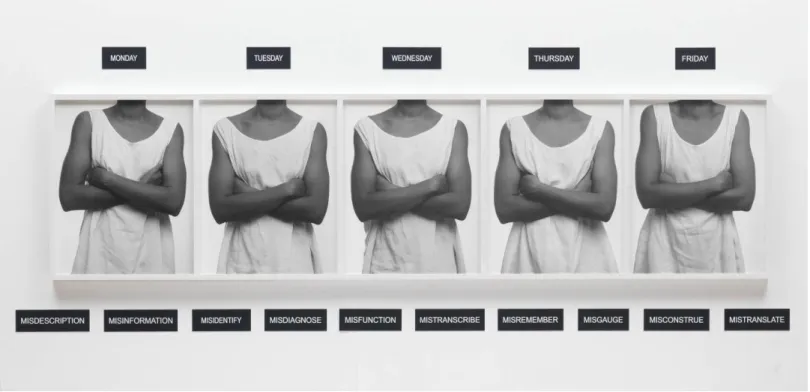
In contrast, Simpson’s 1988 Five Day Forecast (figure 2) is a work that purposefully confuses potential interpretative meanings in order to counter the idea that photography is a truthful representation of an individual or collective’s identity. While Lange’s work was easy to visually digest due to its clear print on silver gelatin, Simpson’s silver gelatin prints present a more confounding work of art that deliberately addresses the viewer’s notions and understand-ings of race. Five Day Forecast consists of five photographs of a black woman, dressed in a white shift. With her arms crossed tightly over her torso, her position shifts slightly in each of the five photographs. The photographs only depict the woman’s neck to the tops of her thighs, the engraved plastic plaques located above and below her functioning as substitutes for the rest of her body. Above each photograph is a plaque bearing the name of each weekday with “Monday” hovering over the left-most image and the fifth and final photograph culminating in “Friday.” If the plaques above the photos function as the figure’s head, the two engraved plaques located be-low each photograph are her legs. The plaques located bebe-low the photos in Five Day Forecast
begins with “mis,” such as “misdescription,” “misfunction,” “misremember,” and “misdiag-nose.” The reading of each word feels like a punch. By the time the viewer reaches the tenth and final plaque beneath the fifth photograph, the viewer understands why the figure crosses her arms around her torso so tightly: as a protection against the daily assault of these words.
Simpson’s incorporation of text and imagery is integral to her intent to disprove the truth-fulness of photography regarding its ability to portray identity. Allan Sekula cites the work of Martha Rosler, specifically her The Bowery in two inadequate descriptive systems as a work that utilizes text as an accompaniment to imagery as a way to “anchor, contradict, reinforce, subvert, complement, particularize, or go beyond the meanings offered by the images themselves.”49The Bowery consists of photographs of the Bowery landscape of streets and buildings placed next to words evoking drunkenness such as “wino” and “barrelhouse bum.” Thirteen years after Rosler created this seminal work, Simpson uses a similar method in Five Day Forecast to confuse the interpretation the photographs alone would offer. While the words serve a vital purpose in com-plicating the figure depicted in the five photos, the fragmentation present is the visual indicator by which the truth of the photograph is disrupted.
The fragmentation evident in Five Day Forecast is another visual tool Simpson employs to prove the false notion of photography as an authentic portrayal of identity. As previously dis-cussed, within Simpson’s work there are two types of fragmentation. In Five Day Forecast the fragmentation occurs in that the body is not represented holistically. Rather it is truncated so that only her torso is seen. Her head has been severed by the frame and her legs are similarly missing.
49 In Sekula’s estimation, Rosler’s The Bowery “comes the closest to unrelenting metacritical [emphasis in original]
in relation to the documentary genre.” The Bowery’s combination of text and photographs forces viewers to confront the “fundamentally flawed, distorted character” of representation. It is unknown whether or not Simpson was aware of Rosler’s work, but it reasonable to assume that during her studies at the School of Visual Arts and at the
The loss of vital parts of the body, such as the head, disrupts the viewer’s understanding of the body. Lange’s photo centers around the woman’s face. The vertical lapels of her sweater leads viewer’s eyes to the woman’s face, highlighted by her vibrant white hair wrap. By looking into the three-quarters turned face of the figure, general convention informs viewers that they know this woman and the truth of her life: that of a hard working former slave that lives in poverty. But in Five Day Forecast Simpson prevents this “knowing” from taking place. Through removing the face of the woman from the photograph, viewers are unable to stare into her eyes and make assumptions based on her the curve of her chin or the wrinkles in the corners of her eyes. By re-moving the face, Simpson takes away our most direct access point to this woman’s identity. Una-ble to determine her identity based on the features of her face, instead viewers are forced to scan the squirming bodies that compose the five photographs hoping for a physical clue to indicate who the woman featured is. Although viewers may seek for these identifying clues, the move-ments of the woman within the photographs evades their efforts.
Furthermore, the disruption of the viewer’s gaze caused by the fragmentation forces viewers to confront the ways in which photographs can be manipulated and thus falsely represent identity. In Ex Slave viewers look upon the woman unencumbered. The photo appears to have a minimal frame (if at all) and the photograph is crisp. In contrast, the fragmentation of the body in
of truth with which photography is so often associated. Disrupting the easy viewing experience of documentary photographs in the past, Simpson has shown us only a fragment of this woman’s body. This un-holistic body along with the text that borders the photographs force viewers to gaze upon this image in confusion rather than provide a definitive statement about black identity.
As discussed in last chapter, You’re Fine and Time Piece were works intended to demon-strate the societal and representational forces that have been used to convey identity. In Five Day Forecast Simpson again takes up this issue by directly referencing documentary photographs and their supposed function as the physical evidence of the camera man or woman’s experience. The fragmentation is a device that disrupts the viewer’s gaze and allows other interpretations to enter into the artwork. Preventing a definitive understanding from taking place, Simpson refutes the notion that a photograph is an accurate telling of an individual or collective’s identity.
Before Simpson purposely engaged with and refuted past notions of identity and photog-raphy, her early photography was primarily in the mode of documentary photogphotog-raphy, albeit a later iteration.50 Beginning in 1978, Simpson studied as an undergraduate at the School of Visual Arts in New York City. New York City, rife with documentary photography, influenced Simpson who absorbed aspects of this photographic practice. Okwui Enwezor argues that even as Simp-son followed the template of documentary photography by going into the streets and “document-ing” the lives of its inhabitants, she refused to portray clichés of the black urban life she
photo-graphed.51 Enwezor advocates that Simpson was aware of the "struggle for power, for control of
50 Like Lange, Simpson traveled across the United States (and Europe and North Africa) to take photographs in the
documentary style. Unlike Lange, Simpson was not interested in showcasing the poverty that black Americans faced whereas highlighting poor living and working conditions was central to Lange’s practice. Okwui
Enwezor, “Repetition and Differentiation –Lorna Simpson’s Iconography of the Racial Sublime,” in Lorna Simpson, (New York: Abrams, in association with the American Federation of Arts, 2006), 103.
representation” inherent in photography even as she first began taking photos.52 The struggle for power and control are themes that continued to be present in Simpson’s works even as she moved away from the more traditional documentary photography.53
Simpson’s photography shifted as she pursued her Masters of Fine Arts. Her graduate studies took place in San Diego, California necessitating a cross country move that provided ex-posure to new art forms.54 Whereas New York City was beset by documentary photography, San Diego was home to a strong contingent of performance artists. Simpson, already in doubt of the ability of documentary photography to portray the reality of an image as it was tied up with is-sues of representation and the personal biases of the photographer, became interested in “the temporal relationship between the performative act and the camera.”55 While in California, Simpson's photographs changed from being candid or semi-candid street shots of the documen-tary photography style to photographs captured in a studio. The transition from street to studio signified Simpson's desire to create staged representations fully under her control.56 An example of an image created within this context is Five Day Forecast whose ultimate meaning depends on altering the individual viewer’s understanding of the role photography can play in represent-ing identity.
As Simpson migrated away from documentary photography she continued to think about the representations of identity that documentary photography put forth. The fragmentation
52 Enwezor, “Repetition and Differentiation,” 105. 53 Ibid.
54 Enwezor, “Repetition and Differentiation,” 108.
55 Enwezor sees Simpson’s engagement with the temporal aspect of photography as a reflection of her doubt in
documentary photography and its ability to convey truth. Enwezor, “Repetition and Differentiation,” 108-9.
56 In order to adequately display the inaccuracies of documentary photography Enwezor posits that Simpson had no
sent in Five Day Forecast and other works from this time are a direct reflection of Simpson’s im-pulse to create work, within the context of the studio that comments on both the faulty methods by which photography conveys identity and the societal forces that continue to shape identity. Scientific photographers of the nineteenth century were also interested in using photography to portray societal conceptions of identity. In their case, however, their notions of identity centered on the inferiority of enslaved black Americans based on the pseudo-science of physiognomy and phrenology.
Scientific photography was used to portray and perpetuate stereotypes based on the false physiognomic claims of marginalized peoples. While throughout the world scientific photog-raphy focused on different populations, in America the effort honed in on enslaved black men and women. The fragmentation present in Twenty Questions (1986)(figure 3)simultaneously complicates a viewer’s comprehension of the figure in the work by disrupting their gaze while also negating the conventions of scientific photography. The fragmentation enables Simpson to reference these conventions but have them serve a different purpose: portray the agency and sub-jectivity of the figures deprived of them by the racist motivations of the early photographers. Simpson is careful in how she accomplishes this depiction of self-determination. Integral to Simpson’s process is the limited access viewers have to the figure’s body. The fragmentation ev-ident in these works is the main visual strategy that accomplishes this limitation. Twenty
at Simpson’s oeuvre from this time makes even an experienced Simpson supporter question whether it is truly the same image.
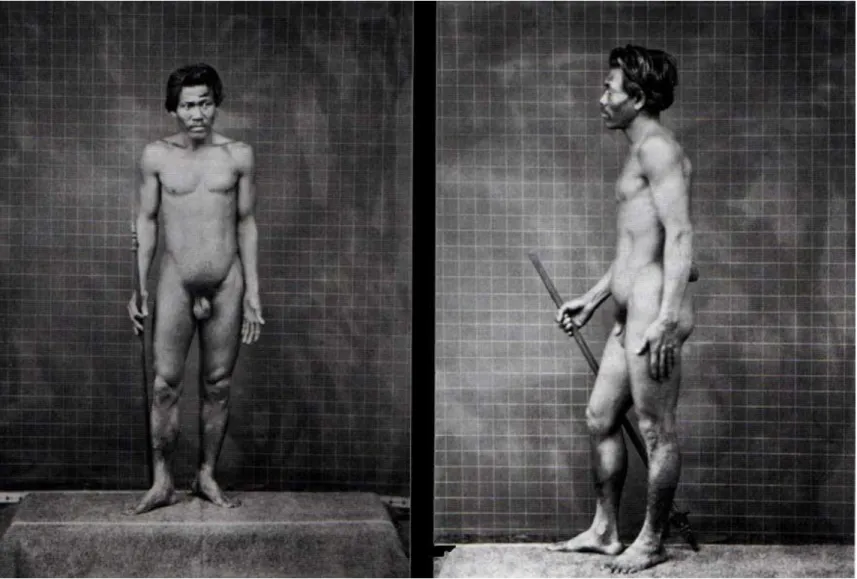
Also not unlike Five Day Forecast, which references documentary photographs of the past, Simpson’s staging of the figure in Twenty Questions recalls the work of J.T. Zealy, a da-guerreotypist working in the nineteenth century. Specifically a connection between Twenty Questions and Zealy’s daguerreotype of Delia (figure 4), an enslaved woman, is seen. Zealy was a local daguerreotypist working in Columbia, South Carolina where the Harvard scientist Louis Agassiz visited to find different types of African slaves to document for his ethnographic re-search with Samuel Morton.57 Zealy was not chosen for his artistic skill, but because of his
prox-imity to the location of the enslaved men and women that Agassiz chose. Truthfully, it has only been recently that daguerreotypists are considered artists at all.58 In 1850 daguerreotypists were as uninvolved in the photographic process as much as was possible. Brian Wallis explains that it was the hands-off approach of the daguerreotype that contributed significantly to the medium’s close association with the truth as the resulting images were considered miniature versions of re-ality because the images was highly detailed.59 The daguerreotype along with its counterpart, the stereotype, which were photographic molds able to produce multiple copies, were the two domi-nant forms of representation and worked neatly to reinforce the ethnographic assertions of Agas-siz and Morton. The stereotypes and denigrating imagery of blackness that continues to exist to-day were established by the collapse between the specificity of the daguerreotype and the “type” that the stereotype disseminated.60 The typological photographs, such as the ones Zealy created for Agassiz, were considered by the general American public to be “self-evident, to speak for themselves, and at the same time be generic” and thus taken as truth.61
57 Brian Wallis, “Black Bodies, White Science, Louis Agassiz’s Slave Daguerreotypes” American Art 9 (1995):40 58 For full quote on the transition of daguerreotypist from anonymous camera man to artist see Wallis, “Black
Bodies,” 40.
59 During the nineteenth century daguerreotypes were associated with truth because of their preciseness and ability
to convey details of the sitter or object photographed. Wallis, “Black Bodies,” 48.
One such Zealy daguerreotype is that of Delia, an enslaved woman from a slave planta-tion around Columbia. Forcibly made to display her breasts with her clothes pooling in her lap, Delia is spotlighted in Zealy’s studio space. The harsh light invasively exposes the contours of Delia’s face and body amidst a dark neutral background. For Aggasiz, Zealy’s daguerreotypes fulfilled the ethnological function he intended: to prove polygenesis and the physiognomic sci-ence that sought to “understand connections between different human groups as well as the inner workings of the mind and spirit.”62 The curve of Delia’s forehead and the angle of her jaw were
used as proof for polygenesis, the pseudo-scientific claim that Africans, and other people of color, descended from an origin different than Adam and Eve. In arguing why Zealy’s daguerre-otypes cannot be considered portraits, Wallis states that the emphasis on the bodies in Zealy’s work “occurs at the expense of speech; the subject is already positioned, known, owned, repre-sented, spoken for, or constructed as silent; in short, it is ignored.”63 Wallis’s description of
De-lia’s muteness explains what makes the fragmentation and the use of text in Simpson’s work so powerful.
Rather than a frontal depiction of the woman in Twenty Questions, Simpson photographs her from the back. What is normally a position of exposure and vulnerability (because the figure is unaware of the viewer’s intrusive gaze) is transformed in Twenty Questions into a position of strength. Simpson only grants us the back of the figure’s head, our access to her face refused and our access to the rest of her body impossible because Simpson has fragmented it so severely. The fragmentation of the body plays a crucial role in understanding what Simpson is trying to
62 Ibid.
63 As much as Wallis sees the loss of speech and self-representation in Agassiz’s daguerreotypes, he also recognizes
convey about the systems that create black identity and representations of identity in the past. By limiting our view of her body onlookers are denied the ability to traverse the landscape of her body in order to make assumptions and decisions about her. Instead, Simpson uses the severed body as well as the words below the images to simply hint at what viewers perceive might be as-pects of this woman’s identity. The plaques’ wording forces viewers to confront their expecta-tions and assumpexpecta-tions of this woman. By simply looking at the photographs does one character-ize her skin as “black as coal” or think of her white shift as granting her purity like that of a lily flower? These taunting words strip viewers of their assumptions. The images demand that while viewers may be able to see part of her body it does not follow that her true identity is discernible. The fragmentation in Twenty Questions and in other similar works acts as a visual metaphor: in the same way that viewers do not have access to the rest of this woman’s body because it is seg-mented by the sharp curve of the cropped photograph, so too do viewers not have access to this woman’s identity nor should they even consider that they do.
looms large even centuries later. As Lorraine O’Grady documents, black women today contend with the “otherness” that these men’s work thrust upon them. In locker rooms before and after swim practice, O’Grady informs, some black women refuse to get fully naked perhaps because “they must still protect themselves from the centuries-long assault which characterizes them.”64
Historian Darlene Clark suggests that due to the persistent and negative types of black female sexuality, black women often choose invisibility, where internally they can determine their own sexuality, rather than attempt to change the societal perception because they knew they do not possess the power or resources to do so.65 The figure in Twenty Questions is far from invisible but her body is protected and sheltered by the fragmentation that allows only the back of her head and her shoulders to be seen. Simpson’s limitation of the body through fragmentation refer-ences the ways that black women contend with the ongoing impact of these assaults while also preventing moments of objectification and subsequent judgement that defined representation of female blackness in the past.
Long characterized as a refusal to reveal her identity, the figure in Twenty Questions
faces away from the camera. This act of defiance through denying access to her face, can be seen as the establishment of an independent gaze similar to that seen in You’re Fine. The refusal, however, is also a further measure that prevents assumptions regarding her identity from being formulated. The lack of access to her face renders viewers unable to recognize her on the street as it would be impossible to identify her solely by the slope of her shoulders. Our conception of
64 Lorraine O’Grady, “Olympia’s Maid: Reclaiming Black Female Subjectivity,” in New Feminist Criticism: Art: Identity, Action, 153. New York: Harper Collins, 1991.
65 The invisibility of black women Clack suggests is not indicative of their refusal to engage with the negative
identifying someone based on their face stems from Alphonse Bertillon. Beginning in 1882, Ber-tillon established a system of classification of Parisian criminals “centered on the anthropometric measurement of criminals.”66 Criminals were posed in a manner now familiar. Two photographs were included in each criminal file in Bertillon’s system. One was of the criminal facing frontal towards the camera and the second a photograph of the individual’s profile. These photographs were so crucial to apprehending a criminal in nineteenth-century Paris that Josh Ellenbogen re-fers to these images as “identity portraits.”67 Bertillon’s system attempted to take the visual and
tactile impression of the world that govern our existence and transform them into easily under-stood data.68 Bertillon’s classification structure became a widely used method within the prison system but had far reaching implications outside of it. Due to the work of Agassiz and Bertillon the face became central to notions of discerning identity within marginalized individuals. Thus, Simpson’s refusal to show the woman’s face in Twenty Questions is a powerful message that re-buffs the typical classification structures of the past in order to prevent such assumptions of iden-tity from taking place.
Reinforcing this notion that Simpson refuses to grant her figures a single identity is ref-erenced directly in parenthetical in the centered plaque above the photographs: “(A Sampler).”
Belisle explains that a sampler is a “model of sewing or quilting in which various styles were demonstrated within one framework.”69 The use of the word “sampler” alludes to the variety of descriptors that could possibly be used to describe the woman in Twenty Questions. The plaques
66 Josh Ellenbogen, Reasoned and Unreasoned Images: The Photography of Bertillon, Galton, and Marey
(Univer-sity Park: The Pennsylvania State Univer(Univer-sity Press, 2008), 30.
67 Ellenbogen, Reasoned and Unreasoned Images, 32.
68 Bertillon’s conception of identity is one that negates entirely the embodied experience. He did not care about the
“everyday visual or tactile” experience in the world but rather on the ways the body is quantifiable. Ellenbogen,
Reasoned and Unreasoned Images, 53.
69 Brooke Belisle, “Felt Surface, Visible Image: Lorna Simpson’s Photography and the Embodiment of
serve as captions to the images they are placed beneath “suggest[ing] the images could correlate with different identities.”70 While this definitely references the various assumptions made about
black women, it also comments on the nature of photography to represent identity in general. The pairing of different texts with each image forces viewers to consider how each representa-tion of identity is just a copy of something that has already been created.71 Even after Simpson deprives us of the figure's face and thus negates our ability to construct this woman's identity that way, the lure of photography may still be too tempting. For so long photography has been
equated with truth, something Zealy's daguerreotypes of enslaved individuals both played on and perpetuated. Even as Simpson tries to dissolve this association in Twenty Questions many may still too easily believe they know this woman because she is represented as a photograph. But Simpson again anticipates this potential reading and thwarts it by repeating the same photograph four times. In doing so, she forces viewers to confront the truth that each photo, a supposed rep-resentation of an individual and their identity, is nothing more than a copy. Our potential grasp-ing of this woman's identity is undermined when it is realized that it is impossible to tell which photograph to determine the truth between the images. Which of the four photographs was the original? Does the original photograph make it the truest representation of the woman?
Wrestling with these questions accomplishes Simpson's goal of forcing her viewers to recognize and confront the inability of photography to represent truth or identity fully. Each pho-tograph in Twenty Questions is laden with a myriad of potential interpretations as intended through the fragmentation and plaques. In works like Five Day Forecast and Twenty Questions
70 In Belisle’s estimation the interaction of the text along with the photographs indicate that each of the four
photo-graphs is already a copy, providing further commentary on the falseness of representing identity. Ibid.
Chapter 2 Illustrations
Chapter 2 Illustrations
Figure 2: Lorna Simpson, Five Day Forecast, 1988, 5 silver gelatin prints, in one frame, 15 en-graved plastic plaques, 20 x 24 inches.
Chapter 2 Illustrations
Chapter 2 Illustrations
Chapter 3: The Grid as Boundary and Fragmenting Force
This thesis, thus far, has analyzed two facets of Lorna Simpson’s use of fragmentation in her early works of the 1980s and 1990s. What has not been evaluated up until this point is the visual mechanism by which this fragmentation of the figures is reinforced. Approaching the frag-mentation as that which is created by the visual tool of a gridded framing system inserts new meanings into Simpson’s work. As previously mentioned, the fragmentation is implemented in two steps in Simpson’s artistic process. The first step takes place in Simpson’s studio where she photographs her models. With her camera, Simpson fragments the body of the figure by photo-graphing it in sections. The fragmentation occurs at this point in her artistic process because many of the works discussed in this chapter, such as Guarded Conditions and Landscape, con-tain Polaroid photographs. By virtue of being a Polaroid the image is unable to be manipulated in the dark room as it is printed immediately after the photograph has been taken. The second as-pect of fragmentation occurs when Simpson inserts the printed photographs into frames. The frames, typically black or wooden, are not just the way Simpson presents her finished photo-graphs, but are integral in reinforcing the fragmentation of the bodies featured.