Abstract
Introduction.Pharmacy Practice Management (PHCY 434) is a required course at the UNC Eshelman School of Pharmacy. As part of the class, students partner with sponsors from around the state to design a business plan that satisfies a need at the site with which the sponsor is employed. This study seeks to determine the impact of these business plan projects on the advancement of pharmacy services in North Carolina.
Methods. A survey using the Qualtrics platform was sent electronically to the sponsors that participated
in the PHCY 434 business plan projects from 2012 – 2016. The number of plans sponsored during this time period was 102. The survey was sent to a total of 59 sponsors at 22 sites, with a unique survey link sent for each business plan with which they were involved. The survey remained open for 2 months, with reminder emails sent every 2 weeks.
Results. After 2 months, 35 responses were received from 26 sponsors at 12 unique sites in North
Carolina for a sponsor participation rate of 44% (26/59) and am overall response rate of 34% (35/102). Of these plans, 43% (15/35) were implemented and 57% (20/35) were not. The majority 71% (25/35) were in the hospital setting. Respondents either strongly agreed or agreed that 73% (8/11) of plans would have taken longer to implement if it had not been for their participation with the PHCY 434 project, with an estimated time saved of 10.2 months. These same respondents either strongly agreed or agreed that 82% (9/11) of plans would have been implemented whether or not they participated with the business plan project. Regarding plans that were not implemented, 65% (13/20) of sponsors either strongly agreed or agreed that the business plan project increased the likelihood of the plans being implemented. Asked if PHCY 434 played a positive role in advancing pharmacy services at their sites, 86% (25/29) of participants either strongly agreed or agreed.
Discussion/Conclusion. The PHCY 434 business plan project saved time for the sites that implemented
their business plans and increased the likelihood of plan implementation for the sites that did not implement a business plan. Overall, Pharmacy Practice Management (PHCY 434) has had a positive impact on advancing pharmacy services at the North Carolina sites in which it has partnered.
Introduction
of achieving definite outcomes that improve a patient’s quality of life.”1 This definition continues to provide the backbone for the American Pharmacy Association’s (APhA) vision and mission for the pharmacy profession,2 as well as other professional pharmacy associations. The role pharmacists play in improving patient care will continue to evolve as healthcare transitions from a fee-for-service to a value-driven model. In this setting of change, the development of new pharmacy services becomes
increasingly vital.
In order to successfully implement new services, management skills and the ability to design a viable business plan are crucial. Unfortunately, pharmacy students are not traditionally trained to develop this skillset and many show low baseline knowledge of business management topics.3 Without the proper training, the implementation of novel services becomes more difficult to execute. Pharmacy business classes can help to solve this problem. One study showed the value of requiring students to work together with a pharmacy manager to develop business plans for implementing a new patient care service. This project significantly improved their perception of their ability to perform the functions necessary for developing a business plan.4 In another class, the incorporation of a business management simulation exercise improved students’ knowledge and understanding of business management topics.5
Courses in the pharmacy curriculum focused on developing management skills appear to be successful in improving managerial skills.3,6
The UNC Eshelman School of Pharmacy includes a mandatory business class as part of its curriculum: Pharmacy Practice Management (PHCY 434). The course is designed to teach fundamental principles of pharmacy practice management, as well as more in depth learning in one of two
concentration areas: (1) services in the community pharmacy setting or (2) services in the health-system setting. Grades in the class are structured as follows: assignments (25%), business plan project (45%), peer evaluation (10%), and final exam (20%). In class instruction includes lectures on how to develop each portion of the business plan to help guide students through the project. The differentiating aspect of the class is that it solicits current needs from hospitals and community pharmacies throughout the state and then partners these businesses with student teams from the UNC Eshelman School of Pharmacy to write the requested business plans.
the main components of planning and developing a new clinical service, including strategic planning, needs assessment and market analysis, financial planning, marketing fundamentals, implementation, and quality assessment.
Business fundamentals including management principles, innovation, and entrepreneurship are required as part of the curriculum per the Accreditation Council for Pharmacy Education (ACPE)7, thus all pharmacy students get exposure to these topics. However, the application to real world settings
provided by PHCY 434 increases the opportunity for affecting real change. In a health system that is constantly evolving, the implementation of new services is paramount to the continued success of the pharmacy profession. Teaching students to create a business plan benefits both the students as future professionals and the profession as a whole by providing them with the abilities necessary to be adaptable within the dynamic world of healthcare. Additionally, PHCY 434 may have an additional impact on the pharmacy profession by promoting the advancement of pharmacy services through the business plan project. The effect of a pharmacy business course on advancing pharmacy services has not been studied. This study aims to discover the impact of PHCY 434 on advancing pharmacy services in North Carolina. Secondarily, the study seeks to further evaluate what types of business plans have been created in PHCY 434.
Methodology
Design
This is an exploratory study with both qualitative and quantitative methodologies. The survey contained 17 total items with a variety of question types, including demographic, dichotomous, open-ended, and five point Likert scale questions. The survey remained open for 2 months, with completion reminders sent in 2 week intervals.
Methods
implemented business plans from PHCY 434 can be determined, along with any potential barriers to the plans being pursued.
A list of six questions exists specifically for the participants that implemented the service described in the business plan. The first two of these questions asks for the year and the quarter when the service was implemented. This makes it possible to determine how long it took between the
development of the business plan and the implementation of the service, as the semester each plan was developed is already known. The remaining questions target how useful PHCY 434 was in the
implementation of the service, i.e. was the service able to be implemented more quickly because of the class and would the service have been implemented at all without the site’s participation in the business plan project. If the respondent answered that the site has not implemented the service, then the survey asks if they have any plans to do so in the future and when.
The remaining questions were posed to all survey participants, regardless of whether or not the site has implemented the service described in the business plan. The survey asks if participation with the course improved the likelihood of the service being implemented at their site. A follow up question asks what percentage from 0% - 100% did the class improve the likelihood of service implementation, with 0% being not at all and 100% meaning the class was fully responsible. The survey posed three more questions that seek to determine the value of the class as a whole. These asked if PHCY 434 played a positive role in advancing services at the participants’ sites, if the PHCY 434 projects are valuable to the
site, and if the sites desire to continue participating in the class. Taken altogether, this survey can thoroughly answer both the primary and secondary research questions.
Survey of Business Plans from Pharmacy Practice Management (PHCY 434)
What would you describe as the focus of the site at which this business plan was proposed? [ ] Hospital [ ] Community [ ] Ambulatory Care [ ] Other: ______________________________
Was the service described in the plan implemented at your site? (Note: for the purposes of this survey the word ‘service’ will also refer to a pharmacy position that was proposed by a business plan. If the
plan was not a proposal for the implementation of a service or a pharmacy position, but rather an evaluation of the need for a service or pharmacy position, then answer whether or not this evaluation led to a service or pharmacy position being proposed.)
If yes: Why was the service implemented?
___________________________________________________________________________________ ___________________________________________________________________________________ ___________________________________________________________________________________
If yes: What year was the service implemented?
Year: ______
In which quarter was the service implemented?
First Quarter Second Quarter Third Quarter Fourth Quarter
If yes: This service would have taken longer to implement if the site had not participated in the PHCY
434 project.
Strongly Disagree Disagree Neutral Agree Strongly Agree
Approximately how much longer (please specify if your answer is in months, years, etc.): __________
If yes: The service described above would have been implemented whether this site participated in
the PHCY 434 project or not.
Strongly Disagree Disagree Neutral Agree Strongly Agree
If yes: The PHCY 434 business plan project was useful in the implementation of the service.
Strongly Disagree Disagree Neutral Agree Strongly Agree
If no: Why was the service not implemented?
___________________________________________________________________________________ ___________________________________________________________________________________ ___________________________________________________________________________________
If no: Are there plans to implement the service in the future?
Yes/No
The PHCY 434 project improved the likelihood of this service being implemented. Strongly Disagree Disagree Neutral Agree Strongly Agree
How much did PHCY 434 increase the likelihood of the service being implemented (from 0% - 100%, with 0% being PHCY 434 played no role and 100% being PHCY 434 was entirely responsible)? _____________
PHCY 434 has played a positive role in advancing the pharmacy services at this site. Strongly Disagree Disagree Neutral Agree Strongly Agree
This business plan project was valuable to the site.
Strongly Disagree Disagree Neutral Agree Strongly Agree
This site would like to continue to participate in the class.
Strongly Disagree Disagree Neutral Agree Strongly Agree Unsure
Figure 1. Survey of sites that participated in the PHCY 434 business plan projects from 2011 – 2016
Results
After remaining open for 2 months, 35 responses were received from 26 sponsors at 12 unique sites in North Carolina for a sponsor participation rate of 44% (26/59) and an overall response rate of 34% (35/102), though participation varied by question. Each response pertains to 1 business plan.
Participants were asked to answer whether or not a business plan project they sponsored as part of a pharmacy business class at the UNC Eshelman School of Pharmacy was implemented at their sites. They were then asked follow up questions based on whether or not the business plan was used at their site to determine the impact the class had on the advancement of pharmacy services.
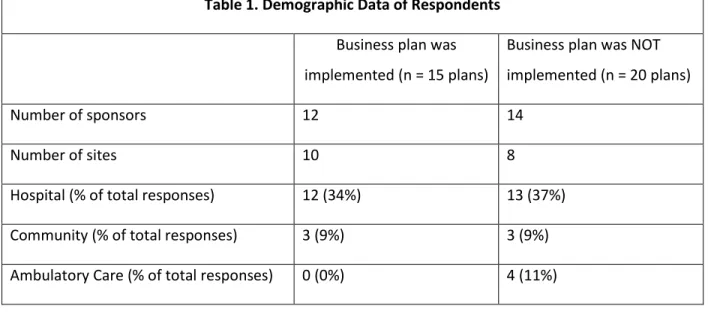
Table 1. Demographic Data of Respondents
Business plan was implemented (n = 15 plans)
Business plan was NOT implemented (n = 20 plans)
Number of sponsors 12 14
Number of sites 10 8
Hospital (% of total responses) 12 (34%) 13 (37%)
Community (% of total responses) 3 (9%) 3 (9%)
Ambulatory Care (% of total responses) 0 (0%) 4 (11%)
A further break down for the 12 plans that were implemented in the hospital setting reveals the following types of plans: 2 focused on residency programs (1 focusing on expanding an existing program and 1 creating a new program; 2 separate health systems), 2 focused on expanding transitions of care services (2 separate health systems), 2 plans expanded ambulatory care services (1 focusing on oncology and 1 on transplant services; 2 separate health systems), 1 plan established an outpatient infusion area, 2 plans expanded educational opportunities for students and residents (1 for first and second year pharmacy students and 1 for pharmacy residents; same health system), 1 plan implemented a
chemotherapy robot in an oncology pharmacy, 1 created a 24 hour pediatric satellite and service line, and 1 utilized students and residents to expand CE opportunities.
The 3 plans implemented in the community setting focused on the development of an effective and profitable MTM workflow, the initiation of pharmacy services at a holistic clinic, and a new store location.
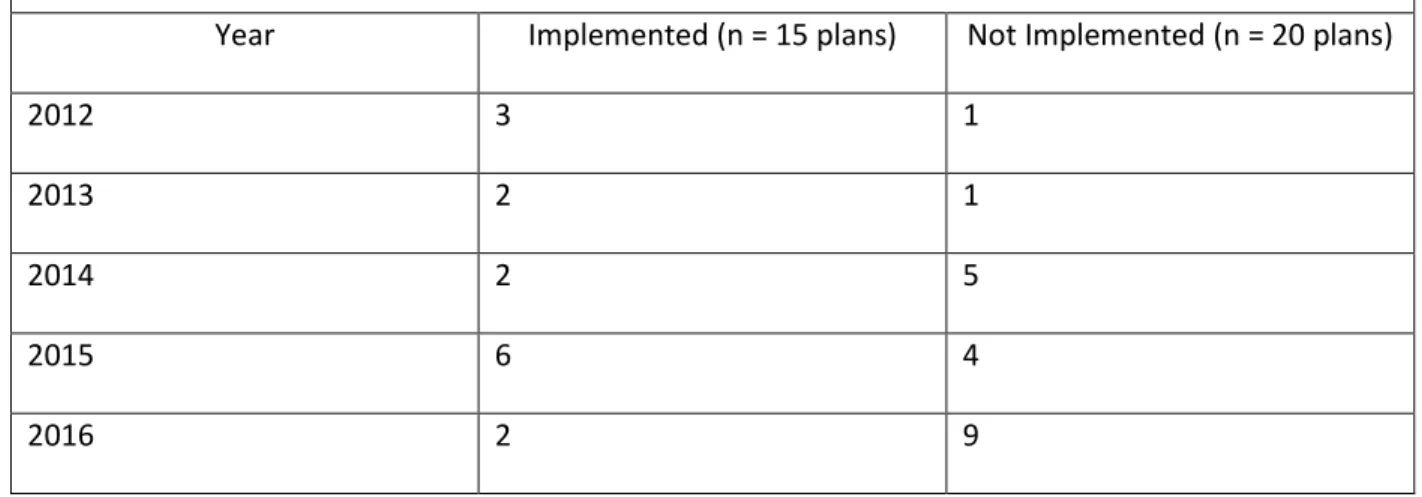
Table 2. Year of Development of Implemented vs Non-Implemented Plans
Year Implemented (n = 15 plans) Not Implemented (n = 20 plans)
2012 3 1
2013 2 1
2014 2 5
2015 6 4
2016 2 9
Of the 15 business plans that were implemented, 4 do not have any additional data, as these participants did not finish the survey. Regarding the 11 implemented plans for which additional data exists, Table 3 details the reasons that the business plans were implemented. The most common reason cited for implementation was a need within the department or business.
Table 3. Reasons for Business Plan Implementation
- Value to leadership
- It was seen as an opportunity for our department - There was a need
- Unmet pharmacy need in the clinic setting - Improve community academic partnerships - Tactic to reduce inpatient readmissions
- Identified need with closure of ambulatory infusion center - Need for medication histories to be owned by pharmacy - For increased clinical pharmacy service revenue
- Expansion
- It was decided to implement this service prior to submitting plan
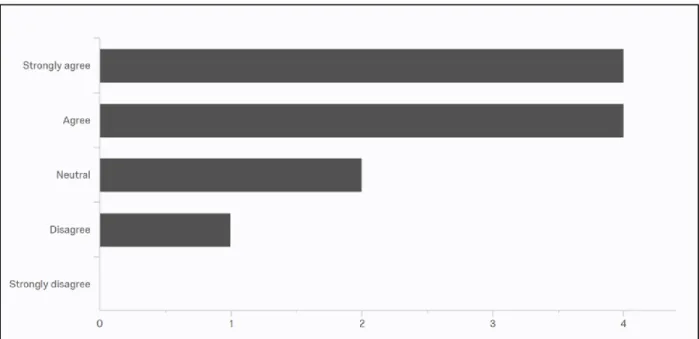
implement if it had not been for their participation with the PHCY 434 project (Figure 2). Only 5 respondents had an exact estimate for how much longer the implementation of the plan would have taken without participation in the project. On average they estimated that it would have taken 10.2 months longer. A sixth participant estimated that it would have taken “years” longer.
Figure 2. Survey Question: This service would have taken longer to implement if the site had not participated in the PHCY 434 project.
Respondents either strongly agreed or agreed that 82% (9/11) of plans would have been implemented whether or not they participated with the business plan project (Figure 3). The same number either strongly agreed or agreed that the business plan project was useful in the
implementation of the service.
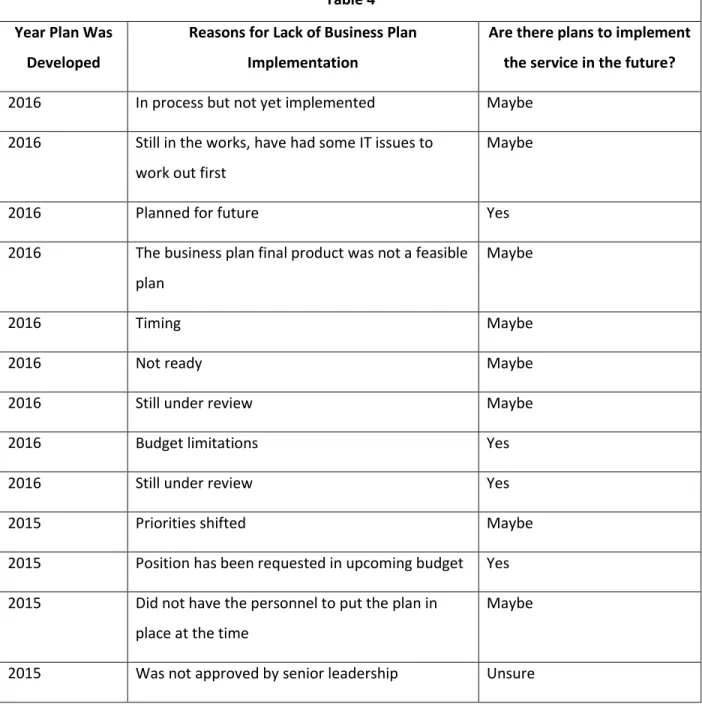
The reasons that 20 business plans were not implemented are listed in Table 4, along with the answer to whether or not there are plans to implement the service in the future and the year each plan was developed.
Table 4
Year Plan Was
Developed
Reasons for Lack of Business Plan
Implementation
Are there plans to implement
the service in the future?
2016 In process but not yet implemented Maybe
2016 Still in the works, have had some IT issues to work out first
Maybe
2016 Planned for future Yes
2016 The business plan final product was not a feasible plan
Maybe
2016 Timing Maybe
2016 Not ready Maybe
2016 Still under review Maybe
2016 Budget limitations Yes
2016 Still under review Yes
2015 Priorities shifted Maybe
2015 Position has been requested in upcoming budget Yes 2015 Did not have the personnel to put the plan in
place at the time
Maybe
2014 BOP regulations Yes 2014 Need for service changed and does fit model of
the plan
Yes
2014 Capital not approved Yes
2014 The concept didn't fit the needs of the department as we would have had to hire another provider. Environment was not conducive to additional hires at the time
Unsure
2013 Other competing projects took precedence for the available funds. Decided to try another approach of spoke and hub model which continues to be under development
Maybe
2012 Not ultimately part of our strategic plan No
Of these 20 plans, participants indicated that 35% (7/20) will be implemented in the future, 50% (10/20) may be implemented, 5% (1/20) will not be, and 10% (2/10) of respondents were unsure. Answers indicate that 65% (13/20) of sponsors for these 20 plans either strongly agreed or agreed that the business plan project increased the likelihood of the plans being implemented. Out of these respondents 14 had an estimate for approximately how long it would be before plan implementation. The average was 1.7 years.
Including the plans that were implemented, 67% (20/30) respondents either strongly agreed or agreed that the project improve the likelihood of the plan being implemented, while 27% (8/30) were neutral, 3% (1/30) disagreed, and 3% (1/30) strongly disagreed. As a follow up to this question, 28 respondents gave an estimate of how much the PHCY 434 project increased the likelihood of service implementation, with 0% meaning the class did not increase the likelihood and all and 100% meaning the class was entirely responsible. On average, the class increased the likelihood of service
implementation by 43%. Out of the 11 business plans in this sample that were implemented, the project increased the likelihood of their implementation by 52%. Out of the 17 plans that were not
The remaining 3 questions had data for 29 plans. Asked if PHCY 434 played a positive role in advancing pharmacy services at their sites, 86% (25/29) of participants either strongly agreed or agreed. (Figure 4). The same percentage either strongly agreed or agreed that the business plan project was valuable to the site. Answers indicated that 90% (26/29) would like to continue to participate in the class, while 3% (1/29) was neutral and 7% (2/29) were unsure.
Figure 4. PHCY 434 has played a positive role in advancing the pharmacy services at this site.
Discussion
The effect that a pharmacy business class has on advancing pharmacy services in North Carolina has not been studied. The analysis presented here suggests that Pharmacy Practice Management has had a positive impact on advancing pharmacy services at the sites with which it has participated.
It is noteworthy that that 82% (9/11) of plans would have been used at the sites whether the site participated with PHCY 434 or not. This suggests that the primary value of the class was in
expediting the amount of time it took for each site to implement a plan, rather than allowing the site to develop a service it would not have otherwise established. Sponsors of 11 implemented plans indicated that PCHY 434 increase likelihood of plan implementation by 52%, suggesting that the class, while not entirely responsible for new services being established, did play a major role.
Additionally, of the plans that were not used 35% (7/20) will be in the future and 50% (10/20) may be. A review of Table 4 shows that only 1 of these plans will definitively not be implemented. Some of the more common barriers to plan implementation were funding, timing, and a shift in priorities. Nearly half (9/20) of business plans not implemented were developed in 2016, so practically many have not yet had the time to be enacted. If these plans were to be excluded from the results then the total number of implemented plans becomes 58% (15/26).
Out of the 20 plans not implemented, the PHCY 434 project increased the likelihood of 65% (13/20) of them being implemented, suggesting that the class still had utility to the sites that did not implement the business plan. This claim is further supported by the 86% (25/29) of participants who either strongly agreed or agreed both that the class played a valuable role in advancing pharmacy services at their site and that the business plan project was valuable to the site.
The major limitations of this study are the small sample size and the drop out of some
Conclusion
The PHCY 434 business plan project saved time for the sites that implemented their business plans and increased the likelihood of plan implementation for the sites that did not implement a business plan. Overall, Pharmacy Practice Management has had a positive impact on advancing pharmacy services at the North Carolina sites in which it has partnered.
References
1. Hepler CD, Strand LM. Opportunities and responsibilities in pharmaceutical care. Am J Hosp Pharm. 1990;47:533-543.
2. Vision and Mission for the Pharmacy Profession. APhA website.
http://www.pharmacist.com/vision-and-mission-pharmacy-profession. Accessed October 22, 2016.
3. Rollins BL, Broedel-Zaugg K, Reiselman J, Sullivan D. Assessment of pharmacy students' perceived business management knowledge: Would exclusion of business management topics be detrimental to pharmacy curricula? Currents in Pharmacy Teaching and Learning.
2012;4(3):197–201.
4. Hicks C, Siganga W, Shah B. Enhancing Pharmacy Student Business Management Skills by Collaborating With Pharmacy Managers to Implement Pharmaceutical Care Services. Am J Pharm Educ. 2004;68(4):1-7.
5. Rollins BL, Gunturi R, Sullivan D. A Pharmacy Business Management Simulation Exercise as a Practical Application of Business Management Material and Principles. Am J Pharm Educ. 2014;78(3):1-6.
6. Latif D. A Management Skills Course for Pharmacy Students. Am J Pharm Educ. 2004;68(1):1-10. 7. Accreditation Standards and Key Elements for the Professional Program in Pharmacy Leading to