Ambulatory Eye Injuries in the Active Duty Military
By
Grace Lea Y. Dumayas-Booth, O.D., F.A.A.O.
A Master’s Paper submitted to the faculty of the University of North Carolina at Chapel Hill
in partial fulfillment of the requirements for degree of Master of Public Health in the Public Health Leadership Program
Chapel Hill Spring 2019
Approved by:
_____________________________________
_____________________________________ Date _____________________________________
ABSTRACT
Grace Lea Y. Dumayas-Booth: Ambulatory Eye Injuries in the Active Duty Military (Under the Direction of Lori Evarts)
The DoD Eye Injury Summary from 2000 to 2017 had a total of 278,182 Ambulatory All Diagnoses (AD) classified injuries with a rate ranging from 8.95 – 12.77 per 1,000 person-years among active duty SMs. The overwhelming types of injuries were classified as superficial, meaning abrasions and external foreign bodies. Females had a higher rate of injuries between 2005 and 2013. Age range most affected were the 40 years and above in both enlisted and officer’s rank. The occupation most affected among enlisted were those working in
construction and craftwork. The occupational category most affected among officers were those in general/flag/executive positions. Overall, the Coast Guard was the branch affected most in both enlisted and officer ranks, however, the Navy eye injury rate peaked between 2002 and 2006 within the subset of officers. Among the sources of injuries, most came from “other or unknown” category. The rates were highest in 2006 and began to decrease until 2014, where the rates began to climb again. Preventable eye injuries in non-military facilities are declining, however, active duty military eye injuries are beginning to rise again. Ambulatory eye injuries in the active duty community occur despite complete fielding of eye protection and posters, cards and flyers for eye protection education. Three new approaches have been recommended and could be piloted to determine efficacy in reducing eye injuries: a quasi-experimental study using two untreated control groups with dependent pre- and post-test using switching replications, an incentive for garrisons and individual and equal access.
ACKNOWLEDGMENTS
TABLE OF CONTENTS
List of Tables ……….. 5
List of Figures ……… 6
List of Abbreviations ……….. 7
Introduction ………. 10
Background ……….. 11
Discussion ……….. 33
Recommendations for Military and Public Health Leaders ………..……….. 47
Proposed Study ………. 48
Incentive ……… 51
Equal Access ……… 52
Conclusion ……….. 53
References ………. 55
LIST OF TABLES
Table 1: Active duty demographics ………. 20 Table 2: Eye injury category, description and ICD-9-CM ……….. 21 Table 3: Eye injury source and type of visits ……….
Table 4: Eye injury category, description and ICD-10-CM ………
22 23 Table 5: Ambulatory All Diagnoses with high eye injury rate 2000-2017………..
Table 6: Contact lens-induced injury by garrison and branch of service ………..
LIST OF FIGURES
Figure 1: Ocular Anatomy ……….…. 13
Figure 2: Birmingham Eye Trauma Terminology System classification .………. 14
Figure 3: Ballistic Laser Protective System (BLPS) ………. 31
Figure 4: Special Protective Eyewear Cylindrical System (SPECS) ……… 31
Figure 5: Approved Protective Eyewear List (APEL) ………. 32
Figure 6: Active duty military population in 2017 ……….……….………….. 33
Figure 7: DoD Ambulatory All Diagnoses Eye Injury Count for 2000-2017 ………….. 34
Figure 8: DoD Ambulatory All Diagnoses Eye Injury Rate for 2000-2017 ………. 35
Figure 9: 5A and 5AM Standard military optical frame ….………….……….………. 45
Figure 10: Sample set of FOC frames ………..……….………. 45
LIST OF ABBREVIATIONS
AD All Diagnoses
AFHSC Armed Forces Health Surveillance Center ANSI American National Standards Institute APEL Approved Protective Eyewear List
ASTM American Society of Testing and Materials BETT Birmingham Eye Trauma Terminology BLPS Ballistic Laser Protective System
BLSSII Bureau of Labor Statistics’ Survey of Injuries and Illnesses BRFSS Behavioral Risk Factor Surveillance System
CBPM Community-Based Preventive Marketing
CHW Community Health Worker
CM Clinical Modification
CP Consumer Product
CPSC CPT
Consumer Product Safety Commission Current Procedural Terminology
DAFW Days Away From Work
DHS DMSS
Department of Homeland Security Defense Medical Surveillance Summary
DoD Department of Defense
FOC GWOT
Frame of Choice
Global War on Terrorism HBM Health Belief Model
ICD International Classification of Disease IEDs Improvised Explosive Devices
IHPS Integrated Head Protection System ISHN Industrial Safety and Hygiene News MCEP Military Combat Eye Protection MSMR Medical Surveillance Monthly Report MTF Military Treatment Facility
NAMCS National Ambulatory Medical Care Survey NEDS Nationwide Emergency Department Sample NEISS National Electronic Injury Surveillance System NHAMCS
NHCS
National Hospital Ambulatory Medical Care Survey National Hospital Care Survey
NHDS National Hospital Discharge Survey NHIS National Health Interview Survey
NIOSH National Institute for Occupational Safety and Health NIS National Inpatient Sample
OEF Operation Enduring Freedom OIF Operation Iraqi Freedom
OTSG Office of the Surgeon General
PD Primary Diagnosis
PPE Personal Protective Equipment RPGs Rocket-Propelled Grenades SCT Social Cognitive Theory SEM Social Ecological Model SM
SPECS
Service member
Special Protective Eyewear Cylindrical System TBI Traumatic Brain Injury
TSVCRD Tri-Service Vision Conservation and Readiness Division TSVCRP Tri-Service Vision Conservation and Readiness Program TTM Trans Theoretical Model/Stages of Change
U.S. USEIR
United States
INTRODUCTION
The Department of Defense (DoD) spends over $2.28 billion dollars on eye injuries per year (Frick & Singman, 2019). Policies exist in the DoD with regards to use of eye protection. Each service member (SM) is provided eye protection appliances, yet ambulatory eye injuries in the active duty component continue. How can ambulatory eye injuries in the active duty military improve from its current state? Three new approaches have been recommended and could be piloted for to determine efficacy in reducing eye injuries: a quasi-experimental study, an incentive for garrisons and individual and equal access.
VisionLearning.org estimated that our vision is responsible for 80 percent of what we learn from the world around us, yet some take their eyes for granted. Scott et al. surveyed over 2,000 American adults including minority groups and over 87 percent agree that good vision is vital to their overall health (Scott, Bressler, Ffolkes, Wittenborn, & Jorkasky, 2016). Eye
organizations in the United States (U.S.) agree that injuries are preventable 90 percent of the time through use of eye protection, administrative controls, education, new technology and policies.
BACKGROUND
Outside of the DoD’s own injury surveillance system, multiple databases that capture eye injuries in the U.S. exist as a secondary source of information for the researcher. Objective instruments for gathering eye injuries may utilize Current Procedural Terminology (CPTâ) and
International Classification of Diseases (ICD), Ninth and Tenth Revisions. Both ICD’s have both been instrumental in capturing eye injury-related diagnoses in many of the databases. ICD-9 is the predecessor of ICD-10, which contains a six-digit alphanumeric code to describe a diagnosis. The ICD-10 replaced ICD-9 on October 1, 2015, in the U.S. and is designed for morbidity
purposes. ICD-10 captures a more detailed situation and is more comprehensive than the ICD-9. Clinical Modification (CM) is used in diagnoses related to emergency hospital visits. CPTâ is a
five-character code used to report medical, surgical and diagnostic procedures during a medical-related visit (Medical Billing & Coding Certification, 2018). An example of a primary source of collecting data is through subjective method, which utilizes surveys either from a caregiver’s or patient’s point of view. Methods for secondary source of data collection are observation, surveillance, systematic reviews, use of administrative and medical records such as the tools mentioned above.
(NAMCS) and National Hospital Discharge Survey (NHDS) (McGwin, Xie, & Owsley, 2005) Chen et al. and Armstrong et al. utilized the Consumer Product Safety Commission’s National Electronic Injury Surveillance System (NEISS) All Injury Program database, which is also capable of estimating eye injuries in the US (Chen, Chan, Linakis, Mello, & Greenberg, 2014) (Armstrong, Chen, Linakis, Mello, & Greenberg, 2014). Studies by Haring et al., Matsa et al. and Ramirez et al. gathered eye injury statistics from the Nationwide Emergency Department Sample (NEDS), a database that provides estimates of emergency department (ED) visits in the U.S. (Haring, Canner, Haider, & Schneider, 2016) (Matsa et al. , 2018) (Ramirez, Porco, Lietman, & Keenan, 2018).
Iftikhar et al. obtained their data from the National Inpatient Sample (NIS) (Iftikhar et al., 2019). Jackson utilized the Bureau of Labor Statistics’ Survey of Injuries and Illnesses (BLSSII), which is a database populated by private industry employers on injuries causing an employee to miss one or more days of work. He also utilized the NEISS in conjunction with the National Institute for Occupational Safety and Health (NIOSH) (Jackson, 2009). Forrest et al. utilized the National Health Interview Survey (NHIS) (Forrest & Cali, 2009). The Behavioral Risk Factor Surveillance System (BRFSS) exists as another method for subjective input.
Unfortunately, data from NIOSH and U.S. Eye Injury Registry (USEIR) are limited in keeping current eye injury statistics. The National Center for Health Statistics has combined ambulatory health care data into the National Hospital Care Survey (NHCS). NCHS combines data gathered from NHAMCS, NHDS, emergency, inpatient and outpatient department visits (CDC, 2019).
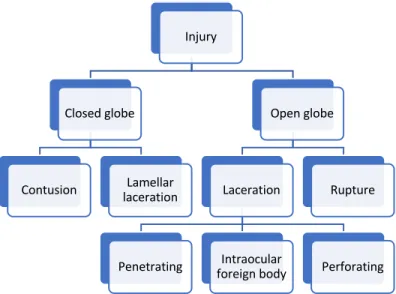
injuries are defined between open and closed globe. The eye or globe has an outer wall called the sclera (white part of the eye) and cornea (clear part of the eye) as illustrated in Figure 1. Closed globe injuries may result in contusion or lamellar laceration. A contusion is not a full thickness wound to the outer wall while lamellar laceration is a partial thickness wound to the outer wall of the eye. Open globe injuries are more serious because the eye’s injury exposes the globe through a laceration or rupture. A rupture occurs when a blunt object creates a full-thickness wound to the outer wall of the eye while laceration is made with a sharp object and also creates a full-thickness wound to the eye. Injuries can either penetrate or perforate an eye. Penetrating injuries can be made by a single or multiple object(s). Foreign objects may or may not exist in penetrating injuries, while perforating injuries create an entry and exit wound by the same object. Figure 2 illustrates the breakdown of the BETT eye injury classification (Kuhn, Morris, Witherspoon, & Mester, 2004).
Figure 2. BETTS classification of eye injuries
The top preventable eye injuries sustained by individuals are related to agriculture, assault, conflict, industry, fireworks, home chores, occupation, self-induced i.e. contact lenses, sports and transport (Patel, 2015). Types of common occupational injuries come from
projectiles, radiation, bloodborne pathogens, and chemicals. Eye injuries from high-risk occupations occur in auto repair, carpentry, construction, electrical work, farming, manufacturing, maintenance, mining, plumbing and welding.
Self-induced eye injuries may come from non-compliance on proper wear and handling of contact lenses or not utilizing proper eye protection. Factors that affect a person’s decision to wear or not wear eye protection may come from discomfort, scratched lens surface, reduced vision due to fogging of the goggles or loss of peripheral visual field (side vision). Although fogging contributes to non-compliance of eye protection wear, Crebolder and Sloan
recommended the use of anti-fog coating when purchasing eye protection because they found anti-fog coating to be relatively effective (Crebolder and Sloan, 2004). Lombardi et al.
conducted a series of seven focus groups comprised of workers and supervisors, totaling 51
Injury
Closed globe
Contusion lacerationLamellar
Open globe
Laceration
participants, to identify barriers to using eye protection in these groups. They concluded that comfort, fogging and scratched surface were the most important barriers to wearing eye protection. Younger age and lack of safety training were the other factors affecting workers from using eye protection (Lombardi et al., 2009).
Injury from contact lens use is preventable. Factors affecting this population may come from inadequate eyeglasses, vision care plans, behavior and lack of education. Vision insurance companies may limit a person from purchasing glasses in a given year, therefore, patients most often choose contact lenses over eyeglasses when they obtain their annual vision related benefits. Unfortunately, persons with a high eye prescription are unable to function adequately without correction. Therefore, when a person with a high prescription chooses to only obtain contact lenses, they limit their choices to contact lenses because they have no available eyeglasses. In order to make eyeglasses effective, eyeglasses should be functional in nature. Functionality should be aesthetically pleasing, contain the most current prescription and be comfortable. Elimination of any of the three factors provides an excuse for the person to not wear their eyeglasses. Unfortunately, a debilitating eye injury from contact lens overuse leading to hospitalization is a corneal ulcer (Lee & Manche, 2016).
emergency visits within the study period in the U.S. (Matsa et al., 2018). A third study by Ramirez et al. conducted an eight-year cross-sectional retrospective study to determine if eye injuries occur in certain seasons from 2006-2013 concluded that eye trauma visits decreased by an average of 4 percent per year during the eight-year study period in the U.S. and incidence was highest in the spring and summer months (Ramirez et al., 2018). In both the Iftikhar et al. and Matsa et al. studies, eye injuries from motor vehicle crashes decreased attributing it to the technological advances in automobiles. Another resonating finding is the consistency of eye injuries as it relates to gender. In all three studies, eye injuries occurred more in males than females. Haring et al. reported 81.3 percent, Ramirez et al. reported 66 percent, Matsa et al. reported 63 percent and Iftikhar et al. reported 59.3 percent of males with a reported eye injury.
McGwin et al. summarized non-specific eye injury rates in the U.S. that ranged from 8.2-13.0/1000 person-years from 1992-2001 using NAMCS, NHAMCS and NHDS (McGwin, Hall, Xie, & Owsley, 2006). A subsequent study of ocular injuries that occurred in 2001 also used the same databases and comprised of inpatient, outpatient, private office and emergency
occurring in homes (McGwin & Owsley, 2005). The rate at which the eye injuries are captured varies significantly depending on databases utilized and classification defined by the study.
The following statistics are related to specific types of injuries. Haring et al. conducted a cross-sectional study from 2010-2013 and found the highest source of sports eye injury from basketball (22.6%; 95% CI, 21.7%-23.6%), baseball or softball (14.3%; 95% CI, 13.7%-14.9%), and shooting an air gun (11.8%; 95% CI, 10.8%-12.8%) (Haring, Sheffield, Canner, & Schneider, 2016). Forrest et al. conducted an occupational related ocular injury survey in 2002, utilizing NHIS for ages 18 and above. They had 28,913 respondents and concluded a lifetime prevalence of eye injury to be 4.4 percent (Forrest & Cali, 2009). While Jackson reported that occupational eye injury rates have declined. He noted a rate of 0.35 injuries per 1,000 person-years on days away from work (DAFW) cases and 1.5 injuries per 1,000 person-years of full-time employees. He summarized that younger males working in the construction industry are at most risk for eye injuries (Jackson, 2009).
percent of the injuries than females (Haring, Sheffield, Channa, Canner, & Schneider, 2016). Corneal ulcer is a complication that could result from contact lens misuse. According to Lee et al., the rate of inpatient hospitalization from corneal ulcers from contact lens wear in 2012 was 2.7 per million person-year (Lee & Manche, 2016).
In the elderly population, Chen et al. conducted a study that quantified and characterized eye injuries as it relates to consumer products (CP) in the U.S. It was a retrospective study that considered persons 65 and older treated in the ED. They analyzed 67,684 visits with CP related injuries. The study utilized consumer product data from NEISS from a sample of 100 hospitals from 2001-2007. They concluded that males were affected more at 64 percent, most injuries occurred in homes in 70 percent of the cases. The cause of injury included chemicals, cutting tools/construction, furniture and gardening in the following percentages of 22, 21, 15 and 14 percent, respectively. Eye injuries resulting from the CP were contusions or abrasions in 39 percent of the patients (Chen, Kim, Linakis, Mello, & Greenberg, 2013).
to view their map, but with a red lens. Even with a red lens, it still takes several seconds before the eyes can resume sight in the dark, therefore navigating through forests with high amounts of shrubbery or branches from trees without illumination can easily injure a person without proper eye protection.
Andreotti et al. conducted a retrospective population-based study on eye injuries in the U.S. Armed Forces in 1998. They aimed to determine the incidence rates of ocular injuries from ambulatory and hospitalized visits. The ambulatory rate was 9.83 per 1,000 person-years while hospitalization’s rate was only 0.17 per 1,000 person-years. They concluded that the most common injuries are orbital floor fractures, contusions and open wounds to the globe and surrounding area for hospitalized members while superficial wounds and foreign body were the most common for the ambulatory injuries. Men were twice as likely to sustain an injury as women. Occupations that were most at risk for injury were metal body machinist, metal workers and welders (Andreotti, Lange, & Brundage, 2001).
DMSS continues to track DoD eye injuries for the active duty component. The U.S. Army Public Health Command (USAPHC) releases an annual summary of active duty eye injury
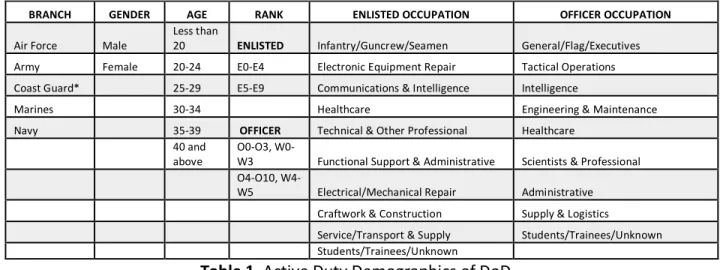
summary report (APHC, 2019). In 2010, the Armed Forces Health Surveillance Center (AFHSC) and Tri-Service Vision Conservation and Readiness Program (TSVCRP) of the USAPHC developed an annual summary report dating back to January 2000 on active duty eye injuries that include Age, Rank, Gender, Occupational Group within each branch; Air Force, Army, Coast Guard, Marines and Navy. Age was divided into six groups: under 20, 20-24, 25-29, 30-34, 35-39, 40 and older. The Occupational Group within the enlisted ranks were: infantry/guncrew/seamen, electronic equipment repair, communications and intelligence, healthcare, technical and other professional, functional support and administrative, electrical/mechanical repair, craftwork and construction, service/transport and supply, students/trainees/unknown enlisted occupation. The officer’s occupations were listed as: general/flag/executives, tactical operations,
intelligence, engineering and maintenance, healthcare, scientists and professional, administrative, supply and logistics, students/trainees/unknown (Table 1).
Table 1. Active Duty Demographics of DoD *Coast Guard is under DHS and not DoD
BRANCH GENDER AGE RANK ENLISTED OCCUPATION OFFICER OCCUPATION
Air Force Male Less than 20 ENLISTED Infantry/Guncrew/Seamen General/Flag/Executives Army Female 20-24 E0-E4 Electronic Equipment Repair Tactical Operations Coast Guard* 25-29 E5-E9 Communications & Intelligence Intelligence
Marines 30-34 Healthcare Engineering & Maintenance
Navy 35-39 OFFICER Technical & Other Professional Healthcare
40 and above O0-O3, W0-W3 Functional Support & Administrative Scientists & Professional
O4-O10, W4-W5 Electrical/Mechanical Repair Administrative
Craftwork & Construction Supply & Logistics
Service/Transport & Supply Students/Trainees/Unknown
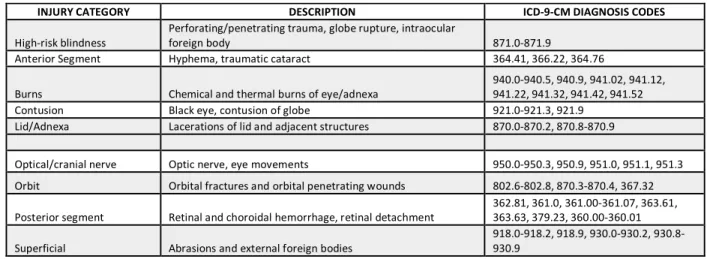
The first Medical Surveillance Monthly Report (MSMR) began in May 2011 where the AFHSC defined the Case Definition for Eye Injuries that includes the methodology to produce the data summary. The rates at which injuries are discussed are compiled into three clinical scenarios: Ambulatory, Deployment-Related Injuries, Hospitalization. The rates used in these reports are per 1,000 person-years. Each scenario is further divided into primary and all diagnoses by count and rate. The eye injury data comes from the ICD-9-CM diagnostic codes utilized by the provider from a fixed non-military (TRICARE claims) and military facilities worldwide. The injury was coded under nine specific categories: high-risk blindness, anterior segment, burns, contusion, lid/adnexa, optic/cranial nerve, orbit, posterior segment and superficial (Table 2).
Table 2. Eye injury category, description and ICD-9-CM codes of eye injuries. High-risk blindness is defined by US Eye Injury Registry data in 2006
For discussion and comparison, this paper will only refer to the Ambulatory Military Treatment Facility (MTF) Visits’ All Diagnoses Rate of these data because the deployment-related injuries are inevitably high-risk for injuries and the hospitalization data had negligible
INJURY CATEGORY DESCRIPTION ICD-9-CM DIAGNOSIS CODES
High-risk blindness Perforating/penetrating trauma, globe rupture, intraocular foreign body 871.0-871.9
Anterior Segment Hyphema, traumatic cataract 364.41, 366.22, 364.76
Burns Chemical and thermal burns of eye/adnexa 940.0-940.5, 940.9, 941.02, 941.12, 941.22, 941.32, 941.42, 941.52
Contusion Black eye, contusion of globe 921.0-921.3, 921.9
Lid/Adnexa Lacerations of lid and adjacent structures 870.0-870.2, 870.8-870.9
Optical/cranial nerve Optic nerve, eye movements 950.0-950.3, 950.9, 951.0, 951.1, 951.3 Orbit Orbital fractures and orbital penetrating wounds 802.6-802.8, 870.3-870.4, 367.32
Posterior segment Retinal and choroidal hemorrhage, retinal detachment 362.81, 361.0, 361.00-361.07, 363.61, 363.63, 379.23, 360.00-360.01
Table 3 lists the sources of injuries in the following categories of war, guns and explosives, sports, machinery and tools, land transport, other transport, slips/trips/falls,
fighting/assault/horseplay and other and unknown causes. The tracking for Coast Guard discontinued from 2016 to 2017 because ICD-10 was not utilized by Coast Guard providers. It is also noteworthy that ICD-10-CM was introduced in 2015 as listed in Table 4. Corneal disorder due to contact lens use was added in 2014 and tracked quarterly by each garrison separately by each branch of service. Vision loss was further tracked under unilateral, bilateral and legally blind diagnoses.
Table 3. Eye injury source and type of visits, the sources of injury were not assessed during Deployment-Associated visits
SOURCE OF INJURY TYPES OF VISITS
Table 4. Eye injury category, description and ICD-10-CM codes of eye injuries and conditions leading to vision loss. High-risk blindness is defined by US Eye Injury Registry data in 2006.
*Corneal disorders added in 2014 tracked per garrison data only **Vision loss associated with injury
INJURY
CATEGORY DESCRIPTION ICD-10-CM DIAGNOSIS CODES
High-risk blindness
Perforating/penetrating trauma, with or without prolapse of tissue, globe rupture, intraocular foreign body, avultion of eye
S05.2, S05.20XA, S05.21XA, S05.22XA, S05.3, S05.30XA, S05.31XA, S05.32XA , S05.5, S05.50XA, S05.51XA , S05.52XA S05.6, S05.60XA, S05.61XA, S05.62XA, S05.7, S05.70XA, S05.71XA, S05.72XA, S05.8
Anterior
Segment Hyphema, iridodyalisis, traumatic cataract
H21.0, H21.00, H21.01, H21.02, H21.03, H21.53, H21.531, H21.532, H21.533, H21.539, H26.10, H26.101 H26.102, H26.103, H26.109, H26.11, H26.111, H26.112, H26.113, H26.119, H26.13, H26.131, H26.132, H26.133, H26.139
Burns
Chemical and thermal burns of eye/adnexa, 1st-3rd degree burns, corrosion of eye
T26.0, T26.00XA, T26.01XA, T26.02XA, T26.1, T26.10XA, T26.11XA, T26.12XA, T26.2, T26.20XA T26.21XA, T26.22XA, T26.3, T26.30XA, T26.31XA, T26.32XA, T26.4, T26.40XA, T26.41XA, T26.42XA T26.5, T26.50XA, T26.51XA, T26.52XA, T26.6, T26.60XA, T26.61XA, T26.62XA, T26.7, T26.70XA T26.71XA, T26.72XA, T26.8, T26.80XA, T26.81XA, T26.82XA, T26.9, T26.90XA, T26.91XA, T26.92XA
Contusion Black eye, contusion of globe S00.1, S00.10XA, S00.11XA, S00.12XA, S05.1, S05.10XA, S05.11XA, S05.12XA, S05.9
Lid/Adnexa
Lacerations/puncture of lid and adjacent structures, with or without foreign body
S01.10, S01.101A, S01.102A, S01.109A, S01.11, S01.111A S01.112A, S01.119A, S01.12, S01.121A, S01.122A , S01.129A, S01.13, S01.131A, S01.132A , S01.139A, S01.14, S01.141A, S01.142A, S01.149A, S01.15, S01.151A, S01.152A, S01.159A Optical/cranial
nerve Optic nerve, nerves affecting eye movements S04.01A, S04.011A, S04.012A, S04.019A, S04.1, S04.10XA, S04.11XA, S04.12XA, S04.2, S04.20XA, S04.21XA, S04.22XA, S04.4, S04.40XA, S04.41XA, S04.42XA
Orbit
Orbital fractures and orbital penetrating wounds with or
without foreign body S02.3, S02.3XXA, S02.3XXB, S02.92, S02.92XA, S05.4, S05.40XA, S05.41XA, S05.42XA, H05.23, H05.231, H05.232, H05.233, H05.239
Posterior segment
Retinal, choroidal, vitreous hemorrhage, retinal detachment
H31.30, H31.301, H31.302, H31.303, H31.309, H31.31, H31.311 H31.312, H31.313, H31.319, H31.32, H31.321, H31.322, H31.323, H31.329, H33.0, H33.00, H33.001, H33.002, H33.003, H33.009, H33.01, H33.011, H33.012, H33.013, H33.019, H33.02, H33.021, H33.022, H33.023, H33.029, H33.03, H33.031, H33.032, H33.033, H33.039, H33.04, H33.041, H33.042, H33.043, H33.049, H33.05, H33.051, H33.052, H33.053, H33.059, H33.8, H35.6, H35.60, H35.61 H35.62, H35.69, H43.1, H43.10, H43.11, H43.12, H43.13, H44.00, H44.001, H44.002, H44.003, H44.009
Superficial
Abrasions, blister, bites and external foreign bodies of periocular area
S00.2, S00.20, S00.201A, S00.202A, S00.209A, S00.21, S00.211A, S00.212A, S00.219A, S00.22, S00.221A S00.222A, S00.229A, S00.25, S00.251A, S00.252A, S00.259A, S00.26, S00.261A , S00.262A, S00.269A, S00.27 S00.271A, S00.272A, S00.279A, S05.0, S05.00XA , S05.01XA, S05.02XA, T15, T15.0, T15.00XA, T15.01XA T15.02XA, T15.1, T15.10XA, T15.11XA, T15.12XA, T15.8, T15.80XA, T15.81XA, T15.82XA, T15.9, T15.90XA T15.91XA, T15.92XA
Corneal
Disorder* Corneal disorder or edema due to contact lens
H18.21, H18.211, H18.212, H18.213, H18.219, H18.82, H18.821, H18.822, H18.823, H18.829
Bilateral** Blindness in one eye and low vision in the other H54.0, H54.1, H54.10, H54.11, H54.12, H54.2
Unilateral**
Low vision in both eyes, blindness in one eye and
normal vision in other eye H54.4, H54.40, H54.41, H54.42, H54.5, H54.50, H54.51, H54.52
The MSMR published in May 2011 report included the count and rate of All Diagnoses under Ambulatory and Hospitalization visits from 2000 to 2011 in the DoD. The total count of ambulatory eye injuries during the 11-year period was 182,525 at a rate of 11.65 per 1,000 person-years and hospitalization visits totaled to 4,030 at a rate of 0.26 per 1,000 person-years. The report concluded that the rate of ambulatory injury was equal between genders and twice higher in males for injuries requiring hospitalization. SMs in the 20-24 age group were
hospitalized nearly two times higher than the 40 and above age group, however considering ambulatory visits, the 40 and above age group had the highest rate of eye injuries while the youngest age group had the lowest injury rates. For ambulatory visits, the occupation with the highest rate of eye injury was among the enlisted group working in construction and craftwork, while general/flag officer and executive position among the officers had the lowest rate. For hospitalization, the highest rate of eye injury occurred in the infantry, guncrew and seamen among the enlisted and tactical operation positions among the officers. The Coast Guard had the highest rate of injuries during ambulatory visits, while the Marine Corps ranked the highest in hospitalization visits.
lowest rate occurred in 2013 with a rate of 12.77 and 8.95 per 1,000 person-years respectively. Similar to PD, females consistently had a higher rate than males from 2005-2013. The
overwhelming types of injuries were classified as superficial, meaning abrasions and external foreign bodies. Of the nine listed sources of eye injuries, the highest count and rate was consistent under “other and unknown causes”.
YE AR CO U N T RA TE GE N D ER
ENLISTED GROUP OFFICER GROUP
AG E GR O U P
OCCUPATION BR
AN CH AG E GR O U P
OCCUPATION BR
AN
CH
2000 15444 11.06 Male 20-24 Construction Craftwork/ Force Air 40+ General / Flag Officer & Executives Air Force
2001 15528 11.12 Male 40+ Construction Craftwork/ Guard Coast 40+ General / Flag Officer & Executives Marine Corps
2002 16819 11.8 Male 40+ Construction Craftwork/ Guard Coast 40+ Engineering Navy
2003 17514 12.09 Female 40+ Construction Craftwork/ Guard Coast 40+ Students/Trainees Navy
2004 18175 12.5 Male 40+ Construction Craftwork/ Guard Coast 40+ General / Flag Officer & Executives Navy
2005 17133 12.1 Female 40+ Construction Craftwork/ Guard Coast 40+ Healthcare Navy
2006 17894 12.77 Female 40+ Construction Craftwork/ Guard Coast 40+ General / Flag Officer & Executives Navy
2007 16502 11.78 Female 40+ Construction Craftwork/ Guard Coast 40+ General / Flag Officer & Executives Coast Guard
2008 15885 11.19 Female 40+ Construction Craftwork/ Guard Coast 40+ Students/Trainees Coast Guard
2009 16009 11.07 Female 25-29 Construction Craftwork/ Guard Coast 40+ General / Flag Officer & Executives Coast Guard
2010 15803 11.09 Female 25-29 Construction Craftwork/ Guard Coast 40+ General / Flag Officer & Executives Coast Guard
2011 15293 10.5 Female 25-29 Construction Craftwork/ Guard Coast 40+ General / Flag Officer & Executives Coast Guard
2012 13214 9.21 Female 40+ Construction Craftwork/ Guard Coast 40+ Students/Trainees Coast Guard
2013 12622 8.95 Female 25-29 Construction Craftwork/ Guard Coast 40+ General / Flag Officer & Executives Coast Guard
2014 13728 9.97 Male 40+ Construction Craftwork/ Guard Coast 40+ Healthcare Coast Guard
2015 14259 10.86 Female 25-29 Construction Craftwork/ Guard Coast 40+ General / Flag Officer & Executives Coast Guard
2016* 13666 10.59 Equal 40+ Construction Craftwork/ Army 40+ General / Flag Officer & Executives Air Force
2017* 12694 10.28 Male 40+ Construction Craftwork/ Army 40+ Scientist/ Professional Army
Table 5. Ambulatory All Diagnoses with high eye injury rate 2000-2017, rate is per 1000 person-years
Age range most affected was the 40 years and above category in both enlisted and officer’s rank. The occupation most affected among enlisted were those working in
construction and craftwork. The occupation most affected among officers were those in general/flag/executive positions. Coast Guard was the branch affected most in both enlisted and officer’s rank, however, the Navy eye injury rate peaked between 2002 and 2006 within the subset of officers. Among the sources of injuries, most came from “other or unknown” category (Table 3). The rates were highest in 2006 and began to decrease until 2014, where the rates began to climb again. In 2015, ICD-10-CM was implemented and several injuries not included in ICD-9-CM (i.e. eyelid insect bites) were included. In order to minimize instrumentation validity, 2015 could be used as a new baseline due to the transition to ICD-10.
Public health Interventions for preventing eye injuries have been implemented throughout the decades from education, behavioral change, technological advances,
environmental controls, policy implementation and protective material. Personal protective equipment considered are goggles, face shields and helmets. The effectiveness of each strategy and combined strategies are discussed below.
provided protective eyewear without training. Through field observations and self-reported use of eyewear, Group A had the greatest change from the other groups thereby concluding that engaging CHWs to provide training about the importance of protective eyewear use is an effective intervention for promoting eye safety (Forst et al. , 2004).
Behavior change through policy change in manufacturing settings showed reduction in eye injuries from Lipscomb’s review of the literature. He reviewed literature focused on change in eye injury rates, use of protective eyewear or cost of eye injury care. He included seven reports from industrial settings. The two types of interventions he considered were; “(1) effectiveness of different types of eye protection and / or environmental controls in the workplace and (2) evaluation of behavioral interventions focus on increasing the use of eye protection among at-risk workers” (Lipscomb, 2000, pg. 27).
Although motor vehicle-related eye injuries are not a primary source of preventable eye injuries, ocular injuries related to these accidents have been impacted by a combination of consumer product engineering, public policy and health education. Iftikhar and Matsa both reported a reduction in ocular injuries associated with motor vehicle accidents (Iftikhar et al. , 2019) (Matsa et al. , 2018). Leonard discussed a 58.2 percent decrease in ED visits for children from motor vehicle crash-related eye injuries attributing it to increased vigilance in child
passenger safety, child seat regulations, improved car seat design, safety belt and airbag design (Leonard, 2019). Armstrong et al. reported a 20 percent decrease in motor vehicle-related eye injuries from 2001 to 2008 (Armstrong et al. , 2014).
light, furnace men, firemen and iron bar processors (Johnson, 2015). Gilbert Igo summarized the history of eye protection published under the Occupational Health and Safety began in 1903. A French scientist named Edouard Benedictus discovered cellulose nitrate by chance. Cellulose nitrate is a liquid plastic that keeps the glass together so plastic stays intact thereby making it shatter-proof. Julius King of Julius King Optical Company in the U.S. created the first safety goggles in 1909 called SANIGLAS. Prescription lenses emerged and incorporated in goggles starting in 1914. In 1935, Furnace Goggles were developed for protection from glare for furnace and forge workers. Melter’s Goggles were developed also during that time for eye protection for steel melter workers, flying metal debris and glare. In 1940, American Optical published the relationship between “Ophthalmic Professions to Industrial Safety and Visual Efficiency” thereby paving the way for creating a national policy requiring employers to protect workers from work environment that may cause injury by way of debris, chemical and radiation (Igo, 2017).
The Occupational Safety and Health Association (OSHA) was created by Congress
through the Occupational Safety and Health Act of 1970. OSHA enforces standards and ensures a safe and healthy working environment for the working population, which exemplifies the effectivity of policies. In summary, OSHA requires all employers to provide personal protective equipment (PPE) to their employees. Besides PPE enforcement, OSHA also conducts training, education assistance and provides outreach (OSHA, 1970).
Pharmaceuticals in 1953 (Editors of Encyclopedia Britannica, 2017). Polycarbonate lenses have been widely used for safety eyewear since 1982.
The American National Standards Institute (ANSI) began in 1918 to promote
standardization on equipment, materials and products. ANSI set the impact standards in 1979 for lenses in eyewear protection so that goggles may use any form or design as long as it passed the high-speed, high-impact test. An ANZI Z87.1 annotation on a pair of goggles indicates that the product passes the basic and high-impact for lenses and frames, exposure to non-ionizing radiation and chemicals and durable against flammables and corrosion (International Safety Equipment Association, 2019).
The American Society of Testing and Materials (ASTM) is an international standards organization that publishes standards on products, materials, services and systems. They establish standards for eye protection for specific sports such as ASTM F803 for racket sports, women’s lacrosse, etc. (ASTM, 2014).
Although protective eyewear has been proven to be effective, one-third of the population admits to not wearing protective eyewear when engaging in high-risk injury activities according to one study conducted by Forrest et al. in 2002. They used the NHIS to determine how many adults participate in high-risk activities and how many wear protective eyewear when conducting these activities. Out of 30,894 participants, 29.3 percent
The need for improving eye injury prevention in the DoD was necessary after realizing that the rate of eye injuries in the DoD rose between 1996 and 2005, with the highest rate in 2004 according to Hilber et al. (Hilber et al. , 2010). The Vision Center of Excellence (VCE) in Walter Reed National Medical Center was established under the National Defense Act of 2008. Its mission is to improve, prevent, mitigate, treat and rehabilitate disorders of the visual system among veterans and members of the armed forces (VCE, 2019). In addition, the Tri-Service Vision Conservation and Readiness Program became the Tri-Service Vision Conservation and Readiness Division (TSVCRD) in 2016. The TSVCRD has evolved from a history of occupational prevention and safety starting in the 1940s with Dr. Joseph Tiffin and falls under the U.S. Army Public Health Center (renamed in 2015). A form of vision conservation program was established in 1991 under the Army Vision Conservation Program. TSVCRD’s mission today is to “identify risks that threaten visual function and to implement reasonable controls, educate employees and encourage eye safety compliance” (APHC, 2019).
Auvil’s article discussed how combat eye protection has improved over time.
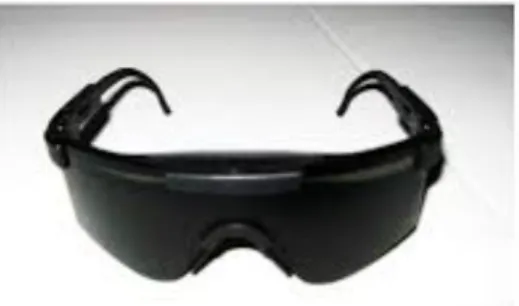
protection use from 20 to 95 percent, unfortunately, this data was unpublished (Auvil, 2016). The current MCEP models are listed under the Approved Protective Eyewear List (APEL) in Figure 5. The approved MCEP came from different manufacturers like Arena, ESS, UVEX, Oakley, Revision, Smith Optix and Wiley X. Requirements for an MCEP to be considered for the APEL (additional requirements beyond ANSI) must meet the following: system configuration, system weight, system interfaces, environmental factors, chemical resistance, ballistic protection (ANSI standards), optical characteristics, flammability and durability. Products are tested every two years for compliance (Vision Conservation & Readiness, 2019).
Figure 3. Ballistic Laser Protective System (BLPS)
(Source: http://armysurpluswarehouse.com/us-military-ballistic-safety-glasses/)
Figure 4. Special Protective Eyewear Cylindrical System (SPECS)
Figure 5. Approved Protective Eyewear List (APEL)
(Source: https://www.peosoldier.army.mil/docs/apls/APEL_Poster.pdf?=98987)
DISCUSSION
Military One Source described the DoD active duty population in 2017 at 1,294,520 SMs. Figure 6 illustrates the percentage of the active duty military population into the following personnel: 472,047 Army; 319,492 Navy; 318,580 Air Force; and 184,401 Marines. The Coast Guard falls under the Department of Homeland Security (DHS) with a strength of 40,600 in 2017, which increased by 15 percent from 2000 (Military One Source, 2017, pg. 13-19), (Military One Source, 2010, pg. 6).
Figure 6. 2017 U.S. Active duty population
When comparing population size from 2000 to 2017, there was a 5 percent decrease in the overall active duty combined DoD and DHS population from 2000 to 2017. Females in the DoD active population increased from 14 to 16 percent in 2000 and 2017 respectively. The ratio between enlisted to officers and males to females were almost identical, approximately 6 to 1.
After comparing both population groups, similarities between non-military and military eye injury are in construction work yielding with the most eye injuries in a workplace and a
35%
24% 14%
24% 3%
Active Duty Military Population 2017
declining trend in eye injury rates over the past two decades with the exception of 2014 forward within the active duty members. The transition from ICD-9-CM to ICD-10-CM is a plausible explanation to the increase of eye injuries. Figure 7 and 8 show the DoD active duty ambulatory eye injuries by count and rates from 2000 to 2017. Barriers and reasons for not wearing eye protection are similar between both population groups. Dissimilarities between non-military and military eye injury are in genders and age groups.
Figure 7. Summary Report for DoD Ambulatory All Diagnoses Eye Injury Count for 2000-2017, Coast Guard unavailable from 2015-2017
0 5000 10000 15000 20000
2000 2002 2004 2006 2008 2010 2012 2014 2016 2018
EY
E
IN
JU
RY
CO
U
N
T
YEAR
DoD Active Duty Ambulatory All
Diagnoses
Figure 8. Summary Report for DoD Ambulatory All Diagnoses Eye Injury Rate for 2000-2017, Coast Guard unavailable from 2015-2017
Currently, no article discusses why eye injuries in females were highest between 2005 and 2013 in the military, however, several factors may explain the etiology of higher rates in eye injury based on the likelihood of women seeing a health provider as compared to men, increased job opportunities in the military and contact lens use. McGraw et al. explained that approximately 300,000 females joined the ranks of deployed male soldiers after September 11, 2001, to Iraq and Afghanistan. Other historical milestones included in the article were: females were permitted to serve on submarines starting in 2011, over 14,000 frontline position
restrictions were lifted by the DoD and opened up for female SM in 2012 and in 2013, and DoD lifted the 1994 ban on women in combat positions. Therefore, women occupied positions associated with a higher risk of injury. (McGraw, Koehlmoos, & Ritchie, 2016) Another plausible explanation, women are more likely to seek medical attention than men, according to CDC’s report that women use ambulatory medical care 33 percent more than men in 1997 and 1998
0 2 4 6 8 10 12 14
2000 2002 2004 2006 2008 2010 2012 2014 2016 2018
EY E IN JU RY R ATE YEAR
DoD Active Duty Ambulatory All
Diagnoses Eye Injury Rate per 1000
(Brett & Burt, 2001). A third reason, women wear contact lenses more than men. Swanson described the demographics of contact lens wearer to be women with higher socioeconomic status and education derived from a univariate analysis in 2012 (Swanson, 2012). Hilber et al. mentioned higher eye injury rates in women because contact lenses produced superficial injuries such as dry eyes, corneal irritation or abrasion (Hilber et al., 2010).
The U.S. Coast Guard stands out as compared to the other active duty branches because its eye injury rates were highest within the enlisted group from 2001 to 2015, and 2007 to 2015 within the officer’s group. Data collection stopped in 2015 because ICD-10 was instituted. Further analysis of the Coast Guard enlisted shows a total of 7,230 eye injuries from 2001 to 2015 ranging from a rate of 12.43 - 17.67 per 1000 person-years, where males consistently had higher rates than females. The enlisted were affected most between the 25-20 age group and equally high among the student trainees and technical occupations. The officers were equally high in the 25-29 and 40 and above age groups. Logistics and supply officers had the highest rate of eye injuries.
The age groups most affected in the DoD were consistently 40 and older within the officer’s rank for 18 years. The enlisted rank had the highest eye injury rates within the 40 and older group in 10 of the 18 years summary report. In two of McGwin et al.’s study, the age groups affected with high eye injury rates were usually in the 20-30 age group. A plausible explanation for high eye injury rate may be due to higher rank status. A higher rank is obtained as the SM gets older, as such, there would be limited enforcement of eye protection use on a senior ranking member versus a junior ranking member, who would be told to use eye
health care. A senior ranking member usually holds an administrative position which enables them to seek medical care as needed, where a junior ranking member may work in the field, far from healthcare facilities and require permission from their supervisor. This unequal access to healthcare may result in under-reporting of eye injuries to the other age groups and eye injury from lack of eye protection use in higher age groups indicates poor enforcement of policy. Hilber et al. mentioned possible explanation such as an increase in older active duty personnel in training and operational activities as well as an increase in older recruits (Hilber et al., 2010). The enlistment age was raised to 42 from 2005 to 2011 under the Fiscal Year 2006 National Defense Authorization Act in order to fill positions for deployment in support of Global War on Terror (GWOT) ("National defense authorization act for fiscal year 2006," 2006).
The eye injury rates were measured as incidence per 1000 person-years, a consistent method of quantifying the rates of injuries. However, the reported data might reflect
proportions that can be deceiving because the values of proportions would appear unusually high if a relatively large number of events occurs in a small population. For certain subgroups i.e. 40 and above age groups, Coast Guard, females, officers, the total number of SMs are smaller than other subgroups, hence could register with higher injury rates. In any case, the incidence of ambulatory eye injuries could stand to improve because these are preventable injuries.
separate googles for particles is also issued should the SM deploy to desert locations. These goggles fit closer to the face so that sand particles cannot enter the googles. Each member’s optical readiness must include two pairs of glasses, MCEP insert, and an insert for an M50 gas mask.
Barriers as mentioned earlier that contribute to a SM not wearing their MCEP can be due to discomfort, reduced peripheral visual field, fogging and scratches on surface causing poor vision. Unfortunately, some SMs are unaware that they are able to replace or exchange their MCEP should it become unserviceable. Since each unit commander chooses their own MCEP, they may use non-aesthetic MCEP, thereby making it undesirable for SM to utilize.
Contact lens use presents as another problem in the military. Though contact lens use provides benefits i.e. increased visual peripheral view, less obstruction from spectacles, less fogging of lenses, less distortion from lenses, some contact lens material may also provide UV protection and for aesthetic reasons; but not always appropriate for SM. Its use in the military is not allowed during basic training, deployment, field training exercises and gas chamber exercises under regulation, DoD policy, DA PAM 40-506 (The Army Vision Conservation and Readiness Program) as well as the U.S. CENTCOM 021922Z (December 2011 Mod 11 to U.S. CENTCOM individual protection and individual-unit deployment policy). An exception to this policy is Air Force Personnel, they must obtain a written authorization to wear contact lenses during combat (Vision Center of Excellence, 2013).
and anytime for the standard 5A and 5AM frames, however, they choose their contact lenses over glasses. Table 6 shows the count and rate per 1000 person-years due to contact lens-related corneal injuries by year, branch of service and garrison.
Recurrences are high in garrisons: HQMC Arlington, NAS Norfolk, NS Norfolk, Sigonella, Humphreys, Carroll, Schofield Barracks, Redstone Arsenal, Davis-Monthan and Hanscom. The Navy and Marine Corp were combined thus appearing to have a higher amount of count and rate of injuries. The overall rate of contact lens-related corneal injury from 2012 to 2017 for the Department of the Navy was 1.87-3.22, Department of the Army was 1.13 – 2.24 and
Department of the Air Force was 1.30 – 2.50. The highest rates occurred in 2012 for all three branches. One plausible explanation for Humphreys and Carroll is non-compliance of the SM to obtain their eyeglasses prior to deploying to the Republic of Korea. SMs without their family (unaccompanied) are deployed for only 12 months, therefore they choose not to bring their eyeglasses. This an example of failure to enforce and hold the SM accountable when they elect to disregard military policies and procedures for contact lens wear.
YEAR NAVY & MARINE CORPS ARMY AIR FORCE
2012 Rate: 2.75-3.22 Count: 1583 Rate: 1.70-2.24 Count: 1085 Rate: 2.05-2.44 Count: 740
GARRISON Norfolk, NS Norfolk NAS HQMC Arlington, NAS Fallon
Humphreys, Carroll,
Kaiserslautern Angeles, Patrick, Kadena Wright-Patterson, Los 2013 Rate: 2.47-2.96 Count: 1383 Rate: 1.38-1.88 Count: 863 Rate: 1.57-2.24 Count: 729
GARRISON NAS Norfolk, Naval Academy, Redstone Arsenal, Fort Carroll, Bamberg, Dix
Vandenberg, Hickam, Dyess
GARRISON NAS Norfolk, NS Norfolk Schofield Barracks, Vicenza Hanscom, Minot Davis-Monthan, 2015 Rate: 1.87-2.75 Count: 1201 Rate: 1.46-1.60 Count: 740 Rate: 1.38-1.66 Count: 474
GARRISON Norfolk, NSA Memphis, Corpus Christie, NS Bahrain
Meyer, Humphreys, Schofield Barracks,
Redstone Arsenal
Davis-Monthan, Shaw, Hanscom 2016 Rate: 2.09-2.59 Count: 1268 Rate: 1.13-1.44 Count: 677 Rate: 1.30 – 1.72 Count: 513
GARRISON HQMC Arlington, Parris Island, Sigonella Barracks, Yongsan, Stanley, Schofield Ansbach
Seymour-Johnson, Andrews, Goodfellow,
Aviano 2017 Rate: 1.93-2.34 Count: 1018 Rate: 1.34-1.72 Count: 680 Rate: 1.33-1.73 Count: 462
GARRISON Sigonella, Naples Naval Academy, Meyer, Presidio, Ansbach Forks, Kadena, Incirlik Goodfellow, Grand
Table 6. Contact lens-induced injury count and rate per 1000 person-years by year, garrison and branch of service
Through twelve years of personal practice, observation and input from SMs during optometry visits in the Army, several root problems may explain why the SM would prefer contact lenses over glasses. Glasses measurement that occurs right after contact lens use presents a problem after a person stops wearing contact lenses. A person’s eyeglasses prescription will inevitably change after discontinued use of contact lenses because more oxygen enters the cornea (front surface of the eye). The cornea may swell during contact lens use thereby inducing a different eyeglass prescription during measurement.
their glasses once deployed. It is equally important to check eyeglasses prescription because it may be fabricated erroneously, the frames do not fit properly or the lenses do not feel
comfortable and causes distortion in the wearer’s vision. An optician or technician is the dispenser and they have been trained to ensure they properly fit the frames for each member, however not all dispensers are created equal and there is no quality assurance in place to hold each person accountable.
Perfectly fitting eyeglasses sit level onto the bridge of the nose, the lenses are centered onto the eyes, the temples are not squeezing the side of the head and the temple arm of the frame wraps around the ear gently without excess material. Throughout practice in Army Optometry, SMs have complained that their glasses are so distorted, they cannot wear them. The temples are either too long or too short, the frames are too big or too small for the face or they arrived in the mail with the wrong prescription or the frames are bent and unserviceable. While it is the responsibility of each SM that their gear should be appropriate, it is paramount that each dispenser makes it clear to return the eyeglasses should they arrive with problems, unfortunately, these problems go unsolved.
A third problem is policy enforcement and lack of repercussion when wearing contact lenses or inconsistent use of eye protection. The rule breakers occur throughout the ranks to include the ones who should be enforcing them. Repercussions have not been implemented so there is no deterrent on wearing contact lenses during conditions that are outlined above or failure to use eye protection during high-risk activities. For example, during weapons
Although military training may produce higher rates of eye injuries while in garrison, other injuries occur not just on duty but during off duty hours. SMs own protective eyewear but do not choose to wear them during off duty time when working with automobiles, cleaning chemicals, playing sports or working with home and gardening equipment. This behavior is consistent in Forrest et al. ’s survey who concluded that a third of those participating in high-risk activities do not wear eye protection (Hilber et al., 2010).
The cost of eye injuries continues to rise as healthcare costs also rise in the U.S.. Buckingham et al. discussed the burden of each eye injury in the military between fiscal year 1988 to 1998 to cost an average of $9,724 and 6.1 days lost from work in the Army, $4,222 and 5.9 days lost from work in the Navy and $3,196 and 4.7 days lost from work in the Air Force. Each figure was derived from the U.S. Army Safety Center, U.S. Navy Safety Center and U.S. Air Force Safety Center respectively. The study also noted that the Safety Centers had a 250 percent under-reporting of eye injuries as found by the comparison between the eye injuries gathered from the Defense Medical Surveillance System (Buckingham, Whitwell, & Lee, 2005).
The Industrial Safety and Hygiene News (ISHN) reported the cost of occupational eye-related injuries at $300 million annually. The cost results from medical care, productivity loss and compensation (Industrial Safety & Hygiene News, 2014). The overall lifetime prevalence of work-related eye injuries was estimated at 4.4 percent (Buckingham et al., 2005).
care, worker’s compensation indemnity payment and value of missed work (Frick & Singman, 2019). Charges for ED related eye injury visits in the U.S. according to Channa et al. totaled $2.0 billion from 2006 to 2011 for 11,929,955 visits. This calculated cost considered a mean annual inflation-adjusted charge (Channa et al., 2016).
Preventable eye injuries are exactly how it is supposed to be – preventable. Although our society engages in high-risk activities, eye injuries are preventable just by taking extra precautions, ignoring prevention instead may lead to vision loss. Epocrates rated strong predictors for eye injuries in the U.S. to occur in males, age group between 18 and 45, those who do not use eye protective gear during work or play and as simple as it may seem, those who chose to wear no UV protection when outdoors (Epocrates, 2019). However, the DoD Summary of Eye Injuries presents a different demographic profile. These data suggest that eye injuries occur most in ages 40 and older, which is inconsistent with non-military studies. Injuries rates were consistently high in the Coast Guard, construction and craftwork occupations as well as general/flag and executive positions. High rates of injuries in the construction and craftwork occupations are consistent with non-military studies.
Lack of education is predictive of preventable eye injuries. For example, although pinguecula or pterygium are eye conditions and not an eye injury, these ocular conditions are caused by multiple factors i.e. UV exposure as one of the main culprit. Pterygium leads to increased astigmatism, redness, exacerbation, dry eyes and yet is highly preventable. These conditions are often seen in people who spend most of their time outdoors (i.e. fishermen). These conditions are prevalent in developing countries because of lack of education and lack of financial capability to purchase protective eyewear.
Figure 9. 5A (left), 5AM (right) standard military optical frame
(SOURCE: https://www.med.navy.mil/sites/nostra/FramesLenses/Pages/Standard-Issue-Eyewear.aspx)
Figure 10. Sample of FOC frames (does not include all choices)
(Source: https://www.dvidshub.net/news/213679/department-defense-offers-refreshed-frame-choice-eyewear-program)
or proper fitting of frames. If done incorrectly, all efforts go wasted if the SM is unable to wear their optical appliances.
Lack of enforcement and re-enforcement of policy when it comes to wearing eye protection or prohibited contact lens use contributes to non-compliance. Enforcing policies with eye protection use and contact lens usage across the uniformed services may impact eye injury rates similar to the policy and enforcement of automotive safety resulting in fewer eye-related injuries in the U.S.
Lack of engineering control in a workplace affects safety. Engineering controls can be considered as guards or shields on machinery. This prevents flying particles from being released onto the worker. Non-operational eyewash stations and ignorance on how to operate them is another predictor for eye injuries in the workplace. Common knowledge of location, operation of eyewash stations and appropriate engineering controls are effective educational
interventions.
Evidence-based intervention in eye protection has evolved from material, technology improvement, policy enforcement to a multi-level approach such as combining community-based preventive marketing (CBPM) and training community health workers (CHW) conducting education about eye protection use. Auvil discussed improved material and design as a
contributing factor for increased use of eye protection in the military. Eye injuries in the military decreased through wear of eye protection, timely intervention and regular eye hygiene (Auvil, 2016).
proven to reduce injuries. A study conducted in Norway among metal workers concluded that after mandatory use of eye protection in 1993 was implemented, the eye injury mean incidence rate decreased from 6.09 to 0.42 per million working hour (Bull, 2007).
In the military, the latest improvement in safety eyewear is incorporating transition lenses. The current military standard issue of protective eyewear also known as “eyepro” includes a clear lens, tinted lens and prescription inserts for the safety eyewear. Another pair of goggles that seals on top, sides and bottom of the lenses for sand and debris is a separate appliance as pictured in Figure 5. The current “eyepro” is not ideal since it is cumbersome to change the lenses, as this may take seconds to minutes to perform, which makes a difference in a person’s survivability. The new safety eyewear called Transition Combat Eye Protection contains only one set of lenses that can change from clear to tinted and back in less than a second. Unfortunately, at $200 a piece, it is not a standard issue to every SM. Instead, a unit commander may choose to purchase this for their personnel. The new helmet has an integrated head protection system (IHPS) which incorporates another layer of a barrier for sand/debris that goes over the safety eyewear, which replaces the form-fitting goggles (Clark, 2017).
RECOMMENDATIONS for Military and Public Health Leaders
how well a policy is enforced. Fortunately, policy already exists in the military regarding use of eye protection and prohibition of contact lens wear in certain circumstances, it’s a matter of enforcement and repercussions. Three solutions are recommended; a study that could lead up to establishing an effective intervention, incentivized solutions and ensuring accountability for equal access.
How an individual behaves off-duty may not be consistent with their behavior on-duty since no supervision exists during their off-duty time, a one-on-one education approach could be effective with each individual. Interpersonally, the individual can be affected by their peer, supervisor or in this case, the optical appliance dispenser. Education by a qualified optical dispenser can be delivered at this level, similar to a CHW, as this method was found to be an effective evidence-based intervention. The SM’s unit or organization, from squad leader to their commander, would enforce policies on eye protection use or certain restrictions related to optical appliances. The SM’s duty location is their community or their garrison, which is headed by the Garrison Commander, another layer of enforcer. Since policies are already in place, it would work only if enforced and repercussions imposed.
PROPOSED STUDY
workers were effective in the case with the Latino farmers, this method could be assimilated with optical dispensers. During gear distribution in basic training, the dispensing of eye protection should be done separately from other military gear. The dispenser should also be trained on proper policies and educate the SM on all their benefits, contact lens policies, proper wear of their “eyepro”, etc. As mentioned earlier, each SM is given a pair of FOC, which are still unknown to some. This is not a blanket statement, however, contact lens wearer may wear glasses more if they know about this benefit, since FOCs are better frames, quality and style.
A quasi-experimental study using an untreated control group with dependent pre and post-test using switching replications is one design for consideration. Two garrisons with the most injuries identified and selected to participate in the study. Two treatments will be utilized, a licensed optician to dispense optical appliances and a document acknowledged by the SM on their benefits and optical related policies. Currently, optical dispensers in the military range from no optical education to a licensed or trained optical dispenser. Licensed opticians would represent the CHW similar to the study by Forst et al. The document outlining the policy, benefits, use and prohibitions on optical appliances will be discussed and acknowledged by the SM with a signature which may serve as a possible behavior modifier. This document will be uploaded into the SM’s medical records and serve as a reference for future incidents related to eye injuries.
not have the treatment. Optical appliances are currently dispensed at central issue facilities for each garrison for all eye protection and prescription inserts and spectacles at optometry clinics. During the treatment phases of the study, all optical appliance dispensing will be conducted by a licensed optician either at the issue facility or optometry clinic. Group A will receive the treatment during phase one and group B receives the treatment during phase two. The groups will switch treatments the following year for another 12 months.
Figure 11. Study design
The study will include two pre-test and one post-test assessments in Group A, while Group B will only get one pre-test and two post-test measurements. Pre- and post-tests will be retrieved from the quarterly measurements of eye injury rates in the garrison at the designated timelines before, during and after the study. Multiple pre- and post-tests measured may
indicate any slope changes before and after implementing treatment. Changes in slope will be evaluated for the existence of causal inference of the intervention. The treatment will be administered for two years. The study should demonstrate if there is a causal inference in
High injury
garrison A Pre-test 1 Pre-test 2 TreatmentPhase 1 Mid-phase test Phase 2 No treatment Post-test 2
High injury
reducing eye injuries in garrison by way of utilizing a licensed optician and educating SMs with the said document.
INCENTIVE
Reduction in eye injuries is possible by enforcing the established policy. Unfortunately, policy breakers may also be the policymakers. Although senior ranking SMs may not be as accountable for their actions, there should be a standard repercussion on all SMs requiring care from avoidable eye injuries. Repercussions will be difficult to apply because of the privacy of medical records. The following are suggestions that could be implemented affecting the organization /community and the individual.
A way to enforce policy is by incentivizing each garrison to reduce its eye injury rate occurrences through monetary gains, thereby affecting a community or an organization. The reports of eye injuries at the garrison level already exists and done quarterly and annually. Once tracked, a level for each garrison could be set depending on their previous rate. The garrison that meets the set goal would gain monetary rewards if the goal was met. McGwin et al. concluded that the national trend of eye injuries has been declining with the lowest at 8.2 per 1000 person-years from 1992-2001 (McGwin et al., 2006) and the DoD’s AD ambulatory’s lowest eye injury rate at 8.95 per 1000 person-years from 2000-2017. These figures could set a baseline for garrisons that are not currently tracked.
to do the proper action and take extra precautions. This method would be difficult to implement because it would be “here say” unless there was proof i.e. video recording the incident proving that eye protection was used or proof of how long the member wears their contact lenses. In addition, policies would be required if SMs are held financially responsible for their medical care. SMs can be punished with reduced pay or given extra duty, which also affects them financially, when they are given a non-judicial punishment under the Uniformed Code of Military Justice, known as an Article 15.
EQUAL ACCESS
Disparity in healthcare access and culture in the military are both plausible factors for the unexplained differences among non-military and military eye injury differences among certain demographics. In this case, the rates between the young and the old. In order to fully understand the military mindset, military culture must be defined. Each branch of service has its own set of core values. The Army has loyalty, duty, respect, selfless service, honor, integrity and personal courage. The Navy and Marine Corps have honor, courage and commitment. The Air Force has integrity first, service before self and excellence in all we do. The Coast Guard has honor, respect, and devotion to duty (Cunha & Curran, 2013).
insisting to see a provider, this access difference causes medical treatment inequity and
undocumented eye injury cases. One study conducted by Pierre-Louis et al. however, showed no disparity in healthcare access exists among junior and senior enlisted SMs and their family members. This was a cross-sectional study conducted with 200 participants (Pierre-Louis, Moore, & Hamilton, 2015). If no disparity exists, then there may be confounding factors i.e. rank that rises with age among SMs. Another reason could come from supervisors ignoring the request of a junior SM. The incumbent must ensure proper care for their subordinate and failure to do otherwise should hold them accountable should an eye injury occur. Another way to mitigate access inequity is by providing a well-trained medic at every training site who will document all potential and existing eye injuries encountered during the event.