DOI 10.1007/s00280-016-3220-6
ORIGINAL ARTICLE
First‑dose and steady‑state pharmacokinetics of orally
administered crizotinib in children with solid tumors: a report
on ADVL0912 from the Children’s Oncology Group Phase 1/Pilot
Consortium
Frank M. Balis1 · Patrick A. Thompson2 · Yael P. Mosse1 · Susan M. Blaney3 ·
Charles G. Minard3 · Brenda J. Weigel4,5 · Elizabeth Fox1
Received: 2 December 2016 / Accepted: 8 December 2016 / Published online: 28 December 2016 © The Author(s) 2016. This article is published with open access at Springerlink.com
crizotinib was 731 ± 241 mL/min/m2. Steady-state AUC 0–τ
at 280 mg/m2/dose was 2.5-fold higher than the AUC 0–∞ in
adults receiving 250 mg (~140 mg/m2). Age, sex and drug
formulation do not account for the inter-subject variability in AUC0–τ at steady state. The accumulation index was 4.9,
and the half-life estimated from the accumulation index was 36 h.
Conclusions The pharmacokinetics of oral crizotinib in children is similar to that in adults. Steady-state trough-free crizotinib concentrations in plasma at the MTD exceed inhibitory concentrations of crizotinib in ALCL cell lines. ClinicalTrials.gov identifier NCT00939770.
Keywords Crizotinib · Pharmacokinetics · Childhood cancer · Children · ALK
Abbreviations
ALCL Anaplastic large-cell lymphoma
AUC Area under the plasma concentration–time curve C12h Plasma concentration 12-h post-first dose
(trough) Css
12h Plasma concentration 12-h post-dose (trough) at
steady state
Cavess Average plasma concentration at steady state
CL Clearance
CL/F Apparent clearance Cmax Peak plasma concentration
Cmaxss Peak plasma concentration at steady state F Fraction of the dose that is absorbed
(bioavailable) FC Formulated capsule
HPLC High-pressure liquid chromatography IRT Immediate-release tablet
MTD Maximum tolerated dose NSCLC Non-small-cell lung cancer
Abstract
Purpose Characterize the pharmacokinetics of oral crizo-tinib in children with cancer.
Methods Sixty-four children with solid tumors or ana-plastic large-cell lymphoma (ALCL) enrolled on a phase 1/2 trial of the ALK, MET and ROS1 inhibitor, crizotinib, had pharmacokinetic sampling after the first dose (n = 15) or at steady state (n = 49). Dose levels studied were 100, 130, 165, 215, 280 and 365 mg/m2/dose administered twice
daily. Two capsule and two oral liquid formulations were used over the course of the trial. Crizotinib was quantified with a validated HPLC/tandem mass spectrometry method with a lower limit of detection of 0.2 ng/mL. Pharmacoki-netic parameters were derived using non-compartmental analysis.
Results Time to peak plasma concentration was 4 h. At 280 mg/m2 (MTD), mean (±SD) steady-state peak
plasma concentration was 717 ± 201 ng/mL, and steady-state trough plasma concentration was 480 ± 176 ng/mL. At steady state, AUC0–τ was proportional to dose over the
dose range of 215–365 mg/m2/dose. Apparent clearance of
* Frank M. Balis [email protected]
1 The Children’s Hospital of Philadelphia, 3501 Civic Center Blvd, CTRB-4024, Philadelphia, PA 19104, USA
2 University of North Carolina Lineberger Comprehensive Cancer Center, Chapel Hill, NC 27599, USA
3 Baylor College of Medicine, Dan L Duncan Comprehensive Cancer Center, Houston, TX 77030, USA
4 University of Minnesota, Masonic Cancer Center, Minneapolis, MN 55455, USA
OS Oral solution PIB Powder in bottle PIC Powder in capsule R Accumulation index τ Dosing interval T1/2 Half-life
tlast Time of last measured plasma concentration
Tmax Time post-dose that the Cmax is reached
Introduction
Crizotinib is a small molecule inhibitor of multiple tyrosine kinases, including the anaplastic lymphoma kinase encoded by the ALK gene, hepatocyte growth factor receptor (c-met) encoded by MET and the tyrosine kinase, ROS encoded by ROS1 [1]. Crizotinib is approved worldwide for the treat-ment of the subset of non-small-cell lung cancers (NSCLC) with rearrangements involving ALK [2–4]. Responses to crizotinib have also been reported in patients with anaplas-tic large-cell lymphoma (ALCL) and inflammatory myofi-broblastic tumors [5, 6], both of which have a high inci-dence of ALK rearrangements, especially in children [7].
The adult recommended oral dose of crizotinib is 250 mg twice daily, which is equivalent to approximately 140 mg/ m2/dose. The pharmacokinetics of crizotinib in adults
has been studied after a single dose and at steady state (≥15 days) in patients with NSCLC using 250-mg formu-lated capsules and after a single 50-mg dose of an experi-mental intravenous formulation or a single 250-mg dose of three oral formulations [formulated capsules (FC), powder in capsules (PIC) and immediate-release tablets (IRT)] in healthy volunteers [8, 9]. The mean (C.V.) clearance (CL) of crizotinib was 47 (18%) L/h, the volume of distribution at steady state was 1770 (18%) L and the half-life (T1/2) was 39 (16%) h, following the intravenous dose. The absolute bio-availability (F) of the IRT formulation was 43%. After oral administration, the time to peak concentration (Tmax) was
5 h, the peak plasma concentration (Cmax) was 120–135 ng/ mL, and the area under the plasma concentration–time curve extrapolated to infinity (AUC0–∞) was 2700–2900 ng h/mL. The three oral formulations were bioequivalent. The accu-mulation index (R) at steady state was 4.5.
A separate phase 1/2 trial of oral crizotinib adminis-tered twice daily using PIC, FC and two liquid formula-tions was conducted in children with solid tumors and ALCL [6]. Dose levels studied were 100, 130, 165, 215, 280 and 365 mg/m2/dose, and the maximum tolerated dose
(MTD) was 280 mg/m2/dose, which is twofold higher than
the adult recommended dose. Steady-state pharmacoki-netic parameters in 18 children receiving 280 mg/m2/dose
were briefly summarized in the previously reported phase 1/2 trial results [6]. This report describes in more detail the
pharmacokinetics of crizotinib in children enrolled on the phase 1/2 trial and includes 64 subjects treated at the six dose levels and studied after the first dose (n = 15) or at steady state (n = 49). The previously reported 18 patients are included in this cohort.
Materials and methods
Drug
Crizotinib was provided by Pfizer Inc. (New York, NY) in four formulations over the course of the phase 1/2 clinical trial:
• PIC in 10, 50 and 100 mg strengths,
• FC (commercial formulation) in 150, 200 and 250 mg strengths,
• Powder in bottles (PIB) containing 2500 mg in a 4 oz vial that is reconstituted to a 25 mg/mL suspension,
• Oral solution (OS) containing 25 mg/mL in a sweetened and flavored aqueous vehicle. OS replaced PIB.
The OS is bioequivalent to FC in adults (Pfizer, data on file).
Study design
The pediatric phase 1/2 trial of crizotinib (ADVL0912) was sponsored by Pfizer Inc. and conducted within the twenty-one member institutions of the Pediatric Phase 1 and Pilot Consortium plus five additional sites. The protocol was con-ducted in accordance with the Declaration of Helsinki and approved by the Institutional Review Boards at all participat-ing institutions. Informed consent was obtained from all jects who were 18 years or older or from the parents of sub-jects under the age of 18 years. The eligibility criteria, trial design and subject cohorts have been previously reported [6]. Crizotinib was administered orally, twice daily, continu-ously at doses of 100, 130, 165, 215, 280 and 365 mg/m2/
dose on the phase 1 dose escalation portion of the trial and at a dose of 280 mg/m2/dose after this dose was identified as
the MTD. For this report, the administered dose per m2 was
calculated by dividing the patient’s dose (in mg) that was determined by a dosing nomogram in the protocol by their body surface area. In subjects receiving capsules, the admin-istered dose per m2 often deviated slightly from the dose
level because of dosing limitations imposed by capsule size.
Sample collection and processing
the morning dose. The evening dose of crizotinib was not administered on day 1 in these subjects. A trough blood sample was also drawn prior to the morning dose on day 7. Subjects studied at steady state (day 15–28 of cycle 1) had blood samples drawn prior to their first dose on day 1, prior to the morning dose at steady state and then 1, 2, 4, 6–8 h after the morning dose. Blood samples were protected from light and placed on ice. Plasma was separated by centrifu-gation at 1700g for 10 min at 4 °C and immediately frozen at −20 to −70 °C until assayed.
Crizotinib assay
Plasma concentrations of crizotinib were quantified by Covance Bioanalytical Services (Indianapolis, IN) using a previously described, validated high-pressure liquid chro-matography (HPLC), tandem mass spectroscopic method with a lower limit of quantification of 0.2 ng/mL [8].
Pharmacokinetic analysis
Crizotinib plasma concentration–time data were analyzed using model-independent methods. The area under the cri-zotinib plasma concentration–time curve to the last meas-ured time point (AUC0–tlast) was derived using the linear trapezoidal rule. The limited sampling duration did not allow for accurate estimation of the terminal slope of the plasma concentration–time curve after the first dose. As a result, the terminal T1/2 could not derived, and the AUC could not be accurately extrapolated to infinity (AUC0–∞)
in the subjects studied after the first dose. For calculat-ing the steady-state AUC over the 12-h doscalculat-ing interval (τ), which is equivalent to AUC0–∞ after a single dose, the trough concentration drawn prior to the dose was also used as the 12-h post-dose concentration. The average plasma crizotinib concentration at steady state (Cssave) was derived
by dividing the AUC0–τ by τ (12 h), and the apparent
clear-ance (CL/F) of crizotinib is the dose divided by AUC0–τ.
R was derived by dividing the day 7 steady-state trough concentration (Css
12h) by the concentration 12 h after the first
dose (C12h). C12h was estimated by extrapolation using the slope estimated from the Ln transformed 8 and 24 h plasma concentrations. T1/2 was estimated from the mean R by
rearranging the equation for calculating R from the T1/2:
Statistical analysis
A linear multiple regression model was used to assess the relationship between AUC0–τ normalized to the
R=
1
1−e
� −
0.693 t1
/2·τ �
.
administered dose/m2 at steady state and age, gender and
drug formulation using the lm function in R statistical soft-ware package (The R Foundation for Statistical Comput-ing, http://www.R-project.org).
Results
Subjects
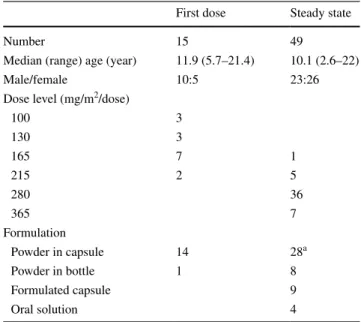
Seventy-five subjects had pharmacokinetic blood sam-ples drawn after their first dose of crizotinib (n = 15) or at steady state immediately prior to and after their morning dose (n = 60). The data from 11 subjects studied at steady state were not evaluable because the trough sample was not drawn at the appropriate time (n = 6), samples were missed (n = 2), the dose of crizotinib had been reduced for prior toxicity (n = 1), the dose was spit out (n = 1), or the pre-ceding evening dose had not been given (n = 1). The char-acteristics of the 64 subjects with evaluable data are listed in Table 1.
First‑dose pharmacokinetics
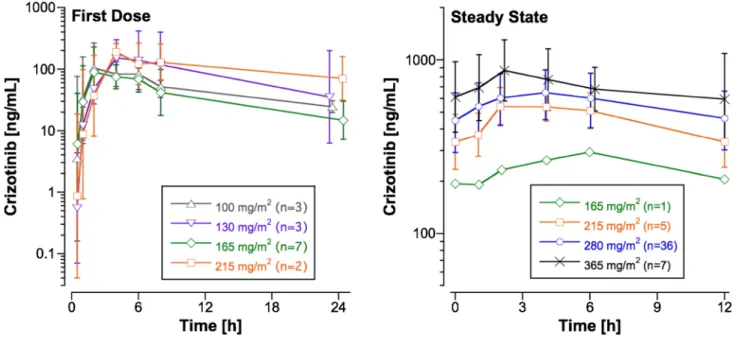
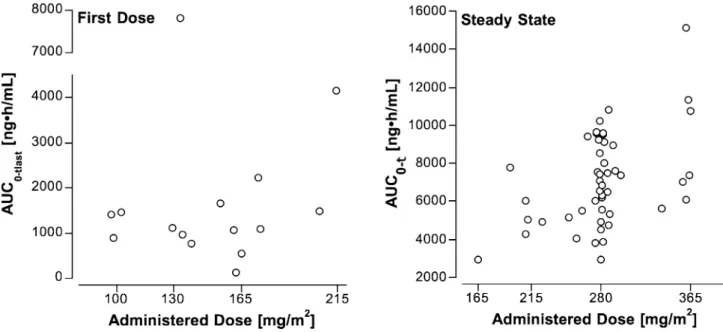
Figure 1 shows the mean plasma crizotinib concentra-tion–time profiles for subjects studied after the first dose at four dose levels, and Table 2 provides the pharmacoki-netic parameters. Figure 2 shows the relationship of dose to AUC0–tlast. AUC0–tlast does not appear to increase in proportion to the dose over the twofold dose range (100– 215 mg/m2). This may reflect the substantial inter-subject
Table 1 Subject characteristics
a One subject received a combination of powder in capsule and pow-der in bottle
First dose Steady state
Number 15 49
Median (range) age (year) 11.9 (5.7–21.4) 10.1 (2.6–22)
Male/female 10:5 23:26
Dose level (mg/m2/dose)
100 3
130 3
165 7 1
215 2 5
280 36
365 7
Formulation
Powder in capsule 14 28a
Powder in bottle 1 8
Formulated capsule 9
variability (C.V. for the AUC0–tlast normalized to the
admin-istered dose per m2 was 105%), as well as the small cohort
size and the influence of an outlier at 130 mg/m2/dose
(Fig. 2). The mean R across the four dose levels was 4.9, and the T1/2 of crizotinib estimated from the mean R was
36 h.
Steady‑state pharmacokinetics
The crizotinib plasma concentration–time profile over the 12-h dosing interval at steady state for the dose levels rang-ing from 165 to 365 mg/m2 is shown in Fig. 1, and the
mean (±SD) steady-state pharmacokinetic parameters are listed in Table 3. At steady state, the increase in AUC0–τ
is dose-proportional over the narrow dose range (215 to 365 mg/m2). The variability appears to be lower at steady
state (C.V. for the AUC0–τ normalized to the administered
dose per m2 was 30%) than after the first dose. The mean
(±SD) CL/F of crizotinib after oral dosing in children was
731 ± 241 mL/min/m2. The ratio of the steady-state peak
plasma concentration (Cmaxss ) to Css
12h at the 280 mg/m
2
dose level (n = 36) was 1.6 ± 0.5, which reflects the intra-subject variation in plasma crizotinib concentrations over the dosing interval at steady state.
A multiple regression analysis evaluating the impact of age, gender and drug formulation on the AUC0–τ
normal-ized to the administered dose per m2 at steady state in 49
subjects demonstrated that these characteristics did not account for the variability in AUC0–τ (multiple R2= 0.11;
p = 0.40). Figure 3 shows the relationship between the nor-malized AUC0–τ and age, gender and drug formulation.
Discussion
We characterized the pharmacokinetics of orally adminis-tered crizotinib in children after the first dose and at steady state (≥14 days of continuous twice daily dosing), at 6
Fig. 1 Plasma concentration–time profiles in subjects studied after the first dose and at steady state at 6 dose levels. Points are the geometric mean and error bars are the SD
Table 2 Pharmacokinetic parameters for oral crizotinib studied after the first dose in children with solid tumors or ALCL at four dose levels ranging from 100 to 215 mg/m2/dose
Fourteen of the 15 subjects received the PIC formulation. Values represent the mean ± SD Dose level (mg/m2/dose) Number of subjects C
max (ng/mL) Tmax (h) AUC0–tlast (ng h/mL) R
100 3 144 ± 97 3.3 ± 2.2 1260 ± 320 2.8 ± 1.6
130 3 236 ± 217 4.7 ± 1.1 3300 ± 3913 5.8 ± 2.9
165 7 145 ± 70 3.7 ± 2.4 1208 ± 558 5.2 ± 2.1
dose levels ranging from 100 to 365 mg/m2/dose using four
drug formulations. Crizotinib was dosed based on body surface area using a dosing nomogram. Despite differences in study design and sampling times, the pharmacokinetics of crizotinib in children appears to be similar to adults. The CL/F of crizotinib in adults was 850 mL/min/m2 after a
sin-gle fixed 250-mg dose in healthy volunteers and 600 mL/ min/m2 at steady state in adults with NSCLC [8, 9]. These
values are comparable to the mean CL/F at steady state in children of 730 mL/min/m2. The Css
max in adults with NSCLC and children is also comparable when adjusted for differences in the dose.
Blood sampling after a single oral 250-mg dose of cri-zotinib in healthy volunteers extended to 144 h, which allows for an accurate determination of the 35 h terminal T1/2 [8]. It is not feasible to withhold crizotinib dosing for 6 d to allow for extended blood sampling in children with cancer, and estimating the T1/2 from the samples collected
over 24 h yields a mean T1/2 of 11 h, which is an under-estimation of the true T1/2 rather than a true difference in
the disposition of crizotinib in children versus adults. The R calculated from the C12h after the first dose and the day 7
trough concentration in children was 4.9, which is similar to 4.5 in adult [9], and the T1/2 estimated from the mean R in children was 36 h, which is similar to the T1/2 in adult healthy volunteers. Although this is an indirect method of estimating the T1/2, it is likely to be more accurate than esti-mating it directly from the concentration–time curve after the first dose because of the limited sampling duration.
At the MTD (280 mg/m2/dose) of crizotinib in children,
the mean (±SD) Cavess is 580 (±170) ng/mL, and the mean C12hss is 480 (±180) ng/mL. Plasma protein binding of
cri-zotinib in adults is 90% [9], and free Css ave and C
ss
12h are
esti-mated to be 60 and 50 ng/mL, respectively. These free drug concentrations exceed the 10 ng/mL IC50 of crizotinib in ALCL cell lines, Karpas299 and SU-DHL-1 that express the NPM-ALK fusion protein [10], consistent with the high objective response rate to crizotinib in children with ALCL treated on the phase 1/2 trial even at doses below the MTD [6].
Fig. 2 Relationship between AUC to the last measured time point (24 h) for subjects studied after the first dose or AUC over the 12-h dosing interval at steady state and the administered dose of oral crizotinib normalized to subject’s body surface area
Table 3 Pharmacokinetic parameters for oral crizotinib studied at steady state in children with solid tumors or ALCL at four dose levels ranging from 165 to 365 mg/m2/dose
Values represent the mean ± SD
Dose level (mg/m2/dose) Number of subjects C
max (ng/mL) Tmax (h) AUC0–τ (ng h/mL) C ss
ave (ng/mL) CL/F (mL/min/m2) C ss
12h (ng/mL)
165 1 294 6 2950 246 735 205
215 5 601 ± 118 4.0 ± 1.4 5630 ± 1370 469 ± 114 652 ± 159 354 ± 133
280 36 717 ± 201 3.8 ± 1.7 6990 ± 2080 582 ± 173 736 ± 255 480 ± 176
The lactam metabolite of crizotinib, PF-06260182, is measurable in plasma, but at substantially lower concen-trations than the parent drug [8]. Although PF-06260182 is active, it is considerably less potent than crizotinib, and it is not thought to contribute significantly to the in vivo activ-ity of crizotinib [9, 11]. For this reason, we did not monitor PF-06260182 plasma concentrations in children.
In summary, the pharmacokinetics of oral crizotinib in children is similar to that in adults. A more palatable for-mulation is currently being evaluated in children. Clinical trials of crizotinib alone and in combination with chemo-therapy in children with neuroblastoma, other solid tumors and ALCL are ongoing.
Acknowledgements Pfizer provided crizotinib for the trial and Cov-ance Indianapolis performed the crizotinib HPLC/MS/MS assay with funding from Pfizer. The Children’s Oncology Group held the IND under which this trial was conducted.
Funding This clinical trial was supported by the National Cancer Institute (NCI) of the National Institutes of Health (NIH) [Award Number UM1 CA097452], Pfizer, Inc., Cookies for Kids’ Cancer Foundation, Alex’s Lemonade Stand Center of Excellence grant, and the Children’s Oncology Group.
Compliance with ethical standards
Conflict of interest F. Balis has research funding from United Ther-apeutics Corp.; Y. Mosse has research funding from Pfizer, Inc. and Novartis; E. Fox has research funding from Glaxo Smith Kline, Merck and Incyta.
Ethical approval The phase 1 clinical trial of crizotinib was reviewed and approved by the Institutional Review Boards at each participating institution, and the clinical trial was conducted in accordance with the ethical standards outlined in the Declaration of Helsinki and the US Federal Regulations governing research in human subjects.
Open Access This article is distributed under the terms of the Creative Commons Attribution 4.0 International License ( http://creativecom-mons.org/licenses/by/4.0/), which permits unrestricted use, distribu-tion, and reproduction in any medium, provided you give appropriate credit to the original author(s) and the source, provide a link to the Creative Commons license, and indicate if changes were made.
References
1. Frampton JE (2013) Crizotinib: a review of its use in the treat-ment of anaplastic lymphoma kinase-positive, advanced
non-small cell lung cancer. Drugs 73(18):2031–2051. doi:10.1007/s40265-013-0142-z
2. Cappuzzo F, Moro-Sibilot D, Gautschi O, Boleti E, Felip E, Groen HJ, Germonpre P, Meldgaard P, Arriola E, Steele N, Fox J, Schnell P, Engelsberg A, Wolf J (2015) Management of crizo-tinib therapy for ALK-rearranged non-small cell lung carcinoma: an expert consensus. Lung Cancer 87(2):89–95. doi:10.1016/j. lungcan.2014.12.010
3. Solomon BJ, Mok T, Kim DW, Wu YL, Nakagawa K, Mekhail T, Felip E, Cappuzzo F, Paolini J, Usari T, Iyer S, Reisman A, Wilner KD, Tursi J, Blackhall F (2014) First-line crizotinib ver-sus chemotherapy in ALK-positive lung cancer. N Engl J Med 371(23):2167–2177. doi:10.1056/NEJMoa1408440
4. Camidge DR, Bang YJ, Kwak EL, Iafrate AJ, Varella-Garcia M, Fox SB, Riely GJ, Solomon B, Ou SH, Kim DW, Salgia R, Fidias P, Engelman JA, Gandhi L, Janne PA, Costa DB, Shap-iro GI, Lorusso P, Ruffner K, Stephenson P, Tang Y, Wilner K, Clark JW, Shaw AT (2012) Activity and safety of crizotinib in patients with ALK-positive non-small-cell lung cancer: updated results from a phase 1 study. Lancet Oncol 13(10):1011–1019. doi:10.1016/S1470-2045(12)70344-3
5. Gambacorti-Passerini C, Messa C, Pogliani EM (2011) Cri-zotinib in anaplastic large-cell lymphoma. N Engl J Med 364(8):775–776. doi:10.1056/NEJMc1013224
6. Mosse YP, Lim MS, Voss SD, Wilner K, Ruffner K, Laliberte J, Rolland D, Balis FM, Maris JM, Weigel BJ, Ingle AM, Ahern C, Adamson PC, Blaney SM (2013) Safety and activity of crizotinib
for paediatric patients with refractory solid tumours or anaplas-tic large-cell lymphoma: a Children’s Oncology Group phase 1 consortium study. Lancet Oncol 14(6):472–480. doi:10.1016/ S1470-2045(13)70095-0
7. Murga-Zamalloa C, Lim MS (2014) ALK-driven tumors and tar-geted therapy: focus on crizotinib. Pharmacogenomics Pers Med 7:87–94. doi:10.2147/PGPM.S37504
8. Xu H, O’Gorman M, Boutros T, Brega N, Kantaridis C, Tan W, Bello A (2015) Evaluation of crizotinib absolute bioavailability, the bioequivalence of three oral formulations, and the effect of food on crizotinib pharmacokinetics in healthy subjects. J Clin Pharmacol 55(1):104–113. doi:10.1002/jcph.356
9. Hamilton G, Rath B, Burghuber O (2015) Pharmacokinetics of crizotinib in NSCLC patients. Expert Opin Drug Metab Toxicol 11(5):835–842. doi:10.1517/17425255.2015.1021685
10. Christensen JG, Zou HY, Arango ME, Li Q, Lee JH, McDon-nell SR, Yamazaki S, Alton GR, Mroczkowski B, Los G (2007) Cytoreductive antitumor activity of PF-2341066, a novel inhibi-tor of anaplastic lymphoma kinase and c-Met, in experimental models of anaplastic large-cell lymphoma. Mol Cancer Ther 6(12 Pt 1):3314–3322. doi:10.1158/1535-7163.MCT-07-0365