and Public Health
Review
Perceptions and Experiences with Flavored
Non-Menthol Tobacco Products: A Systematic Review
of Qualitative Studies
Sarah D. Kowitt1,2,*, Clare Meernik3, Hannah M. Baker2, Amira Osman2, Li-Ling Huang2and Adam O. Goldstein2,3
1 Department of Health Behavior, Gillings School of Global Public Health, University of North Carolina at
Chapel Hill, Chapel Hill, NC 27599, USA
2 Lineberger Comprehensive Cancer Center, University of North Carolina at Chapel Hill, 101 Manning Dr,
Chapel Hill, NC 27514, USA; [email protected] (H.M.B); [email protected] (A.O.); [email protected] (L.-L.H.); [email protected] (A.O.G.)
3 Department of Family Medicine, University of North Carolina at Chapel Hill, 590 Manning Drive,
Chapel Hill, NC 27599, USA; [email protected] * Correspondence: [email protected]; Tel.: +1-704-443-1811
Academic Editor: Zubair Kabir
Received: 16 February 2017; Accepted: 18 March 2017; Published: 23 March 2017
Abstract: Although a few countries have banned flavored cigarettes (except menthol), flavors in most tobacco products remain unregulated across the globe. We conducted a systematic review of qualitative studies examining perceptions of and experiences with flavored non-menthol tobacco products. Of 20 studies on flavored tobacco products included in our qualitative systematic review, 10 examined hookah, six examined e-cigarettes, two examined little cigars and cigarillos (LCCs), and three examined other tobacco products, including cigarettes. The majority of studies, regardless of product type, reported positive perceptions of flavored tobacco products, particularly among young adults and adolescents. In six studies that assessed perceptions of harm (including hookah, LCCs, and other flavored tobacco products), participants believed flavored tobacco products to be less harmful than cigarettes. In studies that examined the role of flavors in experimentation and/or initiation (including three studies on e-cigarettes, one hookah study and one LCC study), participants mentioned flavors as specifically leading to their experimentation and/or initiation of flavored tobacco products. Given that many countries have not yet banned flavors in tobacco products, these findings add to existing research on why individuals use flavored tobacco products and how they perceive harm in flavored tobacco products, providing further support for banning non-menthol flavors in most tobacco products.
Keywords:other tobacco products; tobacco control; flavored tobacco products; regulation
1. Introduction
Flavored tobacco product use among youth and young adults is high, with prevalence rates for current use (i.e., past 30 days) of any flavored tobacco product ranging from 12% among youth to 18.5% among young adults in the United States (U.S.) [1,2]. When examined by product type for young adults, use of any flavored tobacco product ranged from 3% for cigarettes (excluding menthol), to 13% for e-cigarettes, 35% for little cigars/cigarillos or bidis, and 50% for hookah. Additionally, many adolescents initiate tobacco use with flavored products [3], and flavors are one of the main reasons why youth continue to use tobacco products [3]. The 2009 Family Smoking Prevention and Tobacco Control Act authorized the U.S. Food and Drug Administration (FDA) to ban cigarettes with characterizing flavors (except for menthol) [4], but flavors in other non-cigarette tobacco products remain legal [5].
While other countries have also banned flavors in cigarettes (e.g., countries in the European Union), most countries have not enacted such bans, with very few regulating flavors in non-cigarette tobacco products [6,7].
Moreover, while comprehensive reviews have examined the public health impact of menthol tobacco products [8–13], only two systematic reviews have examined non-menthol flavored tobacco products. Feirman, et al., examined the use of and attitudes towards non-menthol flavored tobacco products in quantitative (n= 26) and qualitative (n= 6) studies published in the U.S., prior to September 2013 [14]. Huang et al. examined quantitative data (n = 40) on the role of flavors on attitudes, perceptions, intentions, initiation, and cessation of non-menthol flavored tobacco products in U.S. and non-U.S. studies published through April 2016 [15]. Qualitative research serves a complementary yet separate purpose from quantitative research; researchers often use qualitative data to gain a better understanding of the context of a problem, describe complex relationships, and explore new topics [16]. To extend these previous two reviews and further explore individuals’ perceptions of and experiences with flavored tobacco products—specifically why individuals use flavored tobacco products and how they perceive them—we conducted a systematic review of qualitative studies of non-menthol flavored tobacco products through April 2016, including international and more recent qualitative studies not previously reported [14].
2. Materials and Methods
2.1. Inclusion/Exclusion Criteria
Studies that included populations of any age, race, sex, ethnicity, or country and described individuals’ experiences with or perceptions toward non-menthol flavored tobacco products were included. We excluded articles that were not qualitative; were not English-language; were not peer-reviewed; did not contain original data about flavored tobacco products; did not address the specific impact of flavors on tobacco product perceptions and use behaviors; or limited findings to menthol flavored tobacco products only.
2.2. Data Sources and Study Selection
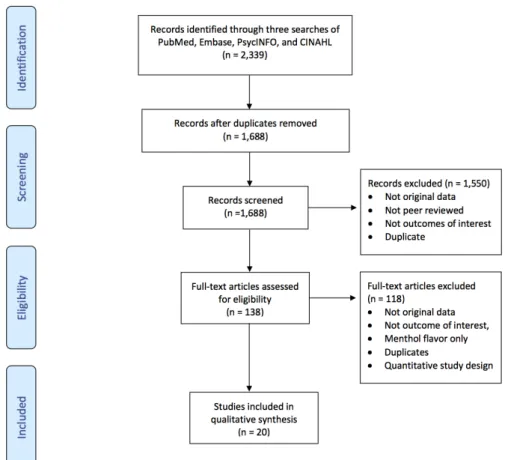
Four databases (PuBMed, Embase, PsycINFO, CINAHL) were used for our search. One author (Hannah M. Baker) searched all of the databases using cognates of “tobacco products” and “flavor” and two authors (Clare Meernik and Hannah M. Baker) conducted a manual search of the reference lists in each included article (see Figure1). Searches were conducted in three waves: March 2015, September 2015, and April 2016. There were no date restrictions regarding when articles were published. After duplicates were removed, a total of 1688 articles were found. After reviewing titles and abstracts, 138 full-text articles were assessed for eligibility. A total of 20 articles were included in the final analysis. For a full description of our search strategy and study selection, please refer to Huang et al. [15].
Figure 1. PRISMA flow diagram of article identification, screening and selection.
2.3. Data Extraction
Two authors (Clare Meernik and Hannah M. Baker) independently extracted data, which included study aim, type of flavored tobacco product, characteristics of study populations and study design, and main results and findings related to the impact of flavors in tobacco products. As findings may differ by type of flavored tobacco product, we synthesized results by type of product. We used the validated Quality Assessment Tool (QATSDD) to assess the quality of studies, [17]. The tool includes 14 criteria that apply to qualitative studies (e.g., explicit theoretical framework; description of procedure for data collection; assessment of reliability of analytic process). Two authors (Clare Meernikand Hannah M. Baker) rated each study on a 4-point scale ranging from “0 = did not address criteria at all” to “3 = completely addressed criteria”. Scores were then summed (range 0–42), with higher scores indicating higher quality. Although we did not use these criteria to rank or exclude studies, they provided information which we used in interpreting findings.
3. Results
3.1. Study Characteristics
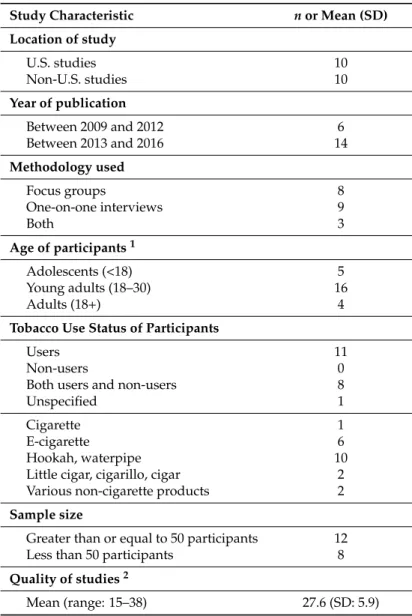
Half of the 20 studies were conducted in the U.S. (n = 10); the remaining studies were conducted in Scotland, the United Kingdom (UK), the Middle East, Canada, and Malaysia (see Table 1). All of the studies were published in 2009 or after. Half of the studies used one-on-one interviews to collect data (n = 9), while the remainder used focus groups (n = 8) or a combination of focus groups and one-on-one interviews (n = 3). The majority of study participants were young adults between the ages of 18–30, although four studies included adolescents and four studies included adults above the age of 30. In addition, studies included mainly users of tobacco products (n = 11) or both users and non-users of tobacco products (n = 8). Quality scores for included studies ranged from 15 to 38, with a mean quality score of 27.6 (Standard Deviation: 5.9) and a median score of 27.
Figure 1.PRISMA flow diagram of article identification, screening and selection.
2.3. Data Extraction
Two authors (Clare Meernik and Hannah M. Baker) independently extracted data, which included study aim, type of flavored tobacco product, characteristics of study populations and study design, and main results and findings related to the impact of flavors in tobacco products. As findings may differ by type of flavored tobacco product, we synthesized results by type of product. We used the validated Quality Assessment Tool (QATSDD) to assess the quality of studies, [17]. The tool includes 14 criteria that apply to qualitative studies (e.g., explicit theoretical framework; description of procedure for data collection; assessment of reliability of analytic process). Two authors (Clare Meernik and Hannah M. Baker) rated each study on a 4-point scale ranging from “0 = did not address criteria at all” to “3 = completely addressed criteria”. Scores were then summed (range 0–42), with higher scores indicating higher quality. Although we did not use these criteria to rank or exclude studies, they provided information which we used in interpreting findings.
3. Results
3.1. Study Characteristics
of tobacco products (n= 8). Quality scores for included studies ranged from 15 to 38, with a mean quality score of 27.6 (Standard Deviation: 5.9) and a median score of 27.
Table 1.Characteristics of included studies,n= 20.
Study Characteristic nor Mean (SD)
Location of study
U.S. studies 10
Non-U.S. studies 10
Year of publication
Between 2009 and 2012 6
Between 2013 and 2016 14
Methodology used
Focus groups 8
One-on-one interviews 9
Both 3
Age of participants1
Adolescents (<18) 5
Young adults (18–30) 16
Adults (18+) 4
Tobacco Use Status of Participants
Users 11
Non-users 0
Both users and non-users 8
Unspecified 1
Cigarette 1
E-cigarette 6
Hookah, waterpipe 10
Little cigar, cigarillo, cigar 2
Various non-cigarette products 2
Sample size
Greater than or equal to 50 participants 12
Less than 50 participants 8
Quality of studies2
Mean (range: 15–38) 27.6 (SD: 5.9)
1Categories are not mutually exclusive.2Quality scores range from 0–42.
3.2. Results by Type of Tobacco Product
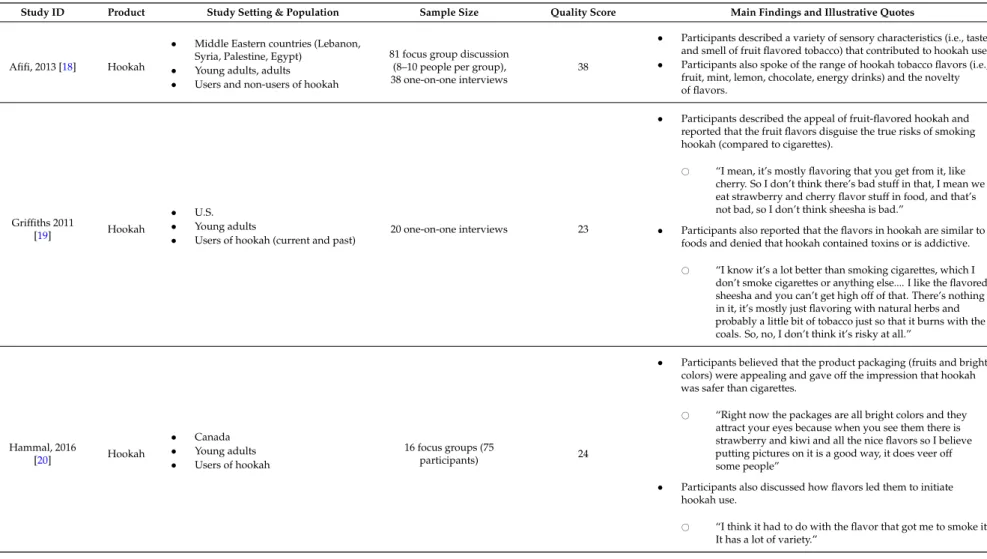
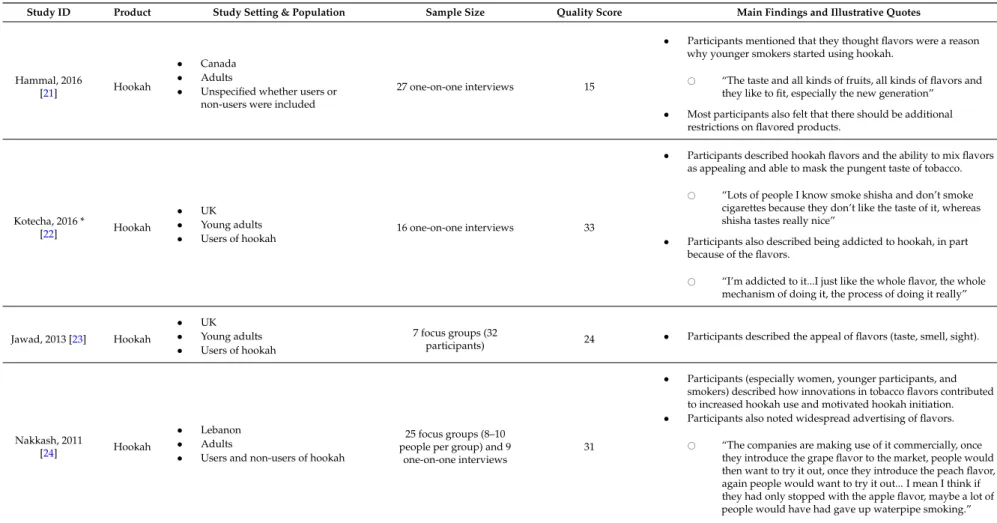
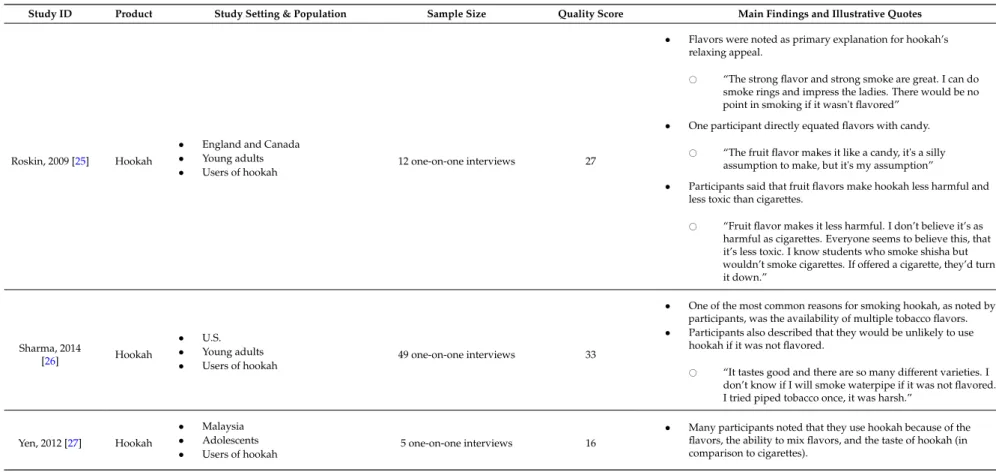
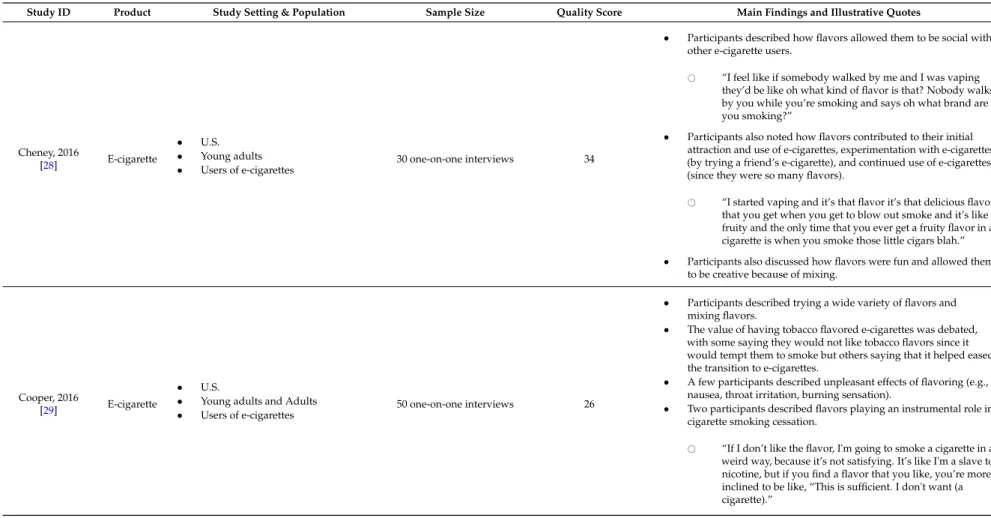
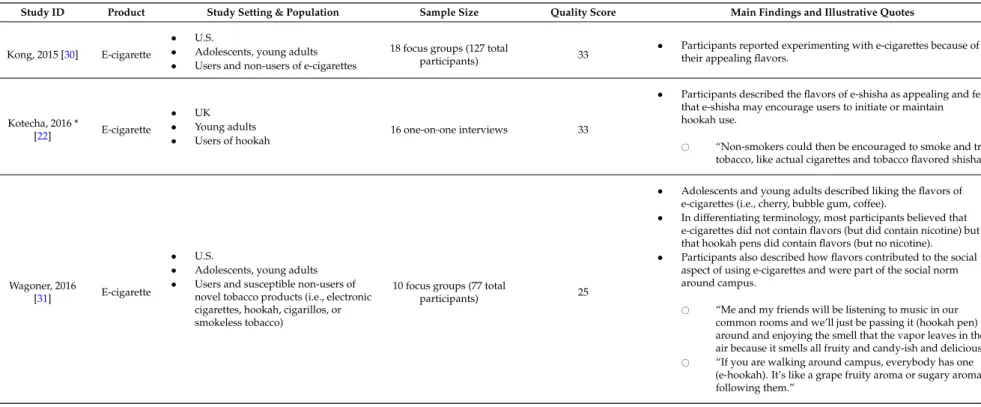
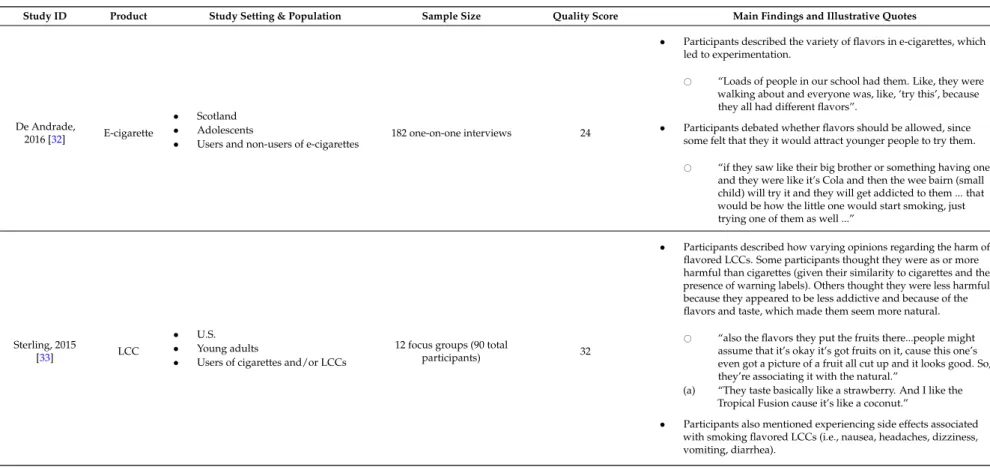
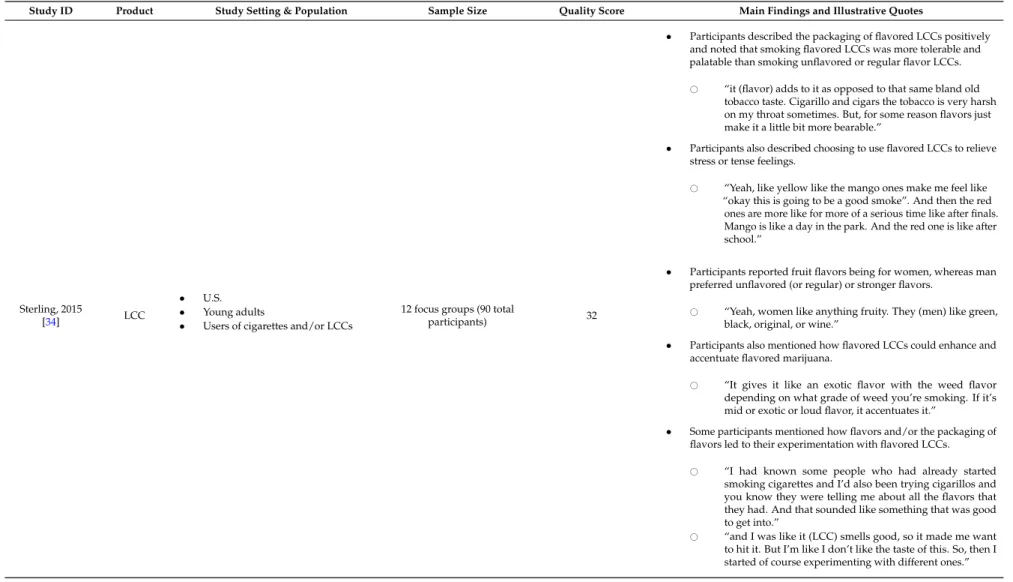
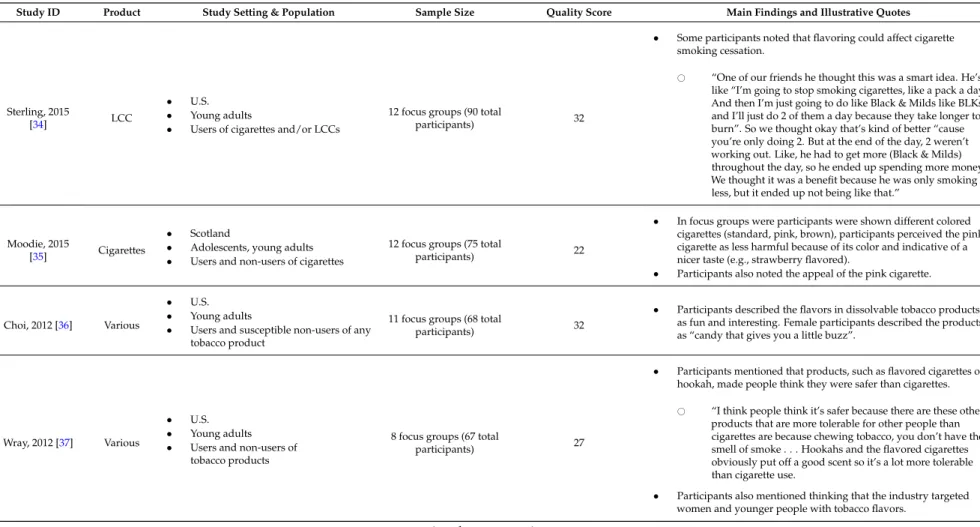
Table 2.Main study findings, organized by type of tobacco product.
Study ID Product Study Setting & Population Sample Size Quality Score Main Findings and Illustrative Quotes
Afifi, 2013 [18] Hookah
• Middle Eastern countries (Lebanon, Syria, Palestine, Egypt)
• Young adults, adults
• Users and non-users of hookah
81 focus group discussion (8–10 people per group), 38 one-on-one interviews
38
• Participants described a variety of sensory characteristics (i.e., taste and smell of fruit flavored tobacco) that contributed to hookah use.
• Participants also spoke of the range of hookah tobacco flavors (i.e., fruit, mint, lemon, chocolate, energy drinks) and the novelty of flavors.
Griffiths 2011
[19] Hookah
• U.S.
• Young adults
• Users of hookah (current and past)
20 one-on-one interviews 23
• Participants described the appeal of fruit-flavored hookah and reported that the fruit flavors disguise the true risks of smoking hookah (compared to cigarettes).
# “I mean, it’s mostly flavoring that you get from it, like cherry. So I don’t think there’s bad stuff in that, I mean we eat strawberry and cherry flavor stuff in food, and that’s not bad, so I don’t think sheesha is bad.”
• Participants also reported that the flavors in hookah are similar to foods and denied that hookah contained toxins or is addictive.
# “I know it’s a lot better than smoking cigarettes, which I don’t smoke cigarettes or anything else.... I like the flavored sheesha and you can’t get high off of that. There’s nothing in it, it’s mostly just flavoring with natural herbs and probably a little bit of tobacco just so that it burns with the coals. So, no, I don’t think it’s risky at all.”
Hammal, 2016
[20] Hookah
• Canada
• Young adults
• Users of hookah
16 focus groups (75
participants) 24
• Participants believed that the product packaging (fruits and bright colors) were appealing and gave off the impression that hookah was safer than cigarettes.
# “Right now the packages are all bright colors and they attract your eyes because when you see them there is strawberry and kiwi and all the nice flavors so I believe putting pictures on it is a good way, it does veer off some people”
• Participants also discussed how flavors led them to initiate hookah use.
Table 2.Cont.
Study ID Product Study Setting & Population Sample Size Quality Score Main Findings and Illustrative Quotes
Hammal, 2016
[21] Hookah
• Canada
• Adults
• Unspecified whether users or non-users were included
27 one-on-one interviews 15
• Participants mentioned that they thought flavors were a reason why younger smokers started using hookah.
# “The taste and all kinds of fruits, all kinds of flavors and they like to fit, especially the new generation”
• Most participants also felt that there should be additional restrictions on flavored products.
Kotecha, 2016 *
[22] Hookah
• UK
• Young adults
• Users of hookah
16 one-on-one interviews 33
• Participants described hookah flavors and the ability to mix flavors as appealing and able to mask the pungent taste of tobacco.
# “Lots of people I know smoke shisha and don’t smoke cigarettes because they don’t like the taste of it, whereas shisha tastes really nice”
• Participants also described being addicted to hookah, in part because of the flavors.
# “I’m addicted to it...I just like the whole flavor, the whole mechanism of doing it, the process of doing it really”
Jawad, 2013 [23] Hookah
• UK
• Young adults
• Users of hookah
7 focus groups (32
participants) 24 • Participants described the appeal of flavors (taste, smell, sight).
Nakkash, 2011
[24] Hookah
• Lebanon
• Adults
• Users and non-users of hookah
25 focus groups (8–10 people per group) and 9
one-on-one interviews
31
• Participants (especially women, younger participants, and smokers) described how innovations in tobacco flavors contributed to increased hookah use and motivated hookah initiation.
• Participants also noted widespread advertising of flavors.
Table 2.Cont.
Study ID Product Study Setting & Population Sample Size Quality Score Main Findings and Illustrative Quotes
Roskin, 2009 [25] Hookah
• England and Canada
• Young adults
• Users of hookah
12 one-on-one interviews 27
• Flavors were noted as primary explanation for hookah’s relaxing appeal.
# “The strong flavor and strong smoke are great. I can do smoke rings and impress the ladies. There would be no point in smoking if it wasn't flavored”
• One participant directly equated flavors with candy.
# “The fruit flavor makes it like a candy, it's a silly assumption to make, but it's my assumption”
• Participants said that fruit flavors make hookah less harmful and less toxic than cigarettes.
# “Fruit flavor makes it less harmful. I don’t believe it’s as harmful as cigarettes. Everyone seems to believe this, that it’s less toxic. I know students who smoke shisha but wouldn’t smoke cigarettes. If offered a cigarette, they’d turn it down.”
Sharma, 2014
[26] Hookah
• U.S.
• Young adults
• Users of hookah
49 one-on-one interviews 33
• One of the most common reasons for smoking hookah, as noted by participants, was the availability of multiple tobacco flavors.
• Participants also described that they would be unlikely to use hookah if it was not flavored.
# “It tastes good and there are so many different varieties. I don’t know if I will smoke waterpipe if it was not flavored. I tried piped tobacco once, it was harsh.”
Yen, 2012 [27] Hookah
• Malaysia
• Adolescents
• Users of hookah
5 one-on-one interviews 16
Table 2.Cont.
Study ID Product Study Setting & Population Sample Size Quality Score Main Findings and Illustrative Quotes
Cheney, 2016
[28] E-cigarette
• U.S.
• Young adults
• Users of e-cigarettes
30 one-on-one interviews 34
• Participants described how flavors allowed them to be social with other e-cigarette users.
# “I feel like if somebody walked by me and I was vaping they’d be like oh what kind of flavor is that? Nobody walks by you while you’re smoking and says oh what brand are you smoking?”
• Participants also noted how flavors contributed to their initial attraction and use of e-cigarettes, experimentation with e-cigarettes (by trying a friend’s e-cigarette), and continued use of e-cigarettes (since they were so many flavors).
# “I started vaping and it’s that flavor it’s that delicious flavor that you get when you get to blow out smoke and it’s like fruity and the only time that you ever get a fruity flavor in a cigarette is when you smoke those little cigars blah.”
• Participants also discussed how flavors were fun and allowed them to be creative because of mixing.
Cooper, 2016
[29] E-cigarette
• U.S.
• Young adults and Adults
• Users of e-cigarettes
50 one-on-one interviews 26
• Participants described trying a wide variety of flavors and mixing flavors.
• The value of having tobacco flavored e-cigarettes was debated, with some saying they would not like tobacco flavors since it would tempt them to smoke but others saying that it helped eased the transition to e-cigarettes.
• A few participants described unpleasant effects of flavoring (e.g., nausea, throat irritation, burning sensation).
• Two participants described flavors playing an instrumental role in cigarette smoking cessation.
Table 2.Cont.
Study ID Product Study Setting & Population Sample Size Quality Score Main Findings and Illustrative Quotes
Kong, 2015 [30] E-cigarette
• U.S.
• Adolescents, young adults
• Users and non-users of e-cigarettes
18 focus groups (127 total
participants) 33
• Participants reported experimenting with e-cigarettes because of their appealing flavors.
Kotecha, 2016 *
[22] E-cigarette
• UK
• Young adults
• Users of hookah
16 one-on-one interviews 33
• Participants described the flavors of e-shisha as appealing and felt that e-shisha may encourage users to initiate or maintain hookah use.
# “Non-smokers could then be encouraged to smoke and try tobacco, like actual cigarettes and tobacco flavored shisha.”
Wagoner, 2016
[31] E-cigarette
• U.S.
• Adolescents, young adults
• Users and susceptible non-users of novel tobacco products (i.e., electronic cigarettes, hookah, cigarillos, or smokeless tobacco)
10 focus groups (77 total
participants) 25
• Adolescents and young adults described liking the flavors of e-cigarettes (i.e., cherry, bubble gum, coffee).
• In differentiating terminology, most participants believed that e-cigarettes did not contain flavors (but did contain nicotine) but that hookah pens did contain flavors (but no nicotine).
• Participants also described how flavors contributed to the social aspect of using e-cigarettes and were part of the social norm around campus.
# “Me and my friends will be listening to music in our common rooms and we’ll just be passing it (hookah pen) around and enjoying the smell that the vapor leaves in the air because it smells all fruity and candy-ish and delicious.”
Table 2.Cont.
Study ID Product Study Setting & Population Sample Size Quality Score Main Findings and Illustrative Quotes
De Andrade,
2016 [32] E-cigarette
• Scotland
• Adolescents
• Users and non-users of e-cigarettes
182 one-on-one interviews 24
• Participants described the variety of flavors in e-cigarettes, which led to experimentation.
# “Loads of people in our school had them. Like, they were walking about and everyone was, like, ‘try this’, because they all had different flavors”.
• Participants debated whether flavors should be allowed, since some felt that they it would attract younger people to try them.
# “if they saw like their big brother or something having one and they were like it’s Cola and then the wee bairn (small child) will try it and they will get addicted to them ... that would be how the little one would start smoking, just trying one of them as well ...”
Sterling, 2015
[33] LCC
• U.S.
• Young adults
• Users of cigarettes and/or LCCs
12 focus groups (90 total
participants) 32
• Participants described how varying opinions regarding the harm of flavored LCCs. Some participants thought they were as or more harmful than cigarettes (given their similarity to cigarettes and the presence of warning labels). Others thought they were less harmful because they appeared to be less addictive and because of the flavors and taste, which made them seem more natural.
# “also the flavors they put the fruits there...people might assume that it’s okay it’s got fruits on it, cause this one’s even got a picture of a fruit all cut up and it looks good. So, they’re associating it with the natural.”
(a) “They taste basically like a strawberry. And I like the Tropical Fusion cause it’s like a coconut.”
Table 2.Cont.
Study ID Product Study Setting & Population Sample Size Quality Score Main Findings and Illustrative Quotes
Sterling, 2015
[34] LCC
12 focus groups (90 total
participants) 32
• Participants described the packaging of flavored LCCs positively and noted that smoking flavored LCCs was more tolerable and palatable than smoking unflavored or regular flavor LCCs.
# “it (flavor) adds to it as opposed to that same bland old tobacco taste. Cigarillo and cigars the tobacco is very harsh on my throat sometimes. But, for some reason flavors just make it a little bit more bearable.”
• Participants also described choosing to use flavored LCCs to relieve stress or tense feelings.
# “Yeah, like yellow like the mango ones make me feel like “okay this is going to be a good smoke”. And then the red
ones are more like for more of a serious time like after finals. Mango is like a day in the park. And the red one is like after school.”
• U.S.
• Young adults
• Users of cigarettes and/or LCCs
• Participants reported fruit flavors being for women, whereas man preferred unflavored (or regular) or stronger flavors.
# “Yeah, women like anything fruity. They (men) like green, black, original, or wine.”
• Participants also mentioned how flavored LCCs could enhance and accentuate flavored marijuana.
# “It gives it like an exotic flavor with the weed flavor depending on what grade of weed you’re smoking. If it’s mid or exotic or loud flavor, it accentuates it.”
• Some participants mentioned how flavors and/or the packaging of flavors led to their experimentation with flavored LCCs.
# “I had known some people who had already started smoking cigarettes and I’d also been trying cigarillos and you know they were telling me about all the flavors that they had. And that sounded like something that was good to get into.”
Table 2.Cont.
Study ID Product Study Setting & Population Sample Size Quality Score Main Findings and Illustrative Quotes
Sterling, 2015
[34] LCC
• U.S.
• Young adults
• Users of cigarettes and/or LCCs
12 focus groups (90 total
participants) 32
• Some participants noted that flavoring could affect cigarette smoking cessation.
# “One of our friends he thought this was a smart idea. He’s like “I’m going to stop smoking cigarettes, like a pack a day. And then I’m just going to do like Black & Milds like BLKs and I’ll just do 2 of them a day because they take longer to burn”. So we thought okay that’s kind of better “cause you’re only doing 2. But at the end of the day, 2 weren’t working out. Like, he had to get more (Black & Milds) throughout the day, so he ended up spending more money. We thought it was a benefit because he was only smoking less, but it ended up not being like that.”
Moodie, 2015
[35] Cigarettes
• Scotland
• Adolescents, young adults
• Users and non-users of cigarettes
12 focus groups (75 total
participants) 22
• In focus groups were participants were shown different colored cigarettes (standard, pink, brown), participants perceived the pink cigarette as less harmful because of its color and indicative of a nicer taste (e.g., strawberry flavored).
• Participants also noted the appeal of the pink cigarette.
Choi, 2012 [36] Various
• U.S.
• Young adults
• Users and susceptible non-users of any tobacco product
11 focus groups (68 total
participants) 32
• Participants described the flavors in dissolvable tobacco products as fun and interesting. Female participants described the products as “candy that gives you a little buzz”.
Wray, 2012 [37] Various
• U.S.
• Young adults
• Users and non-users of tobacco products
8 focus groups (67 total
participants) 27
• Participants mentioned that products, such as flavored cigarettes or hookah, made people think they were safer than cigarettes.
# “I think people think it’s safer because there are these other products that are more tolerable for other people than cigarettes are because chewing tobacco, you don’t have the smell of smoke . . . Hookahs and the flavored cigarettes obviously put off a good scent so it’s a lot more tolerable than cigarette use.
• Participants also mentioned thinking that the industry targeted women and younger people with tobacco flavors.
3.2.1. Hookah
Ten studies examined flavors in waterpipe or hookah (hereafter referred to as hookah), most of which were studies from Western countries (Scotland, Canada, UK, U.S.) (see Table2) [18–27]. In all ten studies, participants spoke about flavors as appealing and/or tasty; in five of the studies, participants also spoke positively about the widespread availability of different flavors and the ability to mix flavors [18,22,24,26,27].
In four studies from Canada, the UK, and the U.S., young adults reported that they used hookah specifically because of the flavors and noted that they would not use other tobacco products, such as cigarettes or piped tobacco [19,22,25,26]. As one young adult user said, “Lots of people I know smoke shisha and don’t smoke cigarettes because they don’t like the taste of it, whereas shisha tastes really nice” [22]. In part, these participants noted the appealing taste of flavors; they also reported believing that flavored hookah was less harmful than cigarettes, as reported in three studies from Canada, the U.S., and the UK [19,20,25]. As one young adult user said, “Fruit flavor makes it less harmful. I don’t believe it’s as harmful as cigarettes. Everyone seems to believe this, that it’s less toxic. I know students who smoke shisha but wouldn’t smoke cigarettes. If offered a cigarette, they’d turn it down” [25].
In two studies from Canada and Lebanon, adult users and non-users of hookah said that flavors were a reason why younger people used hookah [21,24], and in one study among young adults in Canada, flavors were mentioned as the reason for initiating use of hookah: “I think it had to do with the flavor that got me to smoke it. It has a lot of variety” [20]. In one study among young adults in the UK, users described being addicted to hookah, in part because of flavors [22]. Lastly, in a study with 27 adults in Canada, most participants felt that there should be additional restrictions on flavored hookah [21].
3.2.2. E-Cigarettes
Six studies examined flavors in e-cigarettes, e-hookahs, e-shisha, and vape pens (hereafter referred to as e-cigarettes) [22,28–32]. All studies discussed how flavors contributed to the appeal of e-cigarettes. Two studies from the U.S. also mentioned how flavors allowed e-cigarette users to be more social, for instance, by serving as a conversation starter or by allowing people to share flavors in social settings [28,31].
In three studies with young adults and adolescents from the U.S. and Scotland, participants mentioned how flavors contributed to their initiation, experimentation, and/or continued use of e-cigarettes or other tobacco products [28,30,32]. Young adult users of hookah in the UK described the belief that use of e-cigarettes (especially tobacco flavored) could lead to use of other tobacco products, stating, “Non-smokers could then be encouraged to smoke and try tobacco, like actual cigarettes and tobacco flavored shisha” [22]. Additionally, in a study in Scotland, some adolescents felt that e-cigarettes should be regulated because these devices could lead younger generations to start smoking [32]. Conversely, in one U.S. study, two e-cigarette users (out of 50 total participants) noted that they felt that flavors played an instrumental (positive) role in cigarette smoking cessation, stating “If I don’t like the flavor, I’m going to smoke a cigarette in a weird way, because it's not satisfying. It’s like I'm a slave to nicotine, but if you find a flavor that you like, you're more inclined to be like, “This is sufficient. I don’t want (a cigarette)” [29].
3.2.3. Little Cigars and Cigarillos (LCCs)
how flavors and their variety led to experimentation and initiation of LCCs [34]. For example, one participant said, “And I was like it (LCC) smells good, so it made me want to hit it. But I’m like I don’t like the taste of this. So, then I started of course experimenting with different ones” [34]. In this same study, participants also noted that flavored LCCs affected smoking cessation. Specifically, one participant discussed a friend who thought he could quit smoking cigarettes by using flavored LCCs since they take longer to burn. However, at the end of the day, the friend ended up smoking more flavored LCCs than originally intended and not being able to quit cigarettes. Thus, in this case, use of flavored LCCs actually perpetuated tobacco use [34].
3.2.4. Other Tobacco Products
Three studies examined flavors in other tobacco products, which included dissolvables, snus, cigarettes, and other unspecified products [35–37]. In these studies, young adults in the U.S. described the appeal of dissolvable tobacco products [36] and the belief that flavored tobacco products made people think these products were safer than cigarettes given their more tolerable odor [37]. Additionally, in one cigarette study where adolescents and young adults in Scotland were shown different colored cigarettes (standard, pink, brown), participants perceived the pink cigarette as more appealing and less harmful because it looked more like “candy sticks” and its color indicated a nicer taste, regardless of the actual flavor of the product [35].
4. Discussion
This is the first systematic review examining qualitative studies in the U.S. and internationally of non-menthol flavored tobacco products. Our review extends research by Feirman et al. [14], by including international studies, incorporating more studies on non-cigarette products, such as hookah, examining harm perceptions in addition to appeal, and reviewing recent literature published in the last three years.
Supporting previous quantitative research on the appeal of flavored tobacco products [1–3], we found that nearly all 20 studies included in our review reported positive perceptions of flavored tobacco products. Regardless of product type, common reasons for the appeal of flavored tobacco products included the availability and novelty of flavors; the attractiveness of product packaging and marketing of flavors; the associations between certain flavors and relaxation; the tastiness of flavors; the ability to mix flavors (especially for e-cigarettes); and the social aspect of sharing flavors. Moreover, all but four of these studies focused on adolescents and young adults, and all but one study focused on non-cigarette flavored tobacco products, such as hookah and e-cigarettes, suggesting that flavored tobacco products (other than cigarettes) are widely appealing to adolescents and young adults.
Most concerning in our review was the fact that in six studies that assessed harm perceptions (examining hookah, LCCs, and other flavored tobacco products), participants mentioned flavors as a reason why they perceive certain tobacco products as less harmful than cigarettes [19,20,25,33,35,37]. Prior systematic reviews from Huang et al. [15] and Feirman et al. [14] identified several quantitative studies illustrating associations between flavor descriptors and reduced harm perceptions. Our study extends these findings by highlighting potential pathways though which these associations occur. For example, product packaging including colors and flavor descriptors (e.g., fruit flavors and naturalness), and the sweet fruity smells of flavored tobacco products appear to act as implicit modified risk claims that lead users to perceive flavored products as less harmful than cigarettes. Future research should investigate ways in which flavors alter risk perception of tobacco use. Public health interventions and education campaigns could target beliefs associated with flavors to increase risk perceptions of flavored tobacco products and decrease initiation and/or consumption of such products. Moreover, given these patterns across different flavored tobacco products, regulation ofall types of flavored tobacco products (rather than some specific types) may be important.
Participants across studies mentioned how flavors led to their experimentation and/or initiation of flavored tobacco products, consistent with previous quantitative research describing the role of flavors in smoking initiation [1–3]. For instance, in a large nationally representative survey in the U.S., researchers found that the majority of youth ever-tobacco users (81%) reported that the first product they used was flavored [3]. The relationship between flavored tobacco product use and cigarette smoking cessation is less consistent. In our review, two studies (one on e-cigarettes and one on LCCs) provided participants’ perspectives on how flavors may affect cigarette use. Specifically, participants mentioned that e-cigarette flavors could aid smoking cessation (if a participant liked a flavored e-cigarette, they would not feel the need to smoke cigarettes) [29] and that flavored LCCs may deter cigarette smoking cessation (by perpetuating tobacco use) [34].
Flavors are often viewed as a major reason for young people starting out using tobacco products (often with lower nicotine) and moving up to stronger products (with higher nicotine content) over time [1]. Interestingly we found that in four hookah studies, participants noted that they would use flavored hookah, but not other tobacco products, such as cigarettes [19,22,25,26]. On the other hand, in two e-cigarette studies, participants noted that use of flavored e-cigarettes could lead to use of other tobacco products, such as hookah or cigarettes [22,32]. These findings suggest that flavored hookah or e-cigarettes may appeal to different segments of the population than cigarettes. Given associations between initiation of flavored tobacco products in youth or young adulthood and established tobacco use later in life [1], our results suggest the potential of flavors to introduce youth to other tobacco products, but that these patterns may differ by type of product first used. Future longitudinal research could examine whether the type of flavored tobacco products plays a differential role in tobacco use patterns throughout the life course.
Limitations
tool, there are no published thresholds for what constitutes low, medium, or high quality. As a result, we did not use criteria to rank or exclude studies. Instead, since 95% of the studies included in our review met at least 50% of the recommended criteria in our quality assessment tool (i.e., the highest score of 42), we retained all eligible studies and did not exclude articles based on quality information. Last, our review focused on perceptions and experiences with non-menthol flavored tobacco products. While previous reviews have examined the public health impact of menthol [8–13], future research could explore the role of menthol in attitudinal and behavioral outcomes among diverse populations and various tobacco products.
5. Conclusions
Our review extends findings from quantitative studies on flavored tobacco products and provide insights into perceptions of and experiences with flavored tobacco products. More specifically, we found that in nearly all 20 studies included in our review, participants reported positive perceptions of flavored tobacco products and mentioned how flavors led to their experimentation and/or initiation of flavored tobacco products. Moreover, all but four of these studies focused on adolescents and young adults, and all but one study focused on non-cigarette flavored tobacco products, such as hookah and e-cigarettes, suggesting that flavored tobacco products (other than cigarettes) are widely appealing to this population. Our findings provide additional support to ban non-menthol flavors in tobacco products in the US and internationally, especially to curb tobacco use among youth.
Acknowledgments:Research reported in this publication was supported by grant number P50 CA180907 from the National Cancer Institute and the FDA Center for Tobacco Products (CTP). The content is solely the responsibility of the authors and does not necessarily represent the official views of the NIH or the Food and Drug Administration.
Author Contributions:Adam O. Goldstein and Li-Ling Huang designed the idea for the review; Clare Meernik, Hannah M. Baker, and Li-Ling Huang performed the searches, reviewed articles, and extracted the data from included articles; Sarah D. Kowitt and Amira Osman drafted the outline for the manuscript and determined how to frame study findings; Sarah D. Kowitt analyzed the data; Clare Meernik, Hannah M. Baker, Li-Ling Huang, Amira Osman, and Adam O. Goldstein contributed ideas to analyze and interpret the data; Sarah D. Kowitt wrote the first draft of the paper, which was revised by all authors. All authors read and approved the final manuscript.
Conflicts of Interest:The authors declare no conflict of interest. The founding sponsors had no role in the design of the study; in the collection, analyses, or interpretation of data; in the writing of the manuscript, and in the decision to publish the results.
References
1. Villanti, A.C.; Richardson, A.; Vallone, D.M.; Rath, J.M. Flavored tobacco product use among U.S. young adults.Am. J. Prev. Med.2013,44, 388–391. [CrossRef] [PubMed]
2. Corey, C.G.; Ambrose, B.K.; Apelberg, B.J.; King, B.A. Flavored tobacco product use among middle and high school students—United States, 2014.Morb. Mortal. Wkly. Rep.2015,64, 1066–1070. [CrossRef] [PubMed] 3. Ambrose, B.K.; Day, H.R.; Rostron, B.; Conway, K.P.; Borek, N.; Hyland, A.; Villanti, A.C. Flavored tobacco
product use among U.S. youth aged 12–17 years, 2013–2014. JAMA2015, 314, 1871–1873. [CrossRef]
[PubMed]
4. Public Law 111-31 H.R. 1256. Family Smoking Prevention and Tobacco Control Act. Available online:http:
//www.gpo.gov/fdsys/pkg/PLAW-111publ31/pdf/PLAW-111publ31.pdf(accessed on 25 August 2016).
5. Food and Drug Administration. Deeming tobacco products to be subject to the federal food, drug, and cosmetic act, as amended by the family smoking prevention and tobacco control act; regulations on the sale and distribution of tobacco products and required warning statements for tobacco products.Fed. Regist. 2016,79, 1–499.
6. European Commission. 10 Key Changes for Tobacco Products Sold in the EU. Available online: http:
//europa.eu/rapid/press-release_IP-16--1762_en.htm(acessed on 22 September 2016).
8. Anderson, S.J. Menthol cigarettes and smoking cessation behaviour: A review of tobacco industry documents.
Tob. Control2011,20, ii49–ii56. [CrossRef] [PubMed]
9. Lee, Y.O.; Glantz, S.A. Menthol: Putting the pieces together.Tob. Control2011,20, ii1–ii7. [PubMed] 10. Kreslake, J.M.; Wayne, G.F.; Connolly, G.N. The menthol smoker: Tobacco industry research on consumer
sensory perception of menthol cigarettes and its role in smoking behavior.Nicotine Tob. Res.2008,10, 705–715.
[CrossRef] [PubMed]
11. Yerger, V.B.; McCandless, P.M. Menthol sensory qualities and smoking topography: A review of tobacco industry documents.Tob. Control2011,20, ii37–ii43. [CrossRef] [PubMed]
12. Food and Drug Administration. Preliminary Scientific Evaluation of the Possible Public Health Effects of Menthol Versus Nonmenthol Cigarettes. Available online: https://www.fda.gov/downloads/ ScienceResearch/SpecialTopics/PeerReviewofScientificInformationandAssessments/UCM361598.pdf (acessed on 15 March 2017).
13. Tobacco Products Scientific Advisory Committee. Menthol Cigarettes and Public Health: Review of the Scientific Evidence and Recommendations. Available online: https://www.fda.gov/downloads/ AdvisoryCommittees/CommitteesMeetingMaterials/TobaccoProductsScientificAdvisoryCommittee/
UCM269697.pdf(acessed on 15 March 2017).
14. Feirman, S.P.; Lock, D.; Cohen, J.E.; Holtgrave, D.R.; Li, T. Flavored tobacco products in the United States: A systematic review assessing use and attitudes.Nicotine Tob. Res.2016,18, 739–749. [CrossRef] [PubMed] 15. Huang, L.L.; Baker, H.M.; Meernik, C.; Ranney, L.M.; Richardson, A.; Goldstein, A.O. Impact of non-menthol
flavours in tobacco products on perceptions and use among youth, young adults and adults: A systematic review.Tob. Control2016. [CrossRef]
16. Creswell, J.W.Qualitative inquiry and Research Design: Choosing among Five Approaches; SAGE: Thousand Oaks, CA, USA, 2013.
17. Sirriyeh, R.; Lawton, R.; Gardner, P.; Armitage, G. Reviewing studies with diverse designs: The development and evaluation of a new tool.J. Eval. Clin. Pract.2012,18, 746–752. [CrossRef] [PubMed]
18. Afifi, R.; Khalil, J.; Fouad, F.; Hammal, F.; Jarallah, Y.; Abu Farhat, H.; Ayad, M.; Nakkash, R. Social norms and attitudes linked to waterpipe use in the eastern Mediterranean region.Soc. Sci. Med.2013,98, 125–134.
[CrossRef] [PubMed]
19. Griffiths, M.A.; Harmon, T.R.; Gilly, M.C. Hubble bubble trouble: The need for education about and regulation of hookah smoking.J. Public Policy Mark.2011,30, 119–132. [CrossRef]
20. Hammal, F.; Wild, T.C.; Nykiforuk, C.; Abdullahi, K.; Mussie, D.; Finegan, B.A. Waterpipe (hookah) smoking among youth and women in Canada is new, not traditional.Nicotine Tob. Res.2016,18, 757–762. [CrossRef]
[PubMed]
21. Hammal, F.; Wild, T.C.; Finegan, B.A. Knowledge about the waterpipe (hookah), a qualitative assessment among community workers in a major urban center in Canada. J. Community Health2016,41, 689–696.
[CrossRef] [PubMed]
22. Kotecha, S.; Jawad, M.; Iliffe, S. Knowledge, attitudes and beliefs towards waterpipe tobacco smoking and electronic shisha (e-shisha) among young adults in London: A qualitative analysis.Prim. Health Care Res. Dev. 2016,17, 166–174. [CrossRef] [PubMed]
23. Jawad, M.; Jawad, S.; Mehdi, A.; Sardar, A.; Jawad, A.M.; Hamilton, F.L. A qualitative analysis among regular waterpipe tobacco smokers in London universities.Int. J. Tuberc. Lung Dis.2013,17, 1364–1369. [PubMed] 24. Nakkash, R.T.; Khalil, J.; Afifi, R.A. The rise in narghile (shisha, hookah) waterpipe tobacco smoking:
A qualitative study of perceptions of smokers and non smokers.BMC Public Health2011,11, 315. [CrossRef]
[PubMed]
25. Roskin, J.; Aveyard, P. Canadian and english students’ beliefs about waterpipe smoking: A qualitative study.
BMC Public Health2009,9, 10.
26. Sharma, E.; Clark, P.I.; Sharp, K.E. Understanding psychosocial aspects of waterpipe smoking among college students.Am. J. Health Behav.2014,38, 440–447. [CrossRef] [PubMed]
27. Yen, K.P.; Harun, N.; Ishak, F.; Anuar, N.A.I.M.; Karim, N.A.; Azman, A.; Mahmood, T.S.T. Contributory factors to the smoking of shisha among teenagers in the perak city of Ipoh: A preliminary qualitative survey.
Int. J. Public Health Res.2012,2, 80–84.
29. Cooper, M.; Harrell, M.B.; Perry, C.L. A qualitative approach to understanding real-world electronic cigarette use: Implications for measurement and regulation.Prev. Chronic Dis.2016,13, E07. [PubMed]
30. Kong, G.; Morean, M.E.; Cavallo, D.A.; Camenga, D.R.; Krishnan-Sarin, S. Reasons for electronic cigarette experimentation and discontinuation among adolescents and young adults. Nicotine Tob. Res. 2015,17, 847–854. [CrossRef] [PubMed]
31. Wagoner, K.G.; Cornacchione, J.; Wiseman, K.D.; Teal, R.; Moracco, K.E.; Sutfin, E.L. E-cigarettes, hookah pens and vapes: Adolescent and young adult perceptions of electronic nicotine delivery systems.Nicotine Tob. Res. 2016,18, 2006–2012. [CrossRef] [PubMed]
32. De Andrade, M.; Angus, K.; Hastings, G. Teenage perceptions of electronic cigarettes in Scottish tobacco-education school interventions: Co-production and innovative engagement through a pop-up radio project.Perspect. Public Health2016,136, 288–293. [PubMed]
33. Sterling, K.L.; Fryer, C.S.; Fagan, P. The most natural tobacco used: A qualitative investigation of young adult smokers’ risk perceptions of flavored little cigars and cigarillos.Nicotine Tob. Res.2016,18, 827–833.
[CrossRef] [PubMed]
34. Sterling, K.L.; Fryer, C.S.; Nix, M.; Fagan, P. Appeal and impact of characterizing flavors on young adult small cigar use.Tob. Regul. Sci.2015,1, 42–53. [CrossRef] [PubMed]
35. Moodie, C.; Ford, A.; Mackintosh, A.; Purves, R. Are all cigarettes just the same? Female’s perceptions of slim, coloured, aromatized and capsule cigarettes.Health Educ. Res.2015,30, 1–12. [CrossRef] [PubMed] 36. Choi, K.; Fabian, L.; Mottey, N.; Corbett, A.; Forster, J. Young adults’ favorable perceptions of snus,
dissolvable tobacco products, and electronic cigarettes: Findings from a focus group study. Am. J. Public Health2012,102, 2088–2093. [CrossRef] [PubMed]
37. Wray, R.J.; Jupka, K.; Berman, S.; Zellin, S.; Vijaykumar, S. Young adults’ perceptions about established and emerging tobacco products: Results from eight focus groups.Nicotine Tob. Res.2012,14, 184–190. [PubMed] 38. World Health Organization. Waterpipe Tobacco Smoking: Health Effects, Research Needs and Recommended Actions by Regulators. Available online: http://www.who.int/tobacco/global_interaction/tobreg/
Waterpiperecommendation_Final.pdf(accessed on 7 March 2017).
39. Centers for Disease Control and Prevention. Cigars. Smoking & Tobacco Use. Available online: https:
//www.cdc.gov/tobacco/data_statistics/fact_sheets/tobacco_industry/cigars/(accessed on 7 March 2017).
40. Slotkin, T.A. Cholinergic systems in brain development and disruption by neurotoxicants: Nicotine, environmental tobacco smoke, organophosphates.Toxicol. Appl. Pharmacol.2004,198, 132–151. [CrossRef] [PubMed] 41. Grana, R.A. Electronic cigarettes: A new nicotine gateway?J. Adolesc. Health2013,52, 135–136. [PubMed] 42. Pediatrics, A.A.O. Electronic nicotine delivery systems.Pediatrics2015,136, 9.
43. McRobbie, H.; Bullen, C.; Hartmann-Boyce, J.; Hajek, P. Electronic cigarettes for smoking cessation and reduction.Cochrane Database Syst. Rev.2014,12, CD010216.
44. Dwyer, J.B.; McQuown, S.C.; Leslie, F.M. The dynamic effects of nicotine on the developing brain.
Pharmacol. Ther.2009,122, 125–139. [CrossRef] [PubMed]
45. Leventhal, A.M.; Strong, D.R.; Kirkpatrick, M.G.; Unger, J.B.; Sussman, S.; Riggs, N.R.; Stone, M.D.; Khoddam, R.; Samet, J.M.; Audrain-McGovern, J. Association of electronic cigarette use with initiation of combustible tobacco product smoking in early adolescence.JAMA2015,314, 700–707. [CrossRef] [PubMed] 46. Wills, T.A.; Knight, R.; Sargent, J.D.; Gibbons, F.X.; Pagano, I.; Williams, R.J. Longitudinal study of e-cigarette use and onset of cigarette smoking among high school students in Hawaii. Tob. Control2016,26, 34–39.
[CrossRef] [PubMed]
47. Barrington-Trimis, J.L.; Urman, R.; Berhane, K.; Unger, J.B.; Cruz, T.B.; Pentz, M.A.; Samet, J.M.; Leventhal, A.M.; McConnell, R. E-cigarettes and future cigarette use. Pediatrics 2016, 138, e20160379.
[PubMed]
48. Bunnell, R.E.; Agaku, I.T.; Arrazola, R.A.; Apelberg, B.J.; Caraballo, R.S.; Corey, C.G.; Coleman, B.N.; Dube, S.R.; King, B.A. Intentions to smoke cigarettes among never-smoking us middle and high school electronic cigarette users: National youth tobacco survey, 2011–2013.Nicotine Tob. Res.2015,17, 228–235.
[CrossRef] [PubMed]