Suicide ideation among high-risk adolescent females: Examining
the interplay between parasympathetic regulation and
friendship support
MATTEO GILETTA,aPAUL D. HASTINGS,bKAREN D. RUDOLPH,cDANIEL J. BAUER,d
MATTHEW K. NOCK,eANDMITCHELL J. PRINSTEINd
aTilburg University, Tilburg;bUniversity of California, Davis;cUniversity of Illinois Urbana–Champaign;dUniversity of North
Carolina at Chapel Hill; andeHarvard University
Abstract
Poor physiological self-regulation has been proposed as a potential biological vulnerability for adolescent suicidality. This study tested this hypothesis by examining the effect of parasympathetic stress responses on future suicide ideation. In addition, drawing from multilevel developmental psychopathology theories, the interplay between parasympathetic regulation and friendship support, conceptualized as an external source of regulation, was examined. At baseline, 132 adolescent females (Mage¼14.59,SD¼1.39) with a history of mental health concerns participated in an in vivo interpersonal stressor (a laboratory speech task) and completed self-report measures of depressive symptoms and perceived support within a close same-age female friendship. Respiratory sinus arrhythmia (RSA) was measured before and during the speech task. Suicide ideation was assessed at baseline and at 3, 6, and 9 months follow-up. The results revealed that females with greater relative RSA decreases to the laboratory stressor were at higher risk for reporting suicide ideation over the subsequent 9 months. Moreover, parasympathetic responses moderated the effect of friendship support on suicide ideation; among females with mild changes or higher relative increases in RSA, but not more pronounced RSA decreases, friendship support reduced risk for future suicide ideation. Findings highlight the crucial role of physiological and external regulation sources as protective factors for youth suicidality.
Suicidal behavior is one of the most perplexing psychological problems faced by humans. Suicide currently is the 10th ing cause of death in the United States, and it is the 3rd lead-ing cause of death among adolescents and young adults (Cen-ters for Disease Control and Prevention,2014). The risk of suicidal behavior is virtually absent during childhood but in-creases dramatically in early adolescence, with 12% of ado-lescents reporting that they have seriously considered killing themselves and 4% making an actual suicide attempt (Nock et al.,2013). Thus, there is a great need to better understand what factors lead so many adolescents to consider ending their lives.
Prior research on the risk factors for suicide ideation has highlighted the importance of demographic factors (e.g., fe-males are at elevated risk for suicide ideation; Nock et al.,
2013) and psychiatric risk factors (e.g., the presence and ac-cumulation of mental disorders increase risk of suicide idea-tion; Bridge, Goldstein, & Brent,2006; Hawton, Saunders, &
O’Connor,2012). However, we do not yet have a firm under-standing of why some adolescents with these risk factors go on to consider suicide, whereas others do not. Some theoreti-cal models of suicide (e.g., escape theories of suicide) pro-pose that suicide ideation represents an attempt to escape from extreme, aversive emotional distress, which may emerge among individuals with poor emotion regulation, especially in response to stressful events (Baumeister,1990; Linehan,
1993).
Empirical studies have provided some support for this per-spective. For instance, emotion dysregulation has been found to predict suicide ideation during adolescence (e.g., Najmi, Wegner, & Nock,2007; Tama´s et al.,2007), and adolescents who consider and attempt suicide report that the primary mo-tivation for their behavior was to escape from unbearable cir-cumstances (Boergers, Spirito, & Donaldson,1998). How-ever, whereas research has acknowledged the key role of self-regulation processes in predicting adolescent suicide ideation, the majority of existing work in this area has relied on self-report measures of emotion regulation, paying little at-tention to physiological self-regulation (e.g., parasympathetic regulation), particularly in response to acute stressors. More importantly, although developmental psychopathology theory and research has extensively demonstrated that the dynamic interplay of multilevel risk factors is implicated in the etiol-ogy of mental disorders (Cicchetti,2008; Crowell, Derbidge,
Address correspondence and reprint requests to: Matteo Giletta, Depart-ment of DevelopDepart-mental Psychology, Tilburg University, P.O. Box 90153, 5000 LE, Tilburg, The Netherlands; E-mail:[email protected]; or Mitch Prin-stein, Department of Psychology, University of North Carolina at Chapel Hill, Davie Hall, Campus Box 3270, Chapel Hill, NC 27599-3270; E-mail: [email protected].
This work was supported in part by National Institute of Mental Health Grant R01-MH085505.
doi:10.1017/S0954579416001218
& Beauchaine, 2014), suicide studies rarely have adopted such a perspective. Specifically, little is known about how in-dividual differences in biological reactivity to the social ronment (e.g., parasympathetic regulation) interact with envi-ronmental factors (e.g., external sources of regulation) to predict the occurrence of suicide ideation over time. The cur-rent study was designed to address this gap in the literature. Specifically, drawing from multilevel perspectives of psycho-pathology and suicide (e.g., Cicchetti, 2008; Derbidge & Beauchaine,2014), parasympathetic regulation (a physiolog-ical index of self-regulation) and its interplay with friendship support, conceptualized as an external source of regulation, were examined as longitudinal predictors of suicide ideation in a sample of high-risk adolescent females.
Parasympathetic Regulation and Adolescent Suicide Ideation
Adolescence is a crucial developmental period for studying the role of physiological stress responses in the etiology of suicide ideation. During adolescence, biological changes as-sociated with the pubertal transition exert a strong impact on brain function, stress responses, and potentially on youth de-cision making and behavior. Specifically, gonadal hormones induce maturational changes in the limbic regions (e.g., amygdala and ventral striatum) that underlie social–affective processes, leading to increased social orientation and sensi-tivity (Blakemore, Burnett, & Dahl, 2010; Crone & Dahl,
2012; Forbes & Dahl,2010). Changes in the limbic system are accompanied by more gradual changes in the cognitive control systems (e.g., prefrontal cortex), which mature throughout adolescence (Casey, Jones, & Hare,2008). Con-sequently, adolescents exhibit heightened emotional and physiological sensitivity to social cues, but relatively low self-regulation (Casey et al., 2008; Somerville, Jones, & Casey,2010). Despite the adaptive value of these normative developmental changes, they also may act as biological vul-nerabilities. This may be the case especially for youth with a history of psychopathological symptoms (e.g., depressive and anxiety symptoms), who likely are exposed to greater stressors and among which these developmental processes may be particularly powerful (Forbes, Phillips, Silk, Ryan, & Dahl,2011; Luciana,2013).
Parasympathetic nervous system (PNS) activity has been associated with self-regulatory processes (e.g., Beauchaine,
2001; Calkins & Fox, 2002), and therefore may be highly relevant for understanding the occurrence of adolescent sui-cide ideation. The PNS exerts control over heart rate via the myelinated vagus nerve originating in the nucleus ambiguus (Porges,2007). Specifically, cardiac vagal tone, as indexed by respiratory sinus arrhythmia (RSA), reflects the chronotro-pic influence of the parasympathetic vagus nerve on heart rate (Berntson, Cacioppo, & Quigley,1993). The polyvagal the-ory provides an evolutionary-based framework for under-standing how the vagus nerve evolved in mammals to regulate social behavior (Porges,1995,2003,2007). In environments
that are perceived as safe, maintaining or increasing PNS ac-tivity (also referred to as PNS augmentation) facilitates calm social engagement by acting as a brake on the sympathetic nervous system (SNS; e.g., reducing heart rate). Situations that are novel and salient but nonthreatening evoke a mild decrease in PNS influence, which supports orienting and at-tending to the context. However, in response to social and emotional situations perceived as threatening or stressful, greater PNS withdrawal, indexed by strong RSA decreases (also referred to as RSA suppression), occurs within milli-seconds, “releasing the brake” on SNS activation of arousal (i.e., allowing “fight or flight” responses). In this regard, Por-ges (2003) has coined the termneuroceptionto suggest that RSA changes in response to a stimulus can reveal how an in-dividual has implicitly evaluated the safety or social meaning of that stimulus. Thus, neuroception, as a subconscious pro-cess through which individuals evaluate their social environ-ment, influences autonomic nervous system responses and consequently individual behavior in terms of social engage-ment, emotion expression, and regulation. As such, the PNS response, as indexed by RSA changes, has been pro-posed as a physiological marker of self-regulation (Beau-chaine,2001,2012; Hastings, Kahle, & Han,2014).
Empirical work has supported this notion in children and adolescents. Dynamic changes in RSA in response to affec-tively challenging events and contexts are essential for flex-ibly mobilizing adaptive responses (Hastings, Kahle, et al.,
2014). High levels of resting RSA and moderate decreases to stressful or emotionally evocative stimuli are indicative of adaptive physiological self-regulation (Beauchaine,
2001; Hastings, Kahle, et al., 2014). Conversely, children and adolescents with lower levels of resting RSA and who display dysregulated RSA responses (e.g., either excessive decreases or increases) to stressful or emotional stimuli show higher levels of internalizing as well as externalizing symptoms and are at increased risk for developing symptoms of psychopathology over time (for a review, see Graziano & Derefinko, 2013). However, existing findings are inconclu-sive with regard to whether exaggerated decreases in RSA (and hence, increased autonomic arousal) or insufficient de-creases or even inde-creases in RSA (decreased autonomic arousal) pose risk for psychopathology. Although the results from a recent meta-analysis revealed small effects supporting a negative association between RSA decreases and psycho-pathological symptoms (Graziano & Derefinko, 2013), studies have shown mixed findings in relation to both exter-nalizing (e.g., Beauchaine, Gatzke-Kopp, & Mead, 2007; Fortunato, Gatzke-Kopp, & Ram,2013) and especially inter-nalizing symptoms (e.g., Gentzler, Santucci, Kovacs, & Fox,
2009; Shanahan, Calkins, Keane, Kelleher, & Suffness,
re-cent theoretical perspectives suggest that excessive PNS withdrawal in response to emotionally evocative stimuli, indicating an overwhelming physiological state (extreme arousal), may increase risk for suicide ideation (e.g., Crowell et al.,2014; Derbidge & Beauchaine,2014). To our knowl-edge, only one study examined the association between RSA and suicidal behavior among adolescents. In that study, parasuicidal adolescent females (i.e., suicidal and nonsuicidal self-injurious females) had lower resting RSA and greater RSA decreases to emotional stimuli as compared to controls (Crowell et al.,2005). However, it remains unknown whether PNS activity could serve as physiological markers to identify adolescents who are more likely to consider suicide at a later point in time. Moreover, the extent to which individual differ-ences in parasympathetic regulation may interact with envi-ronmental factors to predict longitudinally suicide ideation among adolescents has never been examined.
Friendship Support and Adolescent Suicide Ideation
Many theories of suicide recognize social support as a key factor that influences the occurrence of suicide ideation. For instance, according to the interpersonal theory of suicide (Van Orden et al.,2010), supportive relationships contribute to satisfying the individual’s innate need to belong that, if thwarted, increases risk for suicide ideation. The notion of so-cial support as benefiso-cial for adaptive development is not spe-cific to theories of suicide. Traditional and more recent inter-personal theories of emotion regulation (e.g., attachment theory, Bowlby,1969; relational regulation theory, Lakey & Orehek,2011) have emphasized that supportive dyadic rela-tionships serve as external sources of regulation. Specifically, high-quality relationships that are perceived as supportive provide an intimate environment that may facilitate regulatory processes, often via everyday interactions, eventually confer-ring benefits for individuals’ mental health (Diamond & As-pinwall, 2003; Lakey & Orehek, 2011; Zaki & Williams,
2013).
Whereas parents likely are the most relevant supportive environment throughout childhood, the role of peers, espe-cially friends, increases during adolescence (Zeman, Cas-sano, & Adrian,2013). Adolescents’ enhanced peer orienta-tion and their sensitivity toward peers contribute to a gradual shift in their support networks (Crone & Dahl,2012; Forbes & Dahl,2010). That is, perceived parental closeness and sup-port decline from early adolescence, whereas friends become gradually more important (e.g., De Goede, Branje, & Meeus,
2009; Laursen, DeLay, & Adams,2010). Adolescents spend increasing amounts of their time with friends but the qualita-tive nature of their friendships also changes. Friendship inti-macy increases and friends become a crucial source of sup-port, especially among females (e.g., Furman & Buhrmester,
1992; McNelles & Connolly, 1999; Rose & Rudolph,
2006). Thus, during adolescence, a high-quality and suppor-tive friendship may provide a developmentally salient context that facilitates self-regulation (Zeman et al.,2013) and
there-fore may reduce risk for suicide ideation. Given that adoles-cent females tend to rely more than males on external sources of regulation and to seek social support more often in re-sponse to stress, friendship support may be a specifically rel-evant factor to examine in relation to female suicide ideation (Rose & Rudolph,2006; Taylor et al.,2000). A large body of empirical research shows that supportive friendships may re-duce suicide ideation during adolescence, especially among females (e.g., Prinstein, Boergers, Spirito, Little, & Grapen-tine,2000; Sun & Hui,2007; for a review, see King & Mer-chant,2008).
Despite evidence linking friendship support to suicide ideation, to date no study has investigated the joint effects of friendship support and parasympathetic regulation on sui-cide ideation. Examining the synergistic effect between phys-iological self-regulation and external regulation sources may better contribute to understanding youth psychological devel-opment and therefore identifying youth at risk for mental health problems, including suicide ideation (see Crowell et al.,2014).
The Joint Effect of Parasympathetic Regulation and Friendship Support
Although prior work provided evidence for the main effects of RSA on youth maladjustment, these effects generally have been small in size and, as discussed earlier, inconsistent across studies (Graziano & Derefinko,2013). These findings suggest that RSA responses may not necessarily pose a direct risk for adolescent psychopathology but may likely interact with other factors, such as environmental factors. That is, parasympathetic responses may mark individual differences in sensitivity to the social environment and therefore should be expected to differentially predict adjustment across differ-ent social contexts. This notion is consistdiffer-ent with multilevel perspectives of psychopathology (e.g., Cicchetti,2008).
higher risk for maladjustment when exposed to adverse social experiences, the same individuals show better adjustment in the presence of adaptive and positive environments (e.g., sup-portive parents or peers). According to these perspectives, the same individuals are expected to be more susceptible (i.e., sensitive) to both the negative and the positive effects of their surrounding environment.
Empirical support for both hypotheses has been provided. In line with diathesis–stress models, some studies have docu-mented that youth exposed to adverse family contexts, char-acterized for instance by low levels of emotional support and high levels of psychopathology, were at greater risk for psy-chopathological symptoms when they had dysregulated RSA activity (i.e., low resting RSA and excessive RSA de-creases or inde-creases to laboratory stimuli) than when they had typical RSA activity (e.g., Hastings, Klimes-Dougan, et al.,2014; Shanahan et al.,2014). Consistent with plasticity models, other studies have shown that, among youth with dysregulated RSA activity, exposure to poor family environ-ments was associated with increased risk for psychopathol-ogy but living in positive family contexts posed beneficial ef-fects (e.g., Diamond, Fagundes, & Cribbet,2012; Obradovic´, Bush, & Boyce,2011; Obradovic´, Bush, Stamperdahl, Adler, & Boyce,2010). However, this work almost exclusively ex-amined various characteristics of youths’ family contexts throughout childhood, with little attention to PNS regulation as potential marker of sensitivity to the peer environment dur-ing adolescence, when peers become a primary interactional context.
Diathesis–stress models and plasticity models provide highly valuable frameworks to guide suicide research and identify individual physiological profiles that may act as vul-nerability or susceptibility factors by altering the effects of so-cial contexts on suicide ideation. Drawing from these models, the current study examined whether interindividual differ-ences in PNS activity moderated the effects of friendship sup-port on adolescent suicide ideation.
The Present Study
Adopting a developmental approach, this multiwave study of-fers the opportunity to investigate the prospective indepen-dent and joint effects of PNS responses as a physiological marker of self-regulation, and perceived friendship support as an index of external regulation, on future suicide ideation in a sample of high-risk adolescent females. PNS responses (i.e., RSA responses) were assessed at rest and during an in vivo interpersonal stressor (a speech), a powerful emotion-eliciting situation (Gruenewald, Kemeny, Aziz, & Fahey,
2004). The choice of an interpersonal stress task was driven by work suggesting that RSA responses to negative emotion-ally salient conditions mark individual differences in self-regulatory processes (e.g., Beauchaine,2015), which are par-ticularly relevant for understanding suicide ideation.
Because depressive symptoms have been identified as being one of the strongest and more consistent predictors of
suicide ideation among adolescents (Bridge et al.,2006; Gi-letta et al.,2015; Hawton et al.,2012; Prinstein et al.,2008), and given evidence supporting the link between depressive symptoms and both basal and reactive RSA (see Graziano & Derefinko, 2013), individual differences in depressive symptoms were taken into account.
Hypotheses were formulated based on prior work on self-injurious thoughts and behaviors. That is, although somewhat in contrast with research on psychopathology (see Graziano & Derefinko, 2013), based on prior suicide research (Crowell et al.,2005,2014), it was tentatively hypothesized that lower resting RSA and greater RSA decreases to the in vivo inter-personal stressor, indicating neuroception of threat and poorer physiological self-regulation (heightened arousal), would in-crease females’ risk for reporting suicide ideation in the 9-month follow-up. Moreover, perceived friendship support with a close friend was expected to predict lower levels of sui-cide ideation. Finally, based on multilevel developmental psychopathology theories (e.g., Cicchetti, 2008; Crowell et al.,2014), an interaction effect between RSA activity and friendship support was hypothesized on the occurrence of sui-cide ideation over time. Two alternative hypotheses were formulated regarding the nature of this interaction effect. If a diathesis–stress model holds, the negative effects of low friendship support would be expected to be particularly strong among adolescents with lower resting RSA and greater RSA decreases to the in vivo interpersonal stressor but not among adolescents with higher resting RSA and moderate RSA de-creases, respectively. In other words, low levels of friendship support, indicating the absence of external regulation, would be expected to pose risk for suicide ideation especially in ado-lescents with lower resting RSA and greater RSA decreases, who therefore also lack internal self-regulation. Alternatively, if a plasticity model holds, among adolescents with lower resting RSA and greater RSA decreases to the stress task, low friendship support would be expected to confer height-ened risk for suicide ideation but high friendship support would be expected to predict lower risk for suicide ideation.
Method
Participants
stepfa-ther, or grandparent), or with two other adults (2.3%; e.g., adoptive parents); the other half of the participants reported living a single-adult household, either with one biological parent (39.2%) or another caregiver (2.3%; e.g., aunt). The education level of adolescents’ primary caregiver was di-verse: 12.2% earned a high school diploma or less, 55.8% attended some undergraduate college or earned a trade or ba-chelor’s degree, and 32% attended graduate school or ob-tained a master’s degree or above (PhD or MD).
Based on the caregivers’ report on the Behavioral Assess-ment System for Children (Reynolds & Kamphaus1992), a significant proportion of females (47.7%) experienced clini-cal levels of psychopathologiclini-cal symptoms (T scores70) at baseline, including symptoms of attention deficit and hyperactivity disorder (28.8%), conduct disorder (19.7%), anxiety (16.7%), and depression (9.8%). Moreover, as indi-cated by the adolescents and/or their primary caregivers, about half of the adolescents (49.2%) used antidepressants.
Procedure
Participants were drawn from a larger longitudinal project investigating cognitive and physiological stress responses as risk factors for adolescent self-injurious thoughts and behav-iors. Cardiovascular activity was not assessed during the first few months of data collection; thus, from the overall sample (n¼220), data were available for 78.6% (n¼173) of adoles-cents initially enrolled.
Participants were recruited via advertisements (e.g., flyers, e-mails, or TV commercials) in local psychiatric inpatient units and in the larger suburban and rural communities of the southeast United States. To identify a sample at high risk for suicidal thoughts and behaviors, participants were re-cruited according to four main criteria: (a) female gender, (b) 12 to 16 years old,1 (c) caregiver (e.g., parent or guardian) available to take part in the study, and (d) a history of mental health concerns (e.g., affective disorders, anxiety, substance use, or disruptive behavior disorders) in the past 2 years. To evaluate adolescents’ mental health history in the prior 2 years, trained research assistants conducted telephone screen-ing interviews with adolescents’ caregivers usscreen-ing items from the Schedule for Affective Disorders and Schizophrenia for School-Age Children (Kaufman et al.,1997). A positive his-tory of mental health was defined as having (a) prior diagno-sis, (b) prior treatment, or (c) prior significant psychiatric symptoms in the past 2 years. Participants with active psycho-sis, mental retardation, or any pervasive developmental disor-der were not considisor-dered eligible for the study. Approximately 40% of the participants in the overall sample (n¼220) were recruited via local psychiatric inpatient units; these adoles-cents took part in the study at least 2 months after discharge. At baseline, participants were invited to the laboratory to-gether with a primary caregiver as well as a close same-aged
female friend (for more details see the Measures section). Upon arrival to the laboratory, a trained research assistant welcomed the participants and described the content of the laboratory visit. Subsequently, before the start of any activity, the caregivers provided informed consent for their child’s participation, and the adolescents also provided their assent. During the laboratory visit, participants completed a number of different tasks, including, in the following order: (a) a structured clinical interview to assess prior self-injurious thoughts and behaviors (see Measures section), (b) self-report questionnaires (e.g., depressive symptoms and friendship support), (c) basal assessment of cardiac activity, and (d) a modified Trier Social Stress Test (TSST; Kirschbaum, Pirke, & Hellhammer,1993).
Prespeech basal cardiac activity was recorded approxi-mately 2 hr after arrival to the laboratory and 1 hr before the TSST. In light of the effects of body posture on cardiac activity (Brindle, Ginty, & Conklin,2013; Houtveen, Groot, & Geus,2005) and debate about the optimal approach to as-sess basal measures of RSA (Burt & Obradovic´,2013; Hast-ings, Kahle, et al., 2014), prespeech basal RSA measures were recorded when participants were both sitting and stand-ing. Specifically, participants were told to relax, and cardiac signals were recorded first while participants were seated (2 min) and subsequently while they were standing (1 min). The two prespeech basal assessments of cardiac activity (sit-ting and standing) occurred consecutively, with a brief pause between the change in postural position before the beginning of the recording to ensure that participants adjusted to the new position. The modified TSST began about 3 hr after arrival at the laboratory. Adolescents were asked to pretend to audition for a reality show about how adolescents make friends and in-teract with other teens. Specifically, after a 1-min standing preparation period, participants were asked to remain stand-ing and give a 3-min audition speech. Durstand-ing the preparation and the speech, participants were oriented toward a camera connected to a closed-circuit feedback screen displaying their own live image. A young adult male “judge” was present in the room with the female adolescent during the speech task, ostensibly evaluating the quality of the performance. The presence of an adult and opposite-sex judge was intended to increase the social–evaluative nature of the task, given that laboratory tasks that elicit social evaluation and threaten an individual’s social self are known to activate stress re-sponses, including cardiovascular parasympathetic responses (e.g., McLaughlin, Alves, & Sheridan,2014). The adolescent’s caregiver and friend were not present during the TSST. Cardiac activity was recorded throughout the preparation and speech segments.
Follow-up assessments occurred approximately every 3 months via phone interviews, during which a trained re-searcher readministered a structured clinical interview to as-sess participants’ recent suicidal thoughts and behaviors (see Measures section). For the current study, data from three follow-up assessments (i.e., 3, 6, and 9 months postbaseline) were used. Adolescents were compensated with a $175 gift
card for the laboratory visit and with up to $35 in gift cards for participate in all follow-up assessments. All procedures were approved by the university human subjects committee.
Usable data on cardiac functioning during both the pre-speech and the pre-speech segments were obtained for approxi-mately 80% of participants from whom cardiovascular data were collected. An additional 7 participants were excluded from the final sample because of heart rate problems (n¼ 4; i.e., based on participants’ and/or their caregivers’ report) and missing follow-up data due to withdrawal from the study after baseline (n ¼3). Thus, the final analytic sample in-cluded 132 adolescent females.2 Adolescents included in the final sample (n¼132) did not differ from those excluded (n¼41) on any of the main study variables (i.e., RSA, sui-cide ideation, friendship support, depressive symptoms, and sociodemographics).
About 88.6% (n¼117) of participants in the final sample had complete data at all three follow-ups and all participants but one at two out of three follow-ups. Attrition analyses comparing participants with and without missing data at follow-up on the main study variables did not reveal any sig-nificant differences. Missing data procedures are discussed below (see Data analytic plan section).
Measures
Suicide ideation.Suicide ideation was assessed at baseline and at each follow-up assessment with the Self-Injurious Thoughts and Behaviors Interview (SITBI; Nock, Holmberg, Photos, & Michel,2007). The SITBI is a structured clinical interview designed to assess a variety of self-injurious thoughts and behaviors, including suicide ideation. At base-line, lifetime history of suicide ideation was determined by asking participants whether they ever thought about killing themselves (i.e., “Have you ever had thoughts of killing your-self?”). At each follow-up assessment, the interview was ad-ministered by phone and the presence of suicide ideation in the prior 3 months was assessed with the same item. Subse-quently, at each assessment point, participants were categor-ized into two groups, those who reported suicide ideation (if they answered “yes” to the above-mentioned question) and those who did not (if they answered “no”). Thus, the suicide ideation variables were used as dichotomous indicators, dis-tinguishing between adolescents who reported suicide idea-tion and those who did not. The SITBI has been widely used to assess self-injurious thoughts and behaviors in com-munity and clinical samples of youth (e.g., Nock & Banaji,
2007), and its psychometric properties have been previously established (Nock et al.2007).
Depressive symptoms.Depressive symptoms were measured at baseline with the Mood and Feelings Questionnaire
(Cos-tello & Angold, 1988), a self-report measure including 33 items. Participants were asked to indicate on a 3-point scale how true (0 ¼ not true, 1¼ sometimes true, 2 ¼ mostly true) each statement (e.g., “I felt miserable or unhappy” and “I did everything wrong”) describing depressive symp-toms was in the prior 2 weeks. The Mood and Feelings Questionnaire is designed to assess depressive symptoms in children and adolescents aged 8–18 years old, and its psycho-metric properties have been shown both in nonclinical and clinical samples of youth (e.g., Daviss et al., 2006). Given the focus of this study, 4 items referring to suicidal thoughts (e.g., “I thought about killing myself” and “I thought that life wasn’t worth living”) were omitted. A mean score was com-puted across the remaining 29 items, with higher scores indi-cating greater depressive symptoms (Cronbacha¼0.95).
Friendship support. Perceived friendship support was as-sessed at baseline with eight subscales (i.e., admiration, affec-tion, companionship, emotional support, instrumental aid, in-timacy, nurturance, and reliable alliance) from the Network of Relationships Inventory (Furman,1996). Adolescents were asked to rate on a 5-point scale (1¼little or none, 5¼the most) how much each of 24 items (3 for each subscale) de-scribing a number of relational characteristics (e.g., “How much does your friend really care about you?” and “How much do you share your secrets and private feelings with this person?”) described their relationships with the friend who accompanied them to the laboratory visit. Most adoles-cents (78%) reported that the friend who accompanied them to the visit was their best friend, and 20.5% reported she was a close friend. Only 1.5% of the adolescents (n¼2) rated their friend as not being a very close friend.3Items from each subscale were averaged (Cronbacharange¼0.72–0.88;Mdn
a¼0.82). Subsequently, as in prior work (e.g., Banny, Heil-bron, Ames, & Prinstein, 2011; Furman, 1996), subscales were averaged to create an overall measure of friendship sup-port (intercorrelations among subscales: ranger¼.53–.84,
ps,.001;Mdn r¼.64,p,.001), with higher scores indi-cating higher levels of support. The psychometric properties of this scale have been reported previously (Furman,1996).
RSA. During the laboratory visit, cardiac signals were re-corded using an ambulatory cardiac monitor (i.e., Ambula-tory Impedance Cardiograph MindWare 1000A; MindWare Technologies, Ltd., Gahanna, OH) before and during the speech task (see Procedure section). A female research assis-tant helped participants to place on their torso three spot elec-trodes to measure electrocardiography. Using wireless trans-mission, cardiac signals were transmitted to an ambulatory unit (i.e., BioNex 8-Slot Chassis) to be recorded and ampli-fied. RSA was derived from electrocardiography using
Mind-2. One additional participant did not have usable data for the prespeech sit-ting RSA measure. Therefore, analyses conducted using this measure of RSA included 131 participants.
Ware HRV 3.02 software (MindWare Technologies, Ltd., Gahanna, OH). This software program allowed for visual in-spection of the data and manual editing of recording artifacts. RSA was computed using a moving polynomial method of time domain spectral analysis to identify components of heart rate variability within specified frequency bands correspond-ing to respiratory cycles, uscorrespond-ing a bandpass filter to exclude variance outside the targeted frequency range (Porges & Byrne, 1992). The high-frequency bandpass parameters to quantify RSA were set to 0.12 to 0.40, and sampling rate was set at 500 ms (see Berntson, Quigley, & Lozano,
2007). ThedZ/dtsignal was used as an estimate of respiration and was controlled for in the computation of RSA.
RSA was obtained for 2 min when participants were seated and 1 min when they were standing (i.e., prespeech basal RSA), as well as for 3 min of giving the speech (i.e., speech RSA), using 60-s epochs for the RSA analyses. According to the Task Force guidelines (Task Force of the European Soci-ety of Cardiology,1996; see also Berntson et al.,1997), 1 min is sufficient to properly assess RSA and 1-min assessments are common practice in studies with youth (e.g., Hastings, Klimes-Dougan, et al., 2014; McLaughlin et al., 2014). High intercorrelations were observed among the RSA 60-s epochs assessed during the 2 prespeech minutes when partic-ipants were sitting (r ¼ .81) as well as during the 3-min speech (r¼.74–.79). Thus, RSA 60-s epochs were averaged to create a prespeech (sitting) and speech RSA measure. Fi-nally, two measures of RSA reactivity to the speech task were obtained by calculating standardized residual scores (i.e.,DRSA). To do so, RSA during the speech was regressed on prespeech RSA (assessed while sitting or standing). Stan-dardized residual scores indicate the distance from the regres-sion line of prespeech RSA on speech RSA, and therefore are a measure of change relative to the sample mean. Thus, con-trary to difference scores (i.e., arithmetic difference between speech RSA and prespeech RSA), which represent an abso-lute measure of change, positive and negative standardized residuals scores do not directly indicate PNS augmentation or withdrawal, respectively. However, standardized residual scores have the advantage of taking into account individual differences in basal RSA (see Burt & Obradovic´, 2013). Thus, as suggested by other researchers (Obradovic´ et al.,
2011), they are preferable over difference scores when there are no recognized benchmarks to define high and low levels of reactivity, such as in the case of RSA. Because they are rel-ative measures of change, lower versus higher standardized residual scores (i.e.,DRSA) reflected greater relative RSA de-creases versus RSA inde-creases to the speech task, respectively. Three participants had extreme standardized residual scores (3); therefore, their values were winsorized to within 3SD
from the mean.
Data analytic plan
Descriptive analyses were conducted (i.e., pairedttests and bivariate correlations) to examine RSA changes from
pre-speech to pre-speech and associations among all main study vari-ables. To test the primary study hypotheses, a series of models was fit via generalized estimating equations (GEE). This data analytic approach extends the standard generalized linear model (e.g., logistic regression) to account for the over-time dependence in the repeated measures through the specifica-tion of a working correlaspecifica-tion matrix for the residuals and the estimation of robust standard errors (i.e., via a Huber– White “sandwich” estimator; Zeger, Liang, & Albert,1988). GEEs have been widely employed in longitudinal research, especially with categorical outcomes. In the present case, a lo-gistic specification was used with suicide ideation reported in the three follow-up assessments (at 3, 6, and 9 months post-baseline) as a binary outcome. In addition, a first-order auto-regressive structure was selected for the working correlation matrix (Wang & Carey,2003) in which adjacent observations are assumed to be more highly correlated than nonadjacent ones, a common pattern for repeated measures data. Thus, the occurrence of suicide ideation over the repeated observa-tions was examined by taking into account the correlated na-ture of the follow-up assessments within subjects. Because GEE models allow unbalanced data (i.e., different number of repeated observations in the outcome variable), as descri-bed above, all participants with at least one follow-up assess-ment (n ¼ 132) were included in the analyses under the assumption of covariate-dependent missingness (i.e., missing data depend only on covariates). GEEs yielded population average estimates and the associated odds ratios, which are in-terpretable as in the traditional logistic regression model.
In the first GEE model, the main effects of prespeech RSA, RSA reactivity (i.e., DRSA), and friendship support on suicide ideation at follow-up were examined, after ac-counting for a number of covariates, including a lifetime his-tory of suicide ideation, age, and depressive symptoms. In the second model, the interaction effects between Friendship SupportPrespeech RSA and Friendship SupportRSA re-activity, respectively, were introduced. Significant interaction effects were probed by computing simple slopes and regions of significance on RSA, the latter indicating the values of RSA at which the effects of friendship support on suicide ideation were significant (Preacher, Curran, & Bauer,
2006). Furthermore, regions of significance were computed for friendship support in order to differentiate between diath-esis–stress effects and plasticity effects (Roisman et al.,
How-ever, the results using sitting basal measures of RSA are also presented for comparative purposes. The pattern of results was similar using the two baselines.
Results
Descriptive analyses
Descriptive statistics of the main study variables are presented inTable 1. About half of the adolescents reported a lifetime history of suicide ideation at baseline, and overall, approxi-mately 42% (n¼55) reported suicide ideation at follow-up between 3 and 9 months. More specifically, at each follow-up assessment approximately one-quarter of the sample re-ported suicide ideation in the prior 3 months. Most adoles-cents who reported suicide ideation at follow-up also reported a lifetime history of ideation at baseline (85.5%,n¼47).
Pairedttests revealed several differences between the RSA measures. Mean RSA was significantly higher in the pre-speech sitting condition than in the prepre-speech standing condi-tion,t(130)¼12.92,p,.001, and than during the speech,
t(130)¼7.16,p,.001. Conversely, mean RSA was signif-icantly lower in the prespeech standing condition than during the speech,t(131)¼–3.07,p,.01. However, considerable variability was observed in RSA changes from both pre-speech conditions to pre-speech, with 75.6% of the participants showing some RSA decrease when using a sitting baseline and 31.1% when using a standing baseline.
Bivariate correlations are presented inTable 2. Moderate correlations were observed between lifetime history of suicide ideation and suicide ideation assessed at each follow-up. Nei-ther of the prespeech RSA measures correlated with suicide ideation (either lifetime or follow-up suicide ideation), but small to moderate negative correlations emerged between speech RSA, as well as RSA reactivity (i.e.,DRSA), and sui-cide ideation. Finally, friendship support was negatively asso-ciated with suicide ideation at 9-month follow-up only.
Predicting future suicide ideation: RSA and friendship support
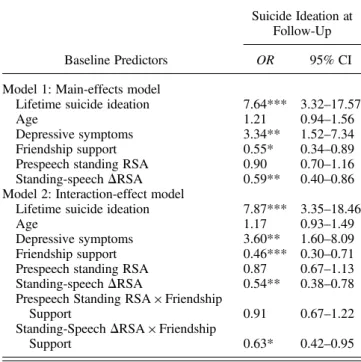
The odds ratios from the GEEs predicting suicide ideation at follow-up are presented inTable 3. The results from the main-effects model revealed that a lifetime history of suicide idea-tion and higher levels of depressive symptoms at baseline both increased risk for reporting suicide ideation over the 9-month follow-up period. After controlling for the effects of these covariates, a main effect of RSA reactivity (i.e., DRSA), but not prespeech standing RSA, on suicide ideation was found. That is, adolescent females who had greater rela-tive RSA decreases in response to the laboratory speech task were more likely to report suicide ideation over the 9-month follow-up period. Moreover, a main effect of friendship sup-port also was observed, indicating that adolescent females with higher levels of friendship support at baseline were less likely to report suicide ideation at follow-up.
The second model yielded a significant interaction effect between RSA reactivity (i.e.,DRSA) and friendship support.4 To probe this interaction, simple slopes for the effect of friendship support (bounded at+2SDfrom the mean; Rois-man et al.,2012) on suicide ideation were calculated at low, average, and highDRSA (i.e., –1SDfrom the mean, mean, andþ1SDfrom the mean; seeFigure 1). Simple slope anal-yses revealed a significant association between friendship support and the likelihood of suicide ideation among females with high,b¼–1.18,t(123)¼3.73,p,.001, and average, b¼–0.78,t(123)¼3.50,p,.001, but not low,b¼–0.37,
t (123)¼1.48,p¼.14,DRSA. At relatively low levels of friendship support, all females had similarly highly elevated risk of reporting suicide ideation. However, as friendship sup-port increased, only females who showed relatively stable or increasing RSA in response to the speech task (i.e., average and highDRSA, respectively) also had a corresponding de-crease in risk for suicide ideation. Having more friendship support did not decrease the risk for suicide ideation in fe-males with relatively decreasing RSA (i.e., low DRSA). More specifically, regions of significance analyses indicated that friendship support was associated with suicide ideation at values ofDRSA above –0.78SDfrom the mean, thus for all adolescents except those with greater relative decreases in RSA (lower and upper bounds on DRSA were –15.68 and –0.78SDfrom the mean).
The lower and upper bounds of the regions of significance on friendship support were –13.80 and –0.59 SD from the mean, respectively, indicating that simple slopes differed only at values of friendship support outside these bounds (shaded area inFigure 1). That the lower bound was far out-side the range of observable values of friendship support in-dicates that adolescents with low levels of friendship support did not differ in their risk for suicide ideation at different pat-terns of RSA reactivity. This result is not consistent with plas-ticity models, according to which at both low and high levels of friendship support, females with different patterns of RSA reactivity would differ in their risk for suicide ideation, nor with diathesis–stress models, according to which at low, but not high, levels of friendship support, females with different RSA patterns would differ in their risk for suicide ideation. No significant interaction effect between prespeech RSA and friendship support on suicide ideation was found.
The GEEs conducted with the prespeech sitting RSA and RSA reactivity computed using the prespeech sitting, instead of standing, RSA yielded highly similar results to those re-ported inTable 3. Specifically, RSA reactivity, but not pre-speech RSA, predicted suicide ideation at follow-up, odds ra-tio (OR)¼0.52,p,.01, 95% confidence interval (CI) [0.33, 0.81], andOR¼1.07,p¼.64, 95% CI [0.82, 1.39],
tively. Moreover, the interaction between friendship support and RSA reactivity similarly emerged as significant,OR¼ 0.52,p,.01, 95% CI [0.31, 0.85]. Again, no significant in-teraction effect between prespeech RSA and friendship sup-port was observed,OR¼1.21,p¼.35, 95% CI [0.82, 1.78].
Additional analyses
To examine the consistency of the study findings, a series of additional analyses was performed. First, because approxi-mately half of the adolescents reported using an antidepres-sant at baseline, GEE models were conducted to examine whether findings were consistent across females who used an antidepressant and those who did not. The results from these models revealed no significant moderating effects of an-tidepressant (dummy-coded as use vs. no use), indicating that, for females who used antidepressant and those who did not, RSA reactivity similarly predicted suicide ideation and similarly moderated the effect of friendship support on suicide ideation. Second, in light of the sociodemographic di-versity of the sample, GEE models were conducted control-ling for a number of additional covariates, including ethnicity (i.e., Caucasian vs. African American), family structure (i.e., household with both biological parents vs. others), and re-cruitment site (i.e., inpatient unit vs. community), all of which were associated with either RSA measures and/or sui-cide ideation. Note that these analyses were limited to Cauca-sian and African American adolescents, because only a mi-nority of females belonged to other ethnic groups. These models yielded identical results to those presented inTable 3. Moreover, none of these covariates moderated the effect of RSA reactivity on suicide ideation or the interaction effect between friendship support and RSA reactivity.
Discussion
Although rates of suicide ideation are remarkably high among adolescents, especially among females, to date research has
been quite unsuccessful in identifying factors that increase risk for future suicidality. In addition to mental disorders, difficulty in self-regulation has been proposed as an impor-tant vulnerability for adolescent suicidality (e.g., Najmi et al., 2007); yet existing evidence mainly comes from cross-sectional studies using self-report measures. This study aimed to address the limitations of prior work by combining an in vivo interpersonal stress paradigm with a multiwave longitudinal design to examine physiological stress responses as prospective predictors of suicide ideation in a sample of high-risk adolescent females. As hypothesized, females with greater parasympathetic withdrawal in response to an in-terpersonal stressor were more likely to consider killing them-selves over a 9-month follow-up period. Moreover, consistent with multilevel theories of developmental psychopathology and suicide (Cicchetti,2008; Crowell et al.,2014; Derbidge & Beauchaine,2014), parasympathetic stress responses mod-erated the effect of females’ perceived support from their close friendship on suicide ideation. As detailed below, find-ings from this study extend different areas of research and have a number of noteworthy theoretical and practical impli-cations.
In this sample of high-risk adolescent females, resting RSA was not concurrently associated with, or longitudinally predictive of, suicide ideation. However, females who mani-fested greater relative RSA decreases from the baseline to the speech condition were significantly more likely to report sui-cide ideation over the ensuing 9 months. RSA reactivity pre-dicted suicide ideation above and beyond females’ depressive symptoms and their lifetime history of suicide ideation, there-fore yielding strong support for the key role of dysregulated parasympathetic stress responses as a risk factor for future suicide ideation. These findings are consistent with theoreti-cal models of suicide (e.g., Crowell et al.,2014; Derbidge & Beauchaine,2014) and prior work utilizing self-report mea-sures of emotion regulation (e.g., Najmi et al.,2007; Tama´s et al.,2007). Findings from this study also corroborate and ex-tend the only previous study documenting the role of
para-Table 1.Descriptive statistics of the main study variables
Range Skewness Kurtosis
Baseline
(n¼132)
3 Months
(n¼129)
6 Months
(n¼124)
9 Months
(n¼127)
Suicide ideation,an(%) 70 (53) 38 (29.5) 31 (25) 31 (24.4)
Age,M(SD) 12 to 17 20.02 20.99 14.59 (1.39)
Depressive symptoms,M(SD) 0 to 1.93 0.73 20.03 0.59 (0.46)
Friendship support,M(SD) 1.92 to 5.00 20.51 20.60 3.76 (0.80)
RSA,M(SD)
Prespeech sitting 3.36 to 9.81 20.08 0.12 6.86 (1.17)
Prespeech standing 2.37 to 9.38 20.18 20.06 5.70 (1.38)
Speech 2.01 to 8.94 20.56 1.44 6.06 (1.13)
Sitting-speechDRSA 21.91 to 1.93 20.17 20.42 0.04 (0.87)
Standing-speechDRSA 22.15 to 1.72 20.45 20.14 0.04 (0.86)
Note:RSA, Respiratory sinus arrhythmia;DRSA, RSA standardized residual scores.
sympathetic responses as relevant predictors of self-injurious behaviors in adolescent females (Crowell et al.,2005).
According to the principle of neuroception in polyvagal theory, increases in parasympathetic activity reflect the per-ception of a social context as safe (Porges,2007) and support social engagement and approach behaviors (Hastings & Miller,2014). Thus, females with more parasympathetic reg-ulation of cardiac activity during the speech likely experi-enced this task as less threatening. They may have had stronger internal self-regulatory capacity to calmly face the social de-mands placed upon them. Conversely, females with with-drawal of parasympathetic activity were responding physiolog-ically as if they felt more challenged or threatened (Hastings, Kahle, et al.,2014). Rather than calm engagement, they may have been motivated to escape or avoid the social situation. Presuming that these patterns of parasympathetic responses were typical of the females’ reactions to socially demanding situations in other aspects of their lives, the females who had greater parasympathetic withdrawal would have recurrent ex-periences of distressed arousal, potentially invoking suicidal thoughts as an ultimate means of escape.
Of note, RSA reactivity moderated the effect of adoles-cents’ perceptions of support within their close friendship. However, in contrast to our hypotheses, at low levels of per-ceived friendship support, females with different patterns of RSA reactivity had a similar risk for suicide ideation at follow-up; conversely, high levels of perceived friendship support reduced the risk for suicide ideation in the presence of RSA increases, but not other RSA reactivity patterns. This finding does not conform to plasticity models (e.g., dif-ferential susceptibility model; Ellis et al.,2011) because fe-males with greater physiological sensitivity (i.e., higher para-sympathetic withdrawal) reported the same risk for suicide ideation regardless of their perceived friendship support. Thus, these females did not benefit more from their close friend’s support, but on the contrary, showed the highest risk for suicide ideation in the context of supportive friend-ships. However, this finding seems also not to be consistent with diathesis–stress models (Monroe & Simons, 1991), given that at low levels of friendship support the risk for sui-cide ideation was not greater in the context of RSA decreases. Instead, in this sample, all females with low friendship sup-port were at similarly higher risk for suicide ideation regard-less of their parasympathetic regulation, and greater parasym-pathetic withdrawal acted as a vulnerability factor regardless of females’ perceived friendship support.
It is of interest that the nature of this interaction suggests that, at least in this high-risk group of females, parasympa-thetic activation in response to an emotionally salient situa-tion may specifically serve as a vantage-sensitivity factor. The notion of vantage-sensitivity has been recently proposed by Pluess and Belsky (2013) to describe individual differ-ences in sensitivity to positive environmental experidiffer-ences. This perspective suggests that some individuals may be uniquely predisposed to benefit from positive social contexts. The concept of vantage-sensitivity mirrors the concept of
nerability proposed by diathesis–stress models; yet the focus here is exclusively on positive experiences. In contrast with plasticity models, the vantage sensitivity to context hypoth-esis highlights that individuals who are sensitive to positive environments are not necessarily more sensitive to social
ad-versity. Thus, these same individuals show more adaptive de-velopmental outcomes or lower risk for maladjustment (e.g., suicide ideation) when in the context of supportive environ-ments (e.g., highly supportive friendships), but are unrespon-sive to social adversity. According to this idea, females with greater parasympathetic activation benefitted from high levels of friendship support but were not at higher risk for suicide ideation, as compared to other females in this sample, in the context of low friendship support.
In line with interpersonal theories of emotion regulation (e.g., Lakey & Orehek,2011; Zaki & Williams,2013), this interaction also suggests the intriguing possibility that sup-portive friendships provide a context within which internal self-regulatory capacity can be expressed. Females with more parasympathetic activation who routinely receive friendship support may be able to engage with social stress in a calm and planful manner, thereby dampening their emo-tional arousal and decreasing their likelihood of turning to suicidal thoughts as a means of escape. In contrast, females with more parasympathetic withdrawal appear unable to ben-efit from the protective effects of friendship support. These females may be prone to high levels of emotion dysregulation in the face of social stress, thereby interfering with their abil-ity to effectively recruit external resources in the interest of alleviating distress. It is even possible that emotionally dysregulated females are more prone to destructive processes (e.g., co-rumination; Rose, 2002) within supportive friend-ships, which would exacerbate rather than dampen their arousal in the face of stress. Of interest, internal physiological regulatory capacity alone was not sufficient to reduce risk for suicide ideation; under conditions of low friendship support,
Table 3.Odds ratios from generalized estimating
equations predicting follow-up suicide ideation
Suicide Ideation at Follow-Up
Baseline Predictors OR 95% CI
Model 1: Main-effects model
Lifetime suicide ideation 7.64*** 3.32–17.57
Age 1.21 0.94–1.56
Depressive symptoms 3.34** 1.52–7.34
Friendship support 0.55* 0.34–0.89
Prespeech standing RSA 0.90 0.70–1.16
Standing-speechDRSA 0.59** 0.40–0.86
Model 2: Interaction-effect model
Lifetime suicide ideation 7.87*** 3.35–18.46
Age 1.17 0.93–1.49
Depressive symptoms 3.60** 1.60–8.09
Friendship support 0.46*** 0.30–0.71
Prespeech standing RSA 0.87 0.67–1.13
Standing-speechDRSA 0.54** 0.38–0.78
Prespeech Standing RSA×Friendship
Support 0.91 0.67–1.22
Standing-SpeechDRSA×Friendship
Support 0.63* 0.42–0.95
Note:RSA, Respiratory sinus arrhythmia;DRSA, RSA standardized residual scores.
females who showed parasympathetic withdrawal as well as females who showed activation were more likely to experi-ence suicide ideation over time. This finding is consistent with multiple lines of research indicating that social support plays a central role for adolescent successful regulation, whereas conditions characterized by a lack thereof (e.g., lone-liness and social rejection) enhance risk for poor physical and mental health, including suicide ideation (Van Orden et al.,
2010). As posited by the social baseline theory (Coan & Mar-esh,2014), social support facilitates regulatory processes be-cause it provides individuals with additional resources that at-tenuate the individual’s own energy required to face environmental demands. Drawing from social baseline the-ory, future research is warranted to examine how the avail-ability of close friends during emotionally demanding situa-tions may affect adolescent physiological and emotional responses. This research will contribute to a better under-standing of the joint effects of interpersonal and internal reg-ulation on adolescent suicidality.
The results from the current study have theoretical impli-cations for future research. First, whereas suicide has been of-ten conceptualized as the result of one or more mental disor-ders, our findings strongly support the notion that suicidality may be better conceptualized as the manifestation of poor physiological self-regulation (Crowell et al., 2014). As such, future studies would benefit from greater attention to physiological stress responses to understand youth suicidal-ity. Although neurobiological models of suicide have pre-viously emphasized the importance of examining the biolog-ical underpinnings of this phenomenon (e.g., Crowell et al.,
2014; Mann,2003), most prior research failed to directly in-vestigate biological responses to stress as potential vulner-abilities for suicidal thoughts and behaviors. Moreover, most prior neurobiological work on suicide has been con-ducted in suicide victims or adult inpatients, with surprisingly little attention to adolescents, despite the biological changes (e.g., heightened emotional and physiological sensitivity combined with low self-regulation) that potentially increase risk for suicidality during this developmental period (Casey et al.,2008).
Second, this study also contributes to the broader devel-opmental psychopathology literature examining multilevel interactions between physiological stress responses and environmental conditions. Building on evolutionary and de-velopmental perspectives (e.g., Beauchaine, Klein, Crowell, Derbidge, & Gatzke-Kopp, 2009; Boyce & Ellis, 2005), such as biological sensitivity to context models and differen-tial susceptibility models, this area of research primarily has examined how interindividual differences in environmental sensitivity interact with the family context to predict chil-dren’s psychosocial adjustment (e.g., El-Sheikh & Erath,
2011; Hastings et al., 2008). Only a minority of studies have examined these processes during adolescence (e.g., Sijt-sema et al.,2013). Even fewer studies have investigated peer relationships as potential environments interacting with bio-logical functioning (for exceptions, see Gregson, Tu, &
Erath,2014; Rudolph, Troop-Gordon, & Granger,2011), de-spite decades of research supporting the role of peers as a cru-cial context of development (Prinstein & Giletta,2016). The observed interaction between friendship support and para-sympathetic stress responses provides initial support for the salience of the peer context in this regard. Given adolescents’ enhanced orientation toward, and sensitivity to, the peer con-text (Crone & Dahl,2012; Forbes & Dahl,2010), future de-velopmental psychopathology research would benefit from examining how individual differences in physiological func-tioning may alter the effects of peer and friendship relation-ships as developmentally salient contexts.
A few implications for clinical practice and intervention development are also noteworthy. Research has provided some support for the effectiveness of interventions based on cognitive–behavioral therapy in improving emotion regu-lation skills (e.g., Suveg, Kendall, Comer, & Robin,2006), reducing physiological stress responses (e.g., Hammerfald et al.,2006), and, in some cases, youth suicidality (Robinson, Hetrick, & Martin, 2011). Nevertheless, the current study suggests that such interventions may not be sufficient to pre-vent suicide ideation among high-risk adolescents. Rather, the results indicate that intervention and treatment programs also should pay attention to the friendship context to prevent and reduce adolescent suicidality. For example, interventions could integrate dyadic interpersonal skill building into more traditional cognitive–behavioral therapies programs to facili-tate the formation and maintenance of supportive friendships. Accordingly, clinicians could benefit from assessing and treating both adolescents’ responses to stress as well as their friendship context. In sum, both internal and external sources of regulation should be targeted in order to increase the prob-ability of successfully reducing suicide ideation among ado-lescents with a history of psychiatric symptoms.
dys-regulation. In addition, this study built on the assumption that supportive friendships provide an external context of regula-tion. Although prior theoretical and empirical work has largely supported this idea (Zaki & Williams,2013; Zeman et al., 2013), research also has suggested that high-quality and supportive friendships may act as contexts that exacerbate stress responses (Calhoun et al.,2014). Thus, future research is warranted to differentiate dyadic processes that promote emotion regulation from processes that, on the contrary, un-dermine it. Third, because this work specifically focused on PNS responses as a physiological indicator of self-regulation, SNS responses to the stress task were not examined. Never-theless, emerging evidence highlights the importance of con-sidering simultaneously both PNS and SNS responses to un-derstand youth developmental outcomes (e.g., El-Sheikh et al.,2009). Accordingly, future suicide research would ben-efit from examining physiological responses across multiple systems. Fourth and finally, limitations regarding the assess-ment of RSA should be acknowledged. Cardiac activity at rest was measured approximately 1 hr before the stress task rather than immediately prior to the beginning of the task. A consec-utive assessment of RSA would have been preferable, espe-cially to allow modeling changes in RSA from baseline to the stress in a more dynamic manner (e.g., using latent growth curve modeling; see Burt & Obradovic, 2013; Hastings, Kahle, et al.,2014). Moreover, the basal standing measure of RSA was assessed for 1 min only, and RSA during the speech was assessed only when participants were standing, but not sitting. Although a 1-min epoch is considered suffi-cient to reliably measure RSA (Berntson et al.,1997), future work would benefit from assessing longer periods of baseline
functioning as well as from examining RSA reactivity across different postures. Findings from our study revealed an aver-age RSA decrease when examining changes from basal sit-ting to speech standing, but an average RSA increase when comparing baseline standing to speech standing. Whereas these differences are likely due to postural effects (Houtveen et al.,2005), they also suggest that the stress task may have differentially activated parasympathetic responses depending on the participants’ postural position. One prior study has supported this hypothesis (Cacioppo, Uchino, & Berntson,
1994), showing parasympathetic increases when RSA was measured while standing during both the basal and task as-sessment and parasympathetic decreases when comparing basal sitting to task sitting RSA. Given the robustness of our results across measurements, these differences do not have direct implications for our findings, yet they clearly highlight the need for future work to take postural changes into account.
To conclude, this study clearly demonstrates that parasym-pathetic withdrawal in response to an interpersonal stressor appears to be a biomarker of poor regulation that represents a vulnerability factor for adolescent females’ suicidality. Moreover, it appears that both internal (i.e., parasympathetic responses) and external (i.e., friendship support) sources of regulation available reduce risk for suicide ideation. As such, this study yields strong empirical support for suicide ideation as a manifestation of poor physiological regulation in response to stress and offers substantial evidence that sui-cide research may benefit from applying a multilevel devel-opmental perspective to identify youth at risk for suicidal thoughts and behaviors.
References
Banny, A. M., Heilbron, N., Ames, A., & Prinstein, M. J. (2011). Relational benefits of relational aggression: Adaptive and maladaptive associations with adolescent friendship quality. Developmental Psychology, 47, 1153–1156.
Baumeister, R. F. (1990). Suicide as escape from self.Psychological Review, 97, 90–113.
Beauchaine, T. P. (2001). Vagal tone, development, and Gray’s motivational theory: Toward an integrated model of autonomic nervous system func-tioning in psychopathology. Development and Psychopathology, 13, 183–214.
Beauchaine, T. P. (2012). Physiological markers of emotion and behavior dysregulation in externalizing psychopathology.Monographs of the Soci-ety for Research in Child Development,77, 79–86.
Beauchaine, T. P. (2015). Future directions in emotion dysregulation and youth psychopathology.Journal of Clinical Child and Adolescent Psy-chology,44, 875–896.
Beauchaine, T. P., Gatzke-Kopp, L., & Mead, H. K. (2007). Polyvagal theory and developmental psychopathology: Emotion dysregulation and con-duct problems from preschool to adolescence.Biological Psychology, 7, 174–184.
Beauchaine, T. P., Klein, D. N., Crowell, S. E., Derbidge, C., & Gatzke-Kopp, L. (2009). Multifinality in the development of personality disor-ders: A BiologySexEnvironment interaction model of antisocial and borderline traits.Development and Psychopathology,21, 735–770. Belsky, J., & Pluess, M. (2009). Beyond diathesis-stress: Differential
sus-ceptibility to environmental influences. Psychological Bulletin, 135, 885–908.
Berntson, G. G., Bigger, J. T., Eckberg, D. L., Grossman, P., Kaufmann, P. G., Malik, M., . . . Van Der Molen, M. W. (1997). Heart rate variability:
Origins, methods, and interpretive caveats. Psychophysiology, 34, 623–648.
Berntson, G. G., Cacioppo, J. T., & Quigley, K. S. (1993). Respiratory sinus arrhythmia: Autonomic origins, physiological mechanisms, and psycho-physiological implications.Psychophysiology,30, 183–196.
Berntson, G. G., Quigley, K. S., & Lozano, D. (2007). Cardiovascular psy-chophysiology. In J. T. Cacioppo, L. G. Tassinary, & G. G. Berntson (Eds.),Handbook of psychophysiology(3rd ed., pp. 182–210). Cam-bridge: Cambridge University Press.
Blakemore, S. J., Burnett, S., & Dahl, R. E. (2010). The role of puberty in the developing adolescent brain.Human Brain Mapping,31, 926–933. Boergers, J., Spirito, A., & Donaldson, D. (1998). Reasons for adolescent
suicide attempts: Associations with psychological functioning.Journal of the American Academy of Child & Adolescent Psychiatry,37, 1287– 1293.
Bowlby, J. (1969).Attachment and loss: Vol. 1. Attachment. New York: Ba-sic Books.
Boyce, W. T., & Ellis, B. J. (2005). Biological sensitivity to context: I. An evolutionary–developmental theory of the origins and functions of stress reactivity.Development and Psychopathology,17, 271–301.
Bridge, J. A., Goldstein, T. R., & Brent, D. A. (2006). Adolescent suicide and suicidal behavior.Journal of Child Psychology and Psychiatry,47, 372–394.
Brindle, R. C., Ginty, A. T., & Conklin, S. M. (2013). Is the association between depression and blunted cardiovascular stress reactions mediated by percep-tions of stress?International Journal of Psychophysiology,90, 66–72. Burt, K. B., & Obradovic´, J. (2013). The construct of psychophysiological