ASSET AND HEALTH: EXAMINING THE ASSET-BUILDING THEORETICAL FRAMEWORK AND PSYCHOLOGICAL DISTRESS
Einav Srulovici
A dissertation submitted to the faculty at the University of North Carolina at Chapel Hill in partial fulfillment of the requirements for the degree of Doctor of Philosophy in the School of Nursing.
Chapel Hill 2014
Approved by: Barbara Mark
Michal Grinstein-Weiss George Knafl
ABSTRACT
Einav Srulovici: Assets and Health: Examining the Asset-Building Theoretical Framework and Psychological Distress
(Under the direction of Barbara Mark)
Policy makers who propose developing policies to improve the health of individuals have an enormously complicated task given the complex, multifaceted, and interacting determinants of health. For social determinants of health, research has been conducted to evaluate the relationship between assets and numerous health measures. Michael Sherraden’s (1991) theoretical framework on asset-based welfare policy is acknowledged as the most complete statement thus far of these relationships. Several randomized trials based on Sherraden’s framework have been conducted. However, few asset-building programs have examined the influence of asset building on health outcomes.
The purpose of this study was to test the asset-building theoretical framework using psychological distress as the dependent variable. The study employed longitudinal data from 6,295 families from the 2001 and 2007 Panel Study of Income Dynamics data sets. Structural equation modeling was used to test 7 direct and 7 indirect hypotheses based on the theoretical framework.
intergenerational transfers were not associated with saving and investment actions. Unexpectedly, saving and investment actions were also associated with lower asset accumulation. Finally, greater asset accumulation was associated with an increase in
psychological distress over time; however, less psychological distress was associated with an increase in asset accumulation over time.
ACKNOWLEDGEMENTS
This dissertation would not have been possible without the support of many people. First, I would like to thank Barbara Mark, my advisor and chair. She has given me constant support, guidance, and encouragement during my PhD studies and the process of writing this dissertation. The decision to ask her to be my advisor and chair was one of the best I have ever made.
This dissertation was also written under the guidance of Michal Grinstein-Weiss, George Knafl, Linda Beeber, and Shawn Kniepp. All my committee members were generous with their time, knowledge, and advice.
Many thanks to Michal Grinstein-Weiss. She was the first professor to give me a chance as a research assistant and hired me to work with her on the Will Way team. Her enthusiasm for the asset-building field and its potential impact on health outcomes taught me that where there is a will, there is a way. I am deeply grateful to her for making the opportunity available to me and for providing ongoing, unwavering support. I am deeply indebted to George Knafl for his help with methodological and statistical issues at any time of the day. I am grateful to Linda Beeber and Shawn Kneipp, who contributed a wealth of knowledge regarding at-risk populations.
I was also honored to work as a research assistant with Eric Hodges. He did more than open my eyes to the cues infants give during feeding; he was also a good friend.
I would like to thank the School of Nursing at the University of Haifa in Israel for their financial support. I also want to thank Aaron and Irma Spencer for the Cheryl Spencer
Scholarship that helped me and four other colleagues from the University of Haifa pursue our PhDs, perform research, and educate the new generation of nurses in Israel. In addition, I would like to thank Anna Zisberg and Efrat Shadmi, from the School of Nursing at the University of Haifa in Israel. Without their help and emotional support, I would have never been here today.
I want to thank the Srulovici and Brock families for their love and support. I owe my parents, Yona and Zvika Brock, for their tremendous educational support since I was very
TABLE OF CONTENTS
LIST OF TABLES ...xiv
LIST OF FIGURES ...xvi
LIST OF ABBREVIATIONS... xviii
CHAPTER 1: BACKGROUND AND SIGNIFICANCE ...1
Introduction ...1
Economic Status and the Definition of Assets Versus Income ...2
Relationships Between Assets and Health ...6
Asset-Building Theoretical Framework ...7
Asset Building From the Life-Course Perspective ...8
Asset Building and Health Outcomes ...9
Evidence on the Relationship Between Assets and Health ... 11
Evidence on the Relationship Between Assets and Health Behaviors... 13
Summary ... 14
Asset-Building Programs ... 14
Evidence From U.S. Asset-Building Programs on the Relationships Between Assets and Health ... 15
Evidence From Asset-Building Programs Outside the US on the Relationship Between Assets and Health ... 19
Summary ... 21
CHAPTER 2: ASSET-BUILDING THEORETICAL FRAMEWORK AND LITERATURE
REVIEW ... 25
The Relationship Between Individual Components and Saving and Investment Actions ... 25
Economic Resources and Needs ... 25
Informal Social Support ... 27
Financial Literacy ... 29
Psychological Variables ... 32
The Relationship Between Institutional Components and Saving and Investment Actions... 33
Access ... 35
Information ... 36
Incentives ... 37
Facilitation ... 40
Expectations... 41
Restrictions ... 42
Security... 43
The Relationships Between Intergenerational and Interhousehold Transfers and Saving and Investment Actions and Asset Accumulation ... 44
The Relationship Between Saving and Investment Actions and Asset Accumulation ... 45
The Relationships Between Asset Accumulation and Health and Psychological Well-Being ... 48
CHAPTER 3: METHODOLOGY ... 54
Design ... 54
Sample Selection ... 58
Dependent Variable... 62
Psychological distress ... 62
Independent Variables ... 64
Latent variable of individual components ... 64
Economic resources and needs ... 66
Informal social support ... 66
Latent variable of institutional components ... 66
Access ... 67
Security ... 67
Incentives ... 67
Asset limits ... 67
Latent variable of intergenerational transfers ... 68
Actual inheritance ... 68
Latent variable of saving and investment actions ... 68
Deposits ... 69
Withdrawals ... 69
Latent variable of asset accumulation ... 69
Liquid savings ... 71
Retirement savings ... 71
Net worth ... 71
Home equity ... 71
Control Variables ... 71
Socioeconomic variables ... 74
Health-related variables ... 75
Statistical variables ... 75
Missing Data ... 75
Sampling Weights ... 76
Analytic Plan ... 76
Bivariate Analyses ... 77
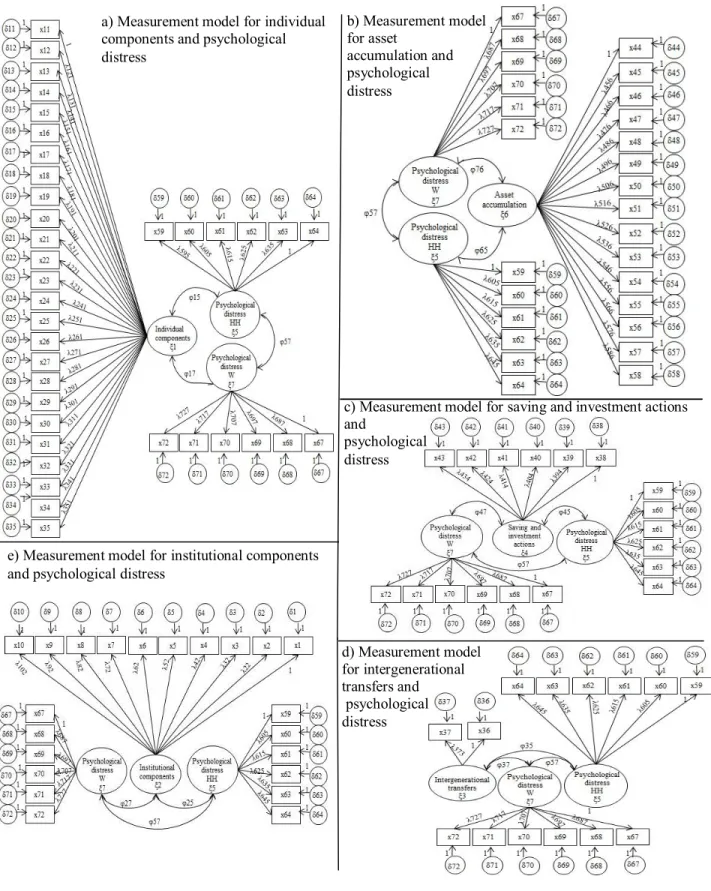
Measurement Model Analysis ... 78
Separate measurement models for each latent variable with psychological distress ... 78
Composite measurement models ... 81
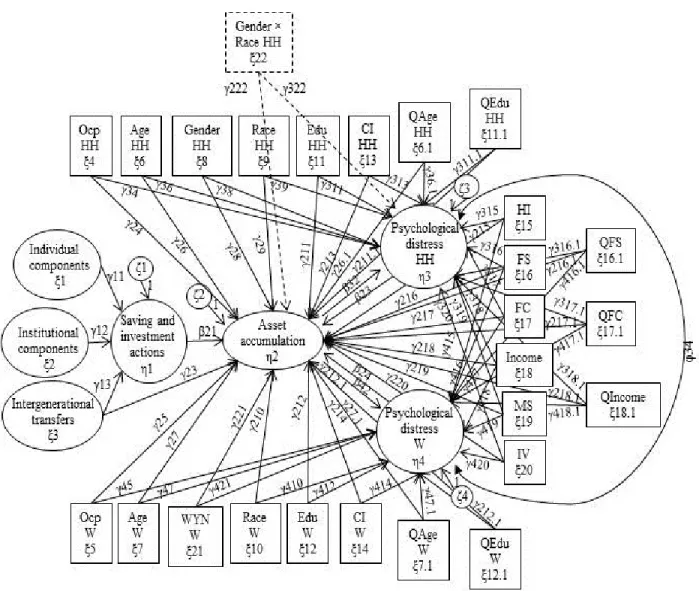
Cross-Sectional Structural Equation Modeling Analysis ... 84
Longitudinal Structural Equation Modeling Analysis ... 89
Power Analysis ... 91
CHAPTER 4: RESULT ... 92
Descriptive Statistics ... 92
Study Sample ... 92
Sociodemographic Information ... 93
Independent Variables ... 97
Psychological Distress ... 104
Bivariate Analysis ... 107
The Relationships Between Control Variables and Psychological Distress During the Past 30 Days ... 107
Latent Variable of Institutional Components ... 123
Latent Variable of Individual Components ... 125
Latent Variable of Intergenerational Transfers ... 129
Latent Variable of Saving and Investment Actions ... 130
Latent Variable of Asset Accumulation ... 133
Composite Measurement Model ... 135
Cross-Sectional Model... 138
Unweighted Cross-Sectional Model ... 143
Weighted Cross-Sectional Model ... 147
Comparison Between Unweighted and Weighted Cross-Sectional Models ... 149
Longitudinal Model ... 150
Unweighted Longitudinal Model ... 160
Weighted Longitudinal Model ... 166
Comparison Between Unweighted and Weighted Longitudinal Models ... 170
CHAPTER 5: DISCUSSION AND CONCLUSIONS ... 174
Discussion ... 174
The Main Hypothesis (H1): the Data Fits the Model... 174
Direct Hypothesis 1: Improvement in Individual Components Will Increase Saving and Investment Actions ... 174
Direct Hypothesis 2: Improvement in Institutional Components Will Increase Saving and Investment Actions ... 177
Direct Hypothesis 3: Larger Intergenerational Transfers Will Increase Saving and Investment Actions ... 183
Direct Hypothesis 5: Greater Saving and Investment Actions Will Increase Asset
Accumulation ... 186
Direct Hypothesis 6 and 7: Greater Asset Accumulation Will Improve Psychological Well-Being and Better Psychological Well-Being Will Increase Asset Accumulation ... 188
Strengths and Weaknesses ... 191
Future Research ... 194
Policy Implications ... 197
In Conclusion ... 199
LIST OF TABLES
Table
1 Psychological Distress and Observed Item Numbers ... 63
2 Individual Components and Observed Item Numbers ... 65
3 Institutional Components and Observed Item Numbers ... 67
4 Intergenerational Transfers and Observed Item Numbers ... 68
5 Saving and Investment Actions and Observed Item Numbers ... 68
6 Asset Accumulation and Observed Item Numbers ... 70
7 Control Variables for Head of Household (HH), Wife (W), and Family Items .... 71
8 Descriptive Statistics of Continuous Sociodemographic Variables ... 93
9 Descriptive Statistics of Categorical Sociodemographic Variables ... 94
10 Descriptive Statistics of Components of Total Family Income ... 96
11 Descriptive Statistics of Individual Components ... 98
12 Descriptive Statistics of Institutional Components ... 100
13 Descriptive Statistics of Intergenerational Transfers ... 101
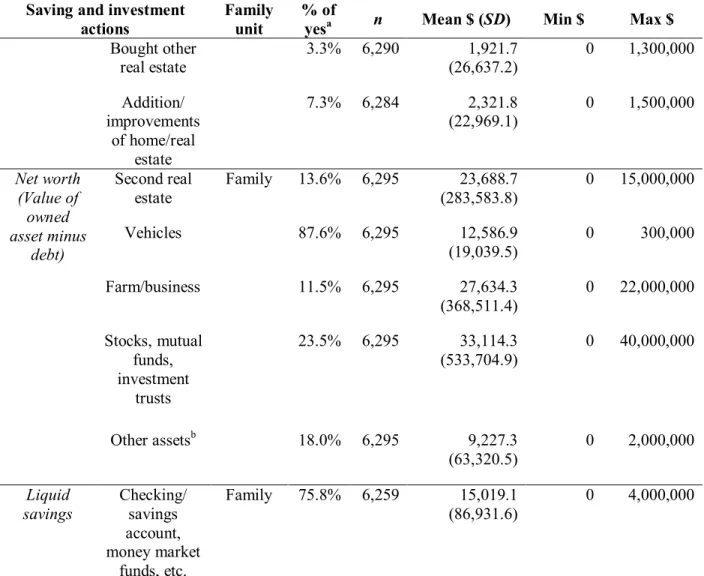
14 Descriptive Statistics of Saving and Investment Actions... 102
15 Descriptive Statistics of Asset Accumulation ... 103
16 Descriptive Statistics of Psychological Distress for Heads of Households (HHs; n = 4169) and Wives (n = 2067)... 105
17 Descriptive Statistics of Categorical Control Variables... 106
18 Correlations Between Psychological Distress and Continuous Control Variables ... 108
20 Relationship Between Psychological Distress in the Past 30 Days of Heads of the Households (n =4161) and Wives (n = 2067) and Dichotomous and
Categorical Control Variables ... 110 21 Relationships Between Continuous Control Variables and Genders of Heads
of the Households (HHs; n = 6295) ... 115 22 Relationships Between Categorical Control Variables and Gender of Heads
of the Households (HHs; N = 6295) ... 116 23 Differences in Total Family Income Between Marital Statuses of Heads of
the Households (HHs) ... 118 24 Differences in Total Family Income Between Races of Heads of the
Households (HHs) ... 119 25 Relationships Between Categorical Control Variables and Imputed Values ... 120 26 Relationships Between Continuous Control Variables and Imputed Values
(N = 6,295)... 122 27 Individual Components, Observed Item Numbers, and Summarized Items ... 125 28 Summary of Main Statistical Results and Hypotheses Support in the Cross-
Sectional Model, Unweighted and Weighted Analyses ... 140 29 Summary of Statistical Results and Hypotheses Support in the Longitudinal
LIST OF FIGURES
Figure
1 Asset-building theoretical framework. ... 23
2 Asset-building theoretical framework with psychological distress and the
observed variables of the Panel Study of Income Dynamics ... 55 3 Separate measurement models for the latent variables of the asset-building
theoretical framework and psychological distress. ... 80 4 The composite measurement model of the asset-building theoretical
framework for psychological distress ... 83 5 Cross-sectional structural equation modeling for the asset-building
theoretical framework and psychological distress. ... 85 6 Moderation of race and gender on the cross-sectional structural equation
modeling for the asset-building theoretical framework and psychological
distress ... 88 7 Longitudinal structural equation modeling of the asset-building theoretical
framework and psychological distress. ... 90 8 Distribution of total family income in 2001. ... 96 9 Separate measurement model of the latent variable of institutional
components and psychological distress, unweighted and weighted analyses. .... 124 10 The separate measurement model of the latent variable of individual
components and psychological distress, unweighted and weighted analyses. .... 129 11 The separate measurement model of the latent variable of intergenerational
transfers and psychological distress, unweighted and weighted analyses. ... 130 12 The separate measurement model of the latent variable of saving and
investment actions and psychological distress, unweighted and weighted
analyses. ... 132 13 The separate measurement model of the latent variable of asset accumulation
and psychological distress, unweighted and weighted analyses. ... 134 14 The composite measurement model of the asset-building theoretical
framework and psychological distress, unweighted and weighted analyses. ... 137 15 The cross-sectional model of the asset-building theoretical framework and
16 Longitudinal model of the asset-building theoretical framework and
LIST OF ABBREVIATIONS
ADD American Dream Demonstration AMND Average monthly net deposit BMI Body mass index
CDA Child development account DH Direct hypothesis
HH Head of household
H1 Main hypothesis
IDA Individual development account IH Indirect hypothesis
IRA Individual retirement account MI Modification indices
MLE Maximum likelihood estimator
OK Oklahoma
PSID Panel Study of Income Dynamics PTSD Post-Traumatic Stress Syndrome R2S Refund to Saving
RMSEA Root mean square error of approximation
SEED Saving for Education, Entrepreneurship, and Downpayment SEM Structural equation modeling
SHDP Seoul Hope Dream Project
TANF Temporary Assistance for Needy Families TLI Tucker-Lewis index
CHAPTER 1: BACKGROUND AND SIGNIFICANCE
Introduction
It has long been understood that an individual’s health depends, to some degree, on their economic status. Until recently, it was common to measure economic status using a person’s or a family’s income, and considerable research has been conducted to evaluate the relationship between income and health outcomes (Banks, Muriel, & Smith, 2010; Berrigan, Dodd, Troiano, Krebs-Smith, & Barbash, 2003; Boyas, Shobe, & Hannam, 2009; Frank, Andresen, & Schmid, 2004; Kahn & Fazio, 2005; J. Kim, 2011). However, in the last two decades, a new perspective has arisen that suggests that economic status should be measured using both income (i.e., the flow of resources available on a daily basis) and assets (i.e., the stock of saved resources available for investments in the future), but little research has been conducted to examine the relationship between individuals’ financial assets and their health.
Michael Sherraden’s (1991) theoretical framework regarding asset-based welfare policy and Lerman and McKernan’s (2008) extension of the theory to include a simultaneous
Few randomized trials based on asset-based welfare policy have been conducted to examine the relationship between asset building and health outcomes. The results are mixed and not entirely supportive of the asset-building theoretical framework (Grinstein-Weiss, Sherraden, Rohe et al., 2012; Y. Kim, Lee, & Kim, 2011; Ssewamala, Han, Neilands, Ismayilova, &
Sperber, 2010). However, these studies did not comprehensively examine the entire theory; rather, they examined only parts of it. Therefore, a more comprehensive empirical examination of Sherraden’s (1991) framework is the purpose of this dissertation.
To set the context for understanding Sherraden’s (1991) framework, I will discuss the differences between assets and income, asset poverty and income poverty, and the strengths and weaknesses of assets and income measures. Next, I will review evidence from the literature about the relationship between assets and health outcomes and give an introduction to the asset-building theoretical framework and asset-asset-building programs that have examined the relationships between assets accumulated through asset-building programs and health outcomes. Finally, I will describe the purpose and hypotheses of this study.
Economic Status and the Definition of Assets Versus Income
1991). Income is vital for the maintenance of everyday life, but it is not necessarily permanent (Rothwell & Han, 2010); therefore, a household that relies only on income is at risk for being driven into poverty during economic hardship. Putting aside a portion of income as savings can help fund future expenses (Sherraden, 1991).
Hurd, Juster, and Smith (2003) stated that measures of income (e.g., monthly or annual personal or household income) have several limitations that may cause significant bias. For example, people may find it difficult to estimate a household’s or other family members’ income levels or their own income if received on an irregular basis. They may also have difficulty when a question about income relates to previous years and not just the recent year.
In the United States (US), poverty is measured based on the annual cash income of a household, which means that a household below a certain threshold is considered poor (Haveman & Wolff, 2004). Low-income households that are considered poor may be eligible for several public assistance programs to help fulfill basic consumption needs essential to the well-being of families and their children (Nam, Huang, & Sherraden, 2008a). However, income support through public assistance programs is not enough to move low-income families out of poverty and break its intergenerational cycle, and increasingly, eligibility for these programs is shifting toward more temporary forms of assistance (Nam, Huang, & Sherraden, 2008b). The eligibility criteria of public assistance programs include asset tests (i.e., a household should have less than a minimum level of assets); thus, public assistance programs may depress savings and asset
accumulation instead of encouraging low-income families to accumulate assets to leave poverty (Caskey, 1997; Nam et al., 2008a, 2008b; Sherraden, 1991).
2006; Sherraden, 1991). Assets refer to the stock of a household’s saved resources available for investments for the future (McKernan & Sherraden, 2008; Shapiro, 2006; Sherraden, 1991), but they can also be converted into a flow of income during economic hardship (McKernan,
Ratcliffe, & Shank, 2011). In asset-building research, “the term ‘assets’ is restricted to the concept of wealth, including both property and financial holdings” (Page-Adams & Sherraden, 1997, p. 423). Therefore, for the purposes of this dissertation, I will use the original terminology of each reviewed study, thus treating assets and wealth as equivalents unless defined differently in a particular study, at which point I will point that out.
According to Beverly et al. (2008), there are several ways to define asset accumulation: liquid savings, retirement savings, net financial worth, home equity, and net worth. Liquid assets are relatively easy to convert to cash in a hardship situation and are the sum of checking and savings accounts, stocks and mutual funds, and other savings (Huang, 2011). Retirement savings are an important asset for an individual’s and/or family’s future financial balance, and it is often missing in low-income households (Cramer, Sherraden, & McKernan, 2008; Johnson &
Sherraden, 1992). Net financial worth is “the total amount of financial resources accumulated as precautionary savings” (Nam et al., 2008b, p. 5). For most American families, home equity is the asset with the highest value when calculating net worth (Beverly et al., 2008; Shapiro, 2006). Finally, net worth is the difference between everything a person owns and everything a person owes (Carasso & McKernan, 2008; Sherraden, 1991).
Researchers have proposed an alternative approach to measuring household poverty, asset poverty, which provides a more complete definition that relies on assets in addition to income (Haveman & Wolff, 2004; Nam et al., 2008b; Sherraden, 1991). The most common definition of asset poverty is the lack of resources needed for a household to meet its basic expenses for three months in the absence of income (Haveman & Wolff, 2004; Nam et al., 2008a; Shapiro, Oliver, & Meschede, 2009). Many households may not be considered income poor but are asset poor (Nam et al., 2008b). An examination of 10 large cities in the US found that on average, 16% of households were income poor, 40% were asset poor, and 26% were extremely asset poor (i.e., households that had zero or negative net worth; Corporation for
asset-poor households are more vulnerable to economic hardship than non-asset-poor households (Nam et al., 2008b).
Relationships Between Assets and Health
Income and assets are significantly correlated measures of economic status (Hajat, Kaufman, Rose, Siddiqi, & Thomas, 2010; Sherraden, 1991; Zagorsky, 2005). However, studies have shown that each contributes to the explained variance of health outcomes. The well-being of an individual, a family, or even a community is based on both income and assets; although income allows the fulfillment of everyday needs, assets can “create opportunities, secure a desired stature and standard of living, or pass class status along to one’s children” (Oliver & Shapiro, 1995, p. 2). The most common measures of assets that have been used in developed countries are net worth, wealth, and homeownership.
(2004) found no significant difference in obesity between men who were homeowners and men who were not homeowners, and Shewry et al. (1992) found no difference in obesity between men who were homeowners and men who were private renters but did find that men who were homeowners were significantly less likely to be obese compared with men who were living in local authority or housing associations.
Asset-Building Theoretical Framework
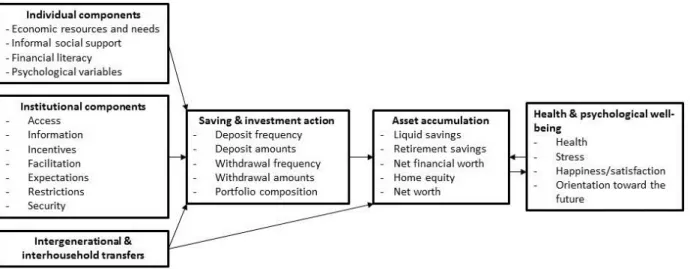
The cornerstone of the asset-building theoretical framework is presented in Sherraden’s (1991) asset-based welfare policy. The theory will be described briefly here and in more depth in the next chapter, and it explains what effects assets have on social, psychological, and economic welfare and how and why these effects occur. It states that individuals can accumulate assets through savings accounts or the investment of money into portfolio composition. Within the framework, there are three mechanisms that can help individuals save and invest money: (a) institutions can provide easy access to savings accounts and investments, encourage individuals to save and invest money with incentives, and increase their financial knowledge; (b) an
individual’s ability to save or invest money, which depends on the individual’s resources, social networks, level of financial knowledge, orientation toward the future, motivation for saving, and experiences with successful savings in the past; and (c) an intergenerational transfer of assets, wherein parents with low income are likely to have fewer assets and can provide their children with fewer assets for their expenses than parents with higher levels of income and assets (Beverly et al., 2008).
hope for the future that in turn increases individuals’ self-improvement. They can provide choices to individuals that can improve their long-term goals. They allow multiple investments that can increase returns. They provide more control and security that increase self-efficacy and can increase social status and provide better positioning for negotiations. They increase political awareness; for example, homeowners may be more likely to vote due to automatic registration, and they will try to protect their main asset: their home (Sherraden, 1991).
Lerman and McKernan (2008) expanded the asset-building framework and included a simultaneous relationship between asset accumulation and health and psychological well-being. It is important to remember that even when results have suggested that increased wealth may have a positive influence on health, it is possible that wealth is an endogenous variable (i.e., a variable that is explained or predicted by one or more other variables) and that more limited health conditions may lead to less wealth (Burkhauser & Weathers, 2001; Robert & House, 2000; Yadama & Sherraden, 1996).
Asset Building From the Life-Course Perspective
The influence of a life-course perspective should be applied when specifically
education, get good jobs with good incomes, and save money. However, their families may also expect them to help other family members financially, which can make it more difficult to save and accumulate assets (Beverly et al., 2008). In addition, a negative life event may cause a chain of events that can adversely affect their wealth; a medical crisis may cause high expenses and the loss of work days, which in turn may cause job loss and so on (Barr, 2012).
Although the life course influences asset building, it should be noted that socioeconomic circumstances during the life course can also affect health outcomes (Shuey &Wilson, 2008; Wadsworth, 1997). Occupation, education, housing environment and homeownership, and family circumstances have different effects on an individual’s health at each stage in life, such as during pregnancy, infancy, childhood, adolescence, and adulthood (Wadsworth, 1997). Pearlin, Schieman, Fazio, and Meersman (2005) found that individuals who suffered from ongoing economic strains during their lives had more health problems compared with individuals who experienced multiple periods of economic hardship but still had periods of economic relief.
Asset Building and Health Outcomes
According to Lerman and McKernan’s (2008) extension of the asset-building theoretical framework, health and psychological well-being includes physical and mental health, an
orientation toward the future, feelings of financial security, stress, happiness, and satisfaction from life. Holding more assets may improve physical and mental health by providing
insurance. Fewer assets, however, may lead to choosing no health insurance or a less expensive health-insurance plan with higher deductibles, which in turn can influence the decision to seek health-care services. In addition, holding more assets can reduce stress levels from unexpected costs (Lerman & McKernan, 2008). A person who holds fewer assets and needs to undergo an expensive medical procedure will probably be more stressed if that expenditure limits his or her ability to buy food or pay rent or the mortgage than a person who holds more assets and is less likely to be in that situation.
Finally, holding more assets makes it easier to plan goals for the future (Lerman & McKernan, 2008; Sherraden, 1991; Shobe & Page-Adams, 2001; Yadama & Sherraden, 1996), and an orientation toward the future may positively affect behaviors, including health behaviors, and attitudes (Grinstein-Weiss, Shanks, & Beverly, 2014; Lerman & McKernan, 2008;
Evidence on the Relationship Between Assets and Health
Studies have provided empirical evidence on the positive impact of asset accumulation on health outcomes and health behaviors, particularly on physical-health outcomes. General health increased significantly across increasing wealth quintiles (Banks et al., 2010; J. Kim, 2011), and people in the lowest quartile of wealth had higher odds of reporting fair or poor health than people in the highest quartile (Cubbin et al., 2011; Finnegan, Marion, & Cox, 2005). Also, holding assets such as home ownership or checking accounts was significantly associated with better health statuses (Boyas et al., 2009). However, in the same study, wealth was not
significantly associated with the general health of people 65 years or older when income was entered into the regression. That result may be explained by the fact that assets are not necessarily liquid (e.g., home equity) and therefore may not provide a flow of resources for immediate needs during retirement (Kahn & Fazio, 2005).
& Sorlie, 1998). It may be that homeownership is not a sensitive-enough variable for evaluating this relationship.
Most studies that focused on obesity and body mass indices (BMIs) have found a
significant association for health outcomes with assets. Less wealth was significantly associated with higher odds for obesity (Banks et al., 2010) when adjusted for income and education (Hajat et al., 2010) or for age, sex, and other socioeconomic status variables (Janssen, Boyce, Simpson, & Pickett, 2006). In addition, men and women have shown significantly higher odds of obesity if not homeowners (Laaksonen et al., 2004). In that study, the relationship was an association and not a causal effect; thus, fewer assets may have caused the obesity or obese participants may have accumulated fewer assets.
Inheritances of more than $10,000 have predicted substantial decreases in obesity and severe obesity rates (B. Kim, & Ruhm, 2010). People who reported having less than $10,000 in liquid assets and people who reported having more than $10,000 in liquid assets did not
significantly differ in their BMI scores (Robert & Reither, 2004), but that finding may have been due to the cutoff of $10,000, which may not be sensitive enough to detect changes in BMI scores. Zagorsky (2004, 2005) found that over a period of 15 years, regardless of BMI, net worth increased over time. However, shifting from a normal BMI to an overweight BMI to an obese BMI was followed by a decline of net worth. In addition, individuals that had less than the median wealth before retirement had a significant increase in their BMI scores after retirement, but individuals that had more wealth before retirement had no significant change in their BMI scores after retirement (Chung, Domino, & Stearns, 2009).
health outcomes and asset accumulation. People who hold fewer assets may experience a higher level of psychological distress because they feel less secure about their lives and futures or people experiencing greater psychological distress may skip work or need medical attention that limits their asset accumulation.
Evidence on the Relationship Between Assets and Health Behaviors
In addition to health outcomes, some studies in the US have reported significant relationships between assets and health behaviors. A negative association was found between wealth and smoking (Banks et al., 2010; Cubbin et al., 2011; Hajat et al., 2010; Headey, Marks, & Wooden, 2005), and a positive association was found between physical activity and wealth for both youth (11–15 years old; Janssen et al., 2006) and older people (55–80 years old; Banks et al., 2010). The influence of wealth on smoking and physical activity may be related to more knowledge about healthier lifestyles and the financial ability to be a gym member and engage in physical activity. Despite the assumption that greater wealth would be related to less alcohol consumption1, study results have been mixed. Some studies found that greater wealth was positively associated with higher alcohol consumption (Banks et al., 2010; Headey et al., 2005; B. Kim & Ruhm, 2010), and others found it was negatively associated with higher alcohol consumption (Muntaner et al., 1998). It is difficult to interpret those findings due to the different measurements used in each study.
1
Summary
Asset accumulation is a financial activity that can be achieved through institutional, individual, and intergenerational support and can influence individuals’, families’, and communities’ health outcomes and health behaviors. Studies have found evidence that higher assets are related to better health outcomes and more positive health behaviors. However, there is little evidence from asset-building program interventions about these relationships. Most of that evidence, which will be discussed in depth in the next section, does not indicate statistically significant differences in health outcomes between participants in treatment groups (e.g., participants who received the opportunity to open an individual development account [IDA] or CDA) and participants in comparison groups (e.g., participants who did not receive such opportunities). These results may have various causes including study designs and analytical methods.
Due to the limited evidence about the relationships between assets and health using the asset-building theoretical framework, Lerman and McKernan (2008) suggested that “more empirical evidence is needed to assess the benefits and consequences of assets for low-income, low-educated, and minority households” (p. 201). Although the asset-building theoretical framework implies an association between assets and health, more studies should be done to examine the topic in general and particularly to examine the theory in its entirety. This study will try to fill that gap in the knowledge about the relationships between assets and health, relying on the asset-building theoretical framework.
Asset-Building Programs
includes three key mechanisms: matched IDA savings, constraint of matches to specific
purchases (i.e., the entire amount that was saved plus matches can be withdrawn only for a preset goal such as higher education, a down payment for a home, or the seed money to start a business) with the opportunity to make unmatched withdrawals, and financial education (Nam, Ratcliffe, & McKernan, 2008; Page-Adams & Sherraden, 1997; Sherraden, 1991). Child development accounts are another form of IDA that provide children and their families with institutional support for accumulating assets through savings. Asset-building programs that provide CDAs usually offer matched CDA savings with matches that are constrained to specific purchases, an initial deposit, and sometimes benchmarks (Grinstein-Weiss et al., 2014; Huang, Sherraden, & Purnell, 2014; Mason, Nam, Clancy, Kim, & Loke, 2009; Loke & Sherraden, 2009).
Asset-building programs can help low-income individuals and families build savings and improve their economic, social, health, and psychological well-being by accumulating assets. They are intended to encourage long-term savings and can have a positive influence on
children’s and parents’ behaviors, aspirations, and goals. This improvement can lead to higher educational performance, better well-being, and better health outcomes (Lerman & McKernan, 2008; Sherraden, 1991). Therefore, both IDAs and CDAs are assumed to assert positive
influence in a variety of areas that might also affect each other. For example, opening a CDA may help a child develop an orientation toward the future, improve the child’s educational attainment, and reduce his or her risky health behaviors (Grinstein-Weiss et al., 2014; Scanlon & Adams, 2009; Shobe & Page-Adams, 2001; Ssewamala et al., 2010).
Evidence From U.S. Asset-Building Programs on the Relationships Between Assets and Health
project that examined the influence of IDAs on low-income individuals in the US, called the American Dream Demonstration (ADD), was conducted in 14 states from 1997 until 2001. For 13 of the 14 states, non-experimental research and cross-sectional methods were applied. However, at the ADD Tulsa, Oklahoma (OK) site, an experimental study was implemented in which participants were randomly assigned to treatment (i.e., access through the program to a matched IDA and financial education) and control (i.e., no access through the program to a matched IDA or financial education) groups. The Tulsa OK ADD experiment was carried out in three waves: the first at baseline before the random assignment to intervention and control groups, the second at the first follow-up 18 months after the random assignment, and the third at a second follow-up 48 months after the random assignment (Grinstein-Weiss, Sherraden et al., 2013). None of the waves examined the influence of asset accumulation on health outcomes.
Moore et al. (2001) conducted a cross-sectional survey with 318 ADD participants from 13 sites, not including the Tulsa OK ADD experiment site. All participants had received an opportunity to open a matched IDA. The majority reported that they felt more confident about their future because of their IDAs, and 30% reported spending less on cigarettes and alcohol to set aside money for their IDAs. But 17% reported that they postponed visits to the doctor or dentist to set aside money for their IDAs. These findings suggest that IDAs may be associated with a decline in smoking and alcohol consumption. However, it is disturbing that some
was no comparison group, so differences between participants who had the opportunity to open a matched IDA and participants who did not could not be examined.
A fourth wave was added to the Tulsa OK ADD experiment ten years after the random assignment. It measured health and health-behavior outcomes. There were no statistically
significant differences between treatment and control groups regarding BMI, general health, pain interference with work, health limits, medical expenses in the past year, and drinking and
smoking behaviors; however, there were also no significant differences between treatment and control groups regarding net worth, homeownership, and total assets (Grinstein-Weiss et al., 2013). The strength of the Tulsa OK ADD is that it was a randomized controlled study, and the strength of the fourth wave is that it had lower attrition rates compared with the third wave participation (Grinstein-Weiss et al., 2012; Grinstein-Weiss et al., 2013). Despite these strengths, no health outcomes or health behaviors were significantly better for participants in the treatment group compared with the control group ten years after random assignment. However, it was not the intent of the original program to evaluate the influence of IDAs on health outcomes. Some health outcomes may have been short-term, such as alcohol consumption or smoking behaviors, with no effect over a longer term after the intervention ended. In addition, there was no baseline for comparing the results for both short- and long-term outcomes; therefore, there was no way to examine the change in health outcomes over time.
children and youth savings account programs . In 2008, 2,704 newborn children in OK, which constituted 37% of the newborns in OK that year, were enrolled in an asset-building program called SEED OK. Those newborn children were randomly assigned to treatment or control groups, and their mothers reported outcomes to the study. The treatment group received a state-owned CDA with $1,000 and an opportunity to open a participant-state-owned CDA with a program contribution of $100 to open it, and the control group received no intervention. The participant-owned CDA was a matched savings account for low- and moderate-income families.
Controlling for baseline depressive symptoms, mothers in the treatment group reported significantly fewer depressive symptoms at the 3-year follow-up compared with mothers in the control group, though what was measured was participants’ self-reported intent to treat
symptoms rather than actual treatments received. For low-income and low-education
subsamples, that relationship was significantly greater when compared with the entire sample. There were no significant sociodemographic differences between treatment and control groups at baseline, and there was a low attrition rate (16%) between 2008 and 2011 (Huang et al., 2014). It is also significant that only 37% of OK’s families with newborns agreed to participate in the SEED OK program (Huang et al., 2014). That low-response rate may imply a selection bias and have limited the generalizability of the findings.
790 participants enrolled in the program. The treatment group received an initial deposit of $800 into a matched CDA for each participant. Both the treatment and control groups had a decrease in their psychological distress levels between baseline and the 4-year follow-up, which was measured as a self-reported intent to treat. However, there was no significant difference between their distress levels at that time (Marks, Rhodes, Engelhardt, Scheffler, & Wallace, 2009). A Limitation of the Michigan SEED study includes significant differences between treatment and comparison groups at baseline in terms of race, the ratio of adults to children living in the household, average housing payments, and possessing savings (Marks et al., 2009).
Evidence From Asset-Building Programs Outside the US on the Relationship Between Assets and Health
Asset-building programs have been conducted in developed and developing countries outside of the US. An IDA and CDA program called theSeoul Hope Dream Project (SHDP) was implemented in 2008 in Seoul, South Korea. Participants in the SHDP were considered the treatment group, and the comparison group was selected from the Korea Welfare Panel Study data set. The treatment group received an opportunity to open a matched IDA in 2009 and reported at 1- and 2-year follow-ups that they experienced less stress and anxiety and more positive feelings and changes in psychological well-being. They showed orientation toward the future by reporting that after completing the program, they were setting new plans for the future and had continued to save money by reducing their consumption (Y. Kim, Lee, & Sherraden, 2012).
(b) The program only examined changes over time for participants in the treatment group and provided qualitative evidence of positive changes in stress, anxiety, positive feelings, and psychological well-being for that group. There was no examination of differences between participants in the treatment and comparison groups or changes over time for the comparison group; (c) The high attrition rate (25%) between baseline and 1-year follow-up may have introduced bias into the results; and (d) There were significant differences between participants in the treatment and comparison groups at baseline for factors such as age, education, and working status (Y. Kim et al., 2011), and those differences may have introduced selection bias and may have caused biased results.
An asset-building project called the Suubi project was conducted between 2005 and 2008 in Uganda for orphans with acquired immunodeficiency syndrome (AIDS). Suubi translates as hope in the local Ugandan language. The participants from 15 schools were randomly assigned to treatment or control groups at the school level. Randomization at the school level is a strength of the study because it reduces the threat to construct validity due to treatment diffusion
(Shadish, Cook, & Campbell, 2002), meaning that there is a lower chance that children who study in different schools share information about the program. At the 10-month follow-up, participants in the treatment group had a statistically significant reduction of 64% in self-reported sexual risk-taking intentions (Ssewamala et al., 2010). However, the study examined only intentions and not actual sexual risk behaviors; therefore, there is no way to know if the treatment group indeed reduced their risky sexual behaviors compared with the control group.
reported significantly lower depressive symptoms compared with the control group, but a double robust estimator suggested that even if the depressive symptoms at baseline had been similar between the two groups, the treatment group would still have indicated significantly lower depressive symptoms compared with the control group at both the 10- and 20-month follow-ups (Ssewamala, Neilands, Waldfogel, & Ismayilova, 2012).
The Suubi project’s outcomes have construct validity threat because of the participants’ potential reactivity to the experimental situation, wherein youth in treatment groups try to provide results that will satisfy the researchers (Shadish et al., 2002). Also, baseline results showed that treatment and control groups were significantly different in household size;
ownership of hut, mud, or brick homes; peer pressure to have sexual intercourse; and intentions to have sexual intercourse (Ssewamala et al., 2010). However, Ssewamala et al. (2010) stated that they controlled for those variables in the regression analyses.
Summary
Asset-building programs that provide low-income individuals and families the institutional support to open matched and restricted IDAs and financial education encourage participants to change their saving behaviors and accumulate assets. Several asset-building programs have been conducted in the US and around the world; however, only a few programs have examined the influence of asset-building on health outcomes, and even fewer were originally set up to examine health outcomes. In the future, it will be helpful to research asset building programs that utilize random assignment to be set up in advance to collect health outcomes data that will theoretically change within the study timeframe due to asset
outcomes. Regarding health behaviors that can be changed in the short- and long-term, those outcomes should include both intended and actual behaviors.
Purpose and Hypotheses of the Study
The asset-building theoretical framework suggests that assets may have positive
influences on health outcomes and health behaviors and that better health and health behaviors may have positive influences on asset accumulation. Prior studies found that holding more assets was significantly associated with better health outcomes. However, results from the few studies that examined this relationship were mixed. That may be due to the limited nature of those studies; only two asset-building programs in the US, the ADD and SEED, tested the relationship between assets and health, and the ADD collected health variables only 10 years after random assignment. The Korean asset-building program, the SHDP, did not compare the change in health outcomes between treatment and comparison groups and had a high attrition rate. The asset-building program in Africa, the Suubi project, only examined depressive symptoms and health-behavior intentions and not actual behavior. In addition, those studies were limited to specific paths of the asset-building theoretical framework: institutional support, saving and investment actions, asset accumulation, and health outcomes. Asset-building programs have been developed based on the asset-building theoretical framework, but to my knowledge, nobody has examined the entire theory. An examination of the theory as a whole may be useful in
developing future asset-building programs that will be health oriented.
(H1) of this study was that the observed covariance of the population under study would not be significantly different from the covariance of the parameter estimates of the hypothesized path model (Bowen & Guo, 2012).
Figure 1. Asset-building theoretical framework. The theoretical framework is based on Beverly et al., 2008, and Lerman & McKernan, 2008.
The following hypotheses about direct effects in the asset-building theoretical framework were examined:
Direct Hypothesis 1 (DH1):Improvement in individual components (i.e., larger economic resources, fewer economic needs, and less informal financial social
support) will increase saving and investment actions (i.e., larger deposits and smaller withdrawals).
Direct Hypothesis 2 (DH2):Improvement in institutional components (i.e., lower asset limits and greater access, security, and incentives) will increase saving and investment.
Direct Hypothesis 3 (DH3):Larger intergenerational and interhousehold transfers (i.e., larger inheritances) will increase saving and investment actions.
Direct Hypothesis 5 (DH5):Greater saving and investment actions will increase asset accumulation.
Direct Hypotheses 6 (DH6):Greater asset accumulation will improve psychological well-being (i.e., lower psychological distress).
Direct Hypotheses 7 (DH7):Better psychological well-being will increase asset accumulation.
The following hypotheses about indirect effects in the asset-building theoretical framework were examined:
Indirect Hypothesis 1 (IH1): Improvement in individual components will increase asset accumulation through an increase in saving and investment actions.
Indirect Hypothesis 2 (IH2): Improvement in institutional components will
increase asset accumulation through an increase in saving and investment actions. Indirect Hypothesis 3 (IH3): Larger intergenerational and interhousehold transfers
will increase asset accumulation through an increase in saving and investment actions.
Indirect Hypothesis 4 (IH4): Improvement in individual components will improve psychological well-being through an increase in saving and investment actions and through an increase in asset accumulation.
Indirect Hypothesis 5 (IH5): Improvement in institutional components will improve psychological well-being through an increase in saving and investment actions and through an increase in asset accumulation.
Indirect Hypothesis 6 (IH6): Larger intergenerational and interhousehold transfers will improve psychological well-being through an increase in saving and
investment actions and through an increase in asset accumulation.
CHAPTER 2: ASSET-BUILDING THEORETICAL FRAMEWORK AND LITERATURE REVIEW
The asset-building theoretical framework (Figure 1) includes six components, each of which includes a number of dimensions. The six components are institutional components, individual components, intergenerational transfers, saving and investment actions, asset accumulation, and health and psychological well-being. The theoretical framework implies six directional paths between those components: institutional components, individual components, and intergenerational transfers predict saving and investment actions; intergenerational transfers and saving and investment actions predict asset accumulation; and asset accumulation predicts and is predicted by health and psychological well-being. In this chapter, I will describe each component and its dimensions and will also discuss evidence from the literature supporting the hypothesized paths between the components.
The Relationship Between Individual Components and Saving and Investment Actions
Individual components includes four dimensions: economic resources and needs, informal social support, financial literacy, and psychological variables. Each dimension will be explained in this section. It is hypothesized that in the asset-building theoretical framework, each individual components dimension will influence saving and investment actions (Beverly et al., 2008).
Economic Resources and Needs
economic resources and therefore less surplus money to save (Beverly et al., 2008). Barr (2012) described individuals with less surplus money as individuals who have little room for slack in their finances; in other words, low-income individuals need to choose more carefully how to spend or save their money than high-income individuals because they have less financial flexibility.
Financial expenses are an example of economic needs. They can interfere with an individual’s saving or investment actions because high expenses increase income consumption and reduce the income amount that can be saved. Financial expenses include medical expenses, vehicle costs, debt payment, and other similar expenses. Medical expenses are usually higher for families without health insurance (Beverly et al., 2008), but families that have health insurance can find it hard to pay medical bills at times of acute or chronic health conditions. Vehicle ownership can cause expected and unexpected costs to a household, such as regular service and inspection or breakdowns. Debt payments include credit-card debt (Beverly et al., 2008) and other regular payments such as the rent or mortgage or loans.
For people considered asset poor, credit may not be available or fairly priced and
sometimes can influence their eligibility to borrow against future income (Sherraden, 1991). For example, in an ethnographic study, low-income African Americans from northwest Mississippi and low- and moderate-income Hispanics from San Jose, California (n = 18 and n = 12,
Although debt can depress saving and investment actions, it can also be considered a good thing when it is “used to develop productive capacity for future economic growth” (Sherraden, 1991, p. 284). For example, debt for a student loan, which is a burden on daily consumption and reduces the amount and frequency of income savings, contributes to education that can present better job opportunities and potentially higher income in the future.
Informal Social Support
A person’s social network can support and encourage saving behavior, but it can also take advantage of that saving for nonrestrictive purposes such as using savings that were restricted to a down payment for a house or higher education for the daily consumption of relatives and/or non-relatives (Sherraden, 1991). A supportive network can provide a positive saving environment that encourages saving actions and reminds a person to perform them. In contrast, a discouraging network expects a person to share that extra income with others. The latter is more common among low-income families, who feel emotional pressure from their friends and family members to help with daily expenses (Beverly et al., 2008). This discouraging network is more common in Black and Hispanic families (Caskey, 1997).
The relationship between informal social support and saving actions has been examined in several qualitative studies. Sherraden et al. (2005) interviewed 84 participants (59 who received the treatment and 25 controls) from the Tulsa OK ADD experiment, previously described in Chapter 1, two years after the random assignment and found that support from relatives and non-relatives was important for their saving actions2. The researchers sampled participants from the treatment group using a stratified sample that included low, middle, and high levels of average monthly deposit savers. They randomly selected participants from the control group. Although the interviewers in the study were trained and practiced in a pilot
2
interview, data collection overlapped with another survey, and some of the participants from the control group knew participants from the treatment group, which may have affected their saving behavior (e.g., by encouraging them to search for other programs that could promote and
influence the result of the study).
In a qualitative study that conducted 14 focus groups with 76 participants from seven SEED program sites, the participants stated that they received a great deal of financial support from their family and friends. Frequently, that financial support was used to cover daily needs. Less frequently, but much costlier when it was needed, that support covered emergency
expenses. Participants stated that although they had received financial support from their relatives and non-relatives, they could only make smaller deposits than they had intended or no deposits at all to the SEED CDA. However, a few participants who received financial help from their family and friends used some of those funds to make financial contributions to the child’s SEED CDA (Wheeler-Brooks, 2009).
Caskey (1997) found in an ethnographic study that low-income African Americans could not save money because they were under pressure to share their money with others and that low- and moderate-income Hispanics could not save money because they had to send it to their relatives in their countries of origin. However, there was no information in the study about how much financial help those families needed from their families and friends. Another
Although the response rate was good (79%) for ADD participants at the time of that study (Moore et al., 2001), it was low (29%) for former ADD participants. There were additional limitations to the study. There was no consistency in data-collection methods (i.e., face-to-face interviews, phone interviews, and group settings were used), which may have affected the participants’ responses. For example, some participants may have felt more comfortable sharing financial information in a face-to-face interview than in a group setting that involved sharing that information with other participants. Another limitation is that only half of the ADD sites agreed to recruit participants for the study, meaning that the study sample may not be fully
representative of the ADD population.
Financial Literacy
Financial literacy is “the ability to understand financial terms and concepts and to translate knowledge into behavior, including such skills as balancing a checkbook and managing cash flows in other accounts, preparing a budget and tracking spending, managing debt and saving and investing” (Schreiner & Sherraden 2007, p. 235). It is assumed that financial education will increase a person’s financial literacy, which in turn will cause better financial behaviors such as better investment decisions, which will affect a person’s saving actions and eventually increase the household’s financial well-being (Beverly et al., 2008; Willis, 2013). However, more financial knowledge does not necessarily prevent a person from making bad financial investment decisions.
after financial education (Willis, 2013). Moreover, in a recent meta-analysis study, Fernandes, Lynch, and Netemeyer (2014) found that the “financial education interventions studied explained only about 0.1% of the variance in the financial behaviors studied, with even weaker average effects of interventions directed at low-income rather than general population samples” (p. 1872).
Willis (2013) provided potential reasons for the lack of a relationship between financial education and financial behaviors. The financial marketplace is a dynamic environment, meaning that something that was true today may not be the best investment decision for tomorrow.
Therefore, teaching children financial education in school about specific information that is relevant for the present time may not be effective because it will take years until they finally use that knowledge. However, financial education focused on general information about markets and investments (e.g., interest rates, compound interest, loans and mortgages) may be effective. Financial illiteracy can cause poor financial choices (Beverly et al., 2008; Gale et al., 2012), which in turn can increase a person’s economic insecurity (Gale et al., 2012). Although low-income individuals are likely to have lower financial literacy than high-low-income individuals (Beverly et al., 2008), low financial literacy is a problem for a significant portion of American adults (Gale et al., 2012; Willis, 2013).
Different subsamples of ADD participants reported that the financial education contributed to their abilities to save and indicated that they had learned specific skills for improving their saving and investment actions. One subsample included participants from 6 out of the 13 ADD sites and was examined in a cross-sectional study (Moore et al., 2001). Another subsample included participants from the Tulsa OK ADD and was examined using a qualitative method (Sherraden et al., 2005). In addition, a longitudinal study of 2,350 ADD participants who were program-selected and self-selected found that more hours of financial education, up to ten, was significantly associated with more asset accumulation through the IDA (Curley, Ssewamala, & Sherraden, 2009; Schreiner & Sherraden, 2007). Specifically for families with children 18 years old or younger, a one-hour increase in financial education increased the average monthly net deposit (AMND) by $0.86 (Grinstein-Weiss, Wagner, & Ssewamala, 2006). That amount may not be considered financially meaningful, and due to the sample selection process,
participants may not have represented the general population. Rather, they were “highly educated and had high rates of employment. . . . They were disproportionately females, African American, and never married” (Schreiner & Sherraden, 2007, p. 122).
Financial Links for Low-Income People program in Illinois. The 163 low-income participants, mainly Temporary Assistance for Needy Families (TANF) recipients, had higher financial knowledge if they were unmarried compared with married participants. That result was
consistent in both pre- and post-training questionnaires. However, the study sample was mainly females and African Americans, about half of whom had never been married (Zhan et al., 2006).
Psychological Variables
According to neoclassical economics, there are three main long-term goals of saving money: retirement, unexpected shocks, and transfers to offspring (Beverly et al., 2008). In a randomized control trial, called Refund to Saving (R2S), that sampled 4,087 TurboTax® users, participants were randomly assigned to specific motivational prompts3 and suggested saving amounts (i.e. 25%, 50%, and 75% of the refund or specific amounts of $100 or $250; Grinstein-Weiss, Comer et al., 2013). Participants who were randomly assigned to specific motivational prompts significantly increased the percentage of their tax refunds intended for savings compared with participants in the control group. However, in a subsample of low-income individuals, those differences were not statistically significant (Key, Grinstein-Weiss, Tucker, Holub, & Ariely, 2013).
Other important long-term goals for saving money are homeownership (Cramer et al., 2008; Nam et al., 2008b), higher education, and seed money to start a business (Nam et al., 2008b; Sherraden, 1991). However, in a qualitative study of low- and moderate-income African Americans and Hispanics, most of the participants that saved money indicated they saved it for a short-term purpose (Caskey, 1997). Finally, people who believe they can successfully save money will probably do so, but people who do not believe they can save money will probably not experience successful saving. It is expected that past experiences, whether experienced by individuals or members of their social networks, with successful or unsuccessful saving will also shape individuals’ future saving and investment behavior (Beverly et al., 2008).
The Relationship Between Institutional Components and Saving and Investment Actions
Institutions such as banks, employers, and federal or state programs provide formal and informal incentives such as matches and restrictions, for a specific purpose for savings accounts,
3
which can constrain the choice sets of individuals regarding saving and investment actions (Sherraden, 1991). Sherraden (2003) described four dimensions of institutional components that can influence saving and investment actions: access, incentives, information, and facilitation. Based on research from asset-building programs, Beverly et al. (2008) added three more
dimensions to the institutional components: expectations, restrictions, and security. These dimensions are discussed in more detail in this section.
The dimensions of institutional components influence asset accumulation, mainly
indirectly, through saving and investment actions (Beverly et al., 2008). For example, individuals will be more likely to have a pension savings account and more likely to deposit a portion of their income frequently into the pension savings account when (a) they have easier access to the pension savings account, usually through an employer; (b) the interest rates or matches from the employer for the pension savings account are better than those individuals will get from a private pension savings account not offered through the employer; (c) they are automatically enrolled in the pension savings account by the employer; (d) there are restrictions about when they can withdraw the money from the pension savings account; (e) they expect to save a certain amount of money each month; (f) they have good knowledge and financial skills; and (g) they feel more secure about depositing a portion of their income into the pension savings account that the bank is operating than using a portion of their income to put their money essentially under a mattress.
were strongly affected by access and incentives through IDAs in the ADD program (Sherraden, 2003).
Access
Individuals can take advantage of access through the tax system, potentially by receiving tax benefits for households, or through their employer, often through retirement savings accounts (Beverly et al., 2008; Johnson & Sherraden; 1992; Sherraden, 1991; Sherraden, Schreiner, & Beverly, 2003). Access benefits mainly wealthy and middle-class people because it is attractive and readily available to them through banks, employers, or federal and state programs. Persons with low incomes are less likely to own a house or work in a place that offers access to
retirement benefits (Johnson & Sherraden, 1992; Schreiner & Sherraden, 2007; Sherraden, 1991). For example, in a sample of 1,801 families with children who participated in the ADD, which they qualified for as low-income households, only 16% were homeowners (Grinstein-Weiss, Wagner et al., 2006) compared with almost 70% of the general population (Shapiro, 2006).
In addition, access may also indicate physical access to financial institutions (e.g., banks), meaning that people who do not have easy access to their banks, usually people who live in rural areas or people without accessible and/or affordable transportation, prefer not to go to the bank to deposit or invest their money (Beverly et al., 2008). Curley et al. (2009) found no significant influence from the number of deposit locations available to participants on saving performance in the ADD sample. In the last decade, this physical-access limitation has declined due to a transition toward technology use; one way to encourage people, especially low-income
deposits and pay bills through their mobile phones (Gross, Hogarth, & Schmeiser, 2012). In an online survey sent from KnowledgePanel®—a proprietary, probability-based web panel of more than 50,000 individuals—to more than 3,000 participants with a response rate of 67.7%, the majority of respondents had a mobile phone (87.1%) and about a fifth used mobile banking. The underbanked4 group reported the highest use of mobile banking (28.4%) compared with fully banked5 or unbanked6 groups (20.8% and 9.7%, respectively; Gross et al., 2012). However, an online survey is prone to bias; for example, the sample that uses the Internet may not be representative of the total population. Regardless, people who benefit from access are more likely to have higher saving rates than those who do not have available access (Sherraden, Schreiner, & Beverly, 2003).
Information
Information refers to knowledge about financial opportunities, how to gain that
knowledge and skills (Beverly et al., 2008), and an understanding of the process and rewards of saving. Whenever people have more knowledge and better understanding of financial
opportunities, their functioning in the financial marketplace is better (Willis, 2013) and the more likely they are to save (Sherraden, 2003; Sherraden et al., 2003) and increase their economic security (Gale et al., 2012). Lusardi and Mitchell (2010) stated that people who were exposed in school to economics classes had higher financial literacy compared with people who were not exposed in school to economics classes and that people who reported greater financial
4
An underbanked consumer was defined as someone who had a checking, savings, or money market account but who also used at least one alternative financial service in the past 12 months such as an auto title loan, payday loan, check-cashing service, or payroll card.
5
A fully banked consumer was defined as someone who had a bank account and did not use alternative financial services.
6
knowledge thought more about retirement planning. Although their study used sampling weights to make the sample a representative sample of the US, it was an Internet-based survey (i.e., the Rand American Life Panel), which may have caused a biased sample. In addition, information from peers in the ADD was also significantly associated with saving performance (Curley et al., 2009).
General information, such as knowledge of the different types of savings accounts that have different interest rates and restrictions, or information specific to a program, such as eligibility for financial opportunities of saving and investment actions, can be gathered independently through employers or through governmental support (Beverly et al., 2008). However, in the US, there is a general problem of economic illiteracy, especially for some disadvantaged groups such as those with low incomes (Gale et al., 2012; Sherraden, 1991), women, minorities, the less well educated, the young (i.e., around the age of 20), and the old (i.e., retired; Gale et al., 2012; Lusardi & Mitchell, 2010).
Incentives
People are more likely to save when the saving goal is feasible and if they receive incentives such as matching deposits and higher earnings on savings (Sherraden, 2003). In other words, people are more likely to save when they are enticed to do so (Sherraden et al., 2003). For example, most employers’ private pensions provide incentives for a person not to retire until a certain age, but they also provide incentives to retire when a person reaches a certain age (Sherraden, 1991). However, different studies that evaluated the ADD using different samples found inconclusive results regarding the influence of matched rates on different saving