Efficacy of Pharmacokinetics-Directed Busulfan,
Cyclophosphamide and Etoposide Conditioning and Autologous
Stem Cell Transplantation for Lymphoma: Comparison of a
Multicenter Phase 2 Study and CIBMTR Outcomes
Christopher R. Flowers, MD1, Luciano J. Costa, MD, PhD2, Marcelo C Pasquini, MD, MS3, Jennifer Le-Rademacher, PhD3, Michael Lill, MD4, Tsiporah B. Shore, MD5, William
Vaughan, MD6, Michael Craig, MD7, Cesar O. Freytes, MD8, Thomas C. Shea, MD9, Mitchell
Corresponding Author: Edmund K. Waller MD, PhD, FACP, 1365B Clifton Road Suite B5119, Winship Cancer Institute, Emory
University, Atlanta, GA, USA, Phone: 404-727-4996; Fax: 404-778-5530, [email protected]. Current Affiliations:
L.J. Costa: Bone Marrow Transplantation Program, University of Alabama at Birmingham, Birmingham, AL, USA; S. Mineishi: Bone Marrow Transplantation Program, University of Alabama at Birmingham, Birmingham, AL, USA; K. Kato: Bristol-Myers Squibb, Princeton, NJ, USA;
J. Le-Rademacher: Department of Health Sciences Research, Mayo Clinic, Rochester MN, USA
Publisher's Disclaimer: This is a PDF file of an unedited manuscript that has been accepted for publication. As a service to our
customers we are providing this early version of the manuscript. The manuscript will undergo copyediting, typesetting, and review of the resulting proof before it is published in its final citable form. Please note that during the production process errors may be discovered which could affect the content, and all legal disclaimers that apply to the journal pertain.
FINANACIAL DISCLOSURE STATEMENT
Christopher R. Flowers, Luciano J. Costa, Marcelo C. Pasquini, Jennifer Le-Rademacher, Michael Lill, Tsiporah B. Shore, William Vaughan, Michael Craig, Thomas C. Shea, Mitchell E. Horwitz, Joseph W. Fay, Ira Braunschweig, Weiyun Ai, Rosa F. Yeh, Tulio E. Rodriguez, Ian Flinn, Andrew M. Yeager, Michael A. Pulsipher, Isabelle Bence-Bruckler, Pierre Laneuville, Philip Bierman, and Andy I. Chen declare no financial conflicts of interest for this study. Cesar O. Freytes has received grant/research support from Otsuka and Merck, is a consultant to Otsuka and Clinipace, and serves on the speakers bureau for Sanofi and advisory boards for Spectrum Pharmaceutical. Shin Mineishi has received research support from Otsuka for an unrelated subject. Damiano Rondelli has received honoraria for advisory boards and speaker bureaus from Sanofi and a research grant from Otsuka. James Mason serves as a consultant to Pfizer and Genoptix. Terrance Comeau serves on advisory boards for Celgene, Johnson & Johnson and Lundbek. Kazunobu Kato, Yanlin Wang, Cong Xu and Angela Smith have been, or are currently, employees of Otsuka Pharmaceutical Development & Commercialization, Inc. Edmund K. Waller has served as a consultant to Otsuka.
PARTICIPATING CENTERS
Cedars Sinai Medical Center (Drs. Michael Lill and Stephen Lim), Medical University of South Carolina (Drs. Luciano Costa and Robert Stuart), Emory University (Drs. Christopher Flowers and Edmund Waller), Medical College of Weill Cornell University (Drs. Tsiporah Shore and Koen van Besien), University of Alabama at Birmingham (Drs. Donna Salzman and William Vaughan), West Virginia University (Dr. Michael Craig), South Texas Veterans Health Care System and The University of Texas Health Science Center at San Antonio (Dr. Cesar Freytes), University of North Carolina Chapel Hill (Dr. Thomas Shea), Loyola University Chicago (Dr. Tulio Rodriguez), Sarah Cannon Research Institute (Dr. Ian Flinn), New Brunswick Stem Cell Transplant Program (Dr. Terrance Comeau), The University of Arizona Cancer Center (Dr. Andrew Yeager), University of Utah (Dr. Michael Pulsipher), The University of Ottawa (Dr. Isabelle Bence-Bruckler), McGill University Health Center (Dr. Pierre Laneuville), University of Nebraska Medical Center (Dr. Philip Bierman), Oregon Health & Science University (Dr. Andy Chen), University of Michigan (Drs. Shin Mineishi and Daniel Couriel), University of Illinois Cancer Center (Dr. Damiano Rondelli), Duke University Medical Center (Dr. Mitchell Horwitz), Baylor University Medical Center (Dr. Joseph Fay), Scripps Clinic (Dr. James Mason), Florida Hospital Cancer Institute (Drs. Vijay Reddy and Melhem Sohl), Montefiore Medical Center (Dr. Ira Braunschweig), The University of California, San Francisco Medical Center (Dr. Weiyun Ai), Texas Transplant Institute (Dr. Paul Shaughnessy), Saskatoon Cancer Center (Dr. Waleed Sabry), The University California Davis Medical Center (Dr. Mehrdad Abedi), Sutter Cancer Center (Dr. Michael Carroll), Louisiana State University in Shreveport (Drs. Francesco Turturro, Gerhard Hildebrandt, and Nebu Koshy), Virginia Commonwealth University (Dr. John McCarty), Queen Elizabeth II Health Sciences Center (Dr. Stephen Couban), University of Oklahoma (Dr. George Selby), Rocky Mountain Blood and Marrow Transplant Program (Drs. Peter McSweeney and Michael Maris), University of Kansas Medical Center (Dr. Joseph McGuirk), Alta Bates Summit Medical Center (Dr. Oleg Krijanovski), University California, San Diego Medical Center (Dr. Edward Ball), University of Chicago (Dr. Sonali Smith), Indiana University (Dr. Sherif Farag), University of Maryland (Drs.
HHS Public Access
Author manuscript
Biol Blood Marrow Transplant
. Author manuscript; available in PMC 2017 July 01.Published in final edited form as:
Biol Blood Marrow Transplant. 2016 July ; 22(7): 1197–1205. doi:10.1016/j.bbmt.2016.03.018.
E. Horwitz, MD10, Joseph W. Fay, MD11, Shin Mineishi, MD12, Damiano Rondelli, MD13, James Mason, MD14, Ira Braunschweig, MD15, Weiyun Ai, MD, PhD16, Rosa F. Yeh,
PharmD17, Tulio E. Rodriguez, MD18, Ian Flinn, MD19, Terrance Comeau, MD20, Andrew M. Yeager, MD21, Michael A. Pulsipher, MD22, Isabelle Bence-Bruckler, MD23, Pierre Laneuville, MD24, Philip Bierman, MD25, Andy I. Chen, MD, PhD26, Kazunobu Kato, MD, PhD27, Yanlin Wang, MS27, Cong Xu, MD, PhD27, Angela J. Smith, MMSc, PA27, and Edmund K. Waller, MD, PhD1
1 Department of Hematology and Medical Oncology, Winship Cancer Institute, Division of BMT, Emory University, Atlanta, GA, USA
2 Medical University of South Carolina, Charleston, SC, USA
3 Center for International Blood and Marrow Transplant Research, Medical College of Wisconsin, Milwaukee, WI, USA
4 Cedars-Sinai Medical Center, Los Angeles, CA, USA
5 Weill Cornell Medical Center Hematology/Oncology, The New York Hospital, New York, NY, USA 6 Bone Marrow Transplantation Program, University of Alabaman at Birmingham, Birmingham, AL, USA
7 West Virginia University - Health Science Center, Morgantown, WV, USA
8 South Texas Veterans Health Care System, University of Texas Health Science Center at San Antonio, San Antonio, TX, USA
9 Division of Hematology/Oncology, University of North Carolina, Chapel Hill, NC, USA 10 Adult Stem Cell Transplant Program, Division of Cellular Therapy, Department of Medicine, Duke University Medical Center, Durham, NC, USA
11 Baylor University Medical Center, Dallas, TX, USA
12 Blood and Marrow Transplant Program, University of Michigan, Ann Arbor, MI, USA
13 Department of Medicine, Section of Hematology-Oncology, University of Illinois at Chicago, Chicago, IL, USA
14 Scripps Clinic, La Jolla, CA, USA
15 Department of Oncology, Montefiore Medical Center, Bronx, NY, USA 16 Medicine, University of California, San Francisco, San Francisco, CA, USA
17 Seattle Cancer Care Alliance, Fred Hutchinson Cancer Research Center, Seattle, WA, USA 18 Cardinal Bernardin Cancer Center, Loyola University Chicago, Maywood, IL, USA
19 Sarah Cannon Research Institute, Nashville, TN, USA
20 New Brunswick Stem Cell Transplant Program, St. John, NB, Canada
21 Blood and Marrow Transplantation Program, The University of Arizona Cancer Center, Tucson, AZ, USA
A
uthor Man
uscr
ipt
A
uthor Man
uscr
ipt
A
uthor Man
uscr
ipt
A
uthor Man
uscr
22 Division of Hematology, Oncology, and Blood and Marrow Transplant, Children's Hospital Los Angeles, Keck School of Medicine and University of Southern California, Los Angeles, CA, USA 23 The University of Ottawa, The Ottawa Hospital, Ottawa, ON, Canada
24 Royal Victoria Hospital, McGill University Health Centre, Montreal, QC, Canada
25 Department of Internal Medicine, University of Nebraska Medical Center, Omaha, NE, USA 26 Center for Hematologic Malignancies, Oregon Health & Science University, Portland, OR, USA 27 Otsuka Pharmaceutical Development & Commercialization, Inc., Princeton, NJ, USA
Abstract
Busulfan, cyclophosphamide and etoposide (BuCyE) is a commonly used conditioning regimen for autologous stem-cell transplantation (ASCT). This multicenter, phase 2 study examined the safety and efficacy of BuCyE with individually-adjusted busulfan based on pre-conditioning pharmacokinetics. The study initially enrolled Hodgkin lymphoma (HL) and non-Hodgkin lymphoma (NHL) patients 18–80 years, but was amended due to high early treatment-related mortality (TRM) in patients >65 years. BuCyE outcomes were compared with contemporaneous recipients of carmustine, etoposide, cytarabine and melphalan (BEAM) from the Center for International Blood and Marrow Transplant Research. Two hundred seven subjects with HL (n=66) or NHL (n=141) were enrolled from 32 centers in North America, and 203 underwent ASCT. Day 100 TRM for all subjects (n=203), patients >65 years (n=17), and patients ≤65 years (n=186) were 4.5%, 23.5% and 2.7%, respectively. The estimated 2-year PFS was 33% for HL, and 58%, 77% and 43% for diffuse large B-cell lymphoma (DLBCL; n=63), mantle cell
lymphoma (MCL; n=29) and follicular lymphoma (FL; n=23), respectively. The estimated 2-year OS was 76% for HL, and 65%, 89% and 89% for DLBCL, MCL and FL, respectively. In the matched analysis, two-year TRM was 3.3% for BuCyE and 3.9% for BEAM, and there were no differences in outcomes for NHL. Patients with HL had lower 2-year PFS with BuCyE, 33% (95% CI: 21–46%) than BEAM, 59% (95% CI: 52–66%), with no difference in TRM or OS. BuCyE provided adequate disease control and safety in B-cell NHL patients ≤ 65 years, but produced worse PFS in HL patients when compared with BEAM.
Keywords
Non-Hodgkin lymphoma; Hodgkin lymphoma; busulfan; autologous stem cell transplantation; stem cell transplantation; lymphoma; chemotherapy
INTRODUCTION
Hodgkin (HL) and non-Hodgkin lymphoma (NHL) constitute a biologically heterogeneous group of commonly-occurring hematological malignancies with marked variability in clinical behavior, treatment approaches and response to conventional therapy. Autologous hematopoietic stem-cell transplantation (ASCT) is a useful therapeutic modality for many patients with relapsed HL and relapsed or high-risk NHL. Patients with relapsed/refractory HL who received high-dose therapy (HDT) and ASCT as compared with conventional salvage chemotherapy also experienced improved outcomes.1-4 Prospective randomized
A
uthor Man
uscr
ipt
A
uthor Man
uscr
ipt
A
uthor Man
uscr
ipt
A
uthor Man
uscr
trials and several retrospective studies have demonstrated improved outcomes when ASCT is utilized for consolidation following salvage chemotherapy in patients with relapsed
aggressive NHL.5-10 A randomized trial also showed that ASCT benefited patients with relapsed follicular lymphoma (FL)11, which was further supported by registry data.12 HDT and ASCT as initial therapy for patients with mantle cell lymphoma (MCL) and diffuse large B-cell lymphoma (DLBCL) with high-risk international prognostic index (IPI) remains controversial, but has been commonly used.13-18 At present, however, only limited data suggest any specific HDT regimen offers benefits over alternatives.19-24
Busulfan (Bu), an alkylating agent, has been shown to be an effective component of the conditioning regimen for myeloablative autologous and allogeneic hematopoietic stem cell transplantation.1, 4, 7, 25-29 One of the theoretical advantages of Bu-based HDT regimens over alternatives is that methods for monitoring plasma concentrations have been well established and individualized dosing is therefore possible.30 Pharmacokinetic (PK)-directed dose adjustment for Bu was originally developed to avoid unpredictable overexposure and resultant unfavorable adverse effects such as vomiting and veno-occlusive disease of the liver (VOD; sinusoid obstruction syndrome), especially when Bu was available only in an oral formulation.25, 27, 30 The introduction of intravenous (IV) Bu bypasses the problem of variable drug absorption from the gastrointestinal tract, which has reduced the incidence of adverse events (AEs). Moreover, single-institution studies showed improvement in overall survival (OS) for patients with NHL when oral Bu was replaced by IV Bu in HDT conditioning for ASCT,25, 27, 31 but multicenter data are lacking. This phase 2 trial was designed to examine conditioning with a PK-directed dosing regimen for IV Bu combined with cyclophosphamide and etoposide (BuCyE) in a multicenter setting and to compare this approach to conditioning with carmustine, etoposide, cytarabine and melphalan (BEAM) using data collected from the Center for International Blood and Marrow Transplant Research (CIBMTR).
MATERIALS AND METHODS
Study Design
This prospective, multicenter, single-arm, phase 2 study investigated the safety and efficacy of an IV BuCyE regimen with PK-directed Bu dosing. The primary objective was to evaluate the clinical outcomes including progression-free survival (PFS; primary endpoint), overall survival (OS), transplant-related mortality (TRM) and overall response rate. TRM was defined as a death after transplant due to any cause other than disease progression. Toxicity was defined by the National Cancer Institute Common Terminology Criteria for Adverse Events, Version 3. The secondary objective was to compare the clinical outcomes of subjects receiving the BuCyE regimen with those receiving a conditioning regimen with BEAM from centers not participating in this clinical trial, as obtained from CIBMTR registry
data.5, 6, 12, 32 CIBMTR data management procedures have been described previously.33 In addition, the accuracy of PK-directed BU dose adjustment utilizing the test-dose method was evaluated.
A
uthor Man
uscr
ipt
A
uthor Man
uscr
ipt
A
uthor Man
uscr
ipt
A
uthor Man
uscr
Study Eligibility
Eligible subjects were those who required first ASCT for HL and B-cell NHL. All subjects had relapsed disease after initial therapy or were initially refractory to an anthracycline-based chemotherapy and had achieved complete remission (CR) or partial remission (PR) following salvage chemotherapy according to the Cheson criteria.34 Additionally, subjects with NHL with IPI35 score 4–5, or MCL were eligible for study treatment as a part of primary therapy. All subjects were required to have had an Eastern Cooperative Oncology Group (ECOG) performance status of 0–2, with at least 2 × 10⁶ CD34+ cells/kg previously stored. Patients with major organ dysfunction or prior treatment with Bu or gemtuzumab ozogamicin were excluded. The study initially enrolled subjects of 18–80 years, but the protocol was amended to reduce the upper age limit to 65 years due to a high TRM rate at 100 days post-transplant for subjects aged >65 years. All subjects provided written informed consent in accordance with the Declaration of Helsinki principles to participate in this study. The trial was registered at www.clinicaltrials.gov as NCT00948090. The same eligibility criteria were applied to the comparator group, selecting patients aged 18–65 years who had received ASCT with BEAM conditioning from 2008 to 2010 in US and Canadian transplant centers not participating in the above mentioned clinical trial and who were registered with CIBMTR.
PK-Directed Dose Adjustment of Busulfan
The method of adjusting busulfan dose per patient via individual PK parameters has been reported previously.36 In brief, six serial blood samples were collected in sodium heparin tubes after administration of the IV Bu test dose (initial therapeutic drug monitoring [TDM]) and the first individualized conditioning dose on day −8 (confirmatory TDM). For the initial TDM, a test dose of IV BU (0.8 mg/kg) was administered over 2 hours between days −14 and −11. This dose was intended to achieve an area-under-the-curve (AUC) of 1000–1500 μM•min. Blood samples were collected at the end of the 2-hour infusion and 15, 30, 120, 180 and 240 minutes thereafter. For the confirmatory TDM on day −8, individual IV Bu doses were calculated to achieve a total AUC of 20,000 μM•min, including the AUC from the test and confirmatory doses.4, 30 Samples for confirmatory TDM were collected at the end of the 3-hour infusion and 30, 90, 180 and 300 minutes thereafter.
The first sample for both the test dose and confirmatory TDM were drawn at the end of the infusion and no samples were drawn during the infusion. Samples were stored on wet-ice or refrigerated immediately after collection, centrifuged at 4°C, and stored at −20°C or below until shipping. To allow same day sample shipping and expedite availability of PK results, test dose and confirmatory TDM sampling were limited to 240 and 300 minutes after the end of infusion, respectively. Standard sampling timepoints were utilized for the test dose, based on 0.8 mg/kg every 6 hours sampling schedule.37-39 For the confirmatory TDM sampling, Bu clearance and AUC estimates have been shown to be comparable from PK sampling over 8 (300 minutes after the end of infusion),11, and 24 hours after the start of infusion for every 24 hour administration and, thus, sampling was limited to 300 minutes after the end of infusion. 40
A
uthor Man
uscr
ipt
A
uthor Man
uscr
ipt
A
uthor Man
uscr
ipt
A
uthor Man
uscr
The pharmacokinetics laboratory at the Seattle Cancer Care Alliance (SCCA) measured plasma Bu concentrations and recommended individualized Bu dosing. Concentrations were analyzed by gas chromatography with mass selective detection as previously described.41 The dynamic range was from 62 to 4500 ng/mL and the intraday and interday coefficient of variations were less than 5% and 8%, respectively. Bu AUC from time 0 to infinity and its estimated corresponding clearance were determined using a one-compartment first-order elimination model via WinNonlin® version 5.2 (Pharsight, Sunnyvale, CA, USA).38, 40 Targeted daily AUC during the conditioning regimen was calculated as follows:
Targeted daily conditioning AUC (μM•min) = [20,000 (μM•min) – test dose measured AUC (μM•min)] / 4
The conditioning regimen daily busulfan dose was then calculated as follows:
Bu IV daily conditioning dose (mg) = Test dose (mg) × targeted daily conditioning AUC (μM•min) / test dose measured AUC (μM•min)
Accuracy of the test dose prediction was assessed by the percent error calculation:
[(Predicted AUCday-8 by the test dose – Confirmed AUCday-8)/Confirmed AUCday-8] × 100
Accuracy of the dose adjustment was assessed by the percent error calculation:
[(Confirmed AUCday-8 – Target AUCday-8)/Target AUCday-8] × 100
Conditioning Regimen With BuCyE
The conditioning regimen consisted of PK-directed doses of Bu on days −8 through −5 (see previous section), etoposide 1.4 g/m2 on day −4 and cyclophosphamide 2.5 g/m2 on days −3 and −2, followed by stem-cell infusion on day 0. Individualized doses of IV Bu were administered over 3 hours once daily. IV Bu doses on days −6 and −5 were modified only when the second PK results on day −8 indicated further adjustment were required to achieve Bu exposure of 20,000 μM•min (± 20%; cumulative Bu exposure between 16,000 to 24,000 μM•min). Although no seizure prophylaxis was instituted during the test dose of IV Bu administration, benzodiazepines and/or levetiracetam were used as anti-seizure medications for conditioning. Peritransplant palifermin and post-transplant use of colony-stimulating factor use were not restricted.
Statistical Analysis
The endpoints of PFS and OS were depicted graphically by Kaplan-Meier curves. Median survival in months, with 95% confidence intervals, as well as one- and two-year survival rates were also estimated. Disease responses were summarized by frequency and percentage at each of the specified time points. Efficacy analyses were based on the modified ITT data set.
This study had a pre-specified endpoint (as described in the approved clinical protocol) comparing efficacy of BuCyE with BEAM from CIBMTR registry data. Baseline
characteristics of patients enrolled in this clinical trial 65 years of age or younger were used
A
uthor Man
uscr
ipt
A
uthor Man
uscr
ipt
A
uthor Man
uscr
ipt
A
uthor Man
uscr
to match with CIBMTR controls. All patients from the phase 2 study selected for efficacy analyses were matched with up to four patients treated with BEAM obtained from CIBMTR to provide approximately 80% power to demonstrate 11% difference in the 2-year PFS rate, assuming that the 2-year PFS rates for BuCyE and BEAM were 66% and 55%,
respectively.24, 42 The four criteria used for matching were: age ± 10 years, Karnofsky Performance Score (≥ 90%, < 90%), disease status prior to transplant as defined above (CR1, CR2 or higher, PR) and histology (HL, FL, DLBCL, MCL, Burkitt, and others). All patients were followed-up for at least 1 year until May 2013, which provided an
approximate median 2-year follow-up for this study. Follow-up visits were timed to match the CIBMTR registry follow-up time points for data comparability: day 100, 6 months, 1 year, and every year after 1 year.
Baseline characteristics at transplantation were tabulated and compared for the phase 2 BuCyE group and the matched CIBMTR cohort conditioned with BEAM. Outcomes were tabulated for patients in the phase 2 BuCyE trial and compared with the matched BEAM patients from the CIBMTR. Survival curves were constructed using the Kaplan-Meier method and were compared by a two-sided log-rank test. Multivariable Cox regression analyses were conducted to compare clinical outcomes after HCT between BuCyE and BEAM. To account for the intra-cluster correlation resulting from covariates matching, marginal models approach were used in all comparisons. Marginal Cox models43 were used to evaluate prognostic factors for PFS, TRM and OS. The proportional hazards assumption was met. An interaction test indicated a differential effect of conditioning regimen by disease type on PFS; therefore, the comparisons are presented by disease type. A level of significance (α) of 0.05 was defined as statistically significant. All statistics were computed using SAS 9.3.
RESULTS
Patient Disposition and Demographics
A total of 207 subjects with HL (n=66) or NHL (n=141) were enrolled from 32 centers in the US and Canada between February 2010 and April 2012. Four subjects did not proceed with ASCT due to insurance or eligibility issues. One patient who experienced a syncopal episode after etoposide administration was not treated with cyclophosphamide and discontinued from the study on day −1. This patient was included in the intent-to-treat population, as stem cells were infused as planned. In addition, four patients were identified as ineligible, but were included in the intent-to-treat analyses. These included: T-cell lymphoma (n=1), failure to confirm CR or PR (n=1), history of hepatitis C (n=1), and a patient with FL who did not receive prior anthracycline (n=1). The study initially enrolled subjects of 18–80 years, but the protocol was amended to reduce the upper age limit to 65 years due to a high TRM rate at 100 days post-transplant for subjects >65 years. We report safety for all the subjects undergoing ASCT (n=203) and efficacy from those aged ≤ 65 years (n=186), and recipients of BuCyE who were matched to up to a maximum of 4 BEAM patients yielding a total of 729 controls.
At baseline, 67% of subjects were male, 87% were Caucasian and 6% were African American, and 96% had an ECOG performance status of 0–1 (Table 1). Median time from
A
uthor Man
uscr
ipt
A
uthor Man
uscr
ipt
A
uthor Man
uscr
ipt
A
uthor Man
uscr
initial diagnosis to the autologous transplant was 18.4 months (range: 71 days to 262 months). Lymphoma subtypes and disease status at transplantation are described in Table 1.
PK-Directed Dose Adjustment of Busulfan
Of the 203 subjects undergoing ASCT in the present study, 200 subjects used individualized Bu doses determined by initial TDM, whereas three subjects used 3.2 mg/kg on days −8 and −7 due to non-evaluable test PK results. Confirmatory TDM samples were collected from 203 subjects on day −8 (n=201) or day −7 (n=2). In one subject, confirmatory TDM was equivocal and not utilized. Consequently, 199 subjects had two sets of evaluable PK parameters obtained with initial and confirmatory TDM.
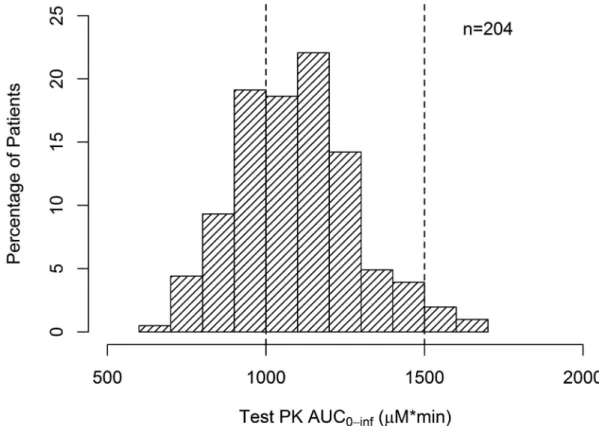
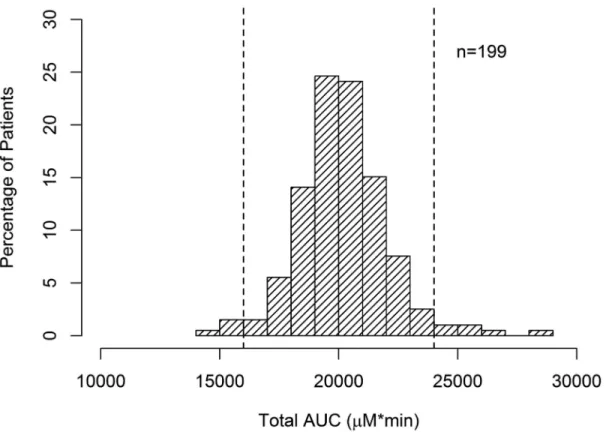
Among the 199 subjects, median Bu clearance calculated from initial TDM was 2.98 ml/min/kg (range 1.95–4.39 ml/min/kg). Overall, 2.9% of subjects had an AUC of >1,500 μM•min and 32.8% of subjects had an AUC of <1,000 μM•min (Figure 1). In total, 35.8% of subjects would likely have been outside the AUC target range if weight-based dosing had been used without TDM. A greater proportion of obese (BMI ≥30) or overweight (BMI = 25.0–29.9) subjects were underexposed to Bu compared with those with normal BMI (BMI = 18.5–24.9) (Table 2). However, stratification by BMI was not sufficient to identify any specific patient population that would not have required TDM. After PK-directed dose adjustments, 95.0% of subjects fell within the target range for total AUC after PK-directed dose adjustments based on initial and confirmatory PK (AUC = 20,000 μM•min ± 20%, Figure 2); 3.0% and 2.0% subjects required additional dose reductions and increases for the last 2 days respectively. Mean absolute error for the test dose predicted AUCday-8
(confirmatory PK) was 7.4% (95% CI 6.5 to 8.3%). Evaluating the accuracy of test PK-based dose adjustments PK-based on the margin of error from the desired daily target exposure, mean absolute error was 7.5% (95% CI 6.5 to 8.4%). No significant change in clearance was observed between test PK and confirmatory PK (p=0.220, paired t-test), indicating that intra-patient variability in clearance was minimal. Median total IV Bu administered was 14.5 mg/kg of actual body weight (range: 8.8–20.1 mg/kg). Busulfan exposure was similar to the overall population in the subgroup of patients experiencing the AEs of TRM or mucositis (Figure 3).
Adverse Events
An early subset-analysis by age in June 2011 revealed that four of 17 subjects >65 years suffered TRM by day 100 which met a protocol-specified stopping rule for this population. The TRM rates by day 100 for all subjects (n=203), patients >65 years (n=17), and patients ≤65 years (n=186) were 4.5% (95% confidence intervals [CI)]: 2.1–8.3%), 23.5% (95% CI: 6.8–49.9%) and 2.7% (95% CI: 0.9–6.2%), respectively. The most common AEs leading to death were respiratory failure (4 subjects, 1.9%), sepsis (3 subjects, 1.4%), multi-organ failure (2 subjects, 1.0%), and acute respiratory distress syndrome (2 subjects, 1.0%). Serious AEs with an incidence of 2% or greater were recorded for 90 (43.5%) subjects. The most common grade 3/4 AEs observed in subjects ≤65 years were febrile neutropenia (Grade 3: 54%; 4: 3%), stomatitis (Grade 3: 41%; 4: 0%), nausea (Grade 3: 10%; 4: 0%), and pneumonia (Grade 3: 7% ; 4:0%). There were no instances of seizure or hepatic VOD based on Baltimore criteria.44 Other grade ≥3 AEs are listed in Table 3.
A
uthor Man
uscr
ipt
A
uthor Man
uscr
ipt
A
uthor Man
uscr
ipt
A
uthor Man
uscr
Efficacy of BuCyE
Efficacy was analyzed for 186 subjects ≤65 years old with HL (n=65) or NHL (n=121), including: DLBCL (n=63), MCL (n=29) and FL (n=23). Of the 186 patients, 156 (84%) underwent transplant in PR or CR2 or higher. The remainder (n=30) underwent ASCT in CR1/CRu1, including 19 patients with MCL. With median follow-up of 20 months, the estimated 2-year PFS was 33% for HL and 58%, 77% and 43% for DLBCL, MCL and FL, respectively. The estimated 2-year OS was 76% for HL and 65%, 89% and 89% for DLBCL, MCL and FL, respectively. The OS and PFS curves for the phase 2 study of PK-directed BuCyE are shown in Figures 4 and 5, respectively.
Comparisons of BuCyE with Matched CIBMTR Patients
Of the 186 patients, 183 recipients of BuCyE with lymphoma in complete or partial response were matched at a maximum ratio of 4:1 with 729 CIBMTR controls based on age,
performance status, disease status prior to transplant and lymphoma histology. No matches were found for three patients. In total, 177 cases had 4 matched controls, and 97% of controls had an age difference from controls of ≤ 5 years. A comparison of patients from the phase 2 trial of BuCyE and the matched cohort of patients conditioned with BEAM from the CIBMTR is shown in Table 4. Patients were well-matched for age, performance status, histologic subtype and response prior to transplant, and the median follow up was 22 months in both cohorts.
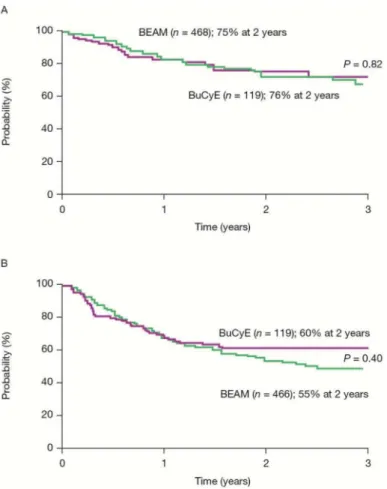
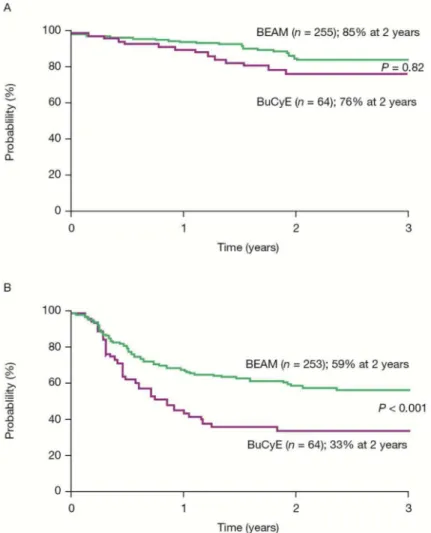
Two-year cumulative incidences of TRM were 3.3% (95% CI: 1.4–6.6%) and 3.9% (95% CI: 2.4–5.7%) for BuCyE and BEAM, respectively. Corresponding 2-year probabilities of OS were 76% (95% CI: 68–82%) and 78% (95% CI: 74–82%). Tables 5 and 6 compare outcomes for NHL and HL separately. Multivariate analysis demonstrated a significant interaction between disease and conditioning regimen in evaluation of disease progression and treatment failure. Analyses by histology demonstrated that among patients with NHL, there were no differences in outcomes between groups. Among patients with HL treated with BuCyE or BEAM, respectively, the 2-year cumulative incidence of progression was 66% (95% CI: 53–77%) and 38% (95% CI: 31–45%) and 2-year PFS was 33% (95% CI: 21–46%) and 59% (95% CI: 52–66%), with no difference in TRM or OS. The 2-year cumulative incidences of TRM were 3.3% (95% CI: 1.4–6.6%) and 3.9% (95% CI: 2.4– 5.7%) for BuCyE and BEAM, respectively. Survival curves comparing BuCyE and BEAM conditioning from this matched analysis for NHL and HL are shown in Figures 6 and 7.
DISCUSSION
This was the first large-scale, multicenter, prospective study in North America in which the IV weight-based Bu dose was further adjusted based on PK results from a pre-conditioning test dose. We found that simple pre-conditioning TDM accurately estimated Bu clearance, allowing for adequate conditioning dosing. Accuracy of the test dose prediction and accuracy of test dose-based dose adjustments were high, comparable to previous studies in which clearance remained consistent across a preconditioning test PK and a conditioning regimen for oral and IV Bu.45-47 Although infusion rates differed between the test dose and the first therapeutic dose by approximately 2- to 4-fold, infusion rate-dependent nonlinear
A
uthor Man
uscr
ipt
A
uthor Man
uscr
ipt
A
uthor Man
uscr
ipt
A
uthor Man
uscr
behavior was not noted. This may be due to determination of Bu AUC and its estimated corresponding clearance using a one-compartment model versus noncompartmental analysis. Bu AUC estimates appear to more variable using noncompartmental analysis.40 In addition, a population PK analysis demonstrated that Bu PK can be adequately described by a linear PK model without inter-occasional variability.48 In this study, more than one-third of patients would have had suboptimal exposure to IV Bu if weight-based dosing alone had been used for conditioning, whereas 95% of subjects achieved the target range of Bu exposure after the introduction of individualized TDM. A pre-conditioning test dose may be more convenient for transplant centers relying on external PK laboratories and can offer another opportunity for TDM on the first day of conditioning if the initial PK results are not evaluable.
Results from the present study further showed that such PK-directed Bu doses in combination with cyclophosphamide and etoposide constituted a tolerable regimen for lymphoma patients <65 years of age and was associated with expected transplant conditioning toxicities and a TRM <5%. BuCyE was not well tolerated in patients ≥65 years, resulting in unacceptable early TRM for older patients with lymphoma. For patients with NHL, PK-directed IV BuCyE produced similar PFS and OS to contemporary patients treated with BEAM; however, a statistically significant difference in PFS was observed between BuCyE and BEAM in subjects with HL, indicating superior outcomes for BEAM in terms of relapse and PFS. Although this trial and the additional matched cohort study design were not originally powered to test the difference between the BuCyE and BEAM arms for subjects with HL, the sample size for the phase 2 cohort subset and the 4:1 matching approach were reasonably large for examining this comparison and strength of the association warrants notice.
Previous clinical data using Bu and cyclophosphamide with or without etoposide have yielded clinical results that are comparable to the other preparative regimens for ASCT in both NHL and HL.4, 7, 24, 26, 27, 29, 30 Bu exposure (as assessed by AUC) has been associated with differences in survival and AEs. Kebriaei and colleagues showed that an optimally-dosed group had a significantly better survival rate than those with lower or higher exposures. Fixed-dose IV Bu administration resulted in two thirds of all the subjects achieving AUC values within the optimal window, but PK-directed dosing increased the frequency of patients within the targeted range of AUC exposure up to 95%. The 2-year OS and PFS were 85% and 57%, respectively, for patients with HL, and 67% and 64%, respectively, for patients with NHL.49 While the outcomes associated with BuCyE for NHL appear similar to BEAM in the present matched analysis, this is not the case for HL.
One common concern of Bu-based conditioning for patients with HL has been the possibility of overlapping toxicity with prior HL therapies such as bleomycin, prior alkylating agents and radiation. However, our findings do not suggest poor outcomes from BuCyE due to excess toxicity or TRM. Indeed, day-28 and day-100 TRM rates were 0% and 1.6%, respectively, for HL patients who received BuCyE conditioning. The primary
differences observed between BuCyE and BEAM in this analysis of HL patients was an increase in early relapses, suggesting that BuCyE may be an inferior regimen for disease control among patients with relapsed HL. Why this regimen would produce worse PFS in
A
uthor Man
uscr
ipt
A
uthor Man
uscr
ipt
A
uthor Man
uscr
ipt
A
uthor Man
uscr
HL but not in NHL or any NHL subtype remains unclear. A prior single institution study of 72 patients with HL or NHL conditioned with either cyclophosphamide, etoposide,
carmustine (CEB) or BEAM found a higher prevalence diarrhea in the BEAM group (81 vs. 51%, P = .0026), but higher OS with BEAM than with CEB (84 vs. 60%); however, outcomes were not stratified by lymphoma subtype.50 Chen et al. compared outcomes after ASCT across different conditioning regimens and among patients with HL, and busulfan-based regimens were also associated with inferior outcomes.51
Interpretation of our findings should also consider the limitations of a non-randomized comparison between the cases and controls. Despite constructing a matched cohort of CIBMTR patients for comparison, unmeasured but important factors could be unbalanced between the two groups, which could bias the interventions. Nevertheless, the matching strategy effectively identified a large, contemporary cohort of patients who were similar in age, performance status and lymphoma subtype, which were previously identified as important determinants of outcome. Additionally, the control cohort patients were from centers not participating in the clinical trial, which minimized selection bias.
At present, identifying the preferred therapy for relapsed HL remains complex, and the most effective form of HDT may differ by patient characteristics. Nevertheless, given the dearth of randomized controlled trials to inform the management of patients with relapsed HL undergoing ASCT, careful consideration of these findings should be undertaken and BEAM conditioning should be preferred for patients with HL undergoing ASCT when all other factors are equivalent.
Supplementary Material
Refer to Web version on PubMed Central for supplementary material.
ACKNOWLEDGMENTS
The authors thank the patients, their caregivers and the staff at participating centers. We also thank Louie Yu and Shiva Patil for pharmacokinetic support, Jeanne Burkart for registry support, Agnes Elekes for medical review, and Cathy Zhao and Peter Loonan for statistical analysis. The authors also thank David Norris, PhD, for editorial assistance provided during the preparation of this report. This assistance was paid for through funding supplied by OPDC to Ecosse Medical Communications, LLC (Falmouth, MA).
Funding: Otsuka Pharmaceutical Development & Commercialization, Inc. (OPDC) sponsored this study and
provided the intravenous busulfan for the analyses.
REFERENCES
1. Bains T, Chen AI, Lemieux A, et al. Improved outcome with busulfan, melphalan and thiotepa conditioning in autologous hematopoietic stem cell transplant for relapsed/refractory Hodgkin lymphoma. Leuk Lymphoma. 2014; 55:583–587. [PubMed: 23697844]
2. Josting A, Muller H, Borchmann P, et al. Dose intensity of chemotherapy in patients with relapsed Hodgkin's lymphoma. J Clin Oncol. 2010; 28:5074–5080. [PubMed: 20975066]
3. Linch DC, Winfield D, Goldstone AH, et al. Dose intensification with autologous bone-marrow transplantation in relapsed and resistant Hodgkin's disease: results of a BNLI randomised trial. Lancet. 1993; 341:1051–1054. [PubMed: 8096958]
4. Santos EC, Sessions J, Hutcherson D, Flowers C, Langston A, Waller EK. Long-term outcome of Hodgkin disease patients following high-dose busulfan, etoposide, cyclophosphamide, and
A
uthor Man
uscr
ipt
A
uthor Man
uscr
ipt
A
uthor Man
uscr
ipt
A
uthor Man
uscr
autologous stem cell transplantation--a similar experience. Biol Blood Marrow Transplant. 2007; 13:746–747. [PubMed: 17531785]
5. Lazarus HM, Carreras J, Boudreau C, et al. Influence of age and histology on outcome in adult non-Hodgkin lymphoma patients undergoing autologous hematopoietic cell transplantation (HCT): a report from the Center For International Blood & Marrow Transplant Research (CIBMTR). Biol Blood Marrow Transplant. 2008; 14:1323–1333. [PubMed: 19041053]
6. McCarthy PL Jr. Hahn T, Hassebroek A, et al. Trends in use of and survival after autologous hematopoietic cell transplantation in North America, 1995-2005: significant improvement in survival for lymphoma and myeloma during a period of increasing recipient age. Biol Blood Marrow Transplant. 2013; 19:1116–1123. [PubMed: 23660172]
7. Ulrickson M, Aldridge J, Kim HT, et al. Busulfan and cyclophosphamide (Bu/Cy) as a preparative regimen for autologous stem cell transplantation in patients with non-Hodgkin lymphoma: a single-institution experience. Biol Blood Marrow Transplant. 2009; 15:1447–1454. [PubMed: 19822305] 8. Flowers CR, Armitage JO. A decade of progress in lymphoma: advances and continuing challenges.
Clin Lymphoma Myeloma Leuk. 2010; 10:414–423. [PubMed: 21156459]
9. Moskowitz AJ, Moskowitz CH. Controversies in the treatment of lymphoma with autologous transplantation. Oncologist. 2009; 14:921–929. [PubMed: 19737999]
10. Philip T, Guglielmi C, Hagenbeek A, et al. Autologous bone marrow transplantation as compared with salvage chemotherapy in relapses of chemotherapy-sensitive non-Hodgkin's lymphoma. N Engl J Med. 1995; 333:1540–1545. [PubMed: 7477169]
11. Schouten HC, Qian W, Kvaloy S, et al. High-dose therapy improves progression-free survival and survival in relapsed follicular non-Hodgkin's lymphoma: results from the randomized European CUP trial. J Clin Oncol. 2003; 21:3918–3927. [PubMed: 14517188]
12. Van Besien K. The evolving role of autologous and allogeneic stem cell transplantation in follicular lymphoma. Blood Rev. 2006; 20:235–244. [PubMed: 16513231]
13. Nastoupil LJ, Shenoy PJ, Ambinder A, et al. Intensive chemotherapy and consolidation with high dose therapy and autologous stem cell transplant in patients with mantle cell lymphoma. Leuk Lymphoma. 2015; 56:383–389. [PubMed: 24828864]
14. Schmitz N, Nickelsen M, Ziepert M, et al. Conventional chemotherapy (CHOEP-14) with rituximab or high-dose chemotherapy (MegaCHOEP) with rituximab for young, high-risk patients with aggressive B-cell lymphoma: an open-label, randomised, phase 3 trial (DSHNHL 2002-1). Lancet Oncol. 2012; 13:1250–1259. [PubMed: 23168367]
15. Stiff PJ, Unger JM, Cook JR, et al. Autologous transplantation as consolidation for aggressive non-Hodgkin's lymphoma. N Engl J Med. 2013; 369:1681–1690. [PubMed: 24171516]
16. Cortelazzo S, Rossi A, Viero P, et al. BEAM chemotherapy and autologous haemopoietic progenitor cell transplantation as front-line therapy for high-risk patients with diffuse large cell lymphoma. Br J Haematol. 1997; 99:379–385. [PubMed: 9375759]
17. Flowers CR, Sinha R, Vose JM. Improving outcomes for patients with diffuse large B-cell lymphoma. CA Cancer J Clin. 2010; 60:393–408. [PubMed: 21030533]
18. Haioun C, Mounier N, Emile JF, et al. Rituximab versus observation after high-dose consolidative first-line chemotherapy with autologous stem-cell transplantation in patients with poor-risk diffuse large B-cell lymphoma. Ann Oncol. 2009; 20:1985–1992. [PubMed: 19567453]
19. Glossmann JP, Josting A, Pfistner B, Paulus U, Engert A, German Hodgkin's Lymphoma Study G. A randomized trial of chemotherapy with carmustine, etoposide, cytarabine, and melphalan (BEAM) plus peripheral stem cell transplantation (PBSCT) vs single-agent high-dose
chemotherapy followed by BEAM plus PBSCT in patients with relapsed Hodgkin's disease (HD-R2). Ann Hematol. 2002; 81:424–429. [PubMed: 12223998]
20. Jo JC, Kang BW, Jang G, et al. BEAC or BEAM high-dose chemotherapy followed by autologous stem cell transplantation in non-Hodgkin's lymphoma patients: comparative analysis of efficacy and toxicity. Ann Hematol. 2008; 87:43–48. [PubMed: 17710401]
21. Shimoni A, Avivi I, Rowe JM, et al. A randomized study comparing yttrium-90 ibritumomab tiuxetan (Zevalin) and high-dose BEAM chemotherapy versus BEAM alone as the conditioning regimen before autologous stem cell transplantation in patients with aggressive lymphoma. Cancer. 2012; 118:4706–4714. [PubMed: 22252613]
22. Vose JM, Carter S, Burns LJ, et al. Phase III randomized study of rituximab/carmustine, etoposide, cytarabine, and melphalan (BEAM) compared with iodine-131 tositumomab/BEAM with autologous hematopoietic cell transplantation for relapsed diffuse large B-cell lymphoma: results from the BMT CTN 0401 trial. J Clin Oncol. 2013; 31:1662–1668. [PubMed: 23478060] 23. Gutierrez-Delgado F, Maloney DG, Press OW, et al. Autologous stem cell transplantation for
non-Hodgkin's lymphoma: comparison of radiation-based and chemotherapy-only preparative regimens. Bone Marrow Transplant. 2001; 28:455–461. [PubMed: 11593318]
24. Kim JE, Lee DH, Yoo C, et al. BEAM or BuCyE high-dose chemotherapy followed by autologous stem cell transplantation in non-Hodgkin's lymphoma patients: a single center comparative analysis of efficacy and toxicity. Leuk Res. 2011; 35:183–187. [PubMed: 20684990] 25. Aggarwal C, Gupta S, Vaughan WP, et al. Improved outcomes in intermediate- and high-risk
aggressive non-Hodgkin lymphoma after autologous hematopoietic stem cell transplantation substituting intravenous for oral busulfan in a busulfan, cyclophosphamide, and etoposide preparative regimen. Biol Blood Marrow Transplant. 2006; 12:770–777. [PubMed: 16785066] 26. Andion M, Molina B, Gonzalez-Vicent M, et al. High-dose busulfan and cyclophosphamide as a
conditioning regimen for autologous peripheral blood stem cell transplantation in childhood non-Hodgkin lymphoma patients: a long-term follow-up study. J Pediatr Hematol Oncol. 2011; 33:e89–91. [PubMed: 21358341]
27. Dean RM, Pohlman B, Sweetenham JW, et al. Superior survival after replacing oral with intravenous busulfan in autologous stem cell transplantation for non-Hodgkin lymphoma with busulfan, cyclophosphamide and etoposide. Br J Haematol. 2010; 148:226–234. [PubMed: 19821828]
28. Grigg AP, Stone J, Milner AD, et al. Phase II study of autologous stem cell transplant using busulfan-melphalan chemotherapy-only conditioning followed by interferon for relapsed poor prognosis follicular non-Hodgkin lymphoma. Leuk Lymphoma. 2010; 51:641–649. [PubMed: 20218809]
29. Lane AA, McAfee SL, Kennedy J, et al. High-dose chemotherapy with busulfan and
cyclophosphamide and autologous stem cell rescue in patients with Hodgkin lymphoma. Leuk Lymphoma. 2011; 52:1363–1366. [PubMed: 21612379]
30. Zhang H, Graiser M, Hutcherson DA, et al. Pharmacokinetic-directed high-dose busulfan combined with cyclophosphamide and etoposide results in predictable drug levels and durable long-term survival in lymphoma patients undergoing autologous stem cell transplantation. Biol Blood Marrow Transplant. 2012; 18:1287–1294. [PubMed: 22370160]
31. Beri R, Chunduri S, Sweiss K, et al. Reliability of a pretransplant i.v. BU test dose performed 2 weeks before myeloablative FluBu conditioning regimen. Bone Marrow Transplant. 2010; 45:249– 253. [PubMed: 19543331]
32. Lazarus HM, Zhang MJ, Carreras J, et al. A comparison of HLA-identical sibling allogeneic versus autologous transplantation for diffuse large B cell lymphoma: a report from the CIBMTR. Biol Blood Marrow Transplant. 2010; 16:35–45. [PubMed: 20053330]
33. Pasquini, MC.; Wang, Z.; Horowitz, M.; Gale, RP. 2010 Report from the Center for International Blood and Marrow Transplant Research (CIBMTR): Current Uses and Outcomes of
Hematopoietic Cell Transplant for Blood and Bone Marrow Disorders.. In: Cecka, JM.; Terazaki, PI., editors. Clinical Transplants 2010. The Terasaki Foundation Laboratory; Los Angeles: 2011. 34. Cheson BD, Pfistner B, Juweid ME, et al. Revised response criteria for malignant lymphoma. J
Clin Oncol. 2007; 25:579–586. [PubMed: 17242396]
35. A predictive model for aggressive non-Hodgkin's lymphoma. The International Non-Hodgkin's Lymphoma Prognostic Factors Project. N Engl J Med. 1993; 329:987–994. [PubMed: 8141877] 36. Costa LJ, Lill M, Yeh RF, et al. Safety of PK-Guided IV Bu Cy VP-16 Preparative Regimen Prior
to Autologous Hematopoietic Stem Cell Transplantation for Lymphoma: Findings From a Multi-Center Phase II Study in North America. ASH Annual Meeting Abstracts. 2012; 120:813. 37. Madden T, de Lima M, Thapar N, et al. Pharmacokinetics of once-daily IV busulfan as part of
pretransplantation preparative regimens: a comparison with an every 6-hour dosing schedule. Biol Blood Marrow Transplant. 2007; 13:56–64. [PubMed: 17222753]
38. Vaughan WP, Carey D, Perry S, Westfall AO, Salzman DE. A limited sampling strategy for pharmacokinetic directed therapy with intravenous busulfan. Biol Blood Marrow Transplant. 2002; 8:619–624. [PubMed: 12463481]
39. Ryu SG, Lee JH, Choi SJ, et al. Randomized comparison of four-times-daily versus once-daily intravenous busulfan in conditioning therapy for hematopoietic cell transplantation. Biol Blood Marrow Transplant. 2007; 13:1095–1105. [PubMed: 17697972]
40. Yeh RF, Pawlikowski MA, Blough DK, et al. Accurate targeting of daily intravenous busulfan with 8-hour blood sampling in hospitalized adult hematopoietic cell transplant recipients. Biol Blood Marrow Transplant. 2012; 18:265–272. [PubMed: 21736869]
41. Slattery JT, Risler LJ. Therapeutic monitoring of busulfan in hematopoietic stem cell transplantation. Ther Drug Monit. 1998; 20:543–549. [PubMed: 9780133]
42. Milpied N, Deconinck E, Gaillard F, et al. Initial treatment of aggressive lymphoma with high-dose chemotherapy and autologous stem-cell support. N Engl J Med. 2004; 350:1287–1295. [PubMed: 15044639]
43. Lee, E.; Wei, L.; Amato, D. Cox-type regression analysis for large numbers of small groups of correlated failure time observations.. In: Klein, J.; Goel, P., editors. Survival Analysis: State of the Art. Kluwer Academic Publishers; Norwell, MA: 1992. p. 237-247.
44. Jones RJ, Lee KS, Beschorner WE, et al. Venoocclusive disease of the liver following bone marrow transplantation. Transplantation. 1987; 44:778–783. [PubMed: 3321587]
45. Beri R, Chunduri S, Mactal-Haaf C, et al. 472: Pre-transplant Busulfan Test Dose is a Reliable Alternative to First Busulfan IV Dose for Pharmacokinetics Studies in Allogeneic Hematopoietic Stem Cell Transplantation. Biology of Blood and Marrow Transplant. 14:166.
46. Kletzel M, Jacobsohn D, Duerst R. Pharmacokinetics of a test dose of intravenous busulfan guide dose modifications to achieve an optimal area under the curve of a single daily dose of intravenous busulfan in children undergoing a reduced-intensity conditioning regimen with hematopoietic stem cell transplantation. Biol Blood Marrow Transplant. 2006; 12:472–479. [PubMed: 16545731] 47. Kangarloo SB, Naveed F, Ng ES, et al. Development and validation of a test dose strategy for
once-daily i.v. busulfan: importance of fixed infusion rate dosing. Biol Blood Marrow Transplant. 2012; 18:295–301. [PubMed: 21801704]
48. Wang Y, Kato K, Le Gallo C, Armstrong E, Rock E, Wang X. Dosing algorithm revisit for busulfan following IV infusion. Cancer Chemother Pharmacol. 2015; 75:505–512. [PubMed: 25561350] 49. Kebriaei P, Madden T, Kazerooni R, et al. Intravenous busulfan plus melphalan is a highly
effective, well-tolerated preparative regimen for autologous stem cell transplantation in patients with advanced lymphoid malignancies. Biol Blood Marrow Transplant. 2011; 17:412–420. [PubMed: 20674757]
50. Wang EH, Chen YA, Corringham S, et al. High-dose CEB vs BEAM with autologous stem cell transplant in lymphoma. Bone Marrow Transplant. 2004; 34:581–587. [PubMed: 15273714] 51. Chen Y-B, Li S, Fisher DC, et al. Phase II Trial of Tandem High-Dose Chemotherapy with
Autologous Stem Cell Transplantation Followed by Reduced-Intensity Allogeneic Stem Cell Transplantation for Patients with High-Risk Lymphoma. Biology of Blood and Marrow Transplant. 21:1583–1588.
A
uthor Man
uscr
ipt
A
uthor Man
uscr
ipt
A
uthor Man
uscr
ipt
A
uthor Man
uscr
Phase 2 study of B-cell NHL and HL examined the safety and efficacy of BuCyE Individually-adjusted busulfan based on pre-conditioning PK
BuCyE outcomes compared with contemporaneous recipients of BEAM registry data BuCyE provided adequate disease control and safety in B-cell NHL patients ≤ 65 years BuCyE produced worse PFS in HL patients when compared with BEAM
A
uthor Man
uscr
ipt
A
uthor Man
uscr
ipt
A
uthor Man
uscr
ipt
A
uthor Man
uscr
Figure 1. Measured AUC from 0.8 mg/kg of IV Bu as a pre-conditioning test PK on one of the days, day −14 to day −11 (n=204)
Dotted line represents ± 20% range of the target AUC (1000–1500 μM●min).
A
uthor Man
uscr
ipt
A
uthor Man
uscr
ipt
A
uthor Man
uscr
ipt
A
uthor Man
uscr
Figure 2. Histograms of estimated total AUC from test PK and confirmatory PK results (n=199)
Dotted line represents the ± 20% range of the target AUC (16,000–24,000 μM●min).
A
uthor Man
uscr
ipt
A
uthor Man
uscr
ipt
A
uthor Man
uscr
ipt
A
uthor Man
uscr
Figure 3. Scatter plot of total estimated Bu area under the curve for all patients and of actual Bu area under the curve for patients with adverse events of transplant-related mortality (TRM) and mucositis/stomatitis (M/S)
Scatter plots represent subjects with no M/S and Grades (GR) 1, 2, and 3 M/S. There were no cases of GR 4 M/S.
A
uthor Man
uscr
ipt
A
uthor Man
uscr
ipt
A
uthor Man
uscr
ipt
A
uthor Man
uscr
Figure 4. Overall survival for the phase 2 study of pharmacokinetics-directed busulfan, cyclophosphamide and etoposide conditioning and autologous stem cell transplantation for lymphoma
A) HL/NHL. B) NHL subtypes.
A
uthor Man
uscr
ipt
A
uthor Man
uscr
ipt
A
uthor Man
uscr
ipt
A
uthor Man
uscr
Figure 5. Progression-free survival for the phase 2 study of pharmacokinetics-directed busulfan, cyclophosphamide and etoposide conditioning and autologous stem cell transplantation for lymphoma
A) HL/NHL. B) NHL subtypes.
A
uthor Man
uscr
ipt
A
uthor Man
uscr
ipt
A
uthor Man
uscr
ipt
A
uthor Man
uscr
Figure 6. Comparison of survival for NHL patients in the matched analysis of phase 2 BuCyE and contemporary lymphoma patients treated with BEAM from CIBMTR
A) Overall survival. B) Progression-free survival.
A
uthor Man
uscr
ipt
A
uthor Man
uscr
ipt
A
uthor Man
uscr
ipt
A
uthor Man
uscr
Figure 7. Comparison of survival for HL patients in the matched analysis of phase 2 BuCyE and contemporary lymphoma patients treated with BEAM from CIBMTR
A) Overall survival. B) Progression-free survival.
A
uthor Man
uscr
ipt
A
uthor Man
uscr
ipt
A
uthor Man
uscr
ipt
A
uthor Man
uscr
A
uthor Man
uscr
ipt
A
uthor Man
uscr
ipt
A
uthor Man
uscr
ipt
A
uthor Man
uscr
ipt
Table 1 Patient Demographics.
Total patients, n 203 Age, median (range) 51 (19–72) Male, n (%) 139 (67) Race, n (%)
Caucasian 177 (87%) African American 13 (6%) American Indian or Alaskan Native 2 (1%) Asian 7 (3%) Other 4 (2%) ECOG performance status, n (%)
0 85 (42%) 1 109 (54%) 2 7 (3%) Missing 2 (1%) Body weight, median kg (range) 83.4 (38.8–178.2) Body mass index, mean kg/m2 (SD) 29.2 (6.3)
Classifications, n (%)
Hodgkin's lymphoma 66 (32) Non-Hodgkin's lymphoma 137 (68) Diffuse large B-cell 74 (54%) Follicular 25 (18%) Mantle cell 32 (23%) Others 6 (4%) Status at transplantation in ITT group, n (%)
1st CR 55 (27) 2nd CR 66 (32) 3rd CR or higher 5 (2) Primary induction failure/in relapse 6 (3) Partial remission 71 (35) Without prior CR 46 (22) With prior CR 20 (10)
A
uthor Man
uscr
ipt
A
uthor Man
uscr
ipt
A
uthor Man
uscr
ipt
A
uthor Man
uscr
ipt
Table 2
Area Under the Curve Exposure From Test Dose (0.8 mg/kg of Intravenous Busulfan) by Body Mass Index Category
BMI Category (kg/m2) BMI (kg/m2) (Mean ± SD)
Clearance (mL/ minute/kg) Median
(range)
AUC (n)
Total (n) < 1000 μM•min < 1000 to 1500
μM•min
> 1000 μM•min
A
uthor Man
uscr
ipt
A
uthor Man
uscr
ipt
A
uthor Man
uscr
ipt
A
uthor Man
uscr
ipt
Table 3
Grade 3/4 Adverse Events Following Pharmacokinetics-Directed Busulfan, Cyclophosphamide and Etoposide Conditioning. N = 203.
Grade 3 n (%) Grade 4 n (%) Total of Grade ≥3 n (%)
A
uthor Man
uscr
ipt
A
uthor Man
uscr
ipt
A
uthor Man
uscr
ipt
A
uthor Man
uscr
ipt
Table 4
Characteristics of Patients Aged ≤ 65 Years in the Matched Analysis of Phase 2 BuCyE and Contemporary Lymphoma Patients Treated with BEAM From CIBMTR.
BuCyE BEAM
Number of patients, n 183 729 Age at transplant, median years (range) 52 (19–65) 50 (19–65) Age group at transplant, n (%)
18–20 years 1 (< 1) 10 (1) 20–30 years 23 (11) 102 (13) 30–40 years 29 (16) 99 (14) 40–50 years 38 (21) 153 (21) 50–60 years 59 (32) 229 (32) 60–65 years 33 (18) 132 (18) Karnofsky score, n (%)
< 90% 42 (23) 167 (23) ≥ 90% 139 (76) 552 (76) Missing 2 (1) 6 (1) Histology, n (%)
NHL
Follicular 23 (13) 90 (12) DLBCL 62 (34) 246 (34) Mantle cell 29 (16) 112 (15) Other 5 (2) 21 (3) HL
Lymphocyte predominant 2 (1) 1 (< 1) Nodular sclerosis 46 (24) 212 (29) Mixed cellularity 7 (4) 13 (2) Lymphocyte depleted 0 2 (< 1) Nodular lymphocyte predominant 2 (1) 11 (1) Unclassified not further specified 7 (4) 17 (2)
A
uthor Man
uscr
ipt
A
uthor Man
uscr
ipt
A
uthor Man
uscr
ipt
A
uthor Man
uscr
ipt
Table 5
Comparison of Outcomes for NHL Patients in the Matched Analysis of Phase 2 BuCyE and Contemporary Lymphoma Patients Treated with BEAM From CIBMTR.
BuCyE (Estimate n [95% CI]) BEAM (Estimate n [95% CI]) P-value
Treatment-related mortality
N 119 466
At 1 year 4 (1–9) 3 (2–5) 0.626 At 2 years 4 (1–9) 4 (2–7) 0.924 Relapse/progression
N 119 466
At 1 year 26 (19–35) 27 (23–32) 0.847 At 2 years 36 (27–46) 41 (35–46) 0.410 Progression-free survival
N 119 466
At 1 year 69 (61–77) 70 (65–74) 0.984 At 2 years 60 (50–69) 55 (49–60) 0.398 Overall survival
N 119 468
At 1 year 83 (76–89) 84 (80–87) 0.839 At 2 years 76 (67–84) 75 (70–79) 0.816
A
uthor Man
uscr
ipt
A
uthor Man
uscr
ipt
A
uthor Man
uscr
ipt
A
uthor Man
uscr
ipt
Table 6
Comparison of Outcomes for HL Patients in the Matched Analysis of Phase 2 BuCyE and Contemporary Lymphoma Patients Treated with BEAM from CIBMTR.
BuCyE (Estimate n [95% CI]) BEAM (Estimate n [95% CI]) P-value
Treatment-related mortality
N 64 253
At 1 year 2 (0–6) 2 (1–4) 0.805 At 2 years 2 (0–6) 3 (1–6) 0.514 Relapse/progression
N 64 253
At 1 year 55 (43–67) 30 (24–36) < 0.001 At 2 years 66 (53–77) 38 (31–45) < 0.001 Progression-free survival
N 64 253
At 1 year 43 (31–55) 68 (62–74) < 0.001 At 2 years 33 (21–46) 59 (52–66) < 0.001 Overall survival
N 64 255
At 1 year 90 (82–96) 95 (92–98) 0.241 At 2 years 76 (64–87) 85 (79–91) 0.168